


 Скачать презентацию Idara-e-Taleem-o-Aagahi ITA The Institute for Professional Learning IPL
6c0a0a8659c4dfc9150917303d7af564.ppt
- Количество слайдов: 74
 Idara-e-Taleem-o-Aagahi (ITA) The Institute for Professional Learning (IPL) (affiliated & HEC recognized) South Asia Forum For Education Development Rethinking our Work Sharing with ITA CEC UK December 9, 2010 Lahore
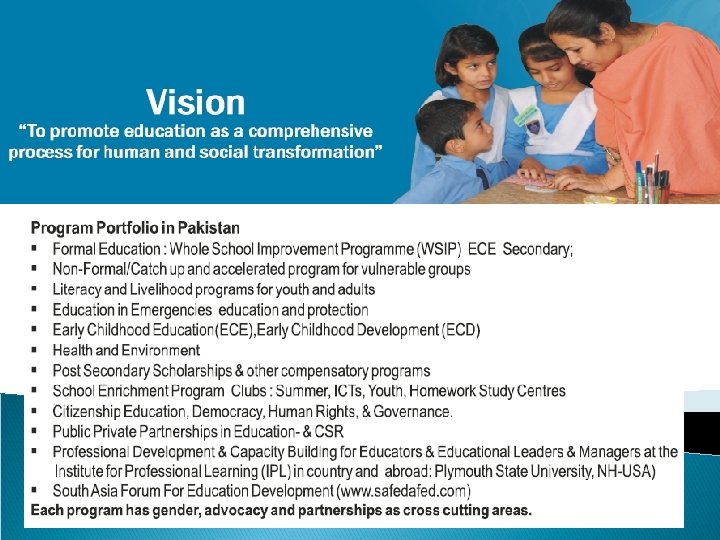
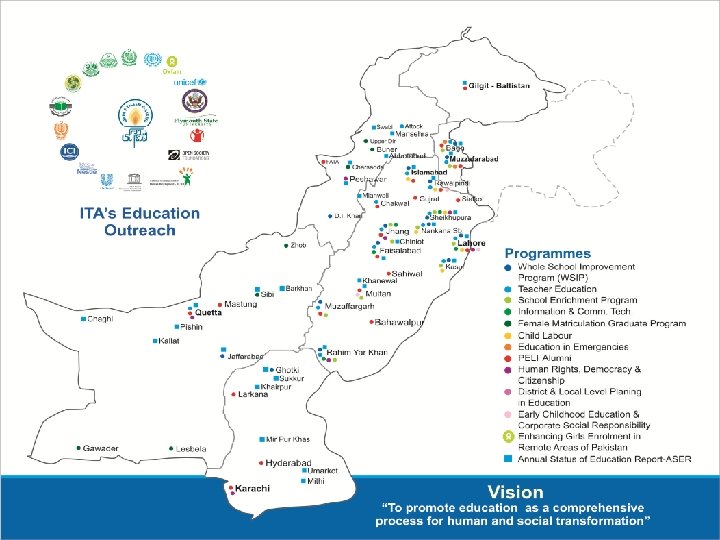
 Vision & Mission of ITA Pakistan Vision “To promote education as a comprehensive process for human and social transformation” Mission Statement To actively pursue universal access and standard setting in education as a comprehensive learning experience for human development By creating contemporary education systems for all children without discrimination due to gender, class, age, religion, color and ethnicity And, endeavoring to address educational bottlenecks through timely resource mobilization and influencing of public policy 3
 Program Portfolio 2000 -2010 ECE WSIP – Formal Non-Formal - Catch up; prep; child labor reduction; skills and livelihood Secondary Support through ACCESS Health & Hygiene in Schools Citizen Youth Matriculation/Health – MNCH Post Matric Scholarships/Youth Program Tertiary – College – Teacher Leaders PELI – PSU 2004 - 2012 Research and Assessment – ASER Pakistan 2008 - 2015 Advocacy – Campaigns Policy Inputs Emergencies Services 4
 Institutional Diversification 2000 -2010 ITA 2000 - 2010 - Multiple programs tested portfolio expanded, toolkits built; forged alliances Institute for Professional Learning (IPL) affiliated and recognized by HEC 2009 - ◦ 6 core program areas - Pre-Service; In-service; Certificate & Diploma; Research/Assessment; Professional Networks and Learning Materials In 2010 December IPL will begin a 3 year journey towards degree awarding status 6
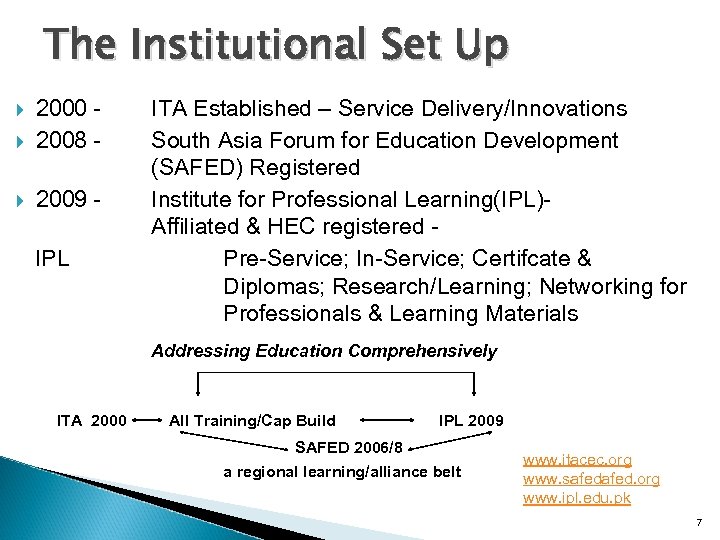 The Institutional Set Up 2000 - 2008 - 2009 - IPL ITA Established – Service Delivery/Innovations South Asia Forum for Education Development (SAFED) Registered Institute for Professional Learning(IPL)- Affiliated & HEC registered - Pre-Service; In-Service; Certifcate & Diplomas; Research/Learning; Networking for Professionals & Learning Materials Addressing Education Comprehensively ITA 2000 All Training/Cap Build IPL 2009 SAFED 2006/8 a regional learning/alliance belt www. itacec. org www. safed. org www. ipl. edu. pk 7
 Strategic Decision… Next 10 Years ITA’s Focus Shifting from small initiatives to scaled up district wide programs Program shift from simply education to education, skills and livelihoods ( Education; VOTECH & Extension Services) Strategically engaging with public sector and affordable private schools/incl. faith based ◦ Early Childhood Education (ECE) ◦ Whole School Improvement – (Hard/Soft components) ◦ Basic education catch up for drop outs and vulnerable, displaced. . mainstreaming/ livelihoods – integrated support ◦ Vocational Technical Programs ◦ Citizen Led Initiatives – district wide/ preferably national ◦ Campaigns for learning ; Health & citizenship/governance 8
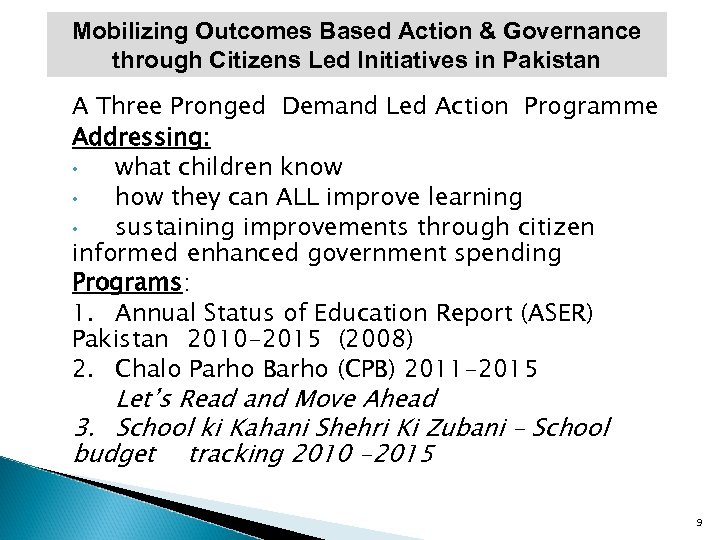 Mobilizing Outcomes Based Action & Governance through Citizens Led Initiatives in Pakistan A Three Pronged Demand Led Action Programme Addressing: • what children know • how they can ALL improve learning • sustaining improvements through citizen informed enhanced government spending Programs: 1. Annual Status of Education Report (ASER) Pakistan 2010 -2015 (2008) 2. Chalo Parho Barho (CPB) 2011 -2015 Let’s Read and Move Ahead 3. School ki Kahani Shehri Ki Zubani – School budget tracking 2010 -2015 9
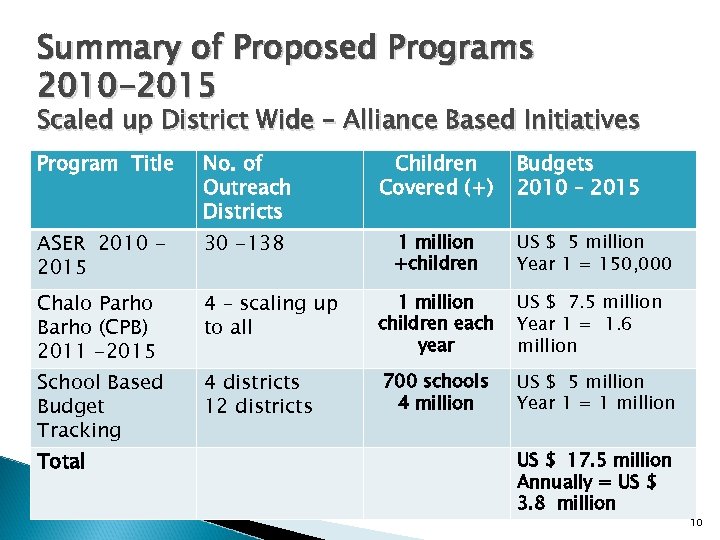 Summary of Proposed Programs 2010 -2015 Scaled up District Wide – Alliance Based Initiatives Program Title No. of Outreach Districts Children Covered (+) ASER 2010 2015 30 -138 1 million +children US $ 5 million Year 1 = 150, 000 Chalo Parho Barho (CPB) 2011 -2015 4 – scaling up to all 1 million children each year US $ 7. 5 million Year 1 = 1. 6 million School Based Budget Tracking 4 districts 12 districts Total 700 schools 4 million Budgets 2010 – 2015 US $ 5 million Year 1 = 1 million US $ 17. 5 million Annually = US $ 3. 8 million 10
 Border Crossings for Improved Learning Outcomes A South-South Movement India – Pakistan-East Africa 11
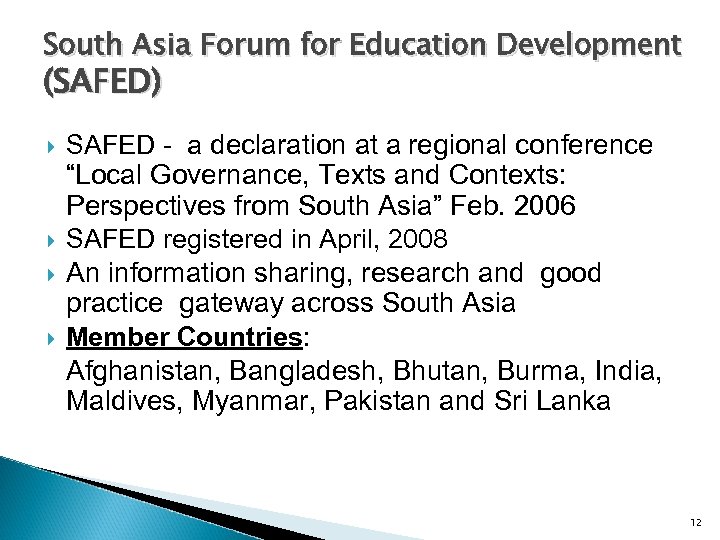 South Asia Forum for Education Development (SAFED) SAFED - a declaration at a regional conference “Local Governance, Texts and Contexts: Perspectives from South Asia” Feb. 2006 SAFED registered in April, 2008 An information sharing, research and good practice gateway across South Asia Member Countries: Afghanistan, Bangladesh, Bhutan, Burma, India, Maldives, Myanmar, Pakistan and Sri Lanka 12
 SAFED’s Areas of Focus Policy and Curriculum Reforms- Research Quality: Teaching and Support Systems; Assessing Learning Levels- ASER Pakistan Up scaling Girls’ Education- PPPs /CSR – Privatization/tuition studies Education for Sustainable Development Human Rights, Peace and Citizenship Education in Emergencies- Embedded in linkages with : higher education, gender and partnerships 13
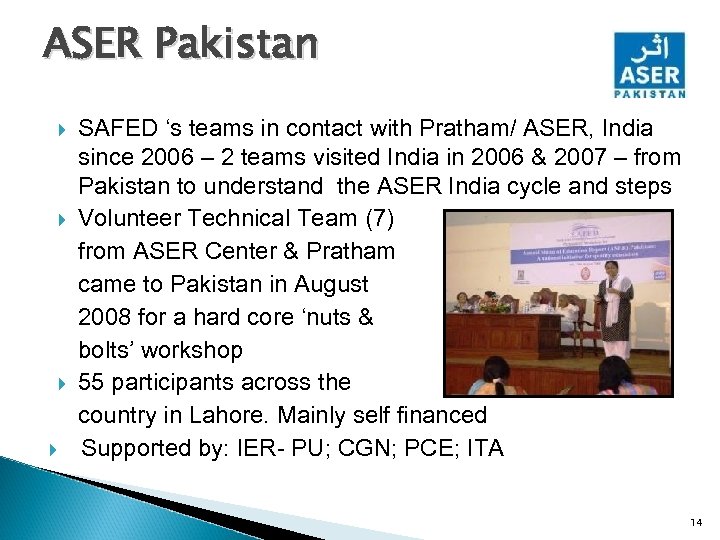 ASER Pakistan SAFED ‘s teams in contact with Pratham/ ASER, India since 2006 – 2 teams visited India in 2006 & 2007 – from Pakistan to understand the ASER India cycle and steps Volunteer Technical Team (7) from ASER Center & Pratham came to Pakistan in August 2008 for a hard core ‘nuts & bolts’ workshop 55 participants across the country in Lahore. Mainly self financed Supported by: IER- PU; CGN; PCE; ITA 14
 Scale of ASER 2009 India & ASER Pakistan 2008 ASER India in all rural areas/districts of India. 16291 villages and 700, 000 children covered in 2009 ASER India. The eventual aim of ASER Pakistan is to conduct the survey in all districts of the country For its first round in 2008, ASER Pakistan conducted in 11 districts (Phase I) from 2 provinces and Islamabad Capital Territory -. ASER Pakistan 2008 totally self –financed by partners, NGOs and volunteers 15
 About the ASER Survey The purpose of the ASER 2008 rapid assessment survey and its planned annual rounds in rural areas is twofold: Ø Ø To get reliable estimates of the status of children’s schooling and basic learning (reading and arithmetic) up to grade II at the district level To measure change in these basic learning and school statistics over time- annually
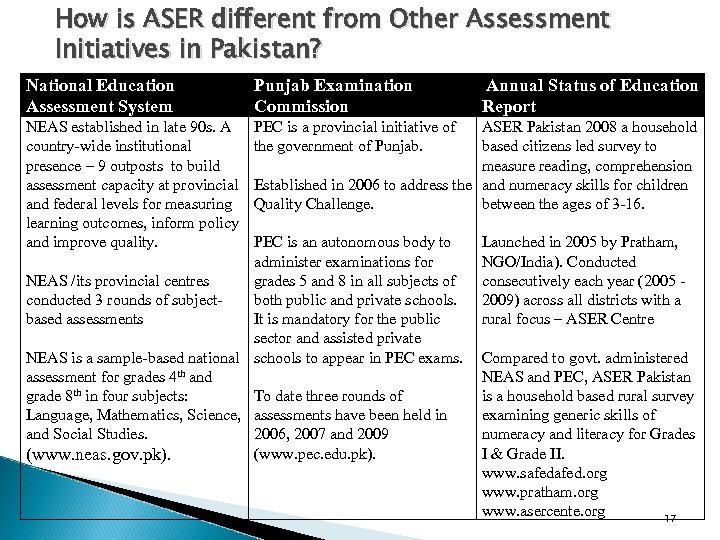 How is ASER different from Other Assessment Initiatives in Pakistan? National Education Assessment System Punjab Examination Commission NEAS established in late 90 s. A country-wide institutional presence – 9 outposts to build assessment capacity at provincial and federal levels for measuring learning outcomes, inform policy and improve quality. Annual Status of Education Report PEC is a provincial initiative of the government of Punjab. ASER Pakistan 2008 a household based citizens led survey to measure reading, comprehension Established in 2006 to address the and numeracy skills for children Quality Challenge. between the ages of 3 -16. PEC is an autonomous body to administer examinations for NEAS /its provincial centres grades 5 and 8 in all subjects of conducted 3 rounds of subjectboth public and private schools. based assessments It is mandatory for the public sector and assisted private NEAS is a sample-based national schools to appear in PEC exams. assessment for grades 4 th and grade 8 th in four subjects: To date three rounds of Language, Mathematics, Science, assessments have been held in and Social Studies. 2006, 2007 and 2009 (www. pec. edu. pk). (www. neas. gov. pk). Launched in 2005 by Pratham, NGO/India). Conducted consecutively each year (2005 2009) across all districts with a rural focus – ASER Centre Compared to govt. administered NEAS and PEC, ASER Pakistan is a household based rural survey examining generic skills of numeracy and literacy for Grades I & Grade II. www. safed. org www. pratham. org www. asercente. org 17
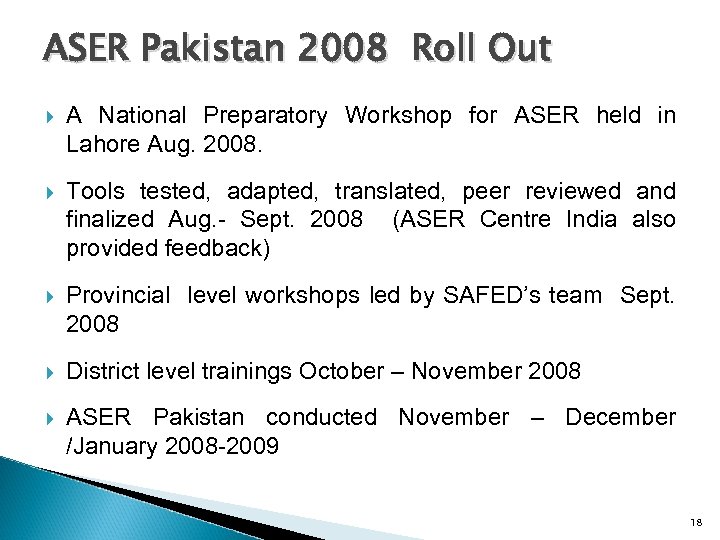 ASER Pakistan 2008 Roll Out A National Preparatory Workshop for ASER held in Lahore Aug. 2008. Tools tested, adapted, translated, peer reviewed and finalized Aug. - Sept. 2008 (ASER Centre India also provided feedback) Provincial level workshops led by SAFED’s team Sept. 2008 District level trainings October – November 2008 ASER Pakistan conducted November – December /January 2008 -2009 18
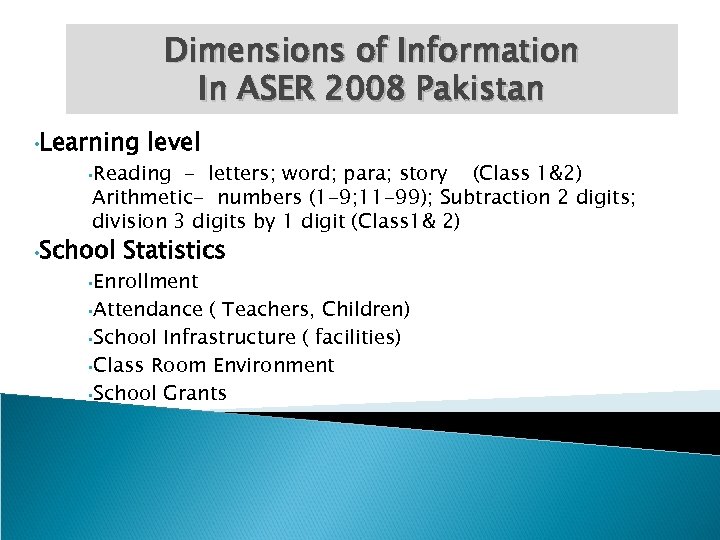 Dimensions of Information In ASER 2008 Pakistan • Learning level • Reading - letters; word; para; story (Class 1&2) Arithmetic- numbers (1 -9; 11 -99); Subtraction 2 digits; division 3 digits by 1 digit (Class 1& 2) • School Statistics • Enrollment • Attendance ( Teachers, Children) • School Infrastructure ( facilities) • Class Room Environment • School Grants
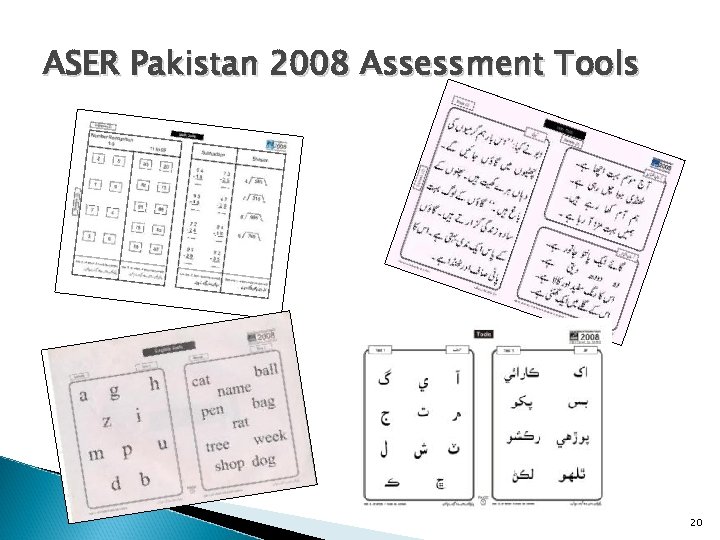 ASER Pakistan 2008 Assessment Tools 20
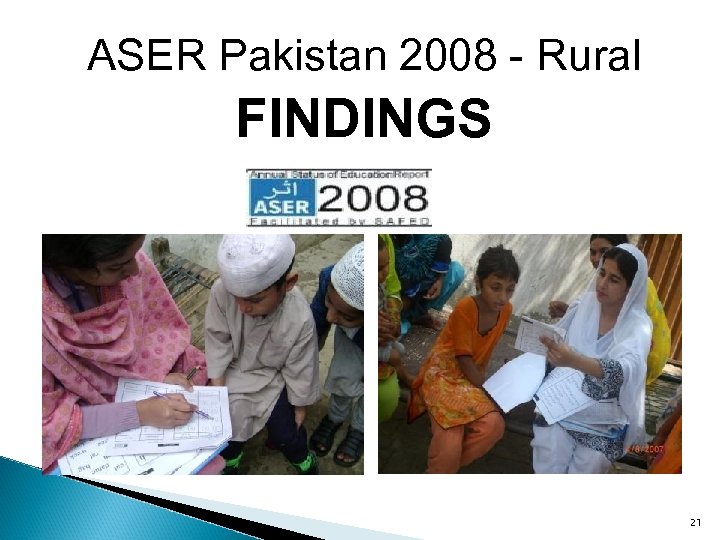 ASER Pakistan 2008 - Rural FINDINGS 21
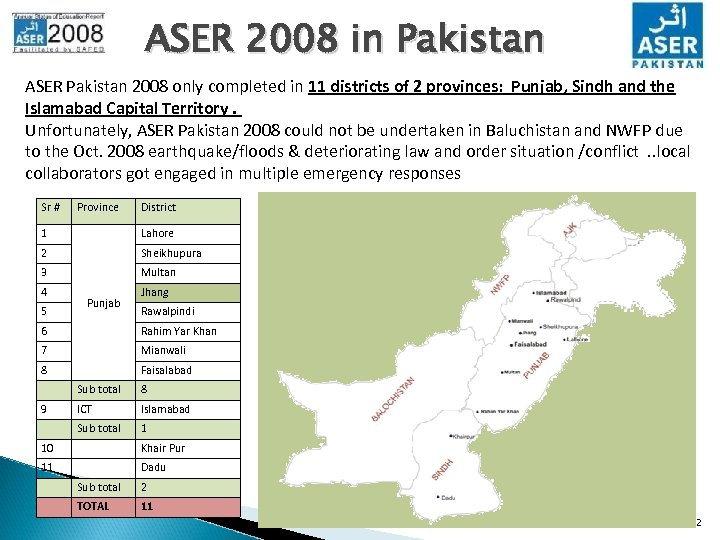 ASER 2008 in Pakistan ASER Pakistan 2008 only completed in 11 districts of 2 provinces: Punjab, Sindh and the Islamabad Capital Territory. Unfortunately, ASER Pakistan 2008 could not be undertaken in Baluchistan and NWFP due to the Oct. 2008 earthquake/floods & deteriorating law and order situation /conflict. . local collaborators got engaged in multiple emergency responses Sr # Province District 1 Lahore 2 Sheikhupura 3 Multan 4 5 Punjab Jhang Rawalpindi 6 Rahim Yar Khan 7 Mianwali 8 Faisalabad Sub total ICT Islamabad Sub total 9 8 1 10 Khair Pur 11 Dadu Sub total 2 TOTAL 11 22
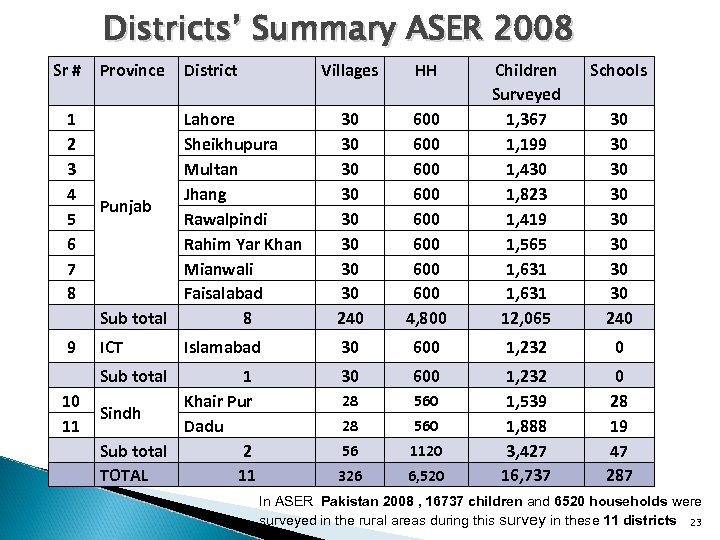 Districts’ Summary ASER 2008 Sr # Province 1 2 3 4 5 6 7 8 Lahore Sheikhupura Multan Jhang Punjab Rawalpindi Rahim Yar Khan Mianwali Faisalabad Sub total 8 30 30 240 600 600 4, 800 Children Surveyed 1, 367 1, 199 1, 430 1, 823 1, 419 1, 565 1, 631 12, 065 9 ICT Islamabad 30 600 1, 232 0 1 Khair Pur Sindh Dadu Sub total 2 TOTAL 11 30 600 28 560 56 1120 326 6, 520 1, 232 1, 539 1, 888 3, 427 16, 737 0 28 19 47 287 Sub total 10 11 District Villages HH Schools 30 30 240 In ASER Pakistan 2008 , 16737 children and 6520 households were surveyed in the rural areas during this survey in these 11 districts 23
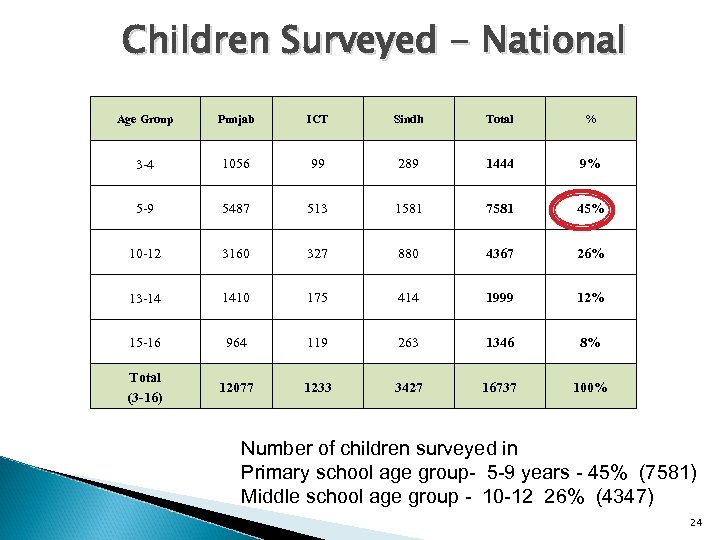 Children Surveyed - National Age Group Punjab ICT Sindh Total % 3 -4 1056 99 289 1444 9% 5 -9 5487 513 1581 7581 45% 10 -12 3160 327 880 4367 26% 13 -14 1410 175 414 1999 12% 15 -16 964 119 263 1346 8% Total (3 -16) 12077 1233 3427 16737 100% Number of children surveyed in Primary school age group- 5 -9 years - 45% (7581) Middle school age group - 10 -12 26% (4347) 24
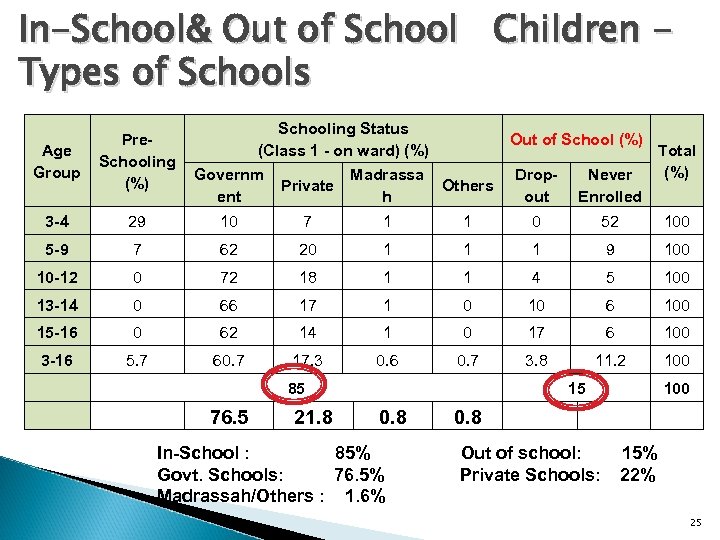 In-School& Out of School Children Types of Schools Age Group Pre. Schooling (%) 3 -4 Schooling Status (Class 1 - on ward) (%) Out of School (%) Total (%) Governm ent Private Madrassa h Others Dropout Never Enrolled 29 10 7 1 1 0 52 100 5 -9 7 62 20 1 1 1 9 100 10 -12 0 72 18 1 1 4 5 100 13 -14 0 66 17 1 0 10 6 100 15 -16 0 62 14 1 0 17 6 100 3 -16 5. 7 60. 7 17. 3 0. 6 0. 7 3. 8 11. 2 100 85 76. 5 21. 8 15 0. 8 100 0. 8 In-School : 85% Out of school: 15% Govt. Schools: 76. 5% Private Schools: 22% Madrassah/Others : 1. 6% 25
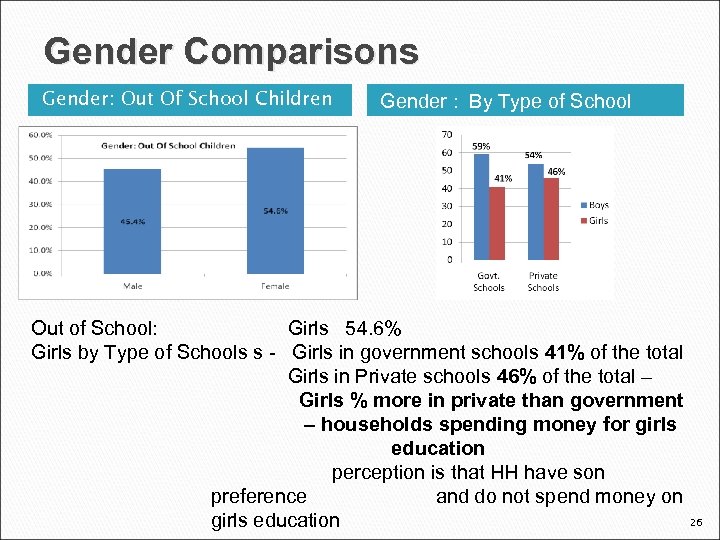 Gender Comparisons Gender: Out Of School Children Gender : By Type of School Out of School: Girls 54. 6% Girls by Type of Schools s - Girls in government schools 41% of the total Girls in Private schools 46% of the total – Girls % more in private than government – households spending money for girls education perception is that HH have son preference and do not spend money on 26 girls education
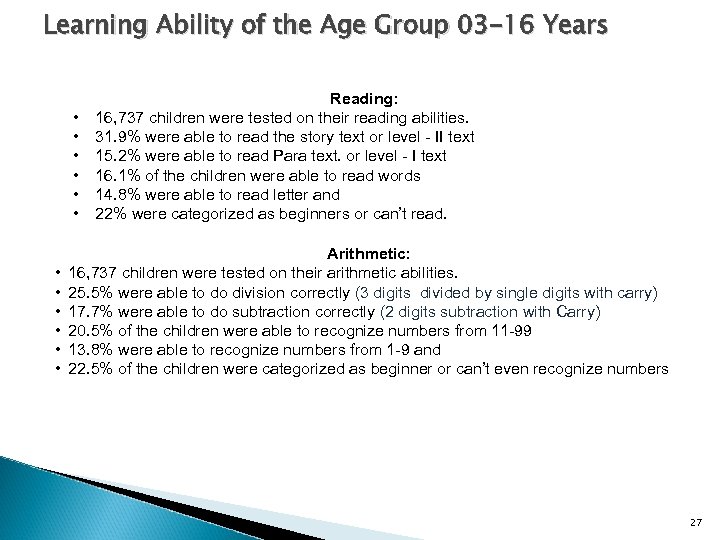 Learning Ability of the Age Group 03 -16 Years • • • Reading: 16, 737 children were tested on their reading abilities. 31. 9% were able to read the story text or level - II text 15. 2% were able to read Para text. or level - I text 16. 1% of the children were able to read words 14. 8% were able to read letter and 22% were categorized as beginners or can’t read. Arithmetic: 16, 737 children were tested on their arithmetic abilities. 25. 5% were able to do division correctly (3 digits divided by single digits with carry) 17. 7% were able to do subtraction correctly (2 digits subtraction with Carry) 20. 5% of the children were able to recognize numbers from 11 -99 13. 8% were able to recognize numbers from 1 -9 and 22. 5% of the children were categorized as beginner or can’t even recognize numbers 27
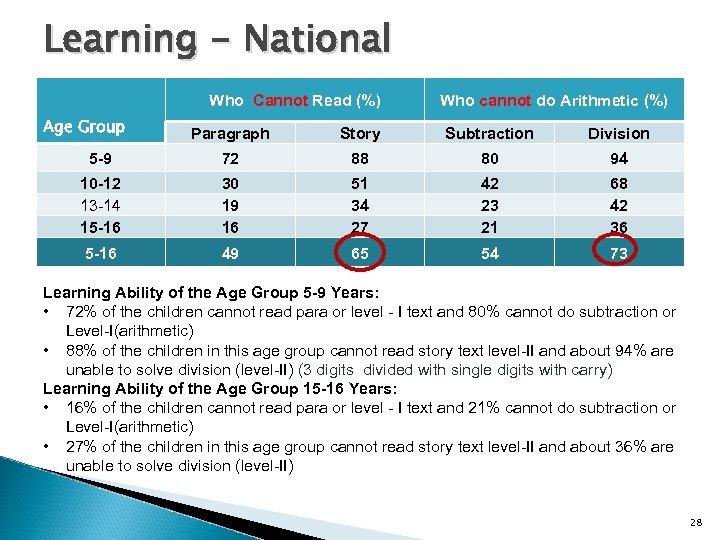 Learning - National Who Cannot Read (%) Age Group Paragraph Story Who cannot do Arithmetic (%) Subtraction Division 5 -9 72 88 80 94 10 -12 13 -14 15 -16 30 19 16 51 34 27 42 23 21 68 42 36 5 -16 49 65 54 73 Learning Ability of the Age Group 5 -9 Years: • 72% of the children cannot read para or level - I text and 80% cannot do subtraction or Level-I(arithmetic) • 88% of the children in this age group cannot read story text level-II and about 94% are unable to solve division (level-II) (3 digits divided with single digits with carry) Learning Ability of the Age Group 15 -16 Years: • 16% of the children cannot read para or level - I text and 21% cannot do subtraction or Level-I(arithmetic) • 27% of the children in this age group cannot read story text level-II and about 36% are unable to solve division (level-II) 28
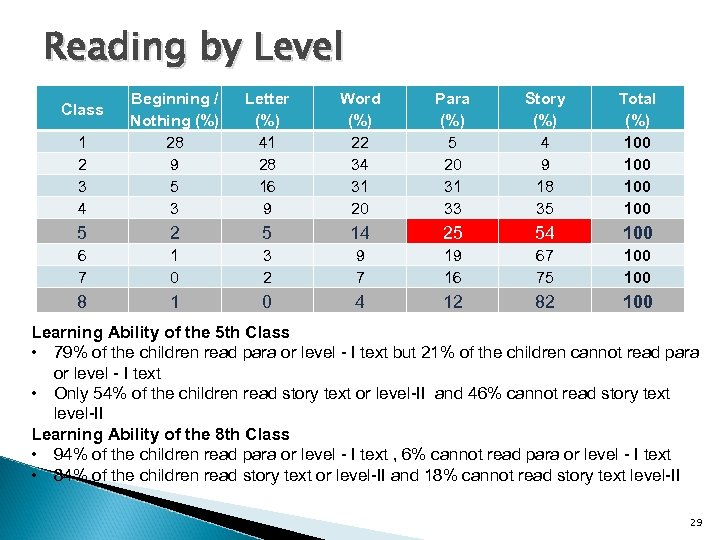 Reading by Level 1 2 3 4 Beginning / Nothing (%) 28 9 5 3 Letter (%) 41 28 16 9 Word (%) 22 34 31 20 Para (%) 5 20 31 33 Story (%) 4 9 18 35 Total (%) 100 100 5 2 5 14 25 54 100 6 7 1 0 3 2 9 7 19 16 67 75 100 8 1 0 4 12 82 100 Class Learning Ability of the 5 th Class • 79% of the children read para or level - I text but 21% of the children cannot read para or level - I text • Only 54% of the children read story text or level-II and 46% cannot read story text level-II Learning Ability of the 8 th Class • 94% of the children read para or level - I text , 6% cannot read para or level - I text • 84% of the children read story text or level-II and 18% cannot read story text level-II 29
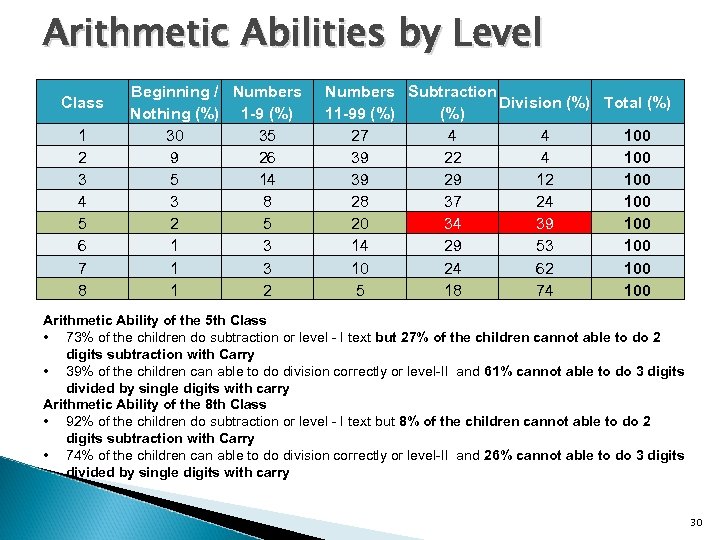 Arithmetic Abilities by Level Class 1 2 3 4 5 6 7 8 Beginning / Numbers Nothing (%) 1 -9 (%) 30 35 9 26 5 14 3 8 2 5 1 3 1 2 Numbers Subtraction Division (%) Total (%) 11 -99 (%) 27 4 4 100 39 22 4 100 39 29 12 100 28 37 24 100 20 34 39 100 14 29 53 100 10 24 62 100 5 18 74 100 Arithmetic Ability of the 5 th Class • 73% of the children do subtraction or level - I text but 27% of the children cannot able to do 2 digits subtraction with Carry • 39% of the children can able to do division correctly or level-II and 61% cannot able to do 3 digits divided by single digits with carry Arithmetic Ability of the 8 th Class • 92% of the children do subtraction or level - I text but 8% of the children cannot able to do 2 digits subtraction with Carry • 74% of the children can able to do division correctly or level-II and 26% cannot able to do 3 digits divided by single digits with carry 30
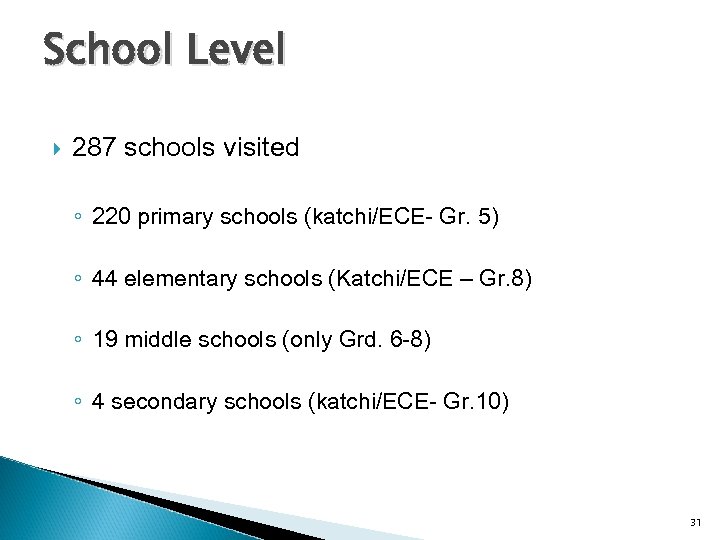 School Level 287 schools visited ◦ 220 primary schools (katchi/ECE- Gr. 5) ◦ 44 elementary schools (Katchi/ECE – Gr. 8) ◦ 19 middle schools (only Grd. 6 -8) ◦ 4 secondary schools (katchi/ECE- Gr. 10) 31
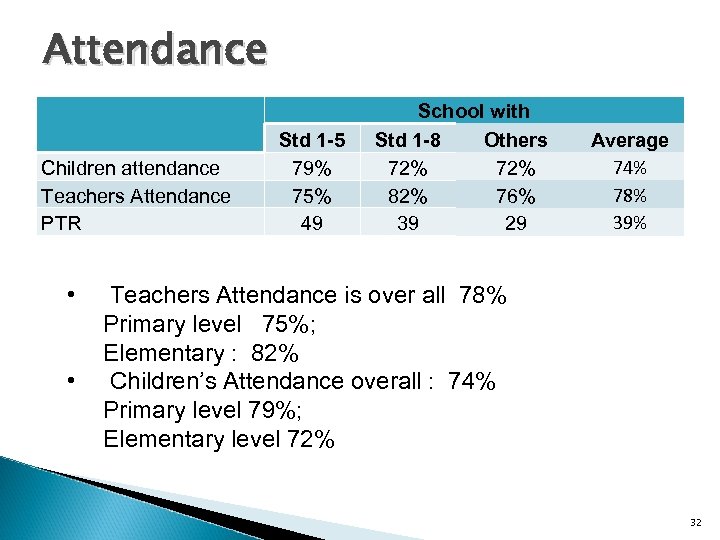 Attendance Children attendance Teachers Attendance PTR • • Std 1 -5 79% 75% 49 School with Std 1 -8 Others 72% 82% 76% 39 29 Average 74% 78% 39% Teachers Attendance is over all 78% Primary level 75%; Elementary : 82% Children’s Attendance overall : 74% Primary level 79%; Elementary level 72% 32
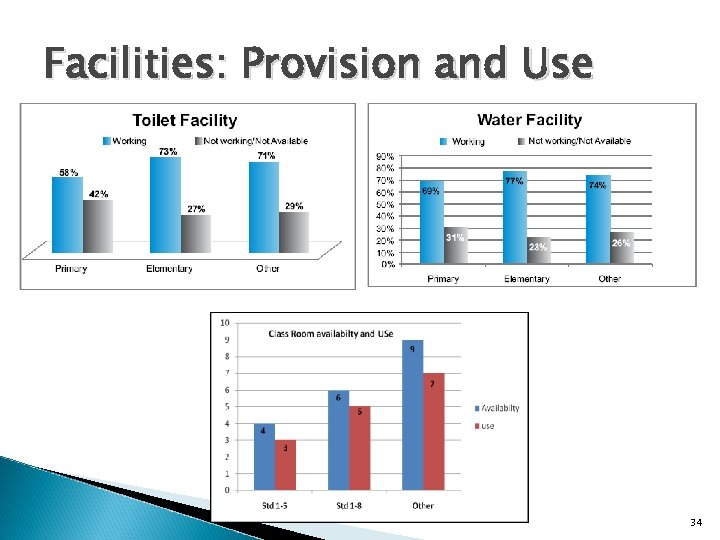
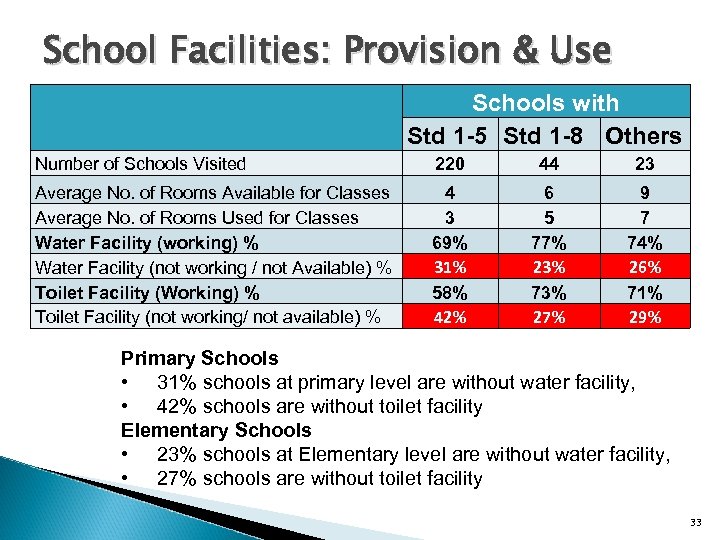 School Facilities: Provision & Use Number of Schools Visited Average No. of Rooms Available for Classes Average No. of Rooms Used for Classes Water Facility (working) % Water Facility (not working / not Available) % Toilet Facility (Working) % Toilet Facility (not working/ not available) % Schools with Std 1 -5 Std 1 -8 Others 220 44 23 4 3 69% 31% 58% 42% 6 5 77% 23% 73% 27% 9 7 74% 26% 71% 29% Primary Schools • 31% schools at primary level are without water facility, • 42% schools are without toilet facility Elementary Schools • 23% schools at Elementary level are without water facility, • 27% schools are without toilet facility 33
 Facilities: Provision and Use 34
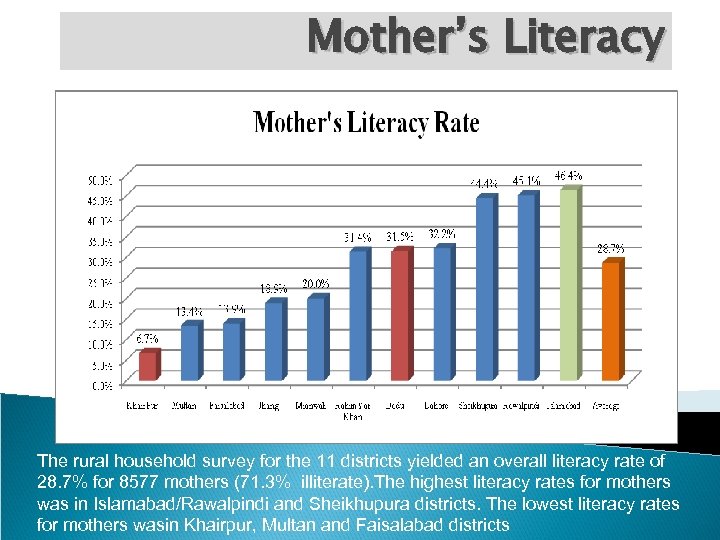 Mother’s Literacy The rural household survey for the 11 districts yielded an overall literacy rate of 28. 7% for 8577 mothers (71. 3% illiterate). The highest literacy rates for mothers was in Islamabad/Rawalpindi and Sheikhupura districts. The lowest literacy rates for mothers wasin Khairpur, Multan and Faisalabad districts
 ASER Pakistan – Key Positive Outcomes Data trends on education indicators in rural areas corroborate with the annual Pakistan Social Living Measurement survey (PSLMs) data – in some areas improvements are noted (drop outs) Good support by local people in villages to ASER Pakistan …many signed up as volunteers for the next round of ASER – became a mobilization campaign – positive energy by the people not govt. bashing but eager to know what /how much their children learn Empowerment witnessed amongst local people and created visible credibility of the process Many organizations who learnt the ASER methodology practiced it intensively in formal and non-formal programs to measure baselines and diagnose quality interventions to improve learning outcomes A big demand for ASER Pakistan only if it is predictable and regular – influenced largely by what ASER India has been able to achieve 36
 Issues & Challenges ASER Pakistan is a powerful tool & movement but: ◦ A scaled up initiative cannot be sustained randomly through statements of intent by civil society organizations ◦ Timelines are critical for an efficient and effective ASER Pakistan – NWFP- Balochistan and Sindh counterparts kept promising until March 2009 – data retrieval. . an issue as NGOs got busy with other ‘priority projects’. June – July 2009 data was retrieved ! ◦ With multiple partners funding their own ASER survey, sensitivity to timing was missing & SAFED had no choice but to wait ◦ Funding was a major constraint for local partners (both strong and weak) – There is limited culture of doing things with ‘own resources’ only through donor supported projects ◦ Volunteers not tapped optimally through colleges /universities/media – often through local CSOs ◦ Finding technical experts was difficult without funding in ASER Pakistan Secretariat at SAFED 37
 Annual Status of Education Report (Rural) ASER Pakistan 2010 PROPOSAL -1
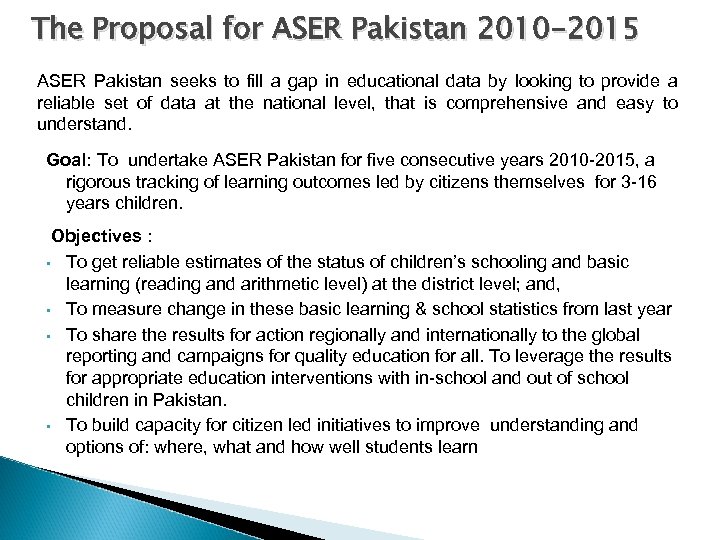 The Proposal for ASER Pakistan 2010 -2015 ASER Pakistan seeks to fill a gap in educational data by looking to provide a reliable set of data at the national level, that is comprehensive and easy to understand. Goal: To undertake ASER Pakistan for five consecutive years 2010 -2015, a rigorous tracking of learning outcomes led by citizens themselves for 3 -16 years children. Objectives : • • To get reliable estimates of the status of children’s schooling and basic learning (reading and arithmetic level) at the district level; and, To measure change in these basic learning & school statistics from last year To share the results for action regionally and internationally to the global reporting and campaigns for quality education for all. To leverage the results for appropriate education interventions with in-school and out of school children in Pakistan. To build capacity for citizen led initiatives to improve understanding and options of: where, what and how well students learn
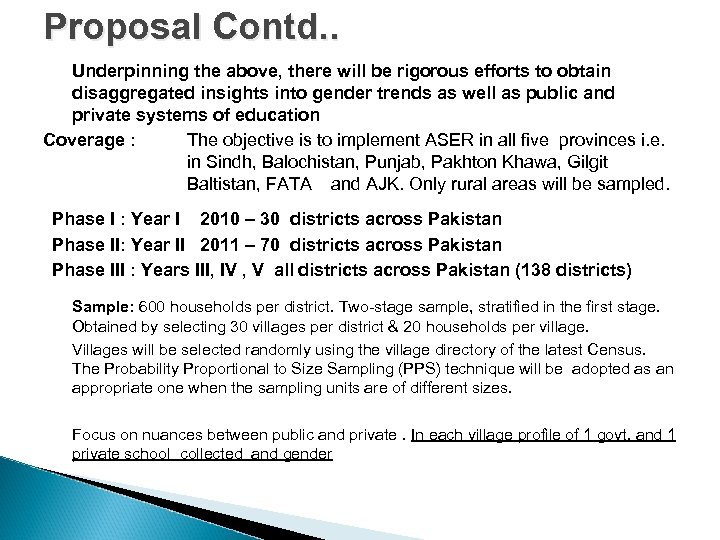 Proposal Contd. . Underpinning the above, there will be rigorous efforts to obtain disaggregated insights into gender trends as well as public and private systems of education Coverage : The objective is to implement ASER in all five provinces i. e. in Sindh, Balochistan, Punjab, Pakhton Khawa, Gilgit Baltistan, FATA and AJK. Only rural areas will be sampled. Phase I : Year I 2010 – 30 districts across Pakistan Phase II: Year II 2011 – 70 districts across Pakistan Phase III : Years III, IV , V all districts across Pakistan (138 districts) Sample: 600 households per district. Two-stage sample, stratified in the first stage. Obtained by selecting 30 villages per district & 20 households per village. Villages will be selected randomly using the village directory of the latest Census. The Probability Proportional to Size Sampling (PPS) technique will be adopted as an appropriate one when the sampling units are of different sizes. Focus on nuances between public and private. In each village profile of 1 govt. and 1 private school collected and gender
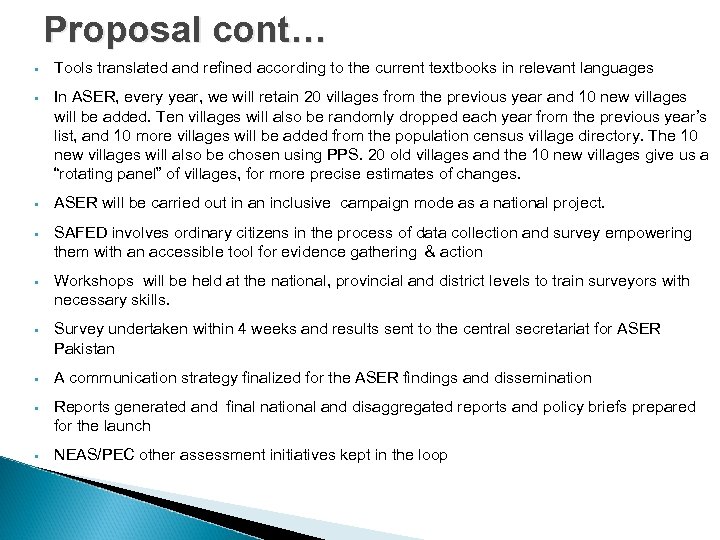 Proposal cont… • Tools translated and refined according to the current textbooks in relevant languages • In ASER, every year, we will retain 20 villages from the previous year and 10 new villages will be added. Ten villages will also be randomly dropped each year from the previous year’s list, and 10 more villages will be added from the population census village directory. The 10 new villages will also be chosen using PPS. 20 old villages and the 10 new villages give us a “rotating panel” of villages, for more precise estimates of changes. • ASER will be carried out in an inclusive campaign mode as a national project. • SAFED involves ordinary citizens in the process of data collection and survey empowering them with an accessible tool for evidence gathering & action • Workshops will be held at the national, provincial and district levels to train surveyors with necessary skills. • Survey undertaken within 4 weeks and results sent to the central secretariat for ASER Pakistan • A communication strategy finalized for the ASER findings and dissemination • Reports generated and final national and disaggregated reports and policy briefs prepared for the launch • NEAS/PEC other assessment initiatives kept in the loop
 Future Plans Proposal ASER Pakistan 2010 -15 Proposal - ASER Pakistan 2010 -2015 has been submitted to donors. UNESCO has agreed to support one fifth of the total budget for ASER 2010) Goal: To undertake ASER Pakistan for five consecutive years 2010 -2015, a rigorous tracking of learning outcomes led by citizens themselves for 3 -16 years children. 42
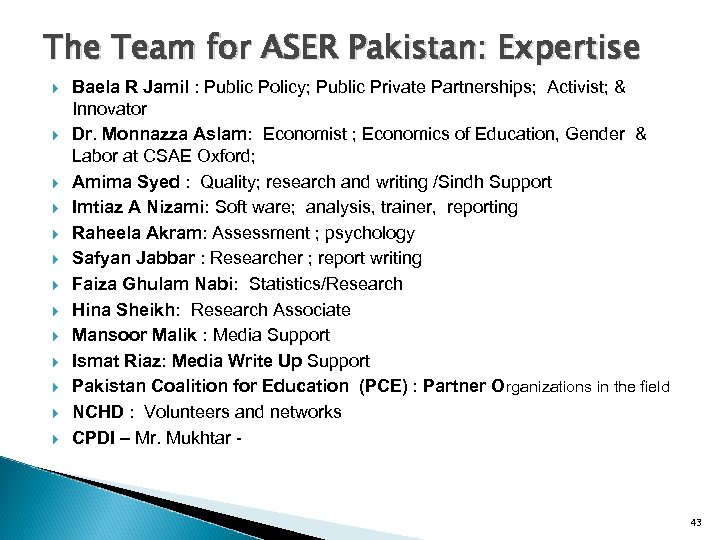 The Team for ASER Pakistan: Expertise Baela R Jamil : Public Policy; Public Private Partnerships; Activist; & Innovator Dr. Monnazza Aslam: Economist ; Economics of Education, Gender & Labor at CSAE Oxford; Amima Syed : Quality; research and writing /Sindh Support Imtiaz A Nizami: Soft ware; analysis, trainer, reporting Raheela Akram: Assessment ; psychology Safyan Jabbar : Researcher ; report writing Faiza Ghulam Nabi: Statistics/Research Hina Sheikh: Research Associate Mansoor Malik : Media Support Ismat Riaz: Media Write Up Support Pakistan Coalition for Education (PCE) : Partner Organizations in the field NCHD : Volunteers and networks CPDI – Mr. Mukhtar - 43
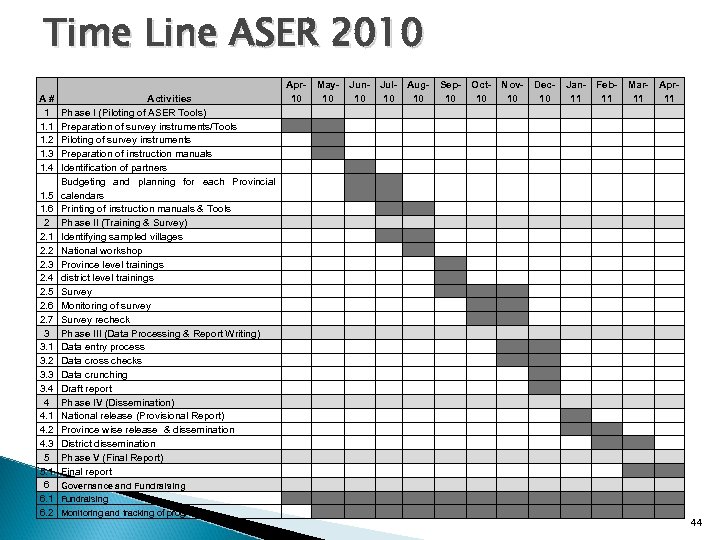 Time Line ASER 2010 A # 1 1. 2 1. 3 1. 4 Activities Phase I (Piloting of ASER Tools) Preparation of survey instruments/Tools Piloting of survey instruments Preparation of instruction manuals Identification of partners Budgeting and planning for each Provincial calendars Printing of instruction manuals & Tools Phase II (Training & Survey) Identifying sampled villages National workshop Province level trainings district level trainings Survey Monitoring of survey Survey recheck Phase III (Data Processing & Report Writing) Data entry process Data cross checks Data crunching Draft report Phase IV (Dissemination) National release (Provisional Report) Province wise release & dissemination District dissemination Phase V (Final Report) Final report 1. 5 1. 6 2 2. 1 2. 2 2. 3 2. 4 2. 5 2. 6 2. 7 3 3. 1 3. 2 3. 3 3. 4 4 4. 1 4. 2 4. 3 5 5. 1 6 Governance and Fundraising 6. 1 Fundraising 6. 2 Monitoring and tracking of progress Apr 10 May 10 Jun 10 Jul 10 Aug 10 Sep 10 Oct 10 Nov 10 Dec 10 Jan 11 Feb 11 Mar 11 Apr 11 44
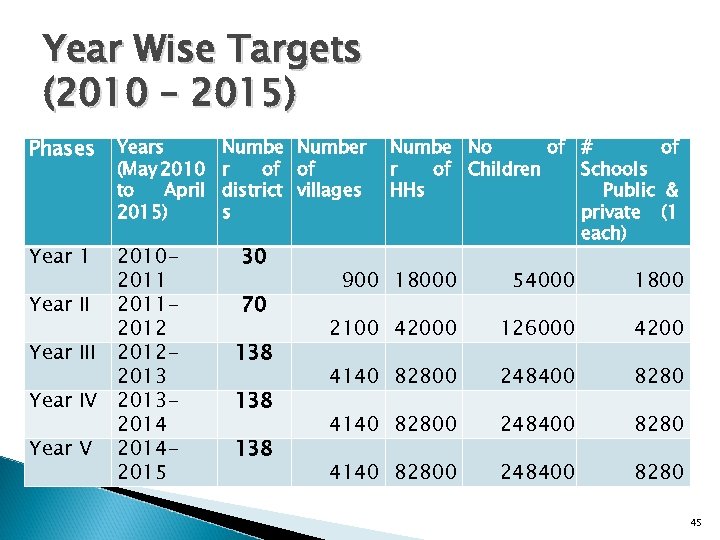 Year Wise Targets (2010 – 2015) Phases Year 1 Years (May 2010 to April 2015) 20102011 Year II 20112012 Year III 20122013 Year IV 20132014 Year V 20142015 Number r of of district villages s 30 70 138 138 Numbe No of # of r of Children Schools HHs Public & private (1 each) 900 18000 54000 1800 2100 42000 126000 4200 4140 82800 248400 8280 45
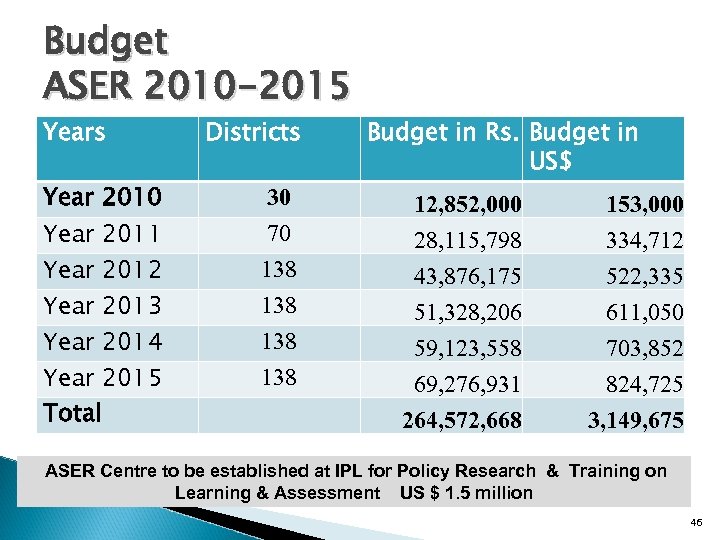 Budget ASER 2010 -2015 Years Year 2010 Year 2011 Year 2012 Year 2013 Year 2014 Year 2015 Total Districts 30 70 138 138 Budget in Rs. Budget in US$ 12, 852, 000 28, 115, 798 153, 000 334, 712 43, 876, 175 51, 328, 206 59, 123, 558 69, 276, 931 264, 572, 668 522, 335 611, 050 703, 852 824, 725 3, 149, 675 ASER Centre to be established at IPL for Policy Research & Training on Learning & Assessment US $ 1. 5 million 46
 Proposals II & III II. Chalo Parho Barho III. School Based Budget Tracking 47
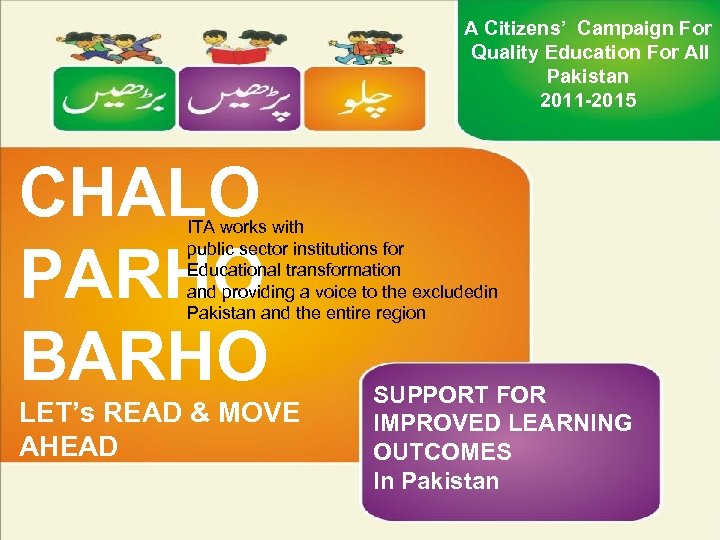 A Citizens’ Campaign For Quality Education For All Pakistan 2011 -2015 CHALO PARHO BARHO ITA works with public sector institutions for Educational transformation and providing a voice to the excludedin Pakistan and the entire region LET’s READ & MOVE AHEAD SUPPORT FOR IMPROVED LEARNING OUTCOMES In Pakistan 48
 CHALO PARHO BARHO - AN ALL OUT ZAKAT/GIVING & CITIZENS’ CAMPAIGN FOR IMPROVED LEARNING OUTCOMES IN PAKISTAN The data from Annual Status of Education Report (ASER) Pakistan 2008, assessed 16737 rural children 3 -16 years of age for up to grades II & III competencies, revealed poor results in reading and maths. Whilst overall reading ability of story level was 31. 9%, maths (division 3 digits) was only 25. 5%, 54% of grade V children could do grade II reading at story level and only 39% of grade V children could do grade III division. (www. safed. org) A low baseline in reading, leads to drop in maths by 4 -14% points. Education for All (EFA) & Millennium Development Goals (MDG) goals will remain unmet! This is unacceptable but can be improved radically if we partner for an all out learning improvement as a massive intensive campaign: ; led by CITIZENS and with govt. support Chalo Parho Barho (CPB) is a movement by ALL CITIZENS! This initiative has been tried in neighbouring countries with success… www. pratham. org 49
 CHALO PARHO BARHO - CPB Duration: It is A Five Year Well Tracked Movement Countdown 2011 to 2015 Core Areas: CHALO PARHO BARHO addresses gaps in reading and numeracy. Target Group: Children Aged 4 -12 in ALL public sector & some private sector schools Where: In a district wide mode selected for the LEARNING UPLIFT program Children will be selected from grades 1 -V in the target schools and local communities Coverage: All government schools in each district covered plus private schools 50
 CHALO PARHO BARHO - CPB How? A learning package focusing on language and maths will be aligned to the National Curriculum (2006) competencies and through volunteers ( Youth and Retired in local areas). Materials? Learning cards, reading letters/sound/word activity materials to attract children who will be engaged with active earning in a non-linear manner. . . Remember, children come to school with Lots of language, maths, life skills and laughter ! Who are the critical human resources? One volunteer, with at least Matric qualification (with 50%+ marks in languages/Urdu/English) to be mobilized per each school. She/he will give 4 hours of time for 18 weeks annually (August/September 2011 – January 2011). She/he will be from the same community- someone with energy, passion, a will to learn and smile! For every 20 schools one cluster mentor. For all schools in district one Program Manager Researchers/data collectors and trainers at central level 51
 CHALO PARHO BARHO - CPB Government Interface: Done for complete ownership and support. The entire input aligned to the curriculum, competencies, time table and teachers’ training and assessment. How will we track learning? Each child will have one Student Report Card- CPB with baseline to establish the learning level. Each child will be tested thrice; a) baseline b) mid way and c) end of program All progress will be posted on the website of the CPB campaign repeated each year until 2015 and tracked by ASER Pakistan 2010 -2015 Partnerships? Depts. Of Education, Education Foundations; National Commission for Human Development (NCHD); Pakistan Coalition for Education, (PCE), RSPs Scouts/ Girl Guide Associations and many other. . 52
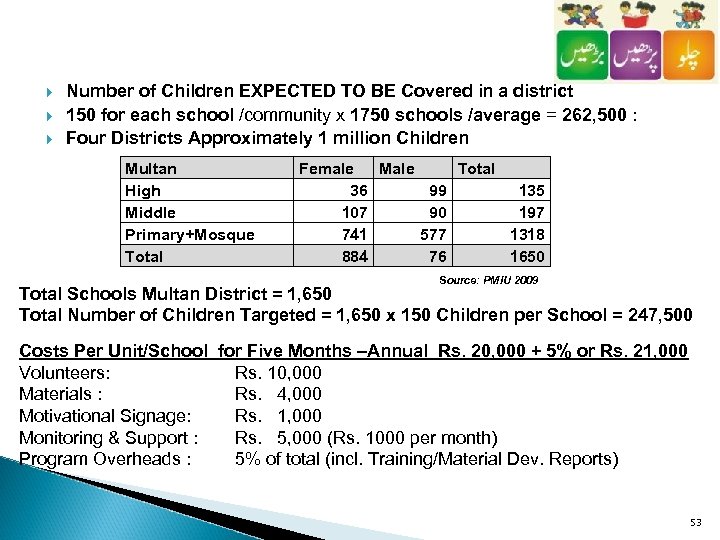 Number of Children EXPECTED TO BE Covered in a district 150 for each school /community x 1750 schools /average = 262, 500 : Four Districts Approximately 1 million Children Multan High Middle Primary+Mosque Total Female Male Total 36 99 135 107 90 197 741 577 1318 884 76 1650 Source: PMIU 2009 Total Schools Multan District = 1, 650 Total Number of Children Targeted = 1, 650 x 150 Children per School = 247, 500 Costs Per Unit/School for Five Months –Annual Rs. 20, 000 + 5% or Rs. 21, 000 Volunteers: Rs. 10, 000 Materials : Rs. 4, 000 Motivational Signage: Rs. 1, 000 Monitoring & Support : Rs. 5, 000 (Rs. 1000 per month) Program Overheads : 5% of total (incl. Training/Material Dev. Reports) 53
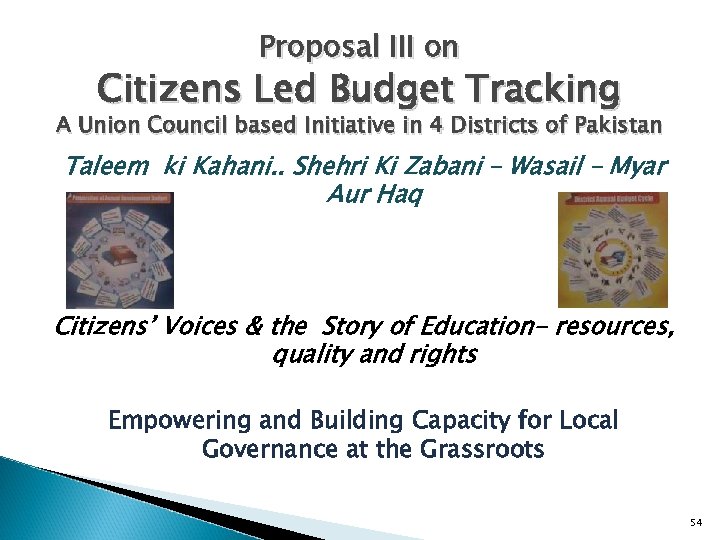 Proposal III on Citizens Led Budget Tracking A Union Council based Initiative in 4 Districts of Pakistan Taleem ki Kahani. . Shehri Ki Zabani – Wasail – Myar Aur Haq Citizens’ Voices & the Story of Education- resources, quality and rights Empowering and Building Capacity for Local Governance at the Grassroots 54
 Goal Sustained increase in government accountability through citizens’ voice and action for quality education services, committed by the Constitution- Articles 25 A & 19 -A; Right to Education and Information 55
 Objectives 1. 2. 3. 4. 5. Identify four districts in four provinces along with target schools with baselines(school and SMC), one in each UC spread evenly across primary. Middle and secondary sub-sectors ; urban/rural and gender (girls/boys/mixed) Undertake collection of information research /knowledge generated on local level planning, mapping resources/ budget tracking in Pakistan for an accessible information pack on macro level understanding Collecting and widely disseminating data related to planning processes, resource allocations, expenditures and institutional arrangements for service delivery with new technologies Prepare toolkits on micro – school/community based budget tracking and capacity building (pre-tests/ finalized) Engage for a minimum of 15 days with 140 target schools /communities per district (4) through a well orchestrated timetable throughout the annual planning and budget tracking cycle. 56
 Objectives 6. 7. 8. 9. 10. 11. 12. Build capacities for primary/secondary stakeholders to effectively participate in planning and resource tracking and informing policies and decisions Publish simple school and district report cards on budget tracking and performance for wider dissemination and citizen action Seek opportunities for synergies in the target districts for other citizen led initiatives such as ASER Pakistan 2010 on learning assessments and Chalo Parhain Barhain (CPB) to improve learning outcomes. Create a valid compelling basis for emerging citizen-centred accountable tools/systems for adopting/adapting by the government systems at the provincial, district and federal levels Feed the entire program into the policy/legal/implementation measures for Articles 25 A and 19 A at the national and provincial levels Social Marketing/Communication undertaken rigorously throughout the budget cycle at district, provincial and national level in a campaign mode Link with similar initiatives regionally 57
 Strategy Phase I – Year I 2010 -2011 Sample Frame: Select one district in four provinces (not Gilgit Baltistan as yet) Select 1 government school per Union Council (average 120 -140) Ensure even percentage of primary, middle and high schools Ensure even percentage of girls, boys and mixed schools 58
 Strategy (cont…. ) Agreement formalized for each district with the EDOs education, literacy and F&P / DCOs/Administrators (copy to provinces) Collect the baseline – resource mapping on budget cycles and allocation /expenditure trends over the past three years 2007/8 - 2009 /2010. Collect baselines of the target schools; Facilities, Budgets transferred including SMCs/SCs Integrate technologies spatial and communication on schools and citizens for virtual access by any citizens to information and informed decisions. Define the moments/milestones of engagements on budget tracking aligned to the Budget /Planning cycle Fill out the data/ report cards for collation and dissemination by the citizens themselves Produce school and district report cards. Inform policy level/decision making stakeholders at local and national levels (Assemblies debates/media debates/local jirga/panchayat debates) LIKE MINDED INSTITUTIONS /PARTNERS TO BE SOUGHT IN THIS EFFORT- SOME HAVE ALREADY AGREED FOR THE GREATER NATIONAL GOOD 59
 Key Activities Research for repackaging – knowledge management Knowledge and MIS generation on resources for education Communication Strategy and repackaging of information for accessibility to the public using new and traditional technologies ◦ SMSs to the public (100 miliion plus mobiles) – segmenting audiences ◦ GPS to map each school - virtual tracking. . accessible anywhere Accessing schools preparing baseline profiles(School/SMCs) for School Report Cards/’District Report Cards Working six days with the Schools/SCs/Communities on critical days of budget tracking aligned to the budget/planning cycle of the government Working 6 -8 days on capacity building with three core personel from each school to understand propagate budget tracking for outcomes Reports/Documentation /Disseminationally, provincially and at district level – internationally Informing policy and implementability of Right to Information and Right to Education articles 19 A and 25 A 60
 Outcomes Increased knowledge amongst providers at the district and provincial level on planning processes, fund flows and institutional roles and responsibilities Greater and effective citizen participation in the planning process MIS systems are adopted at the district level to monitor fund flows Regular, pro-active reporting by the government on plans, allocations and expenditures Timely and predictable fund flows Increased debate in the public domain on the quality and effectiveness of expenditures and on finding the right institutional design for the delivery of elementary education Changing systems of planning, budgeting and tracking funds for education across Pakistan 61
 Coverage Scaled Up to four entire districts Coverage of 600 schools and actually all schools in the districts approximately 7000 -8000 Over 4 million population District- Provincial and National Governments and Political representatives Linkages to be sought with South Asian initiatives on Budget Tracking in Education/Social Sectors 62
 Partners in Implementation Provincial Govts. (Depts of Education/Finance/Planning) District Govts (Depts of Education/Finance/Planning) Schools /Communities/SMCs Technical partners ITA/SAFED (agreed Principal Agency) PCE (Agreed) CPDI (agreed for capacity building in schools/Parliamentarians) i. SAPs (if they agree) Oxfam Action Aid Others from the Region mobilized through SAFED (eg. Pratham/ASER Centre India etc ) 63
 Teams & Budget Teams in District : ◦ 14 persons in each district (4) ◦ Two Vehicles Program Team - Lahore/Islamabad ◦ 12 Budget US $: 1 million to 1. 25 million maximum annually 64
 Principles & Way Forward for the Three Initiatives Synergies with other alliances eg. ◦ NCHD partnership, PCE and Education Foundations ◦ Public strategic operational and policy interface Synergies of three initiatives ◦ ASER Pakistan ◦ Chalo Parhain Barhain ◦ School Based Budget Tracking Synergies in Capacity building with alliances - Regionally ASER Centre/Pratham/UWEZO - Nationally with like –minded institutions 65
 CSR Initiatives – Campaigns Surf Excel – ECE Program Lifebuoy - Health and Hygiene Program Fair & Lovely – Post Secondary Scholarship Program UPL Rahim Yar Khan: WSIP & Vocational Training Program : School as a Community Centre Gender Empowerment Program for livelihoods – multiple brands Multiple Brands: Emergency Program 66
 District Plans – OXFAM GB Dubai Cares WSIP Close Out Muzzafargarh ◦ Unilever initaitives ◦ Emergency programs of WSIP, ECE, - Mothers/Youth Skills/Livelihood Initiatives - Per unit need Rs. 5 million for two years ◦ 3 Units – OCHA proposals Chiniot ◦ ? Multan Rahim Yar Khan 67
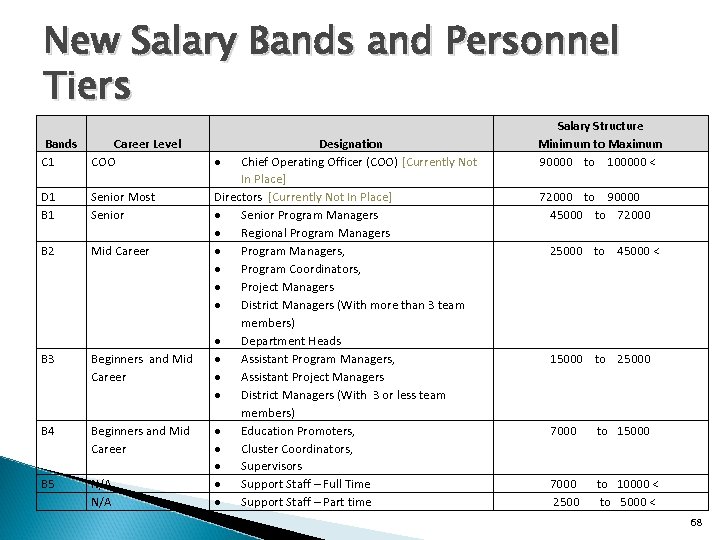 New Salary Bands and Personnel Tiers Bands C 1 Career Level COO D 1 B 1 Senior Most Senior B 2 Mid Career B 3 Beginners and Mid Career B 4 Beginners and Mid Career B 5 N/A Designation Chief Operating Officer (COO) [Currently Not In Place] Directors [Currently Not In Place] Senior Program Managers Regional Program Managers, Program Coordinators, Project Managers District Managers (With more than 3 team members) Department Heads Assistant Program Managers, Assistant Project Managers District Managers (With 3 or less team members) Education Promoters, Cluster Coordinators, Supervisors Support Staff – Full Time Support Staff – Part time Salary Structure Minimum to Maximum 90000 to 100000 < 72000 to 90000 45000 to 72000 25000 to 45000 < 15000 to 25000 7000 to 15000 7000 2500 to 10000 < to 5000 < 68
 Governance & Partnership Arrangements Expanded local Advisory Board Volunteer Mobilization Programs 69
 Core Statements ITACEC UK ITA UK works with public sector institutions for Educational transformation and providing a voice to the excluded in Pakistan and the entire region “ Learning is the only wealth tyrants cannot despoil, only death can dim the lamp of knowledge that is within you. The true wealth of a nation lies not in its gold or silver but in its learning, wisdom and in the uprightness of its citizens. ” (Khalil Gibran 1883 -1931) 70
 ITA CEC UK – Support to Pakistan Training Head Teachers 2001 School Improvement Programs: Lahore, Chiniot Schools 2002 -2008 Earthquake /Floods Emergency support 2005 -2010 Capacity Building and Advocacy - South Africa; UKFIET Oxford and placement of ITA personnel in the UK Post Primary Support for Children withdrawn from child labor in Sheikhupura and Nankana 2007 -2010 Vulnerable children in Drop in Center – Habib Colony 2010 -2011 – One year Sanjan Nagar Public Education Trust 2005 -6 fundraiser in UK Scholarships from the Commonwealth Trust for secondary and higher secondary levels Support for the Anita Ghulam Ali Awards Exploring quality learning options for school improvement Learning for Living 71
 New Directions for ITA CEC UK in Pakistan 72
 Support From ITA Pakistan School Improvement Program Teacher/Head Teacher Training Homework Study Centers, Drop In, Literacy and Skills centers Earthquake and emergency support to school construction and improvement Continuing education at middle levels for mainstreamed child labor children Capacity Building of ITA's core staff, in Pakistan and abroad Fund Raising School to School link : CDG Girls Primary School Yakki Gate and Cannobury Primary School UK, and ICT based initiatives Exchange Training Session with other Schools Linking Commonwealth Scholarships for deserving students in Pakistan Sharing with ITA learning materials and information on professional development and school improvement programs in practice in UK 73
 Thank you 74