 Скачать презентацию ICT Policies Global Supply Chain Penetration in
79a644ee27bd82e06a01b70c862d15b8.ppt
- Количество слайдов: 23



ICT Policies & Global Supply Chain Penetration in Developing Countries WSIS Facilitation Meeting on « E-Business and E-Employment » UNCTAD, ITC and ILO Palais des Nations , 24 May 2007 Claudine Bichara de Oliveira ne. Tune, Executive Director (Brazil)
ICT Policies & GSC Penetration in Developing Countries Plan • Global Supply Chains in Developing Countries – How it Works? – Main Obstacles – ICT Requirements and Trends • Policies & Practices in Latin America – Business Environment Policies – ICT related Policies and Practices – Innovation and IT Adoption by SMEs • General Assessment 2 | Claudine Bichara de Oliveira | ne. Tune Ltd, Brazil
ICT Policies & GSC Penetration in Developing Countries Global Supply/Value Chains: What is it? “Global Value Chains cover a full range of interrelated productive activities performed by firms in different geographical locations to bring out a product or a service from conception to complete production and delivery to final consumers” Global Value chains for Building National Productive Capacities UNCTAD – TD/B/COM. 3/79 3 | Claudine Bichara de Oliveira | ne. Tune Ltd, Brazil
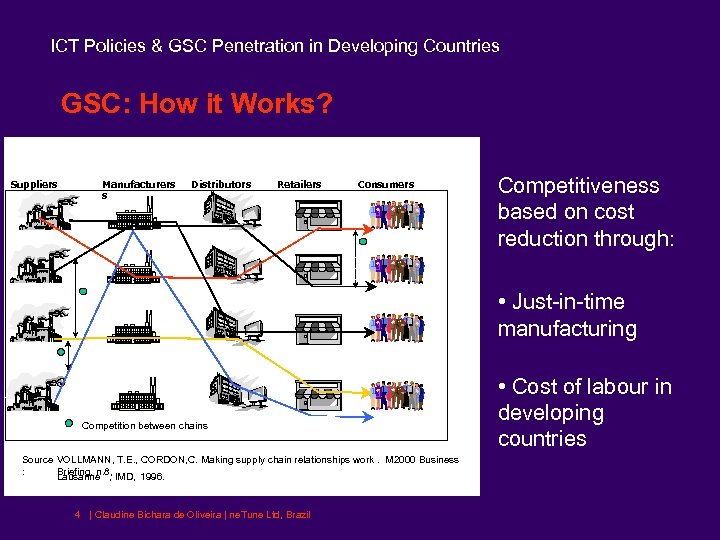
ICT Policies & GSC Penetration in Developing Countries GSC: How it Works? Suppliers Manufacturers s Distributors Retailers Consumers Competitiveness based on cost reduction through: • Just-in-time manufacturing Competition between chains Source VOLLMANN, T. E. , CORDON, C. Making supply chain relationships work. M 2000 Business : Briefing, n. 8, Lausanne , IMD, 1996. 4 | Claudine Bichara de Oliveira | ne. Tune Ltd, Brazil • Cost of labour in developing countries
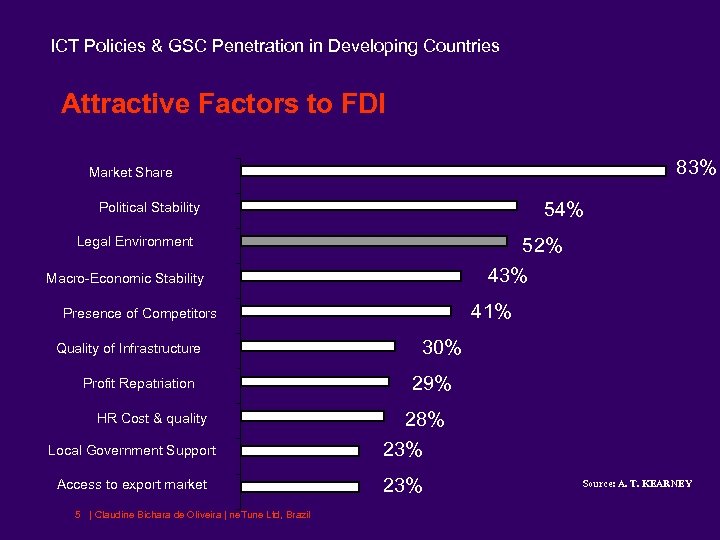
ICT Policies & GSC Penetration in Developing Countries Attractive Factors to FDI 83% Market Share 54% Political Stability Legal Environment 52% 43% Macro-Economic Stability 41% Presence of Competitors Quality of Infrastructure Profit Repatriation HR Cost & quality Local Government Support Access to export market 5 | Claudine Bichara de Oliveira | ne. Tune Ltd, Brazil 30% 29% 28% 23% Source: A. T. KEARNEY
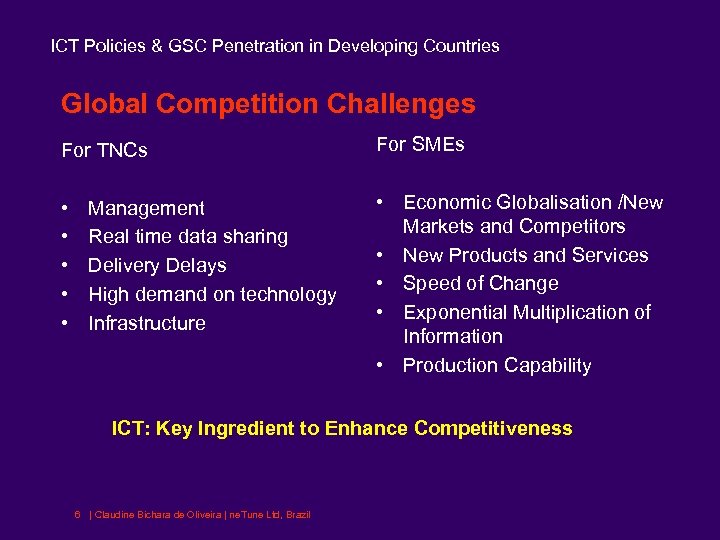
ICT Policies & GSC Penetration in Developing Countries Global Competition Challenges For TNCs For SMEs • • • Economic Globalisation /New Markets and Competitors • New Products and Services • Speed of Change • Exponential Multiplication of Information • Production Capability Management Real time data sharing Delivery Delays High demand on technology Infrastructure ICT: Key Ingredient to Enhance Competitiveness 6 | Claudine Bichara de Oliveira | ne. Tune Ltd, Brazil
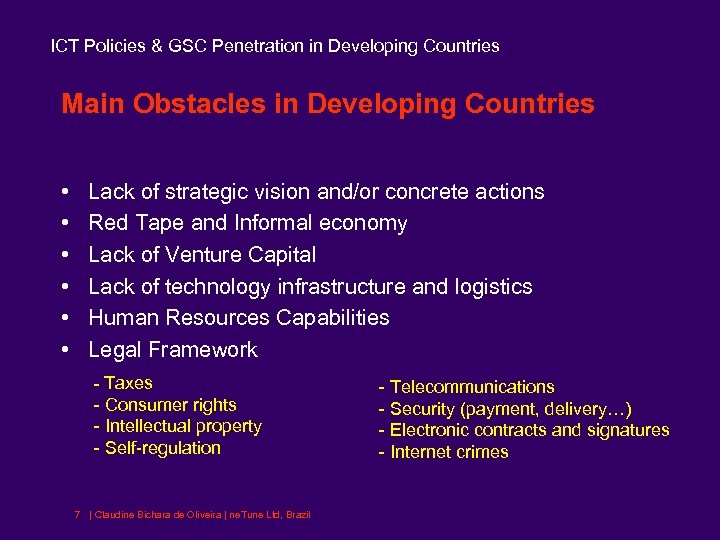
ICT Policies & GSC Penetration in Developing Countries Main Obstacles in Developing Countries • • • Lack of strategic vision and/or concrete actions Red Tape and Informal economy Lack of Venture Capital Lack of technology infrastructure and logistics Human Resources Capabilities Legal Framework - Taxes - Consumer rights - Intellectual property - Self-regulation 7 | Claudine Bichara de Oliveira | ne. Tune Ltd, Brazil - Telecommunications - Security (payment, delivery…) - Electronic contracts and signatures - Internet crimes
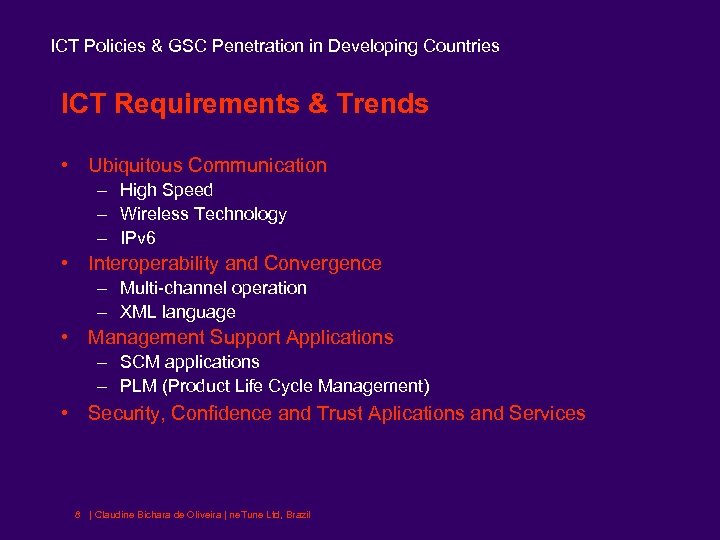
ICT Policies & GSC Penetration in Developing Countries ICT Requirements & Trends • Ubiquitous Communication – High Speed – Wireless Technology – IPv 6 • Interoperability and Convergence – Multi-channel operation – XML language • Management Support Applications – SCM applications – PLM (Product Life Cycle Management) • Security, Confidence and Trust Aplications and Services 8 | Claudine Bichara de Oliveira | ne. Tune Ltd, Brazil
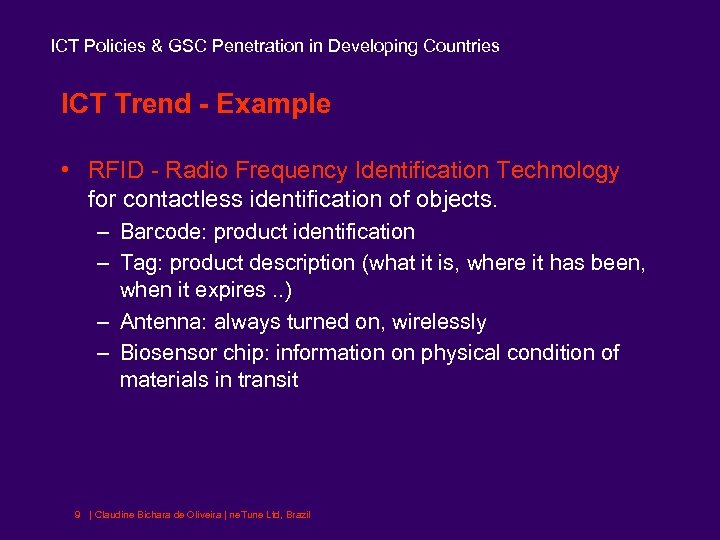
ICT Policies & GSC Penetration in Developing Countries ICT Trend - Example • RFID - Radio Frequency Identification Technology for contactless identification of objects. – Barcode: product identification – Tag: product description (what it is, where it has been, when it expires. . ) – Antenna: always turned on, wirelessly – Biosensor chip: information on physical condition of materials in transit 9 | Claudine Bichara de Oliveira | ne. Tune Ltd, Brazil
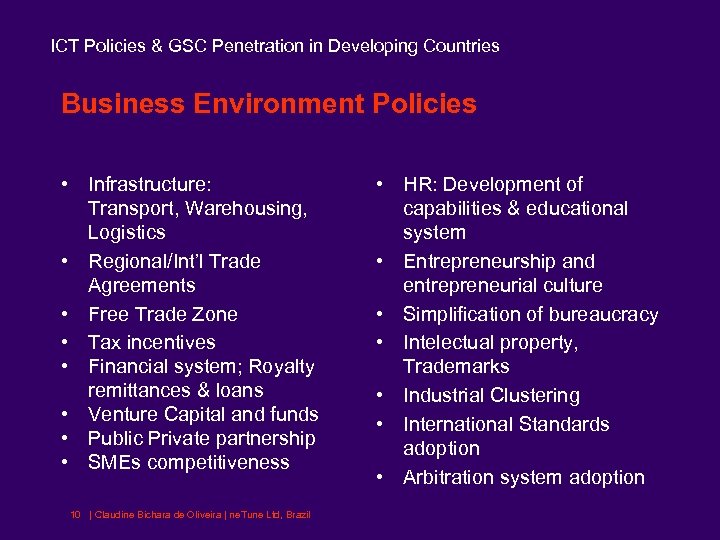
ICT Policies & GSC Penetration in Developing Countries Business Environment Policies • Infrastructure: Transport, Warehousing, Logistics • Regional/Int’l Trade Agreements • Free Trade Zone • Tax incentives • Financial system; Royalty remittances & loans • Venture Capital and funds • Public Private partnership • SMEs competitiveness 10 | Claudine Bichara de Oliveira | ne. Tune Ltd, Brazil • HR: Development of capabilities & educational system • Entrepreneurship and entrepreneurial culture • Simplification of bureaucracy • Intelectual property, Trademarks • Industrial Clustering • International Standards adoption • Arbitration system adoption
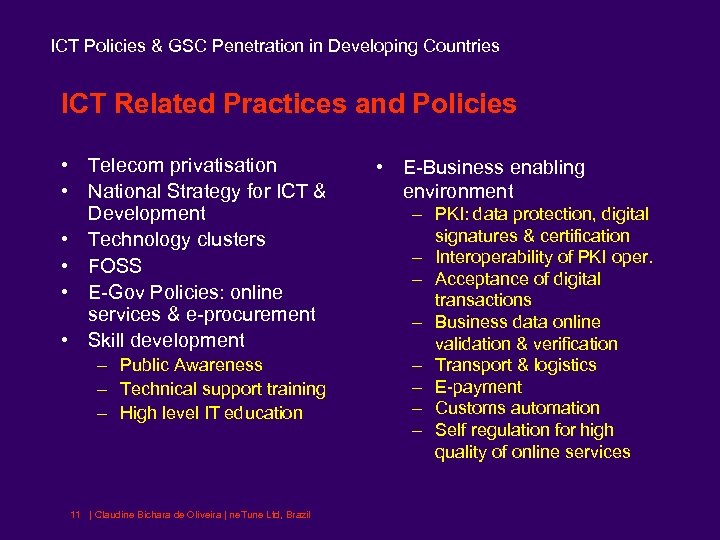
ICT Policies & GSC Penetration in Developing Countries ICT Related Practices and Policies • Telecom privatisation • National Strategy for ICT & Development • Technology clusters • FOSS • E-Gov Policies: online services & e-procurement • Skill development – Public Awareness – Technical support training – High level IT education 11 | Claudine Bichara de Oliveira | ne. Tune Ltd, Brazil • E-Business enabling environment – PKI: data protection, digital signatures & certification – Interoperability of PKI oper. – Acceptance of digital transactions – Business data online validation & verification – Transport & logistics – E-payment – Customs automation – Self regulation for high quality of online services
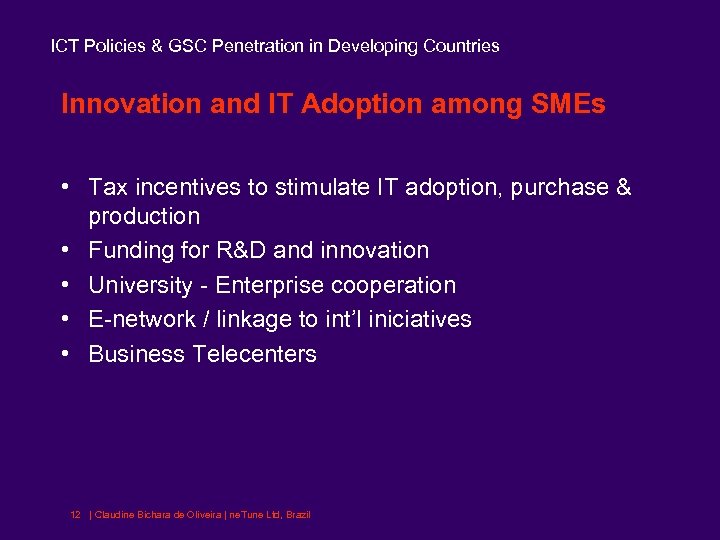
ICT Policies & GSC Penetration in Developing Countries Innovation and IT Adoption among SMEs • Tax incentives to stimulate IT adoption, purchase & production • Funding for R&D and innovation • University - Enterprise cooperation • E-network / linkage to int’l iniciatives • Business Telecenters 12 | Claudine Bichara de Oliveira | ne. Tune Ltd, Brazil
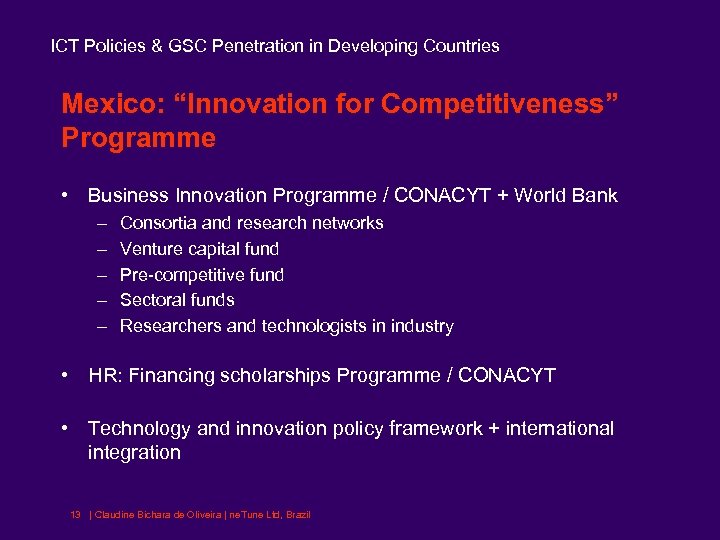
ICT Policies & GSC Penetration in Developing Countries Mexico: “Innovation for Competitiveness” Programme • Business Innovation Programme / CONACYT + World Bank – – – Consortia and research networks Venture capital fund Pre-competitive fund Sectoral funds Researchers and technologists in industry • HR: Financing scholarships Programme / CONACYT • Technology and innovation policy framework + international integration 13 | Claudine Bichara de Oliveira | ne. Tune Ltd, Brazil
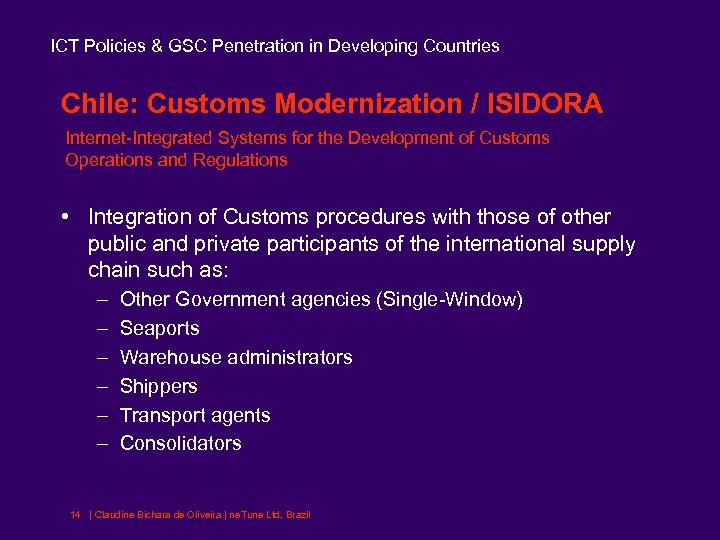
ICT Policies & GSC Penetration in Developing Countries Chile: Customs Modernization / ISIDORA Internet-Integrated Systems for the Development of Customs Operations and Regulations • Integration of Customs procedures with those of other public and private participants of the international supply chain such as: – – – Other Government agencies (Single-Window) Seaports Warehouse administrators Shippers Transport agents Consolidators 14 | Claudine Bichara de Oliveira | ne. Tune Ltd, Brazil
ICT Policies & GSC Penetration in Developing Countries What is Brazil doing ? 15 | Claudine Bichara de Oliveira | ne. Tune Ltd, Brazil
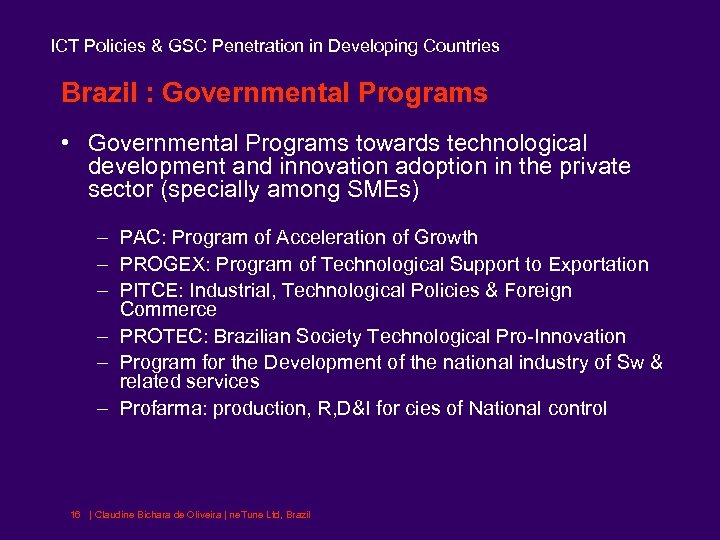
ICT Policies & GSC Penetration in Developing Countries Brazil : Governmental Programs • Governmental Programs towards technological development and innovation adoption in the private sector (specially among SMEs) – PAC: Program of Acceleration of Growth – PROGEX: Program of Technological Support to Exportation – PITCE: Industrial, Technological Policies & Foreign Commerce – PROTEC: Brazilian Society Technological Pro-Innovation – Program for the Development of the national industry of Sw & related services – Profarma: production, R, D&I for cies of National control 16 | Claudine Bichara de Oliveira | ne. Tune Ltd, Brazil
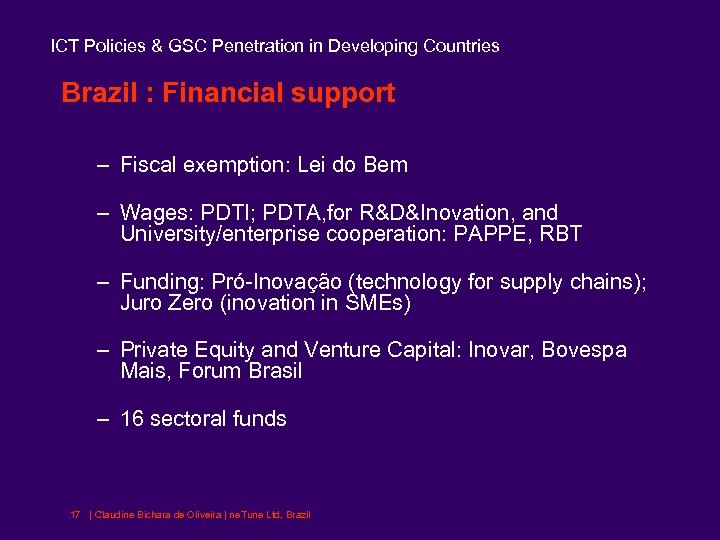
ICT Policies & GSC Penetration in Developing Countries Brazil : Financial support – Fiscal exemption: Lei do Bem – Wages: PDTI; PDTA, for R&D&Inovation, and University/enterprise cooperation: PAPPE, RBT – Funding: Pró-Inovação (technology for supply chains); Juro Zero (inovation in SMEs) – Private Equity and Venture Capital: Inovar, Bovespa Mais, Forum Brasil – 16 sectoral funds 17 | Claudine Bichara de Oliveira | ne. Tune Ltd, Brazil
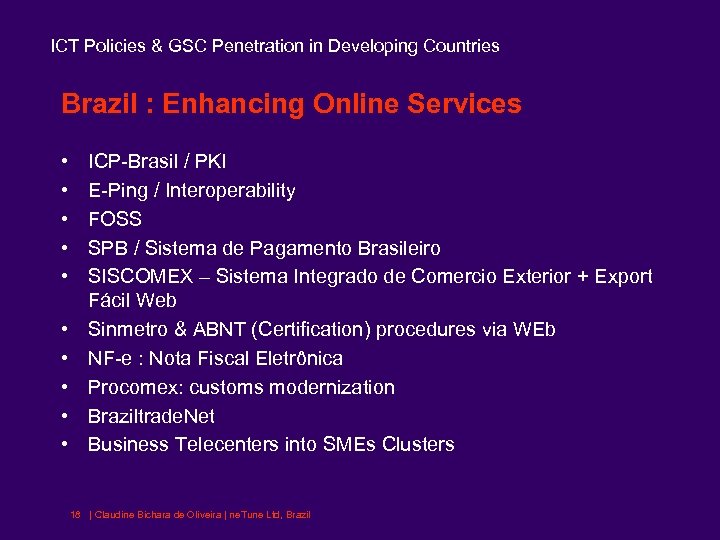
ICT Policies & GSC Penetration in Developing Countries Brazil : Enhancing Online Services • • • ICP-Brasil / PKI E-Ping / Interoperability FOSS SPB / Sistema de Pagamento Brasileiro SISCOMEX – Sistema Integrado de Comercio Exterior + Export Fácil Web Sinmetro & ABNT (Certification) procedures via WEb NF-e : Nota Fiscal Eletrônica Procomex: customs modernization Braziltrade. Net Business Telecenters into SMEs Clusters 18 | Claudine Bichara de Oliveira | ne. Tune Ltd, Brazil
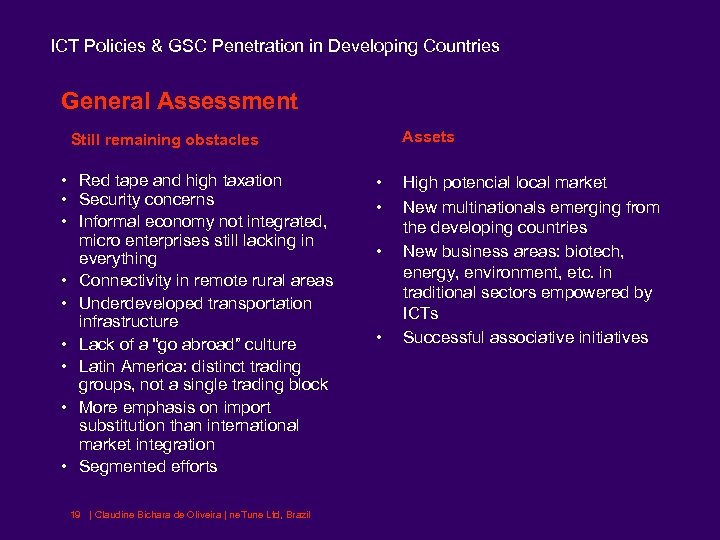
ICT Policies & GSC Penetration in Developing Countries General Assessment Assets Still remaining obstacles • Red tape and high taxation • Security concerns • Informal economy not integrated, micro enterprises still lacking in everything • Connectivity in remote rural areas • Underdeveloped transportation infrastructure • Lack of a “go abroad” culture • Latin America: distinct trading groups, not a single trading block • More emphasis on import substitution than international market integration • Segmented efforts 19 | Claudine Bichara de Oliveira | ne. Tune Ltd, Brazil • • High potencial local market New multinationals emerging from the developing countries New business areas: biotech, energy, environment, etc. in traditional sectors empowered by ICTs Successful associative initiatives
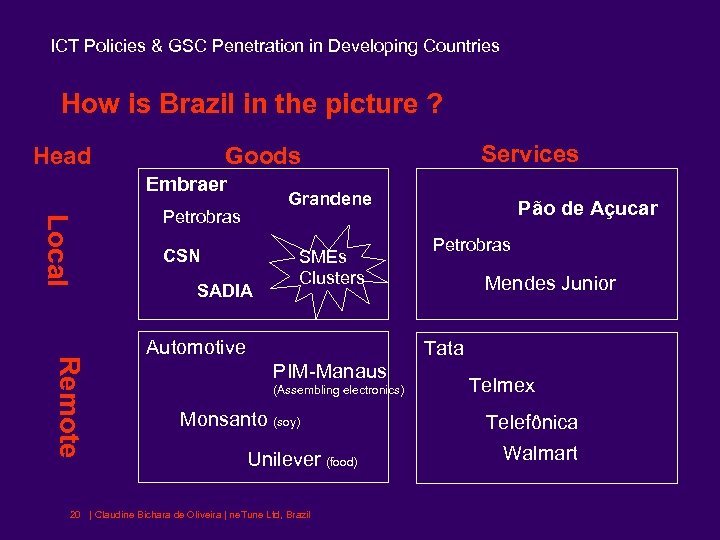
ICT Policies & GSC Penetration in Developing Countries How is Brazil in the picture ? Head Services Goods Embraer Grandene Local Petrobras CSN SADIA SMEs Clusters Remote Automotive Pão de Açucar Petrobras Mendes Junior Tata PIM-Manaus (Assembling electronics) Monsanto (soy) Unilever (food) 20 | Claudine Bichara de Oliveira | ne. Tune Ltd, Brazil Telmex Telefônica Walmart
ICT Policies & GSC Penetration in Developing Countries Role of International Organizations • Situation analysis and strategy definition for e-trade practices • International standards and norms • Research and information exchange with other regions • Capacity building at all levels 21 | Claudine Bichara de Oliveira | ne. Tune Ltd, Brazil
ICT Policies & GSC Penetration in Developing Countries Is the World Flat ? “Globalization has bound people, countries, markets closer than ever, rendering national borders relics of a bygone era – or so we’re told” “[But] In fact, more than 90% of all phone calls, web traffic, and investment is local” “Why the world isn’t Flat”- Pankaj Ghemawat, Harvard Business School Foreign Policy, March-april 2007 pp. 54 -60 “Obviously, the world is not yet flat. …. This is about trend lines and a scale of change brought on by these “flattening” new technologies. Answer from Thomas L. Friedman – “The World is Flat” author Foreign policy, May-June 2007 p. 4 - Letters 22 | Claudine Bichara de Oliveira | ne. Tune Ltd, Brazil
ICT Policies & GSC Penetration in Developing Countries THANK YOU ! claudine@netune. com. br Rio de Janeiro, Brazil Tel/Fax: +55 21 2511 -3129 www. netune. com. br 23 | Claudine Bichara de Oliveira | ne. Tune Ltd, Brazil
Скачать презентацию ICT Policies Global Supply Chain Penetration in
79a644ee27bd82e06a01b70c862d15b8.ppt