 Скачать презентацию ICT in the UK public sector defence market
157dec190a57591ef8f8b23a8beb6c4a.ppt
- Количество слайдов: 29



ICT in the UK public sector defence market March 2007
ICT within the UK Defence market 1. International View UK public sector defence market 1. Structure 2. Key drivers 3. Key initiatives 4. Procurement 5. ICT market forecast 6. ICT outsourcing
International view
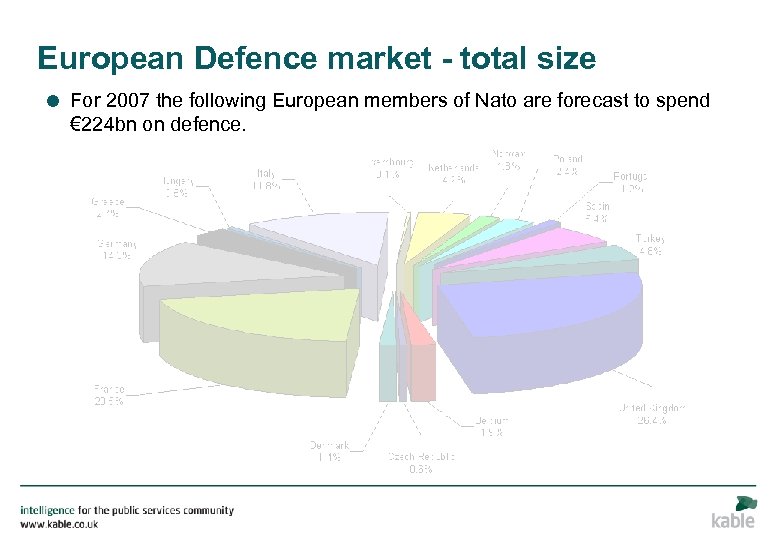
European Defence market - total size = For 2007 the following European members of Nato are forecast to spend € 224 bn on defence.
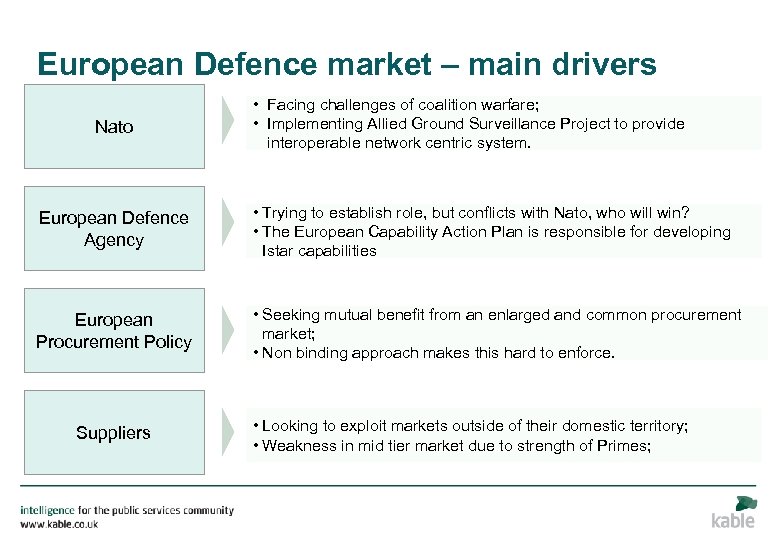
European Defence market – main drivers Nato • Facing challenges of coalition warfare; • Implementing Allied Ground Surveillance Project to provide interoperable network centric system. European Defence Agency • Trying to establish role, but conflicts with Nato, who will win? • The European Capability Action Plan is responsible for developing Istar capabilities European Procurement Policy • Seeking mutual benefit from an enlarged and common procurement market; • Non binding approach makes this hard to enforce. Suppliers • Looking to exploit markets outside of their domestic territory; • Weakness in mid tier market due to strength of Primes;
UK public sector defence market structure
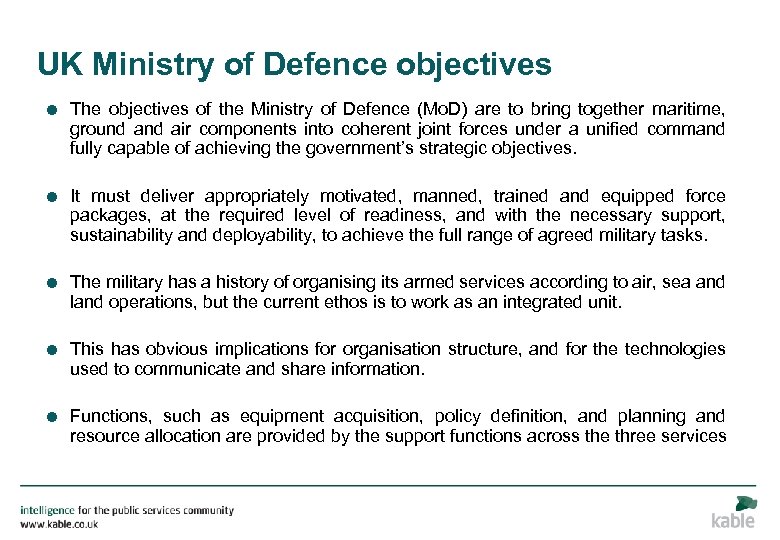
UK Ministry of Defence objectives = The objectives of the Ministry of Defence (Mo. D) are to bring together maritime, ground air components into coherent joint forces under a unified command fully capable of achieving the government’s strategic objectives. = It must deliver appropriately motivated, manned, trained and equipped force packages, at the required level of readiness, and with the necessary support, sustainability and deployability, to achieve the full range of agreed military tasks. = The military has a history of organising its armed services according to air, sea and land operations, but the current ethos is to work as an integrated unit. = This has obvious implications for organisation structure, and for the technologies used to communicate and share information. = Functions, such as equipment acquisition, policy definition, and planning and resource allocation are provided by the support functions across the three services
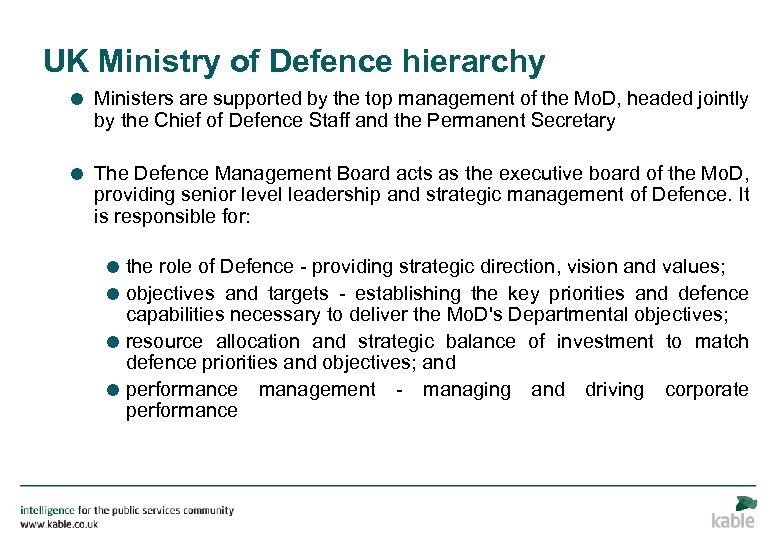
UK Ministry of Defence hierarchy = Ministers are supported by the top management of the Mo. D, headed jointly by the Chief of Defence Staff and the Permanent Secretary = The Defence Management Board acts as the executive board of the Mo. D, providing senior level leadership and strategic management of Defence. It is responsible for: = the role of Defence - providing strategic direction, vision and values; = objectives and targets - establishing the key priorities and defence capabilities necessary to deliver the Mo. D's Departmental objectives; = resource allocation and strategic balance of investment to match defence priorities and objectives; and = performance management - managing and driving corporate performance
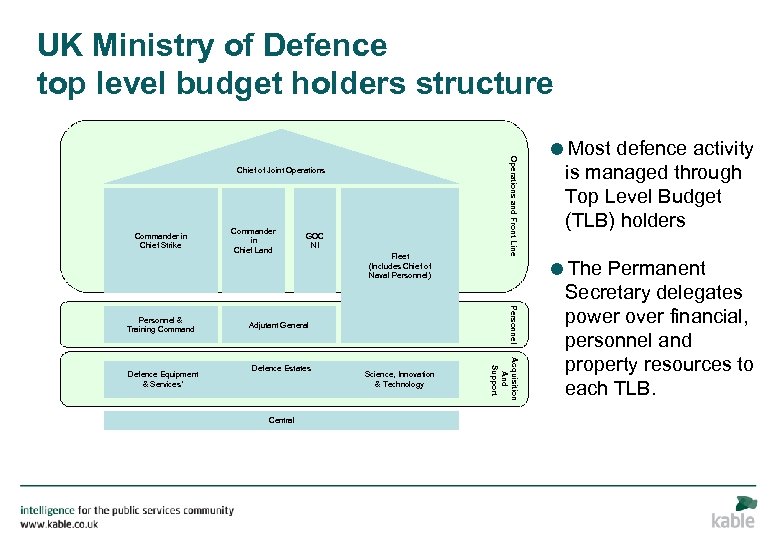
UK Ministry of Defence top level budget holders structure Commander in Chief Strike Fleet (Includes Chief of Naval Personnel) Adjutant General Defence Estates Central Science, Innovation & Technology Acquisition And Support Defence Equipment & Services* GOC NI Personnel & Training Commander in Chief Land Operations and Front Line Chief of Joint Operations =Most defence activity is managed through Top Level Budget (TLB) holders =The Permanent Secretary delegates power over financial, personnel and property resources to each TLB.
UK public sector defence key drivers
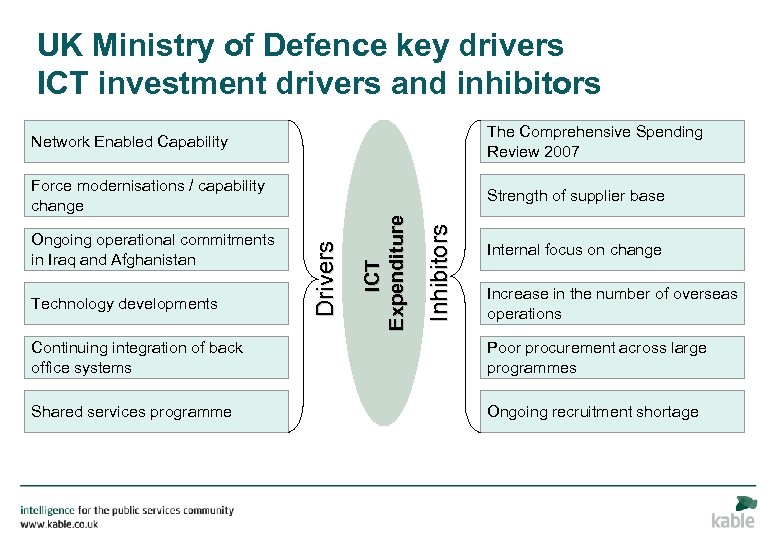
UK Ministry of Defence key drivers ICT investment drivers and inhibitors Strength of supplier base Ongoing operational commitments in Iraq and Afghanistan Technology developments Inhibitors Force modernisations / capability change ICT Expenditure The Comprehensive Spending Review 2007 Drivers Network Enabled Capability Internal focus on change Increase in the number of overseas operations Continuing integration of back office systems Poor procurement across large programmes Shared services programme Ongoing recruitment shortage
UK public sector defence initiatives
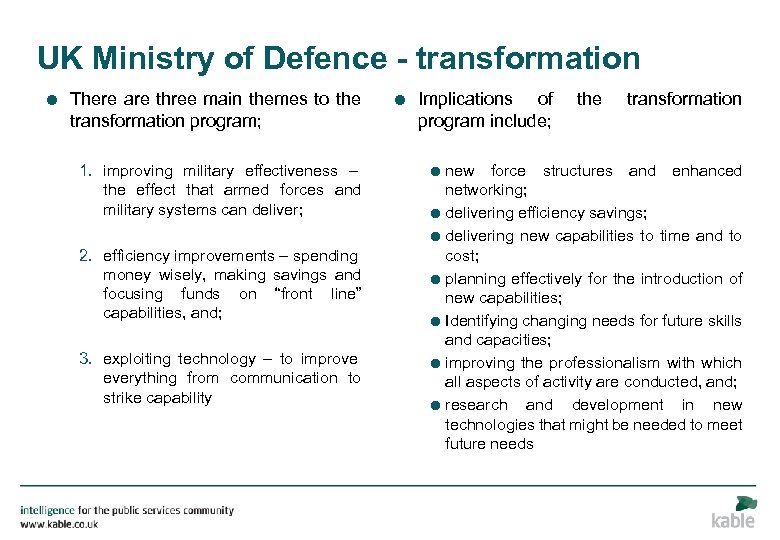
UK Ministry of Defence - transformation = There are three main themes to the transformation program; 1. improving military effectiveness – the effect that armed forces and military systems can deliver; 2. efficiency improvements – spending money wisely, making savings and focusing funds on “front line” capabilities, and; 3. exploiting technology – to improve everything from communication to strike capability = Implications of program include; the transformation = new force structures and enhanced networking; = delivering efficiency savings; = delivering new capabilities to time and to cost; = planning effectively for the introduction of new capabilities; = Identifying changing needs for future skills and capacities; = improving the professionalism with which all aspects of activity are conducted, and; = research and development in new technologies that might be needed to meet future needs
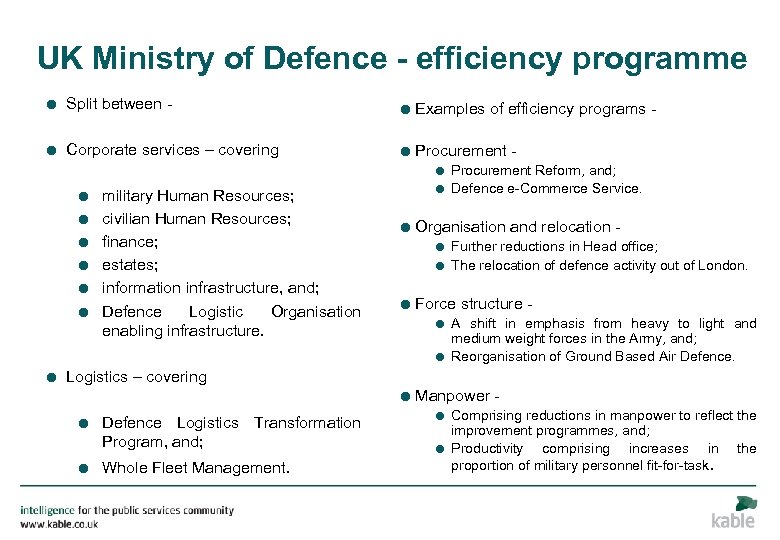
UK Ministry of Defence - efficiency programme = Split between - = Examples of efficiency programs - = Corporate services – covering = Procurement - = = = military Human Resources; civilian Human Resources; finance; estates; information infrastructure, and; Defence Logistic Organisation enabling infrastructure. = Procurement Reform, and; = Defence e-Commerce Service. = Organisation and relocation = Further reductions in Head office; = The relocation of defence activity out of London. = Force structure = A shift in emphasis from heavy to light and medium weight forces in the Army, and; = Reorganisation of Ground Based Air Defence. = Logistics – covering = Manpower = Defence Logistics Transformation Program, and; = Whole Fleet Management. = Comprising reductions in manpower to reflect the improvement programmes, and; = Productivity comprising increases in the proportion of military personnel fit-for-task.
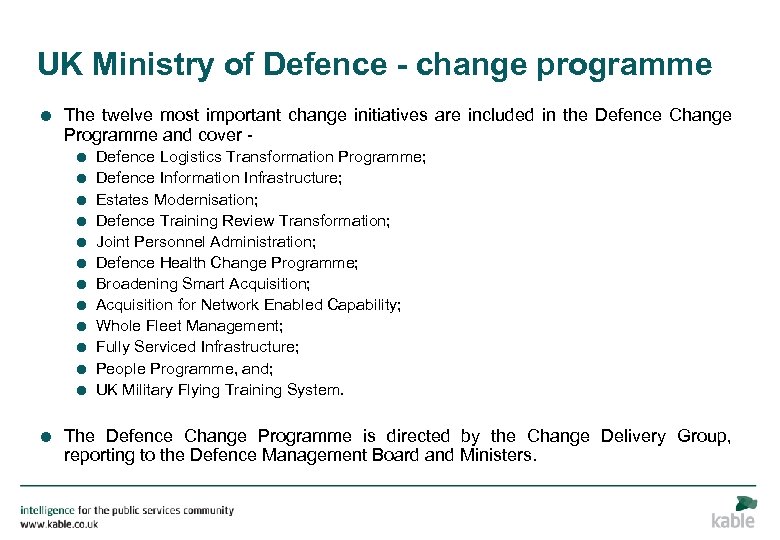
UK Ministry of Defence - change programme = The twelve most important change initiatives are included in the Defence Change Programme and cover = = = Defence Logistics Transformation Programme; Defence Information Infrastructure; Estates Modernisation; Defence Training Review Transformation; Joint Personnel Administration; Defence Health Change Programme; Broadening Smart Acquisition; Acquisition for Network Enabled Capability; Whole Fleet Management; Fully Serviced Infrastructure; People Programme, and; UK Military Flying Training System. = The Defence Change Programme is directed by the Change Delivery Group, reporting to the Defence Management Board and Ministers.
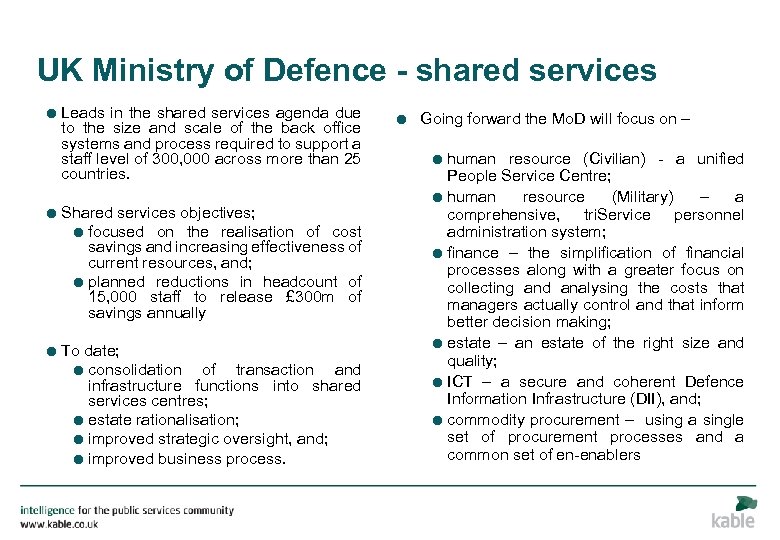
UK Ministry of Defence - shared services = Leads in the shared services agenda due to the size and scale of the back office systems and process required to support a staff level of 300, 000 across more than 25 countries. = Shared services objectives; = focused on the realisation of cost savings and increasing effectiveness of current resources, and; = planned reductions in headcount of 15, 000 staff to release £ 300 m of savings annually = To date; = consolidation of transaction and infrastructure functions into shared services centres; = estate rationalisation; = improved strategic oversight, and; = improved business process. = Going forward the Mo. D will focus on – = human resource (Civilian) - a unified People Service Centre; = human resource (Military) – a comprehensive, tri. Service personnel administration system; = finance – the simplification of financial processes along with a greater focus on collecting and analysing the costs that managers actually control and that inform better decision making; = estate – an estate of the right size and quality; = ICT – a secure and coherent Defence Information Infrastructure (DII), and; = commodity procurement – using a single set of procurement processes and a common set of en-enablers
UK public sector defence procurement
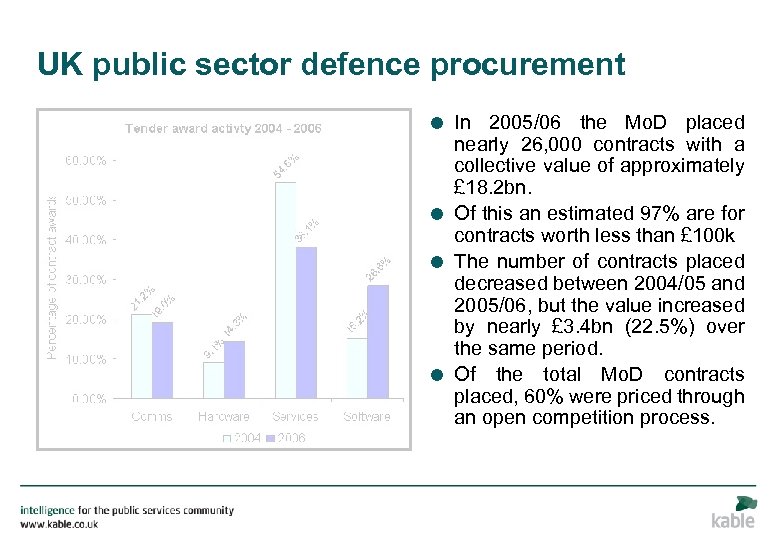
UK public sector defence procurement = In 2005/06 the Mo. D placed nearly 26, 000 contracts with a collective value of approximately £ 18. 2 bn. = Of this an estimated 97% are for contracts worth less than £ 100 k = The number of contracts placed decreased between 2004/05 and 2005/06, but the value increased by nearly £ 3. 4 bn (22. 5%) over the same period. = Of the total Mo. D contracts placed, 60% were priced through an open competition process.
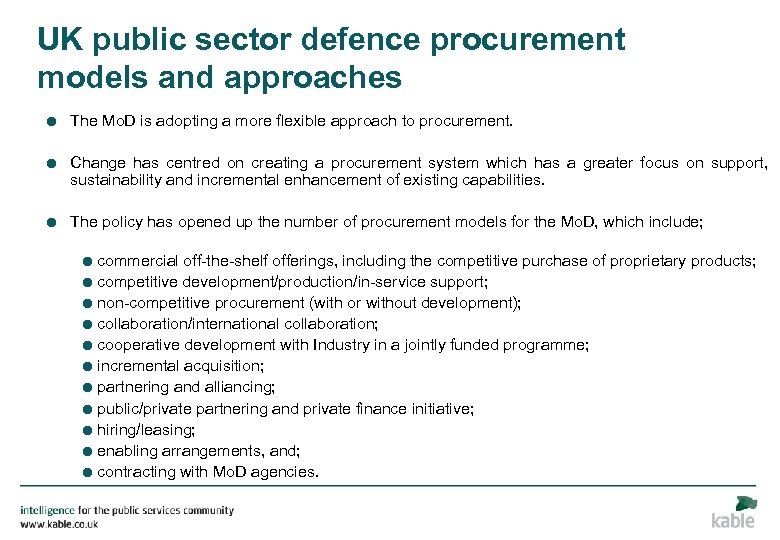
UK public sector defence procurement models and approaches = The Mo. D is adopting a more flexible approach to procurement. = Change has centred on creating a procurement system which has a greater focus on support, sustainability and incremental enhancement of existing capabilities. = The policy has opened up the number of procurement models for the Mo. D, which include; = commercial off-the-shelf offerings, including the competitive purchase of proprietary products; = competitive development/production/in-service support; = non-competitive procurement (with or without development); = collaboration/international collaboration; = cooperative development with Industry in a jointly funded programme; = incremental acquisition; = partnering and alliancing; = public/private partnering and private finance initiative; = hiring/leasing; = enabling arrangements, and; = contracting with Mo. D agencies.
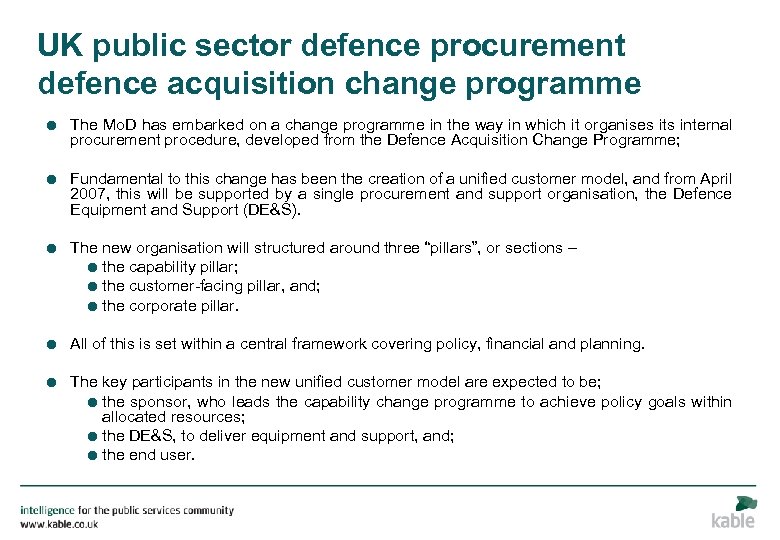
UK public sector defence procurement defence acquisition change programme = The Mo. D has embarked on a change programme in the way in which it organises its internal procurement procedure, developed from the Defence Acquisition Change Programme; = Fundamental to this change has been the creation of a unified customer model, and from April 2007, this will be supported by a single procurement and support organisation, the Defence Equipment and Support (DE&S). = The new organisation will structured around three “pillars”, or sections – = the capability pillar; = the customer-facing pillar, and; = the corporate pillar. = All of this is set within a central framework covering policy, financial and planning. = The key participants in the new unified customer model are expected to be; = the sponsor, who leads the capability change programme to achieve policy goals within allocated resources; = the DE&S, to deliver equipment and support, and; = the end user.
UK public sector defence ICT market forecast
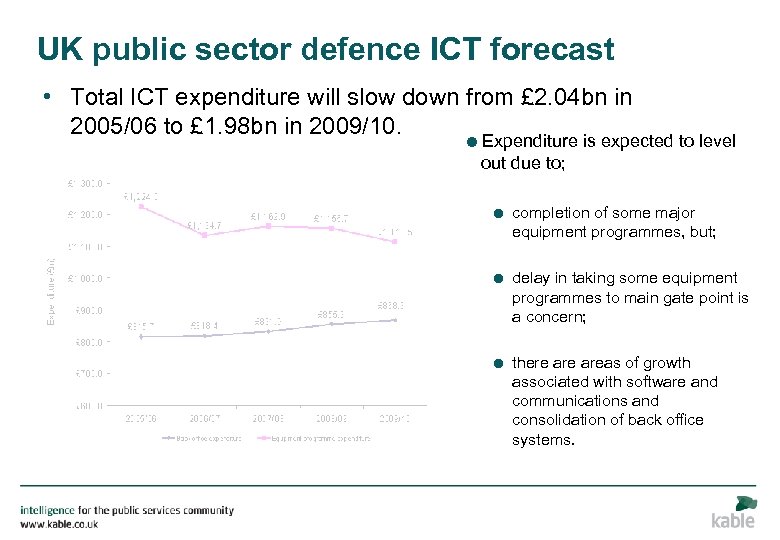
UK public sector defence ICT forecast • Total ICT expenditure will slow down from £ 2. 04 bn in 2005/06 to £ 1. 98 bn in 2009/10. =Expenditure is expected to level out due to; = completion of some major equipment programmes, but; = delay in taking some equipment programmes to main gate point is a concern; = there areas of growth associated with software and communications and consolidation of back office systems.
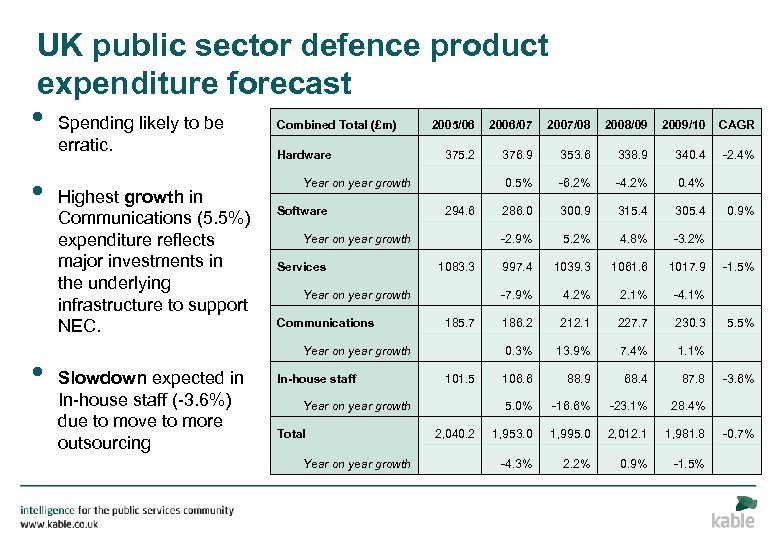
UK public sector defence product expenditure forecast • • • Spending likely to be erratic. Highest growth in Communications (5. 5%) expenditure reflects major investments in the underlying infrastructure to support NEC. Combined Total (£m) Hardware 2005/06 2006/07 2007/08 2008/09 2009/10 CAGR 375. 2 376. 9 353. 6 338. 9 340. 4 -2. 4% 0. 5% -6. 2% -4. 2% 0. 4% 286. 0 300. 9 315. 4 305. 4 -2. 9% 5. 2% 4. 8% -3. 2% 997. 4 1039. 3 1061. 6 1017. 9 -7. 9% 4. 2% 2. 1% -4. 1% 186. 2 212. 1 227. 7 230. 3% 13. 9% 7. 4% 1. 1% 106. 6 88. 9 68. 4 87. 8 5. 0% -16. 6% -23. 1% 28. 4% 1, 953. 0 1, 995. 0 2, 012. 1 1, 981. 8 -4. 3% 2. 2% 0. 9% -1. 5% Year on year growth Software 294. 6 Year on year growth Services 1083. 3 Year on year growth Communications 185. 7 Year on year growth Slowdown expected in In-house staff (-3. 6%) due to move to more outsourcing In-house staff 101. 5 Year on year growth Total Year on year growth 2, 040. 2 0. 9% -1. 5% 5. 5% -3. 6% -0. 7%
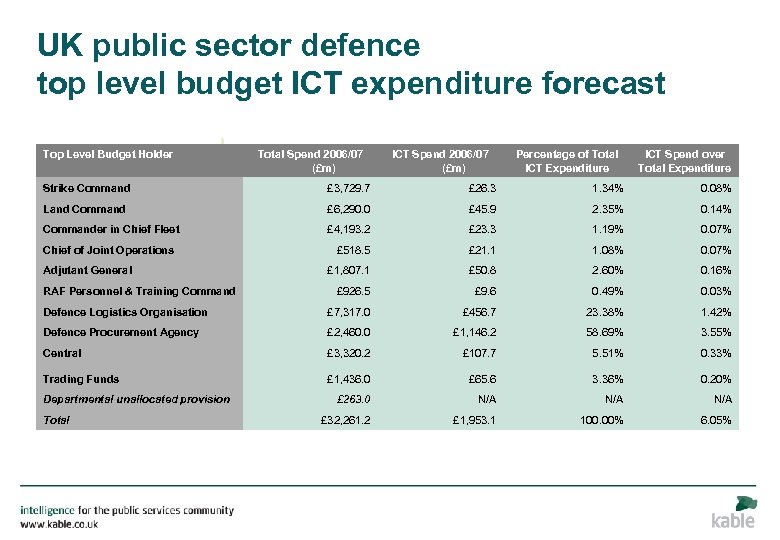
UK public sector defence top level budget ICT expenditure forecast Top Level Budget Holder Total Spend 2006/07 (£m) ICT Spend 2006/07 (£m) Percentage of Total ICT Expenditure ICT Spend over Total Expenditure Strike Command £ 3, 729. 7 £ 26. 3 1. 34% 0. 08% Land Command £ 6, 290. 0 £ 45. 9 2. 35% 0. 14% Commander in Chief Fleet £ 4, 193. 2 £ 23. 3 1. 19% 0. 07% £ 518. 5 £ 21. 1 1. 08% 0. 07% £ 1, 807. 1 £ 50. 8 2. 60% 0. 16% £ 926. 5 £ 9. 6 0. 49% 0. 03% Defence Logistics Organisation £ 7, 317. 0 £ 456. 7 23. 38% 1. 42% Defence Procurement Agency £ 2, 460. 0 £ 1, 146. 2 58. 69% 3. 55% Central £ 3, 320. 2 £ 107. 7 5. 51% 0. 33% Trading Funds £ 1, 436. 0 £ 65. 6 3. 36% 0. 20% £ 263. 0 N/A N/A £ 32, 261. 2 £ 1, 953. 1 100. 00% 6. 05% Chief of Joint Operations Adjutant General RAF Personnel & Training Command Departmental unallocated provision Total
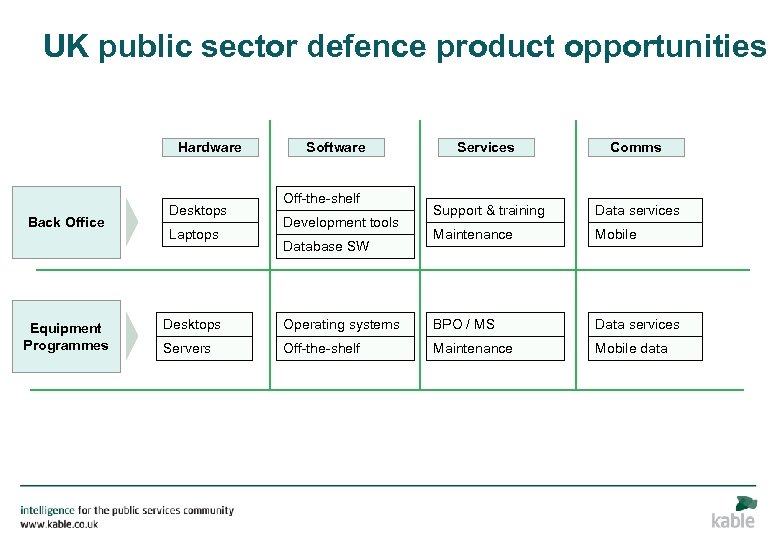
UK public sector defence product opportunities Hardware Back Office Equipment Programmes Desktops Laptops Software Off-the-shelf Development tools Database SW Services Comms Support & training Data services Maintenance Mobile Desktops Operating systems BPO / MS Data services Servers Off-the-shelf Maintenance Mobile data
UK public sector defence ICT outsourcing
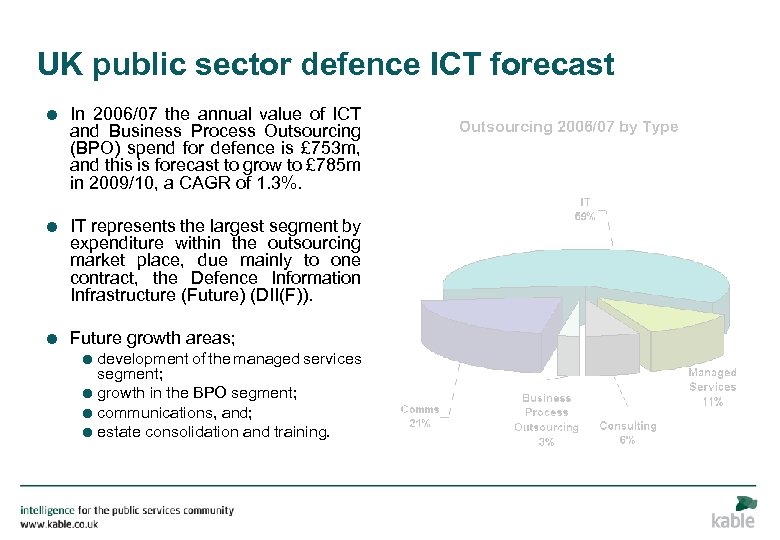
UK public sector defence ICT forecast = In 2006/07 the annual value of ICT and Business Process Outsourcing (BPO) spend for defence is £ 753 m, and this is forecast to grow to £ 785 m in 2009/10, a CAGR of 1. 3%. = IT represents the largest segment by expenditure within the outsourcing market place, due mainly to one contract, the Defence Information Infrastructure (Future) (DII(F)). = Future growth areas; = development of the managed services segment; = growth in the BPO segment; = communications, and; = estate consolidation and training.
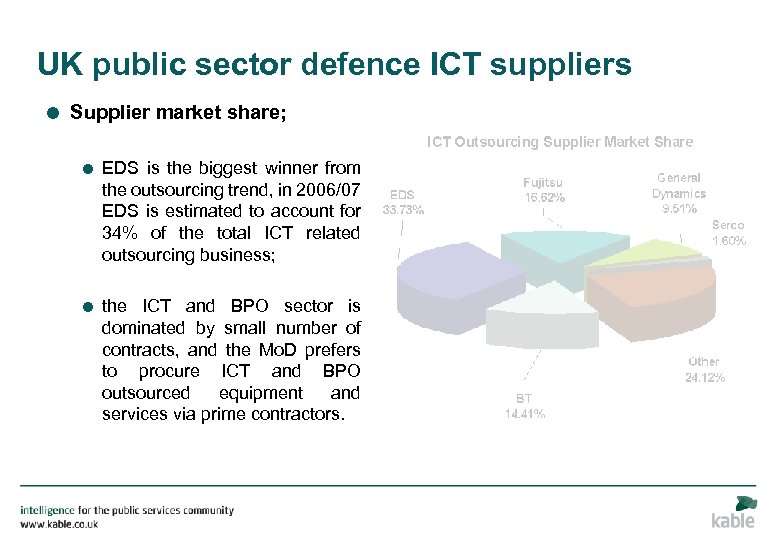
UK public sector defence ICT suppliers = Supplier market share; = EDS is the biggest winner from the outsourcing trend, in 2006/07 EDS is estimated to account for 34% of the total ICT related outsourcing business; = the ICT and BPO sector is dominated by small number of contracts, and the Mo. D prefers to procure ICT and BPO outsourced equipment and services via prime contractors.
Since 1990, Kable has been helping ICT businesses to prosper in the public sector arena and assisting public servants to make informed decisions about their ICT-related business strategy. In a market which accounts for 30% of total UK ICT spend, Kable's public sector focus can help you navigate to success. We enable our clients to get the right message, to the right people, at the right time and place. Our expertise will help you to accelerate your business development, to focus on the right opportunities and to get the best return on your resources. Kable’s value is built on the range of its engagement with the public sector. Kable has longstanding working relationships with government, renowned analyst and consultant expertise, and an unrivalled exposure to public servants via thousands of interviews and the full range of media. Kable's end-to-end services range from consultancy, to in-depth market intelligence, to publishing, with the industry-leading GC magazine (formerly Government Computing), and events. Gain a competitive edge through working with the market leader. Kable's expertise and experience have made it the trusted advisor and route to market: 17 of the top 20 suppliers to government use Kable services. The company’s client list includes the likes of IBM, Microsoft, BT, Accenture and Dell, as well as top government organisations. Kable is an accredited Catalist supplier. Kable Ltd 20 – 24 Kirby Street London EC 1 N 8 TS Tel: +44 (0) 20 7061 3251
Скачать презентацию ICT in the UK public sector defence market
157dec190a57591ef8f8b23a8beb6c4a.ppt