


 Скачать презентацию ICT and Power Electricity Prof Rahul Tongia School
fc6cf2320ea09d21c9df3927206c9776.ppt
- Количество слайдов: 44
 ICT and Power (Electricity) Prof. Rahul Tongia School of Computer Science CMU 17 -899 Fall 2003 Rahul Tongia, CMU
 Topics for Discussion n Electricity and Development Power for ICT for Power Rahul Tongia, CMU 2
 Fundamentals n n Electricity is a form of energy (k. Wh) Does not exist in usable forms n Conversion usually requires prime movers (steam turbines, water turbines, etc. ) n n Access to fuels (primary energy) is a key issue for developing countries Electricity is only about 125 years old n Widespread use is much more recent n US required special programs n n n Rural Electrification Administration (REA) [now Rural Utilities Service] TVA Electricity from the grid can not be easily stored (AC) n Most electronics use DC Rahul Tongia, CMU 3
 What’s Special about LDCs? n Very low levels of Electrification n 2 billion+ lack electricity Bad quality, intermittent, and often expensive power if available Lower Level of Economic Development n Large rural agricultural sector n n Large quantities of crop residues: primary energy source Special needs for agricultural services (e. g. , pumping water ~ 1/3 of India’s electricity) Heavily subsidized in many countries Industrial-Political Organization n State-centered economies n n State-owned enterprises (SOEs) handle not just power but much of the economy Weak formal institutions n Rahul Tongia, E. g. , CMU regulatory institutions, courts, corporate governance 4
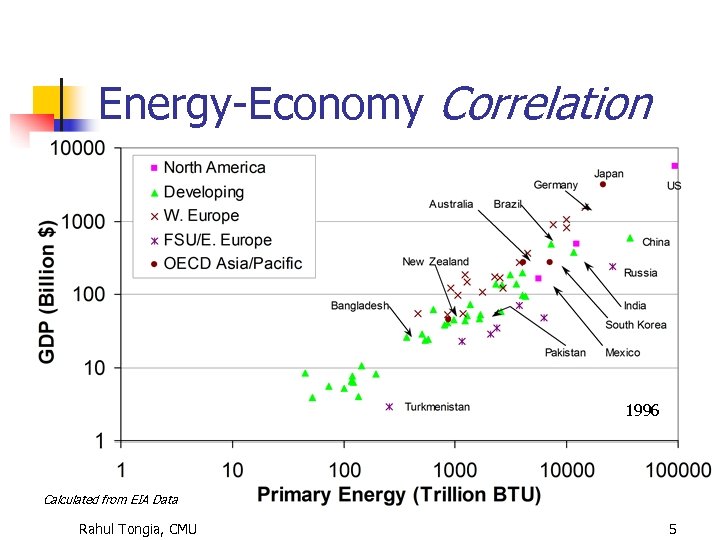 Energy-Economy Correlation 1996 Calculated from EIA Data Rahul Tongia, CMU 5
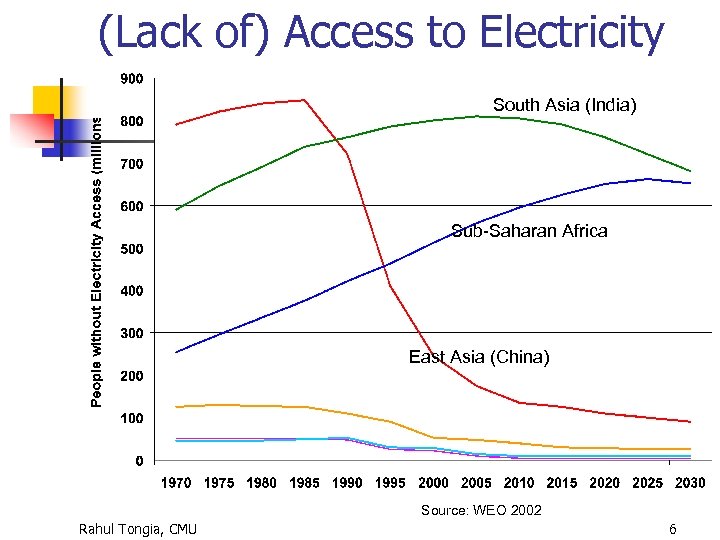 (Lack of) Access to Electricity South Asia (India) Sub-Saharan Africa East Asia (China) Source: WEO 2002 Rahul Tongia, CMU 6
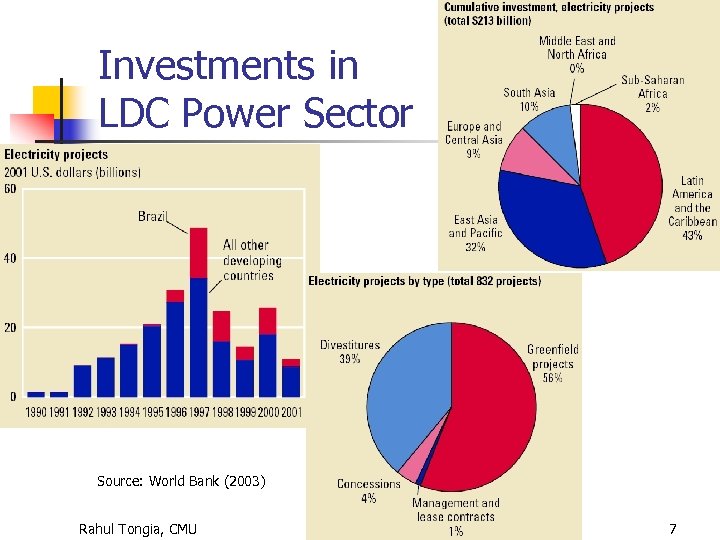 Investments in LDC Power Sector Source: World Bank (2003) Rahul Tongia, CMU 7
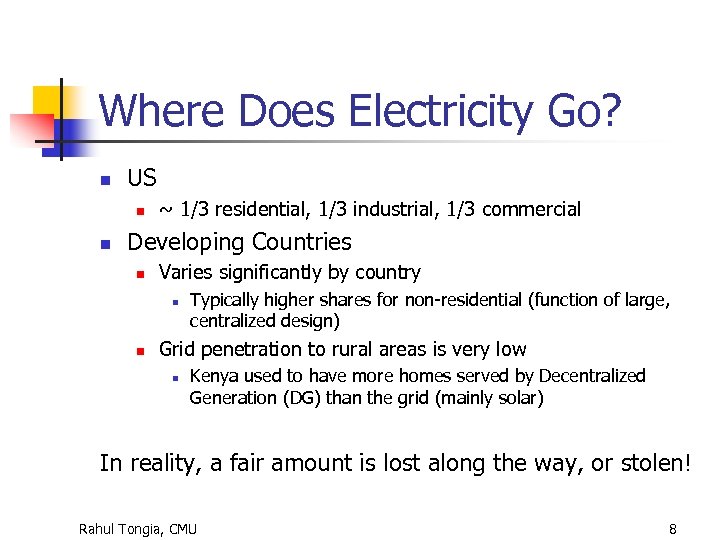 Where Does Electricity Go? n US n n ~ 1/3 residential, 1/3 industrial, 1/3 commercial Developing Countries n Varies significantly by country n n Typically higher shares for non-residential (function of large, centralized design) Grid penetration to rural areas is very low n Kenya used to have more homes served by Decentralized Generation (DG) than the grid (mainly solar) In reality, a fair amount is lost along the way, or stolen! Rahul Tongia, CMU 8
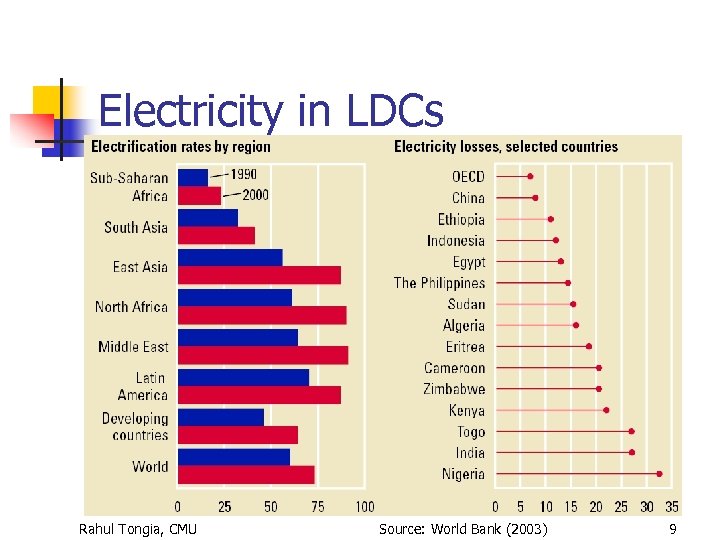 Electricity in LDCs Rahul Tongia, CMU Source: World Bank (2003) 9
 How Much Electricity Does ICT Use? n Numbers as high as 13% of US electricity were claimed n n n End users, servers, networking, etc. Later debunked ICT – Energy (Power) linkages n n Greater Service Economy, even in developing countries But, increased globalization Rahul Tongia, CMU 10
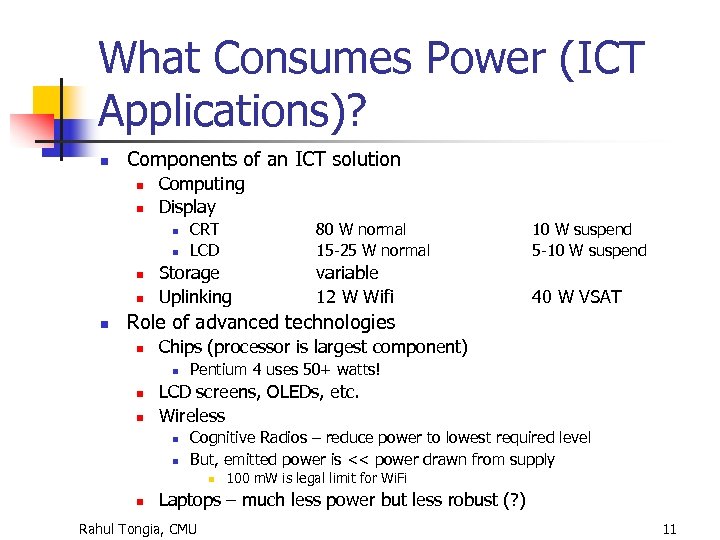 What Consumes Power (ICT Applications)? n Components of an ICT solution n n Computing Display n n n CRT LCD 80 W normal 15 -25 W normal Storage Uplinking 10 W suspend 5 -10 W suspend variable 12 W Wifi 40 W VSAT Role of advanced technologies n Chips (processor is largest component) n n n Pentium 4 uses 50+ watts! LCD screens, OLEDs, etc. Wireless n n Cognitive Radios – reduce power to lowest required level But, emitted power is << power drawn from supply n n 100 m. W is legal limit for Wi. Fi Laptops – much less power but less robust (? ) Rahul Tongia, CMU 11
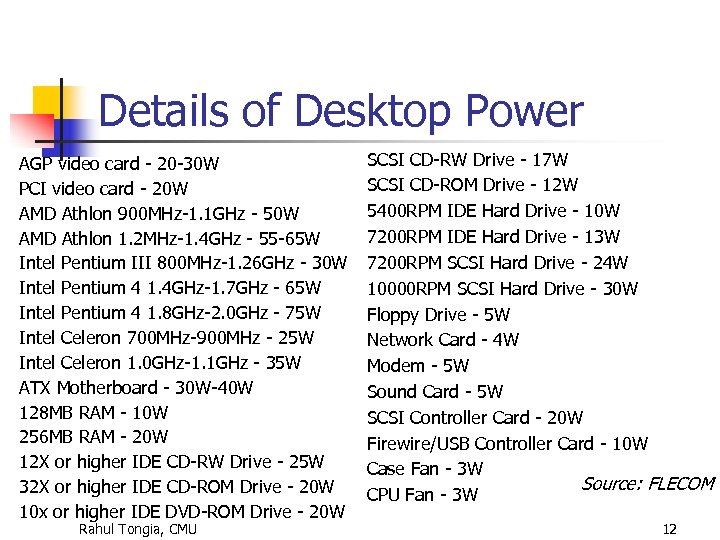 Details of Desktop Power AGP video card - 20 -30 W PCI video card - 20 W AMD Athlon 900 MHz-1. 1 GHz - 50 W AMD Athlon 1. 2 MHz-1. 4 GHz - 55 -65 W Intel Pentium III 800 MHz-1. 26 GHz - 30 W Intel Pentium 4 1. 4 GHz-1. 7 GHz - 65 W Intel Pentium 4 1. 8 GHz-2. 0 GHz - 75 W Intel Celeron 700 MHz-900 MHz - 25 W Intel Celeron 1. 0 GHz-1. 1 GHz - 35 W ATX Motherboard - 30 W-40 W 128 MB RAM - 10 W 256 MB RAM - 20 W 12 X or higher IDE CD-RW Drive - 25 W 32 X or higher IDE CD-ROM Drive - 20 W 10 x or higher IDE DVD-ROM Drive - 20 W Rahul Tongia, CMU SCSI CD-RW Drive - 17 W SCSI CD-ROM Drive - 12 W 5400 RPM IDE Hard Drive - 10 W 7200 RPM IDE Hard Drive - 13 W 7200 RPM SCSI Hard Drive - 24 W 10000 RPM SCSI Hard Drive - 30 W Floppy Drive - 5 W Network Card - 4 W Modem - 5 W Sound Card - 5 W SCSI Controller Card - 20 W Firewire/USB Controller Card - 10 W Case Fan - 3 W Source: FLECOM CPU Fan - 3 W 12
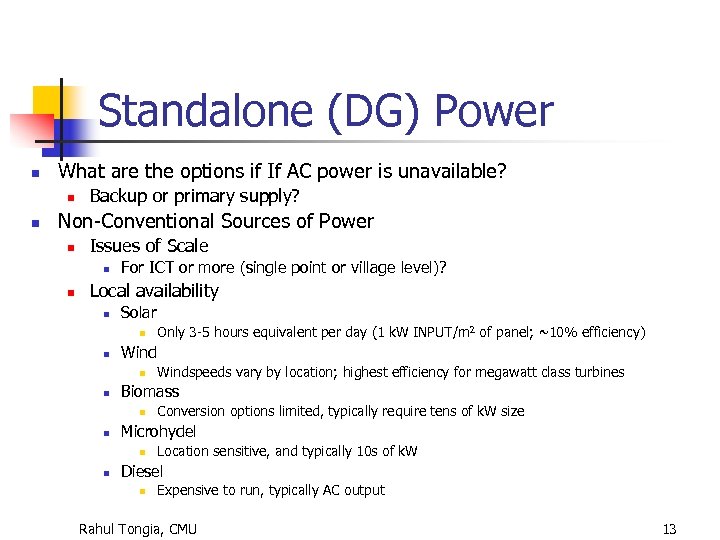 Standalone (DG) Power n What are the options if If AC power is unavailable? n n Backup or primary supply? Non-Conventional Sources of Power n Issues of Scale n n For ICT or more (single point or village level)? Local availability n Solar n n Wind n n Conversion options limited, typically require tens of k. W size Microhydel n n Windspeeds vary by location; highest efficiency for megawatt class turbines Biomass n n Only 3 -5 hours equivalent per day (1 k. W INPUT/m 2 of panel; ~10% efficiency) Location sensitive, and typically 10 s of k. W Diesel n Expensive to run, typically AC output Rahul Tongia, CMU 13
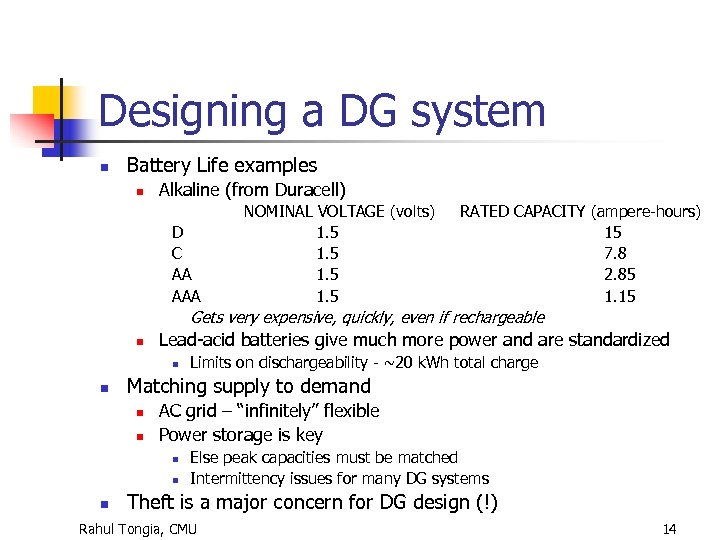 Designing a DG system n Battery Life examples n Alkaline (from Duracell) D C AA AAA NOMINAL VOLTAGE (volts) 1. 5 RATED CAPACITY (ampere-hours) 15 7. 8 2. 85 1. 15 Gets very expensive, quickly, even if rechargeable n Lead-acid batteries give much more power and are standardized n n Matching supply to demand n n AC grid – “infinitely” flexible Power storage is key n n n Limits on dischargeability - ~20 k. Wh total charge Else peak capacities must be matched Intermittency issues for many DG systems Theft is a major concern for DG design (!) Rahul Tongia, CMU 14
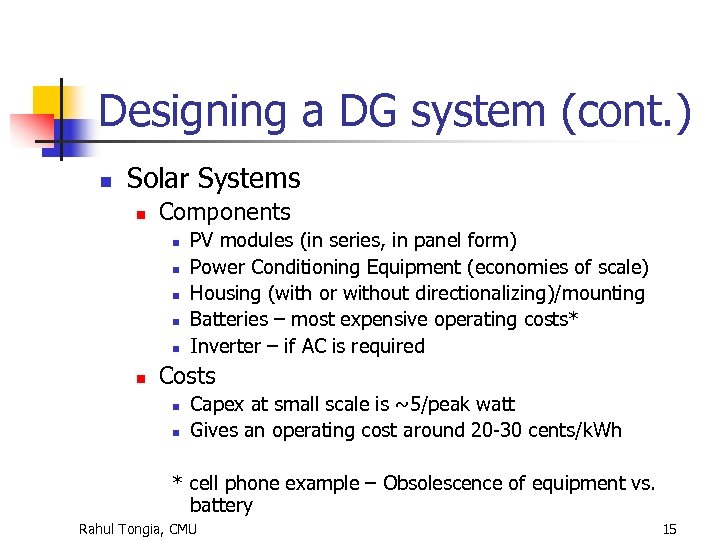 Designing a DG system (cont. ) n Solar Systems n Components n n n PV modules (in series, in panel form) Power Conditioning Equipment (economies of scale) Housing (with or without directionalizing)/mounting Batteries – most expensive operating costs* Inverter – if AC is required Costs n n Capex at small scale is ~5/peak watt Gives an operating cost around 20 -30 cents/k. Wh * cell phone example – Obsolescence of equipment vs. battery Rahul Tongia, CMU 15
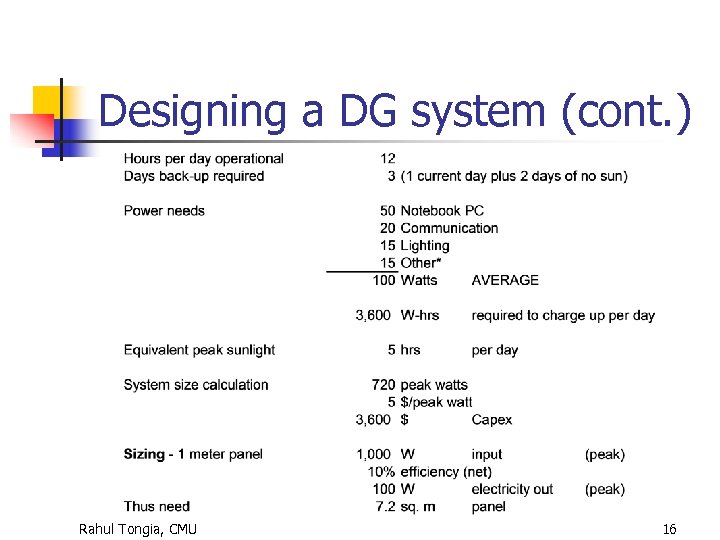 Designing a DG system (cont. ) Rahul Tongia, CMU 16
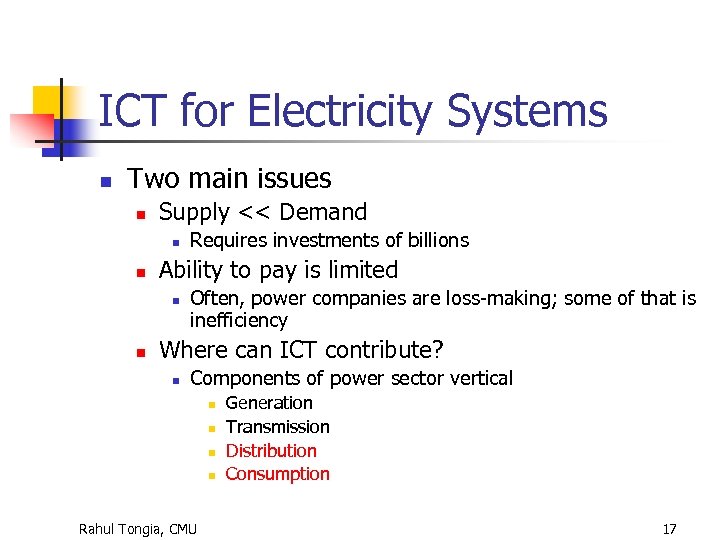 ICT for Electricity Systems n Two main issues n Supply << Demand n n Ability to pay is limited n n Requires investments of billions Often, power companies are loss-making; some of that is inefficiency Where can ICT contribute? n Components of power sector vertical n n Rahul Tongia, CMU Generation Transmission Distribution Consumption 17
 Conventional Wisdom n One can not do real-time power flow management (transactions and billing) for transmission level flows n n Today, pools operate based on historical or aggregated information One can not measure demand (usage) from all consumers in real-time with high granularity What has changed to make these outdated – the growth of IT technology Rahul Tongia, CMU 18
 Focus here on Distribution/Consumption n n IT is already extensively used in generation/transmission in developed countries Other Synergies n n Stringing Optical Fibers along power lines Smart Cards (pre-payment) n n Found extensive use in S. Africa in Black Townships (12 years experience) Can link to other utilities or consumer services (pre-paid cell-phone cards are very popular) Rahul Tongia, CMU 19
 Using IT to Enable Sustainability n Sustainability has many components n Resource utilization n n Economic viability n n n Efficiency and loss reduction are sine-qui-non Theft reduction Management IT can improve power sector distribution, consumption (utilization), and quality of service n Requires a change in mindset, and the willingness of utilities to innovate Rahul Tongia, CMU 20
 Case study on IT for power sector improvement in India today has the world’s largest number of persons lacking electricity n n 400 million (equivalent to Africa’s unserved!) Reforms began in 1991 n n n Vertically integrated government department monopolies are being broken Initial focus was on generation New realization that distribution is the key to India’s power sector viability n Newer entities should be run as businesses Many parallels to other developing countries Rahul Tongia, CMU 21
 India’s Power Sector Overview n 5 th largest in the world – 107, 000+ MW of capacity n But, per capita consumption is very low n n n 350 k. Wh, vs. world average over 2, 000 k. Wh 40% of households (60% of rural HH) lack electricity In very dire straits n Supply << Demand n n n Blackouts are common, with shortfall estimated between 10 -15% Most utilities are heavily loss-making, with an average rate of return of negative 30% or worse (on asset base) High levels of losses = 25+% n n Technical losses – poor design and operation Commercial losses (aka theft) often over 10% Rahul Tongia, CMU 22
 Reasons for the problems n Agricultural sector n n Consumes 1/3 of the power, provides <5% of revenues Pumpsets are overwhelmingly unmetered – just pay flat rate based on pump size n n Adds to uncertainty in technical losses vs. commercial losses and usage Utilities lack load duration curves to optimize generation and utilize Demand Side Management n All generation is assumed to be baseload, and priced accordingly n n n Leads to poor energy supply portfolio Doesn’t send correct signals to consumers, either Utilities end up using just average costing numbers, not recognizing the marginal costs Rahul Tongia, CMU 23
 Idea – use IT for power sector management n Posit – If new meters are to be installed, why not “smart” digital meters, which are also controllable, and communications-enabled? n n n Incremental costs would be low Instead of just quantity of power, can also improve quality of power Analysis presented is based on collaborative work with a major utility in India (name withheld for confidentiality reasons) Rahul Tongia, CMU 24
 Quality of Power n India is focusing on quantity of power only n Current “shortfall” numbers are contrived n n Quality norms are often missed n n Based only on loadshedding with minor correction for frequency Do no factor in peak clipping fully Do not account for lack of access (e. g. , over 60% of rural homes lack connections) Voltage – often deviates by 25+% Frequency – often deviates by 5% (!) Even farmers pay a lot for their bad quality power (around 1 cent/k. Wh implicit, even higher in some regions) Use of voltage stabilizing equipment n n Additional capital costs (in the multiple percent range) Efficiency losses (2 -30% lost!) Rahul Tongia, CMU 25
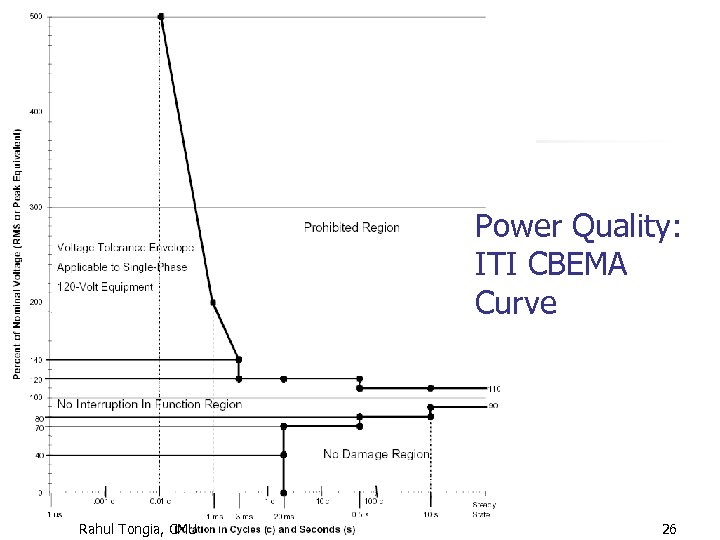 Power Quality: ITI CBEMA Curve Rahul Tongia, CMU 26
 Why the Focus on Distribution? n n It’s where the consumer (and hence, revenue) is High losses today n n n Technical losses, 10+ % in rural areas DSM and efficiency measures possible Use of standards required n n n Use a combination of technology, industrial partnership, and regulations Learn from experiences elsewhere Bulk of India's consumption is for just several classes of devices n n Rahul Tongia, CMU Pumpsets Refrigerators Synchronous motors Heating (? ) 27
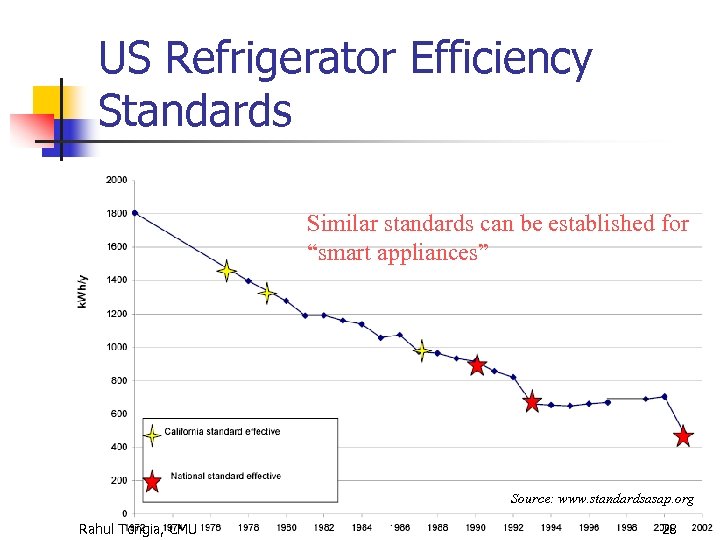 US Refrigerator Efficiency Standards Similar standards can be established for “smart appliances” Source: www. standardsasap. org Rahul Tongia, CMU 28
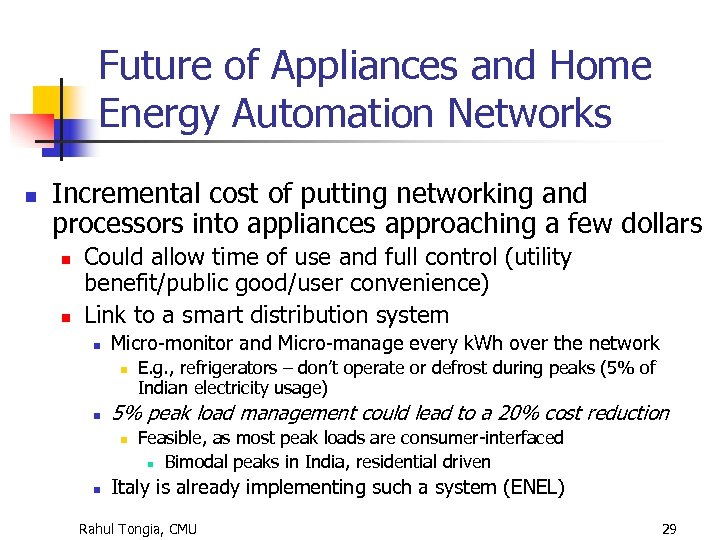 Future of Appliances and Home Energy Automation Networks n Incremental cost of putting networking and processors into appliances approaching a few dollars n n Could allow time of use and full control (utility benefit/public good/user convenience) Link to a smart distribution system n Micro-monitor and Micro-manage every k. Wh over the network n n 5% peak load management could lead to a 20% cost reduction n n E. g. , refrigerators – don’t operate or defrost during peaks (5% of Indian electricity usage) Feasible, as most peak loads are consumer-interfaced n Bimodal peaks in India, residential driven Italy is already implementing such a system (ENEL) Rahul Tongia, CMU 29
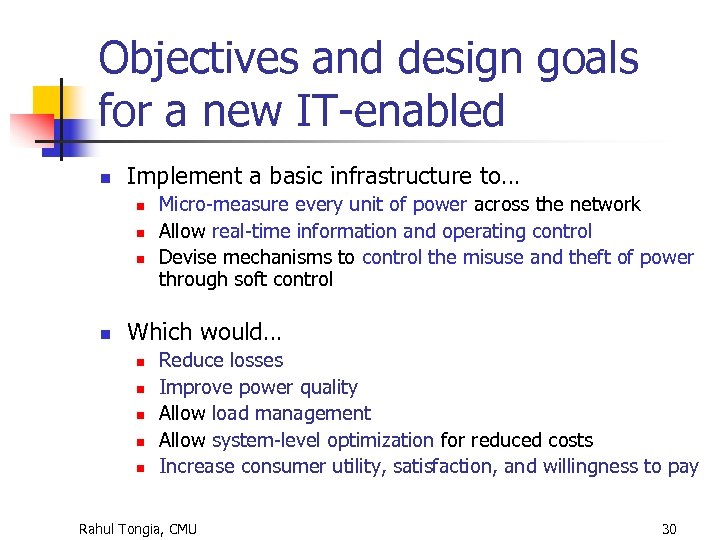 Objectives and design goals for a new IT-enabled n Implement a basic infrastructure to… n n Micro-measure every unit of power across the network Allow real-time information and operating control Devise mechanisms to control the misuse and theft of power through soft control Which would… n n n Reduce losses Improve power quality Allow load management Allow system-level optimization for reduced costs Increase consumer utility, satisfaction, and willingness to pay Rahul Tongia, CMU 30
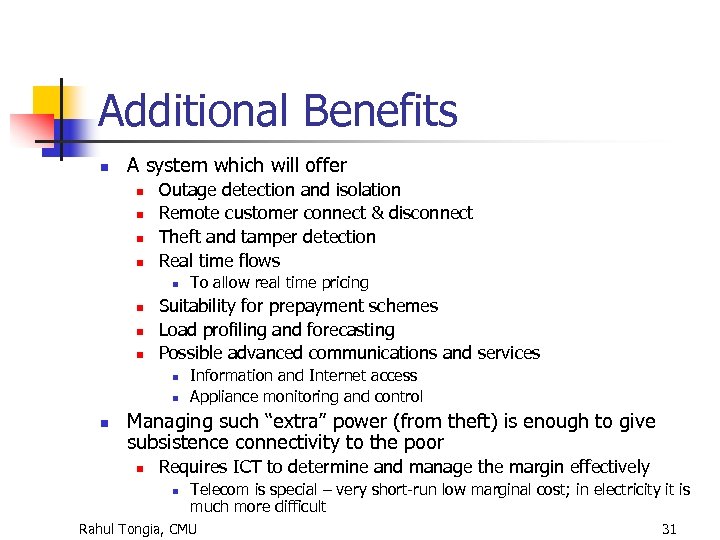 Additional Benefits n A system which will offer n n Outage detection and isolation Remote customer connect & disconnect Theft and tamper detection Real time flows n n Suitability for prepayment schemes Load profiling and forecasting Possible advanced communications and services n n n To allow real time pricing Information and Internet access Appliance monitoring and control Managing such “extra” power (from theft) is enough to give subsistence connectivity to the poor n Requires ICT to determine and manage the margin effectively n Telecom is special – very short-run low marginal cost; in electricity it is much more difficult Rahul Tongia, CMU 31
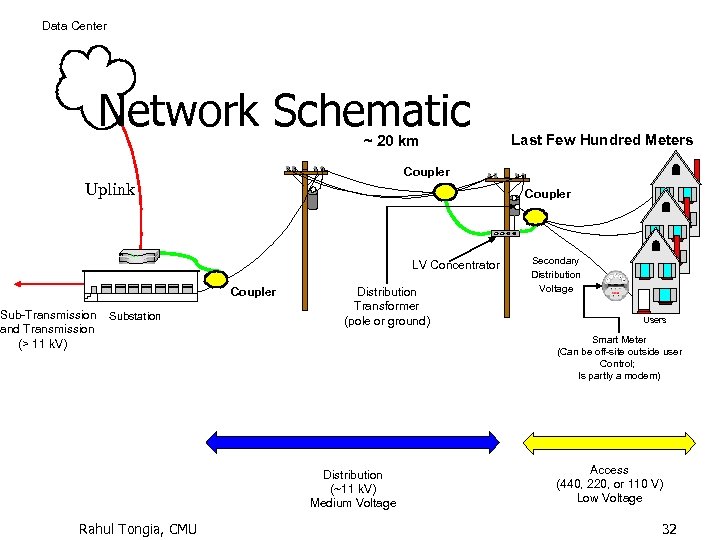 Data Center Network Schematic ~ 20 km Coupler r Uplink Last Few Hundred Meters Coupler House LV Concentrator Coupler Sub-Transmission and Transmission (> 11 k. V) Substation Distribution Transformer (pole or ground) House Users Smart Meter (Can be off-site outside user Control; Is partly a modem) Distribution (~11 k. V) Medium Voltage Rahul Tongia, CMU Secondary Distribution Voltage Access (440, 220, or 110 V) Low Voltage 32
 Components of the solution n One segmentation – locational n At consumer n Meter/Gateway n n In home network n n n Meter could be pole-side if required Needed connect to enabled devices (appliances) Eventually, homes would also have Decentralized Generation available (? fuel cells, flywheel storage, etc. ) Access (low voltage distribution) n From gateway to a concentrator, on user side of distribution transformers – Using Power. Line Carrier (PLC) Rahul Tongia, CMU 33
 Solution Components (Cont. ) n Concentrator upwards n n Concentrator – Each Distribution Transformer (aka Low Voltage Transformer) feeds on the order of 100 -200 homes in India (as in Europe). In contrast, US Distribution Transformers feed 5 -10 users. Communications medium n Over Medium Voltage PLC to the Sub-station or n n Wireless n Limited Coverage in Developing Countries Substation upwards (uplinking) n Usually based on leased lines or optical fiber Rahul Tongia, CMU 34
 Technologies for various segments n In-Home Network n Appliances n n n Emerging Standards are talked about by appliance companies (Maytag, Samsung, GE, Ariston etc. ) Using Simple Control Protocol (or other appropriate “thin” protocols) Meters n n n Solid-State meters exist, but not yet the norm in developing countries Most have communications capabilities for external ports Lowest cost solution (if feasible) – PLC – target 5$ incremental cost Rahul Tongia, CMU 35
 Technologies for various segments (cont. ) n Access n n n MV n n n Low Voltage PLC is available today Being explored for Internet access, in fact (Megabits per second) Crossing through transformers remains a technical challenge Going long distances an issue Uplinking n Availability of optical fiber or leased lines can be met through planning Rahul Tongia, CMU 36
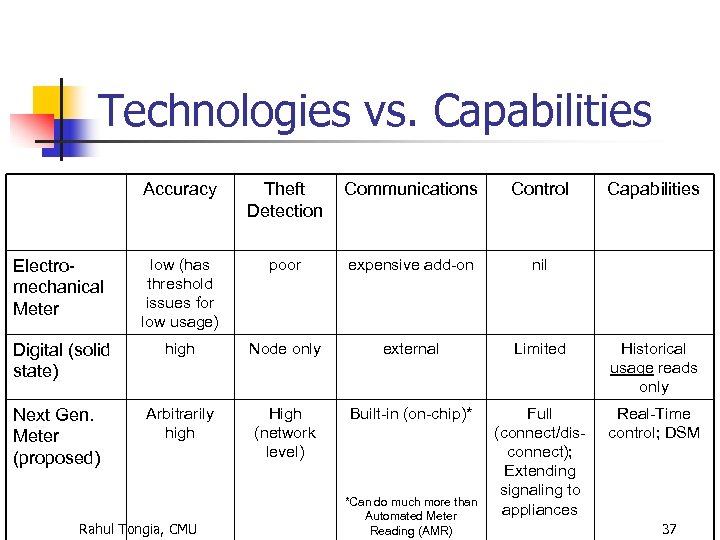 Technologies vs. Capabilities Accuracy Theft Detection Communications Control Electromechanical Meter low (has threshold issues for low usage) poor expensive add-on nil Digital (solid state) high Node only external Limited Historical usage reads only Arbitrarily high High (network level) Built-in (on-chip)* Full (connect/disconnect); Extending signaling to appliances Real-Time control; DSM Next Gen. Meter (proposed) Rahul Tongia, CMU *Can do much more than Automated Meter Reading (AMR) Capabilities 37
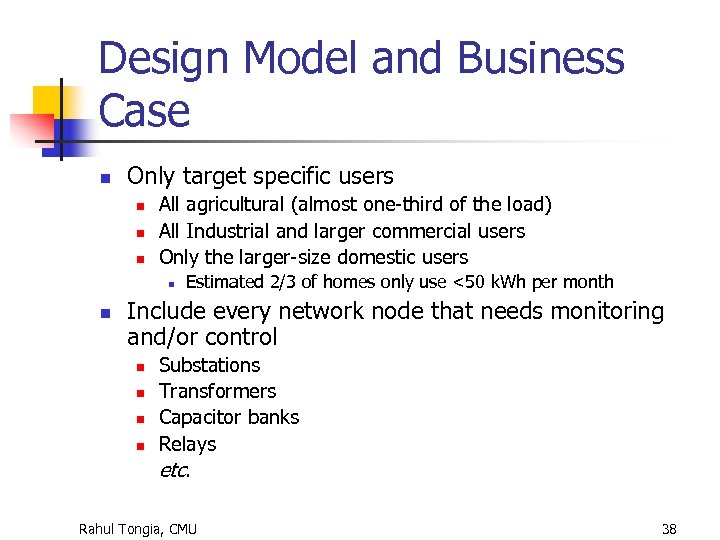 Design Model and Business Case n Only target specific users n n n All agricultural (almost one-third of the load) All Industrial and larger commercial users Only the larger-size domestic users n n Estimated 2/3 of homes only use <50 k. Wh per month Include every network node that needs monitoring and/or control n n Substations Transformers Capacitor banks Relays etc. Rahul Tongia, CMU 38
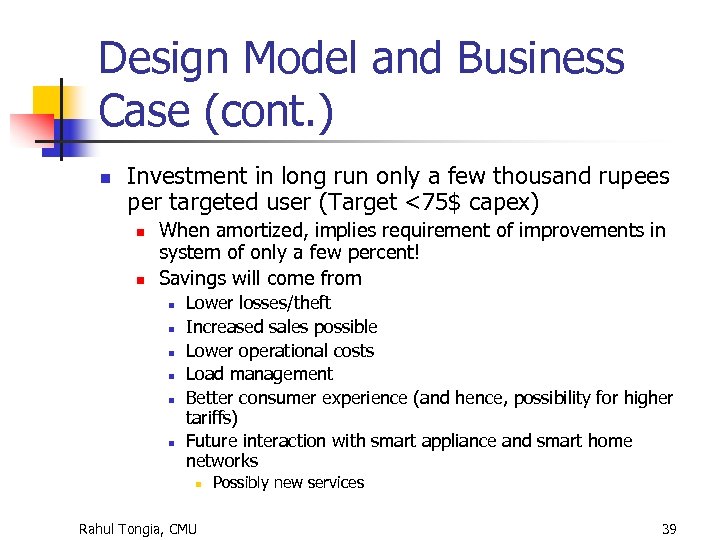 Design Model and Business Case (cont. ) n Investment in long run only a few thousand rupees per targeted user (Target <75$ capex) n n When amortized, implies requirement of improvements in system of only a few percent! Savings will come from n n n Lower losses/theft Increased sales possible Lower operational costs Load management Better consumer experience (and hence, possibility for higher tariffs) Future interaction with smart appliance and smart home networks n Rahul Tongia, CMU Possibly new services 39
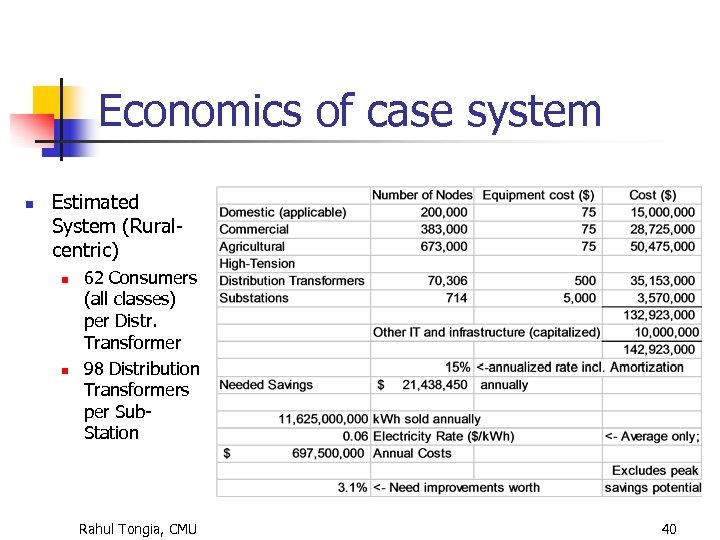 Economics of case system n Estimated System (Ruralcentric) n n 62 Consumers (all classes) per Distr. Transformer 98 Distribution Transformers per Sub. Station Rahul Tongia, CMU 40
 Economics (cont. ) n n 6 -7 year payback on investment (conservative) possible with just 3% improvement in system Savings will come from n n Theft Reduction Time-of-Day and DSM measures (peak reduction) System Quality, reliability, and uptime Higher Collection Rahul Tongia, CMU 41
 Challenges n Protocols n n n PLC n n n How to couple around transformers or other obstacles How to go long runs with low errors (and high enough bandwidth) – Shannon’s theorem provides a limit Noisy line conditions in many developing countries Appliances n n Use of thin protocols to reduce capex for embedded systems Security – PLC can be a shared medium Need for standards to bring down costs and ensure inter-operability Design – Should the PLC signals pass through the meter/gateway directly to appliances? How active or passive should consumer behavior modification be? Costs (as always) Rahul Tongia, CMU 42
 Challenges – Implementation and Management n n Utilities are typically risk-averse They face increased regulatory uncertainty n n n Without some portions of a market, how do they benefit? Will they (should they) pass all pricing information on to the consumer? Developing country management issues n n Utilities were typically State Owned Enterprises (SOEs) Utilities were run with social engineering goals n Increased automation, control, and sophistication (and theft detection) poses risks to the large cadre of current employees Rahul Tongia, CMU 43
 A New World for Power Systems n n Includes “smarts” for significant improvements in efficiency New services can be enabled once the appropriate infrastructure is in place Segmentation of development allows independent, modular innovation, e. g. , home automation and appliances Developing countries (esp. Asia) can lead the way through leap-frogging Rahul Tongia, CMU 44