


 Скачать презентацию ICNRG Meeting IETF-84 August 1 st 2012
f5116474aaaaca49ec2f320d47706476.ppt
- Количество слайдов: 27
 ICNRG Meeting @ IETF-84, August 1 st, 2012 REBOOK: a Network Resource Booking Algorithm draft-montessoro-rebook-00 Pier Luca Montessoro, Riccardo Bernardini montessoro@uniud. it, riccardo. bernardini@uniud. it Multimedia Networking and Applications lab DIEGM - University of Udine, Italy
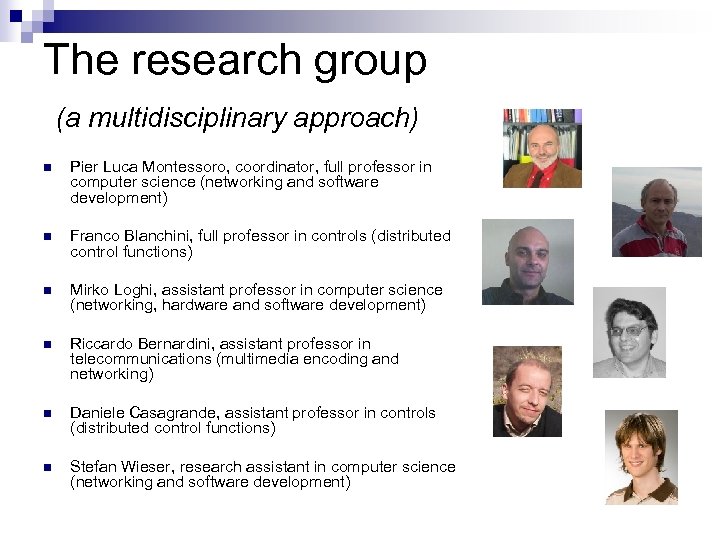 The research group (a multidisciplinary approach) n Pier Luca Montessoro, coordinator, full professor in computer science (networking and software development) n Franco Blanchini, full professor in controls (distributed control functions) n Mirko Loghi, assistant professor in computer science (networking, hardware and software development) n Riccardo Bernardini, assistant professor in telecommunications (multimedia encoding and networking) n Daniele Casagrande, assistant professor in controls (distributed control functions) n Stefan Wieser, research assistant in computer science (networking and software development)
 Our possible contribution to ICN n ICN can benefit from congestion- and flow-controlled transport of objects from a given location to the interested receiver n REBOOK provides deterministic, dynamic and scalable resource reservation maximum delivery time for generic NDOs ® adequate transport performance for multimedia streaming services ® n n REBOOK can be useful for some instances of ICN (We are looking for feedbacks!)
 REBOOK n n n n IS NOT another reservation protocol IS a distributed algorithm for efficient status information handling within intermediate nodes provides an open framework for congestion avoidance/control, fast packet forwarding and other features can be applied to existing or new protocols provides interaction and feedbacks between the network and the hosts/applications provides circuit performance for packet forwarding, for free high degree of flexibility (IPv 4, IPv 6, multicast)
 REBOOK and ICN n REBOOK: new paradigm ¨ n routers, senders and receivers cooperate and handle per-flow state information ICN: new architecture ¨ routers, senders and receivers are merged n n ¨ n cooperation becomes natural they can trust each other REBOOK can be useful to improve the transport services for ICN based on packet switching Deployment REBOOK is designed for incremental deployment ¨ it works even along partially rebook-aware routes ¨ we guess ICN represents an ideal environment for its implementation and deployment ¨
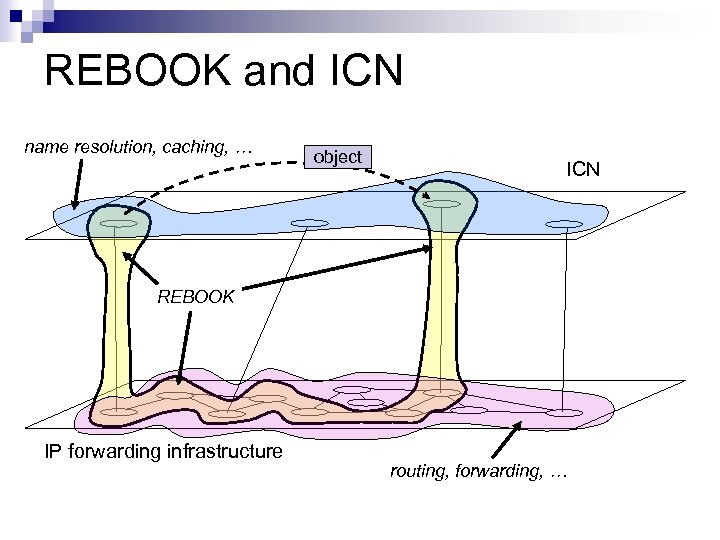 REBOOK and ICN name resolution, caching, … object ICN REBOOK IP forwarding infrastructure routing, forwarding, …
 The Question “Routers cannot keep state information for each connection (flow) traversing a node. It does not scale”. n In practical applications, is it still true with today’s technology?
 A tale of space and time… Available memory Computation time
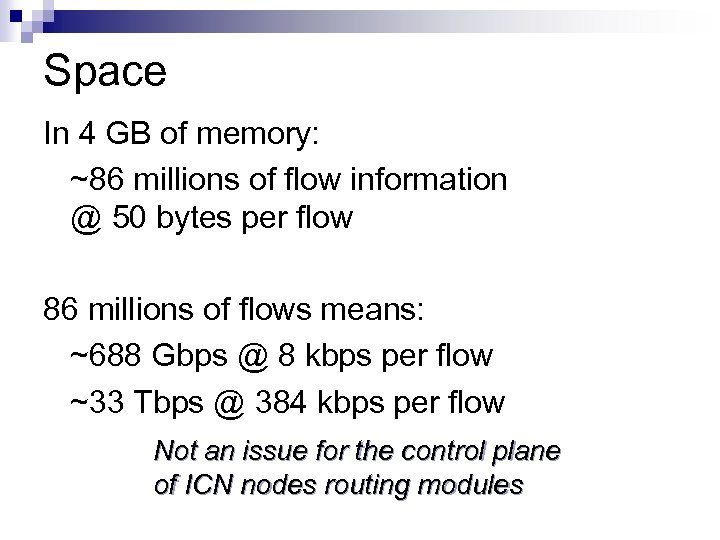 Space In 4 GB of memory: ~86 millions of flow information @ 50 bytes per flow 86 millions of flows means: ~688 Gbps @ 8 kbps per flow ~33 Tbps @ 384 kbps per flow Not an issue for the control plane of ICN nodes routing modules
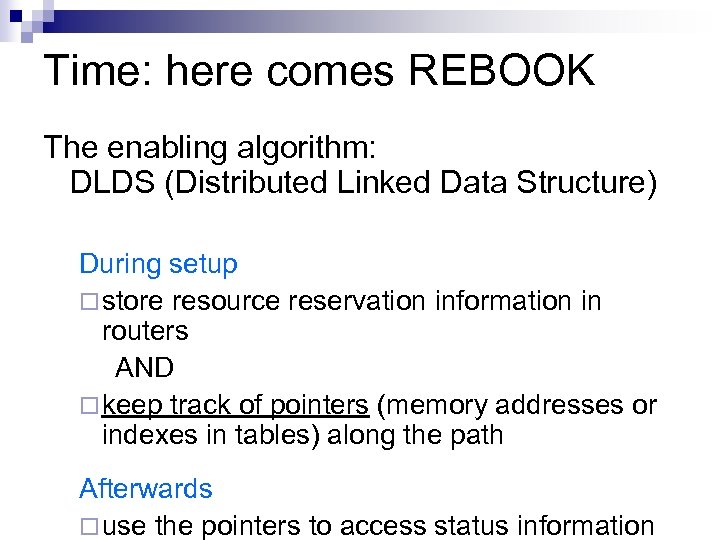 Time: here comes REBOOK The enabling algorithm: DLDS (Distributed Linked Data Structure) During setup ¨ store resource reservation information in routers AND ¨ keep track of pointers (memory addresses or indexes in tables) along the path Afterwards ¨ use the pointers to access status information
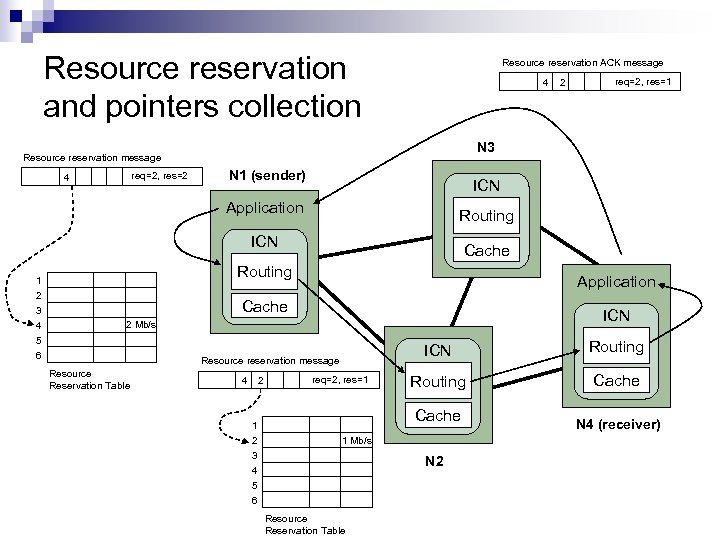 Resource reservation and pointers collection Resource reservation ACK message 4 req=2, res=2 N 1 (sender) ICN Application Routing ICN 3 4 5 6 Cache Routing 1 2 Application Cache ICN 2 Mb/s ICN Resource reservation message Resource Reservation Table req=2, res=1 N 3 Resource reservation message 4 2 1 2 req=2, res=1 Routing Cache 1 Mb/s 3 4 5 6 N 2 Resource Reservation Table N 4 (receiver)
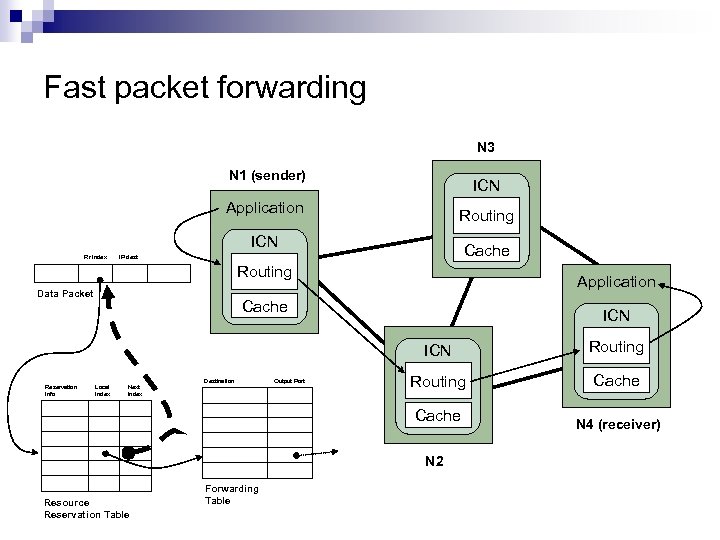 Fast packet forwarding N 3 N 1 (sender) ICN Application Routing ICN Rr index Cache IP dest Routing Data Packet Application Cache ICN Reservation Info Local Index Next Index Destination Output Port Routing Cache N 2 Resource Reservation Table Forwarding Table N 4 (receiver)
 A few problems n route changes, disappearing flows, end nodes or routers faults ¨ high speed consistency check ¨ highly efficient, low priority table cleanup process n need to dynamically change assigned resource amounts ¨ partial release ¨ distributed control function for optimality and fairness
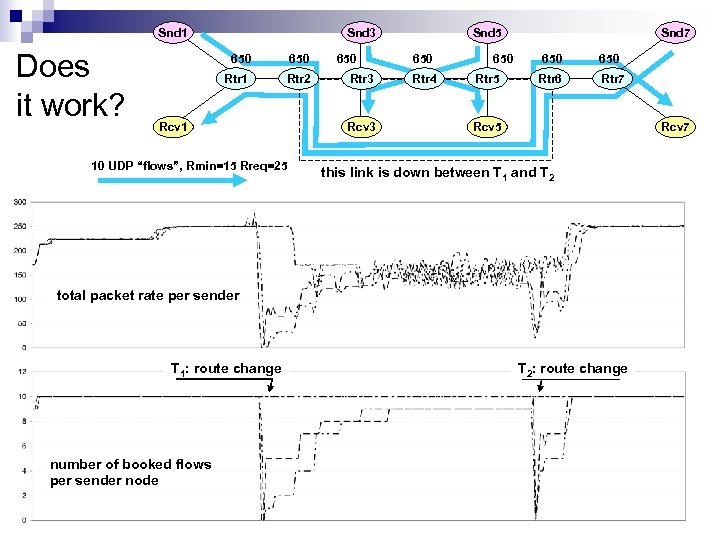 Snd 1 Does it work? Snd 3 650 Rtr 1 Rtr 2 Rcv 1 10 UDP “flows”, Rmin=15 Rreq=25 650 Rtr 3 Rcv 3 Snd 5 650 Rtr 4 650 Rtr 5 Snd 7 650 Rtr 6 Rtr 7 Rcv 5 Rcv 7 this link is down between T 1 and T 2 total packet rate per sender T 1: route change number of booked flows per sender node T 2: route change
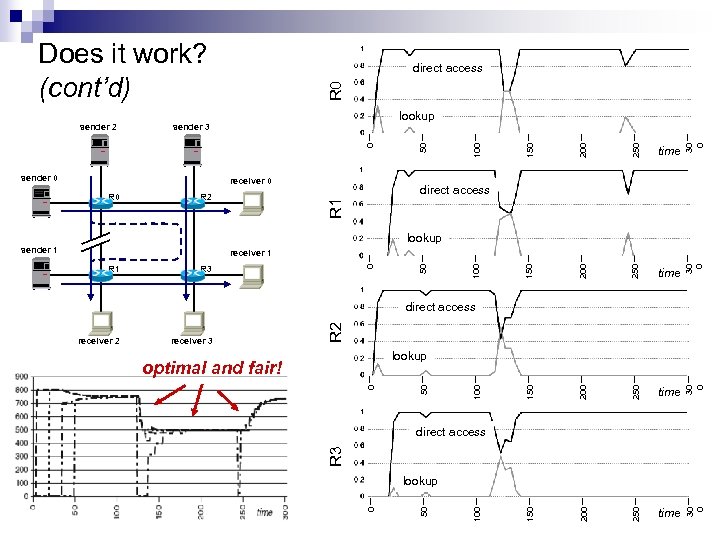 Does it work? (cont’d) R 0 30 0 250 time 30 0 250 250 time 30 0 200 time 200 150 R 2 direct access R 1 R 0 150 receiver 0 time 150 sender 0 50 lookup sender 3 0 sender 2 direct access lookup sender 1 100 R 3 50 R 1 0 receiver 1 100 0 optimal and fair! 50 lookup direct access 200 150 100 0 lookup 50 receiver 3 R 3 receiver 2 R 2 direct access
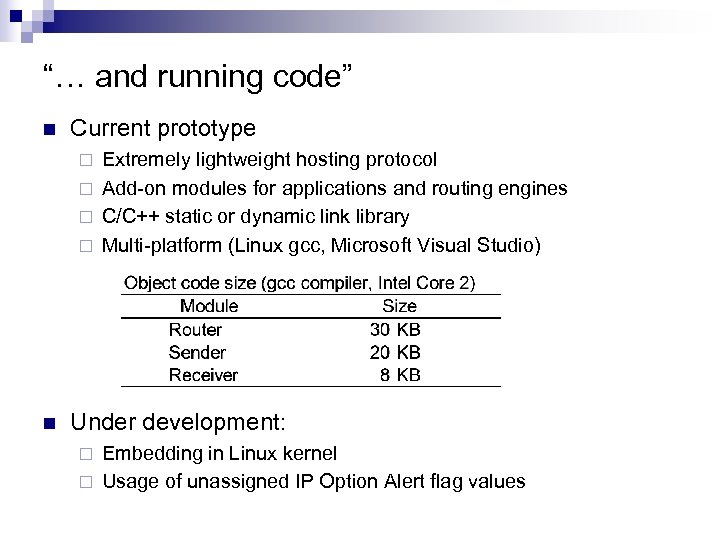 “… and running code” n Current prototype Extremely lightweight hosting protocol ¨ Add-on modules for applications and routing engines ¨ C/C++ static or dynamic link library ¨ Multi-platform (Linux gcc, Microsoft Visual Studio) ¨ n Under development: Embedding in Linux kernel ¨ Usage of unassigned IP Option Alert flag values ¨
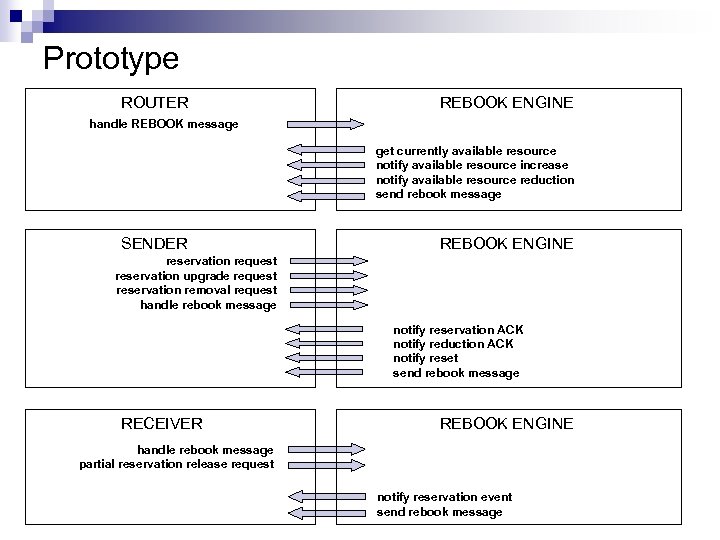 Prototype ROUTER REBOOK ENGINE handle REBOOK message get currently available resource notify available resource increase notify available resource reduction send rebook message SENDER REBOOK ENGINE reservation request reservation upgrade request reservation removal request handle rebook message notify reservation ACK notify reduction ACK notify reset send rebook message RECEIVER REBOOK ENGINE handle rebook message partial reservation release request notify reservation event send rebook message
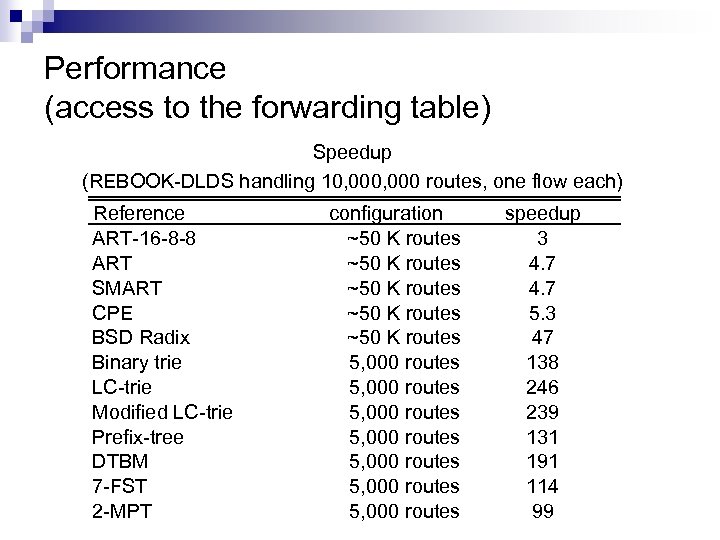
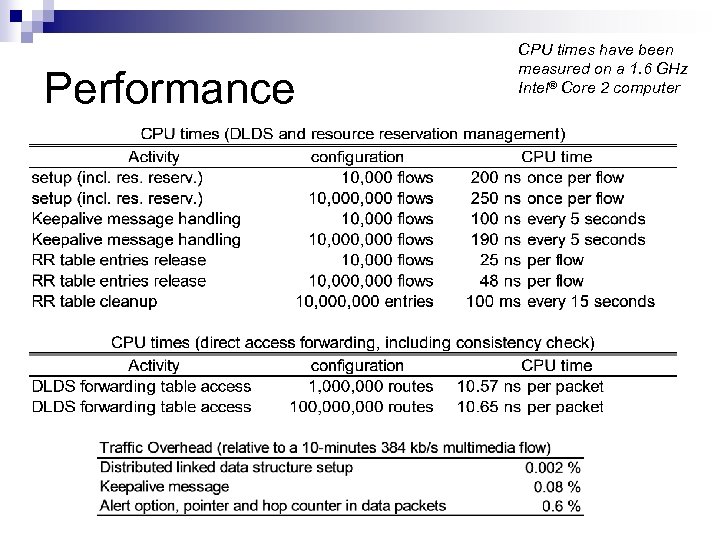 Performance CPU times have been measured on a 1. 6 GHz Intel® Core 2 computer
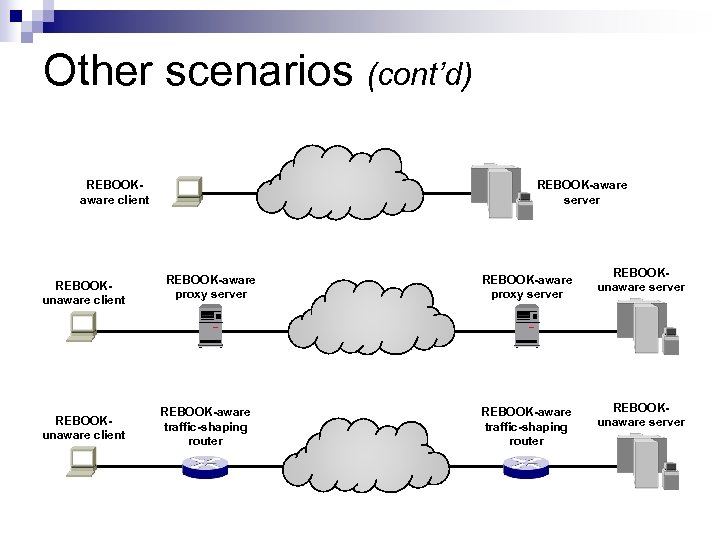
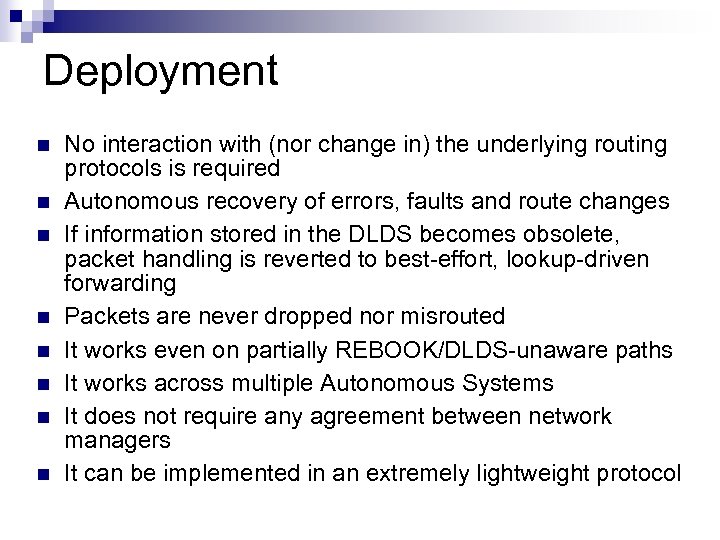 Deployment n n n n No interaction with (nor change in) the underlying routing protocols is required Autonomous recovery of errors, faults and route changes If information stored in the DLDS becomes obsolete, packet handling is reverted to best-effort, lookup-driven forwarding Packets are never dropped nor misrouted It works even on partially REBOOK/DLDS-unaware paths It works across multiple Autonomous Systems It does not require any agreement between network managers It can be implemented in an extremely lightweight protocol
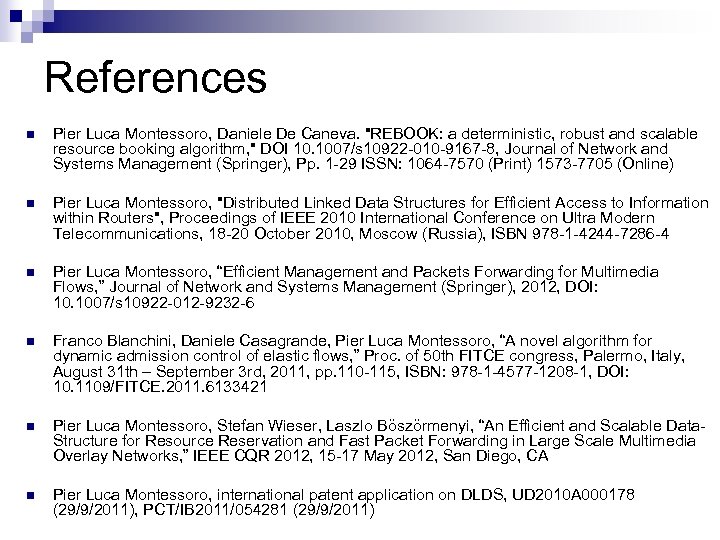 References n Pier Luca Montessoro, Daniele De Caneva. "REBOOK: a deterministic, robust and scalable resource booking algorithm, " DOI 10. 1007/s 10922 -010 -9167 -8, Journal of Network and Systems Management (Springer), Pp. 1 -29 ISSN: 1064 -7570 (Print) 1573 -7705 (Online) n Pier Luca Montessoro, "Distributed Linked Data Structures for Efficient Access to Information within Routers", Proceedings of IEEE 2010 International Conference on Ultra Modern Telecommunications, 18 -20 October 2010, Moscow (Russia), ISBN 978 -1 -4244 -7286 -4 n Pier Luca Montessoro, “Efficient Management and Packets Forwarding for Multimedia Flows, ” Journal of Network and Systems Management (Springer), 2012, DOI: 10. 1007/s 10922 -012 -9232 -6 n Franco Blanchini, Daniele Casagrande, Pier Luca Montessoro, “A novel algorithm for dynamic admission control of elastic flows, ” Proc. of 50 th FITCE congress, Palermo, Italy, August 31 th – September 3 rd, 2011, pp. 110 -115, ISBN: 978 -1 -4577 -1208 -1, DOI: 10. 1109/FITCE. 2011. 6133421 n Pier Luca Montessoro, Stefan Wieser, Laszlo Böszörmenyi, “An Efficient and Scalable Data. Structure for Resource Reservation and Fast Packet Forwarding in Large Scale Multimedia Overlay Networks, ” IEEE CQR 2012, 15 -17 May 2012, San Diego, CA n Pier Luca Montessoro, international patent application on DLDS, UD 2010 A 000178 (29/9/2011), PCT/IB 2011/054281 (29/9/2011)
 In the articles… Distributed control function for fairness and optimality n Deployment n Security n Fast packet forwarding n Implementation details n
 Conclusion n Some instances of ICN can use REBOOK ¨ for congestion- and flow-controlled transport of objects from a given location to the interested receiver ¨ to provide fast packet forwarding in softwarebased routers or inexpensive hardware implementation n Why ICN? Why REBOOK? ¨ new architecture that overcome the rigid separation (and mistrust) between hosts/applications and the network
 Thank you!
 Other scenarios Outside the cloud: Overlay Network
 Other scenarios (cont’d) Inside the cloud: REBOOK/DLDSaware routers
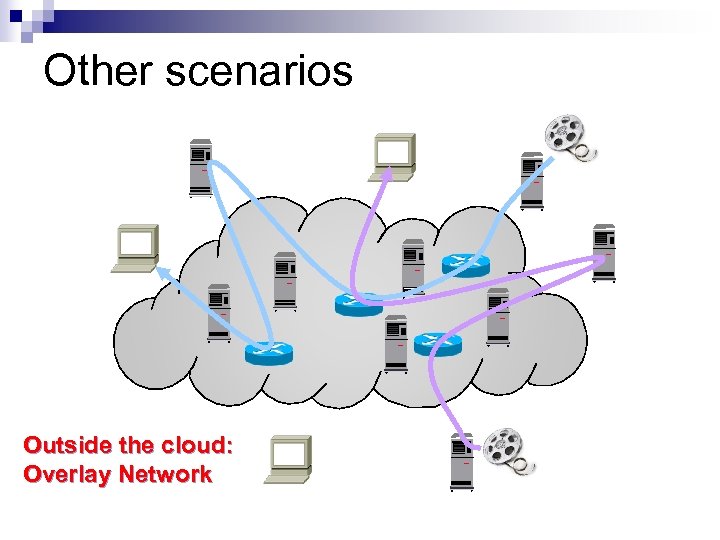
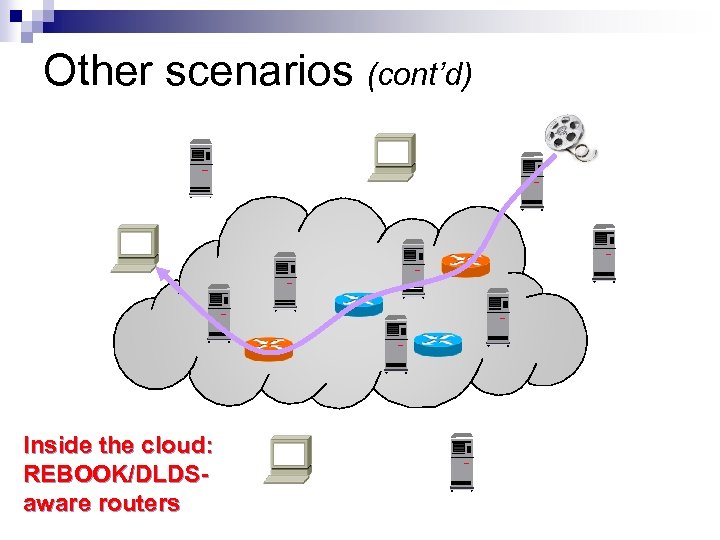
 Other scenarios (cont’d) REBOOKaware client REBOOKunaware client REBOOK-aware server REBOOK-aware proxy server REBOOK-aware traffic-shaping router REBOOKunaware server
 Performance (access to the forwarding table) Speedup (REBOOK-DLDS handling 10, 000 routes, one flow each) Reference ART-16 -8 -8 ART SMART CPE BSD Radix Binary trie LC-trie Modified LC-trie Prefix-tree DTBM 7 -FST 2 -MPT configuration ~50 K routes ~50 K routes 5, 000 routes 5, 000 routes speedup 3 4. 7 5. 3 47 138 246 239 131 191 114 99