 Скачать презентацию ICIW 2006 Guadeloupe Adding semantics to Web
56f0fe61600bfcbdd2e1883e39d2929f.ppt
- Количество слайдов: 192



ICIW 2006, Guadeloupe
Adding semantics to Web services with the Web Service Modeling Ontology Mick Kerrigan Liliana Cabral Jacek Kopecky John Domingue Matthew Moran Stefania Galizia Dumitru Roman Barry Norton Brahmananda Sapkota 2
The aims of this tutorial • Introduce the aims & challenges of Semantic Web Services (SWS) - the WSMO approach • Present a general overview of a fully fledged framework for SWS: a conceptual model, a language, and execution environments • Experience and work with WSMO enabled tools and systems 3
But first a few words about us… • We are members of: – Knowledge Media Institute (KMi) (at Open University) – Conversational Hypermedia, Group. Ware, Telepresence, Knowledge Management in Engineering, Knowledge Engineering for Narrative Creation, Semantic Web and Knowledge Services – Digital Enterprise Research Institute (DERI) - DERI’s vision is to make the Semantic Web and Semantic Web Services a reality enabling fully flexible e. Commerce for small, medium-sized and large enterprises. • Our main focus - Semantic Web Services; SWS have the potential to become a key-enabling infrastructure for Knowledge Management and e. Work, Enterprise Application Integration, and e. Commerce => In consequence, Semantic Web Services are one of the key areas of applied computer science 4
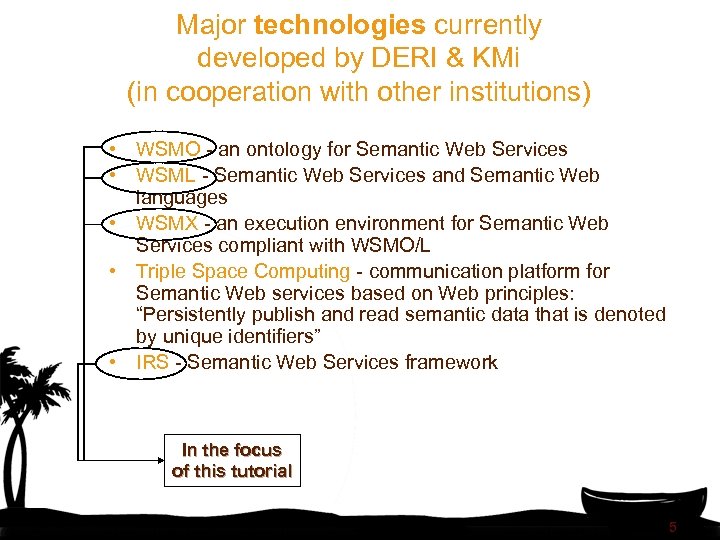
Major technologies currently developed by DERI & KMi (in cooperation with other institutions) • WSMO - an ontology for Semantic Web Services • WSML - Semantic Web Services and Semantic Web languages • WSMX - an execution environment for Semantic Web Services compliant with WSMO/L • Triple Space Computing - communication platform for Semantic Web services based on Web principles: “Persistently publish and read semantic data that is denoted by unique identifiers” • IRS - Semantic Web Services framework In the focus of this tutorial 5
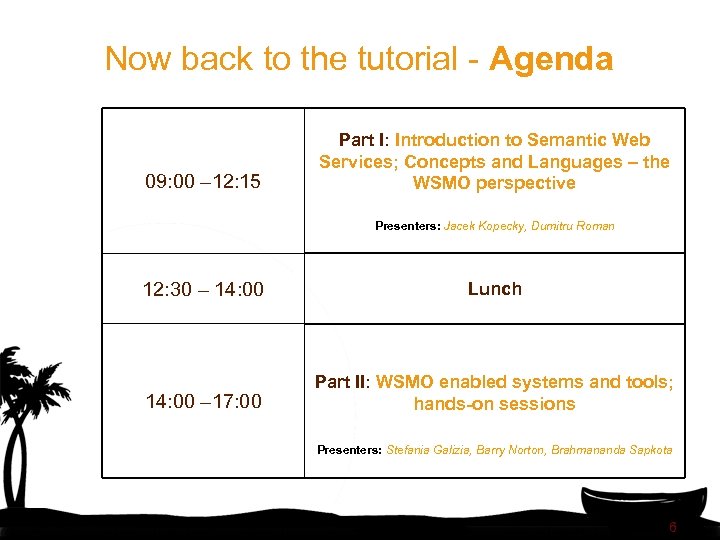
Now back to the tutorial - Agenda 09: 00 – 12: 15 Part I: Introduction to Semantic Web Services; Concepts and Languages – the WSMO perspective Presenters: Jacek Kopecky, Dumitru Roman 12: 30 – 14: 00 Lunch 14: 00 – 17: 00 Part II: WSMO enabled systems and tools; hands-on sessions Presenters: Stefania Galizia, Barry Norton, Brahmananda Sapkota 6
Part I: Introduction to Semantic Web Services; Concepts and Languages – the WSMO perspective 7
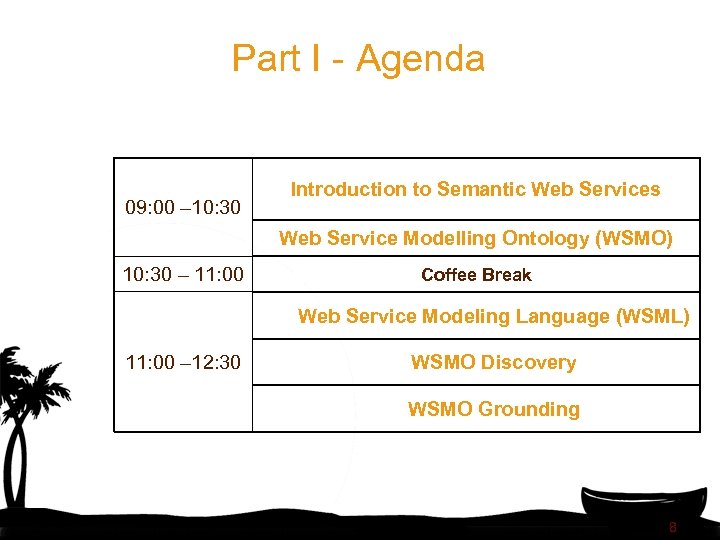
Part I - Agenda 09: 00 – 10: 30 Introduction to Semantic Web Services Web Service Modelling Ontology (WSMO) 10: 30 – 11: 00 Coffee Break Web Service Modeling Language (WSML) 11: 00 – 12: 30 WSMO Discovery WSMO Grounding 8
Intro to Semantic Web Services • Introduction to Semantic Web • Introduction to Web services Semantic Web Services 9
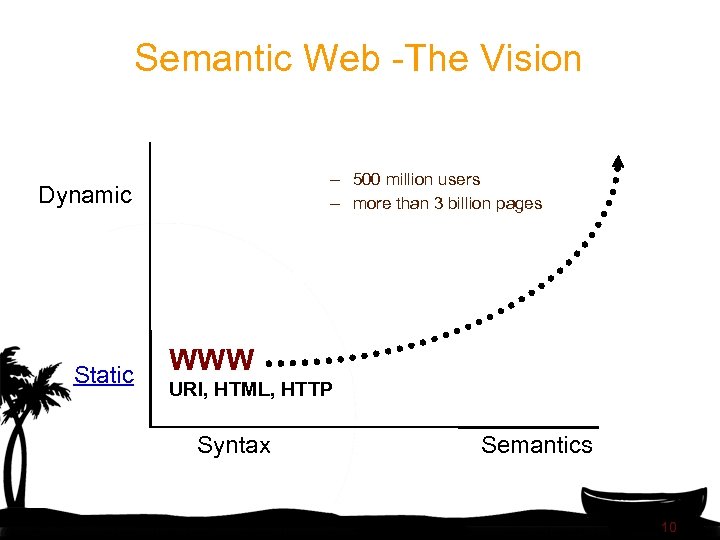
Semantic Web -The Vision – 500 million users – more than 3 billion pages Dynamic Static WWW URI, HTML, HTTP Syntax Semantics 10
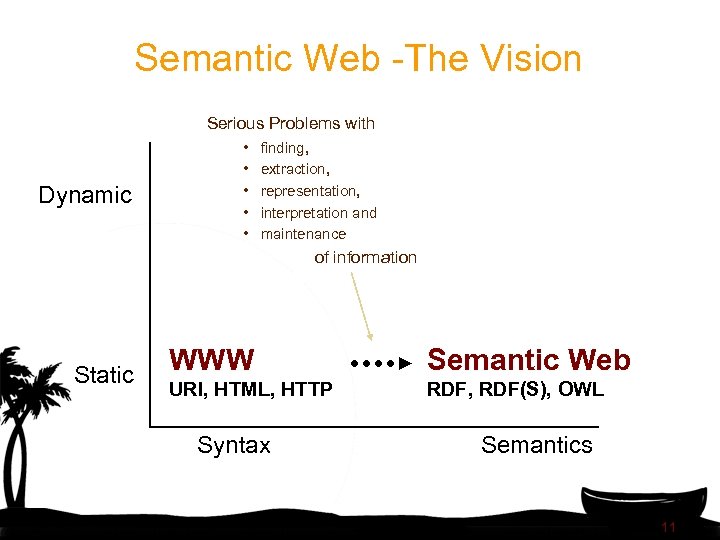
Semantic Web -The Vision Serious Problems with Dynamic • • • finding, extraction, representation, interpretation and maintenance of information Static WWW Semantic Web URI, HTML, HTTP RDF, RDF(S), OWL Syntax Semantics 11
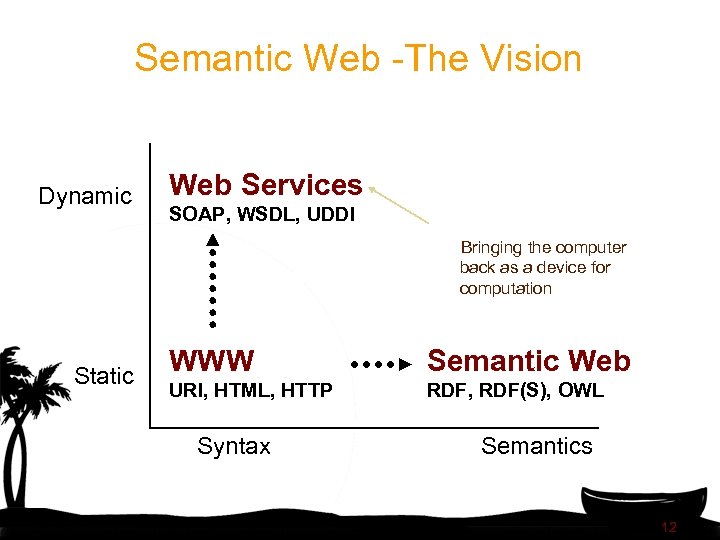
Semantic Web -The Vision Dynamic Web Services SOAP, WSDL, UDDI Bringing the computer back as a device for computation Static WWW Semantic Web URI, HTML, HTTP RDF, RDF(S), OWL Syntax Semantics 12
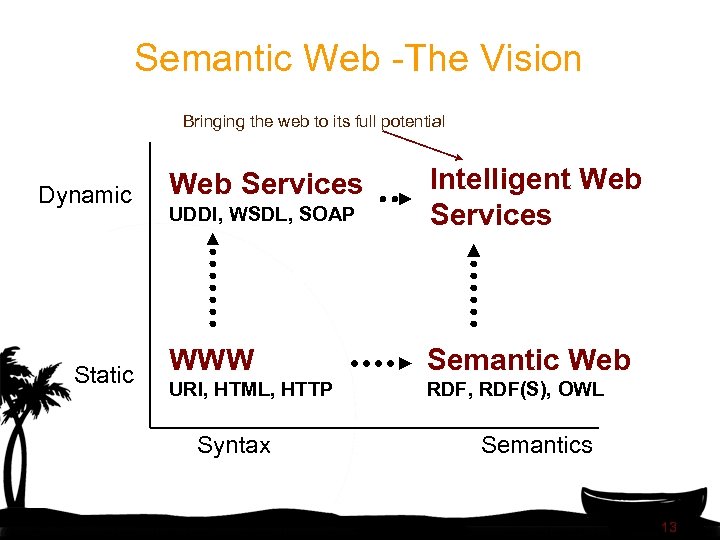
Semantic Web -The Vision Bringing the web to its full potential Dynamic Static UDDI, WSDL, SOAP Intelligent Web Services WWW Semantic Web URI, HTML, HTTP RDF, RDF(S), OWL Web Services Syntax Semantics 13
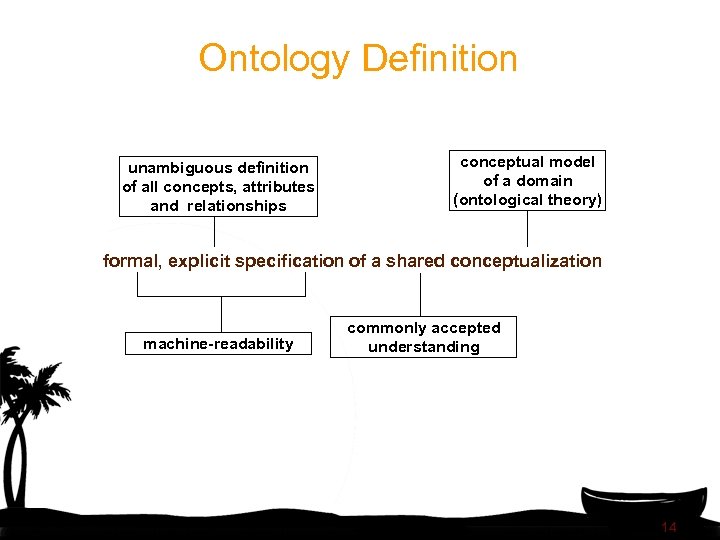
Ontology Definition unambiguous definition of all concepts, attributes and relationships conceptual model of a domain (ontological theory) formal, explicit specification of a shared conceptualization machine-readability commonly accepted understanding 14
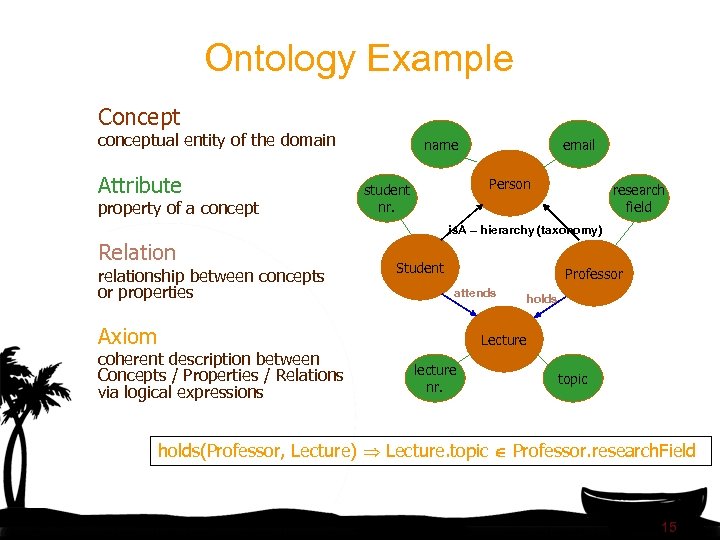
Ontology Example Concept conceptual entity of the domain Attribute property of a concept name email Person student nr. research field is. A – hierarchy (taxonomy) Relation relationship between concepts or properties Student Professor attends Axiom holds Lecture coherent description between Concepts / Properties / Relations via logical expressions lecture nr. topic holds(Professor, Lecture) Lecture. topic Professor. research. Field 15
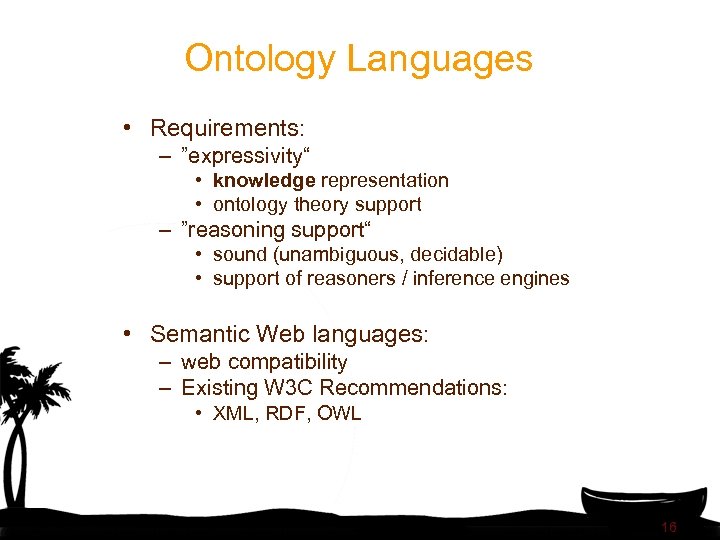
Ontology Languages • Requirements: – ”expressivity“ • knowledge representation • ontology theory support – ”reasoning support“ • sound (unambiguous, decidable) • support of reasoners / inference engines • Semantic Web languages: – web compatibility – Existing W 3 C Recommendations: • XML, RDF, OWL 16
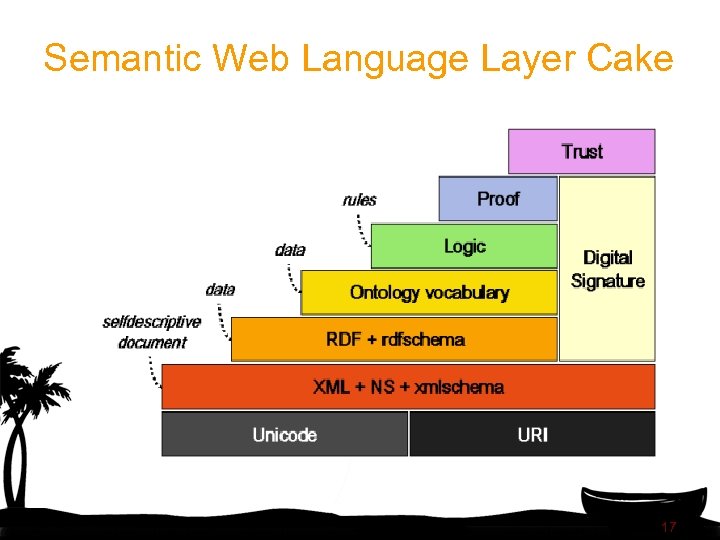
Semantic Web Language Layer Cake 17
![Web Services: [Stencil Group] • loosely coupled, reusable components • encapsulate discrete functionality •](https://present5.com/presentation/56f0fe61600bfcbdd2e1883e39d2929f/image-18.jpg "Web Services: [Stencil Group] • loosely coupled, reusable components • encapsulate discrete functionality •")
Web Services: [Stencil Group] • loosely coupled, reusable components • encapsulate discrete functionality • distributed • programmatically accessible over standard internet protocols • add new level of functionality on top of the current web 18
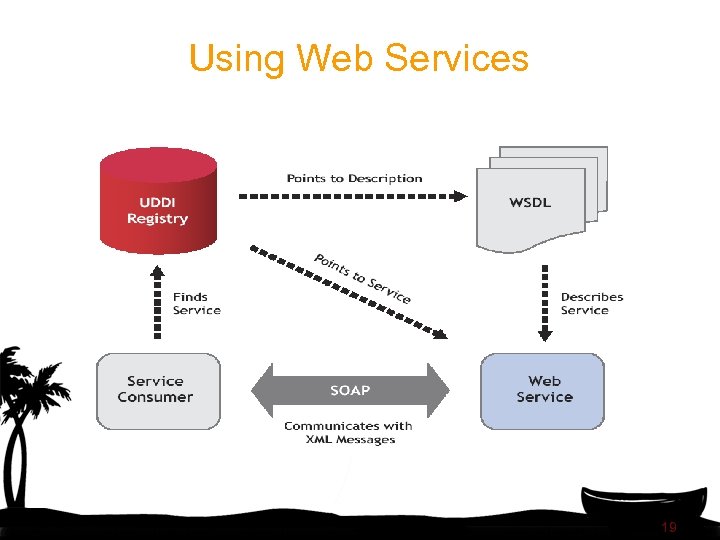
Using Web Services 19
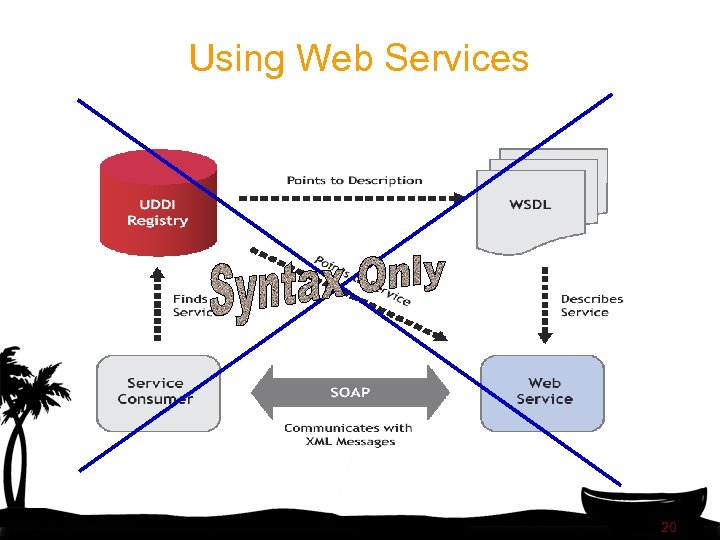
Using Web Services 20
Lack of SWS standards Current technology does not allow realization of any of the parts of the Web Service usage process: • • • Only syntactical standards available Lack of fully developed semantic markup languages Lack of semantically marked up content and services Lack of semantically enhanced repositories Lack of frameworks that facilitate discovery, composition and execution • Lack of tools and platforms that allow to semantically enrich current Web content 21
Semantic Web Services • Define exhaustive description frameworks for describing Web Services and related aspects (Web Service Description Ontologies) • Support ontologies as underlying data model to allow machine supported data interpretation (Semantic Web aspect) • Define semantically driven technologies for automation of the Web Service usage process (Web Service aspect) 22
Semantic Web Services (2) Usage Process: • Publication: Make available the description of the capabilities of a service • Discovery: Locate different services suitable for a given task • Selection: Choose the most appropriate services among the available ones • Composition: Combine services to achieve a goal • Mediation: Solve mismatches (in data or process) among the combined services • Execution: Invoke services following programmatic conventions 23
Semantic Web Services (3) Usage Process – execution support • Monitoring: Control the execution process • Compensation: Provide transactional support and undo or mitigate unwanted effects • Replacement: Facilitate the substitution of services by equivalent ones • Auditing: Verify that service execution occurred in the expected way 24
Summary Semantic Web Services = Semantic Web Technology + Web Service Technology 25
Web Service Modeling Ontology (WSMO) • A conceptual model for Semantic Web Services: – Ontology of core elements for Semantic Web Services – a formal description language (WSML) – execution environment (WSMX) • … derived from and based on the Web Service Modeling Framework WSMF • an SDK-Cluster Working Group (joint European research and development initiative) 26
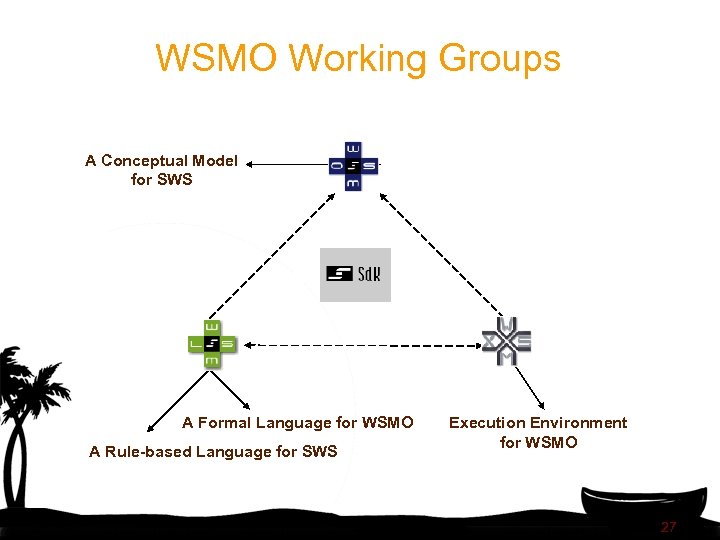
WSMO Working Groups A Conceptual Model for SWS A Formal Language for WSMO A Rule-based Language for SWS Execution Environment for WSMO 27
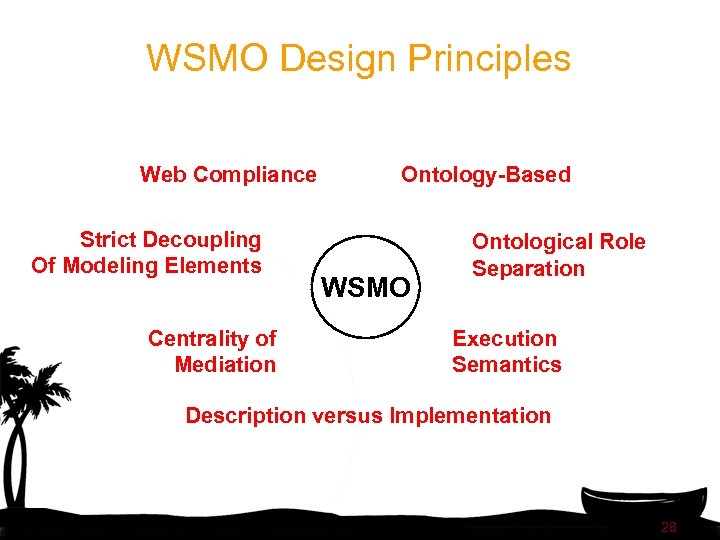
WSMO Design Principles Web Compliance Strict Decoupling Of Modeling Elements Centrality of Mediation Ontology-Based WSMO Ontological Role Separation Execution Semantics Description versus Implementation 28
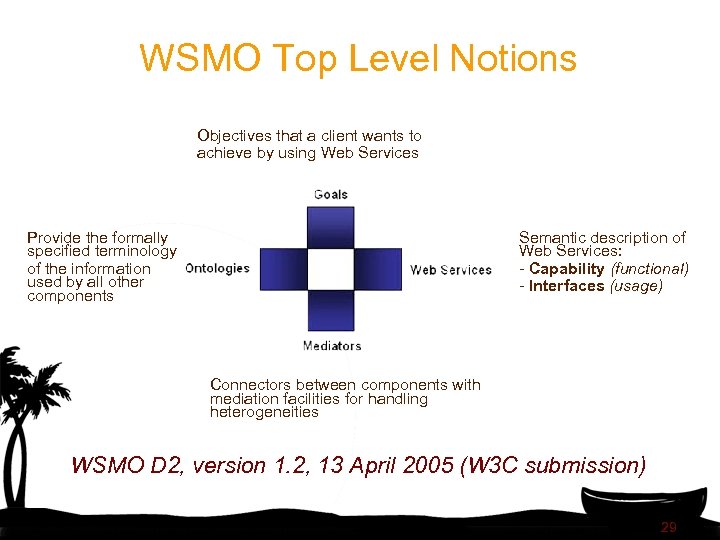
WSMO Top Level Notions Objectives that a client wants to achieve by using Web Services Provide the formally specified terminology of the information used by all other components Semantic description of Web Services: - Capability (functional) - Interfaces (usage) Connectors between components with mediation facilities for handling heterogeneities WSMO D 2, version 1. 2, 13 April 2005 (W 3 C submission) 29
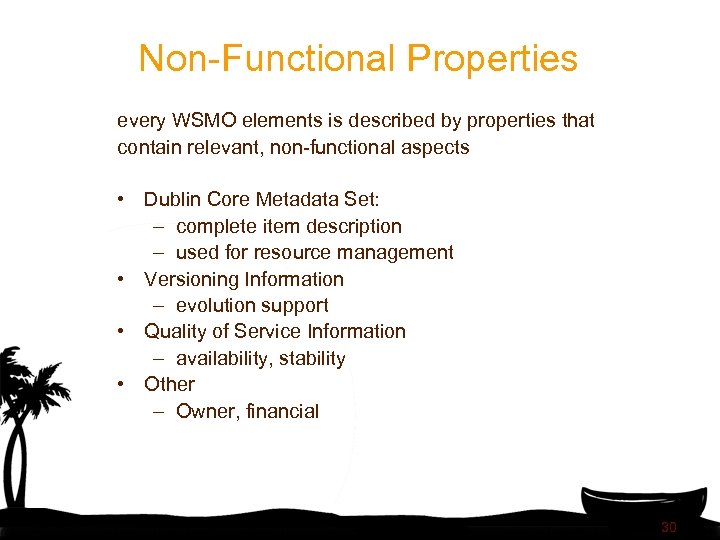
Non-Functional Properties every WSMO elements is described by properties that contain relevant, non-functional aspects • Dublin Core Metadata Set: – complete item description – used for resource management • Versioning Information – evolution support • Quality of Service Information – availability, stability • Other – Owner, financial 30
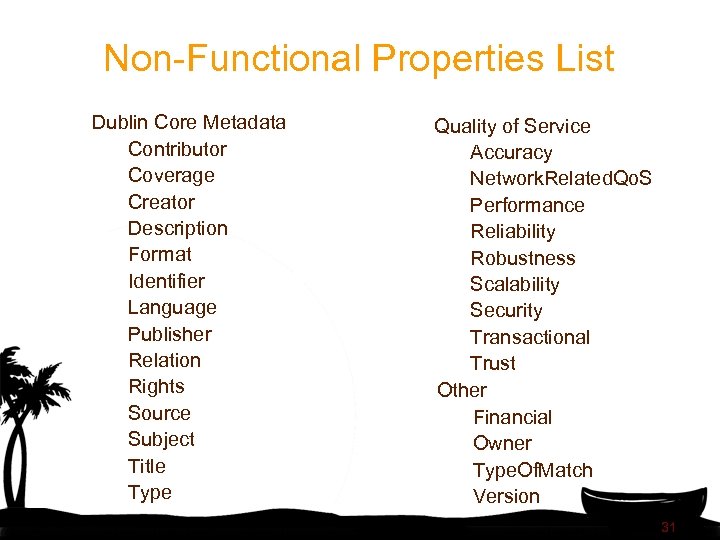
Non-Functional Properties List Dublin Core Metadata Contributor Coverage Creator Description Format Identifier Language Publisher Relation Rights Source Subject Title Type Quality of Service Accuracy Network. Related. Qo. S Performance Reliability Robustness Scalability Security Transactional Trust Other Financial Owner Type. Of. Match Version 31
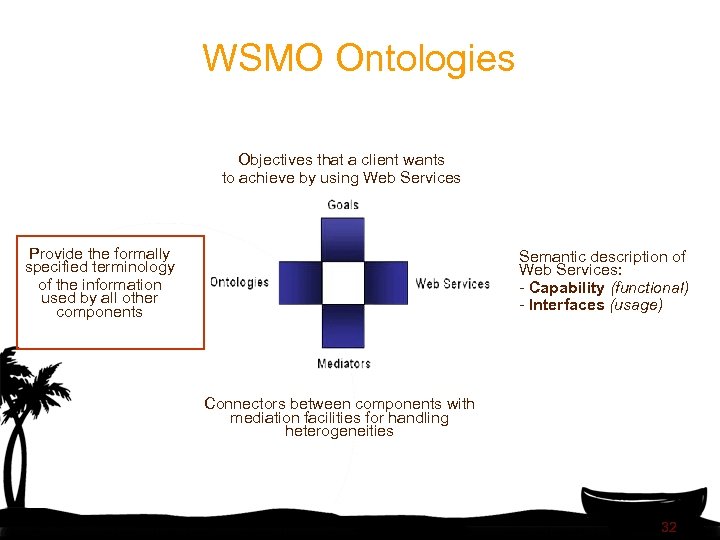
WSMO Ontologies Objectives that a client wants to achieve by using Web Services Provide the formally specified terminology of the information used by all other components Semantic description of Web Services: - Capability (functional) - Interfaces (usage) Connectors between components with mediation facilities for handling heterogeneities 32
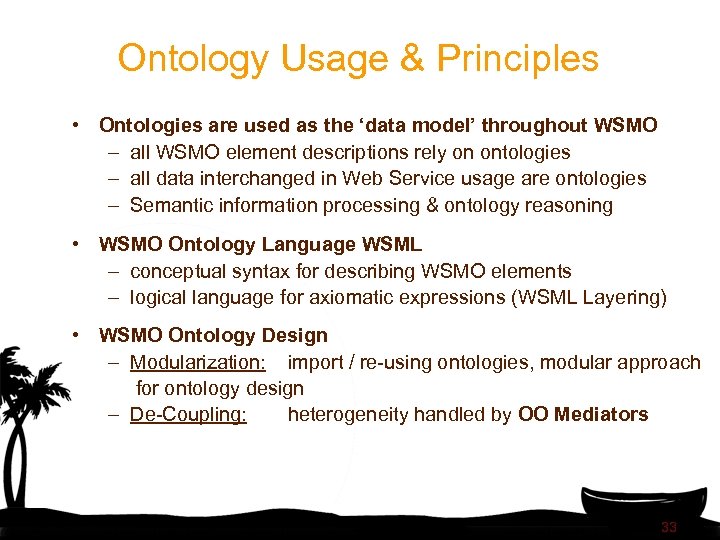
Ontology Usage & Principles • Ontologies are used as the ‘data model’ throughout WSMO – all WSMO element descriptions rely on ontologies – all data interchanged in Web Service usage are ontologies – Semantic information processing & ontology reasoning • WSMO Ontology Language WSML – conceptual syntax for describing WSMO elements – logical language for axiomatic expressions (WSML Layering) • WSMO Ontology Design – Modularization: import / re-using ontologies, modular approach for ontology design – De-Coupling: heterogeneity handled by OO Mediators 33
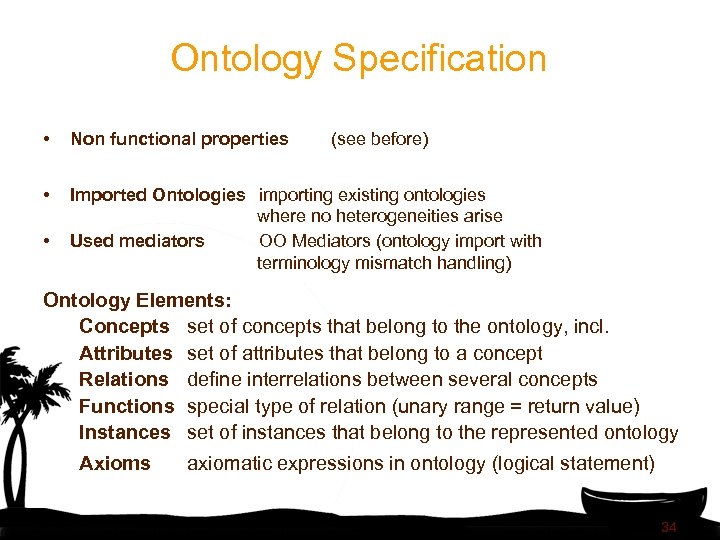
Ontology Specification • Non functional properties • Imported Ontologies importing existing ontologies where no heterogeneities arise Used mediators OO Mediators (ontology import with terminology mismatch handling) • (see before) Ontology Elements: Concepts set of concepts that belong to the ontology, incl. Attributes set of attributes that belong to a concept Relations define interrelations between several concepts Functions special type of relation (unary range = return value) Instances set of instances that belong to the represented ontology Axioms axiomatic expressions in ontology (logical statement) 34
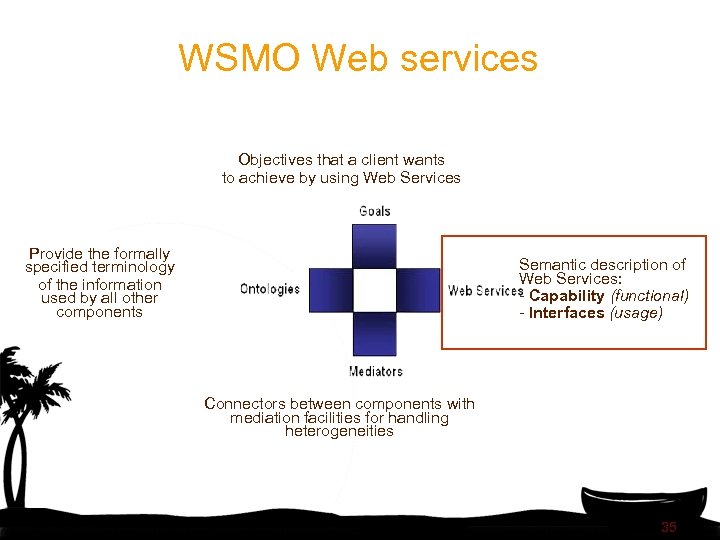
WSMO Web services Objectives that a client wants to achieve by using Web Services Provide the formally specified terminology of the information used by all other components Semantic description of Web Services: - Capability (functional) - Interfaces (usage) Connectors between components with mediation facilities for handling heterogeneities 35
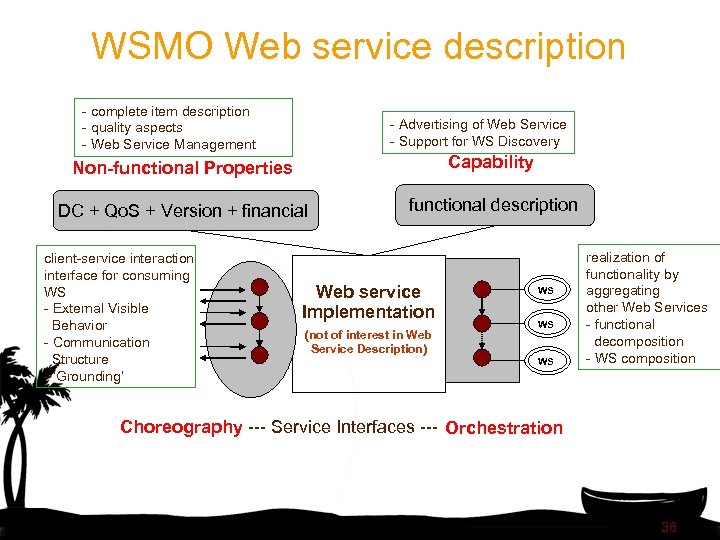
WSMO Web service description - complete item description - quality aspects - Web Service Management - Advertising of Web Service - Support for WS Discovery Non-functional Properties Capability DC + Qo. S + Version + financial functional description client-service interaction interface for consuming WS - External Visible Behavior - Communication Structure - ‘Grounding’ Web service Implementation (not of interest in Web Service Description) WS WS WS realization of functionality by aggregating other Web Services - functional decomposition - WS composition Choreography --- Service Interfaces --- Orchestration 36
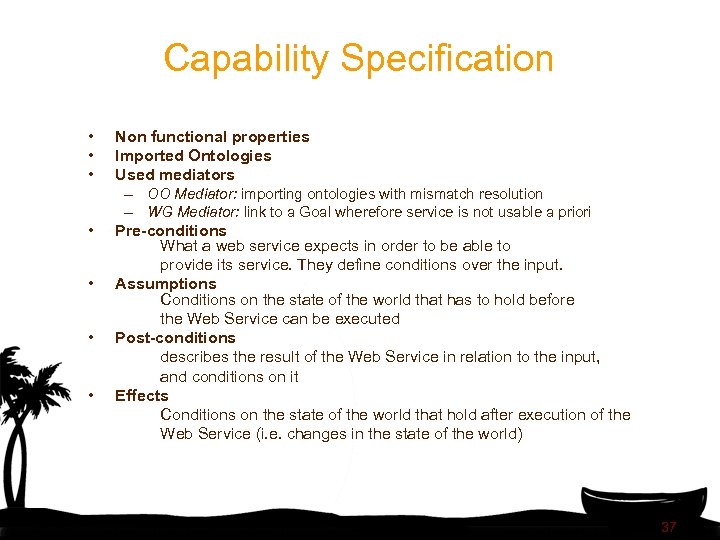
Capability Specification • • Non functional properties Imported Ontologies Used mediators – OO Mediator: importing ontologies with mismatch resolution – WG Mediator: link to a Goal wherefore service is not usable a priori Pre-conditions What a web service expects in order to be able to provide its service. They define conditions over the input. Assumptions Conditions on the state of the world that has to hold before the Web Service can be executed Post-conditions describes the result of the Web Service in relation to the input, and conditions on it Effects Conditions on the state of the world that hold after execution of the Web Service (i. e. changes in the state of the world) 37
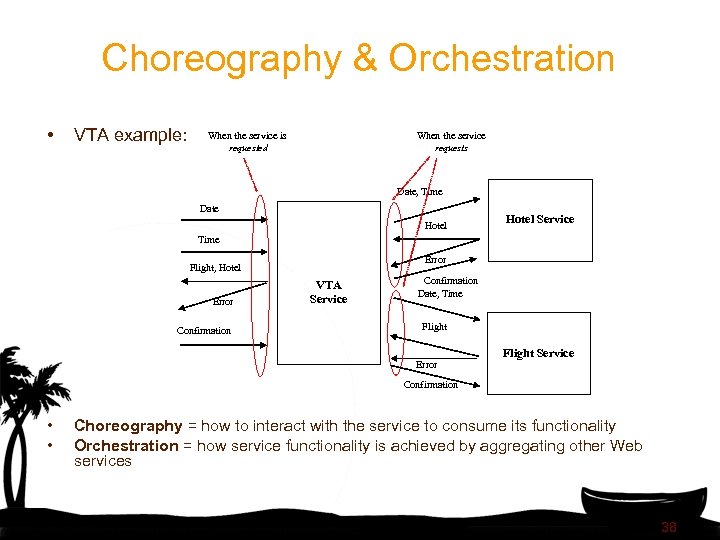
Choreography & Orchestration • VTA example: When the service is requested When the service requests Date, Time Date Hotel Service Time Error Flight, Hotel Error Confirmation VTA Service Confirmation Date, Time Flight Service Error Confirmation • • Choreography = how to interact with the service to consume its functionality Orchestration = how service functionality is achieved by aggregating other Web services 38
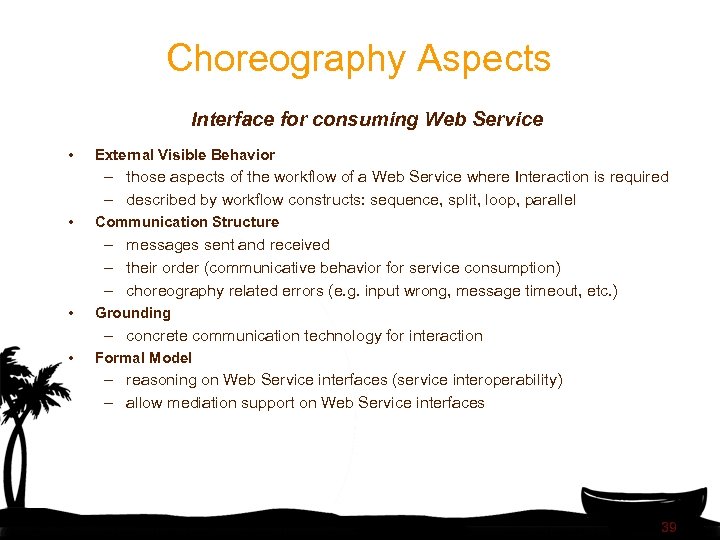
Choreography Aspects Interface for consuming Web Service • External Visible Behavior – those aspects of the workflow of a Web Service where Interaction is required – described by workflow constructs: sequence, split, loop, parallel • Communication Structure – messages sent and received – their order (communicative behavior for service consumption) – choreography related errors (e. g. input wrong, message timeout, etc. ) • Grounding – concrete communication technology for interaction • Formal Model – reasoning on Web Service interfaces (service interoperability) – allow mediation support on Web Service interfaces 39
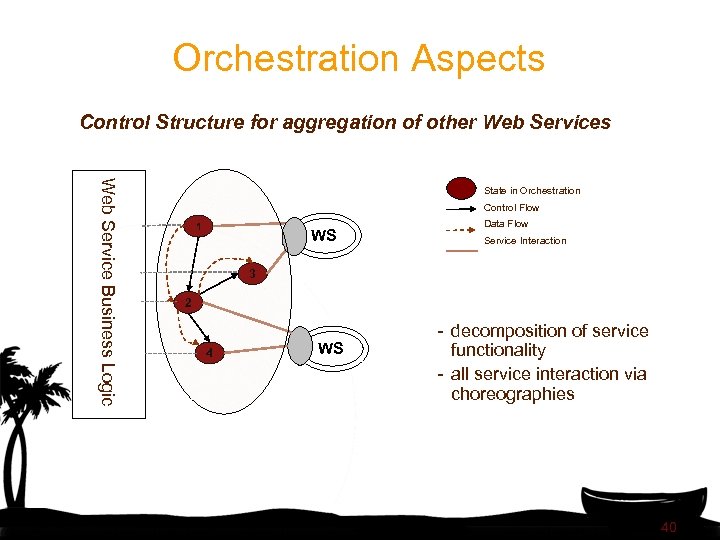
Orchestration Aspects Control Structure for aggregation of other Web Services Web Service Business Logic State in Orchestration Control Flow 1 WS Data Flow Service Interaction 3 2 4 WS - decomposition of service functionality - all service interaction via choreographies 40
Orchestration Aspects • Service interfaces are concerned with service consumption and interaction • Choreography and Orchestration as sub-concepts of Service Interface • Common requirements for service interface description: 1. represent the dynamics of information interchange during service consumption and interaction 2. support ontologies as the underlying data model 3. appropriate communication technology for information interchange 4. sound formal model / semantics of service interface specifications in order to allow operations on them. 41
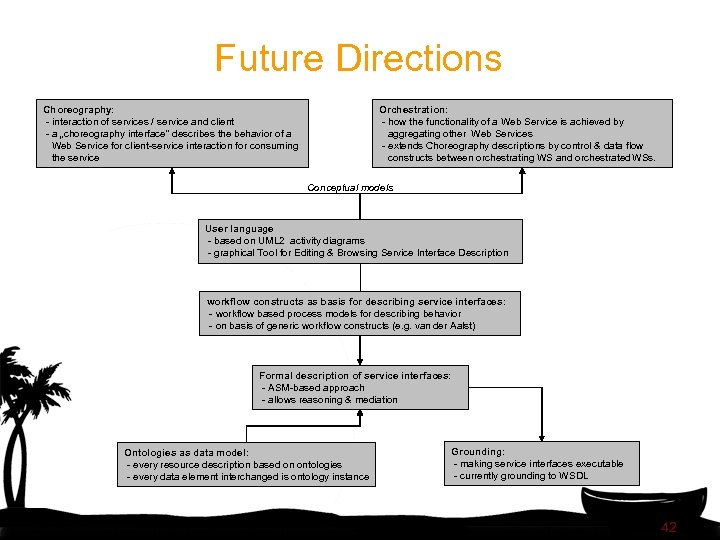
Future Directions Choreography: - interaction of services / service and client - a „choreography interface“ describes the behavior of a Web Service for client-service interaction for consuming the service Orchestration: - how the functionality of a Web Service is achieved by aggregating other Web Services - extends Choreography descriptions by control & data flow constructs between orchestrating WS and orchestrated WSs. Conceptual models User language - based on UML 2 activity diagrams - graphical Tool for Editing & Browsing Service Interface Description workflow constructs as basis for describing service interfaces: - workflow based process models for describing behavior - on basis of generic workflow constructs (e. g. van der Aalst) Formal description of service interfaces: - ASM-based approach - allows reasoning & mediation Ontologies as data model: - every resource description based on ontologies - every data element interchanged is ontology instance Grounding: - making service interfaces executable - currently grounding to WSDL 42
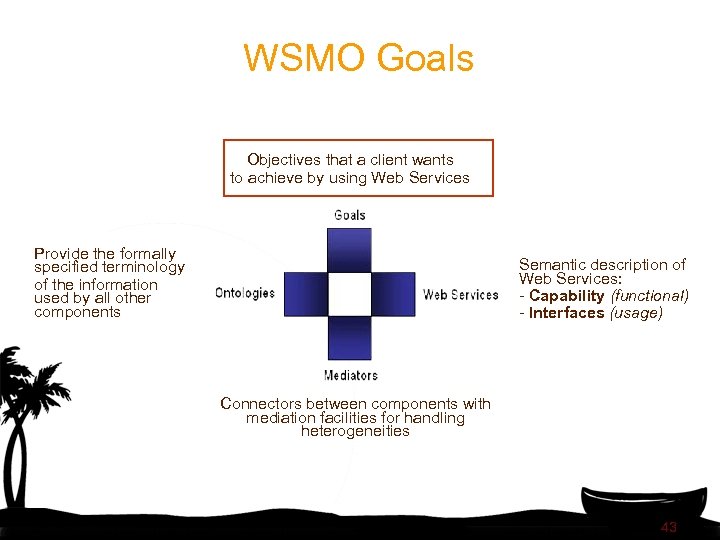
WSMO Goals Objectives that a client wants to achieve by using Web Services Provide the formally specified terminology of the information used by all other components Semantic description of Web Services: - Capability (functional) - Interfaces (usage) Connectors between components with mediation facilities for handling heterogeneities 43
Goals • Ontological De-coupling of Requester and Provider • Goal-driven Approach, derived from AI rational agent approach – Requester formulates objective independently – ‘Intelligent’ mechanisms detect suitable services for solving the Goal – allows re-use of Services for different purposes • Usage of Goals within Semantic Web Services – A Requester, that is an agent (human or machine), defines a Goal to be resolved – Web Service Discovery detects suitable Web Services for solving the Goal automatically – Goal Resolution Management is realized in implementations 44
Goal Specification • • • Non functional properties Imported Ontologies Used mediators – OO Mediators: importing ontologies with heterogeneity resolution – GG Mediator: • Goal definition by reusing an already existing goal • allows definition of Goal Ontologies • Requested Capability – describes service functionality expected to resolve the objective – defined as capability description from the requester perspective • Requested Interface – describes communication behaviour supported by the requester for consuming a Web Service (Choreography) – Restrictions / preferences on orchestrations of acceptable Web Services 45
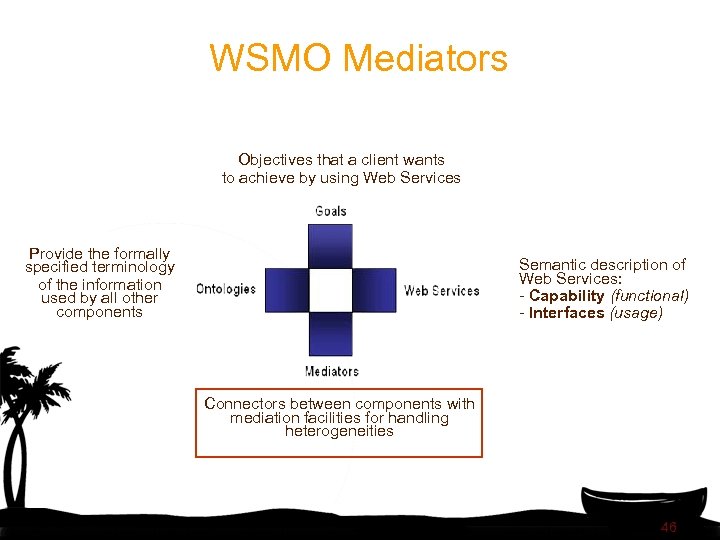
WSMO Mediators Objectives that a client wants to achieve by using Web Services Provide the formally specified terminology of the information used by all other components Semantic description of Web Services: - Capability (functional) - Interfaces (usage) Connectors between components with mediation facilities for handling heterogeneities 46
Mediation • Heterogeneity … – Mismatches on structural / semantic / conceptual / level – Occur between different components that shall interoperate – Especially in distributed & open environments like the Internet • Concept of Mediation (Wiederhold, 94): – Mediators as components that resolve mismatches – Declarative Approach: • Semantic description of resources • ‘Intelligent’ mechanisms that resolve mismatches independent of content – Mediation cannot be fully automated (integration decision) • Levels of Mediation within Semantic Web Services (WSMF): (1) Data Level: mediate heterogeneous Data Sources (2) Protocol Level: mediate heterogeneous Communication Patterns (3) Process Level: mediate heterogeneous Business Processes 47
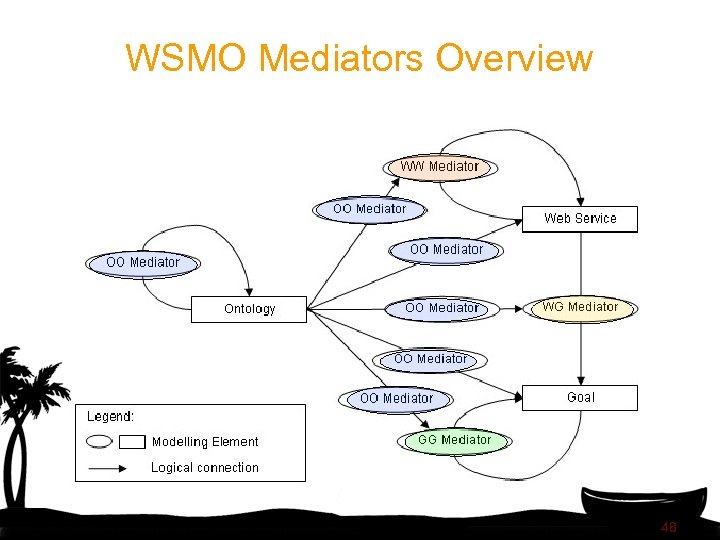
WSMO Mediators Overview 48
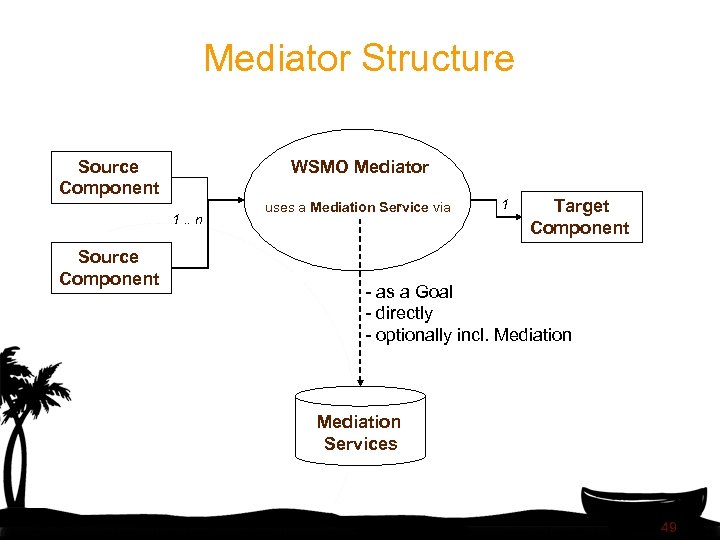
Mediator Structure Source Component WSMO Mediator 1. . n Source Component uses a Mediation Service via 1 Target Component - as a Goal - directly - optionally incl. Mediation Services 49
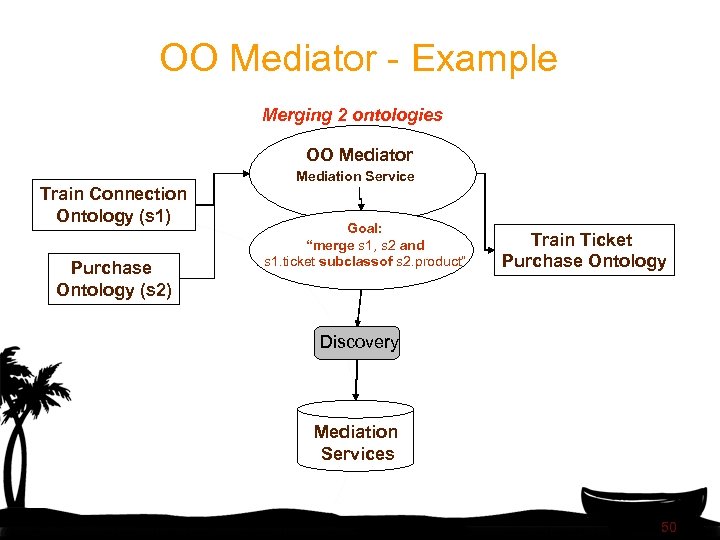
OO Mediator - Example Merging 2 ontologies OO Mediator Mediation Service Train Connection Ontology (s 1) Purchase Ontology (s 2) Goal: “merge s 1, s 2 and s 1. ticket subclassof s 2. product” Train Ticket Purchase Ontology Discovery Mediation Services 50
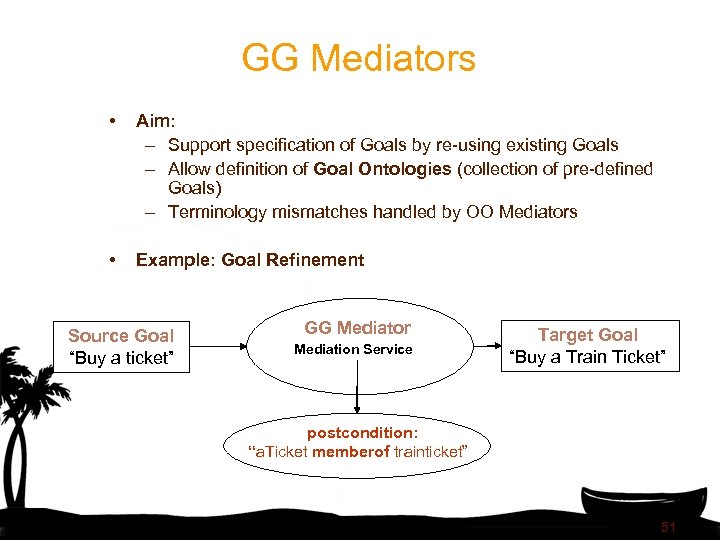
GG Mediators • Aim: – Support specification of Goals by re-using existing Goals – Allow definition of Goal Ontologies (collection of pre-defined Goals) – Terminology mismatches handled by OO Mediators • Example: Goal Refinement Source Goal “Buy a ticket” GG Mediator Mediation Service Target Goal “Buy a Train Ticket” postcondition: “a. Ticket memberof trainticket” 51
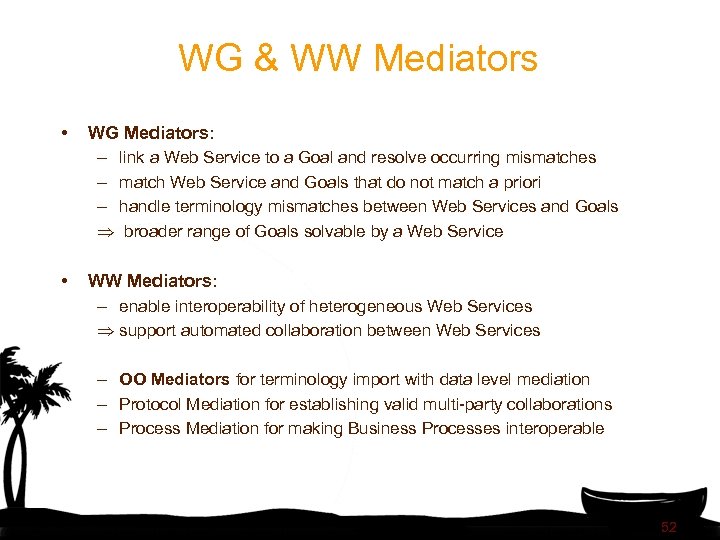
WG & WW Mediators • WG Mediators: – link a Web Service to a Goal and resolve occurring mismatches – match Web Service and Goals that do not match a priori – handle terminology mismatches between Web Services and Goals broader range of Goals solvable by a Web Service • WW Mediators: – enable interoperability of heterogeneous Web Services support automated collaboration between Web Services – OO Mediators for terminology import with data level mediation – Protocol Mediation for establishing valid multi-party collaborations – Process Mediation for making Business Processes interoperable 52
Web Service Modeling Language (WSML) • Aim – to provide a language (or a set of interoperable languages) for representing the elements of WSMO: – Ontologies, Web services, Goals, Mediators • WSML provides a formal language for the conceptual elements of WSMO, based on: – Description Logics – Logic Programming – First-Order Logic – Frame Logic 53
Rationale of WSML • Provide a Web Service Modeling Language based on the WSMO conceptual model – Concrete syntax – Semantics • Provide a Rule Language for the Semantic Web • Many current Semantic Web languages have – undesirable computational properties – unintuitive conceptual modeling features – inappropriate language layering • RDFS/OWL • OWL Lite/DL/Full • OWL/SWRL 54
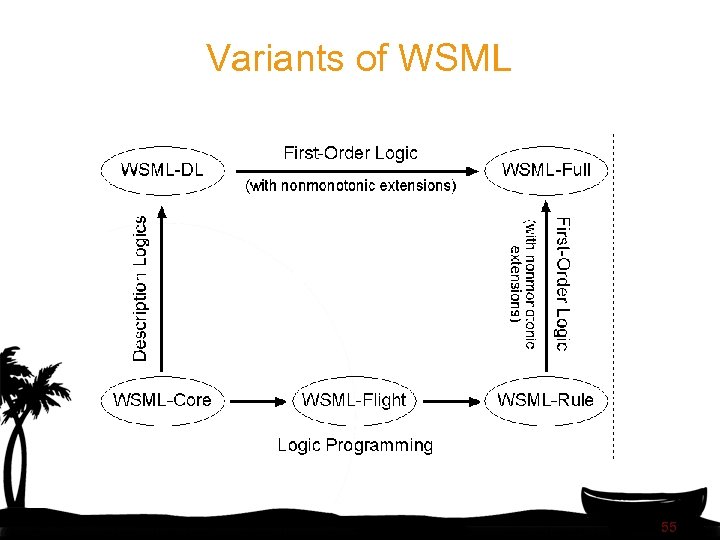
Variants of WSML 55
WSML-Core • Basic interoperability layer between Description Logics and Logic Programming paradigms • Based on Description Logic Programs – Expressive intersection of Description Logic SHIQ and Datalog – Allows to take advantage of many years of established research in Databases and Logic Programming – Allows reuse of existing efficient Deductive Database and Logic programming reasoners • Some limitations in conceptual modeling of Ontologies – No cardinality constraints – Only “inferring” range of attributes – No meta-modeling 56
WSML-DL • Extension of WSML-Core • Based on the Description Logic SHIQ – Entailment is decidable – Close to DL species of Web Ontology Language OWL – Many efficient subsumption reasoners • Some limitations in conceptual modeling of Ontologies – No cardinality constraints – Only “inferring” range of attributes – No meta-modeling • Limitations in logical expressions – From Logic Programming point-of-view, there is a lack of: • N-ary predicates • Chaining variables over predicates • (Default) negation 57
WSML-Flight • Extension of WSML-Core • Based on the Datalog, – Ground entailment is decidable – Allows to take advantage of many years of established research in Databases and Logic Programming – Allows reuse of existing efficient Deductive Database and Logic programming reasoners • No limitations in conceptual modeling of Ontologies – Cardinality constraints – Value constraints for attributes – Meta-modeling 58
WSML-Rule • Extension of WSML-Flight; based on Horn fragment of F-Logic – Ground entailment is undecidable – Turing complete – Allows to take advantage of many years of established research in Logic Programming – Allows reuse of existing efficient Logic programming reasoners • • Extends WSML-Flight logical expressions with: – Function symbols – Unsafe rules From Description Logic point-of-view, there is a lack of: – Existentials – Disjunction – (Classical) negation – Equality 59
WSML-Full • • • Extension of WSML-Rule and WSML-DL Based on First Order Logic with nonmonotonic extensions – Entailment is undecidable – Very expressive Extends WSML-DL logical expressions with: – Chaining variables over predicates – Function symbols – Nonmonotonic negation – N-ary predicates Extends WSML-Rule with: – Existentials – Disjunction – Classical negation – Equality Specification of WSML-Full is open research issue 60
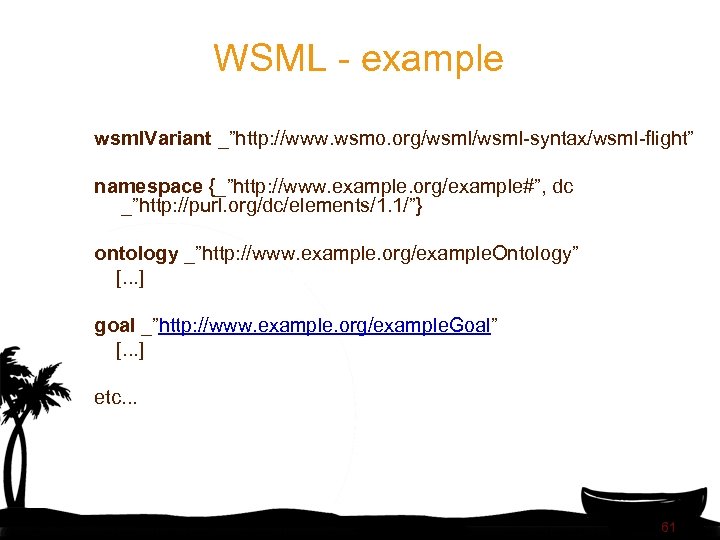
WSML - example wsml. Variant _”http: //www. wsmo. org/wsml-syntax/wsml-flight” namespace {_”http: //www. example. org/example#”, dc _”http: //purl. org/dc/elements/1. 1/”} ontology _”http: //www. example. org/example. Ontology” [. . . ] goal _”http: //www. example. org/example. Goal” [. . . ] etc. . . 61
WSML Syntax • WSML human-readable syntax • WSML exchange syntaxes: – XML syntax: • Syntax for exchange over the Web • Translation between human-readable and XML syntax • XML Schema for WSML has been defined – RDF syntax: • • • Interoperability with RDF applications Maximal reuse of RDF and RDFS vocabulary WSML RDF includes most of RDF Translation between human-readable and RDF syntax For logical expressions, XML literals are used 62
WSMO Discovery • • Web Service vs. Service Automated WS discovery Descriptions and Discovery WSMO Discovery process 63
Web Service vs. Service • • Notions of Web Service & Service are often interpreted in various ways in the literature We use the following terminology & interpretation here – Service • A provision of value in some domain (not necessarily monetary, independent of how service provider and requestor interact) – Web Service • Computational entity accessible over the Internet (using Web Service Standards & Protocols), provides access to (concrete) services for the clients. • Thus, we have the following relation between the notions: – Service corresponds to a concrete execution of a Web service (with given input values) – Web Service provides a set of services to its client; one service for each possible input value tuple 64
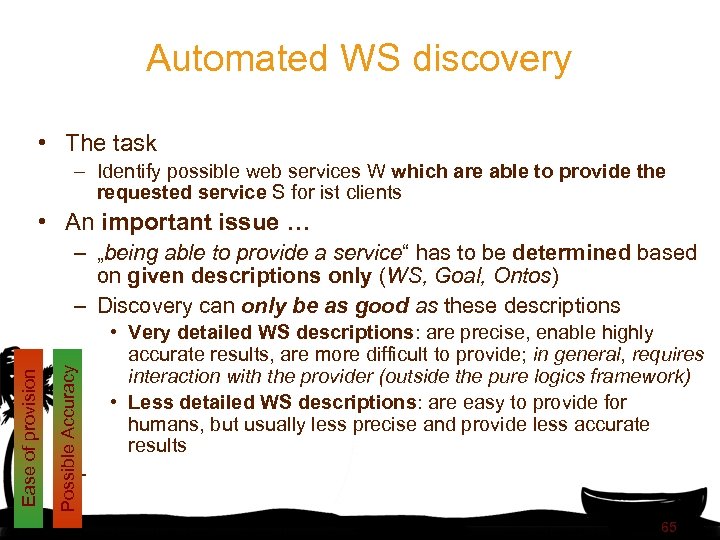
Automated WS discovery • The task – Identify possible web services W which are able to provide the requested service S for ist clients • An important issue … Possible Accuracy Ease of provision – „being able to provide a service“ has to be determined based on given descriptions only (WS, Goal, Ontos) – Discovery can only be as good as these descriptions • Very detailed WS descriptions: are precise, enable highly accurate results, are more difficult to provide; in general, requires interaction with the provider (outside the pure logics framework) • Less detailed WS descriptions: are easy to provide for humans, but usually less precise and provide less accurate results – 65
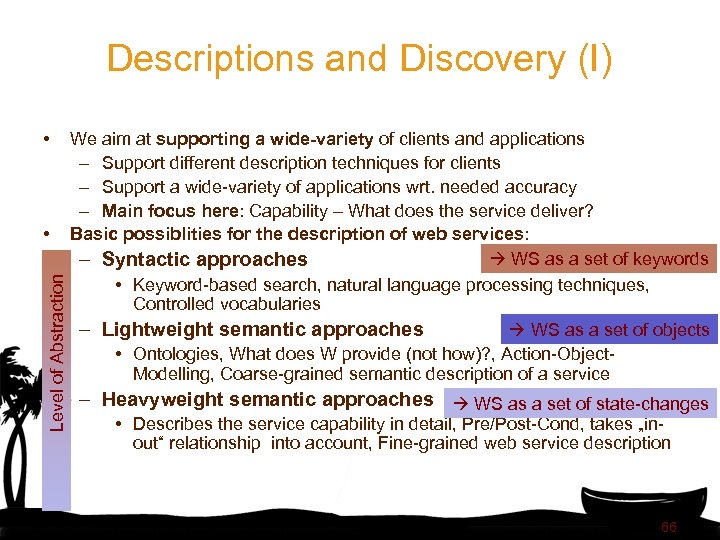
Descriptions and Discovery (I) • Level of Abstraction • A b s t r a c t i o n We aim at supporting a wide-variety of clients and applications – Support different description techniques for clients – Support a wide-variety of applications wrt. needed accuracy – Main focus here: Capability – What does the service deliver? Basic possiblities for the description of web services: WS as a set of keywords – Syntactic approaches • Keyword-based search, natural language processing techniques, Controlled vocabularies WS as a set of objects – Lightweight semantic approaches • Ontologies, What does W provide (not how)? , Action-Object. Modelling, Coarse-grained semantic description of a service – Heavyweight semantic approaches WS as a set of state-changes • Describes the service capability in detail, Pre/Post-Cond, takes „inout“ relationship into account, Fine-grained web service description 66
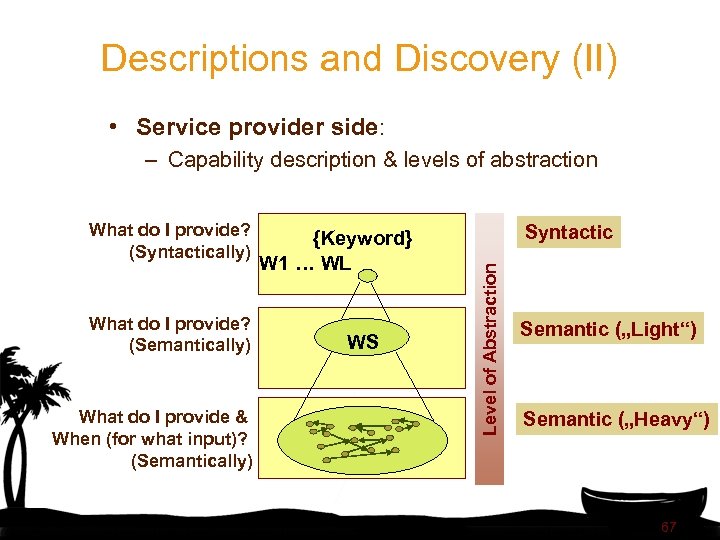
Descriptions and Discovery (II) • Service provider side: – Capability description & levels of abstraction What do I provide? (Semantically) What do I provide & When (for what input)? (Semantically) {Keyword} W 1 … WL WS Syntactic Level of Abstraction What do I provide? (Syntactically) Semantic („Light“) Semantic („Heavy“) 67

Descriptions and Discovery (III) • Service requester side: Goal description What do I want? (Semantically) What do I want & What (input) can I provide? (Semant. ) {Keyword} K 1 … Kn Syntactic Level of Abstraction What do I want? (Syntactically) Semantic („Light“) Semantic („Heavy“) 68
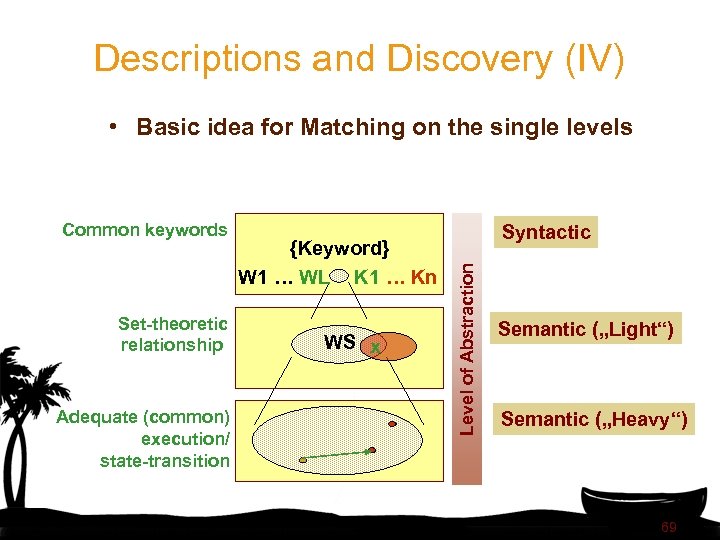
Descriptions and Discovery (IV) • Basic idea for Matching on the single levels Set-theoretic relationship Adequate (common) execution/ state-transition {Keyword} W 1 … WL K 1 … Kn WS x Syntactic Level of Abstraction Common keywords Semantic („Light“) Semantic („Heavy“) 69
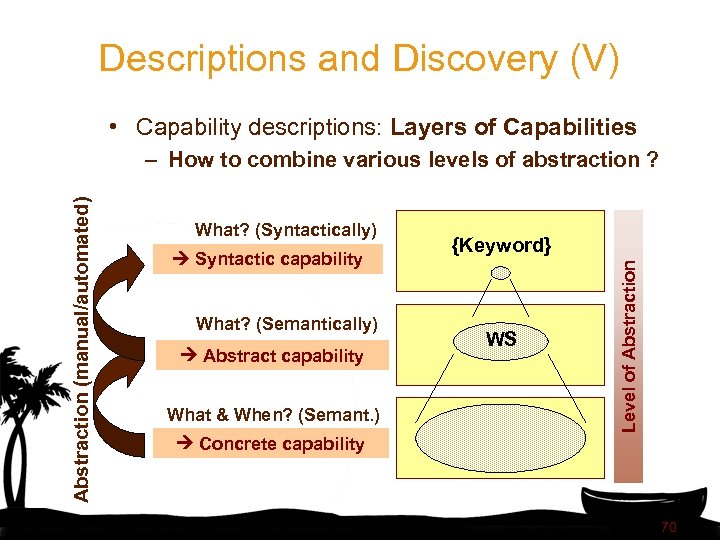
Descriptions and Discovery (V) • Capability descriptions: Layers of Capabilities What? (Syntactically) Syntactic capability What? (Semantically) Abstract capability What & When? (Semant. ) {Keyword} WS Level of Abstraction (manual/automated) – How to combine various levels of abstraction ? Concrete capability 70
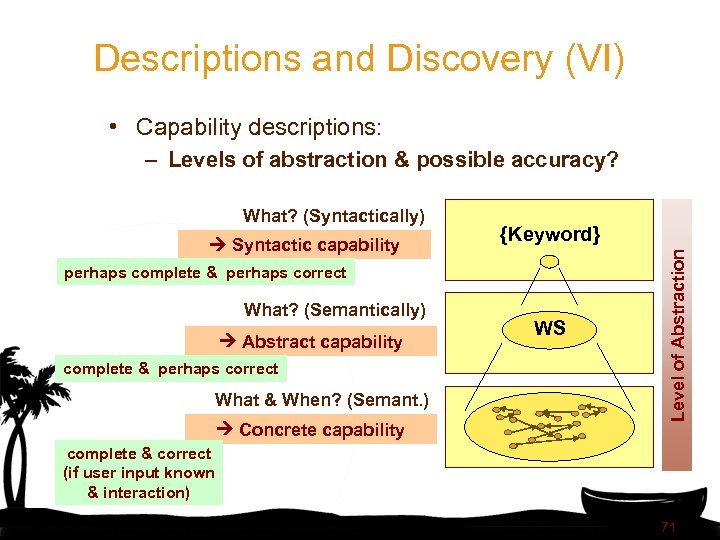
Descriptions and Discovery (VI) • Capability descriptions: – Levels of abstraction & possible accuracy? Syntactic capability {Keyword} perhaps complete & perhaps correct What? (Semantically) Abstract capability complete & perhaps correct What & When? (Semant. ) Concrete capability WS Level of Abstraction What? (Syntactically) complete & correct (if user input known & interaction) 71
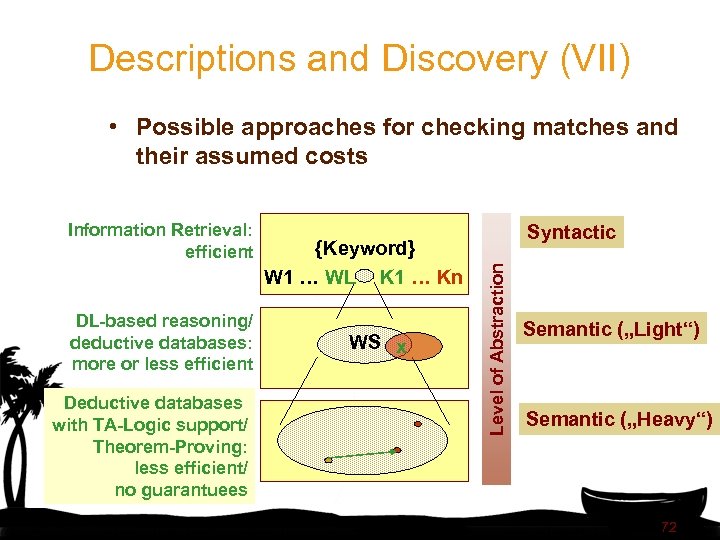
Descriptions and Discovery (VII) • Possible approaches for checking matches and their assumed costs DL-based reasoning/ deductive databases: more or less efficient Deductive databases with TA-Logic support/ Theorem-Proving: less efficient/ no guarantuees {Keyword} W 1 … WL K 1 … Kn WS x Syntactic Level of Abstraction Information Retrieval: efficient Semantic („Light“) Semantic („Heavy“) 72
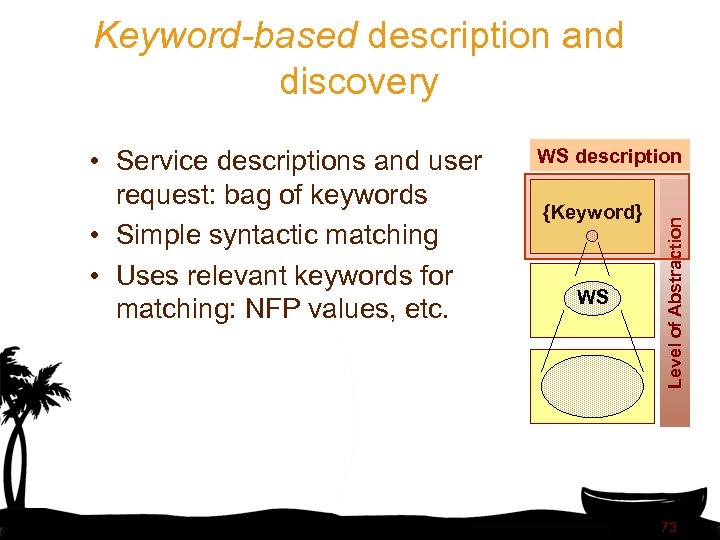
Keyword-based description and discovery WS description {Keyword} WS Level of Abstraction • Service descriptions and user request: bag of keywords • Simple syntactic matching • Uses relevant keywords for matching: NFP values, etc. 73
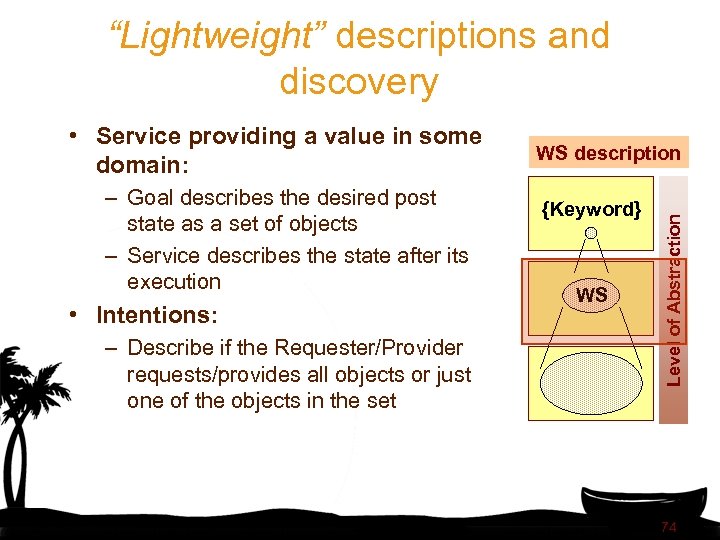
“Lightweight” descriptions and discovery – Goal describes the desired post state as a set of objects – Service describes the state after its execution • Intentions: – Describe if the Requester/Provider requests/provides all objects or just one of the objects in the set WS description {Keyword} WS Level of Abstraction • Service providing a value in some domain: 74
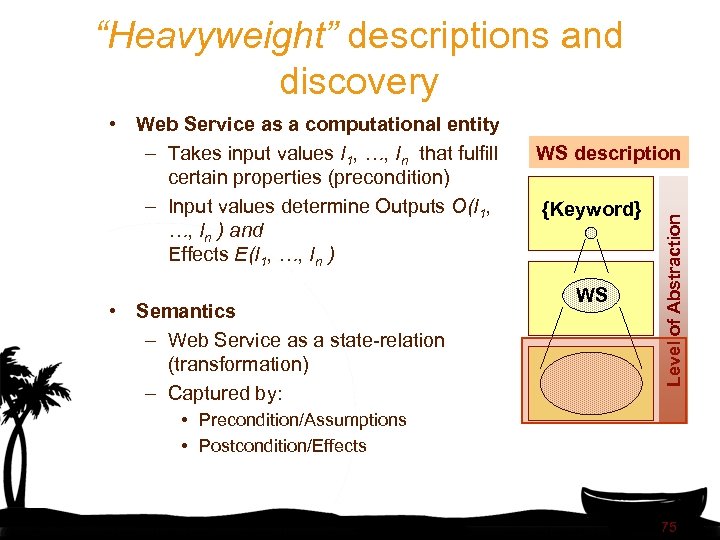
“Heavyweight” descriptions and discovery • Semantics – Web Service as a state-relation (transformation) – Captured by: WS description {Keyword} WS Level of Abstraction • Web Service as a computational entity – Takes input values I 1, …, In that fulfill certain properties (precondition) – Input values determine Outputs O(I 1, …, In ) and Effects E(I 1, …, In ) • Precondition/Assumptions • Postcondition/Effects 75
WSMO Discovery Process (I) • • Distinguish further between – Web Service Discovery – Service Discovery Web Service Discovery – No interaction with the provider, matches are only based on static capability descriptions – Matching is less accurate (we can only return web services which might be able to deliver a requested service) – Possibly ignore preconditions and inputs in service capabilites – Most likely with abstract capabilities • Service Discovery – Interaction with the provider with concrete input from user (dynamic capabilities) – Only with heavyweight descriptions of service capabilities possible (Input has to be considered)! – Matching is can be as accurate as possible – The more interaction, the less efficient becomes checking a match 76
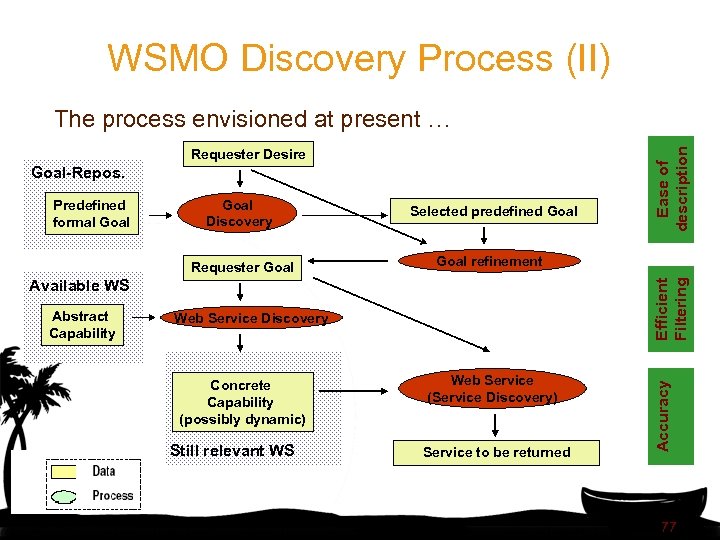
WSMO Discovery Process (II) Requester Desire Goal-Repos. Goal Discovery Requester Goal Selected predefined Goal refinement Abstract Capability Efficient Filtering Available WS Web Service Discovery Concrete Capability (possibly dynamic) Still relevant WS Web Service (Service Discovery) Service to be returned Accuracy Predefined formal Goal Ease of description The process envisioned at present … 77
WSMO Grounding • Motivation – It’s a WSDL and XML Schema world • Background – XML, XML Schema, what’s been done before • Approached to Mappings – Three possible approaches, one chosen • Creating the Mappings – Methodology, identifying mappings, next steps • Grounding WSMO Choreography to WSDL – Linking to WS standards 78
Motivation • • Web services being created and deployed now and for the next few years will be described using WSDL and XML Schema Want to define the mechanism for how WSMO service descriptions can be grounded to WSDL – Ground WSMO ontologies to XML Schema – Ground WSMO choreography descriptions to WSDL operations • Lifting XML Schema to a corresponding ontology provides opportunities for data mapping at the conceptual level 79
Background - XML • XML Pros – Standard language for sharing data across systems, especially on the Web – Application-dependent tag set great flexibility – Many XML based languages for all kinds of purposes – Strong tool support parsers, editors, storage, querying • XML Con – Semantics must be known by receiver of XML documents in advance; can not be determined from the document itself 80
Background - XML Schema • Defines constraints on structure of XML documents – Legal elements and attributes, order of child elements, default and fixed values for elements and attributes • Components of XML Schema – Elements • An association between a name and a type definition (simple or complex) – Attributes • An association between a name and a simple type. They can be global or in the scope of a complex type. – Simple types • Built-in or defining constraints on values of built-in types – Complex types • Define a data type composed of child elements of other data types • Define allowed structure of child elements • Extend or restrict definition of an existing complex type 81
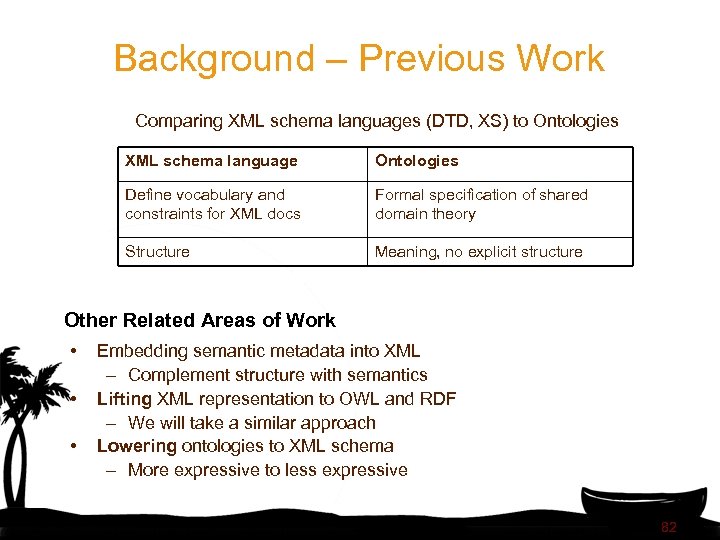
Background – Previous Work Comparing XML schema languages (DTD, XS) to Ontologies XML schema language Ontologies Define vocabulary and constraints for XML docs Formal specification of shared domain theory Structure Meaning, no explicit structure Other Related Areas of Work • • • Embedding semantic metadata into XML – Complement structure with semantics Lifting XML representation to OWL and RDF – We will take a similar approach Lowering ontologies to XML schema – More expressive to less expressive 82
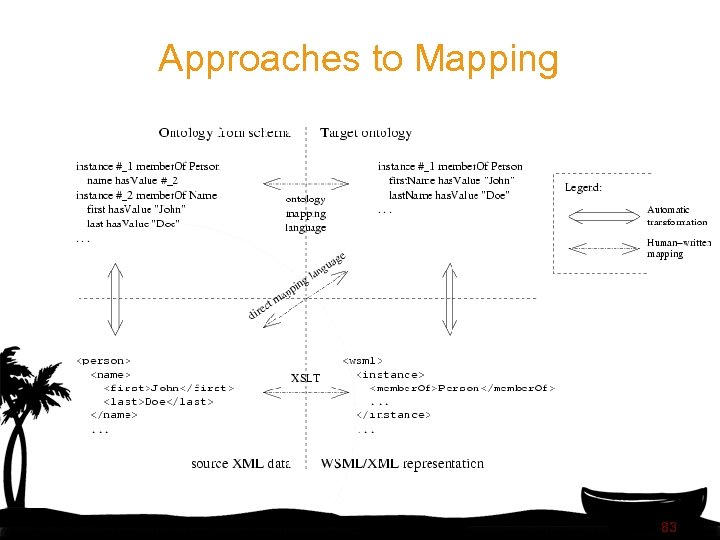
Approaches to Mapping 83
Approach to Mapping #1 • • • Transformation between XML as defined in WSDL and the XML syntax for a target WSMO ontology Use XSLT Disadvantages – XML syntax of WSML does not reflect data structure, the XSLT becomes complex – Low possibility for re-use of WSMO data mediation 84
Approach to Mapping #2 • • Map directly between XML and WSML instances Create a specific mapping language for this • Disadvantages – Low possibility for re-use of WSMO data mediation – Yet another mapping language 85
Approach to Mapping #3 (the chosen one) • Define mapping at the conceptual level • Create WSMO Ontology from XML Schema in WSDL – Define mappings from conceptual framework for XML Schema to WSMO Ontology metamodel – Generate ad-hoc ontology – Create set of executable mapping rules for data instances • Benefits – Take advantage of data mediation – No manually-created mapping required (in simplest case) 86
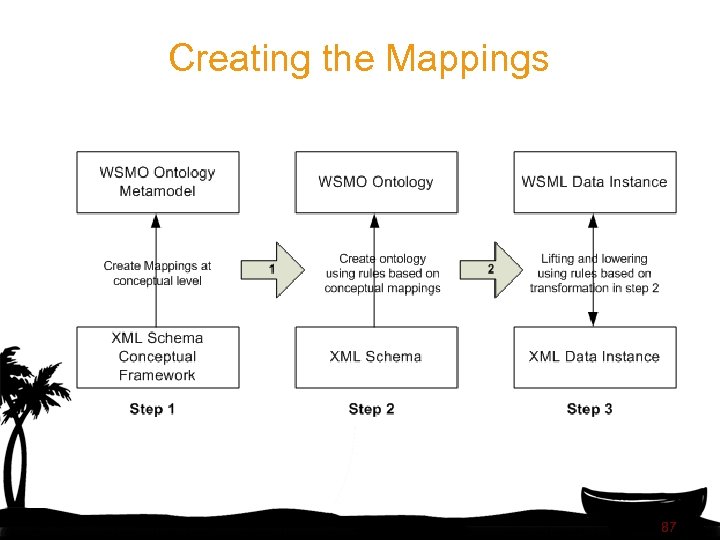
Creating the Mappings 87
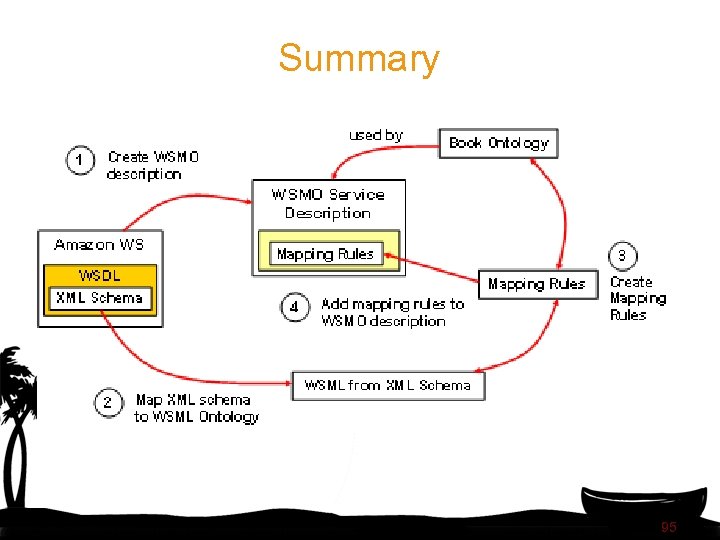
Creating the Mappings Explained • Define a mapping between the XML Schema Conceptual Model to the WSMO Ontology Metamodel. • Create an executable description of these mappings to enable the automatic creation of ad-hoc WSMO ontologies from specific XML Schema. • Create the bidirectional mappings rules to be used for the transformation between XML instances and WSMO instances. – Should be created at the same time as the generation of the ad-hoc WSMO ontology from an XML Schema. – The creation of these mapping rules should be automatic as they should be completely derived from the actions described in the first two bullet points. 88
Creating the Mappings Example Scenario • Semantic service description designer with task of providing a description for the Amazon service • Only consider in terms of data grounding • Assuming a tool exists for creating the ad-hoc WSMO ontology from an XML Schema • Two scenario use cases – No mediation required – Mediation required 89
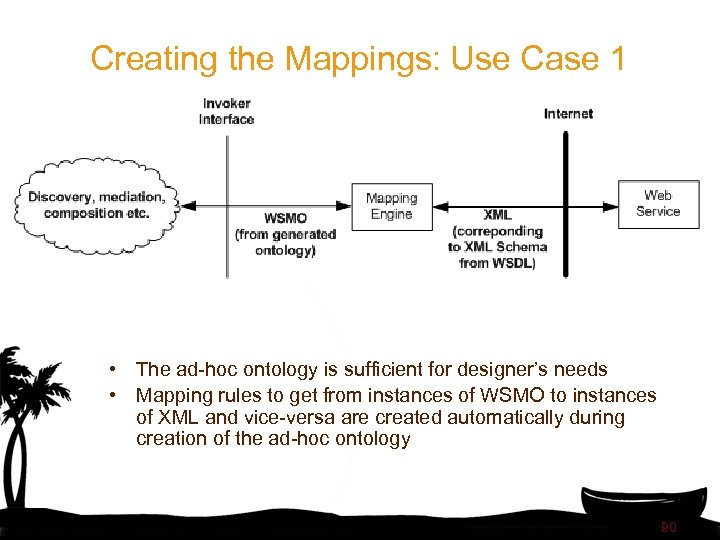
Creating the Mappings: Use Case 1 • The ad-hoc ontology is sufficient for designer’s needs • Mapping rules to get from instances of WSMO to instances of XML and vice-versa are created automatically during creation of the ad-hoc ontology 90
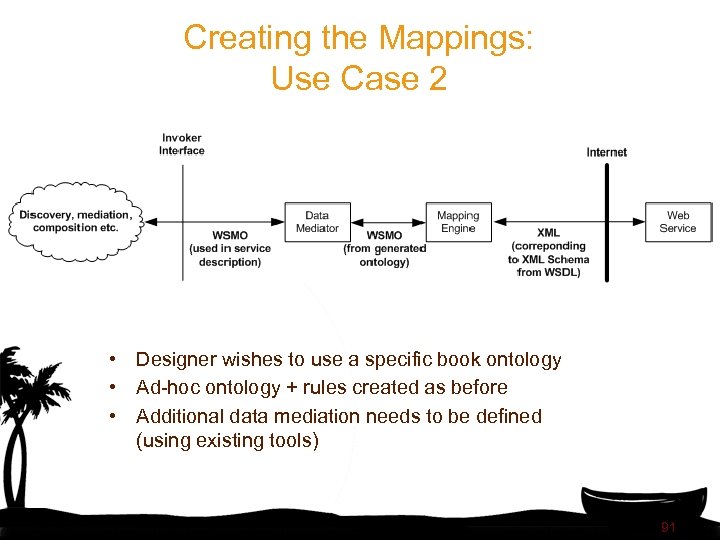
Creating the Mappings: Use Case 2 • Designer wishes to use a specific book ontology • Ad-hoc ontology + rules created as before • Additional data mediation needs to be defined (using existing tools) 91
Some Discussion Points & Next Steps • • • XSLT is powerful but does not take account of semantics Conceptual mapping offers better opportunity for reuse How to deal with structural info during the mapping? – Does a WSMO attribute map back to a sub-element or to an attribute of an element? – How to maintain the element names for the XML Schema – neither an attribute nor a sub-element • • • Need to formalise the mappings Need to extend the mappings Need to define how they mappings should be executed 92
Grounding WSMO Choreography to WSDL • Choreography representation in WSMO – States (made up of concepts) and transitions – Some concepts represent in or out messages • Mode non-functional property – In, out, shared • Grounding non-functional property – Specifies a set of URIs relating to that message – URIs point to WSDL in, out or fault messages • URIs for identifying messages in WSDL 2. 0 http: //example. com/#wsdl. interface. Message. Reference(Printer. Interface/print/In) • • WSDL WSMO – manual (with tool support) WSMO WSDL – auto generation of WSDL 93
WSMO Grounding – Summary • Motivation is to provide the link from WSMO to the WSDL and XML Schema world • Grounding is needed for semantic service designers to describe an existing WSDL service • Looked at a scenario with and without mediation • Three steps in approach – Define mappings from metamodel of XML Schema to that of WSMO – Use the mappings to create ad-hoc WSMO ontologies – During ontology creation, generate mapping rules that can be applied at runtime to lift and lower data instances • Had a quick look at the approach for grounding WSMO choreography 94
Summary 95
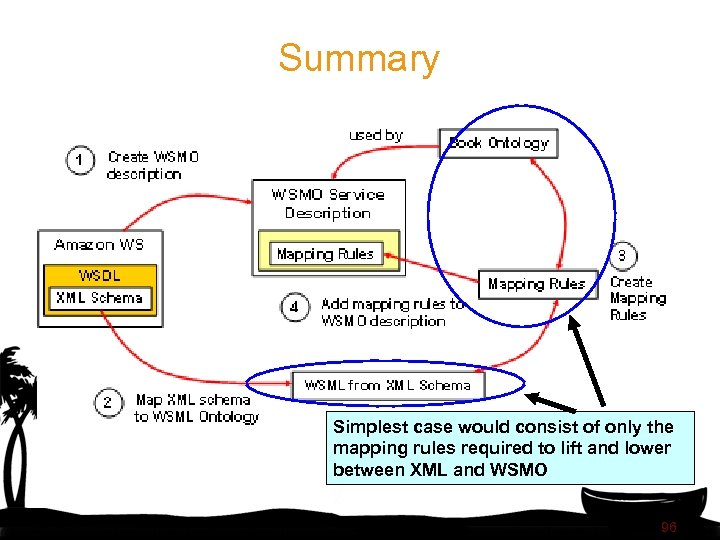
Summary Simplest case would consist of only the mapping rules required to lift and lower between XML and WSMO 96
Part I – summary and conclusions • • WSMO - a conceptual model for SWS and a basis for SWS languages and SWS execution environments; More needs to be done with respect to Web service behavior modeling WSML is a language for modeling of Semantic Web Services; based on the WSMO; WSML is a Web language: – IRIs for object identification – XML datatypes WSML is based on well-known logical formalisms: Description Logics, Logic Programming, and Frame Logic WSML - syntax has two parts: – Conceptual modeling – Arbitrary logical expressions WSML - XML and RDF syntaxes for exchange over the Web WSMO Discovery – a framework for SWS Discovery WSMO Grounding – top-down approach meets the bottom-up real world; under development 97
Part II: WSMO enabled systems and tools; hands-on sessions 98
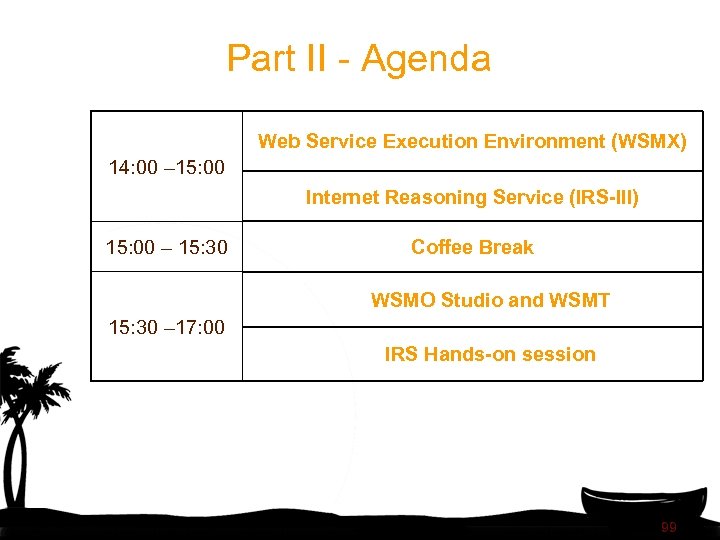
Part II - Agenda Web Service Execution Environment (WSMX) 14: 00 – 15: 00 Internet Reasoning Service (IRS-III) 15: 00 – 15: 30 Coffee Break WSMO Studio and WSMT 15: 30 – 17: 00 IRS Hands-on session 99
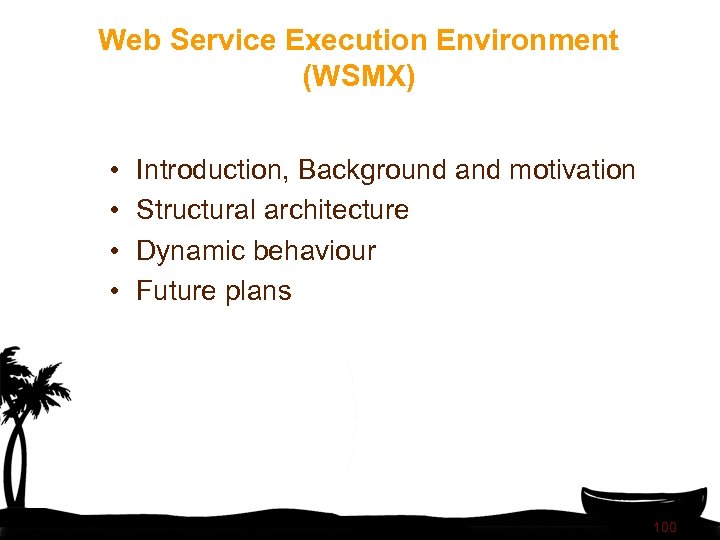
Web Service Execution Environment (WSMX) • • Introduction, Background and motivation Structural architecture Dynamic behaviour Future plans 100
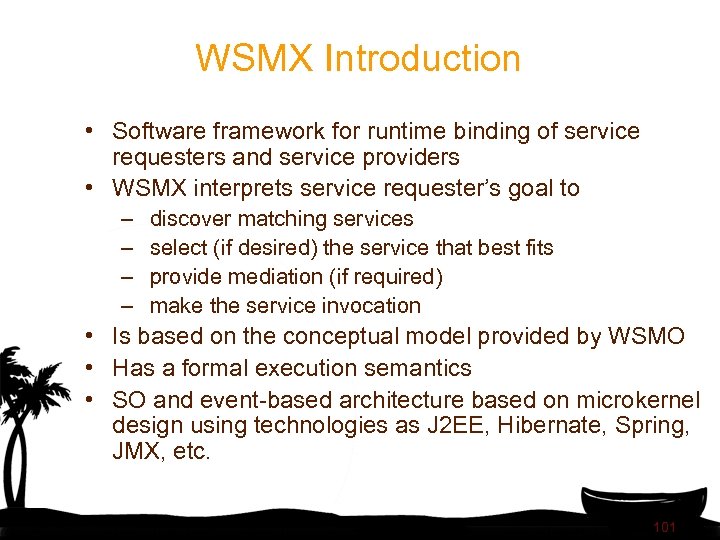
WSMX Introduction • Software framework for runtime binding of service requesters and service providers • WSMX interprets service requester’s goal to – – discover matching services select (if desired) the service that best fits provide mediation (if required) make the service invocation • Is based on the conceptual model provided by WSMO • Has a formal execution semantics • SO and event-based architecture based on microkernel design using technologies as J 2 EE, Hibernate, Spring, JMX, etc. 101
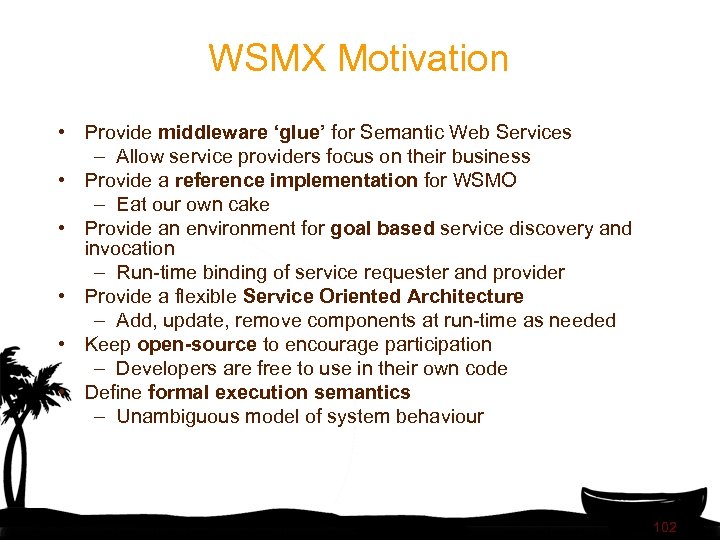
WSMX Motivation • Provide middleware ‘glue’ for Semantic Web Services – Allow service providers focus on their business • Provide a reference implementation for WSMO – Eat our own cake • Provide an environment for goal based service discovery and invocation – Run-time binding of service requester and provider • Provide a flexible Service Oriented Architecture – Add, update, remove components at run-time as needed • Keep open-source to encourage participation – Developers are free to use in their own code • Define formal execution semantics – Unambiguous model of system behaviour 102
WSMX Usage Scenario - P 2 P • • • A P 2 P network of WSMX ‘nodes’ Each WSMX node described as a SWS Communication via WSML over SOAP Distributed discovery – first aim Longer term aim - distributed execution environment 104
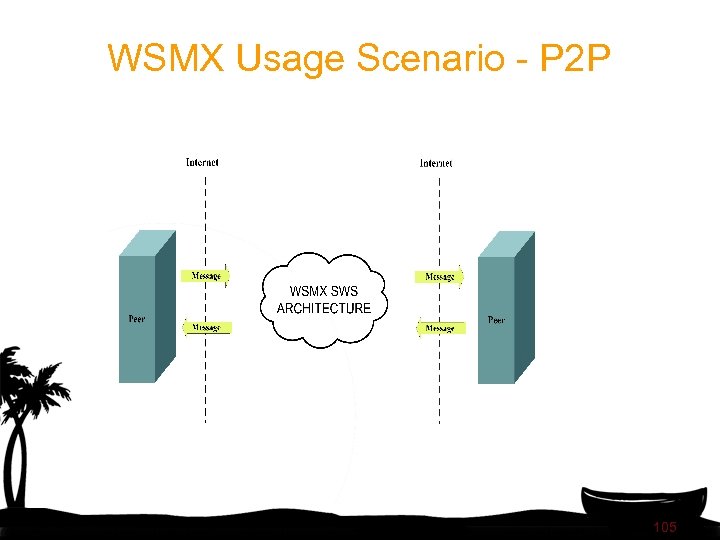
WSMX Usage Scenario - P 2 P 105
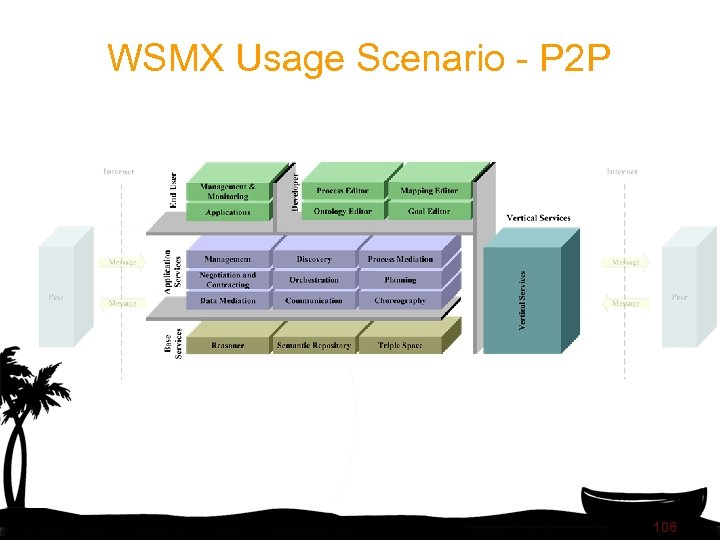
WSMX Usage Scenario - P 2 P 106
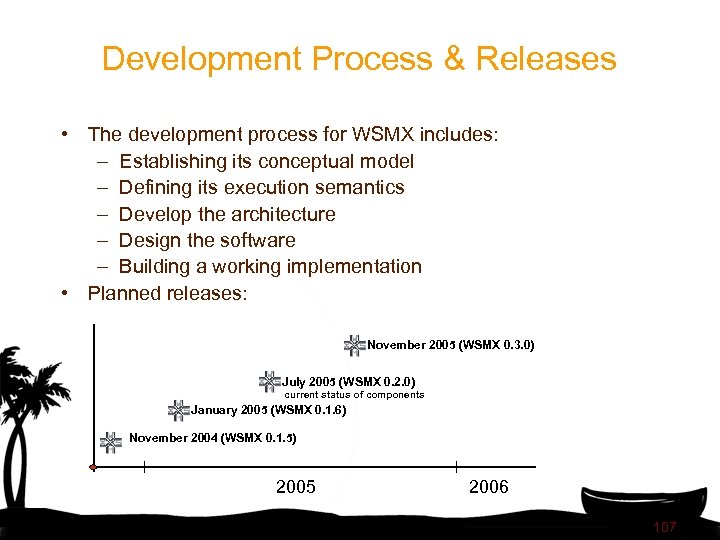
Development Process & Releases • The development process for WSMX includes: – Establishing its conceptual model – Defining its execution semantics – Develop the architecture – Design the software – Building a working implementation • Planned releases: November 2005 (WSMX 0. 3. 0) July 2005 (WSMX 0. 2. 0) current status of components January 2005 (WSMX 0. 1. 6) November 2004 (WSMX 0. 1. 5) 2005 2006 107
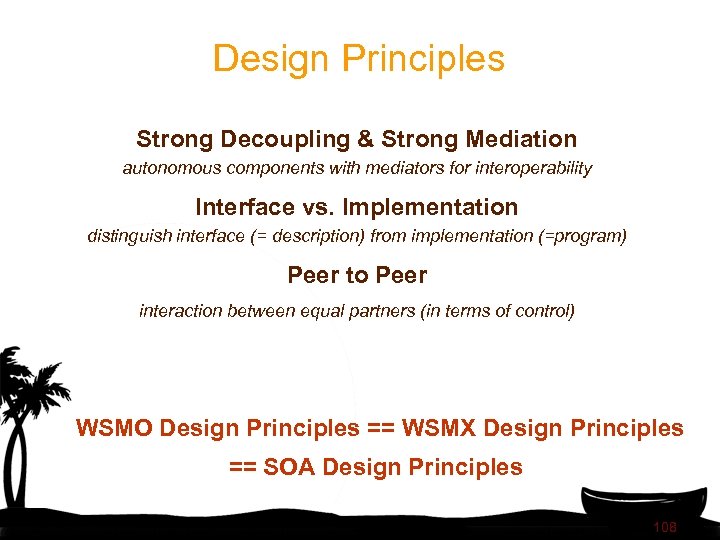
Design Principles Strong Decoupling & Strong Mediation autonomous components with mediators for interoperability Interface vs. Implementation distinguish interface (= description) from implementation (=program) Peer to Peer interaction between equal partners (in terms of control) WSMO Design Principles == WSMX Design Principles == SOA Design Principles 108
Benefits of SOA • Better reuse – Build new functionality (new execution semantics) on top of existing Business Services • Well defined interfaces – Manage changes without affecting the Core System • Easier Maintainability – Changes/Versions are not all-or-nothing • Better Flexibility 109
Service Oriented State • The interface to the service is implementationindependent • The service can be dynamically invoked – Runtime binding • The service is self-contained – Maintains its own state 110
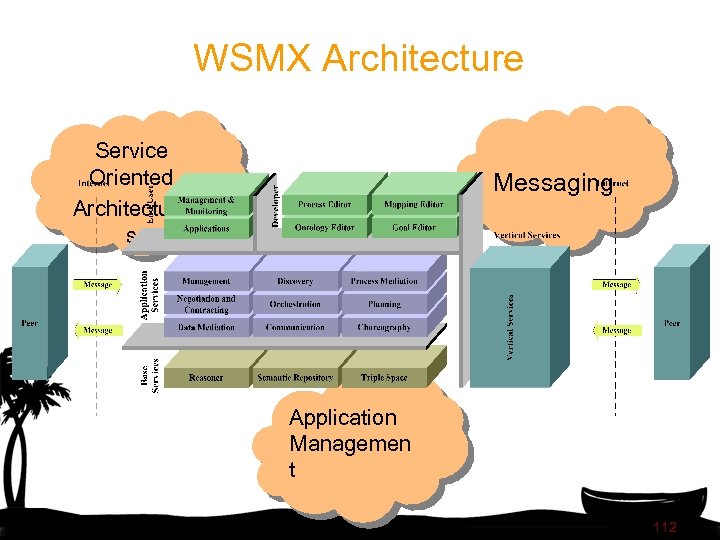
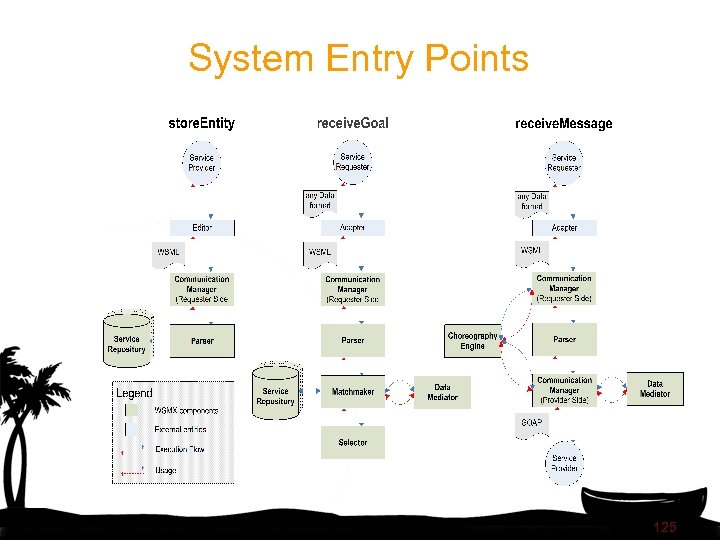
WSMX Architecture Service Oriented Architecture s Messaging Application Managemen t 112
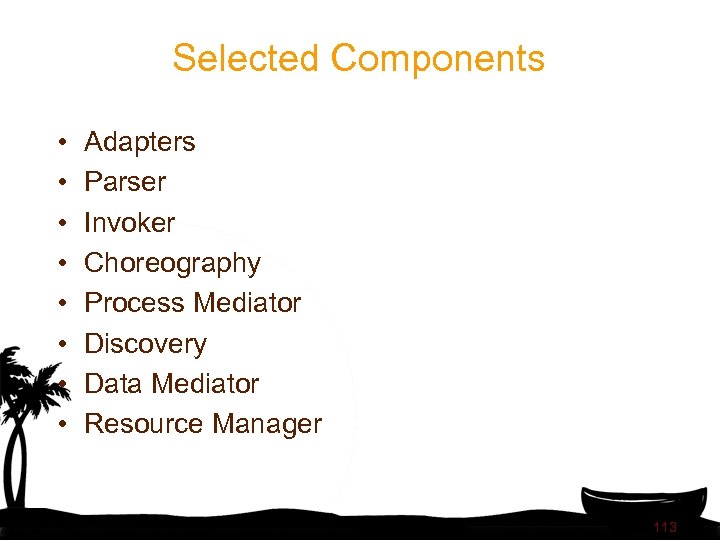
Selected Components • • Adapters Parser Invoker Choreography Process Mediator Discovery Data Mediator Resource Manager 113
Adapters • To overcome data representation mismatches on the communication layer • Transforms the format of a received message into WSML compliant format • Based on mapping rules 114
Parser • WSML compliant parser – Code handed over to wsmo 4 j initiative http: //wsmo 4 j. sourceforge. net/ • Validates WSML description files • Compiles WSML description into internal memory model • Stores WSML description persistently (using Resource Manager) 115
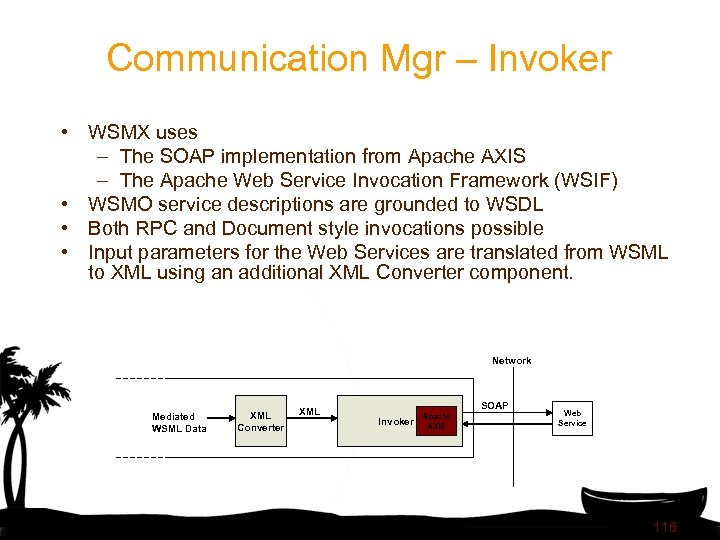
Communication Mgr – Invoker • WSMX uses – The SOAP implementation from Apache AXIS – The Apache Web Service Invocation Framework (WSIF) • WSMO service descriptions are grounded to WSDL • Both RPC and Document style invocations possible • Input parameters for the Web Services are translated from WSML to XML using an additional XML Converter component. Network Mediated WSML Data XML Converter XML SOAP Invoker Apache AXIS Web Service 116
Choreography • Requester and provider have their own observable communication patterns – Choreography part of WSMO • A choreography instance is loaded for each – Both requester and provider have their own WSMO descriptions • The Choreography component examines a service’s choreography to determine next step in communication • The Choreography component raises events for the Invoker to make actual service invocations 117
Process Mediator • Requester and provider have their own communication patterns • Only if the two match precisely, a direct communication may take place • At design time equivalences between the choreographies’ conceptual descriptions is determined and stored as set of rules • The Process Mediator provides the means for runtime analyses of two choreography instances and uses mediators to compensate possible mismatches 118
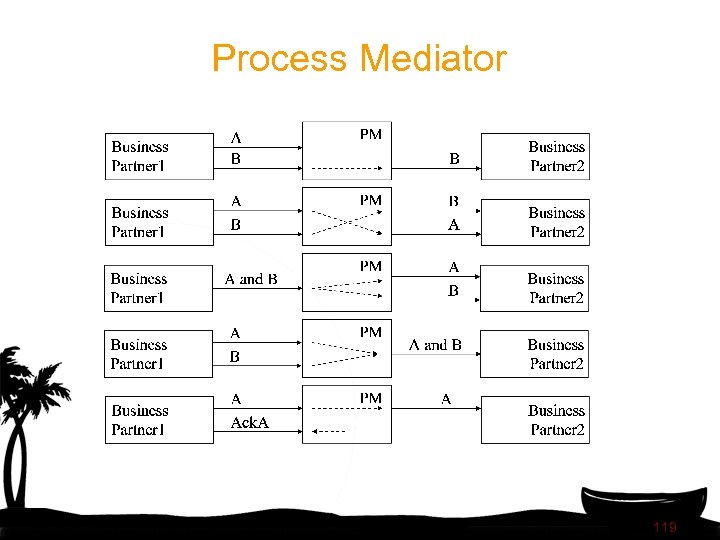
Process Mediator 119
Discovery • Responsible for finding appropriate Web Services to achieve a goal (discovery) • Current discovery component is based on simple matching • Advanced semantic discovery in prototypical stage 120
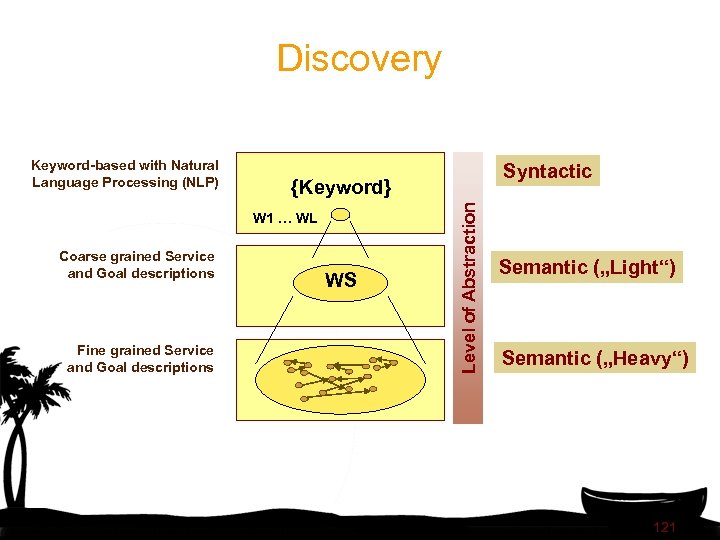
Discovery {Keyword} W 1 … WL Coarse grained Service and Goal descriptions Fine grained Service and Goal descriptions Syntactic WS Level of Abstraction Keyword-based with Natural Language Processing (NLP) Semantic („Light“) Semantic („Heavy“) 121
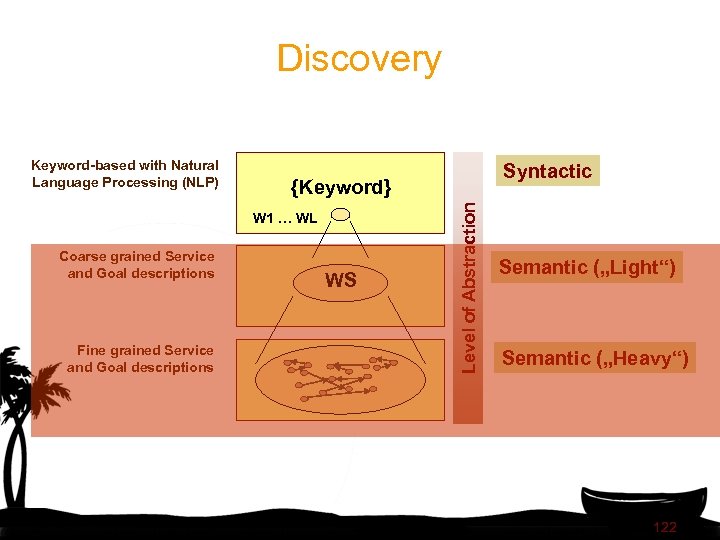
Discovery {Keyword} W 1 … WL Coarse grained Service and Goal descriptions Fine grained Service and Goal descriptions Syntactic WS Level of Abstraction Keyword-based with Natural Language Processing (NLP) Semantic („Light“) Semantic („Heavy“) 122
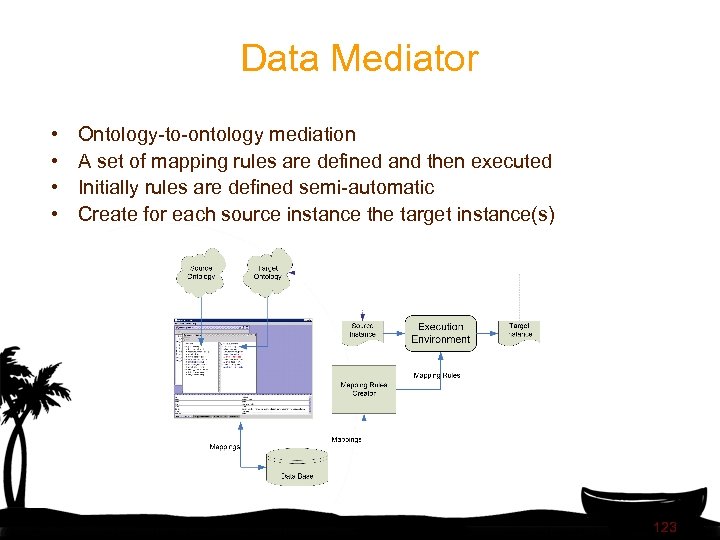
Data Mediator • • Ontology-to-ontology mediation A set of mapping rules are defined and then executed Initially rules are defined semi-automatic Create for each source instance the target instance(s) 123
Resource Manager • Stores internal memory model to a data store • Decouples storage mechanism from the rest of WSMX • Data model is compliant to WSMO API • Independent of any specific data store implementation i. e. database and storage mechanism 124
System Entry Points 125
Define “Business” Process 126
Generate Wrappers for Components 127
Context Data 128
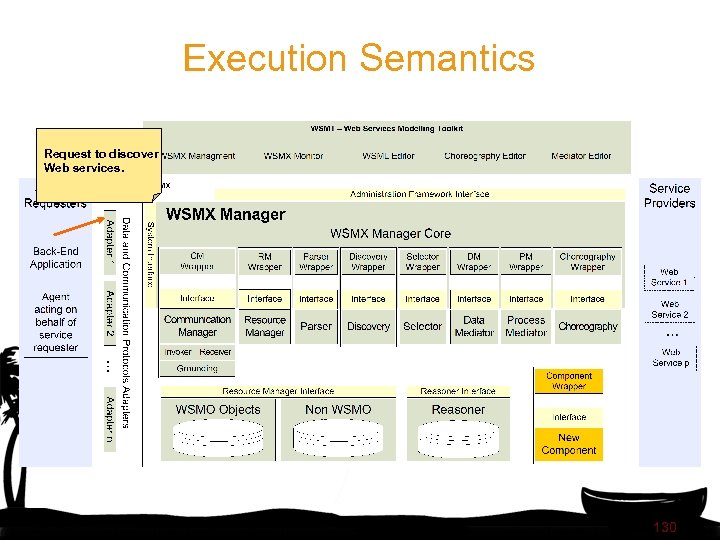
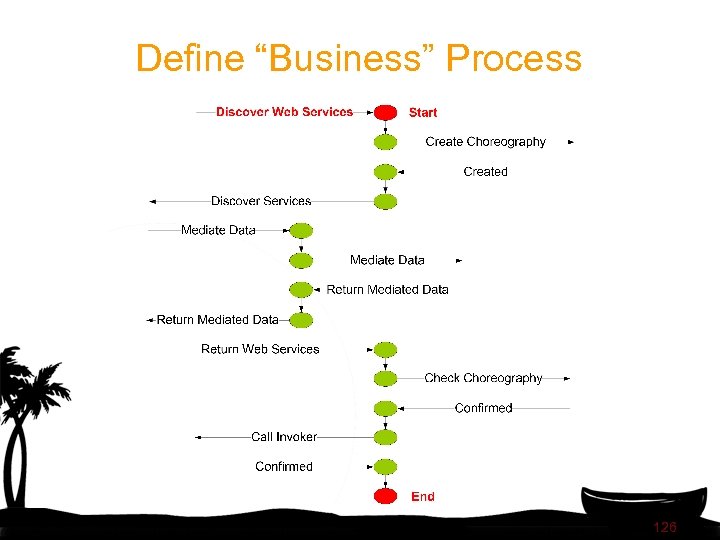
Execution Semantics Request to discover Web services. 130
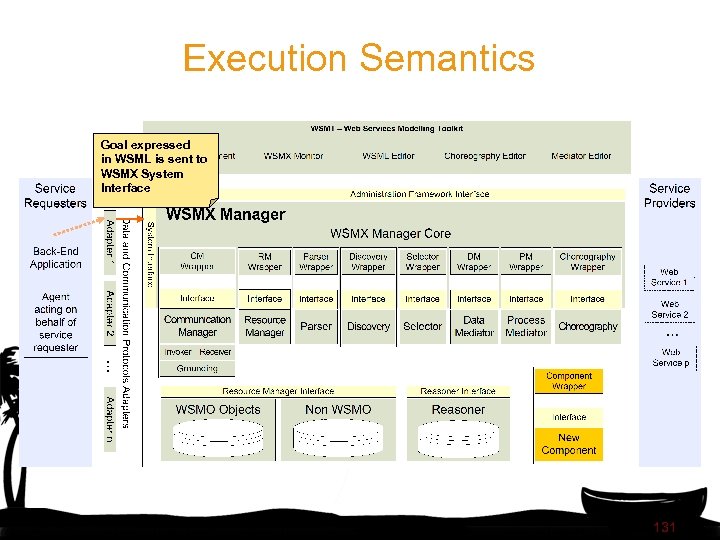
Execution Semantics Goal expressed in WSML is sent to WSMX System Interface 131
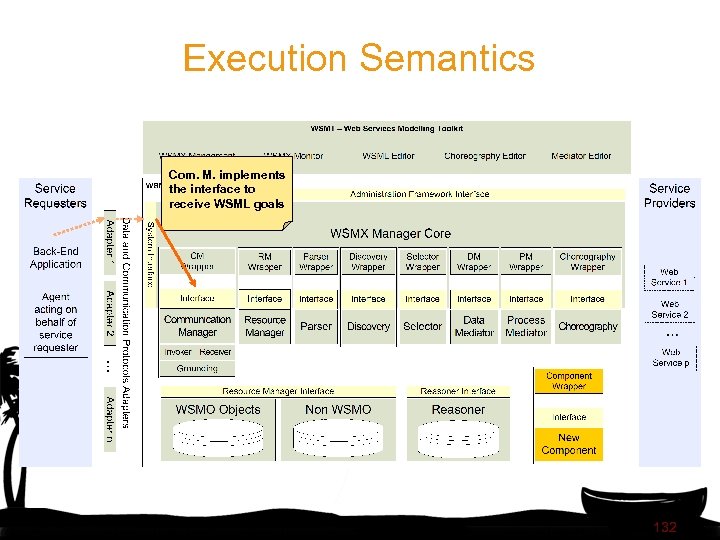
Execution Semantics Com. M. implements the interface to receive WSML goals 132
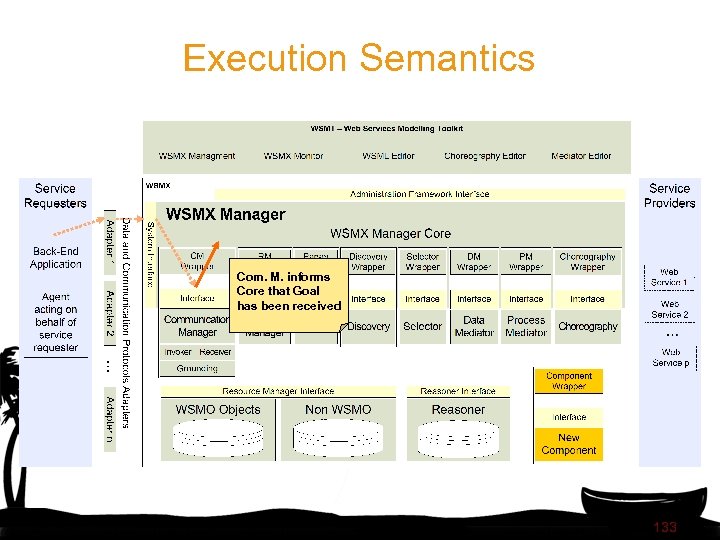
Execution Semantics Com. M. informs Core that Goal has been received 133
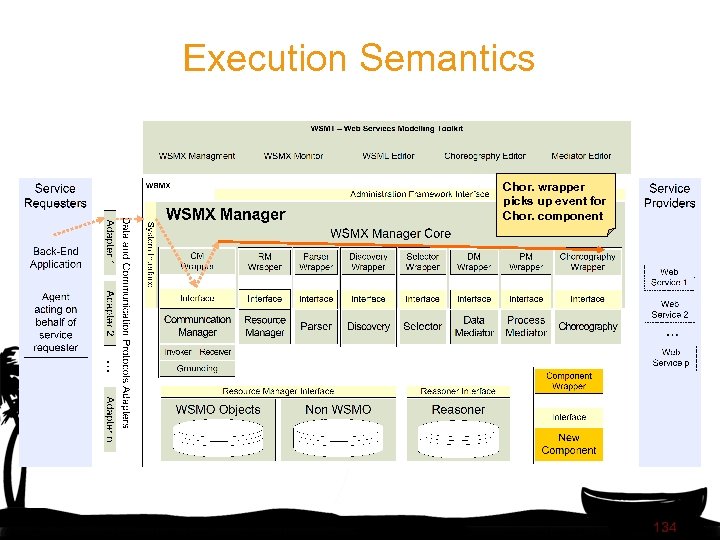
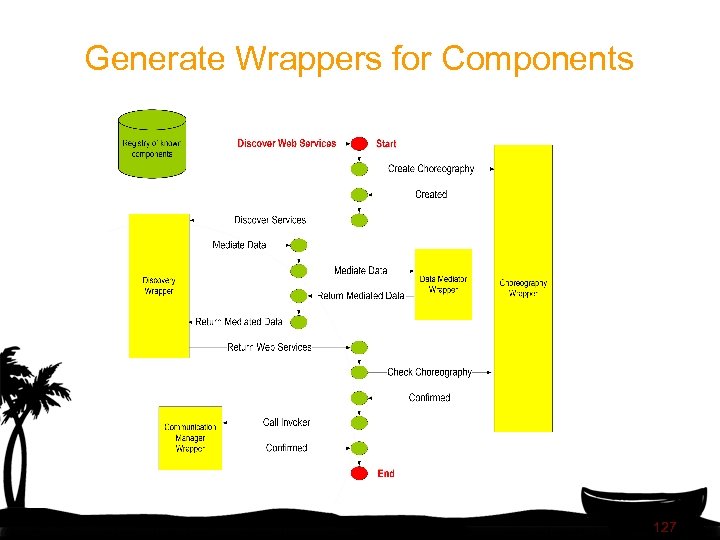
Execution Semantics Chor. wrapper picks up event for Chor. component 134
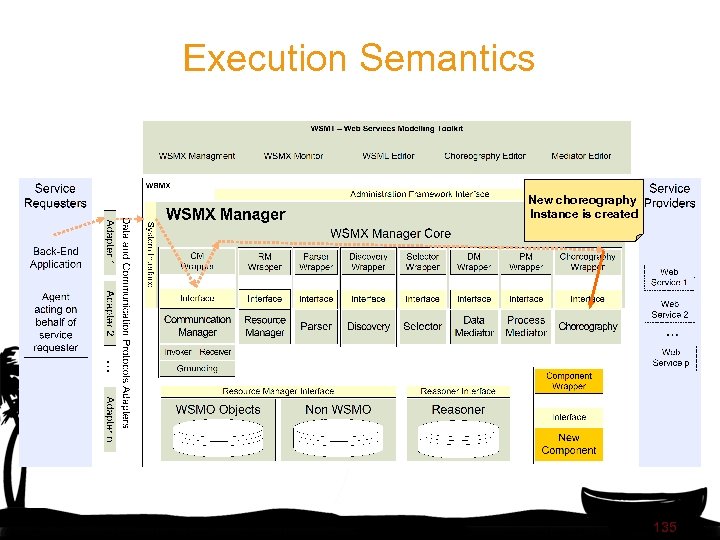
Execution Semantics New choreography Instance is created 135
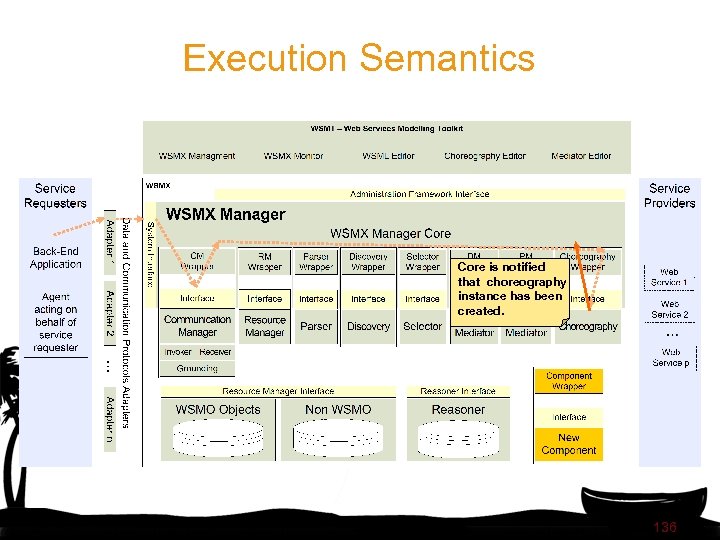
Execution Semantics Core is notified that choreography instance has been created. 136
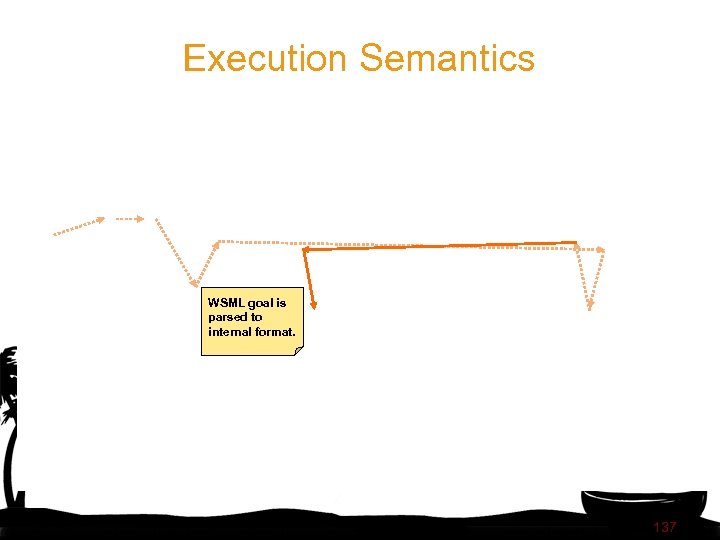
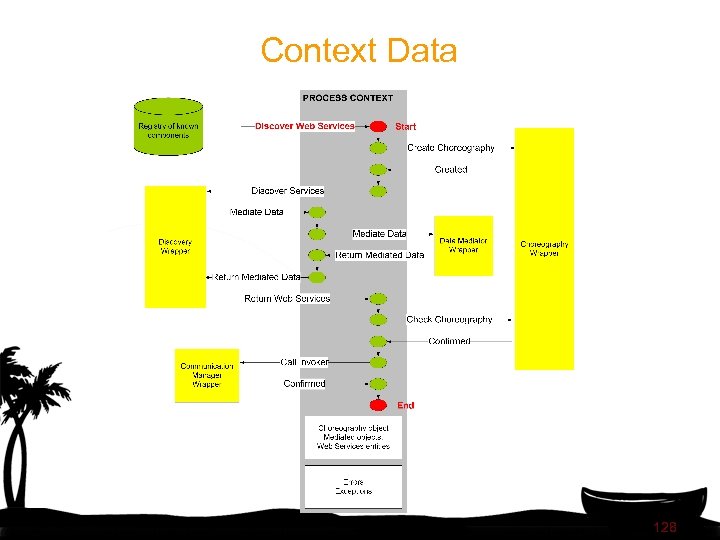
Execution Semantics WSML goal is parsed to internal format. 137
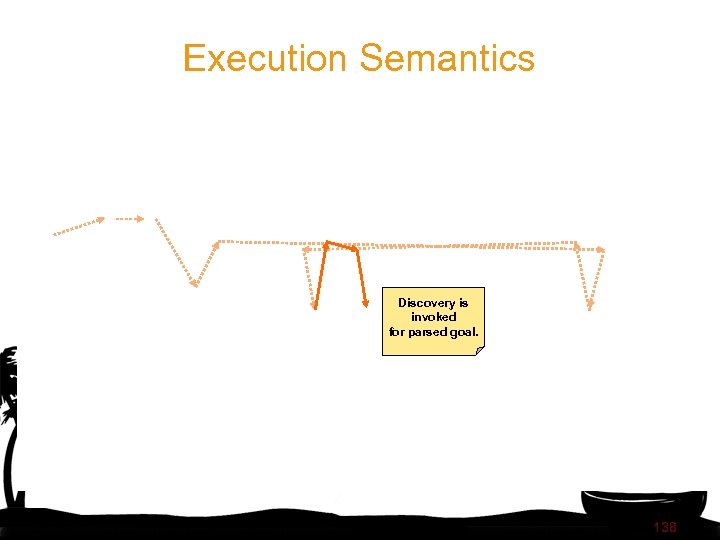
Execution Semantics Discovery is invoked for parsed goal. 138
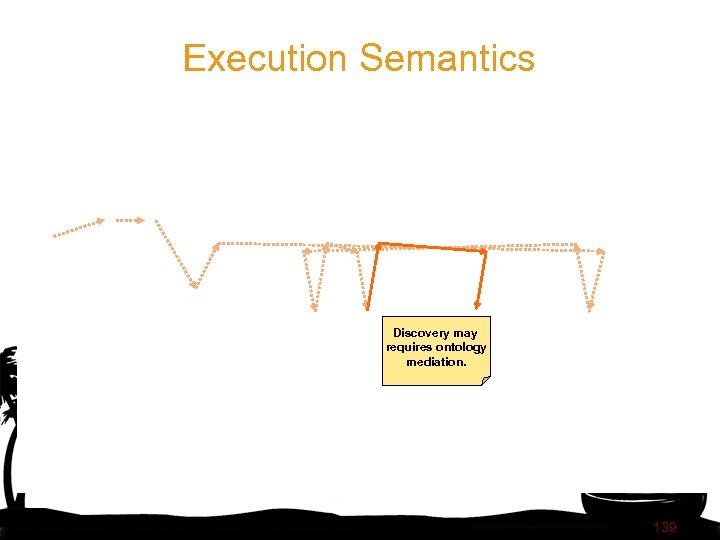
Execution Semantics Discovery may requires ontology mediation. 139
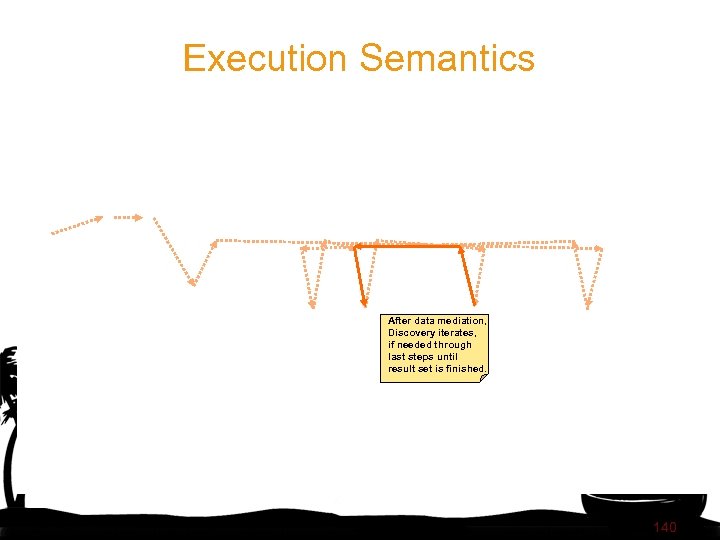
Execution Semantics After data mediation, Discovery iterates, if needed through last steps until result set is finished. 140
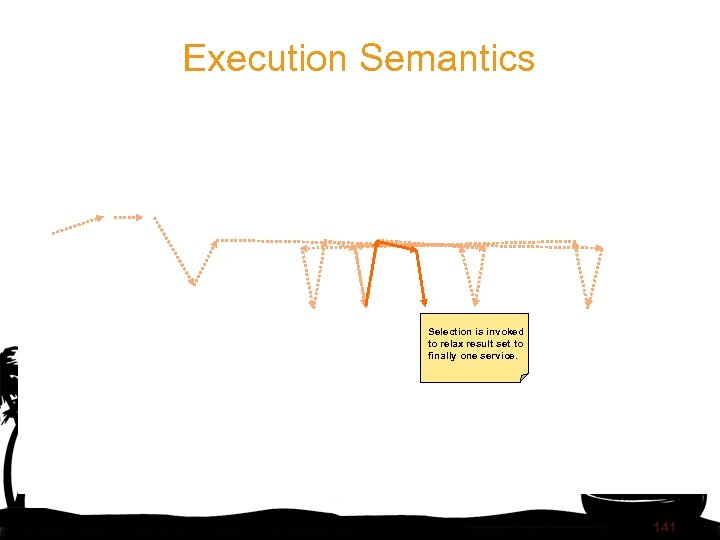
Execution Semantics Selection is invoked to relax result set to finally one service. 141
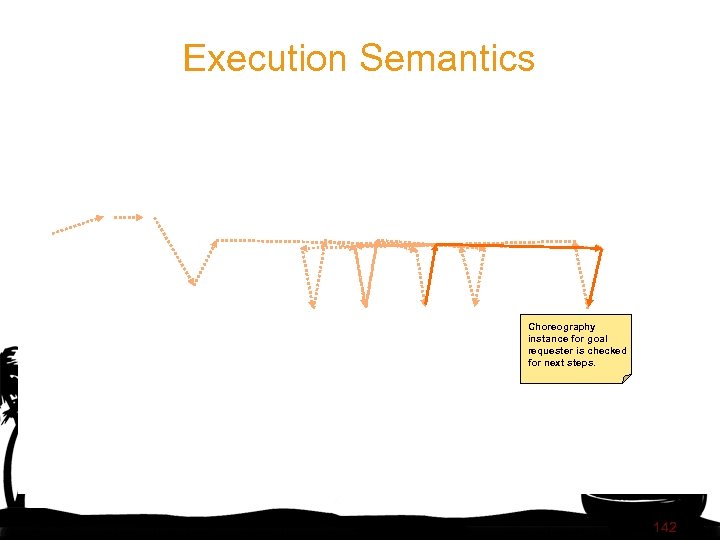
Execution Semantics Choreography instance for goal requester is checked for next steps. 142
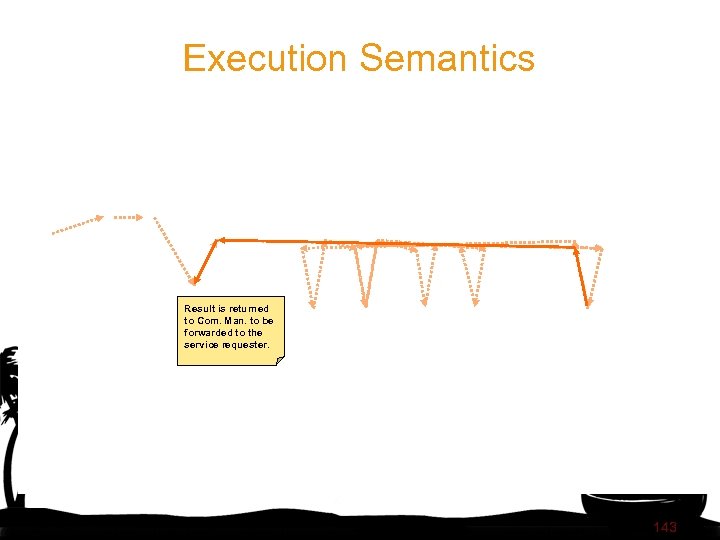
Execution Semantics Result is returned to Com. Man. to be forwarded to the service requester. 143
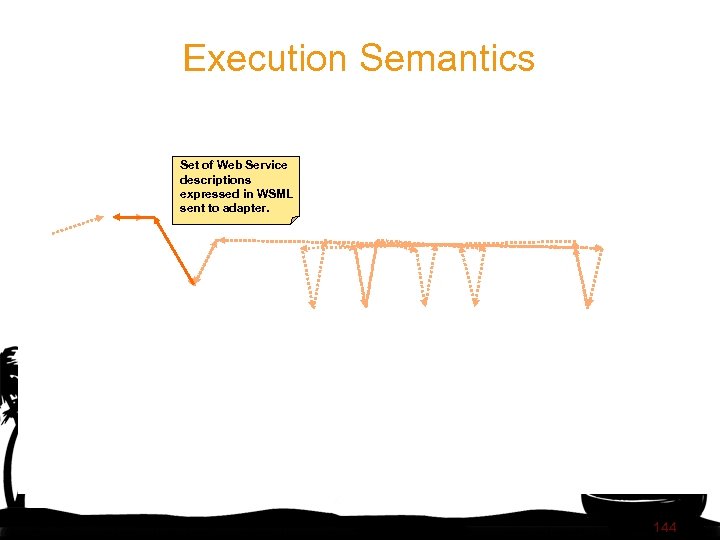
Execution Semantics Set of Web Service descriptions expressed in WSML sent to adapter. 144
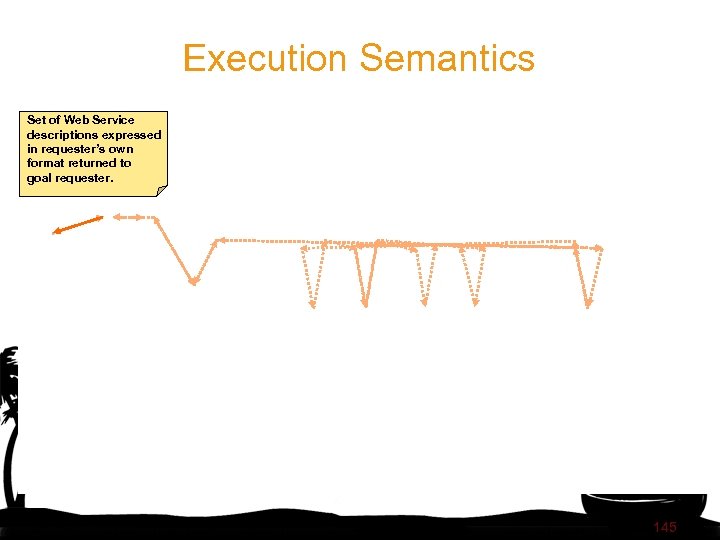
Execution Semantics Set of Web Service descriptions expressed in requester’s own format returned to goal requester. 145
WSMX Usage Scenario - P 2 P • Complete the functionality for all the boxes 146
WSMX Conclusions • • Conceptual model is WSMO End to end functionality for executing SWS Has a formal execution semantics Real implementation Open source code base at Source. Forge Event-driven component architecture Growing functionality - developers welcome 147
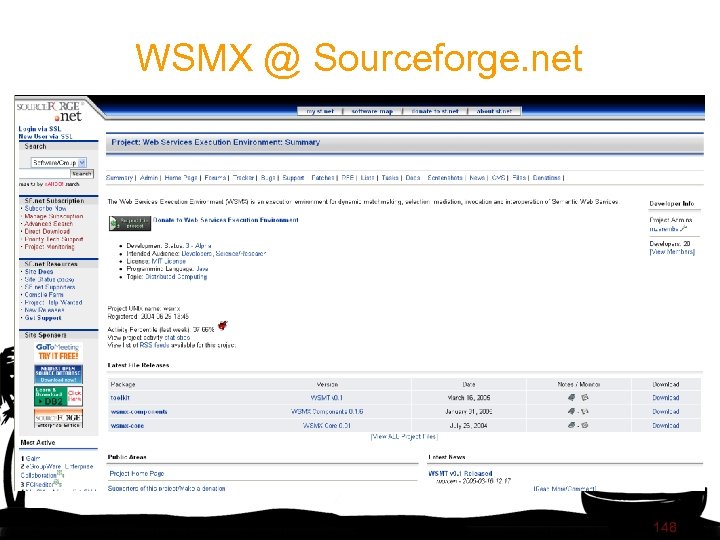
WSMX @ Sourceforge. net 148
IRS-III: A framework and platform for building Semantic Web Services 149
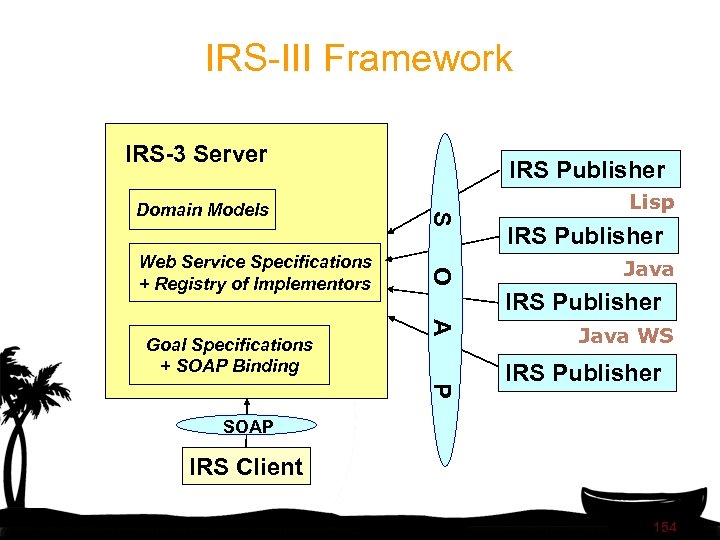
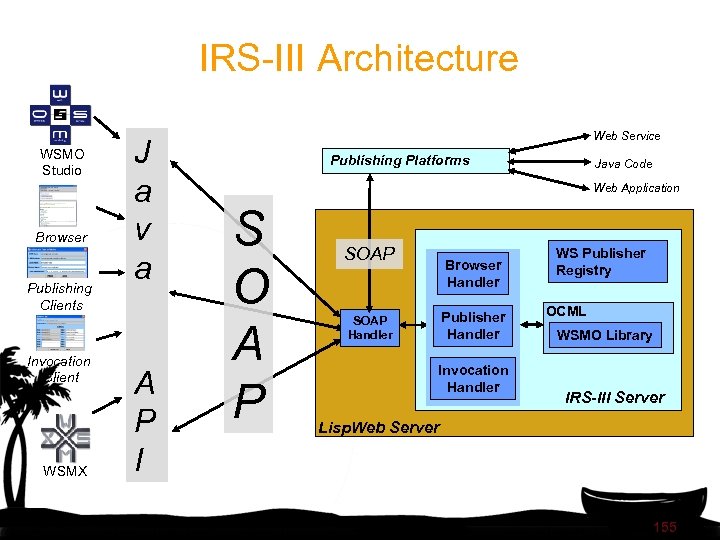
IRS-III • IRS-III: The Internet Reasoning Service is an infrastructure for publishing, locating, executing and composing Semantic Web Services • Internet Reasoning Service (IRS-III): – System overview – Demonstration 150
Design Principles • • • Ontological separation of User and Web Service Contexts Capability Based Invocation Ease of Use One Click Publishing Agnostic to Service Implementation Platform Connected to External Environment Open Complete Descriptions Inspectable Interoperable with SWS Frameworks and Platforms 151
Features of IRS-III (1/2) • Based on Soap messaging standard • Provides Java API for client applications • Provides built-in brokering and service discovery support • Provides capability-centred service invocation 152
Features of IRS-III (2/2) • Publishing support for variety of platforms – Java, Lisp, Web Applications, Java Web Services • Enables publication of ‘standard code’ – Provides clever wrappers – One-click publishing of web services • Integrated with standard Web Services world – Semantic web service to IRS – ‘Ordinary’ web service 153
IRS-III Framework IRS-3 Server Lisp IRS Publisher Java IRS Publisher A Goal Specifications + SOAP Binding O Web Service Specifications + Registry of Implementors S Domain Models IRS Publisher Java WS P IRS Publisher SOAP IRS Client 154
IRS-III Architecture WSMO Studio Browser Publishing Clients Invocation Client WSMX J a v a A P I Web Service Publishing Platforms Java Code Web Application S O A P SOAP Browser Handler Publisher Handler SOAP Handler Invocation Handler WS Publisher Registry OCML WSMO Library IRS-III Server Lisp. Web Server 155
European Travel Scenario 156
European Travel Demo 157
IRS-III/WSMO differences • Underlying language OCML • Goals have inputs and outputs • IRS-III broker finds applicable Web Services via Mediators – Used mediator within WS capability – Mediator source = Goal • Web Services have inputs and outputs ‘inherited’ from goal descriptions • Web Service selected via assumption (in capability) 158
WSMO Studio and WSMT 159
WSMO Studio • Integrated Service Environment for WSMO • http: //www. wsmostudio. org • Provide easy to use GUI for various WSMO tasks – Working with ontologies – Creating WSMO descriptions: goals, services, mediators – Creating WSMO centric orchestration and choreography specifications – Import (export) from (to) various formats – Front-end for ontology and service repositotories – Front-end for runtime SWS environments (WSMX, IRS-III) 160
Requirements for an ISE • Modular design – Different users need to customise the functionality in a specific way – Easier to maintain (e. g. ship new versions and bugfixes) – More suitable for 3 rd party contributions • Extensibility – SWS is an emerging domain – It is difficult to specify requirements and functionality affront • Architecture based on open standards – Lowers the cost of adopting / integrating a tool – 3 rd party extensions and improvements are more likely to occur • Flexible licensing – An Open Source licence improves the adoption rate 161
WSMO Studio • Java based implementation • Open Source core – LGPL – 3 rd party contributors are free to choose their respective licensing terms • Modular design – an Eclipse based plug-in architecture • Extensible – 3 rd parties may contribute new functionality (plug-ins) or modify existing functionality 162
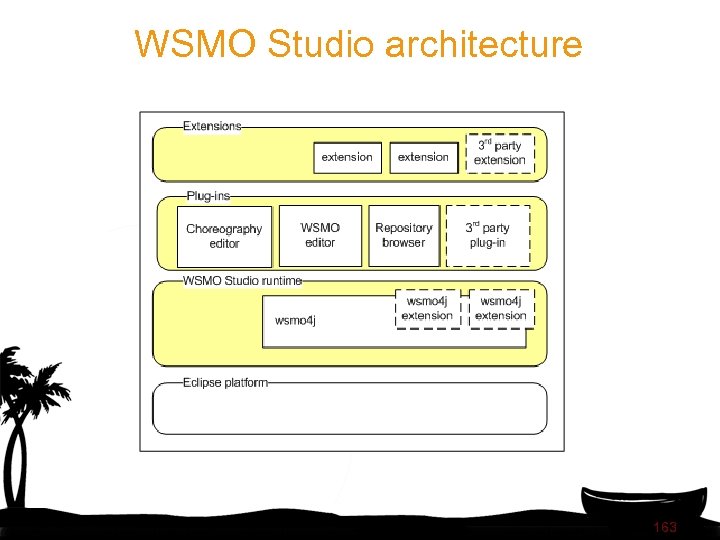
WSMO Studio architecture 163
WSMT • The Web Services Modeling Toolkit (WSMT) is a collection of tools for Semantic Web services implemented in the Eclipse framework. • Three different collections of tools: – WSML Perspective for creating and managing WSML descriptions – Data Mediation Perspective for creating mappings that can be used for runtime instance transformation – WSMX Perspective for managing and monitoring the Web Service Execution Environent (WSMX) 164
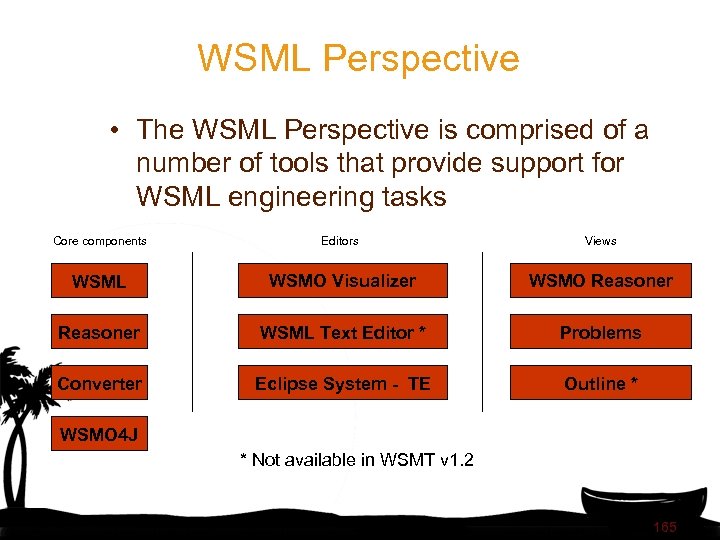
WSML Perspective • The WSML Perspective is comprised of a number of tools that provide support for WSML engineering tasks Core components Editors Views WSML WSMO Visualizer WSMO Reasoner WSML Text Editor * Problems Converter Eclipse System - TE Outline * WSMO 4 J * Not available in WSMT v 1. 2 165
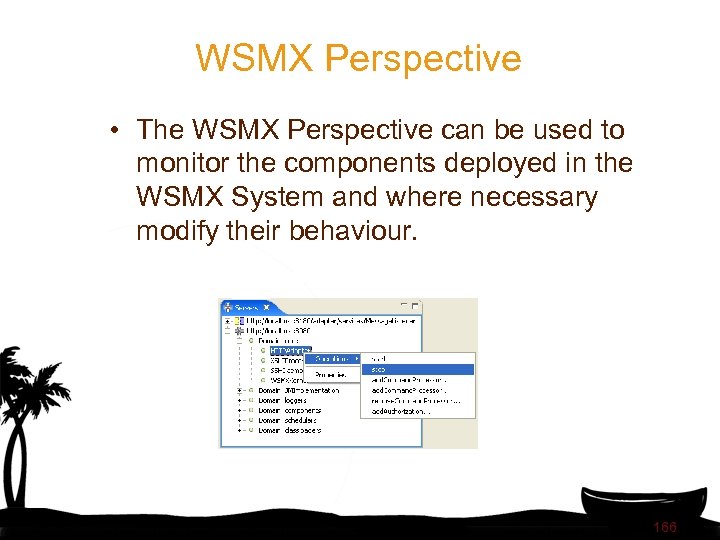
WSMX Perspective • The WSMX Perspective can be used to monitor the components deployed in the WSMX System and where necessary modify their behaviour. 166
WSMT • WSMT is available from : http: //wsmt. sourceforge. net • Current licensing model is GPL • Licensing Model is currently being revised to give more flexibility • WSMT will be integrated with Distributed Ontology Management Environment (DOME) in the coming months. • WSMT toolset is complementary to that in WSMO Studio 167
Semantic Web Services Hands-On Introduction 168
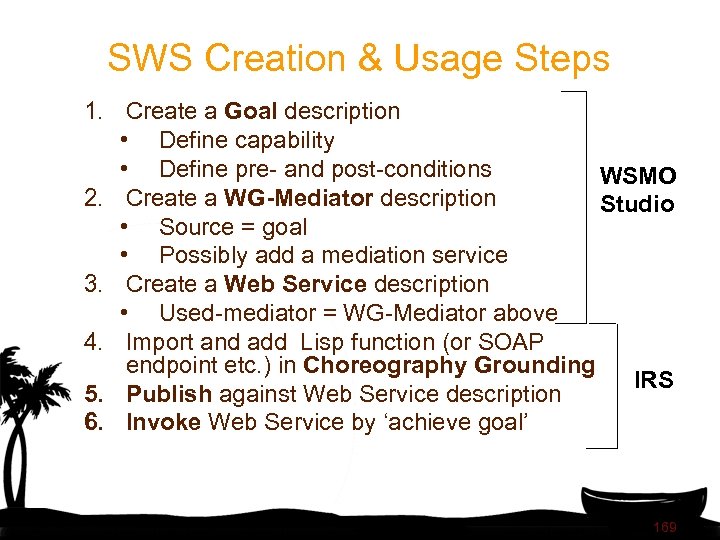
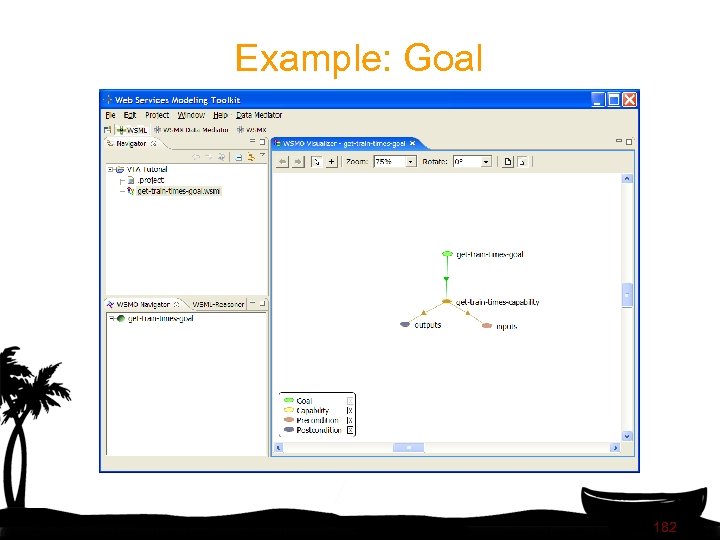
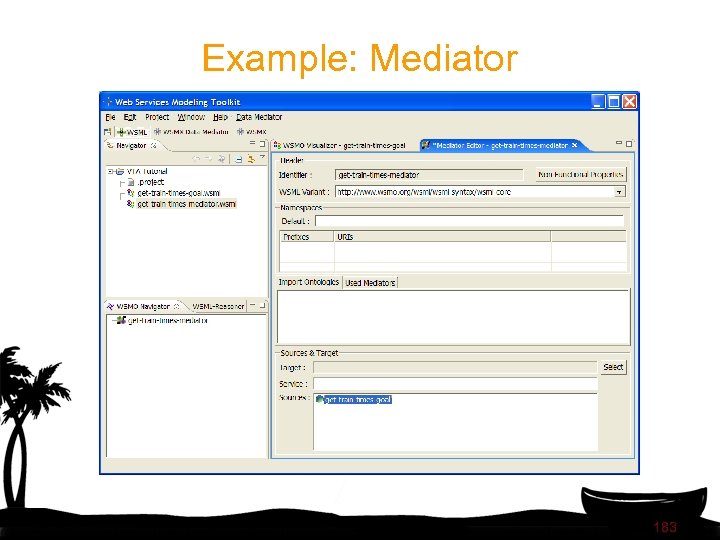
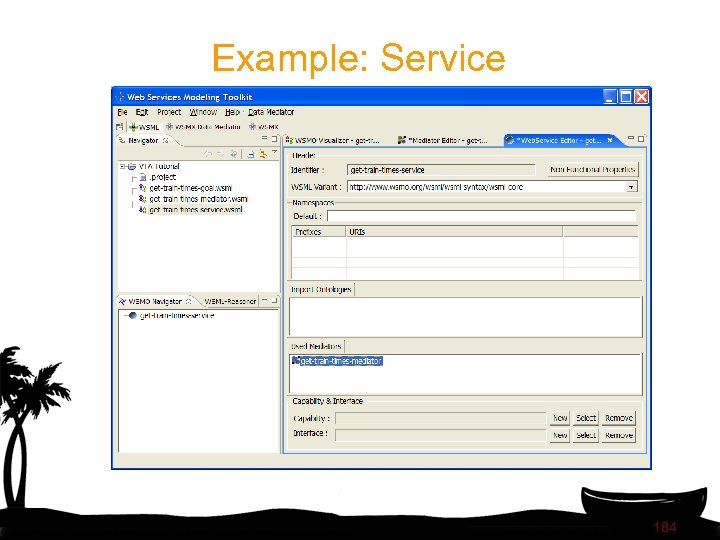
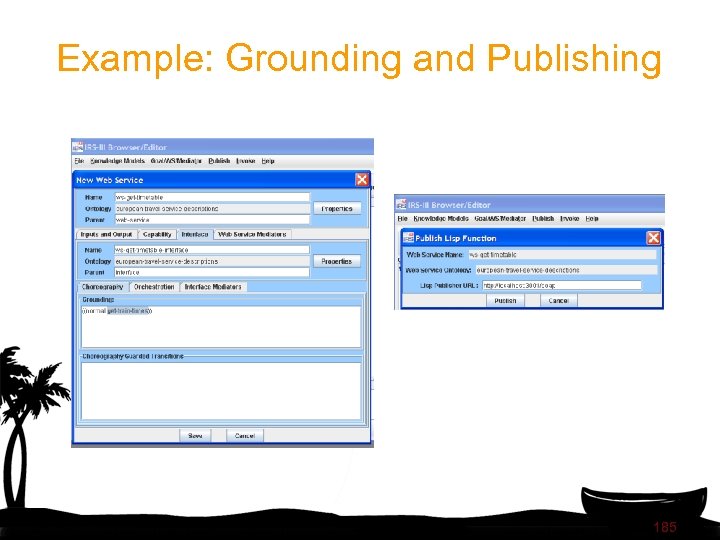
SWS Creation & Usage Steps 1. Create a Goal description • Define capability • Define pre- and post-conditions WSMO 2. Create a WG-Mediator description Studio • Source = goal • Possibly add a mediation service 3. Create a Web Service description • Used-mediator = WG-Mediator above 4. Import and add Lisp function (or SOAP endpoint etc. ) in Choreography Grounding IRS 5. Publish against Web Service description 6. Invoke Web Service by ‘achieve goal’ 169
Multiple WS for goal • Each Web Service has a WG-Mediator in used-mediator slot – some Web Services may share a Mediator • Each Web Service carries Assumptions over its inputs – in IRS these are defined in OCML • Web Service chosen for Goal according to these Assumptions = Capability-Driven Invocation 170
Defining a Mediation Service • Mediation Goal defines necessary transformation between Goal and Service – Mediation Goal input roles are a subset of Goal’s input roles • WG-Mediator has Mediation Goal as source • Mediation Service uses this mediator • WG-Mediator linking Goal and its Service has Mediation Goal in ‘uses mediation service’ slot 171
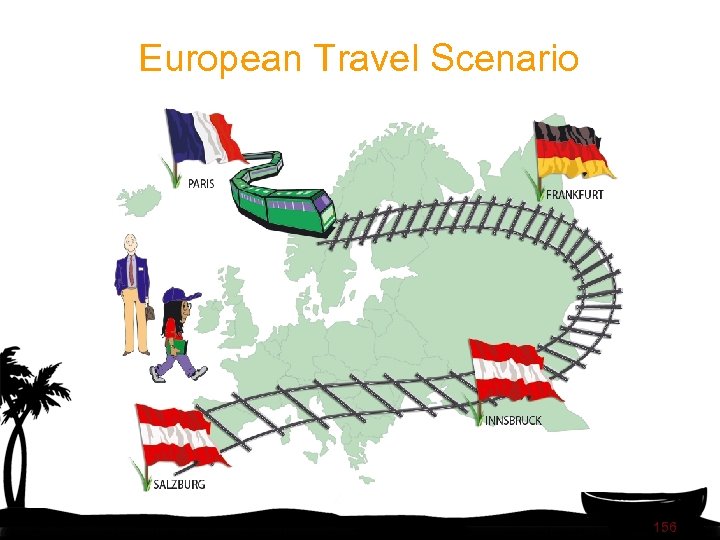
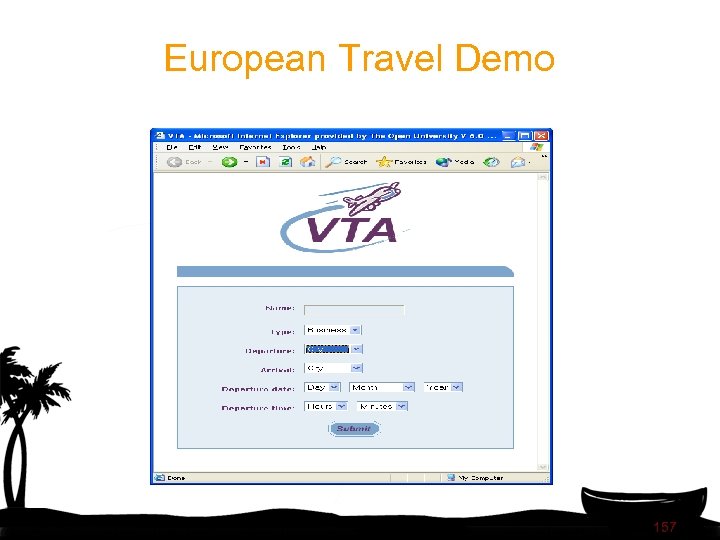
IRS-III Hands On Task • Develop an application for the European Travel scenario based on SWS. The application should support a person booking a train ticket between 2 European cities at a specific time and date • Create Goal, Web service and Mediator WSMO descriptions in WSMO Studio • Import definitions into IRS-III ‘european-travel-service-descriptions’ ontology • In IRS Browser ground (to Lisp functions) and add (OCML) assumptions to services, then deploy. • Invoke the web services 172
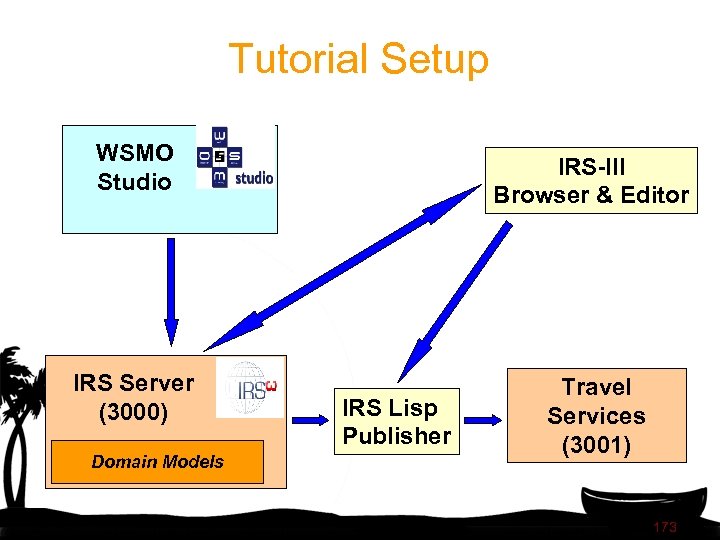
Tutorial Setup WSMO Studio IRS Server (3000) Domain Models IRS-III Browser & Editor IRS Lisp Publisher Travel Services (3001) 173
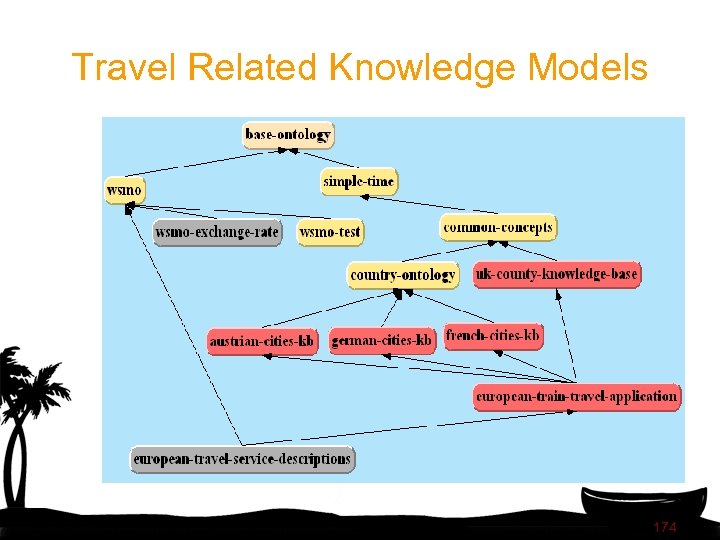
Travel Related Knowledge Models 174
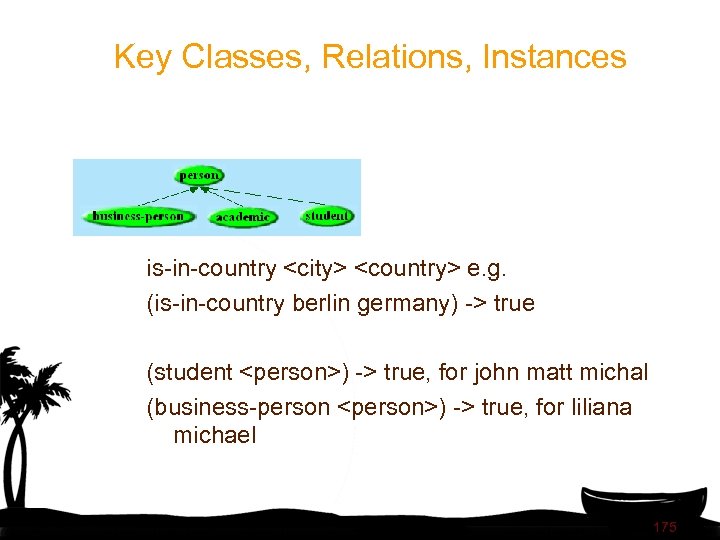
Key Classes, Relations, Instances is-in-country <city> <country> e. g. (is-in-country berlin germany) -> true (student <person>) -> true, for john matt michal (business-person <person>) -> true, for liliana michael 175
Goals 1 - Get train timetable – Inputs: origin and destination cities (city), date (dateand-time, e. g. (18 4 2004)) – Output: timetable (string) 2 - Book train – Inputs: passenger name (person), origin and destination cities, departure time-date (list-date-andtime, e. g. (20 33 16 15 9 2004)) – Output: booking information (string) 176
Services • 1 service available for goal 1 – No constraints • 6 services available for goal 2 – As a provider write the constraints applicable to the services to satisfy the goal (assumption logical expressions) • 1 wg-mediator mediation-service – Used to convert time in list format to time in universal format 177
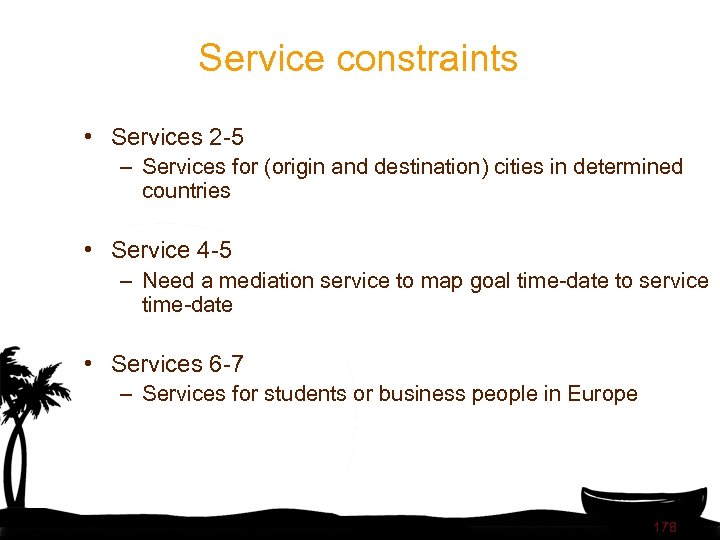
Service constraints • Services 2 -5 – Services for (origin and destination) cities in determined countries • Service 4 -5 – Need a mediation service to map goal time-date to service time-date • Services 6 -7 – Services for students or business people in Europe 178
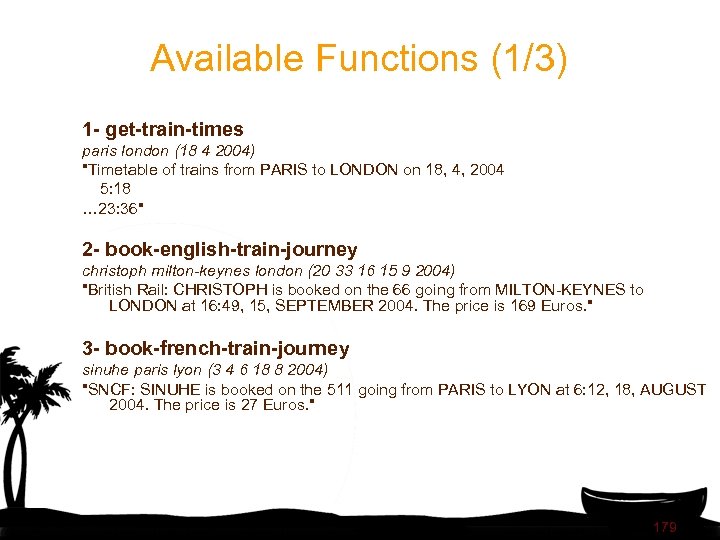
Available Functions (1/3) 1 - get-train-times paris london (18 4 2004) "Timetable of trains from PARIS to LONDON on 18, 4, 2004 5: 18 … 23: 36" 2 - book-english-train-journey christoph milton-keynes london (20 33 16 15 9 2004) "British Rail: CHRISTOPH is booked on the 66 going from MILTON-KEYNES to LONDON at 16: 49, 15, SEPTEMBER 2004. The price is 169 Euros. " 3 - book-french-train-journey sinuhe paris lyon (3 4 6 18 8 2004) "SNCF: SINUHE is booked on the 511 going from PARIS to LYON at 6: 12, 18, AUGUST 2004. The price is 27 Euros. " 179
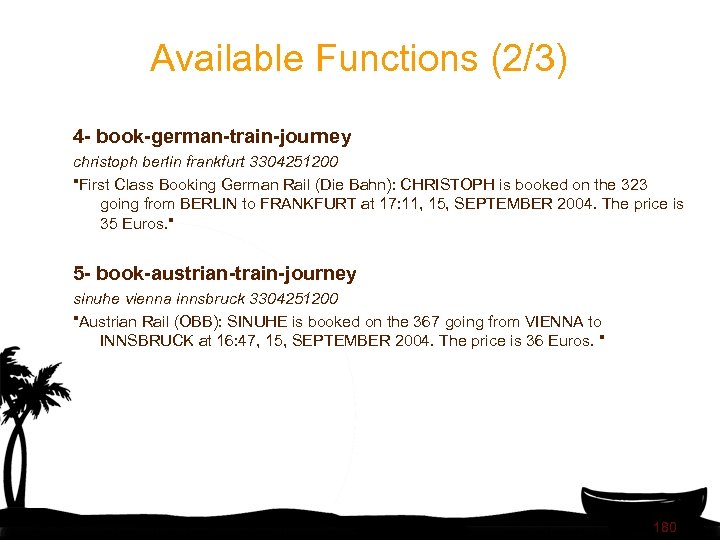
Available Functions (2/3) 4 - book-german-train-journey christoph berlin frankfurt 3304251200 "First Class Booking German Rail (Die Bahn): CHRISTOPH is booked on the 323 going from BERLIN to FRANKFURT at 17: 11, 15, SEPTEMBER 2004. The price is 35 Euros. " 5 - book-austrian-train-journey sinuhe vienna innsbruck 3304251200 "Austrian Rail (OBB): SINUHE is booked on the 367 going from VIENNA to INNSBRUCK at 16: 47, 15, SEPTEMBER 2004. The price is 36 Euros. " 180
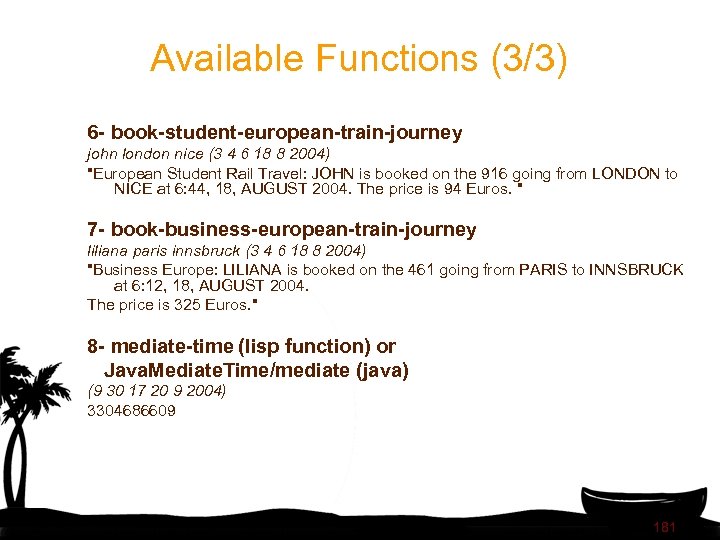
Available Functions (3/3) 6 - book-student-european-train-journey john london nice (3 4 6 18 8 2004) "European Student Rail Travel: JOHN is booked on the 916 going from LONDON to NICE at 6: 44, 18, AUGUST 2004. The price is 94 Euros. " 7 - book-business-european-train-journey liliana paris innsbruck (3 4 6 18 8 2004) "Business Europe: LILIANA is booked on the 461 going from PARIS to INNSBRUCK at 6: 12, 18, AUGUST 2004. The price is 325 Euros. " 8 - mediate-time (lisp function) or Java. Mediate. Time/mediate (java) (9 30 17 20 9 2004) 3304686609 181
Example: Goal 182
Example: Mediator 183
Example: Service 184
Example: Grounding and Publishing 185
Closing, Outlook, References, Acknowledgements 186
Tutorial Wrap-up • The targets of the presented tutorial were to: – understand aims & challenges within Semantic Web Services – understand WSMO approach to Semantic Web Services • WSML • WSMO Discovery • WSMO Grounding – present WSMX and IRS - future Web Service based IT middlewares • design and architecture • components design => you should now be able to correctly assess WSMO technologies and utilize these for your future work 187
Beyond WSMO • Although WSMO is one of the main initiatives on Semantic Web services, there also other initiatives in the area: OWL-S, SWSL, WSDL-S • Semantic Web Services Interest Group – Interest group founded at W 3 C to discuss issues related to Semantic Web Services (http: //www. w 3. org/2002/ws/swsig/) – Standardization Working Group in starting phase • SWSI: International initiative to push toward a standardization of SWS (http: //www. swsi. org) • Semantic Web services are entering the main stream – UDDI is adopting OWL for semantic search – WSDL 2 will contain a mapping to RDF – The use of semantics is also discussed in the context of standards for WS Policies 188
SWSI (www. swsi. org) • SWSI (Semantic Web Services Initiative) is becoming the point of synthesis of the SWS activity around the World • SWSI includes many participants belonging to both academy and industry from the US and Europe • SWSI is composed of two committees – SWSL which is expected to produce a language for Semantic Web services – SWSA which is expected to describe the architectural requirements for Semantic Web services • OWL-S and WSMO are two main inputs, but contributions include IRS, Meteor-S 189
Semantics in the Main Stream • • Many WS standardization groups are realizing that they need to add semantic representation UDDI v. next – UDDI v. next is the new version of UDDI – UDDI TC has decided to use OWL as a standard language for the representation of business taxonomies – OWL-based inference will be used to improve WS search Web Service Description Language v 2 – The WSDL working group at W 3 C has decided to add an RDF mapping to WSDL 2 – The RDF mapping may effectively provide a standard grounding mechanism for OWL-S and WSMO Web Services policies proposals require a significant amount of inference – There have been proposals to use OWL or SWRL as basic languages – Or to provide a mapping to semantic Web languages 190
References WSMO • The central location where WSMO work and papers can be found is WSMO Working Group: http: //www. wsmo. org • WSMO languages – WSML Working Group http: //www. wsml. org • Web Service Execution Environment WSMX – WSMX working group : http: //www. wsmx. org – WSMX open source can be found at: https: //sourceforge. net/projects/wsmx/ 191
![References WSMO • [WSMO Specification]: Roman, D. ; Lausen, H. ; Keller, U. (eds.](https://present5.com/presentation/56f0fe61600bfcbdd2e1883e39d2929f/image-189.jpg "References WSMO • [WSMO Specification]: Roman, D. ; Lausen, H. ; Keller, U. (eds.")
References WSMO • [WSMO Specification]: Roman, D. ; Lausen, H. ; Keller, U. (eds. ): Web Service Modeling Ontology, WSMO Working Draft D 2, final version 1. 2, 13 April 2005. • [WSMO Primer]: Feier, C. (ed. ): WSMO Primer, WSMO Working Draft D 3. 1, 18 February 2005. • [WSMO Choreography and Orchestration] Roman, D. ; Scicluna, J. , Feier, C. (eds. ): Ontology-based Choreography and Orchestration of WSMO Services, WSMO Working Draft D 14, 01 March 2005. • [WSMO Use Case] Stollberg, M. ; Lausen, H. ; Polleres, A. ; Lara, R. (ed. ): WSMO Use Case Modeling and Testing, WSMO Working Drafts D 3. 2; D 3. 3. ; D 3. 4; D 3. 5, 05 November 2004. • [WSML] de Bruijn, J. (Ed. ): The WSML Specification, WSML Working Draft D 16, 03 February 2005. 192
References WSMX • • • The central location where WSMX work, papers, and software can be found is the WSMX working group homepage: http: //www. wsmx. org. The main documents are: – Conceptual Model (http: //www. wsmo. org/2004/d 13. 1/v 0. 3/) – Architecture (http: //www. wsmo. org/TR/d 13. 4/v 0. 2/) – Implementation: open source at http: //sourceforge. net/projects/wsmx – Documentation (http: //www. wsmo. org/TR/d 22/v 0. 2/) – Execution Semantics (http: //www. wsmo. org/TR/d 13. 2/) – WSMX Toolkit (http: //www. wsmo. org/TR/d 9. 1/v 0. 2/) Further Readings: Bussler, C. (2003): B 2 B Integration. Berlin, Heidelberg: Springer. Haselwanter, T. ; Zaremba, Ma. . , Zaremba Mi. : Enabling Components Management and Executions Semantics in WSMX. In Proceedings of the 2 nd International WSMO Implementation Workshop (WIW 2005), Innsbruck, Austria, June 2005. Zaremba, M. and Bussler, C. : Towards Dynamic Execution Semantics in Semantic Web Services. In Proceedings of the WWW 2005 Workshop on Web Service Semantics: Towards Dynamic Business Integration, 2005. 193
References IRS III • J. Domingue, S. Galizia and L. Cabral (2005). Choreography in IRS-III - Coping with Heterogeneous Interaction Patterns in Web Services. 4 th International Semantic Web Conference (ISWC 2005). Galway, Ireland, November 6 th - 10 th 2005. • J. Domingue, L. Cabral, F. Hakimpour, D. Sell and E. Motta (2004). IRS-III: A Platform and Infrastructure for Creating WSMO-based Semantic Web Services. Proceedings of the Workshop on WSMO Implementations (WIW 2004) Frankfurt, Germany, September 29 th-30 th, 2004. • S. Galizia and J. Domingue (2004). Towards a Choreography for IRS-III. Proceedings of the Workshop on WSMO Implementations (WIW 2004) Frankfurt, Germany, September 29 th-30 th, 2004. • Cabral, L. , Domingue, J. , Motta, E. , Payne, T. and Hakimpour, F. (2004). Approaches to Semantic Web Services: An Overview and Comparisons. In proceedings of the First European Semantic Web Symposium (ESWS 2004). May 10 th-12 th 2004, Heraklion, Crete, Greece. • Motta, E. , Domingue, J. , Cabral, L. and Gaspari, M. (2003) IRS-II: A Framework and Infrastructure for Semantic Web Services. In proceedings of the 2 nd International Semantic Web Conference (ISWC 2003) October 20 th-23 th 2003, Sundial Resort, Sanibel Island, Florida, USA. These papers and software downloads can be found at: http: //kmi. open. ac. uk/projects/irs 194
Acknowledgements The WSMO work is funded by the European Commission under the projects ASG, DIP, Knowledge Web, SEKT, SWWS, AKT and Esperonto; by Science Foundation Ireland under the DERI-Lion project; and by the Austrian government under the FIT-IT program. IRS development is funded by the European Commission under the DIP project, and formerly IBROW, and by the UK EPSRC under the AKT project, and formerly MIAKT. 195
Скачать презентацию ICIW 2006 Guadeloupe Adding semantics to Web
56f0fe61600bfcbdd2e1883e39d2929f.ppt