 Скачать презентацию ICEA MEETING 12 February 2013 HELPING SECURE THE
746bdc7270a4b48c520aa5fd267e132c.ppt
- Количество слайдов: 13



ICEA MEETING 12 February 2013 HELPING SECURE THE BIGGEST BANG FOR THE TAXPAYERS’ BUCK: DEFENCE RESOURCE MANAGEMENT IN THE UK NEIL V DAVIES , ex-CHIEF ECONOMIST ANDREW GIBBONS, ex-ECONOMIC ADVISER MINISTRY OF DEFENCE, UNITED KINGDOM
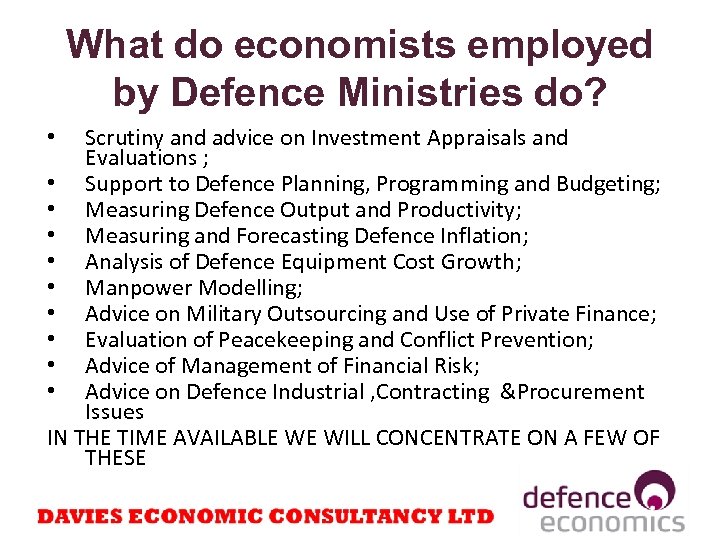
What do economists employed by Defence Ministries do? Scrutiny and advice on Investment Appraisals and Evaluations ; • Support to Defence Planning, Programming and Budgeting; • Measuring Defence Output and Productivity; • Measuring and Forecasting Defence Inflation; • Analysis of Defence Equipment Cost Growth; • Manpower Modelling; • Advice on Military Outsourcing and Use of Private Finance; • Evaluation of Peacekeeping and Conflict Prevention; • Advice of Management of Financial Risk; • Advice on Defence Industrial , Contracting &Procurement Issues IN THE TIME AVAILABLE WE WILL CONCENTRATE ON A FEW OF THESE •
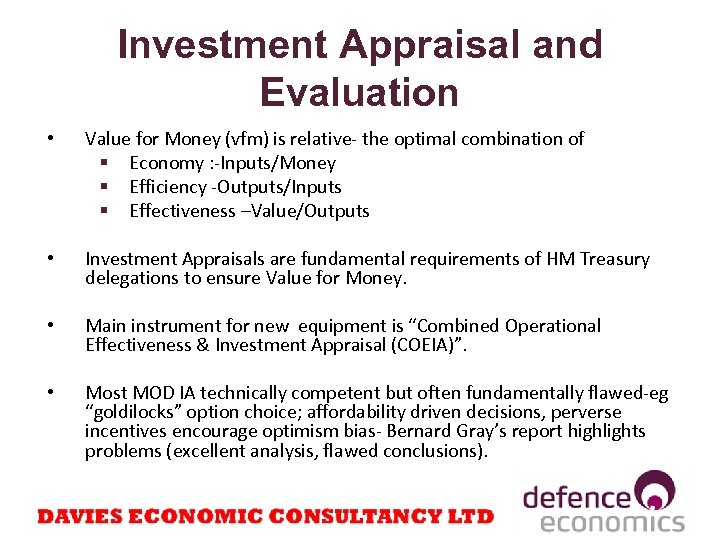
Investment Appraisal and Evaluation • Value for Money (vfm) is relative- the optimal combination of § Economy : -Inputs/Money § Efficiency -Outputs/Inputs § Effectiveness –Value/Outputs • Investment Appraisals are fundamental requirements of HM Treasury delegations to ensure Value for Money. • Main instrument for new equipment is “Combined Operational Effectiveness & Investment Appraisal (COEIA)”. • Most MOD IA technically competent but often fundamentally flawed-eg “goldilocks” option choice; affordability driven decisions, perverse incentives encourage optimism bias- Bernard Gray’s report highlights problems (excellent analysis, flawed conclusions).
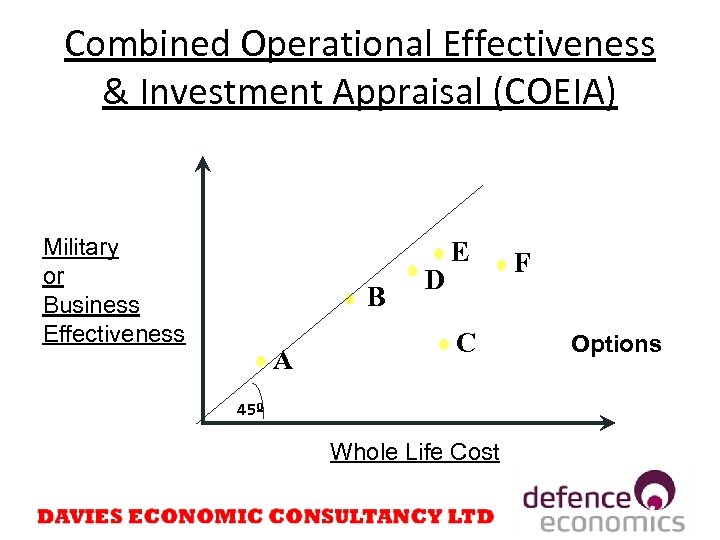
Combined Operational Effectiveness & Investment Appraisal (COEIA) Military or Business Effectiveness B A D E C 45º Whole Life Cost F Options
Use of outsourcing/public private partnering • • During late 1980 s – all support functions “market tested” and “Agencified” or “Outsourced”. Private Finance Initiative introduced in 1997. Advantages – Affordability (no up-front investment); More explicit definition of requirements; Incentives to deliver to time and cost; Greater transfer of risk; Opportunities for innovation- in-house arrangements typically incredibly inefficient! Disadvantages – Higher Financing Costs; Extra time to secure agreement (typically extra 12 months to contract signature)
Defence Inflation and Defence Equipment Cost Growth • Forecasting defence inflation used to be a key task for MOD Economists for PES negotiations with HM Treasury- defence inflation generally above GDP Deflator Inflation. • New estimates show Unit Cost Growth over past 50 years substantially lower than earlier estimates– for Sea Platforms in range 3 - 4%(real); – for Air Platforms in the range 4 -5 1/2%(real); – for Land Platforms around 6%(real); • Most, if not all, of unit cost growth explained by changes in platform characteristics- eg ship tonnage, speed , engine power.
Consequences of Unit Cost Growth • • • Fewer Units (eg ships, aircraft) of new generations. Proportion of Fixed to Variable Costs rises adding further to unit cost escalation Seeking to spread fixed costs through international collaboration Reduced volume of production forces consolidation of defence manufacturing reducing competition Lower manning levels (eg for Attack submarine – from 130 crew of Trafalgar class to 98 for Astute class; from 289 for T 42 destroyers to 190 for T 42 destroyers but with fuller grade/rank mix further increases costs
Promoting economic efficiency in defence procurement • • • Need to overcome misperceptions – – that trade is a “zero sum game“ with exports good and imports bad – that procurement should favour creating/sustaining jobs – that there are very large spill-over benefits from defence R&D. Comparative advantage – specialisation rather than self sufficiency. Competition, where practicable, encourages efficiency. Exports only beneficial where they generate positive net value added, greater than alternative use of same resources. Spill-overs from defence R&D smaller than for civil R&D (c 20 – 30% returns). Net effects after allowing for crowding out can be negative. Lower adjustment costs with defence industry restructuring.
Defence industrial developments • Fundamental objective is value for money. If resources allocated efficiently and economy at full capacity no justification for distorting defence procurement decisions. • Defence industrial and technology policy should focus on maximising the net economic contribution to the country. • Not be about jobs or exports, but efficient resource allocation. • This means addressing barriers to technology transfer, sustaining competition and intelligent application of Mo. D’s position as the industry’s dominant customer.
Selling radio spectrum • History of free/admin allocation • No central record of utilisation • Rejection of internal market/charging • High value asset: HMT budgetting for receipts => Admin task to migrate users => Uncertainty about future requirements => cross-cutting impact; authority to implement? • Economists: auction design theory to max value
Counterinsurgency: promoting development in a non-permissive environment • Mao Tse Tung and fish • Separate the guerrillas from the people • Consent: sort grievances, create security, growth & dev • 90% of Helmand livelihoods from agriculture • => enhancing markets in labour and farming • ISAF approach: ANDS, Helmand Plan, Helmand Growth Programme Op. Moshtarak: security, development, political
Boosting the Economy in Non. Permissive Environments Key networks need route security: Products to market, goods/pax in & out Bus, postal, telecom, banking Public admin: health, education, justice => All-weather roads, convoys, rapid reaction forces, intel Economist/multidis: priorities, max linkages

ANY QUESTIONS?
Скачать презентацию ICEA MEETING 12 February 2013 HELPING SECURE THE
746bdc7270a4b48c520aa5fd267e132c.ppt