


 Скачать презентацию IC 10 Henize 2 -10 NGC 253 COMPARISON
ccaf281a9994cc1c5906556a055ae013.ppt
- Количество слайдов: 14
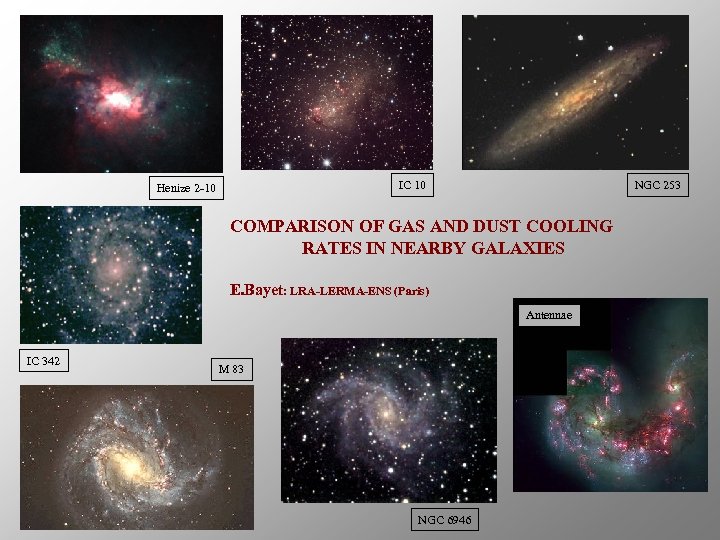 IC 10 Henize 2 -10 NGC 253 COMPARISON OF GAS AND DUST COOLING RATES IN NEARBY GALAXIES E. Bayet: LRA-LERMA-ENS (Paris) Antennae IC 342 M 83 NGC 6946
 E. Bayet Moriond – March, 6 th-12 th 2005 INTRODUCTION : OBJECTS : warm and dense molecular clouds in the nuclei of 20 nearby galaxies with different morphological types (D < 10 Mpc) targets for ALMA and Herschel GOALS : 1) describe the physical properties of these objects localize the GMCs in these nuclei correlations morphological types - cooling rates ? prediction of emission lines for more distant objects 2) understand the links existing between dust and gas cooling rates HOW : Observations of C and CO lines in mm-submm windows (υ=200 -850 GHz) with CSO (Hawaii, USA) and IRAM-Pd. B (FRANCE) for the first time C(3 P 2 -3 P 1) (υ=809 GHz) high-J CO lines observed : 12 CO(6 -5), (7 -6) (υ=691 GHz, 806 GHz) LVG (radiative transfer calculations) and PDR (photodissociation regionsthermal balance) models to derive the physical properties
 E. Bayet Moriond – March, 6 th-12 th 2005 GALAXIES SAMPLE : Properties : - accessibles from the northern hemisphere - bright in the low-J CO lines, e. g. , 12 CO(1 -0) and 12 CO(2 -1) - ~20 nearby galaxies with different morphological types: normal spiral galaxies: IC 342, M 51, NGC 6946 Henize 2 -10 irregular star forming galaxies: Henize 2 -10 , IC 10 starburst galaxies: M 82, M 83, NGC 253 the Antennae interacting galaxies: NGC 6090, IRAS 10565+2448, the Antennae ULIRGs: Markarian 231, Arp 220 LINER: NGC 4736, NGC 3079 …
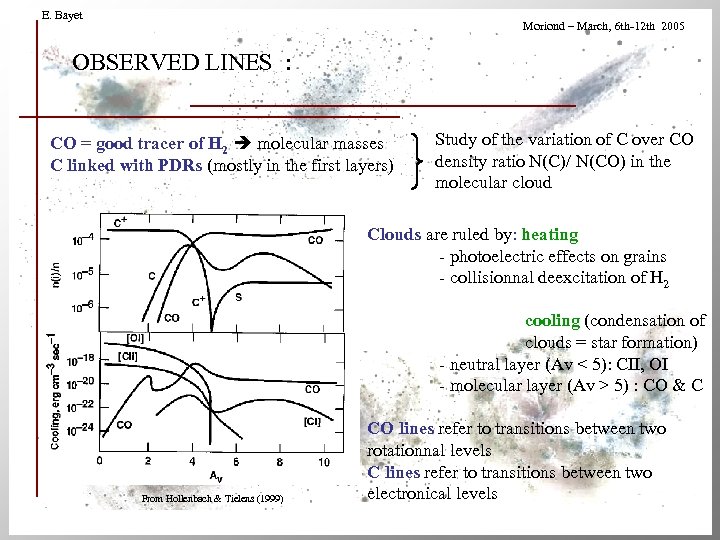 E. Bayet Moriond – March, 6 th-12 th 2005 OBSERVED LINES : CO = good tracer of H 2 molecular masses C linked with PDRs (mostly in the first layers) Study of the variation of C over CO density ratio N(C)/ N(CO) in the molecular cloud Clouds are ruled by: heating - photoelectric effects on grains - collisionnal deexcitation of H 2 cooling (condensation of clouds = star formation) - neutral layer (Av < 5): CII, OI - molecular layer (Av > 5) : CO & C From Hollenbach & Tielens (1999) CO lines refer to transitions between two rotationnal levels C lines refer to transitions between two electronical levels
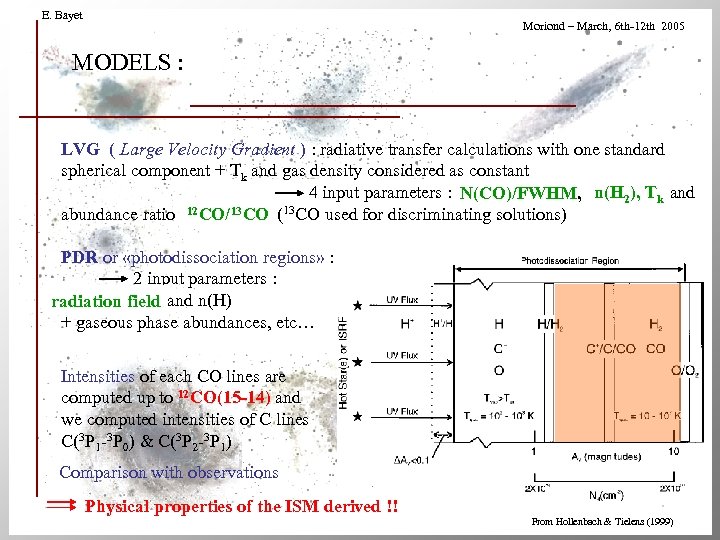 E. Bayet Moriond – March, 6 th-12 th 2005 MODELS : LVG ( Large Velocity Gradient ) : radiative transfer calculations with one standard spherical component + Tk and gas density considered as constant 4 input parameters : N(CO)/FWHM , n(H 2), Tkk and N(CO)/FWHM, 2 T 12 CO/ abundance ratio 12 CO/13 CO (13 CO used for discriminating solutions) PDR or «photodissociation regions» : 2 input parameters : radiation field and n(H) + gaseous phase abundances, etc… Intensities of each CO lines are computed up to 12 CO(15 -14) and we computed intensities of C lines C(3 P 1 -3 P 0) & C(3 P 2 -3 P 1) Comparison with observations Physical properties of the ISM derived !! From Hollenbach & Tielens (1999)
 E. Bayet Moriond – March, 6 th-12 th 2005 RESULTS : example (IC 342) of CO cooling curve Observations of the 13 CO(6 -5), 12 CO(8 -7) and up will be very useful to discriminate models solutions ALMA & Herschel !! 2 LVG models needed to reproduce cold and warm molecular gas
 E. Bayet Moriond – March, 6 th-12 th 2005 CO cooling curves : ØHe 2 -10, M 83 & Cloverleaf QSO : peak position 12 CO(7 -6) and up ØIC 10, NGC 253, NGC 4038, NGC 6946 & Overlap : peak position 12 CO(6 -5) ØIC 342 and Center of Milky Way : peak position 12 CO(5 -4) and below CO(5 -4) to CO(7 -6) = major coolants C(3 P 2 -3 P 1) = major coolant CO cooling rate > C cooling rate Similarities in the CO cooling curves mean similarities in the physical properties, morphological types Grey full points are derived from PDR models
 E. Bayet Moriond – March, 6 th-12 th 2005 Comparison between differents tracers : 1) Morphologic ØLarger dispersion in dust cooling than in radiation field and density Density (CII / OI) Radiation field (CII / C) (neutral and molecular gas + dust) Dust cooling Cooling efficiency (CO / FIR & C/ FIR) PDR / TOTAL (CII) Dust cooling ØContribution of the CII from PDR more important in NGC 6946 ØCO cooling rate more efficient than C cooling rate ØIC 10 clearly differs from others Heating efficiency
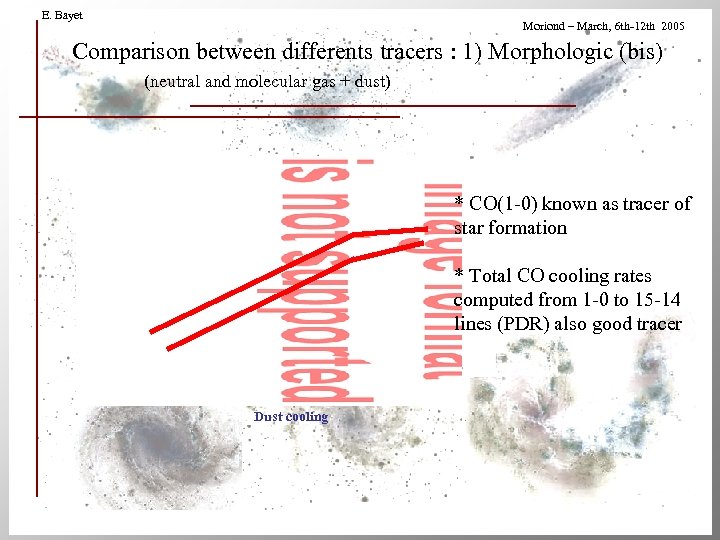 E. Bayet Moriond – March, 6 th-12 th 2005 Comparison between differents tracers : 1) Morphologic (bis) (neutral and molecular gas + dust) * CO(1 -0) known as tracer of star formation * Total CO cooling rates computed from 1 -0 to 15 -14 lines (PDR) also good tracer Dust cooling
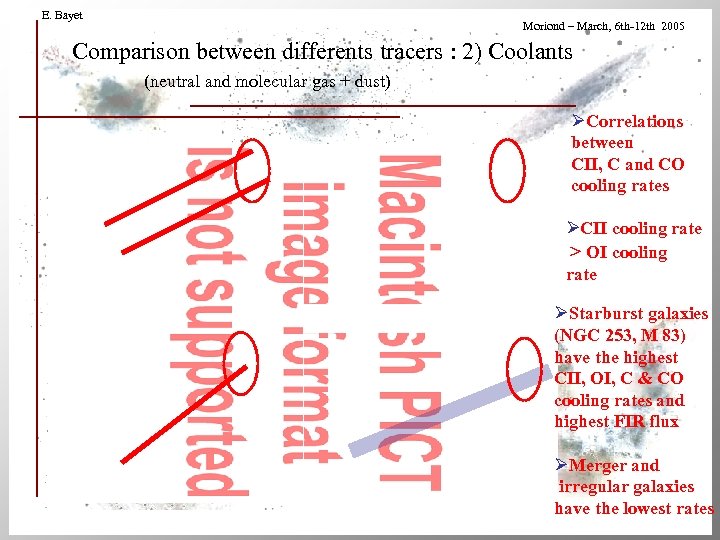 E. Bayet Moriond – March, 6 th-12 th 2005 Comparison between differents tracers : 2) Coolants (neutral and molecular gas + dust) ØCorrelations between CII, C and CO cooling rates ØCII cooling rate > OI cooling rate ØStarburst galaxies (NGC 253, M 83) have the highest CII, OI, C & CO cooling rates and highest FIR flux ØMerger and irregular galaxies have the lowest rates
 E. Bayet PERSPECTIVES : Moriond – March, 6 th-12 th 2005 MERCI ! ØFinish the analysis of these figures and quantify precisely the links existing between o morphological type of nuclei & lines which contribute the most to the CO and C cooling rates o different coolant species (relation between neutral, molecular gas and dust) o cooling and heating processes in the GMCs Ø Complete these results with the other galaxies from our sample: LVG and PDR models should be applied (already published paper in A&A: The submillimeter C and CO lines in Henize 2 -10 and NGC 253 and paper in preparation for the other sources) Ø Other works in progress: - Localize the GMCs in IC 10 nucleus from high resolution IRAM-Plateau De Bure observations and compare CO with ISO data (LW 2 et LW 3 at 7 and 15 µm) - Collaboration at the Leiden Observatory (F. Israel) concerning models: plan to use a combined XDR-PDR models in development My Ph. D work shall be included in the future large programs performed by ALMA, the Herschel satellite with the HIFI, PACS and SPIRE instruments and the Spitzer Space Satellite with the IRAC camera and the IRS spectrometer.

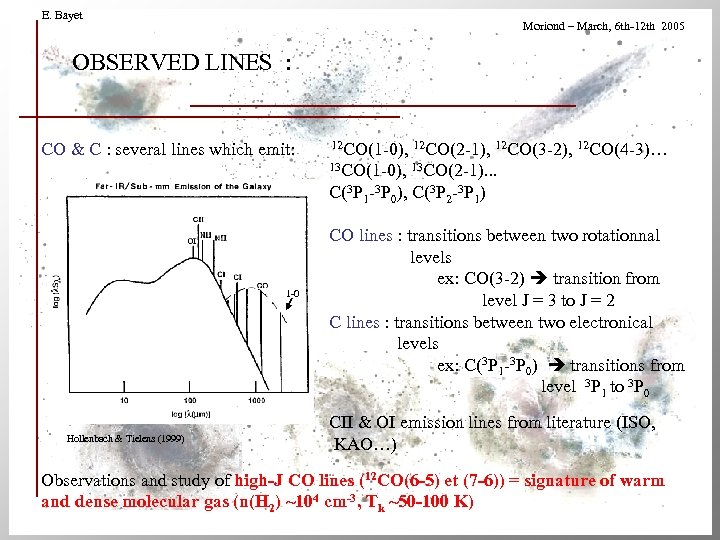 E. Bayet Moriond – March, 6 th-12 th 2005 OBSERVED LINES : CO & C : several lines which emit: 12 CO(1 -0), 12 CO(2 -1), 12 CO(3 -2), 12 CO(4 -3)… 13 CO(1 -0), 13 CO(2 -1). . . C(3 P 1 -3 P 0), C(3 P 2 -3 P 1) 1 -0 Hollenbach & Tielens (1999) CO lines : transitions between two rotationnal levels ex: CO(3 -2) transition from level J = 3 to J = 2 C lines : transitions between two electronical levels ex: C(3 P 1 -3 P 0) transitions from level 3 P 1 to 3 P 0 CII & OI emission lines from literature (ISO, KAO…) Observations and study of high-J CO lines (12 CO(6 -5) et (7 -6)) = signature of warm and dense molecular gas (n(H 2) ~104 cm-3, Tk ~50 -100 K)
 E. Bayet Moriond – March, 6 th-12 th 2005