


IBM WATSON
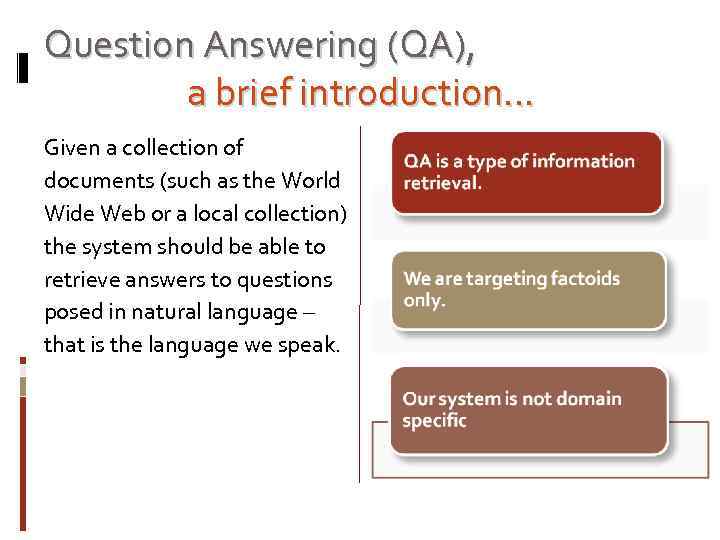
Question Answering (QA), a brief introduction… Given a collection of documents (such as the World Wide Web or a local collection) the system should be able to retrieve answers to questions posed in natural language – that is the language we speak.
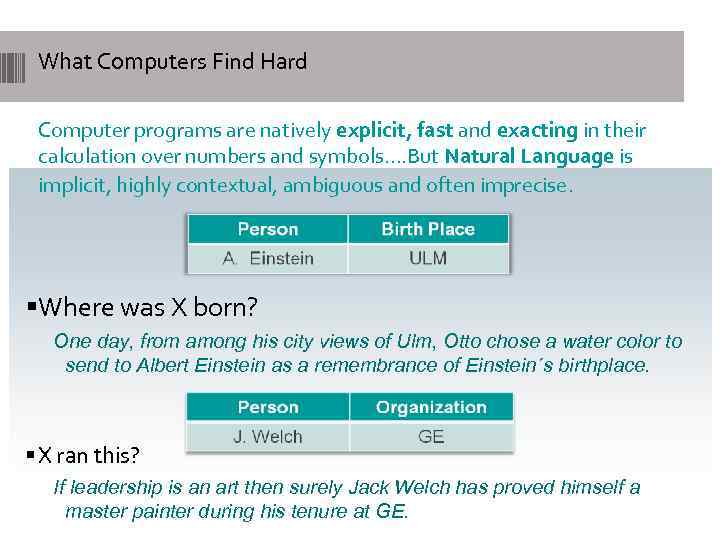
What Computers Find Hard Computer programs are natively explicit, fast and exacting in their calculation over numbers and symbols…. But Natural Language is implicit, highly contextual, ambiguous and often imprecise. Where was X born? One day, from among his city views of Ulm, Otto chose a water color to send to Albert Einstein as a remembrance of Einstein´s birthplace. X ran this? If leadership is an art then surely Jack Welch has proved himself a master painter during his tenure at GE.
IBM Watson Project started in 2007, lead David Ferrucci • Initial goal: create a system able to process natural language & extract knowledge faster than any other computer or human • Jeopardy! was chosen because it’s a huge challenge for a computer to find the questions to such “human” answers under time pressure • Watson was NOT online! • Watson weighs the probability of his answer being right – doesn’t ring the buzzer if he’s not confident enough • Which questions Watson got wrong almost as interesting as which he got right!
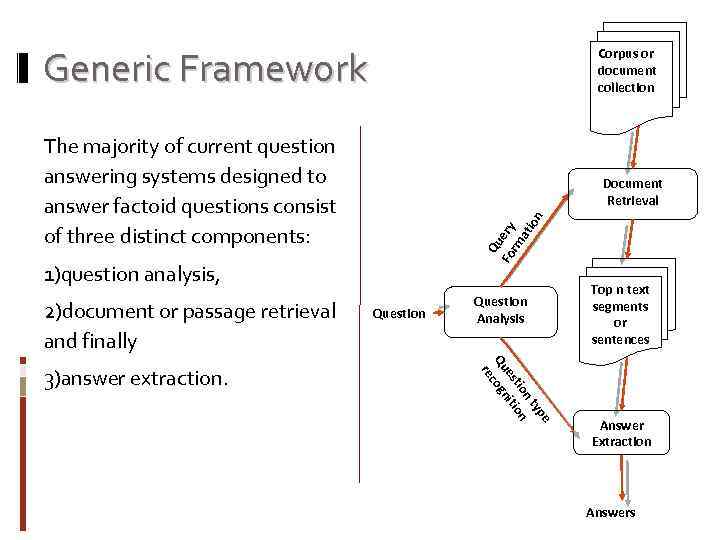
Generic Framework Corpus or document collection The majority of current question answering systems designed to answer factoid questions consist of three distinct components: Qu Fo ery rm ati on Document Retrieval 1)question analysis, 2)document or passage retrieval and finally e yp nt tio on es iti Qu cogn re 3)answer extraction. Question Analysis Top n text segments or sentences Answer Extraction Answers
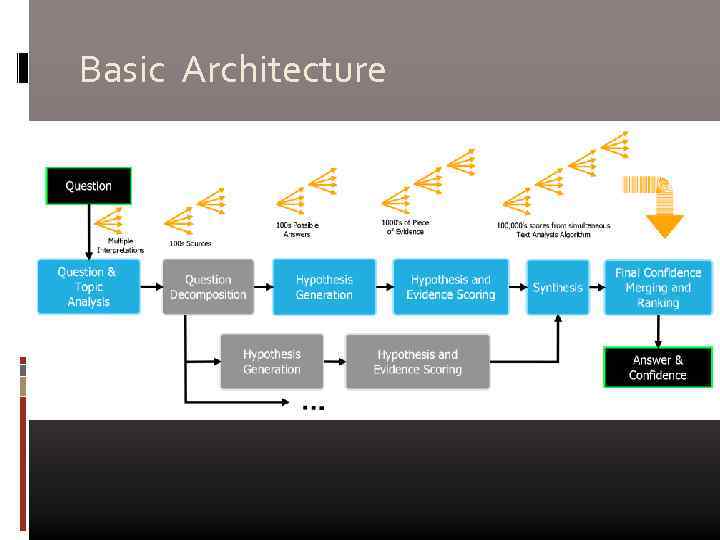
Basic Architecture
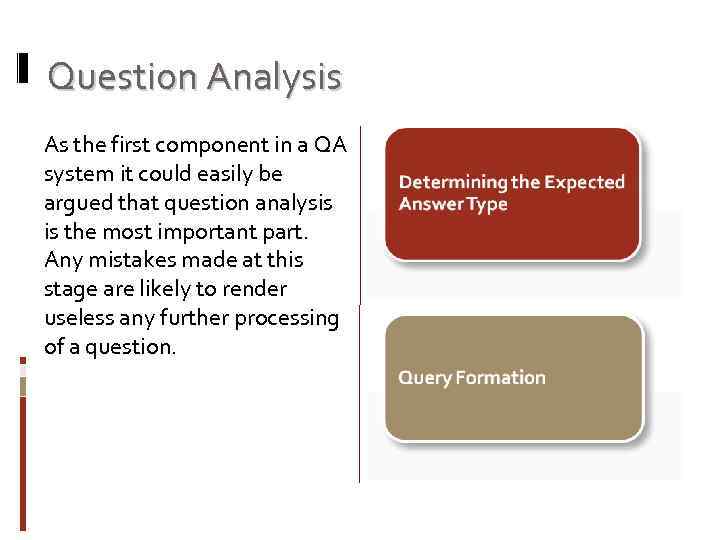
Question Analysis As the first component in a QA system it could easily be argued that question analysis is the most important part. Any mistakes made at this stage are likely to render useless any further processing of a question.
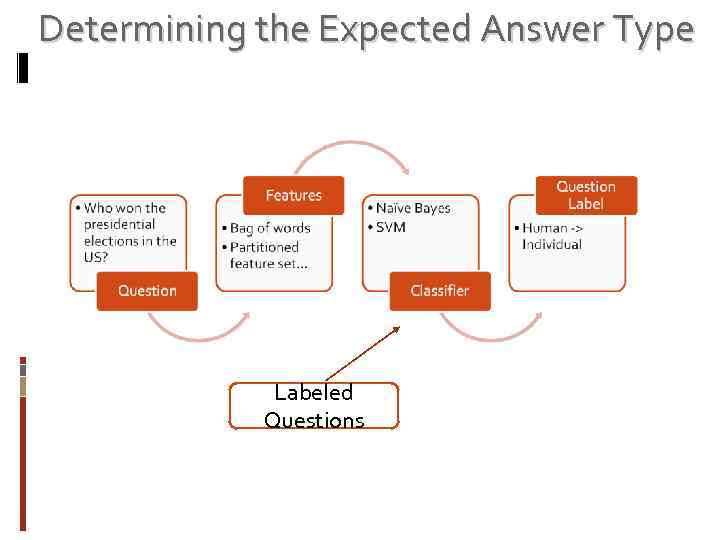
Determining the Expected Answer Type Labeled Questions
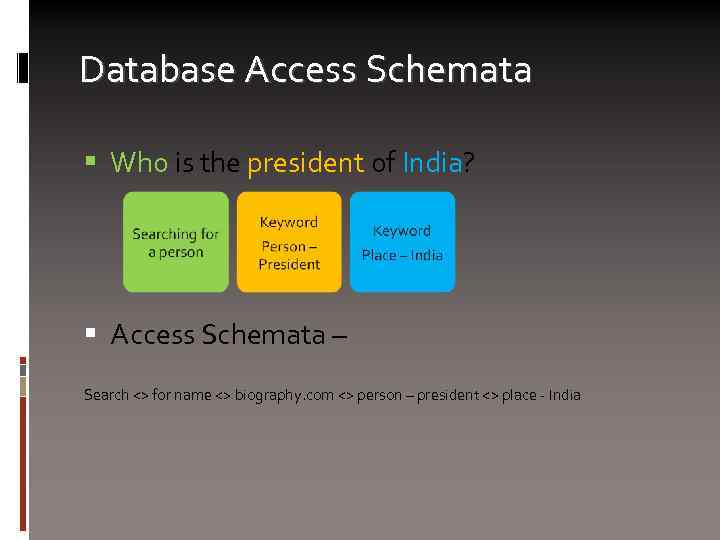
Database Access Schemata Who is the president of India? Access Schemata – Search <> for name <> biography. com <> person – president <> place - India
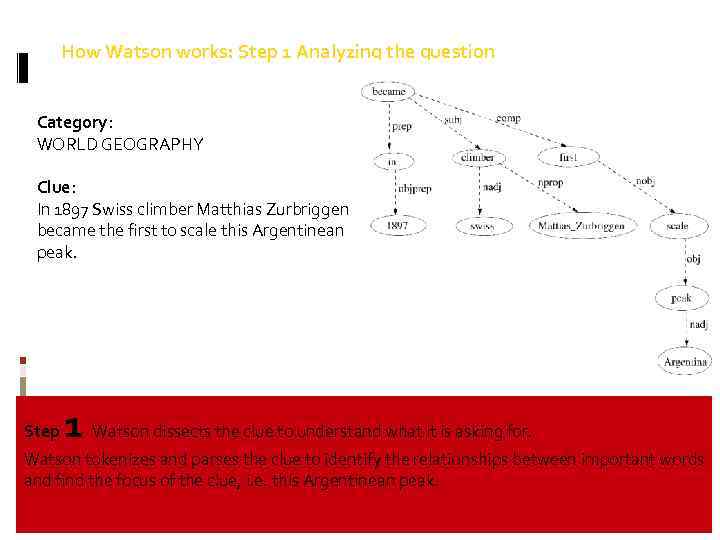
How Watson works: Step 1 Analyzing the question Category: WORLD GEOGRAPHY Clue: In 1897 Swiss climber Matthias Zurbriggen became the first to scale this Argentinean peak. Step 1 Watson dissects the clue to understand what it is asking for. Watson tokenizes and parses the clue to identify the relationships between important words and find the focus of the clue, i. e. this Argentinean peak.
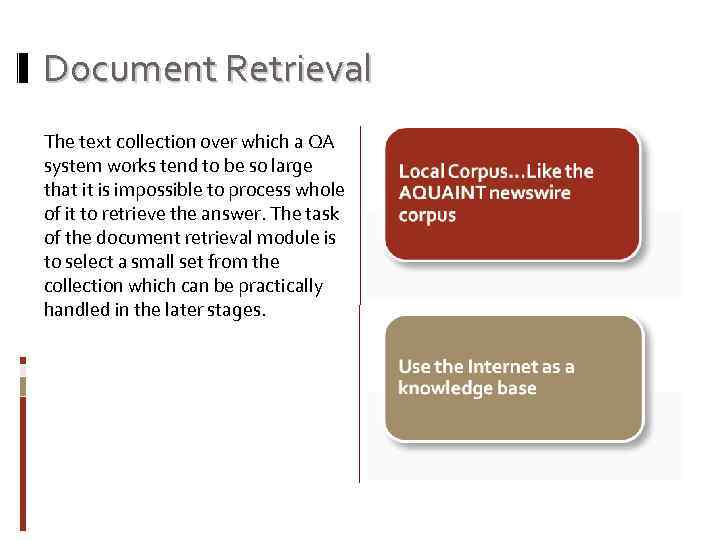
Document Retrieval The text collection over which a QA system works tend to be so large that it is impossible to process whole of it to retrieve the answer. The task of the document retrieval module is to select a small set from the collection which can be practically handled in the later stages.
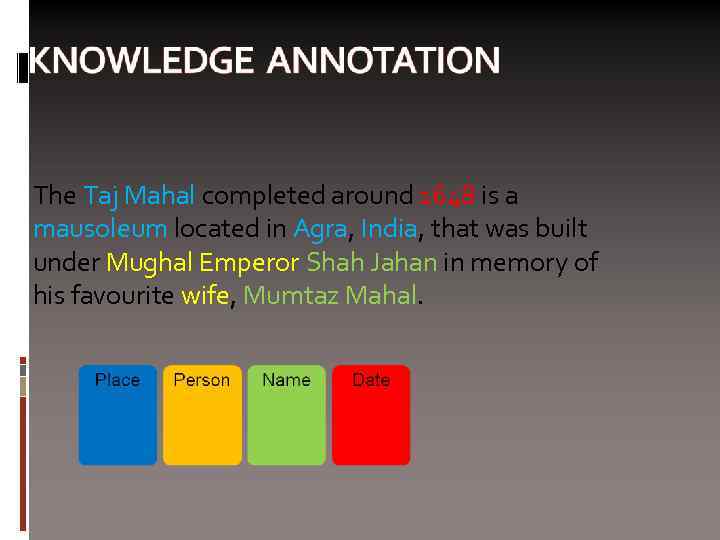
The Taj Mahal completed around 1648 is a mausoleum located in Agra, India, that was built under Mughal Emperor Shah Jahan in memory of his favourite wife, Mumtaz Mahal.
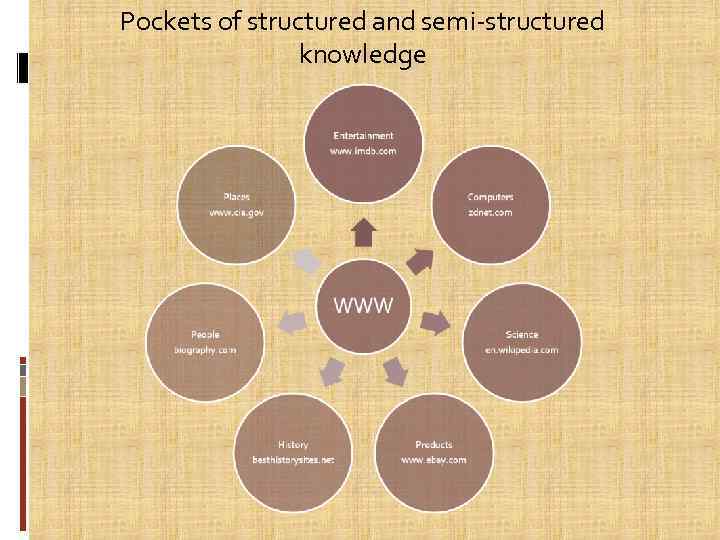
Pockets of structured and semi-structured knowledge
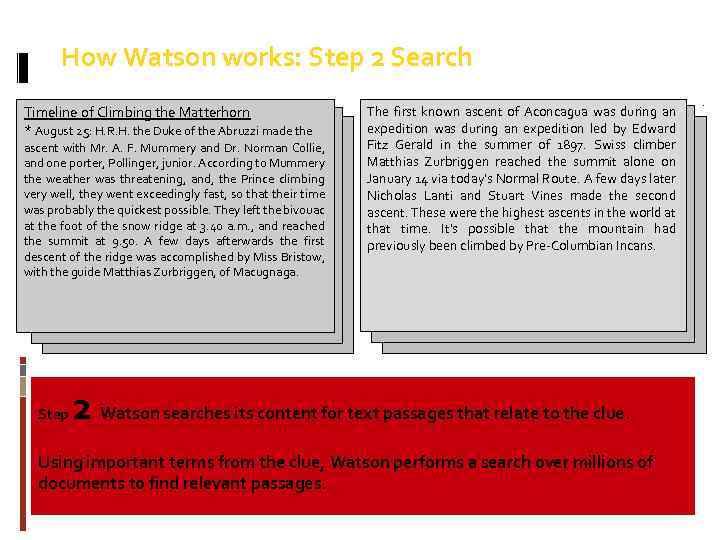
How Watson works: Step 2 Search Timeline of Climbing the Matterhorn * August 25: H. R. H. the Duke of the Abruzzi made the ascent with Mr. A. F. Mummery and Dr. Norman Collie, and one porter, Pollinger, junior. According to Mummery the weather was threatening, and, the Prince climbing very well, they went exceedingly fast, so that their time was probably the quickest possible. They left the bivouac at the foot of the snow ridge at 3. 40 a. m. , and reached the summit at 9. 50. A few days afterwards the first descent of the ridge was accomplished by Miss Bristow, with the guide Matthias Zurbriggen, of Macugnaga. Step The first known ascent of Aconcagua was during an expedition led by Edward Fitz Gerald in the summer of 1897. Swiss climber Matthias Zurbriggen reached the summit alone on January 14 via today's Normal Route. A few days later Nicholas Lanti and Stuart Vines made the second ascent. These were the highest ascents in the world at that time. It's possible that the mountain had previously been climbed by Pre-Columbian Incans. 2 Watson searches its content for text passages that relate to the clue. Using important terms from the clue, Watson performs a search over millions of documents to find relevant passages.
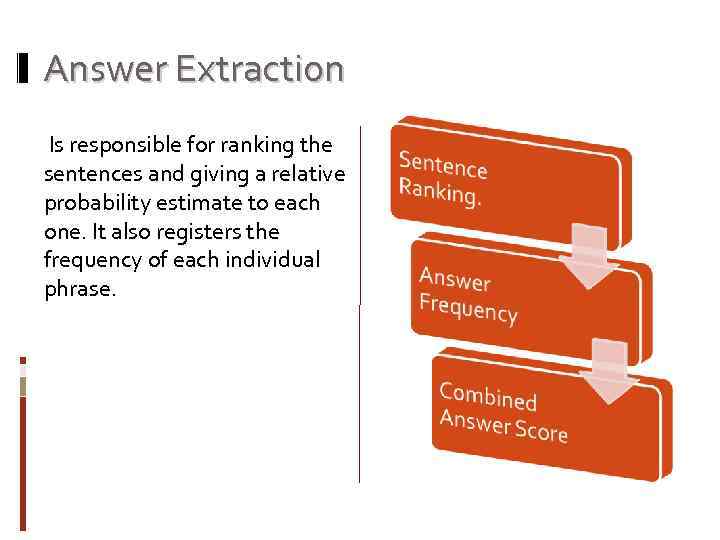
Answer Extraction Is responsible for ranking the sentences and giving a relative probability estimate to each one. It also registers the frequency of each individual phrase.
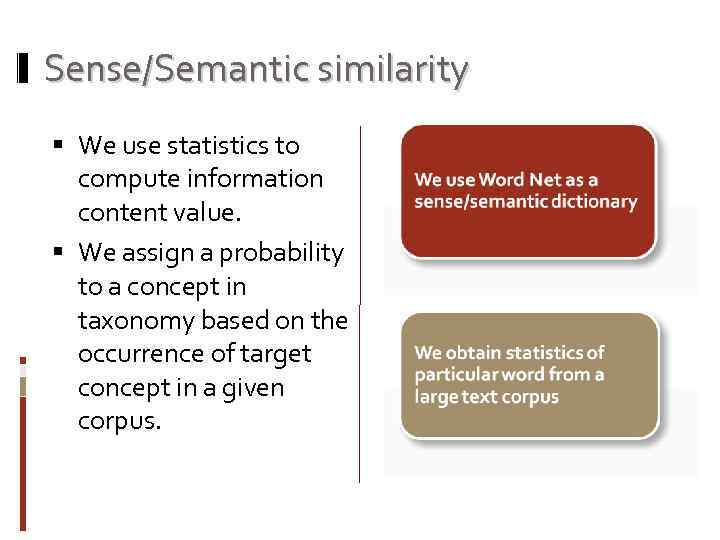
Sense/Semantic similarity We use statistics to compute information content value. We assign a probability to a concept in taxonomy based on the occurrence of target concept in a given corpus.
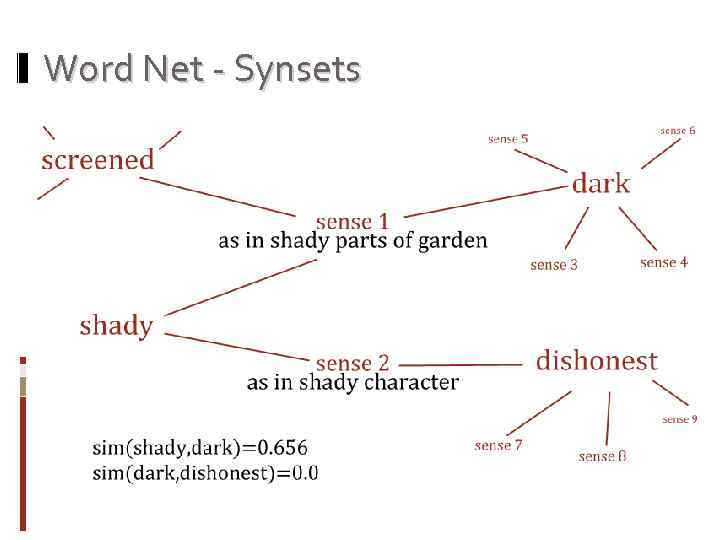
Word Net - Synsets
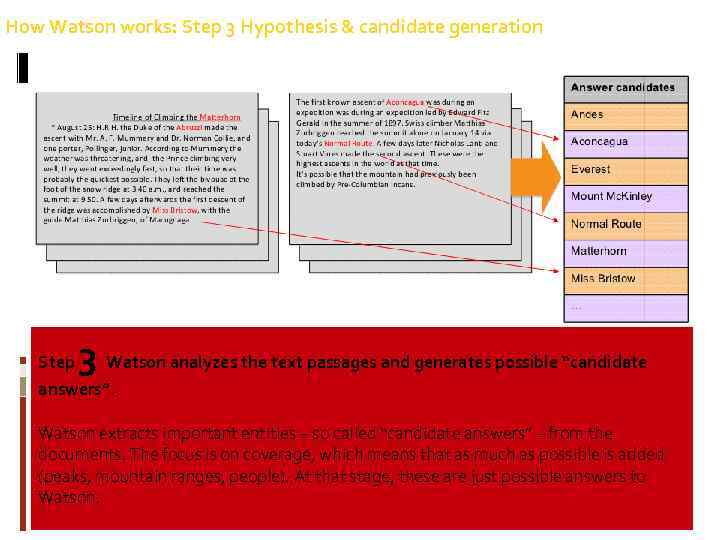
How Watson works: Step 3 Hypothesis & candidate generation Step 3 Watson analyzes the text passages and generates possible “candidate answers”. Watson extracts important entities – so called “candidate answers” – from the documents. The focus is on coverage, which means that as much as possible is added (peaks, mountain ranges, people). At that stage, these are just possible answers to Watson.
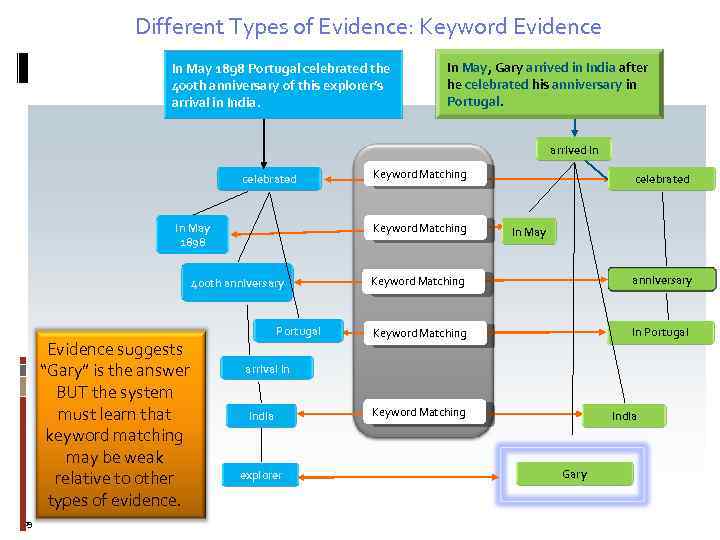
Different Types of Evidence: Keyword Evidence In May 1898 Portugal celebrated the 400 th anniversary of this explorer’s arrival in India. In May, Gary arrived in India after he celebrated his anniversary in Portugal. arrived in celebrated Keyword Matching In May 1898 400 th anniversary Evidence suggests “Gary” is the answer BUT the system must learn that keyword matching may be weak relative to other types of evidence. 19 Keyword Matching Portugal celebrated In May Keyword Matching anniversary Keyword Matching in Portugal arrival in India explorer Keyword Matching India Gary
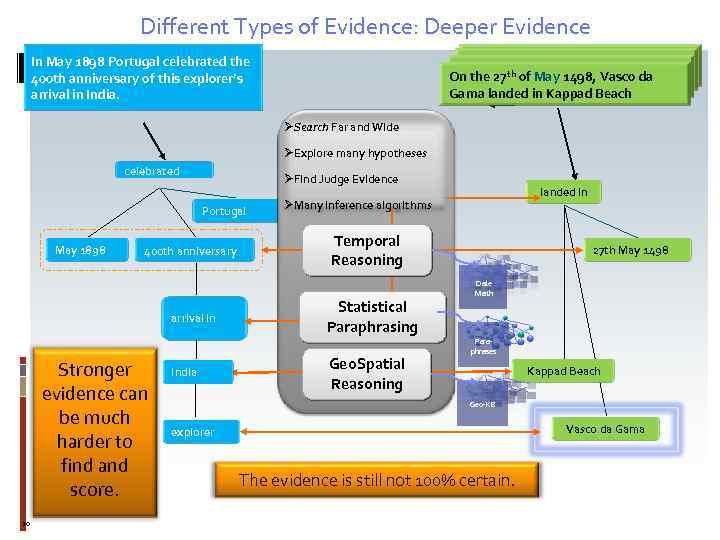
Different Types of Evidence: Deeper Evidence On 27 th May 1498, Vasco da Gama landed On 27 th May Beach Vasco da Gama landed in Kappad 1498, Onin Kappad of May 1498, Vasco da the 27 th Beach in Kappad Beach In May 1898 Portugal celebrated the 400 th anniversary of this explorer’s arrival in India. Gama landed in Kappad Beach Search Far and Wide Explore many hypotheses celebrated Find Judge Evidence Portugal May 1898 400 th anniversary arrival in Stronger evidence can be much harder to find and score. 20 India landed in Many inference algorithms Temporal Reasoning Statistical Paraphrasing Geo. Spatial Reasoning 27 th May 1498 Date Math Paraphrases Kappad Beach Geo-KB Vasco da Gama explorer The evidence is still not 100% certain.
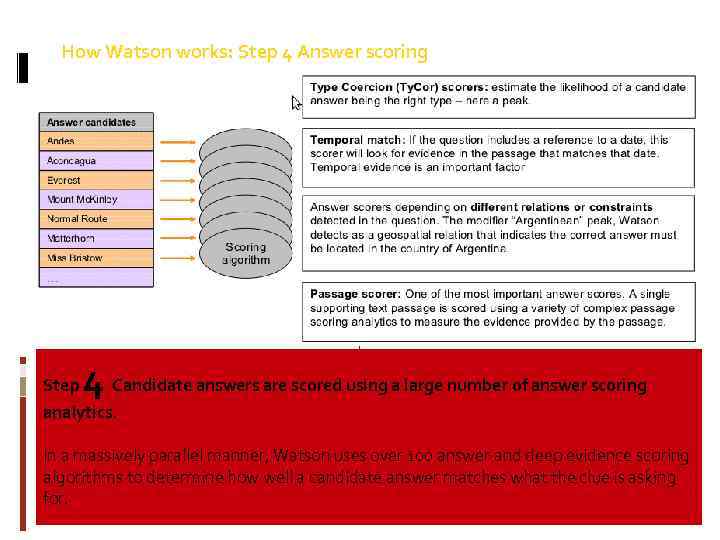
How Watson works: Step 4 Answer scoring Step 4 Candidate answers are scored using a large number of answer scoring analytics. In a massively parallel manner, Watson uses over 100 answer and deep evidence scoring algorithms to determine how well a candidate answer matches what the clue is asking for.
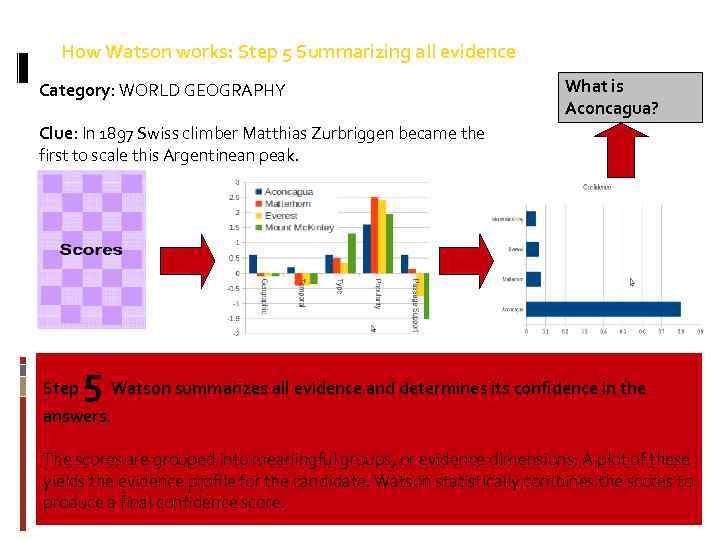
How Watson works: Step 5 Summarizing all evidence Category: WORLD GEOGRAPHY What is Aconcagua? Clue: In 1897 Swiss climber Matthias Zurbriggen became the first to scale this Argentinean peak. Step 5 Watson summarizes all evidence and determines its confidence in the answers. The scores are grouped into meaningful groups, or evidence dimensions. A plot of these yields the evidence profile for the candidate. Watson statistically combines the scores to produce a final confidence score.
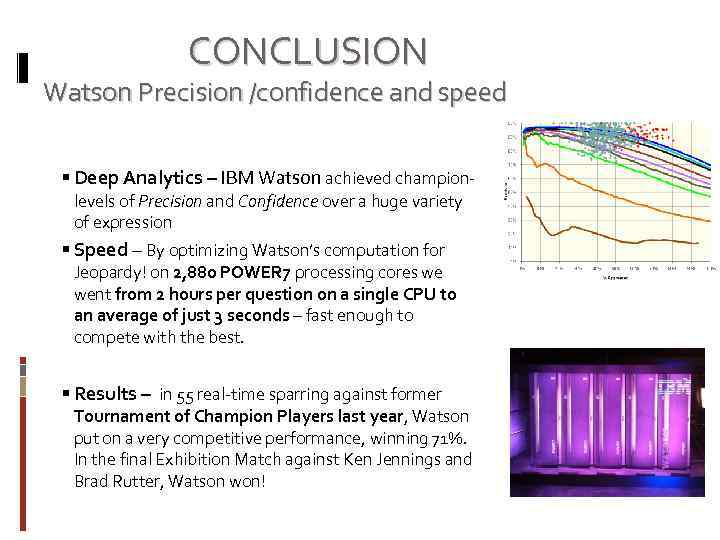
CONCLUSION Watson Precision /confidence and speed Deep Analytics – IBM Watson achieved championlevels of Precision and Confidence over a huge variety of expression Speed – By optimizing Watson’s computation for Jeopardy! on 2, 880 POWER 7 processing cores we went from 2 hours per question on a single CPU to an average of just 3 seconds – fast enough to compete with the best. Results – in 55 real-time sparring against former Tournament of Champion Players last year, Watson put on a very competitive performance, winning 71%. In the final Exhibition Match against Ken Jennings and Brad Rutter, Watson won!
