 Скачать презентацию IBM University Programs worldwide accelerating regional development IBM
e4ef7927dc819fcf104842d7dba08526.ppt
- Количество слайдов: 43



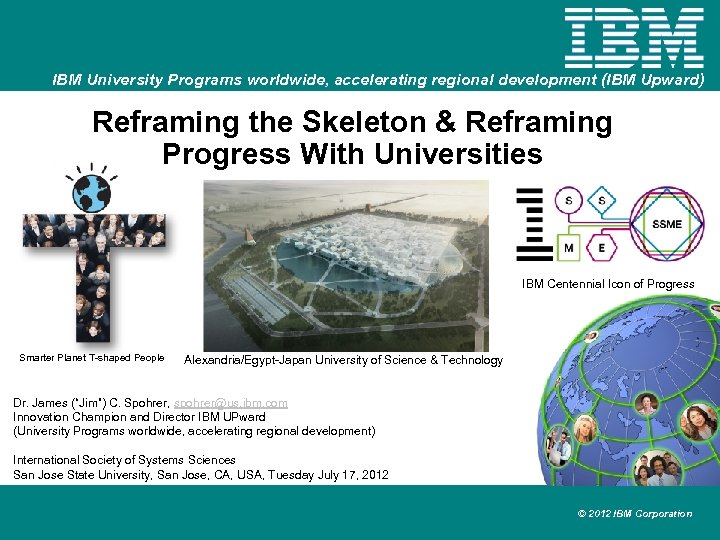
IBM University Programs worldwide, accelerating regional development (IBM Upward) Reframing the Skeleton & Reframing Progress With Universities IBM Centennial Icon of Progress Smarter Planet T-shaped People Alexandria/Egypt-Japan University of Science & Technology Dr. James (“Jim”) C. Spohrer, spohrer@us. ibm. com Innovation Champion and Director IBM UPward (University Programs worldwide, accelerating regional development) International Society of Systems Sciences San Jose State University, San Jose, CA, USA, Tuesday July 17, 2012 © 2012 IBM Corporation
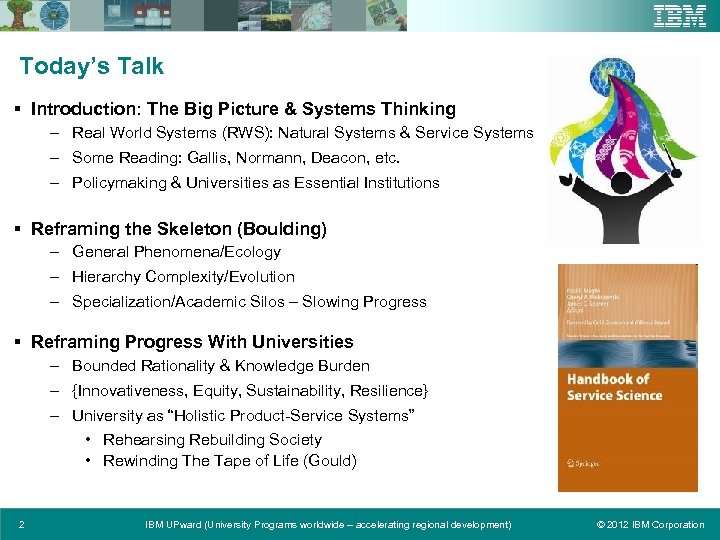
Today’s Talk § Introduction: The Big Picture & Systems Thinking – Real World Systems (RWS): Natural Systems & Service Systems – Some Reading: Gallis, Normann, Deacon, etc. – Policymaking & Universities as Essential Institutions § Reframing the Skeleton (Boulding) – General Phenomena/Ecology – Hierarchy Complexity/Evolution – Specialization/Academic Silos – Slowing Progress § Reframing Progress With Universities – Bounded Rationality & Knowledge Burden – {Innovativeness, Equity, Sustainability, Resilience} – University as “Holistic Product-Service Systems” • Rehearsing Rebuilding Society • Rewinding The Tape of Life (Gould) 2 IBM UPward (University Programs worldwide – accelerating regional development) © 2012 IBM Corporation
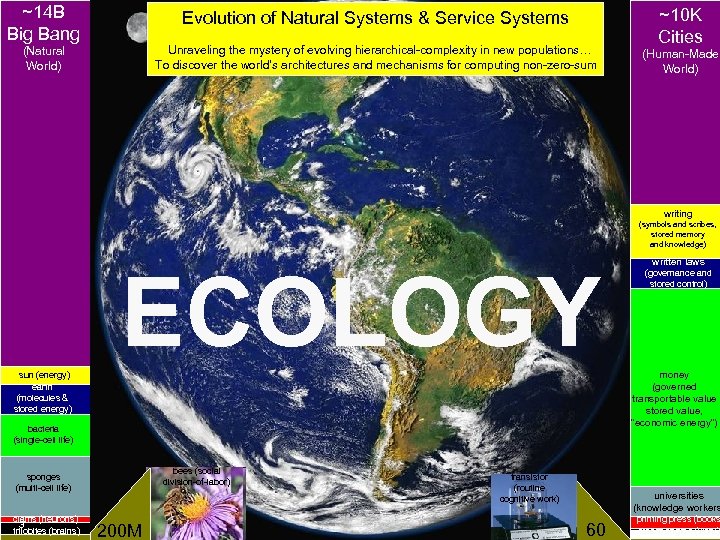
~14 B Big Bang Evolution of Natural Systems & Service Systems Unraveling the mystery of evolving hierarchical-complexity in new populations… To discover the world’s architectures and mechanisms for computing non-zero-sum (Natural World) Time ~10 K Cities (Human-Made World) writing (symbols and scribes, stored memory and knowledge) ECOLOGY money (governed transportable value stored value, “economic energy”) sun (energy) earth (molecules & stored energy) bacteria (single-cell life) bees (social division-of-labor) sponges (multi-cell life) clams (neurons) 3 trilobites (brains) written laws (governance and stored control) 200 M transistor (routine cognitive work) IBM UPward (University Programs worldwide – accelerating regional development) universities (knowledge workers printing press (books steam engine (work) © 2012 IBM Corporation 60
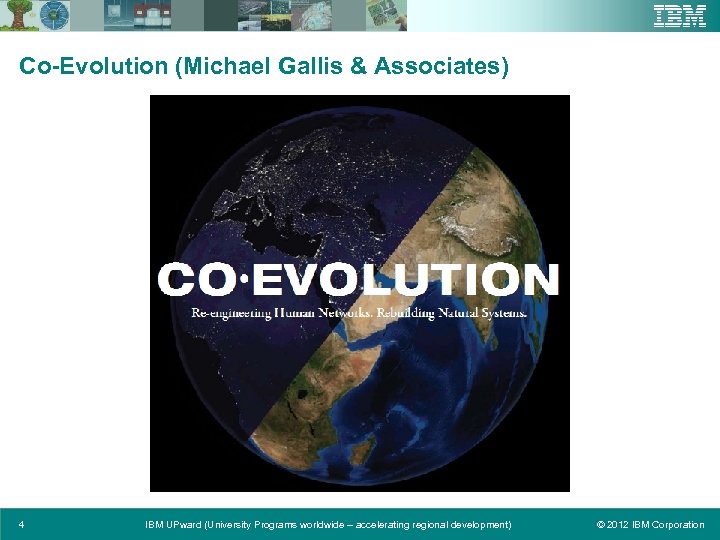
Co-Evolution (Michael Gallis & Associates) http: //www. scribd. com/doc/46259459/Co-Evolution 4 IBM UPward (University Programs worldwide – accelerating regional development) © 2012 IBM Corporation
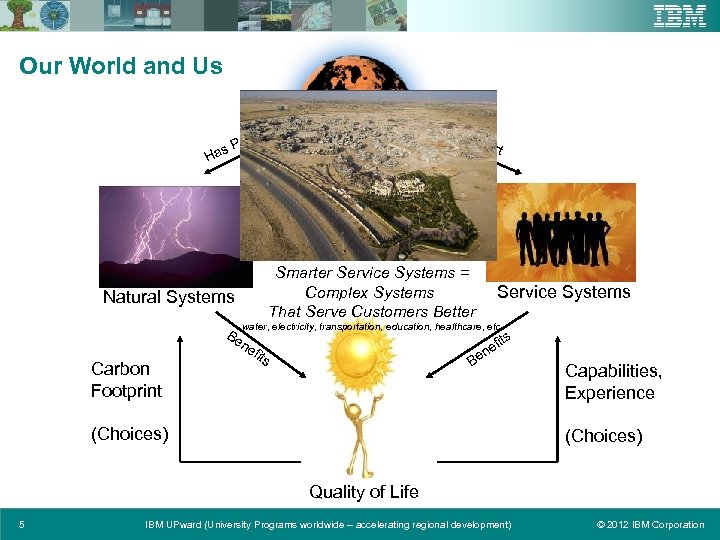
Our World and Us Ha Ha s P art Smarter Service Systems = Complex Systems Natural Systems Planetary Systems Serve Customers Better That water, electricity, transportation, education, healthcare, etc. Be ts efi n ne Carbon Footprint Service Systems fits Be (Choices) Capabilities, Experience (Choices) Quality of Life 5 IBM UPward (University Programs worldwide – accelerating regional development) © 2012 IBM Corporation
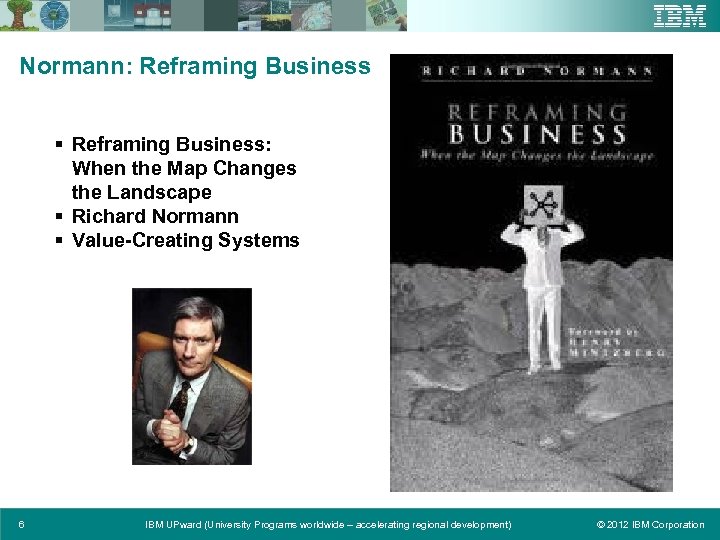
Normann: Reframing Business § Reframing Business: When the Map Changes the Landscape § Richard Normann § Value-Creating Systems 6 IBM UPward (University Programs worldwide – accelerating regional development) © 2012 IBM Corporation
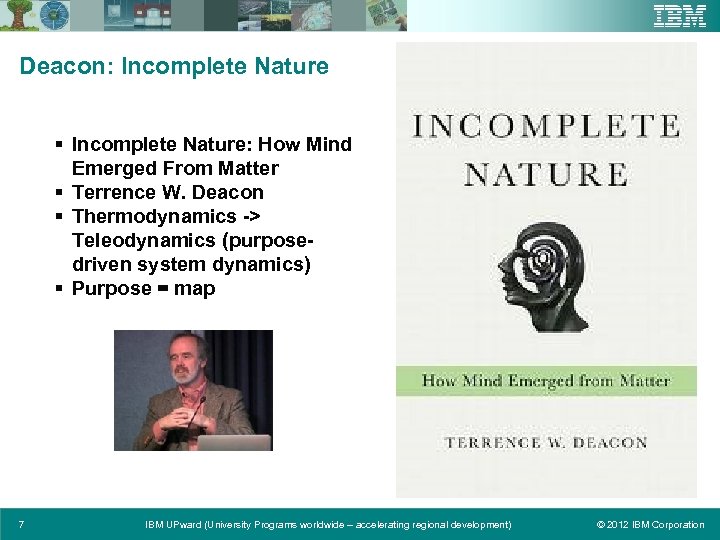
Deacon: Incomplete Nature § Incomplete Nature: How Mind Emerged From Matter § Terrence W. Deacon § Thermodynamics -> Teleodynamics (purposedriven system dynamics) § Purpose = map 7 IBM UPward (University Programs worldwide – accelerating regional development) © 2012 IBM Corporation
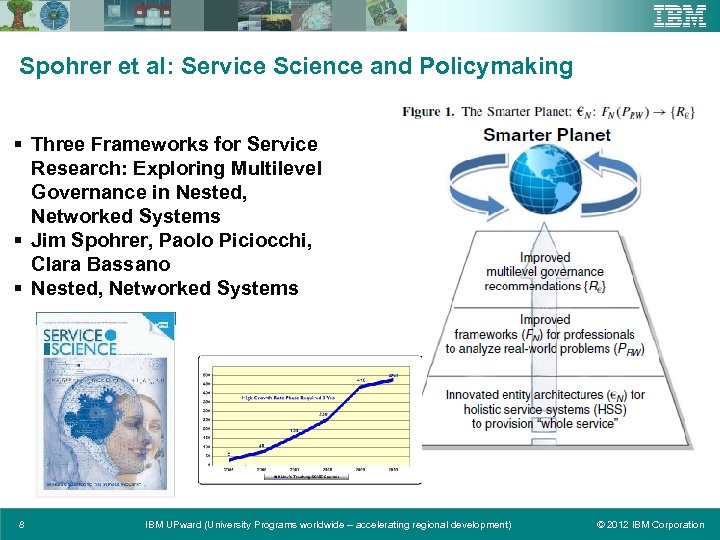
Spohrer et al: Service Science and Policymaking § Three Frameworks for Service Research: Exploring Multilevel Governance in Nested, Networked Systems § Jim Spohrer, Paolo Piciocchi, Clara Bassano § Nested, Networked Systems 8 IBM UPward (University Programs worldwide – accelerating regional development) © 2012 IBM Corporation
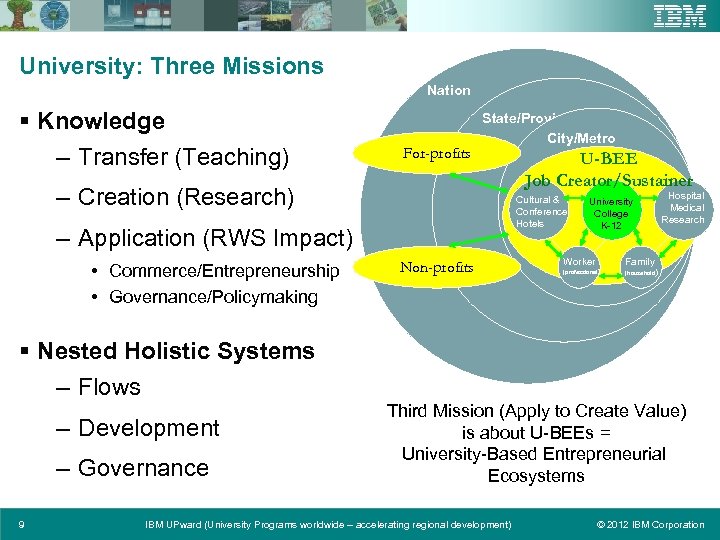
University: Three Missions Nation § Knowledge – Transfer (Teaching) For-profits State/Province City/Metro – Creation (Research) Cultural & Conference Hotels – Application (RWS Impact) • Commerce/Entrepreneurship • Governance/Policymaking U-BEE Job Creator/Sustainer Non-profits University College K-12 Worker Family (professional ) Hospital Medical Research (household ) § Nested Holistic Systems – Flows – Development – Governance 9 Third Mission (Apply to Create Value) is about U-BEEs = University-Based Entrepreneurial Ecosystems IBM UPward (University Programs worldwide – accelerating regional development) © 2012 IBM Corporation
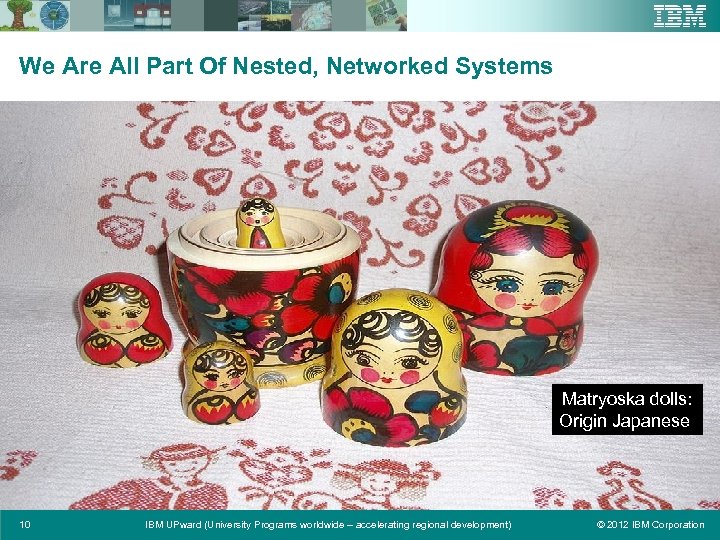
We Are All Part Of Nested, Networked Systems Matryoska dolls: Origin Japanese 10 IBM UPward (University Programs worldwide – accelerating regional development) © 2012 IBM Corporation
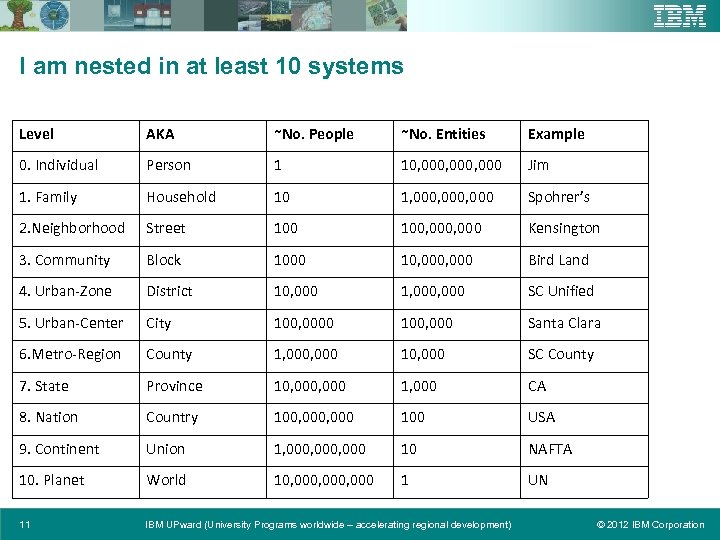
I am nested in at least 10 systems Level AKA ~No. People ~No. Entities Example 0. Individual Person 1 10, 000, 000 Jim 1. Family Household 10 1, 000, 000 Spohrer’s 2. Neighborhood Street 100, 000 Kensington 3. Community Block 1000 10, 000 Bird Land 4. Urban-Zone District 10, 000 1, 000 SC Unified 5. Urban-Center City 100, 0000 100, 000 Santa Clara 6. Metro-Region County 1, 000 10, 000 SC County 7. State Province 10, 000 1, 000 CA 8. Nation Country 100, 000 100 USA 9. Continent Union 1, 000, 000 10 NAFTA 10. Planet World 10, 000, 000 1 UN 11 IBM UPward (University Programs worldwide – accelerating regional development) © 2012 IBM Corporation
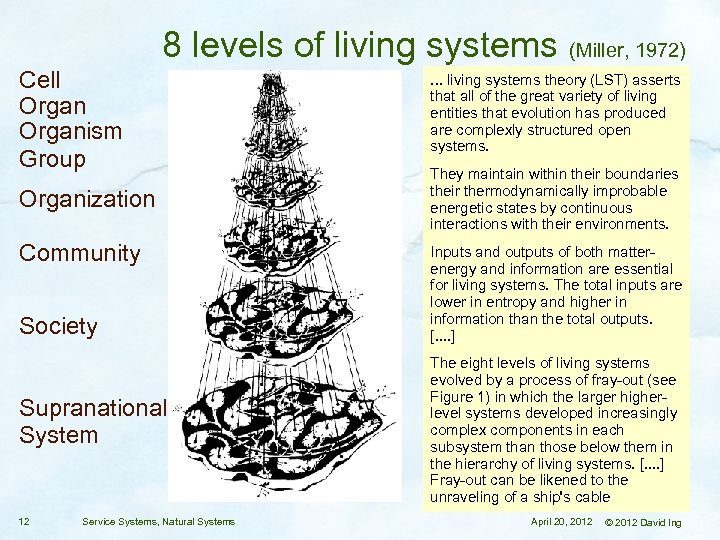
8 levels of living systems (Miller, 1972) Cell Organism Group Organization Community Society Supranational System 12 Service Systems, Natural Systems . . . living systems theory (LST) asserts that all of the great variety of living entities that evolution has produced are complexly structured open systems. They maintain within their boundaries their thermodynamically improbable energetic states by continuous interactions with their environments. Inputs and outputs of both matterenergy and information are essential for living systems. The total inputs are lower in entropy and higher in information than the total outputs. [. . ] The eight levels of living systems evolved by a process of fray-out (see Figure 1) in which the larger higherlevel systems developed increasingly complex components in each subsystem than those below them in the hierarchy of living systems. [. . ] Fray-out can be likened to the unraveling of a ship's cable April 20, 2012 © 2012 David Ing
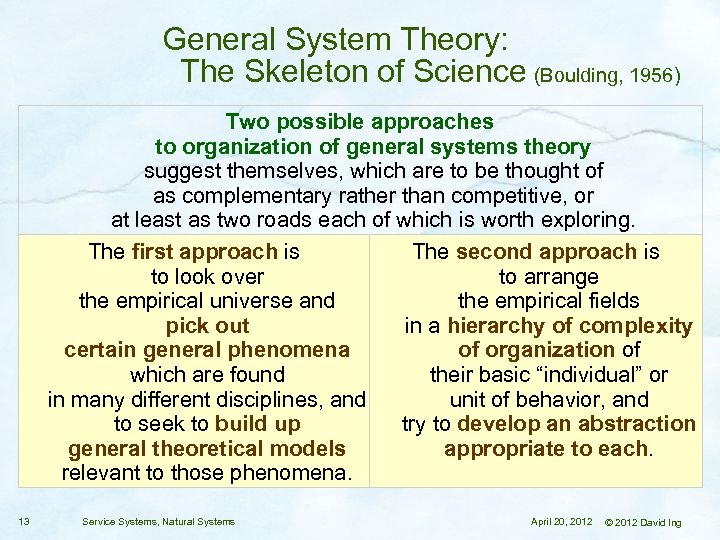
General System Theory: The Skeleton of Science (Boulding, 1956) Two possible approaches to organization of general systems theory suggest themselves, which are to be thought of as complementary rather than competitive, or at least as two roads each of which is worth exploring. The first approach is The second approach is to look over to arrange the empirical universe and the empirical fields pick out in a hierarchy of complexity certain general phenomena of organization of which are found their basic “individual” or in many different disciplines, and unit of behavior, and to seek to build up try to develop an abstraction general theoretical models appropriate to each. relevant to those phenomena. 13 Service Systems, Natural Systems April 20, 2012 © 2012 David Ing
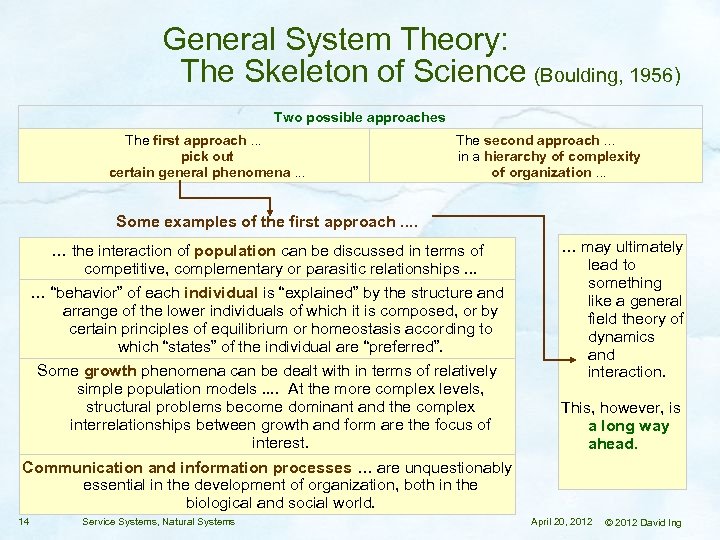
General System Theory: The Skeleton of Science (Boulding, 1956) Two possible approaches The first approach. . . pick out certain general phenomena. . . The second approach. . . in a hierarchy of complexity of organization. . . Some examples of the first approach. . … the interaction of population can be discussed in terms of competitive, complementary or parasitic relationships. . . … “behavior” of each individual is “explained” by the structure and arrange of the lower individuals of which it is composed, or by certain principles of equilibrium or homeostasis according to which “states” of the individual are “preferred”. Some growth phenomena can be dealt with in terms of relatively simple population models. . At the more complex levels, structural problems become dominant and the complex interrelationships between growth and form are the focus of interest. … may ultimately lead to something like a general field theory of dynamics and interaction. This, however, is a long way ahead. Communication and information processes … are unquestionably essential in the development of organization, both in the biological and social world. 14 Service Systems, Natural Systems April 20, 2012 © 2012 David Ing
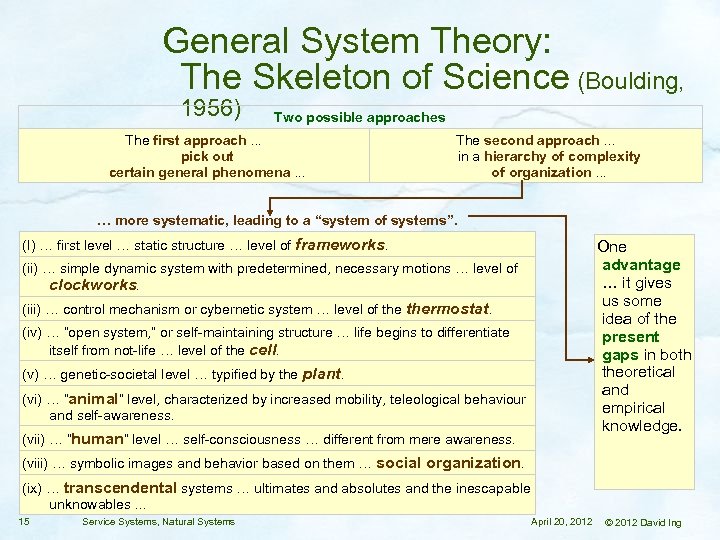
General System Theory: The Skeleton of Science (Boulding, 1956) Two possible approaches The first approach. . . pick out certain general phenomena. . . The second approach. . . in a hierarchy of complexity of organization. . . … more systematic, leading to a “system of systems”. (I) … first level … static structure … level of frameworks. One advantage … it gives us some idea of the present gaps in both theoretical and empirical knowledge. (ii) … simple dynamic system with predetermined, necessary motions … level of clockworks. (iii) … control mechanism or cybernetic system … level of thermostat. (iv) … “open system, ” or self-maintaining structure … life begins to differentiate itself from not-life … level of the cell. (v) … genetic-societal level … typified by the plant. (vi) … “animal” level, characterized by increased mobility, teleological behaviour and self-awareness. (vii) … “human” level … self-consciousness … different from mere awareness. (viii) … symbolic images and behavior based on them … social organization. (ix) … transcendental systems … ultimates and absolutes and the inescapable unknowables. . . 15 Service Systems, Natural Systems April 20, 2012 © 2012 David Ing
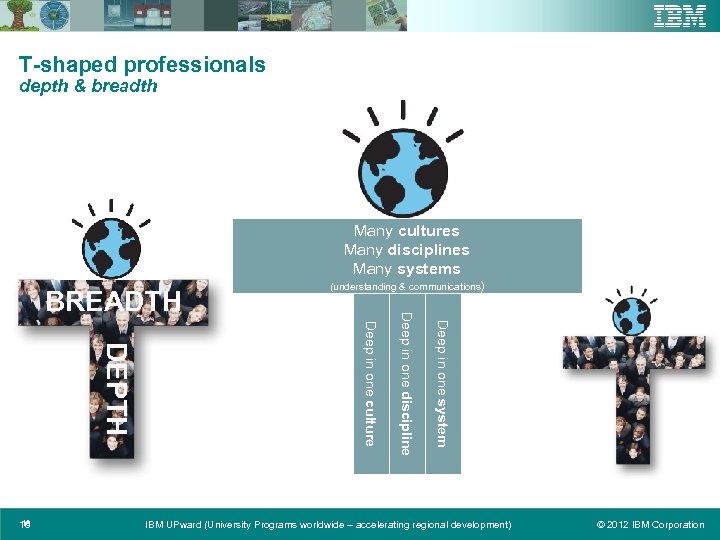
T-shaped professionals depth & breadth Many cultures Many disciplines Many systems Deep in one system Deep in one culture DEPTH Deep in one discipline BREADTH (understanding & communications) (analytic thinking & problem solving) 16 16 IBM UPward (University Programs worldwide – accelerating regional development) © 2012 IBM Corporation
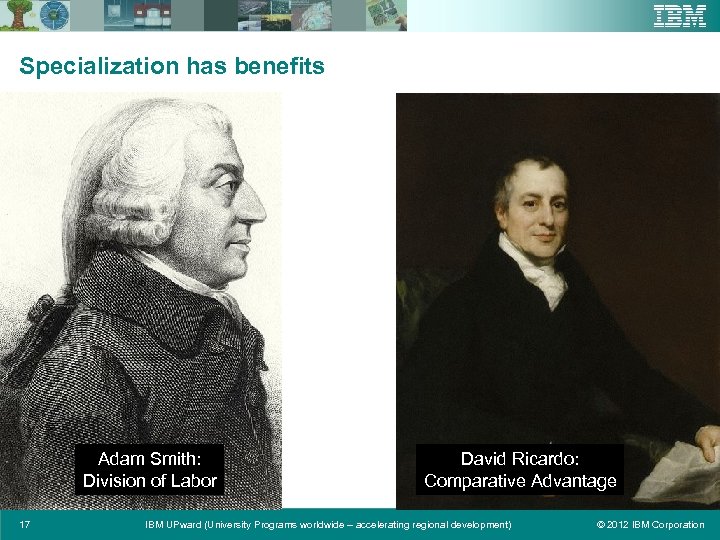
Specialization has benefits Adam Smith: Division of Labor 17 David Ricardo: Comparative Advantage IBM UPward (University Programs worldwide – accelerating regional development) © 2012 IBM Corporation
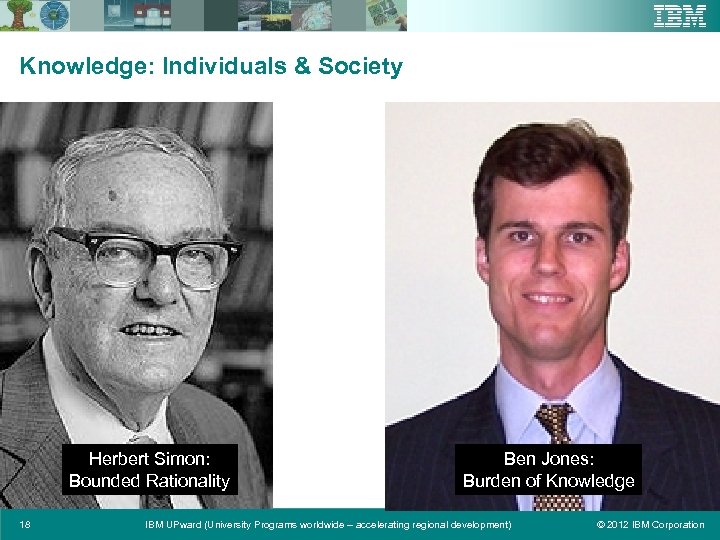
Knowledge: Individuals & Society Herbert Simon: Bounded Rationality 18 Ben Jones: Burden of Knowledge IBM UPward (University Programs worldwide – accelerating regional development) © 2012 IBM Corporation
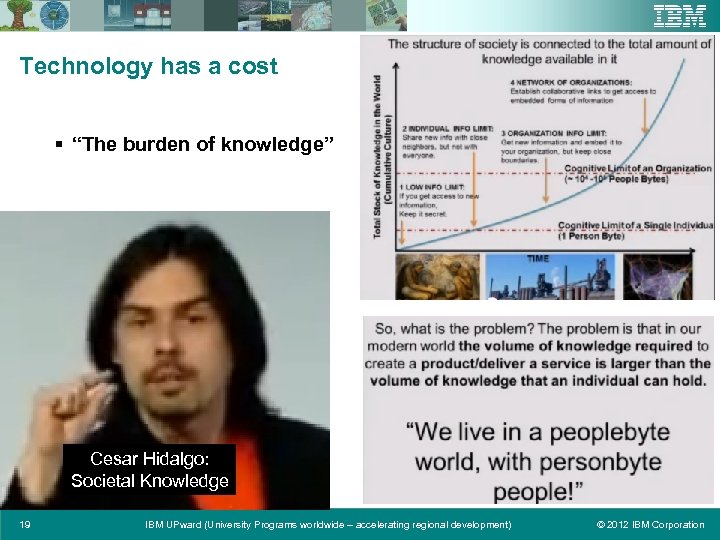
Technology has a cost § “The burden of knowledge” Cesar Hidalgo: Societal Knowledge 19 IBM UPward (University Programs worldwide – accelerating regional development) © 2012 IBM Corporation
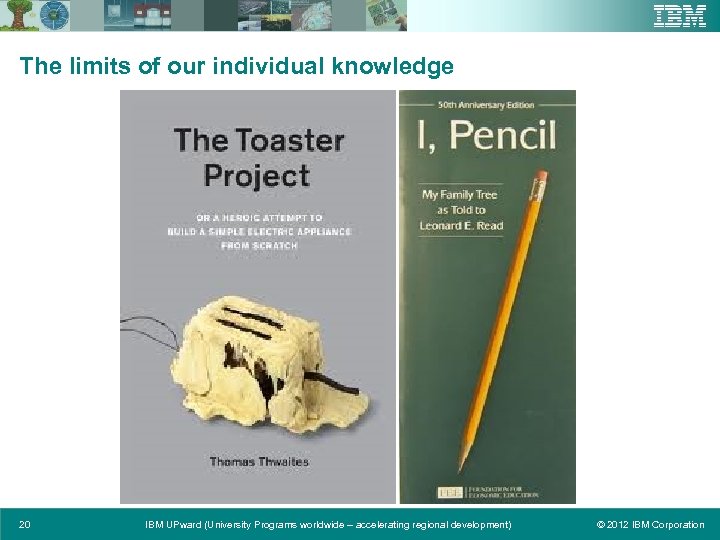
The limits of our individual knowledge 20 IBM UPward (University Programs worldwide – accelerating regional development) © 2012 IBM Corporation
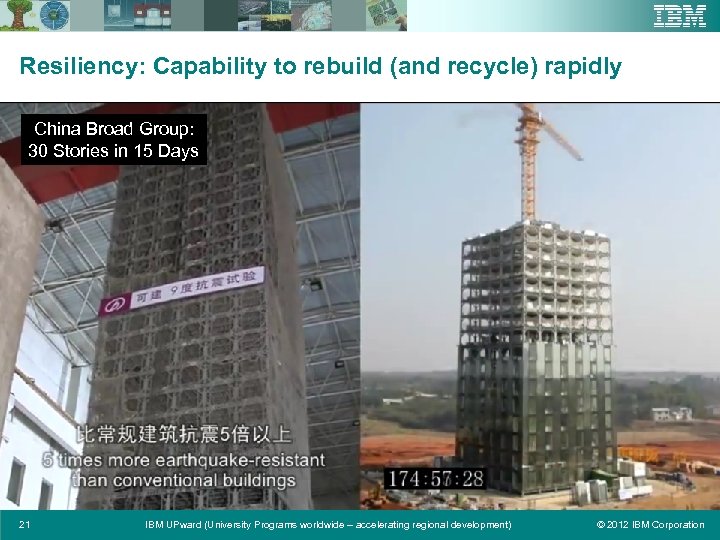
Resiliency: Capability to rebuild (and recycle) rapidly China Broad Group: 30 Stories in 15 Days 21 IBM UPward (University Programs worldwide – accelerating regional development) © 2012 IBM Corporation
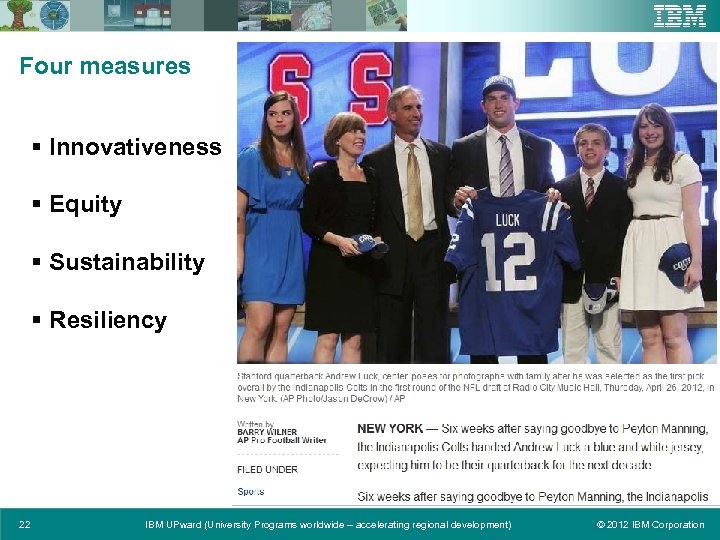
Four measures § Innovativeness § Equity § Sustainability § Resiliency 22 IBM UPward (University Programs worldwide – accelerating regional development) © 2012 IBM Corporation
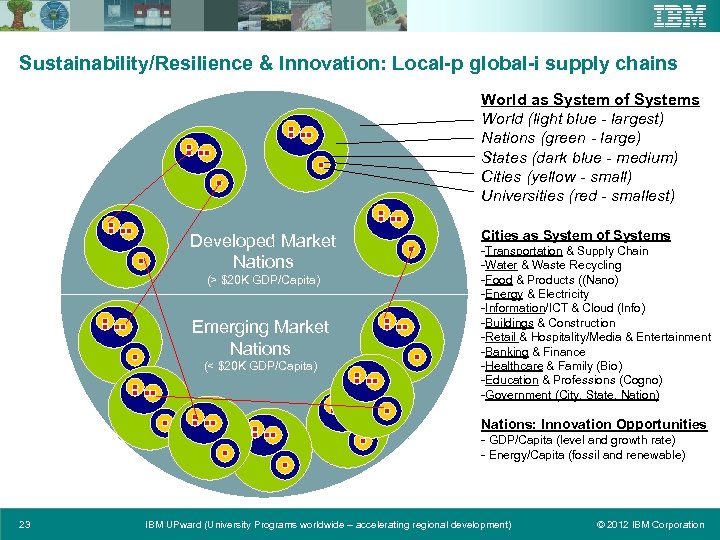
Sustainability/Resilience & Innovation: Local-p global-i supply chains World as System of Systems World (light blue - largest) Nations (green - large) States (dark blue - medium) Cities (yellow - small) Universities (red - smallest) Developed Market Nations (> $20 K GDP/Capita) Emerging Market Nations (< $20 K GDP/Capita) Cities as System of Systems -Transportation & Supply Chain -Water & Waste Recycling -Food & Products ((Nano) -Energy & Electricity -Information/ICT & Cloud (Info) -Buildings & Construction -Retail & Hospitality/Media & Entertainment -Banking & Finance -Healthcare & Family (Bio) -Education & Professions (Cogno) -Government (City, State, Nation) Nations: Innovation Opportunities - GDP/Capita (level and growth rate) - Energy/Capita (fossil and renewable) 23 IBM UPward (University Programs worldwide – accelerating regional development) © 2012 IBM Corporation
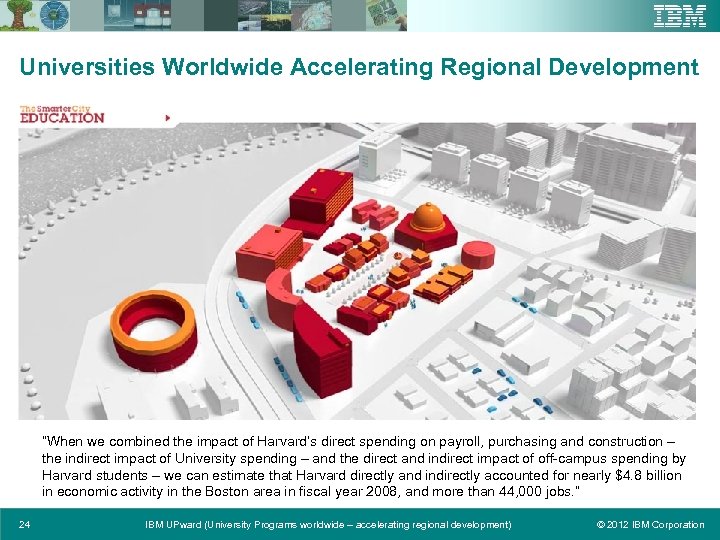
Universities Worldwide Accelerating Regional Development “When we combined the impact of Harvard’s direct spending on payroll, purchasing and construction – the indirect impact of University spending – and the direct and indirect impact of off-campus spending by Harvard students – we can estimate that Harvard directly and indirectly accounted for nearly $4. 8 billion in economic activity in the Boston area in fiscal year 2008, and more than 44, 000 jobs. ” 24 IBM UPward (University Programs worldwide – accelerating regional development) © 2012 IBM Corporation
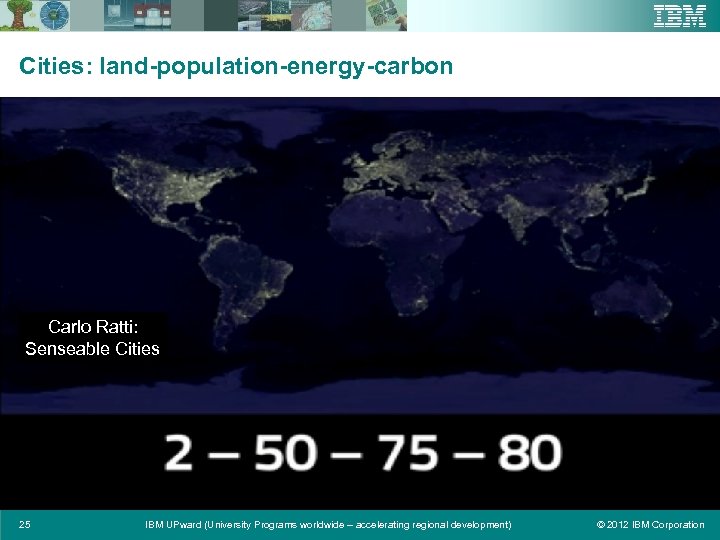
Cities: land-population-energy-carbon Carlo Ratti: Senseable Cities 25 IBM UPward (University Programs worldwide – accelerating regional development) © 2012 IBM Corporation
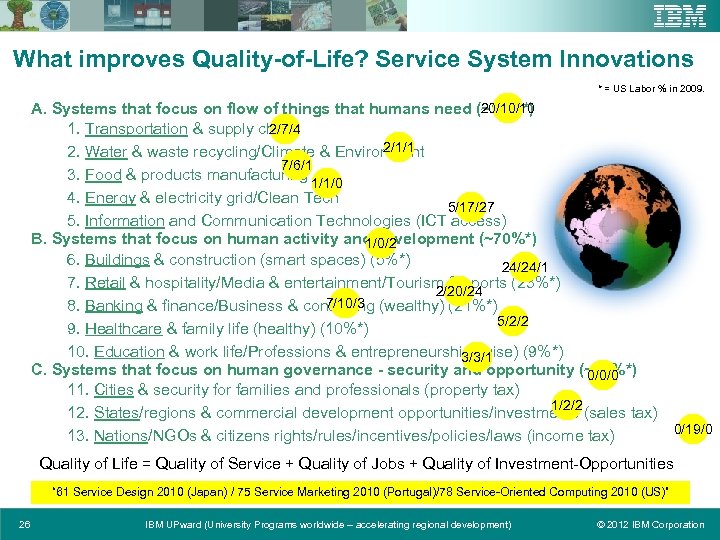
What improves Quality-of-Life? Service System Innovations * = US Labor % in 2009. 20/10/10 A. Systems that focus on flow of things that humans need (~15%*) 1. Transportation & supply chain 2/7/4 2/1/1 2. Water & waste recycling/Climate & Environment 7/6/1 3. Food & products manufacturing 1/1/0 4. Energy & electricity grid/Clean Tech 5/17/27 5. Information and Communication Technologies (ICT access) B. Systems that focus on human activity and development (~70%*) 1/0/2 6. Buildings & construction (smart spaces) (5%*) 24/24/1 7. Retail & hospitality/Media & entertainment/Tourism & sports (23%*) 2/20/24 7/10/3 8. Banking & finance/Business & consulting (wealthy) (21%*) 5/2/2 9. Healthcare & family life (healthy) (10%*) 10. Education & work life/Professions & entrepreneurship (wise) (9%*) 3/3/1 C. Systems that focus on human governance - security and opportunity (~15%*) 0/0/0 11. Cities & security for families and professionals (property tax) 1/2/2 12. States/regions & commercial development opportunities/investments (sales tax) 13. Nations/NGOs & citizens rights/rules/incentives/policies/laws (income tax) 0/19/0 Quality of Life = Quality of Service + Quality of Jobs + Quality of Investment-Opportunities “ 61 Service Design 2010 (Japan) / 75 Service Marketing 2010 (Portugal)/78 Service-Oriented Computing 2010 (US)” 26 IBM UPward (University Programs worldwide – accelerating regional development) © 2012 IBM Corporation
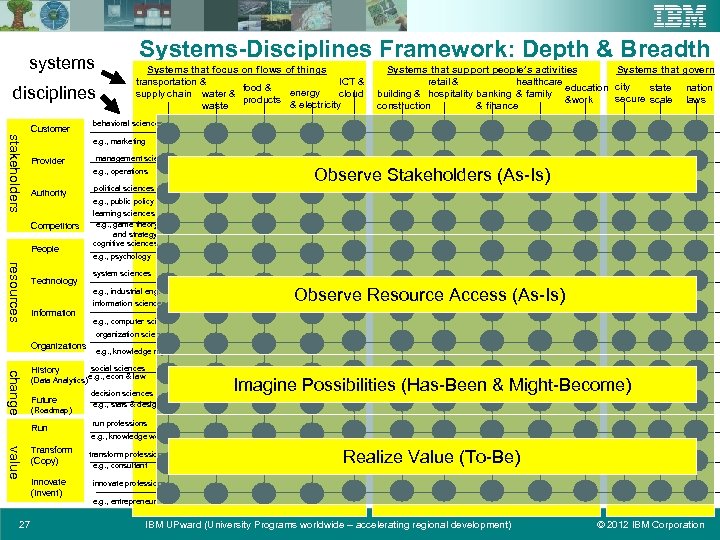
Systems-Disciplines Framework: Depth & Breadth systems disciplines Customer Systems that focus on flows of things transportation & ICT & food & energy supply chain water & cloud products & electricity waste Systems that support people’s activities Systems that govern retail & healthcare education city state nation building & hospitality banking & family secure scale laws &work construction & finance behavioral sciences stakeholders e. g. , marketing Provider management sciences e. g. , operations Authority Competitors resources People Technology political sciences e. g. , public policy learning sciences e. g. , game theory and strategy cognitive sciences e. g. , psychology system sciences e. g. , industrial eng. information sciences Information Observe Stakeholders (As-Is) Observe Resource Access (As-Is) e. g. , computer sci organization sciences Organizations change value 27 History (Data Analytics) Future (Roadmap) Run Transform (Copy) Innovate (Invent) e. g. , knowledge mgmt social sciences e. g. , econ & law decision sciences e. g. , stats & design Imagine Possibilities (Has-Been & Might-Become) run professions e. g. , knowledge worker transform professions e. g. , consultant Realize Value (To-Be) innovate professions e. g. , entrepreneur IBM UPward (University Programs worldwide – accelerating regional development) © 2012 IBM Corporation
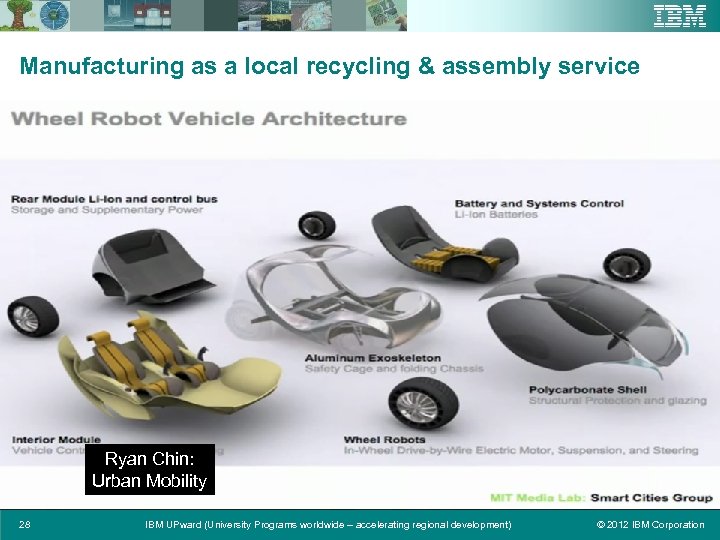
Manufacturing as a local recycling & assembly service Ryan Chin: Urban Mobility 28 IBM UPward (University Programs worldwide – accelerating regional development) © 2012 IBM Corporation
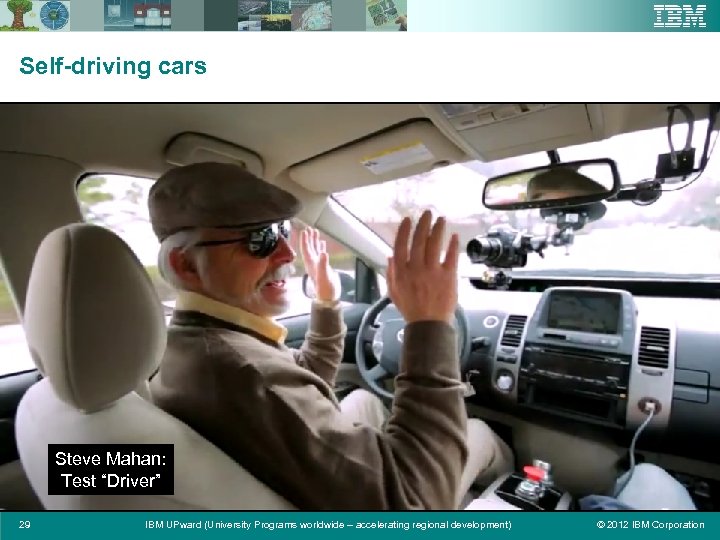
Self-driving cars Steve Mahan: Test “Driver” 29 IBM UPward (University Programs worldwide – accelerating regional development) © 2012 IBM Corporation
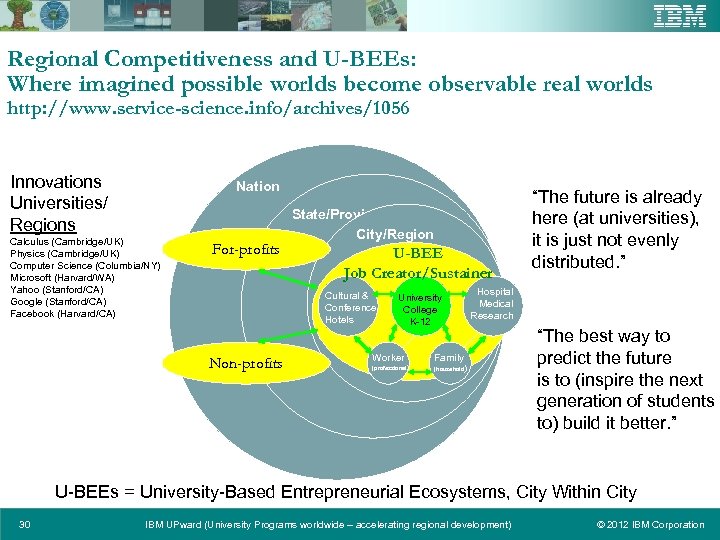
Regional Competitiveness and U-BEEs: Where imagined possible worlds become observable real worlds http: //www. service-science. info/archives/1056 Innovations Universities/ Regions Nation Calculus (Cambridge/UK) Physics (Cambridge/UK) Computer Science (Columbia/NY) Microsoft (Harvard/WA) Yahoo (Stanford/CA) Google (Stanford/CA) Facebook (Harvard/CA) For-profits State/Province City/Region U-BEE Job Creator/Sustainer Cultural & Conference Hotels Non-profits University College K-12 Worker Hospital Medical Research Family (professional ) “The future is already here (at universities), it is just not evenly distributed. ” (household ) “The best way to predict the future is to (inspire the next generation of students to) build it better. ” U-BEEs = University-Based Entrepreneurial Ecosystems, City Within City 30 IBM UPward (University Programs worldwide – accelerating regional development) © 2012 IBM Corporation
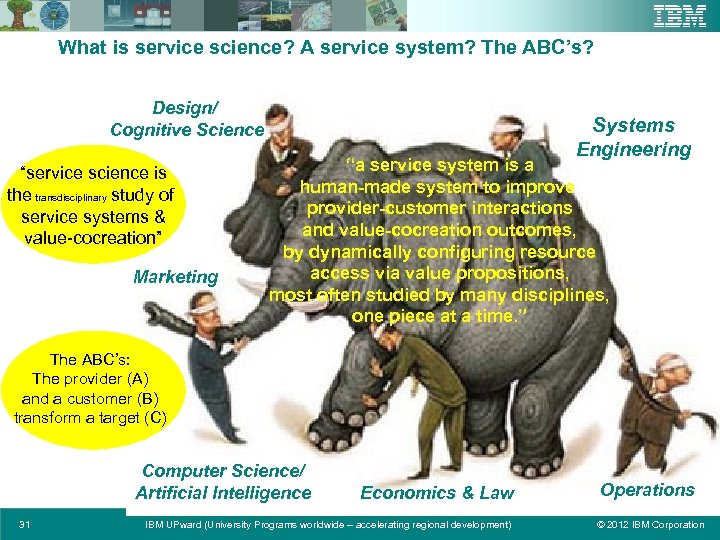
What is service science? A service system? The ABC’s? Design/ Cognitive Science “service science is the transdisciplinary study of service systems & value-cocreation” Marketing Systems Engineering “a service system is a human-made system to improve provider-customer interactions and value-cocreation outcomes, by dynamically configuring resource access via value propositions, most often studied by many disciplines, one piece at a time. ” The ABC’s: The provider (A) and a customer (B) transform a target (C) Computer Science/ Artificial Intelligence 31 Economics & Law IBM UPward (University Programs worldwide – accelerating regional development) Operations © 2012 IBM Corporation
A Framework for Global Civil Society § Daniel Patrick Moynihan said nearly 50 years ago: "If you want to build a world class city, build a great university and wait 200 years. " His insight is true today – except yesterday's 200 years has become twenty. More than ever, universities will generate and sustain the world’s idea capitals and, as vital creators, incubators, connectors, and channels of thought and understanding, they will provide a framework for global civil society. – John Sexton, President NYU 32 IBM UPward (University Programs worldwide – accelerating regional development) © 2012 IBM Corporation
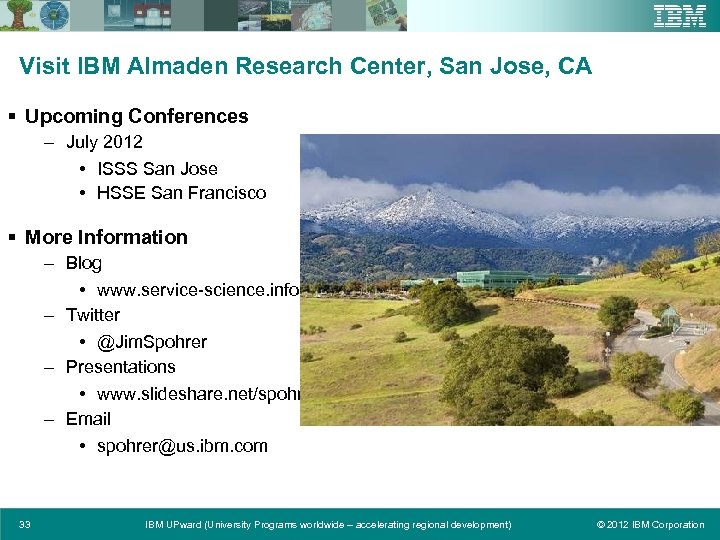
Visit IBM Almaden Research Center, San Jose, CA § Upcoming Conferences – July 2012 • ISSS San Jose • HSSE San Francisco § More Information – Blog • www. service-science. info – Twitter • @Jim. Spohrer – Presentations • www. slideshare. net/spohrer – Email • spohrer@us. ibm. com 33 IBM UPward (University Programs worldwide – accelerating regional development) © 2012 IBM Corporation
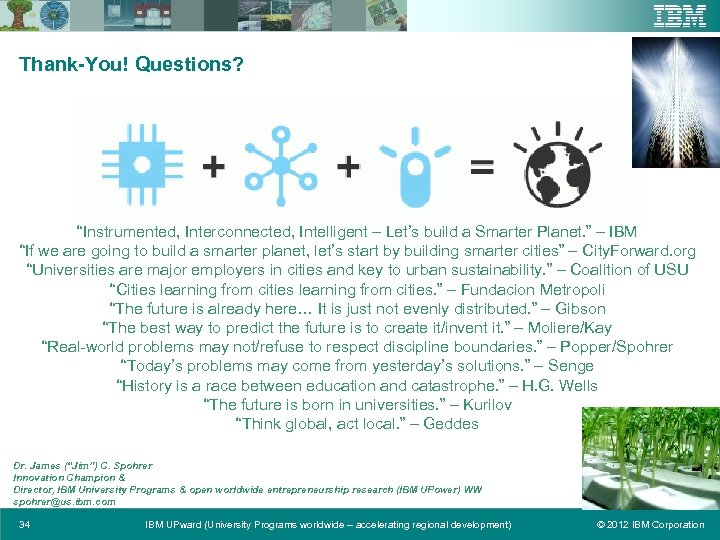
Thank-You! Questions? “Instrumented, Interconnected, Intelligent – Let’s build a Smarter Planet. ” – IBM “If we are going to build a smarter planet, let’s start by building smarter cities” – City. Forward. org “Universities are major employers in cities and key to urban sustainability. ” – Coalition of USU “Cities learning from cities. ” – Fundacion Metropoli “The future is already here… It is just not evenly distributed. ” – Gibson “The best way to predict the future is to create it/invent it. ” – Moliere/Kay “Real-world problems may not/refuse to respect discipline boundaries. ” – Popper/Spohrer “Today’s problems may come from yesterday’s solutions. ” – Senge “History is a race between education and catastrophe. ” – H. G. Wells “The future is born in universities. ” – Kurilov “Think global, act local. ” – Geddes Dr. James (“Jim”) C. Spohrer Innovation Champion & Director, IBM University Programs & open worldwide entrepreneurship research (IBM UPower) WW spohrer@us. ibm. com 34 IBM UPward (University Programs worldwide – accelerating regional development) © 2012 IBM Corporation
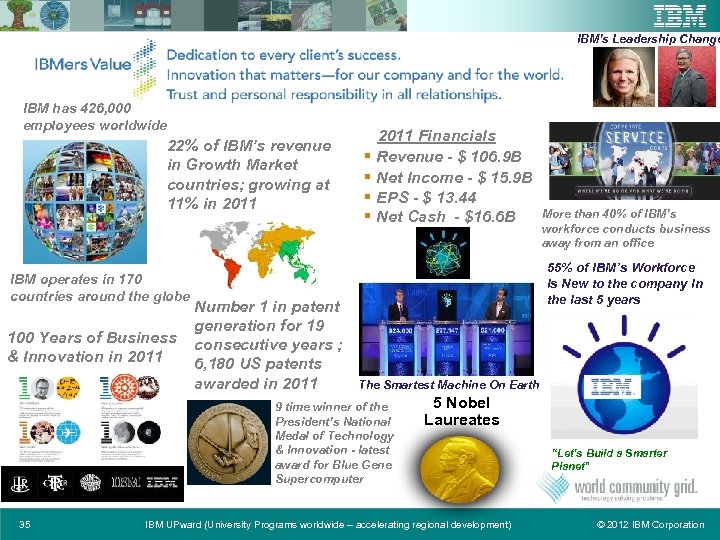
IBM’s Leadership Change IBM has 426, 000 employees worldwide 22% of IBM’s revenue in Growth Market countries; growing at 11% in 2011 IBM operates in 170 countries around the globe 100 Years of Business & Innovation in 2011 Number 1 in patent generation for 19 consecutive years ; 6, 180 US patents awarded in 2011 Financials § Revenue - $ 106. 9 B § Net Income - $ 15. 9 B § EPS - $ 13. 44 § Net Cash - $16. 6 B 55% of IBM’s Workforce is New to the company in the last 5 years The Smartest Machine On Earth 9 time winner of the President’s National Medal of Technology & Innovation - latest award for Blue Gene Supercomputer 35 More than 40% of IBM’s workforce conducts business away from an office 5 Nobel Laureates IBM UPward (University Programs worldwide – accelerating regional development) “Let’s Build a Smarter Planet" © 2012 IBM Corporation
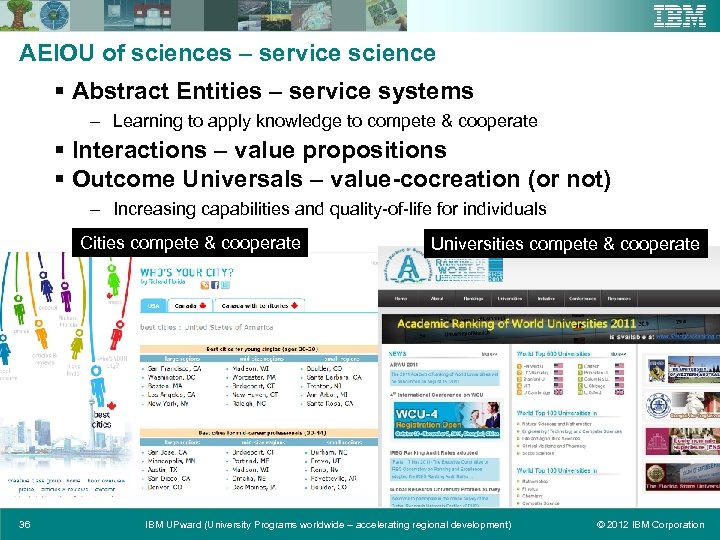
AEIOU of sciences – service science § Abstract Entities – service systems – Learning to apply knowledge to compete & cooperate § Interactions – value propositions § Outcome Universals – value-cocreation (or not) – Increasing capabilities and quality-of-life for individuals Cities compete & cooperate 36 Universities compete & cooperate IBM UPward (University Programs worldwide – accelerating regional development) © 2012 IBM Corporation
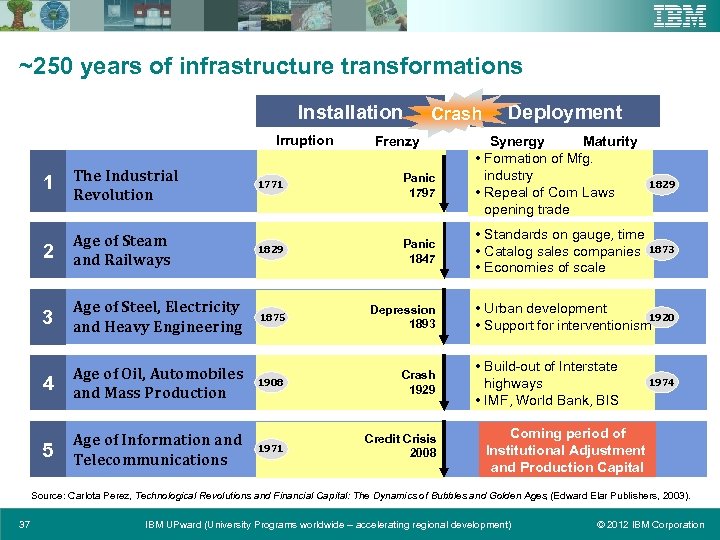
~250 years of infrastructure transformations Installation Irruption 1 The Industrial Revolution Crash Frenzy Deployment Synergy Maturity • Formation of Mfg. industry • Repeal of Corn Laws opening trade 1771 Panic 1797 2 Age of Steam and Railways 1829 Panic 1847 • Standards on gauge, time • Catalog sales companies 1873 • Economies of scale 3 Age of Steel, Electricity and Heavy Engineering 1875 Depression 1893 • Urban development 1920 • Support for interventionism 4 Age of Oil, Automobiles and Mass Production 1908 Crash 1929 5 Age of Information and Telecommunications 1971 Credit Crisis 2008 • Build-out of Interstate highways • IMF, World Bank, BIS 1829 1974 Coming period of Institutional Adjustment and Production Capital Source: Carlota Perez, Technological Revolutions and Financial Capital: The Dynamics of Bubbles and Golden Ages ; (Edward Elar Publishers, 2003). 37 IBM UPward (University Programs worldwide – accelerating regional development) © 2012 IBM Corporation
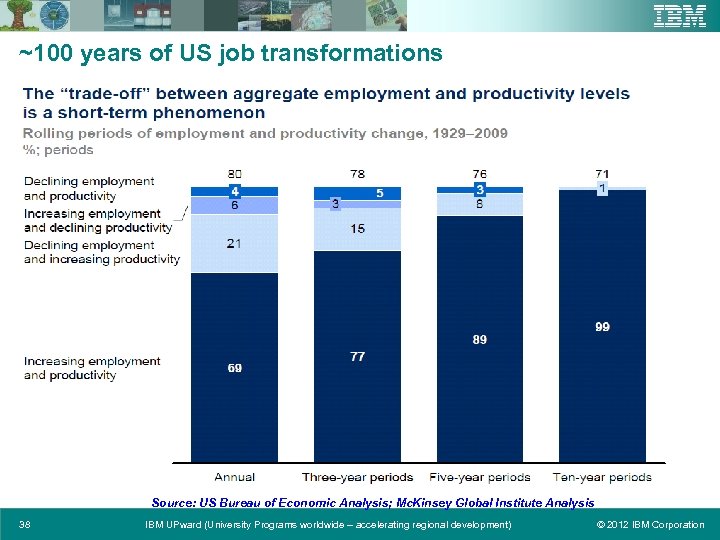
~100 years of US job transformations Source: US Bureau of Economic Analysis; Mc. Kinsey Global Institute Analysis 38 IBM UPward (University Programs worldwide – accelerating regional development) © 2012 IBM Corporation
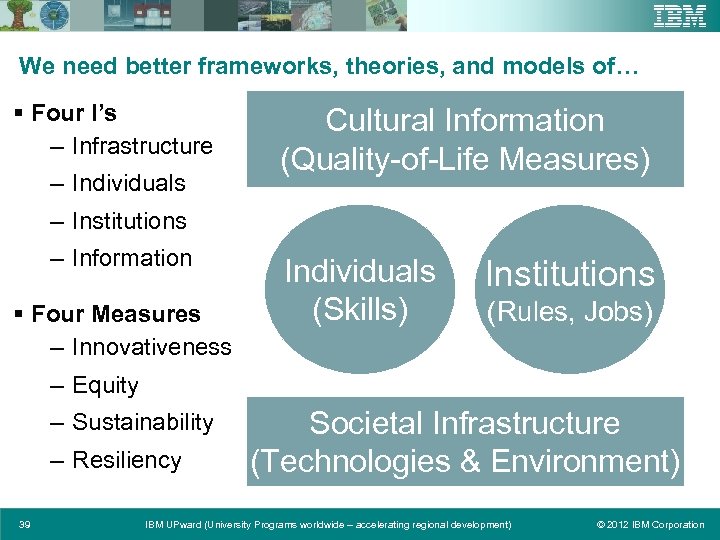
We need better frameworks, theories, and models of… § Four I’s – Infrastructure – Individuals Cultural Information (Quality-of-Life Measures) – Institutions – Information § Four Measures – Innovativeness Individuals (Skills) Institutions (Rules, Jobs) – Equity – Sustainability – Resiliency 39 Societal Infrastructure (Technologies & Environment) IBM UPward (University Programs worldwide – accelerating regional development) © 2012 IBM Corporation
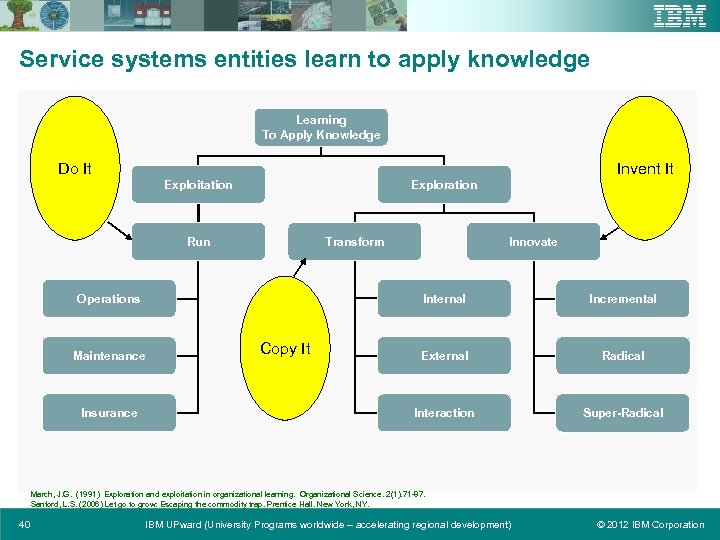
Service systems entities learn to apply knowledge Learning To Apply Knowledge Do It Invent It Exploitation Exploration Run Transform L Maintenance Copy It Internal Incremental External Radical Interaction Operations Insurance Innovate Super-Radical March, J. G. (1991) Exploration and exploitation in organizational learning. Organizational Science. 2(1). 71 -87. Sanford, L. S. (2006) Let go to grow: Escaping the commodity trap. Prentice Hall. New York, NY. 40 IBM UPward (University Programs worldwide – accelerating regional development) © 2012 IBM Corporation
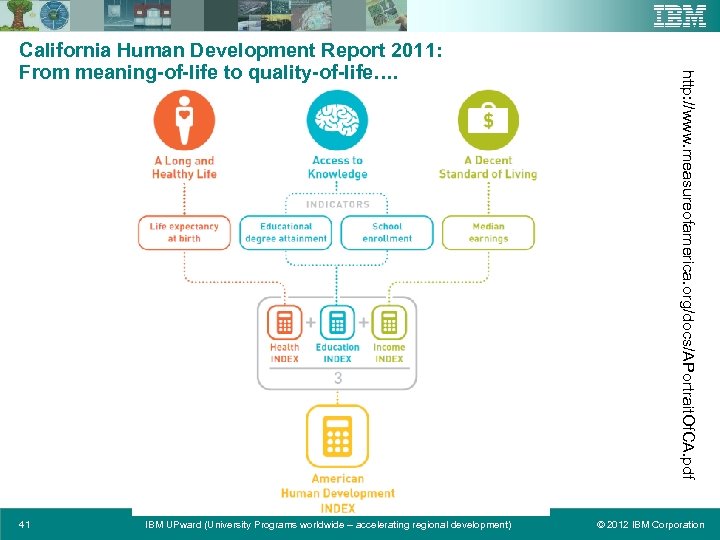
41 IBM UPward (University Programs worldwide – accelerating regional development) http: //www. measureofamerica. org/docs/APortrait. Of. CA. pdf California Human Development Report 2011: From meaning-of-life to quality-of-life…. © 2012 IBM Corporation
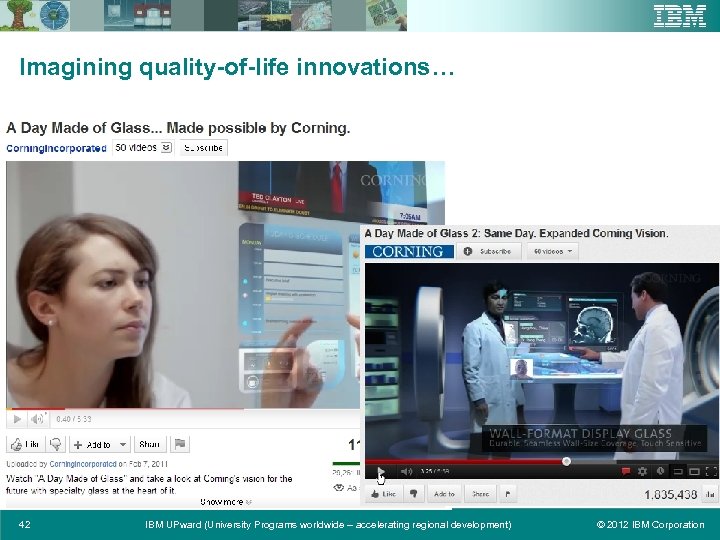
Imagining quality-of-life innovations… 42 IBM UPward (University Programs worldwide – accelerating regional development) © 2012 IBM Corporation
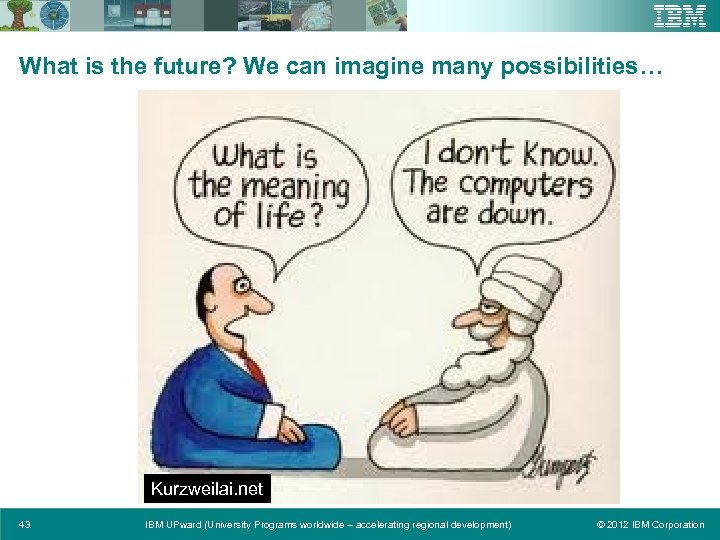
What is the future? We can imagine many possibilities… Kurzweilai. net 43 IBM UPward (University Programs worldwide – accelerating regional development) © 2012 IBM Corporation
Скачать презентацию IBM University Programs worldwide accelerating regional development IBM
e4ef7927dc819fcf104842d7dba08526.ppt