 Скачать презентацию IBM Systems and Technology Group IBM System Storage
885bdee6a2ee7bc86eeb1e0d7e7ab682.ppt
- Количество слайдов: 75



IBM Systems and Technology Group IBM System Storage – Software © 2008 IBM Corporation This document is for IBM and IBM Business Partner use only. It is not intended for customer distribution or use with customers.
IBM Systems and Technology Group Agenda § San Volume Controller – Disk Virtualization § Total Storage Productivity Center- Infrastructure Management § Tivoli Storage Management- Archival, Save/Restore, Space Management 2 © 2008 IBM Corporation
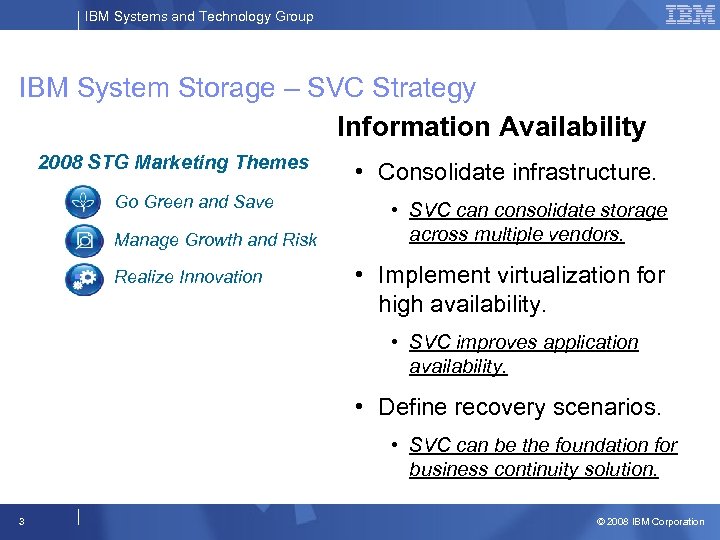
IBM Systems and Technology Group IBM System Storage – SVC Strategy Information Availability 2008 STG Marketing Themes § Go Green and Save § Manage Growth and Risk § Realize Innovation • Consolidate infrastructure. • SVC can consolidate storage across multiple vendors. • Implement virtualization for high availability. • SVC improves application availability. • Define recovery scenarios. • SVC can be the foundation for business continuity solution. 3 © 2008 IBM Corporation
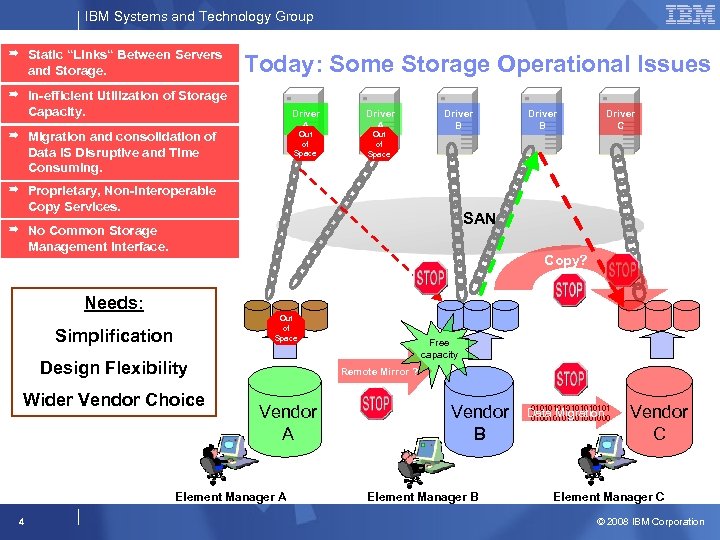
IBM Systems and Technology Group º Static “Links“ Between Servers and Storage. Today: Some Storage Operational Issues º In-efficient Utilization of Storage Capacity. Driver A º Migration and consolidation of Out of Space Data IS Disruptive and Time Consuming. Driver A Out of Space Driver B Driver C º Proprietary, Non-interoperable Copy Services. SAN º No Common Storage Management Interface. Copy? Needs: Out of Space Simplification Design Flexibility Wider Vendor Choice Remote Mirror ? Vendor A Element Manager A 4 Free capacity Vendor B Element Manager B 0101010101 Data Migration 010010101101001000 Vendor C Element Manager C © 2008 IBM Corporation
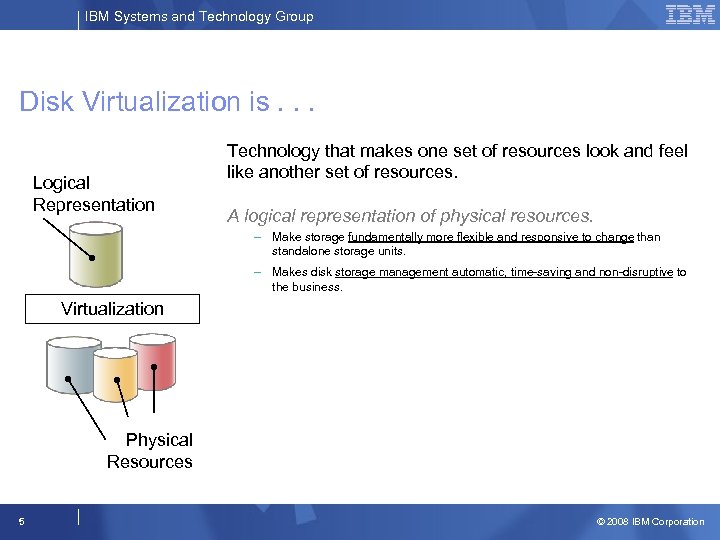
IBM Systems and Technology Group Disk Virtualization is. . . Logical Representation Technology that makes one set of resources look and feel like another set of resources. A logical representation of physical resources. – Make storage fundamentally more flexible and responsive to change than standalone storage units. – Makes disk storage management automatic, time-saving and non-disruptive to the business. Virtualization Physical Resources Source: Evaluator Group 5 © 2008 IBM Corporation
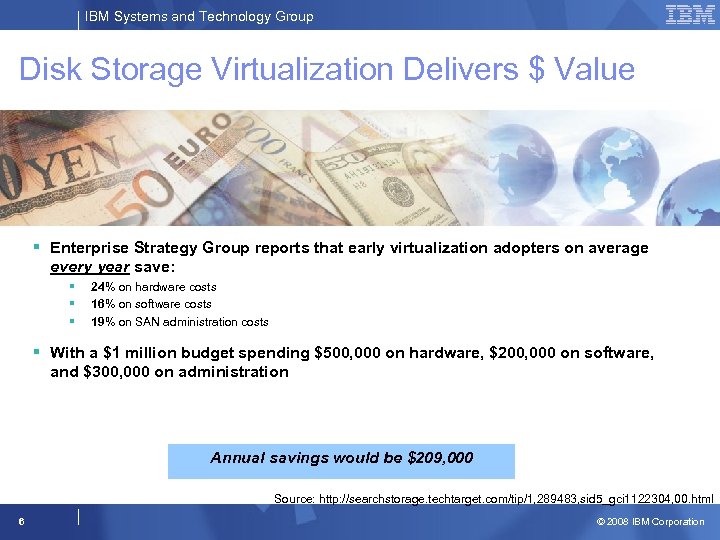
IBM Systems and Technology Group Disk Storage Virtualization Delivers $ Value § Enterprise Strategy Group reports that early virtualization adopters on average every year save: § § § 24% on hardware costs 16% on software costs 19% on SAN administration costs § With a $1 million budget spending $500, 000 on hardware, $200, 000 on software, and $300, 000 on administration Annual savings would be $209, 000 Source: http: //searchstorage. techtarget. com/tip/1, 289483, sid 5_gci 1122304, 00. html 6 © 2008 IBM Corporation
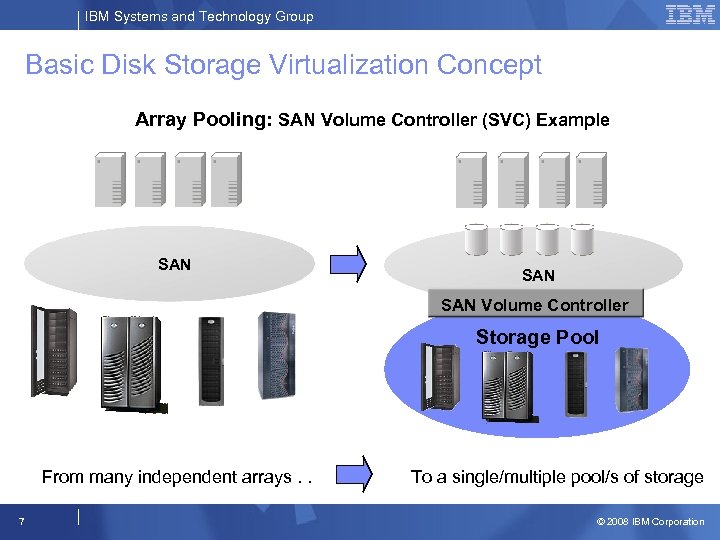
IBM Systems and Technology Group Basic Disk Storage Virtualization Concept Array Pooling: SAN Volume Controller (SVC) Example SAN SAN Volume Controller Storage Pool From many independent arrays. . 7 To a single/multiple pool/s of storage © 2008 IBM Corporation
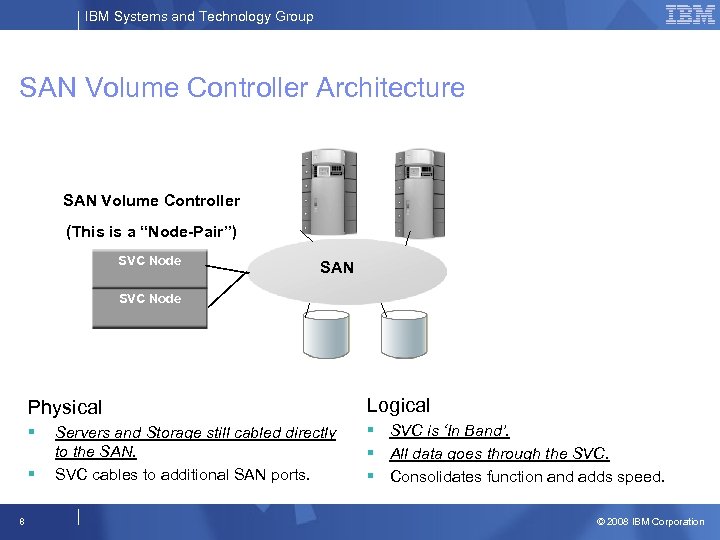
IBM Systems and Technology Group SAN Volume Controller Architecture SAN Volume Controller (This is a “Node-Pair”) SVC Node SAN SVC Node Physical Logical § § SVC is ‘In Band’. § All data goes through the SVC. § Consolidates function and adds speed. § 8 Servers and Storage still cabled directly to the SAN. SVC cables to additional SAN ports. © 2008 IBM Corporation
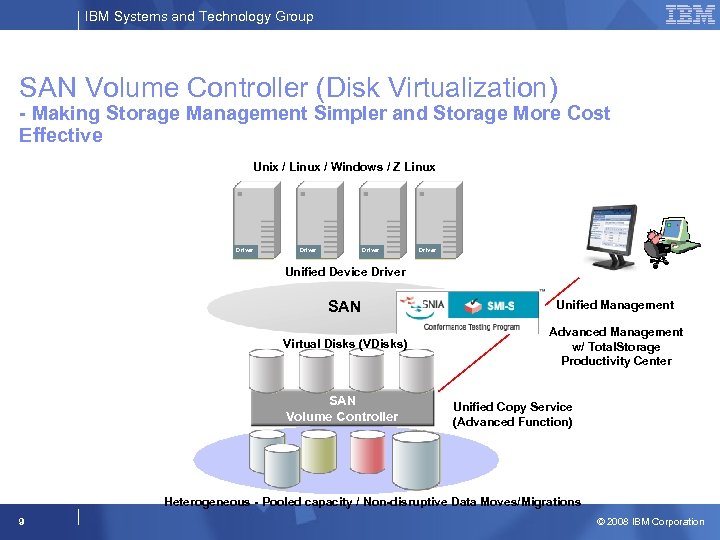
IBM Systems and Technology Group SAN Volume Controller (Disk Virtualization) - Making Storage Management Simpler and Storage More Cost Effective Unix / Linux / Windows / Z Linux Driver Unified Device Driver SVC GUI SAN Unified Management Virtual Disks (VDisks) Advanced Management w/ Total. Storage Productivity Center SAN Volume Controller Unified Copy Service (Advanced Function) Heterogeneous - Pooled capacity / Non-disruptive Data Moves/Migrations 9 © 2008 IBM Corporation
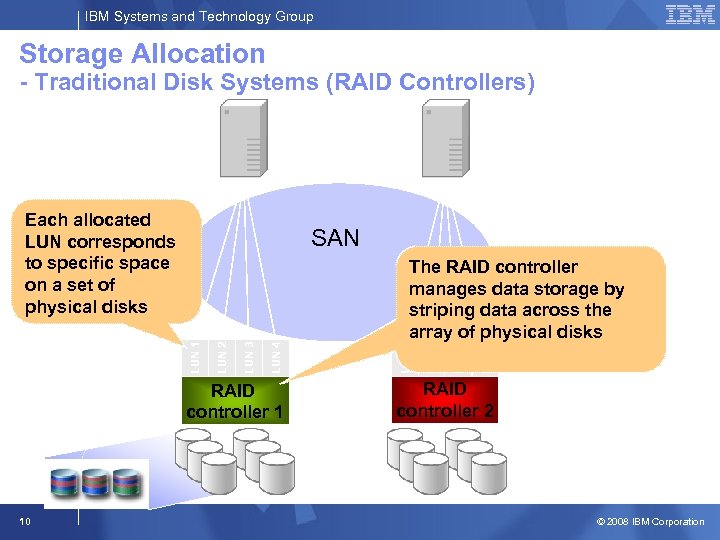
IBM Systems and Technology Group Storage Allocation - Traditional Disk Systems (RAID Controllers) Each allocated LUN corresponds to specific space on a set of physical disks SAN RAID controller 1 10 LUN 4 LUN 3 LUN 2 LUN 1 The RAID controller manages data storage by striping data across the array of physical disks RAID controller 2 © 2008 IBM Corporation
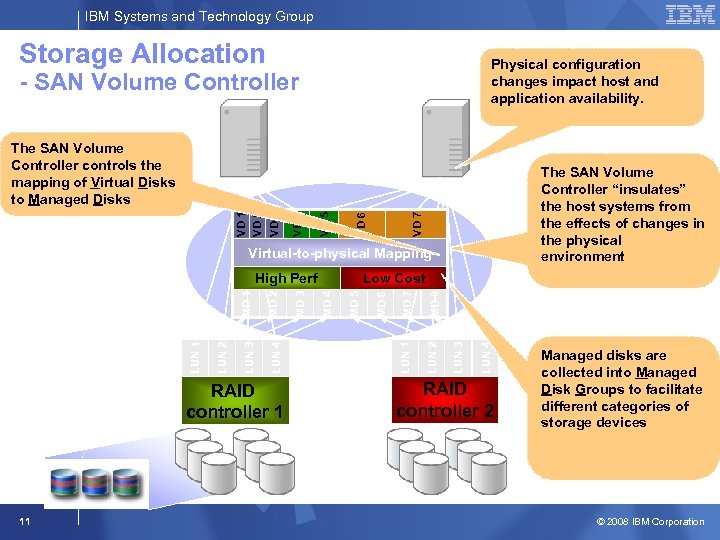
IBM Systems and Technology Group Storage Allocation Physical configuration changes impact host and application availability. - SAN Volume Controller The SAN Volume Controller “insulates” the host systems from the effects of changes in the physical environment VD 7 VD 6 VD 5 Virtual Disks VD 4 VD 1 VD 2 VD 3 The SAN Volume Controller controls the mapping of Virtual Disks to Managed Disks SAN Virtual-to-physical Mapping 11 LUN 4 MD 8 LUN 2 LUN 3 MD 7 LUN 1 MD 6 MD 5 Low Cost MD 4 MD 2 LUN 4 RAID controller 1 MD 3 MD 1 LUN 2 SCSI LUNs LUN 1 Managed Disks LUN 3 High Perf RAID controller 2 Managed disks are collected into Managed Disk Groups to facilitate different categories of storage devices © 2008 IBM Corporation
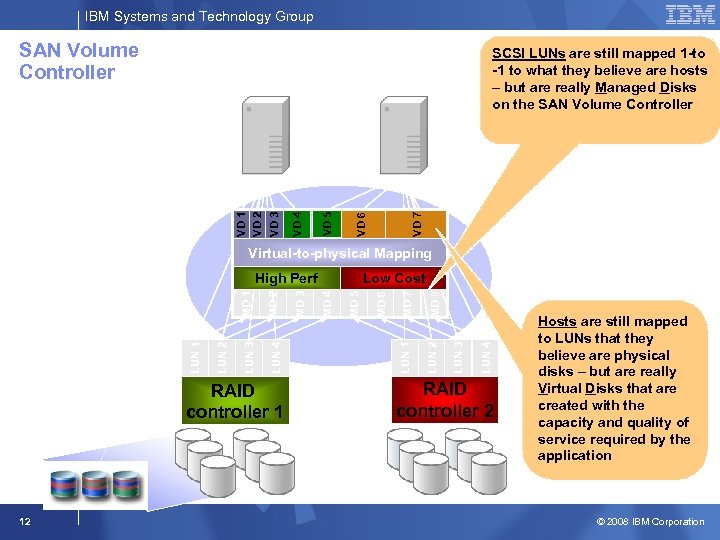
IBM Systems and Technology Group SAN Volume Controller VD 7 VD 6 VD 5 Virtual Disks VD 4 VD 1 VD 2 VD 3 SCSI LUNs are still mapped 1 -to -1 to what they believe are hosts – but are really Managed Disks on the SAN Volume Controller SAN Virtual-to-physical Mapping 12 LUN 4 MD 8 LUN 2 LUN 3 MD 7 LUN 1 MD 6 MD 5 Low Cost MD 4 MD 2 LUN 4 RAID controller 1 MD 3 MD 1 LUN 2 SCSI LUNs LUN 1 Managed Disks LUN 3 High Perf RAID controller 2 Hosts are still mapped to LUNs that they believe are physical disks – but are really Virtual Disks that are created with the capacity and quality of service required by the application © 2008 IBM Corporation
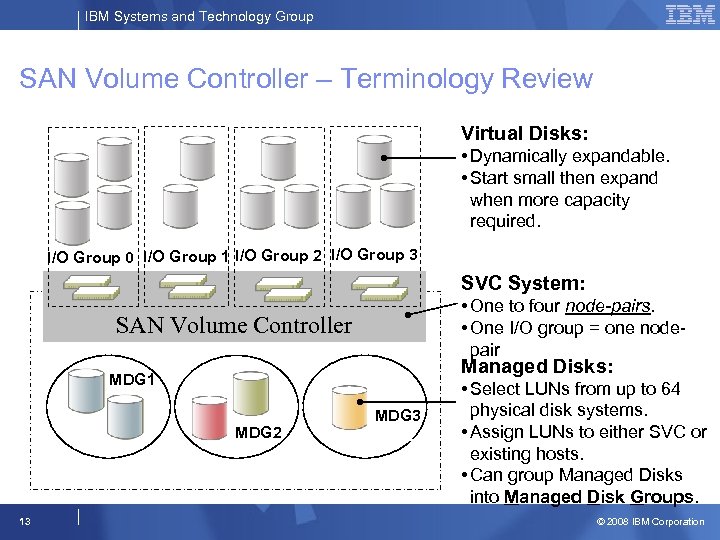
IBM Systems and Technology Group SAN Volume Controller – Terminology Review Virtual Disks: • Dynamically expandable. • Start small then expand when more capacity required. I/O Group 0 I/O Group 1 I/O Group 2 I/O Group 3 SVC System: • One to four node-pairs. • One I/O group = one nodepair SAN Volume Controller Managed Disks: MDG 1 MDG 2 13 MDG 3 • Select LUNs from up to 64 physical disk systems. • Assign LUNs to either SVC or existing hosts. • Can group Managed Disks into Managed Disk Groups. © 2008 IBM Corporation
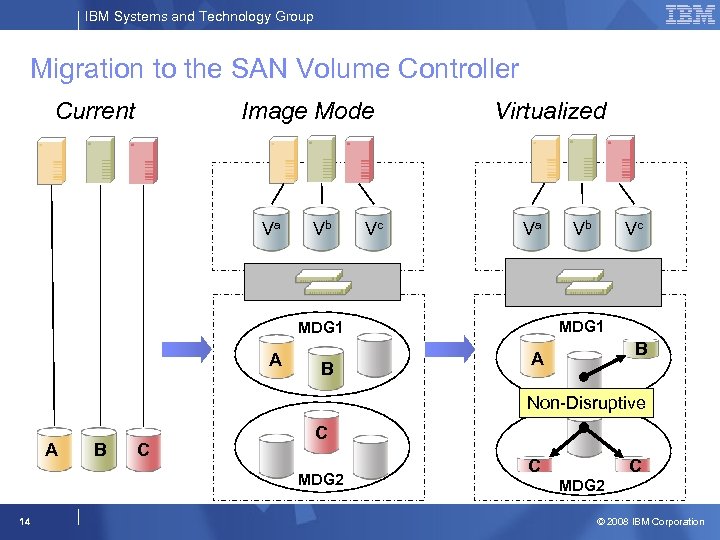
IBM Systems and Technology Group Migration to the SAN Volume Controller Current Image Mode Va Vb Vc Virtualized Va B Vc MDG 1 A Vb B A Non-Disruptive A B C C MDG 2 14 C C MDG 2 © 2008 IBM Corporation
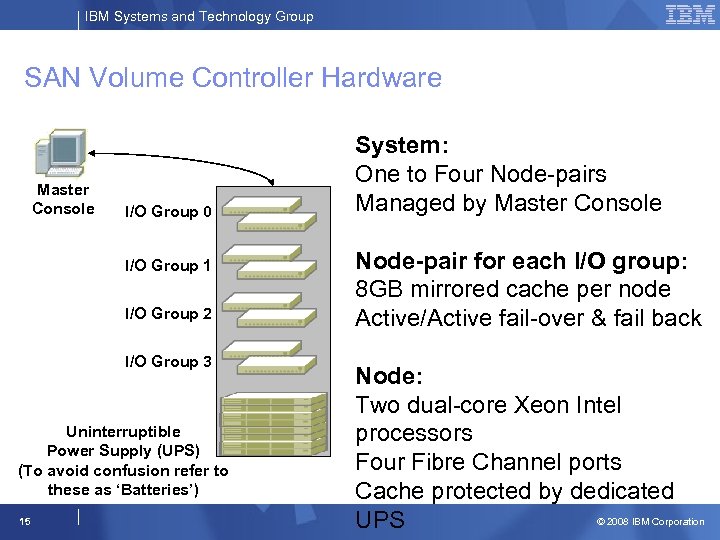
IBM Systems and Technology Group SAN Volume Controller Hardware Master Console I/O Group 0 I/O Group 1 I/O Group 2 I/O Group 3 Uninterruptible Power Supply (UPS) (To avoid confusion refer to these as ‘Batteries’) 15 System: One to Four Node-pairs Managed by Master Console Node-pair for each I/O group: 8 GB mirrored cache per node Active/Active fail-over & fail back Node: Two dual-core Xeon Intel processors Four Fibre Channel ports Cache protected by dedicated © 2008 IBM Corporation UPS
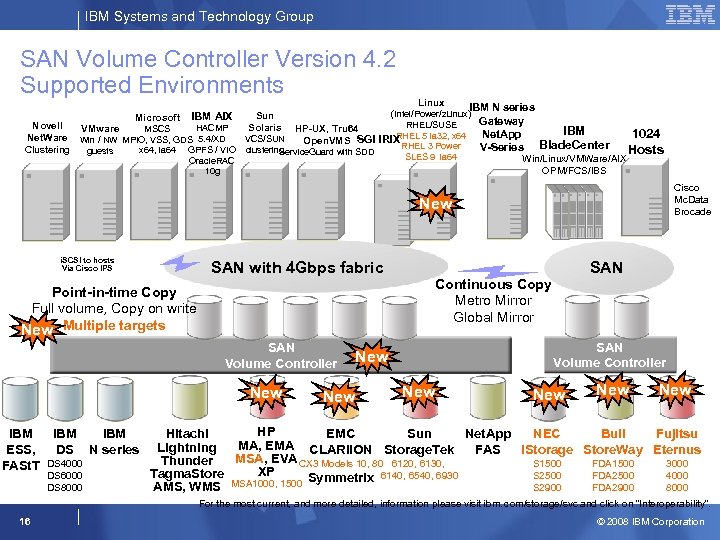
IBM Systems and Technology Group SAN Volume Controller Version 4. 2 Supported Environments Novell Net. Ware Clustering Microsoft IBM AIX HACMP MSCS VMware Win / NW MPIO, VSS, GDS 5. 4/XD x 64, ia 64 GPFS / VIO guests Oracle. RAC 10 g Linux IBM N series Gateway IBM Net. App V-Series Blade. Center (Intel/Power/z. Linux) RHEL/SUSE HP-UX, Tru 64 RHEL 5 ia 32, x 64 VCS/SUN Open. VMS SGI IRIX RHEL 3 Power clustering Service. Guard with SDD SLES 9 ia 64 Sun Solaris Win/Linux/VMWare/AIX OPM/FCS/IBS 1024 Hosts Cisco Mc. Data Brocade New i. SCSI to hosts Via Cisco IPS SAN with 4 Gbps fabric Continuous Copy Metro Mirror Global Mirror Point-in-time Copy Full volume, Copy on write New Multiple targets SAN Volume Controller New IBM IBM DS N series ESS, DS 4000 FASt. T DS 6000 DS 8000 SAN Volume Controller New SAN New New HP Hitachi EMC Sun Net. App NEC Bull Fujitsu MA, EMA CLARii. ON Storage. Tek Lightning FAS i. Storage Store. Way Eternus MSA, EVA CX 3 Models 10, 80 6120, 6130, Thunder S 1500 FDA 1500 3000 XP Tagma. Store 6140, 6540, 6930 S 2500 FDA 2500 4000 Symmetrix S 2900 FDA 2900 8000 AMS, WMS MSA 1000, 1500 For the most current, and more detailed, information please visit ibm. com/storage/svc and click on “Interoperability”. 16 © 2008 IBM Corporation
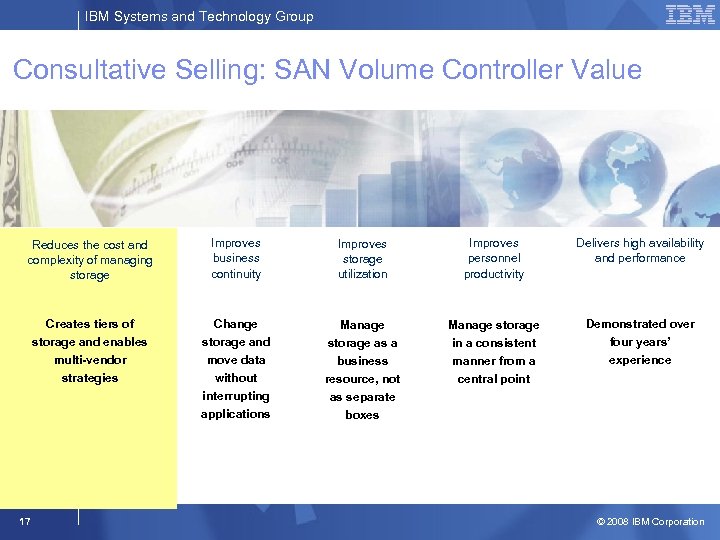
IBM Systems and Technology Group Consultative Selling: SAN Volume Controller Value Reduces the cost and complexity of managing storage Improves business continuity Improves storage utilization Improves personnel productivity Delivers high availability and performance Creates tiers of storage and enables multi-vendor strategies Change storage and move data without interrupting applications Manage storage as a business resource, not as separate boxes Manage storage in a consistent manner from a central point Demonstrated over four years’ experience 17 © 2008 IBM Corporation
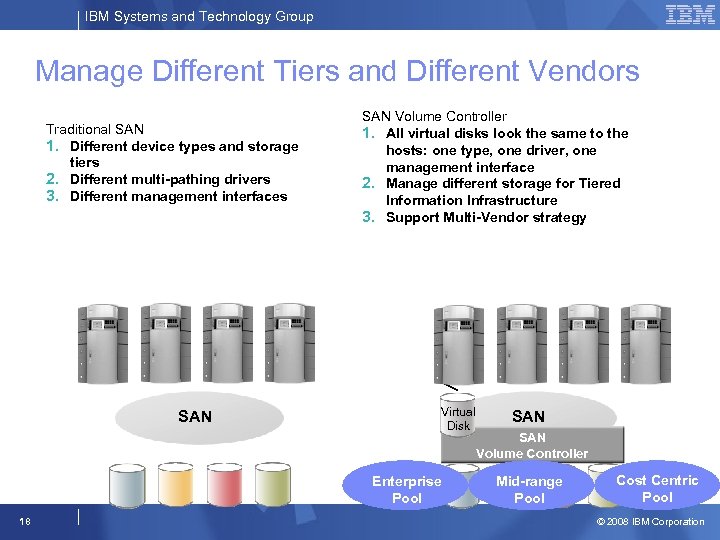
IBM Systems and Technology Group Manage Different Tiers and Different Vendors Traditional SAN 1. Different device types and storage tiers 2. Different multi-pathing drivers 3. Different management interfaces SAN Volume Controller 1. All virtual disks look the same to the hosts: one type, one driver, one management interface 2. Manage different storage for Tiered Information Infrastructure 3. Support Multi-Vendor strategy Virtual Disk Enterprise Pool 18 SAN Volume Controller Mid-range Pool Cost Centric Pool © 2008 IBM Corporation
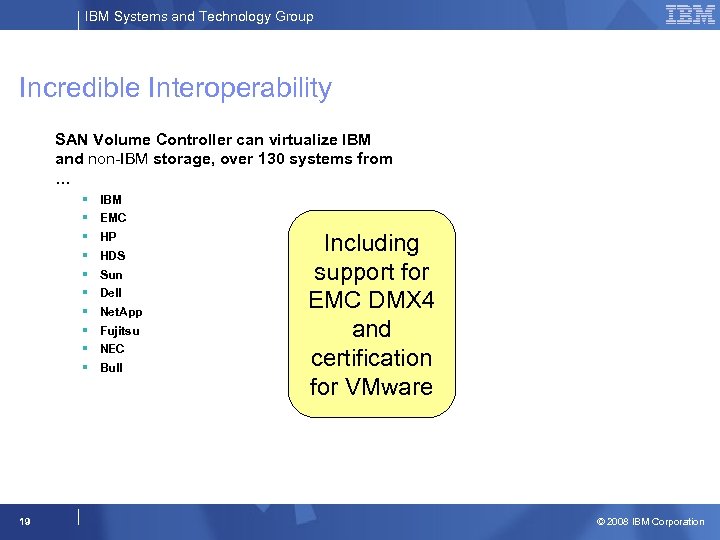
IBM Systems and Technology Group Incredible Interoperability SAN Volume Controller can virtualize IBM and non-IBM storage, over 130 systems from … § § § § § 19 IBM EMC HP HDS Sun Dell Net. App Fujitsu NEC Bull Including support for EMC DMX 4 and certification for VMware © 2008 IBM Corporation
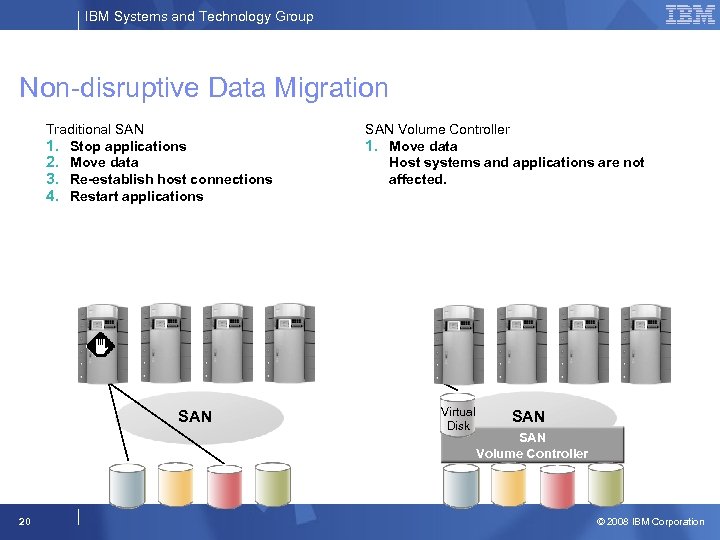
IBM Systems and Technology Group Non-disruptive Data Migration Traditional SAN 1. Stop applications 2. Move data 3. Re-establish host connections 4. Restart applications SAN 20 SAN Volume Controller 1. Move data Host systems and applications are not affected. Virtual Disk SAN Volume Controller © 2008 IBM Corporation
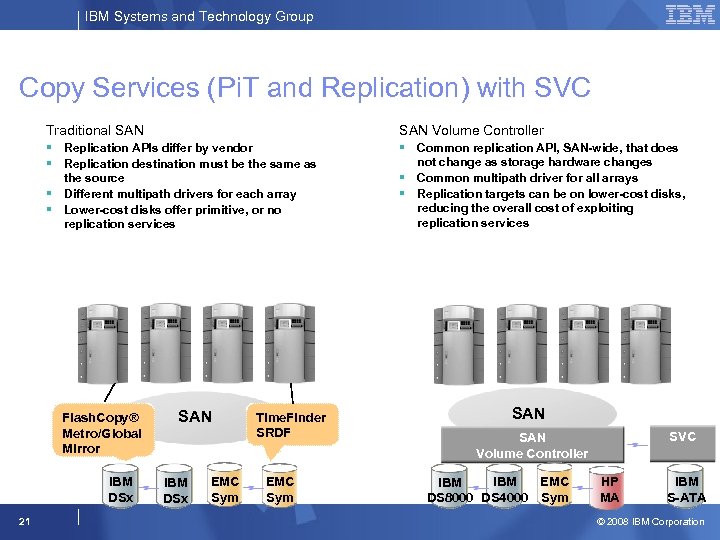
IBM Systems and Technology Group Copy Services (Pi. T and Replication) with SVC Traditional SAN § Replication APIs differ by vendor § Replication destination must be the same as the source § Different multipath drivers for each array § Lower-cost disks offer primitive, or no replication services Flash. Copy® Metro/Global Mirror IBM DSx 21 SAN IBM DSx EMC Sym Time. Finder SRDF EMC Sym SAN Volume Controller § Common replication API, SAN-wide, that does not change as storage hardware changes § Common multipath driver for all arrays § Replication targets can be on lower-cost disks, reducing the overall cost of exploiting replication services SAN SVC SAN Volume Controller IBM EMC IBM DS 8000 DS 4000 Sym HP MA IBM S-ATA © 2008 IBM Corporation
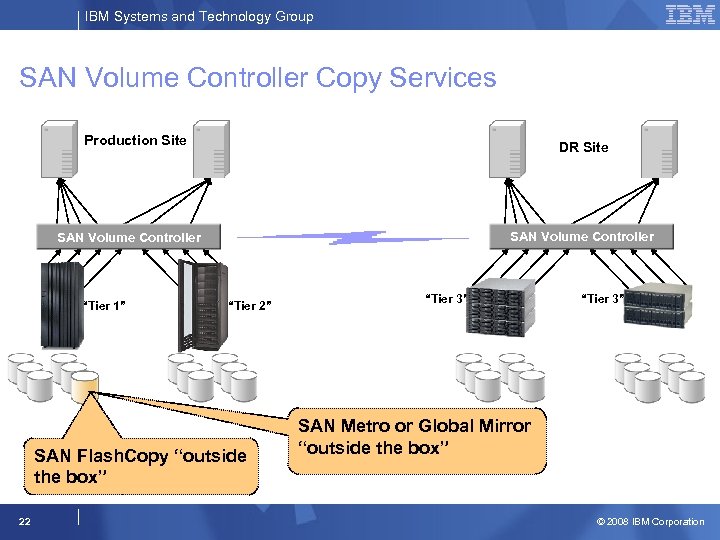
IBM Systems and Technology Group SAN Volume Controller Copy Services Production Site DR Site SAN Volume Controller “Tier 1” “Tier 2” SAN Flash. Copy “outside the box” 22 “Tier 3” SAN Metro or Global Mirror “outside the box” © 2008 IBM Corporation
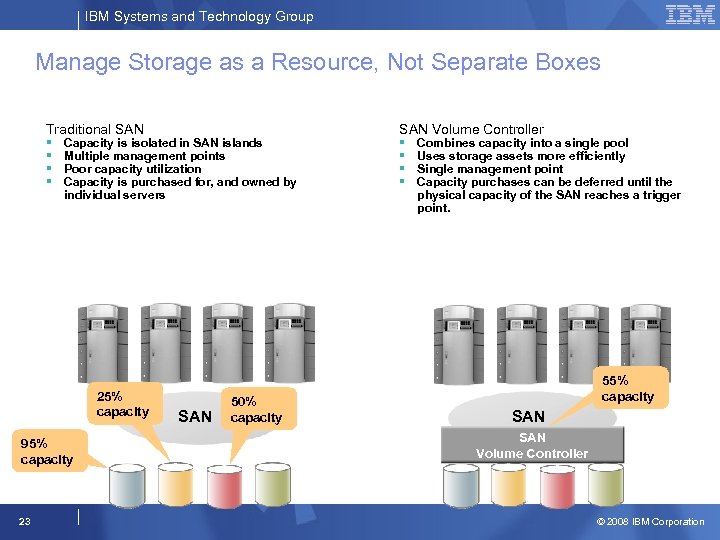
IBM Systems and Technology Group Manage Storage as a Resource, Not Separate Boxes Traditional SAN § Capacity is isolated in SAN islands § Multiple management points § Poor capacity utilization § Capacity is purchased for, and owned by individual servers 25% capacity 95% capacity 23 SAN 50% capacity SAN Volume Controller § Combines capacity into a single pool § Uses storage assets more efficiently § Single management point § Capacity purchases can be deferred until the physical capacity of the SAN reaches a trigger point. 55% capacity SAN Volume Controller © 2008 IBM Corporation
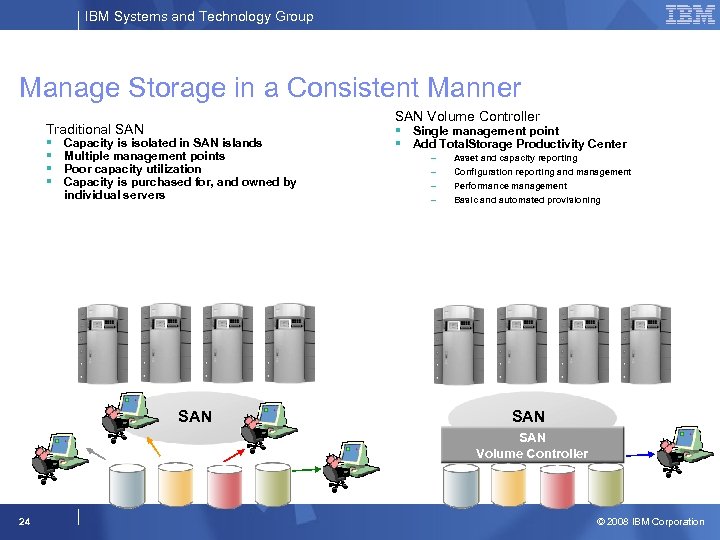
IBM Systems and Technology Group Manage Storage in a Consistent Manner Traditional SAN § Capacity is isolated in SAN islands § Multiple management points § Poor capacity utilization § Capacity is purchased for, and owned by individual servers SAN Volume Controller § Single management point § Add Total. Storage Productivity Center – – Asset and capacity reporting Configuration reporting and management Performance management Basic and automated provisioning SAN Volume Controller 24 © 2008 IBM Corporation
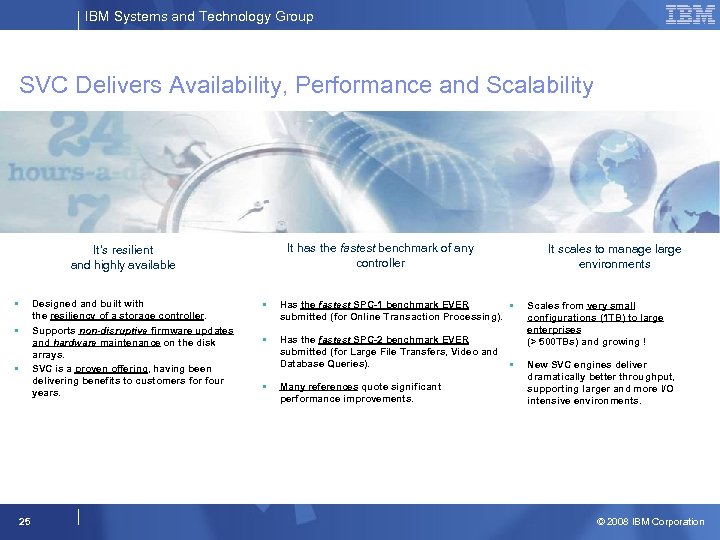
IBM Systems and Technology Group SVC Delivers Availability, Performance and Scalability It has the fastest benchmark of any controller It’s resilient and highly available § § § 25 Designed and built with the resiliency of a storage controller. Supports non-disruptive firmware updates and hardware maintenance on the disk arrays. SVC is a proven offering, having been delivering benefits to customers for four years. It scales to manage large environments § Has the fastest SPC-1 benchmark EVER § submitted (for Online Transaction Processing). § Has the fastest SPC-2 benchmark EVER submitted (for Large File Transfers, Video and Database Queries). § Many references quote significant performance improvements. § Scales from very small configurations (1 TB) to large enterprises (> 500 TBs) and growing ! New SVC engines deliver dramatically better throughput, supporting larger and more I/O intensive environments. © 2008 IBM Corporation
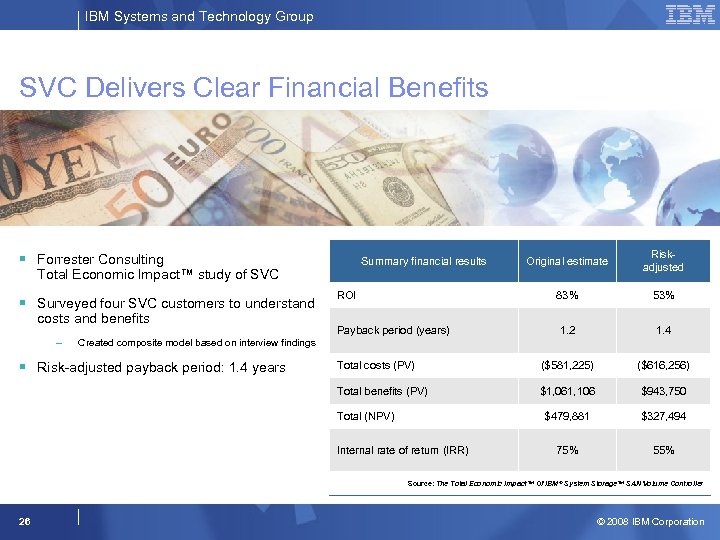
IBM Systems and Technology Group SVC Delivers Clear Financial Benefits Original estimate Riskadjusted 83% 53% 1. 2 1. 4 Total costs (PV) ($581, 225) ($616, 256) Total benefits (PV) $1, 061, 106 $943, 750 $479, 881 $327, 494 75% 55% § Forrester Consulting Summary financial results Total Economic Impact™ study of SVC § Surveyed four SVC customers to understand costs and benefits – ROI Payback period (years) Created composite model based on interview findings § Risk-adjusted payback period: 1. 4 years Total (NPV) Internal rate of return (IRR) Source: The Total Economic Impact™ Of IBM ® System Storage™ SAN Volume Controller 26 © 2008 IBM Corporation
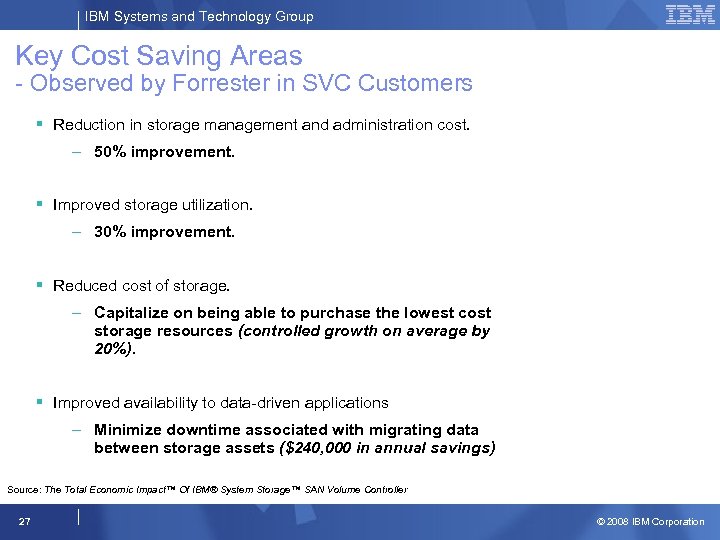
IBM Systems and Technology Group Key Cost Saving Areas - Observed by Forrester in SVC Customers § Reduction in storage management and administration cost. – 50% improvement. § Improved storage utilization. – 30% improvement. § Reduced cost of storage. – Capitalize on being able to purchase the lowest cost storage resources (controlled growth on average by 20%). § Improved availability to data-driven applications – Minimize downtime associated with migrating data between storage assets ($240, 000 in annual savings) Source: The Total Economic Impact™ Of IBM® System Storage™ SAN Volume Controller 27 © 2008 IBM Corporation
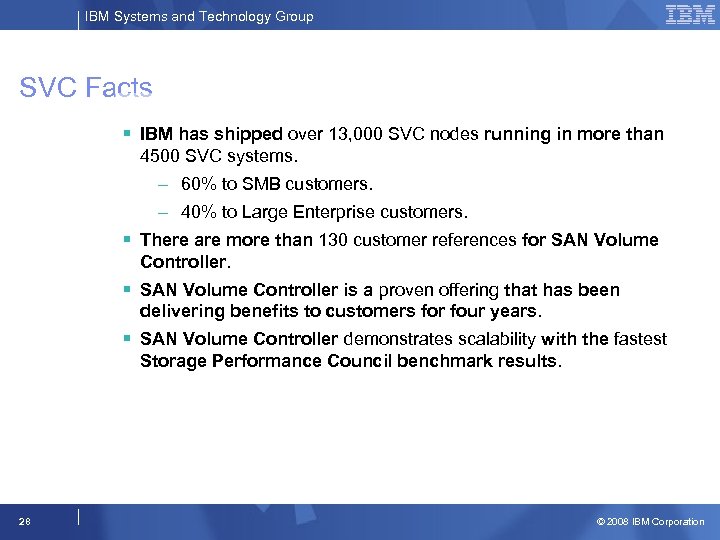
IBM Systems and Technology Group SVC Facts § IBM has shipped over 13, 000 SVC nodes running in more than 4500 SVC systems. – 60% to SMB customers. – 40% to Large Enterprise customers. § There are more than 130 customer references for SAN Volume Controller. § SAN Volume Controller is a proven offering that has been delivering benefits to customers for four years. § SAN Volume Controller demonstrates scalability with the fastest Storage Performance Council benchmark results. 28 © 2008 IBM Corporation
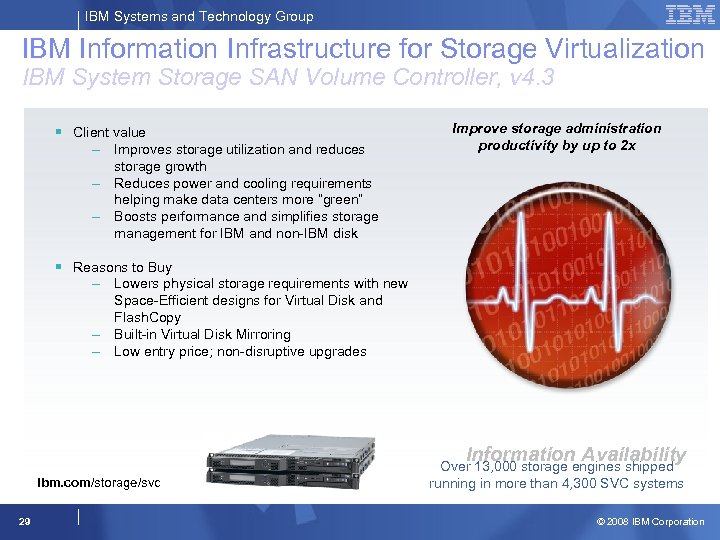
IBM Systems and Technology Group IBM Information Infrastructure for Storage Virtualization IBM System Storage SAN Volume Controller, v 4. 3 § Client value – Improves storage utilization and reduces storage growth – Reduces power and cooling requirements helping make data centers more “green” – Boosts performance and simplifies storage management for IBM and non-IBM disk Improve storage administration productivity by up to 2 x § Reasons to Buy – Lowers physical storage requirements with new Space-Efficient designs for Virtual Disk and Flash. Copy – Built-in Virtual Disk Mirroring – Low entry price; non-disruptive upgrades Information Availability ibm. com/storage/svc 29 Over 13, 000 storage engines shipped running in more than 4, 300 SVC systems © 2008 IBM Corporation
IBM Systems and Technology Group IBM’s Enabling Technologies: Total. Storage Productivity Center © 2008 IBM Corporation
IBM Systems and Technology Group IBM Infrastructure Management Strategy 1. Provide for day-to-day operational storage management. – Ensure IBM hardware provides Standards-Based Open Interfaces to administer and configure IBM hardware consistently. – Provide management software that uses these open interfaces to monitor and configure the infrastructure. 2. Provide the ability for customers to monitor and manage their servers, storage systems, networks, data replication and other related services. – IBM Systems Director Foundation: – IBM Director 5. 2 … for heterogeneous servers. – IBM Productivity Center … for heterogeneous storage. 3. Link to overall IT service management. – Prepare for and provide Infrastructure Orchestration, Provisioning and Storage Process Management software that can be used to automate infrastructure management workflows. 31 © 2008 IBM Corporation
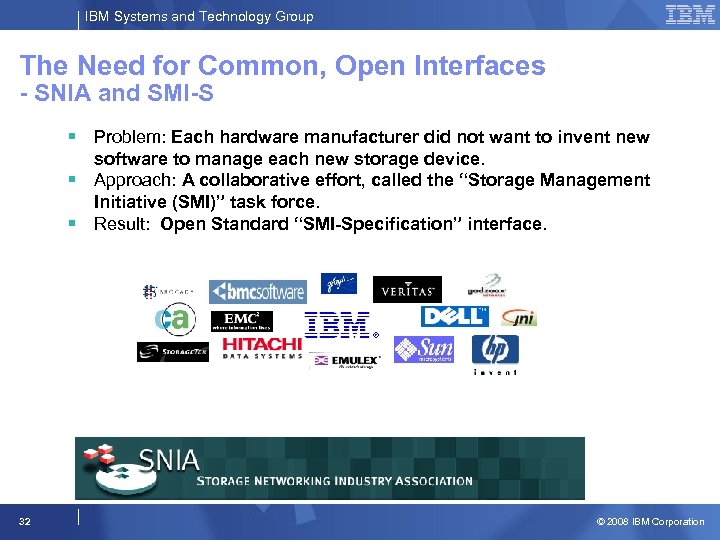
IBM Systems and Technology Group The Need for Common, Open Interfaces - SNIA and SMI-S § Problem: Each hardware manufacturer did not want to invent new software to manage each new storage device. § Approach: A collaborative effort, called the “Storage Management Initiative (SMI)” task force. § Result: Open Standard “SMI-Specification” interface. 32 © 2008 IBM Corporation
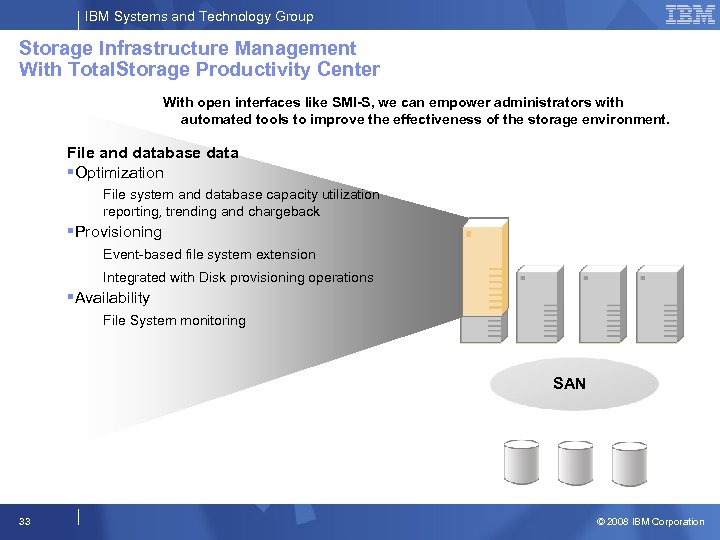
IBM Systems and Technology Group Storage Infrastructure Management With Total. Storage Productivity Center With open interfaces like SMI-S, we can empower administrators with automated tools to improve the effectiveness of the storage environment. File and database data §Optimization File system and database capacity utilization reporting, trending and chargeback §Provisioning Event-based file system extension Integrated with Disk provisioning operations §Availability File System monitoring SAN 33 © 2008 IBM Corporation
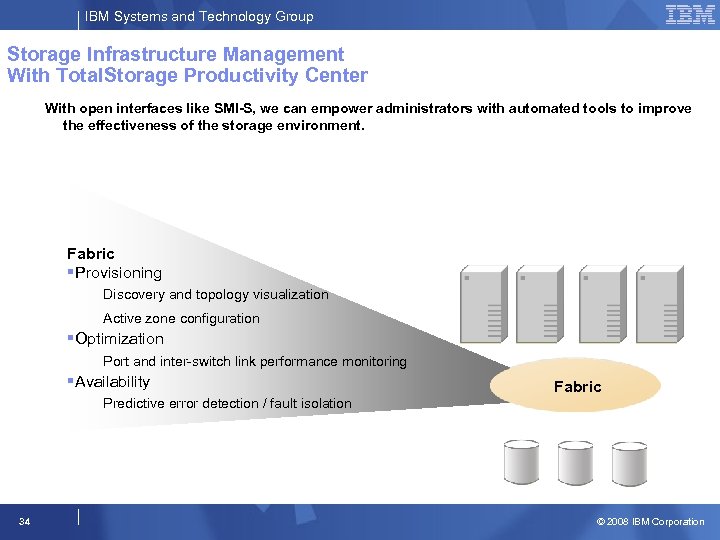
IBM Systems and Technology Group Storage Infrastructure Management With Total. Storage Productivity Center With open interfaces like SMI-S, we can empower administrators with automated tools to improve the effectiveness of the storage environment. Fabric §Provisioning Discovery and topology visualization Active zone configuration §Optimization Port and inter-switch link performance monitoring §Availability SAN Fabric Predictive error detection / fault isolation 34 © 2008 IBM Corporation
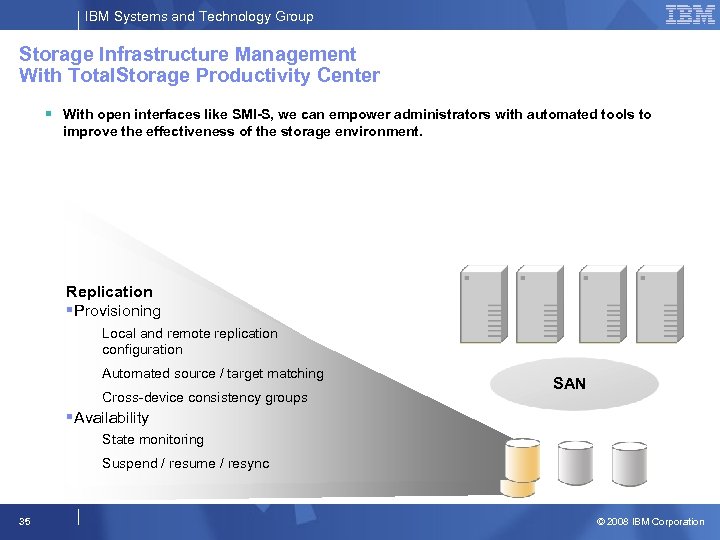
IBM Systems and Technology Group Storage Infrastructure Management With Total. Storage Productivity Center § With open interfaces like SMI-S, we can empower administrators with automated tools to improve the effectiveness of the storage environment. Replication §Provisioning Local and remote replication configuration Automated source / target matching Cross-device consistency groups SAN §Availability State monitoring Suspend / resume / resync 35 © 2008 IBM Corporation
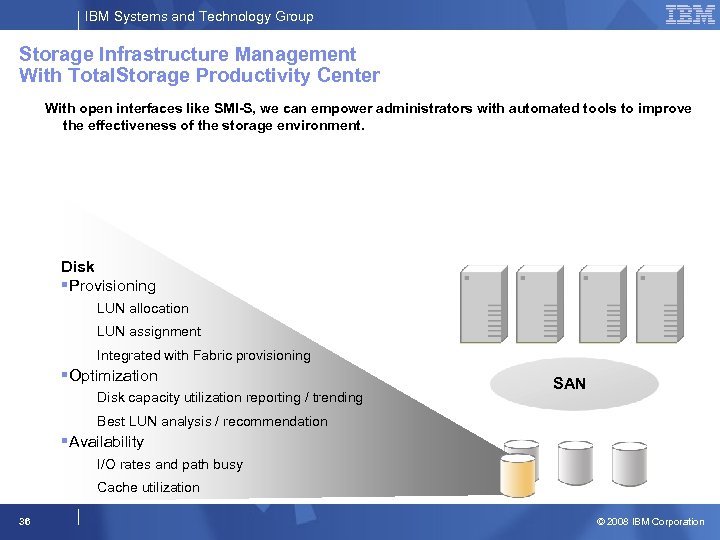
IBM Systems and Technology Group Storage Infrastructure Management With Total. Storage Productivity Center With open interfaces like SMI-S, we can empower administrators with automated tools to improve the effectiveness of the storage environment. Disk §Provisioning LUN allocation LUN assignment Integrated with Fabric provisioning §Optimization Disk capacity utilization reporting / trending SAN Best LUN analysis / recommendation §Availability I/O rates and path busy Cache utilization 36 © 2008 IBM Corporation
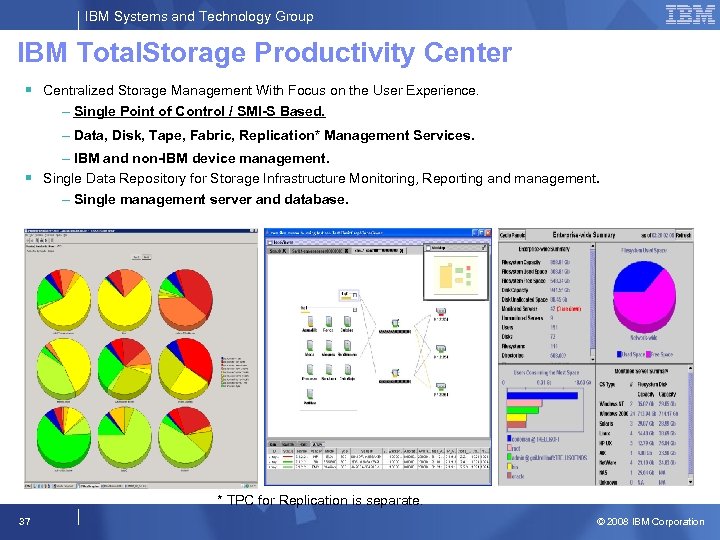
IBM Systems and Technology Group IBM Total. Storage Productivity Center § Centralized Storage Management With Focus on the User Experience. – Single Point of Control / SMI-S Based. – Data, Disk, Tape, Fabric, Replication* Management Services. – IBM and non-IBM device management. § Single Data Repository for Storage Infrastructure Monitoring, Reporting and management. – Single management server and database. * TPC for Replication is separate. 37 © 2008 IBM Corporation
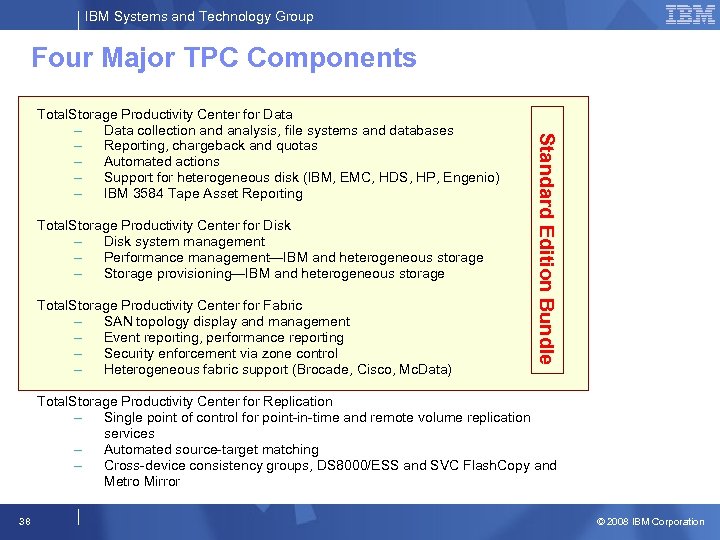
IBM Systems and Technology Group Four Major TPC Components Total. Storage Productivity Center for Disk – Disk system management – Performance management—IBM and heterogeneous storage – Storage provisioning—IBM and heterogeneous storage Total. Storage Productivity Center for Fabric – SAN topology display and management – Event reporting, performance reporting – Security enforcement via zone control – Heterogeneous fabric support (Brocade, Cisco, Mc. Data) Standard Edition Bundle Total. Storage Productivity Center for Data – Data collection and analysis, file systems and databases – Reporting, chargeback and quotas – Automated actions – Support for heterogeneous disk (IBM, EMC, HDS, HP, Engenio) – IBM 3584 Tape Asset Reporting Total. Storage Productivity Center for Replication – Single point of control for point-in-time and remote volume replication services – Automated source-target matching – Cross-device consistency groups, DS 8000/ESS and SVC Flash. Copy and Metro Mirror 38 © 2008 IBM Corporation
IBM Systems and Technology Group Value of IBM Total. Storage Productivity Center § Optimize IT through operational management of storage. § Leverage the information from reports to make better plans, policies and decisions. § Mitigate Risks by increasing your data availability and business resilience. § Enable Business Flexibility with support for open standards to manage heterogeneous storage. 39 © 2008 IBM Corporation
IBM Systems and Technology Group IBM’s Enabling Technologies: IBM System Storage Productivity Center © 2008 IBM Corporation
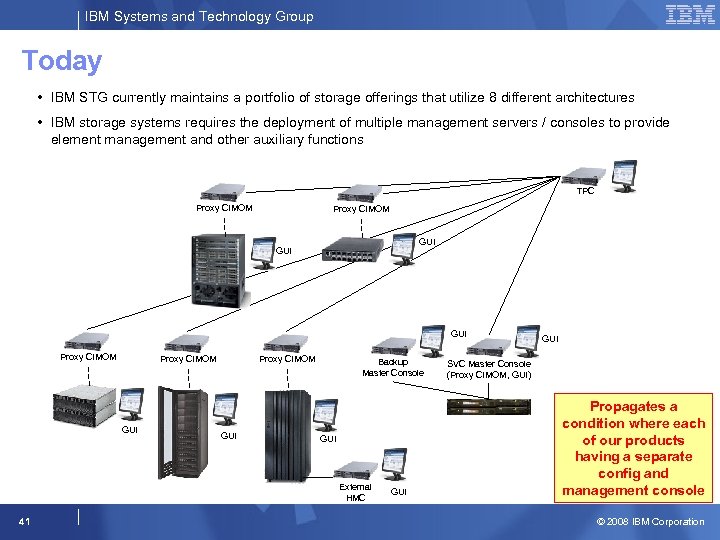
IBM Systems and Technology Group Today • IBM STG currently maintains a portfolio of storage offerings that utilize 8 different architectures • IBM storage systems requires the deployment of multiple management servers / consoles to provide element management and other auxiliary functions TPC Proxy CIMOM GUI GUI Proxy CIMOM GUI Backup Master Console GUI Internal HMC External HMC 41 GUI SVC Master Console (Proxy CIMOM, GUI) Propagates a condition where each of our products having a separate config and management console © 2008 IBM Corporation
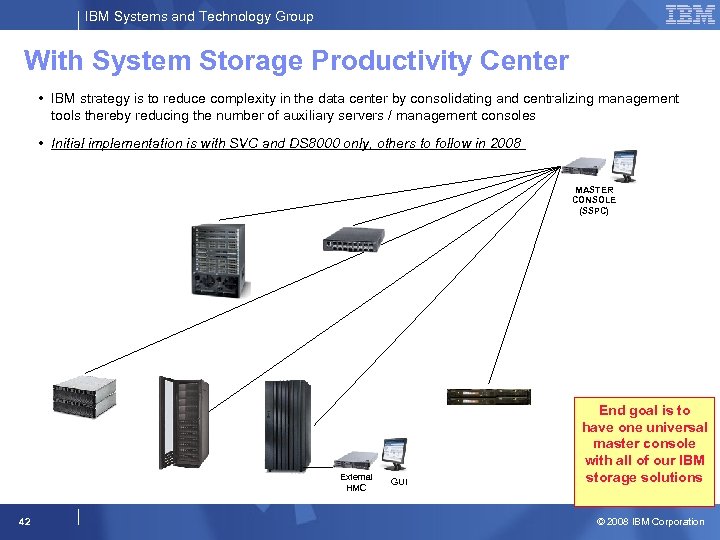
IBM Systems and Technology Group With System Storage Productivity Center • IBM strategy is to reduce complexity in the data center by consolidating and centralizing management tools thereby reducing the number of auxiliary servers / management consoles • Initial implementation is with SVC and DS 8000 only, others to follow in 2008 MASTER CONSOLE (SSPC) Internal HMC External HMC 42 GUI End goal is to have one universal master console with all of our IBM storage solutions © 2008 IBM Corporation
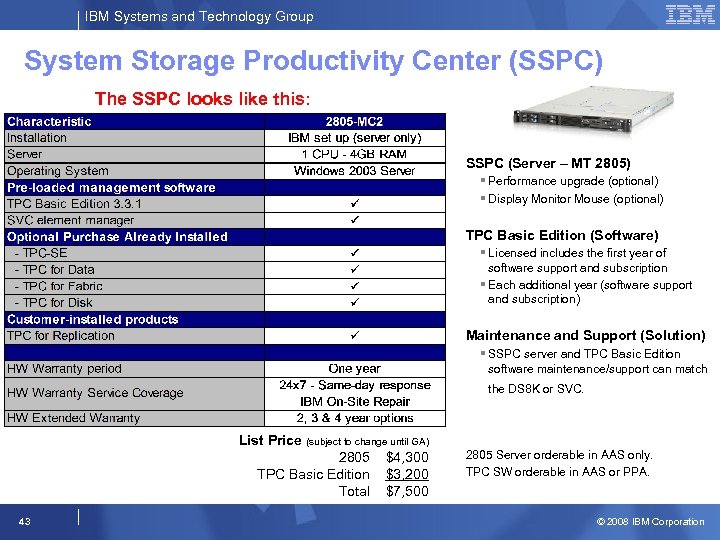
IBM Systems and Technology Group System Storage Productivity Center (SSPC) The SSPC looks like this: SSPC (Server – MT 2805) § Performance upgrade (optional) § Display Monitor Mouse (optional) TPC Basic Edition (Software) § Licensed includes the first year of software support and subscription § Each additional year (software support and subscription) Maintenance and Support (Solution) § SSPC server and TPC Basic Edition software maintenance/support can match the DS 8 K or SVC. List Price (subject to change until GA) 2805 $4, 300 TPC Basic Edition $3, 200 Total $7, 500 43 2805 Server orderable in AAS only. TPC SW orderable in AAS or PPA. © 2008 IBM Corporation
IBM Systems and Technology Group Selling Infrastructure Management Tools © 2008 IBM Corporation
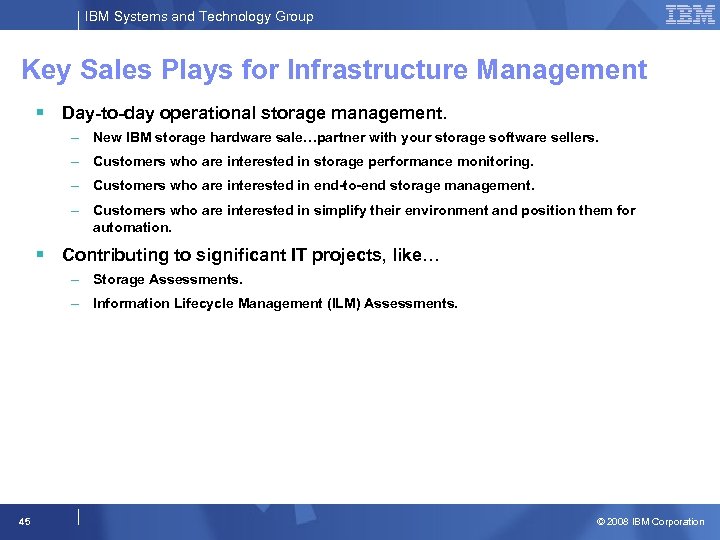
IBM Systems and Technology Group Key Sales Plays for Infrastructure Management § Day-to-day operational storage management. – New IBM storage hardware sale…partner with your storage software sellers. – Customers who are interested in storage performance monitoring. – Customers who are interested in end-to-end storage management. – Customers who are interested in simplify their environment and position them for automation. § Contributing to significant IT projects, like… – Storage Assessments. – Information Lifecycle Management (ILM) Assessments. 45 © 2008 IBM Corporation
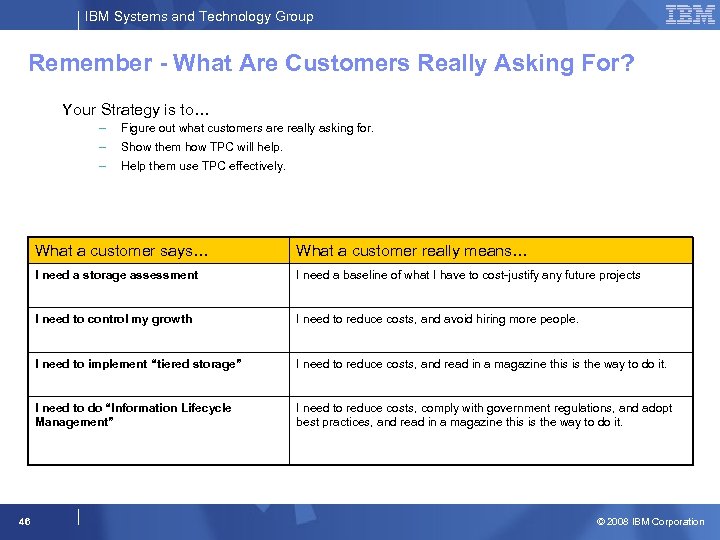
IBM Systems and Technology Group Remember - What Are Customers Really Asking For? Your Strategy is to… – – – Figure out what customers are really asking for. Show them how TPC will help. Help them use TPC effectively. What a customer says… I need a storage assessment I need a baseline of what I have to cost-justify any future projects I need to control my growth I need to reduce costs, and avoid hiring more people. I need to implement “tiered storage” I need to reduce costs, and read in a magazine this is the way to do it. I need to do “Information Lifecycle Management” 46 What a customer really means… I need to reduce costs, comply with government regulations, and adopt best practices, and read in a magazine this is the way to do it. © 2008 IBM Corporation
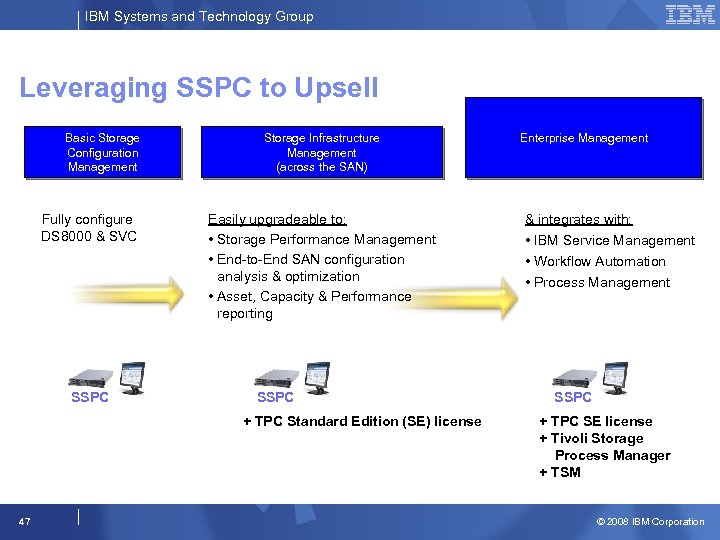
IBM Systems and Technology Group Leveraging SSPC to Upsell Basic Storage Configuration Management Fully configure DS 8000 & SVC SSPC Storage Infrastructure Management (across the SAN) Easily upgradeable to: • Storage Performance Management • End-to-End SAN configuration analysis & optimization • Asset, Capacity & Performance reporting SSPC + TPC Standard Edition (SE) license 47 Enterprise Management & integrates with: • IBM Service Management • Workflow Automation • Process Management SSPC + TPC SE license + Tivoli Storage Process Manager + TSM © 2008 IBM Corporation
IBM Systems and Technology Group Tivoli Storage Manager © 2008 IBM Corporation
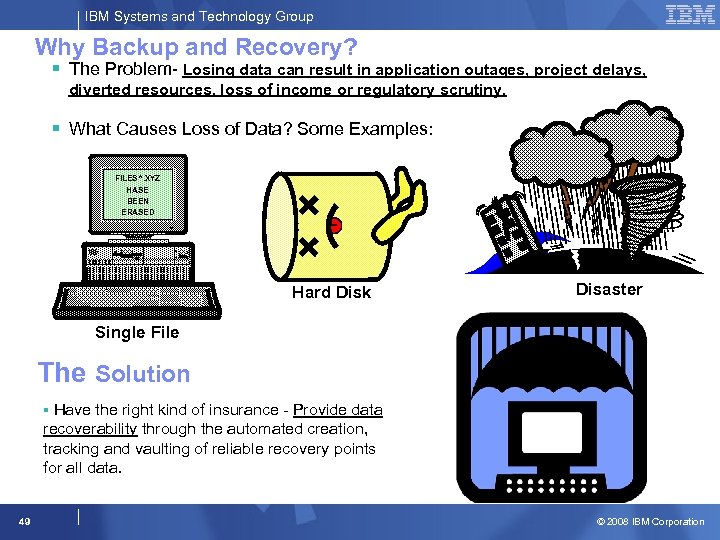
IBM Systems and Technology Group Why Backup and Recovery? § The Problem- Losing data can result in application outages, project delays, diverted resources, loss of income or regulatory scrutiny. § What Causes Loss of Data? Some Examples: FILES *. XYZ HASE BEEN ERASED Hard Disk Disaster Single File The Solution § Have the right kind of insurance - Provide data recoverability through the automated creation, tracking and vaulting of reliable recovery points for all data. 49 © 2008 IBM Corporation
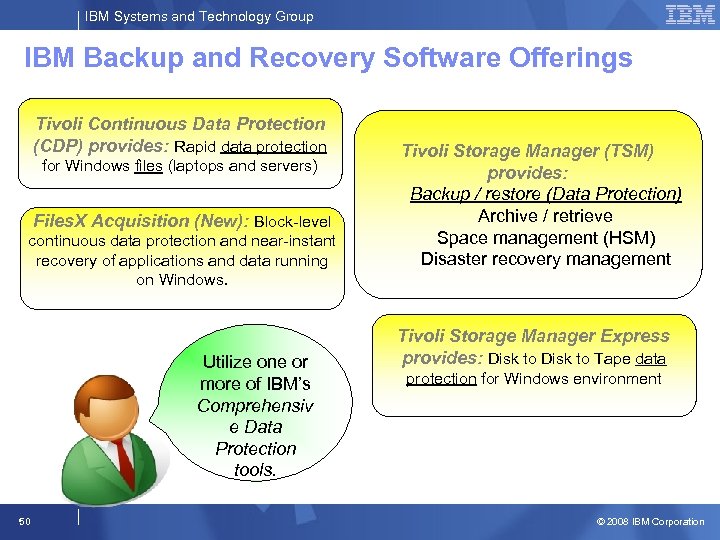
IBM Systems and Technology Group IBM Backup and Recovery Software Offerings Tivoli Continuous Data Protection (CDP) provides: Rapid data protection for Windows files (laptops and servers) Files. X Acquisition (New): Block-level continuous data protection and near-instant recovery of applications and data running on Windows. Utilize one or more of IBM’s Comprehensiv e Data Protection tools. 50 Tivoli Storage Manager (TSM) provides: Backup / restore (Data Protection) Archive / retrieve Space management (HSM) Disaster recovery management Tivoli Storage Manager Express provides: Disk to Tape data protection for Windows environment © 2008 IBM Corporation
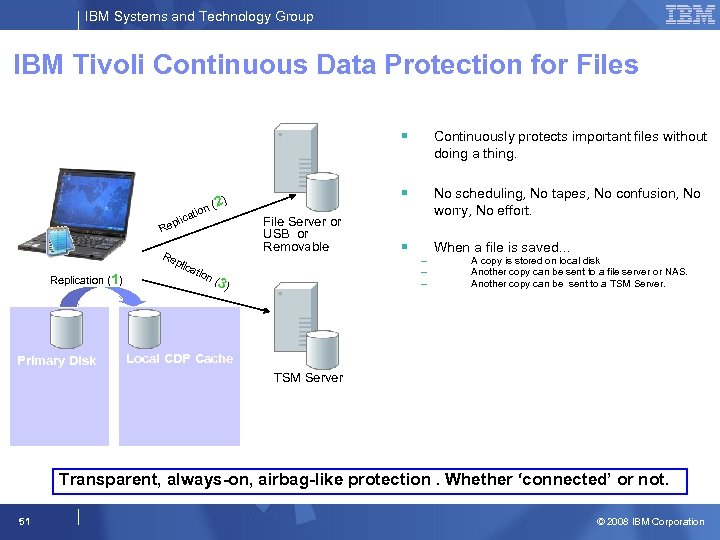
IBM Systems and Technology Group IBM Tivoli Continuous Data Protection for Files § ) n (2 atio ic epl R Re Replication (1) Primary Disk plic atio n( § File Server or USB or Removable 3) Continuously protects important files without doing a thing. No scheduling, No tapes, No confusion, No worry, No effort. § – – – When a file is saved. . . A copy is stored on local disk Another copy can be sent to a file server or NAS. Another copy can be sent to a TSM Server. Local CDP Cache TSM Server Transparent, always-on, airbag-like protection. Whether ‘connected’ or not. 51 © 2008 IBM Corporation
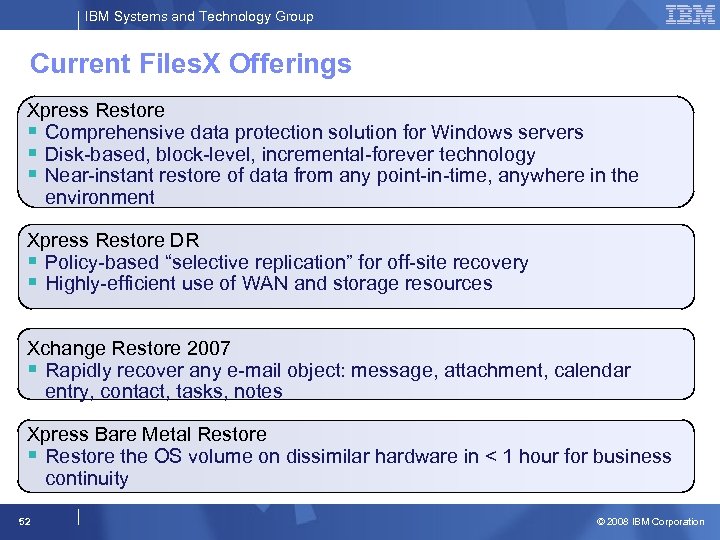
IBM Systems and Technology Group Current Files. X Offerings Xpress Restore § Comprehensive data protection solution for Windows servers § Disk-based, block-level, incremental-forever technology § Near-instant restore of data from any point-in-time, anywhere in the environment Xpress Restore DR § Policy-based “selective replication” for off-site recovery § Highly-efficient use of WAN and storage resources Xchange Restore 2007 § Rapidly recover any e-mail object: message, attachment, calendar entry, contact, tasks, notes Xpress Bare Metal Restore § Restore the OS volume on dissimilar hardware in < 1 hour for business continuity 52 © 2008 IBM Corporation
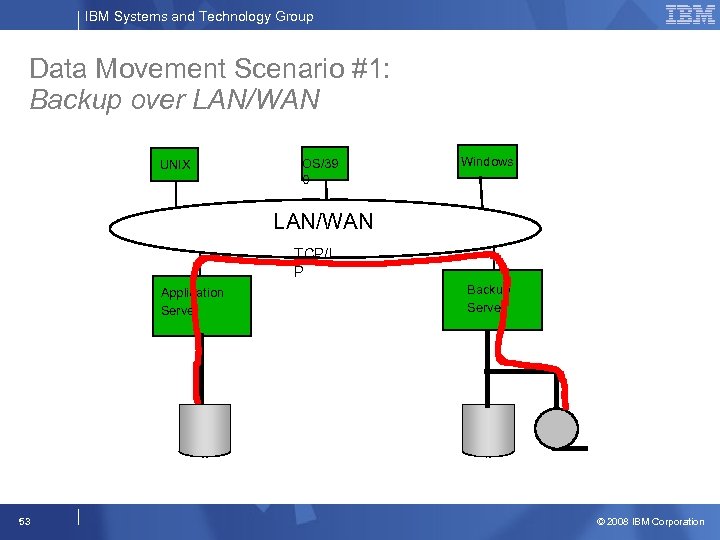
IBM Systems and Technology Group Data Movement Scenario #1: Backup over LAN/WAN UNIX OS/39 0 Windows LAN/WAN TCP/I P Application Server 53 Backup Server © 2008 IBM Corporation
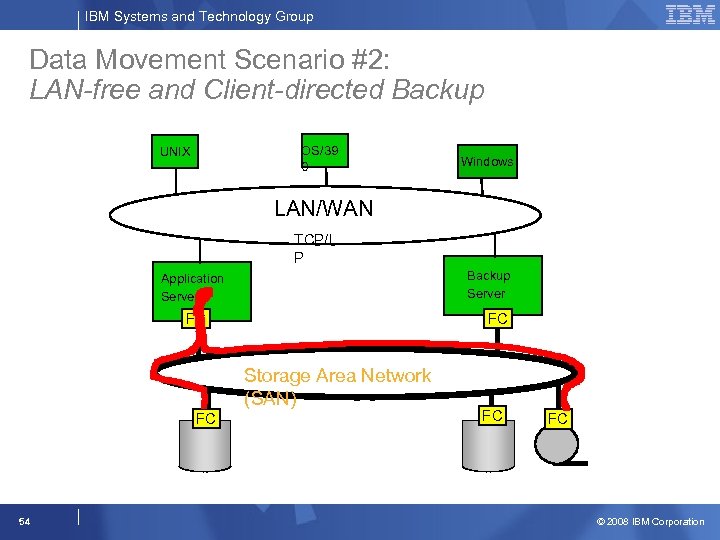
IBM Systems and Technology Group Data Movement Scenario #2: LAN-free and Client-directed Backup OS/39 0 UNIX Windows LAN/WAN TCP/I P Backup Server Application Server FC FC Storage Area Network (SAN) FC 54 FC FC © 2008 IBM Corporation
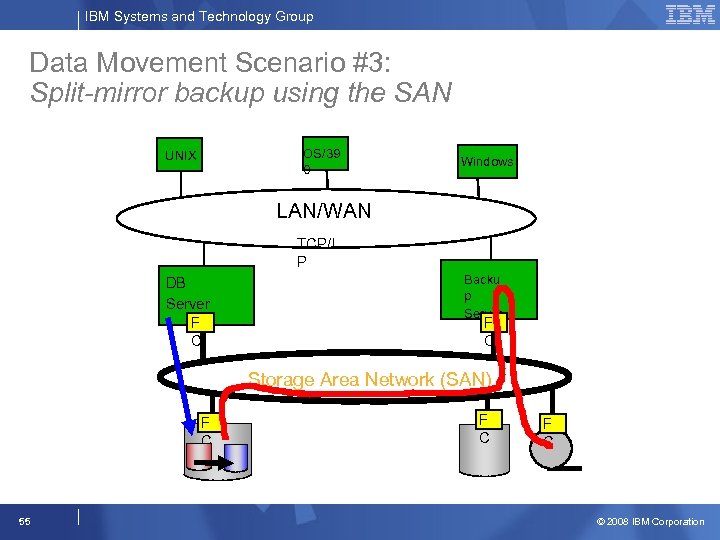
IBM Systems and Technology Group Data Movement Scenario #3: Split-mirror backup using the SAN OS/39 0 UNIX Windows LAN/WAN TCP/I P DB Server F C Backu p Server F C Storage Area Network (SAN) F C 55 F C © 2008 IBM Corporation
IBM Systems and Technology Group IBM Tivoli Storage Manager 4 Major Functions: 1. Backup and Restore. 2. Archive and Retrieve. 3. Hierarchical Storage Management (HSM or Space Management). 4. Disaster Recovery Planning and Management. Enterprise Attributes: – Built on superior relational database technology. – – 56 Works across 13 different operating environments. Extensive server support from Intel-based through mainframe. © 2008 IBM Corporation
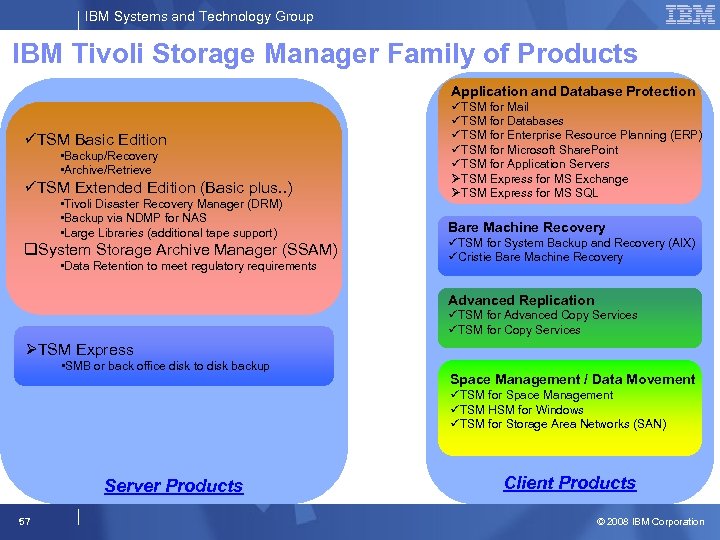
IBM Systems and Technology Group IBM Tivoli Storage Manager Family of Products Application and Database Protection üTSM Basic Edition • Backup/Recovery • Archive/Retrieve üTSM Extended Edition (Basic plus. . ) • Tivoli Disaster Recovery Manager (DRM) • Backup via NDMP for NAS • Large Libraries (additional tape support) q. System Storage Archive Manager (SSAM) • Data Retention to meet regulatory requirements üTSM for Mail üTSM for Databases üTSM for Enterprise Resource Planning (ERP) üTSM for Microsoft Share. Point üTSM for Application Servers ØTSM Express for MS Exchange ØTSM Express for MS SQL Bare Machine Recovery üTSM for System Backup and Recovery (AIX) üCristie Bare Machine Recovery Advanced Replication üTSM for Advanced Copy Services üTSM for Copy Services ØTSM Express • SMB or back office disk to disk backup Space Management / Data Movement üTSM for Space Management üTSM HSM for Windows üTSM for Storage Area Networks (SAN) Server Products 57 Client Products © 2008 IBM Corporation
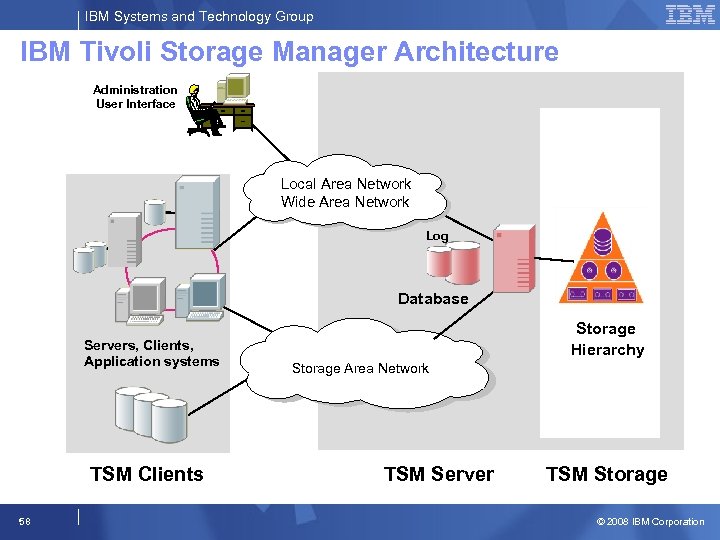
IBM Systems and Technology Group IBM Tivoli Storage Manager Architecture Administration User Interface Local Area Network Wide Area Network Log Database Servers, Clients, Application systems TSM Clients 58 Storage Hierarchy Storage Area Network TSM Server TSM Storage © 2008 IBM Corporation
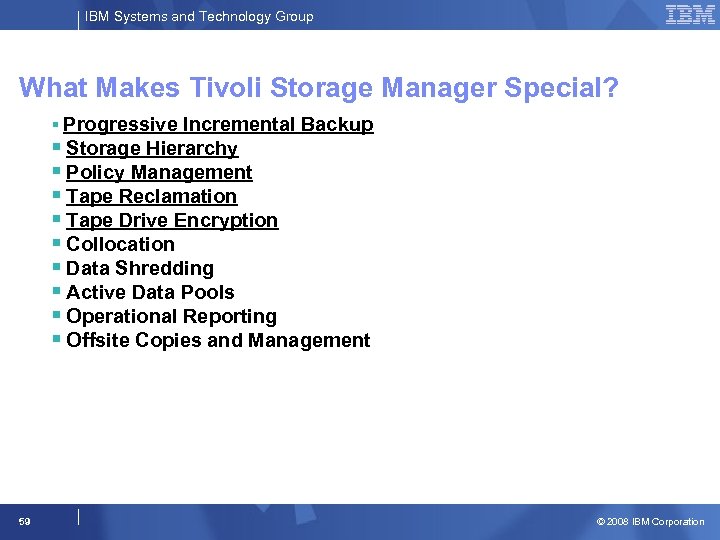
IBM Systems and Technology Group What Makes Tivoli Storage Manager Special? § Progressive Incremental Backup § Storage Hierarchy § Policy Management § Tape Reclamation § Tape Drive Encryption § Collocation § Data Shredding § Active Data Pools § Operational Reporting § Offsite Copies and Management 59 © 2008 IBM Corporation
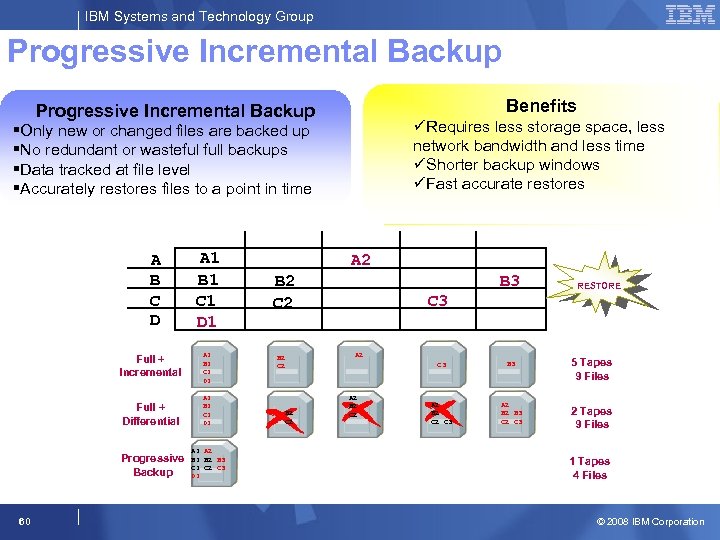
IBM Systems and Technology Group Progressive Incremental Backup Benefits Progressive Incremental Backup üRequires less storage space, less network bandwidth and less time üShorter backup windows üFast accurate restores §Only new or changed files are backed up §No redundant or wasteful full backups §Data tracked at file level §Accurately restores files to a point in time Monday A B C D Full + Incremental A 1 B 1 C 1 D 1 Full + Differential Progressive Backup 60 A 1 B 1 C 1 D 1 A 2 B 1 B 2 B 3 C 1 C 2 C 3 D 1 Tuesday Wednesday Thursday Friday A 2 B 3 B 2 C 2 RESTORE C 3 A 2 B 2 C 2 B 3 A 2 B 2 C 3 A 2 B 3 C 2 C 3 5 Tapes 9 Files 2 Tapes 9 Files 1 Tapes 4 Files © 2008 IBM Corporation
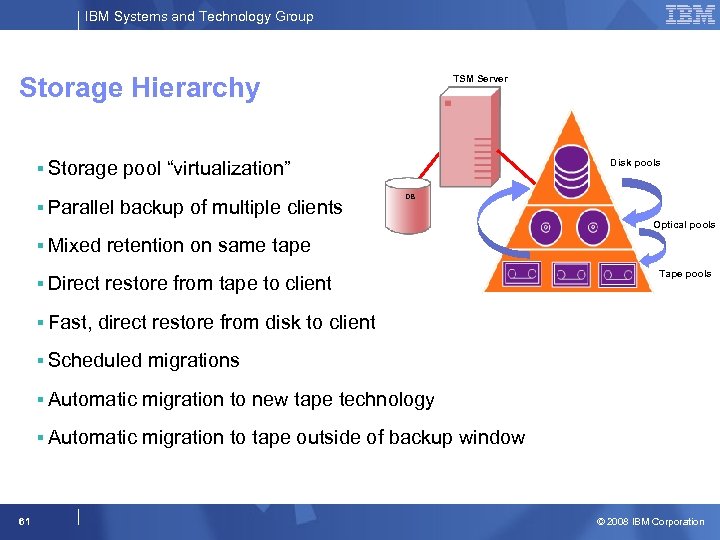
IBM Systems and Technology Group Storage Hierarchy TSM Server § Storage pool “virtualization” § Parallel backup of multiple clients Disk pools DB Optical pools § Mixed retention on same tape § Direct restore from tape to client Tape pools § Fast, direct restore from disk to client § Scheduled migrations § Automatic migration to new tape technology § Automatic migration to tape outside of backup window 61 © 2008 IBM Corporation
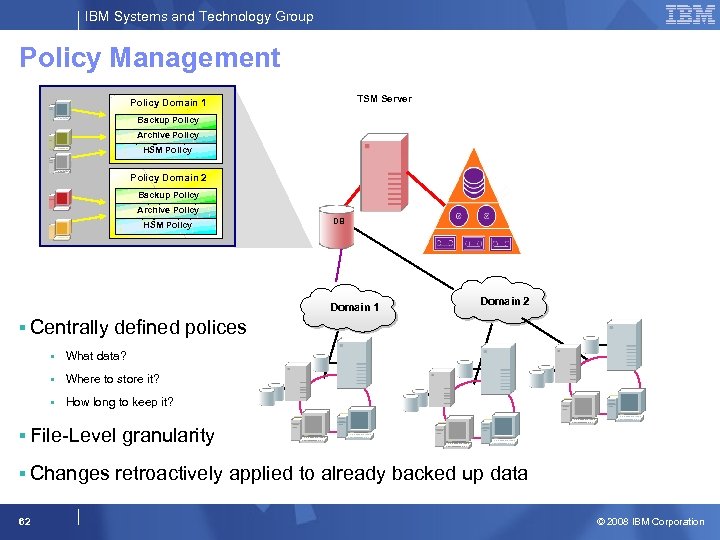
IBM Systems and Technology Group Policy Management TSM Server Policy Domain 1 Backup Policy Archive Policy HSM Policy Domain 2 Backup Policy Archive Policy HSM Policy DB Domain 1 Domain 2 § Centrally defined polices § What data? § Where to store it? § How long to keep it? § File-Level granularity § Changes retroactively applied to already backed up data 62 © 2008 IBM Corporation
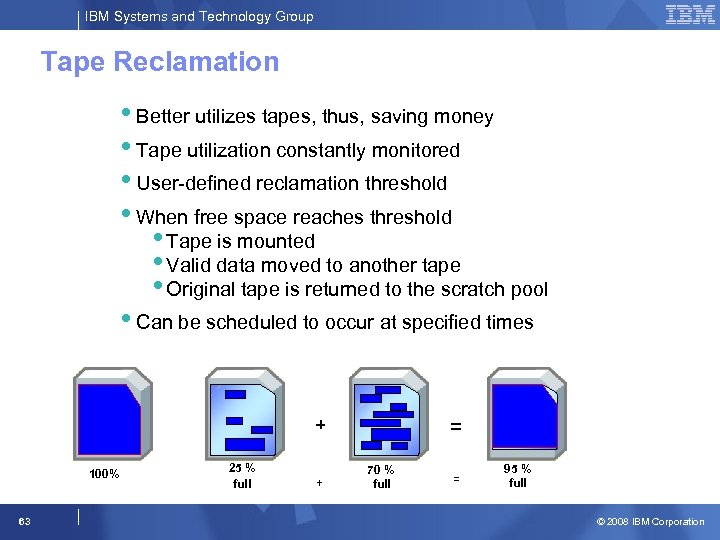
IBM Systems and Technology Group Tape Reclamation • Better utilizes tapes, thus, saving money • Tape utilization constantly monitored • User-defined reclamation threshold • When free space reaches threshold • Tape is mounted • Valid data moved to another tape • Original tape is returned to the scratch pool • Can be scheduled to occur at specified times + 100% 63 25 % full + = 70 % full = 95 % full © 2008 IBM Corporation
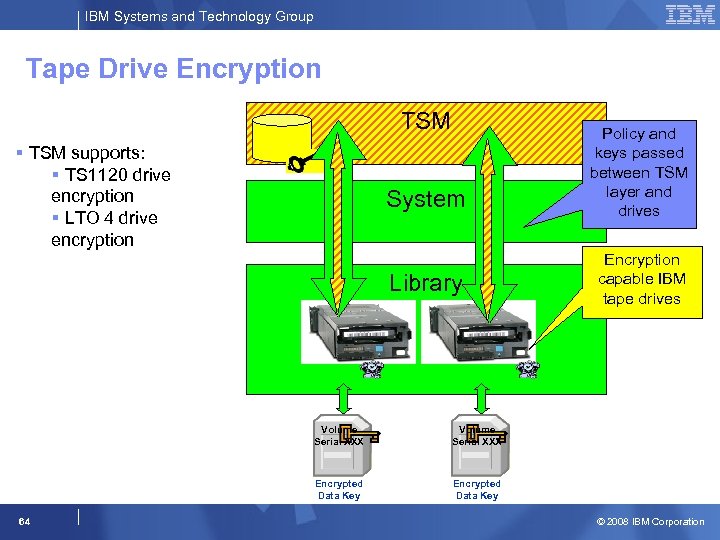
IBM Systems and Technology Group Tape Drive Encryption TSM § TSM supports: § TS 1120 drive encryption § LTO 4 drive encryption System Library Volume Serial XXX 64 Encryption capable IBM tape drives Volume Serial XXX Encrypted Data Key Policy and keys passed between TSM layer and drives Encrypted Data Key © 2008 IBM Corporation
IBM Systems and Technology Group Selling Backup and Recovery Solutions © 2008 IBM Corporation
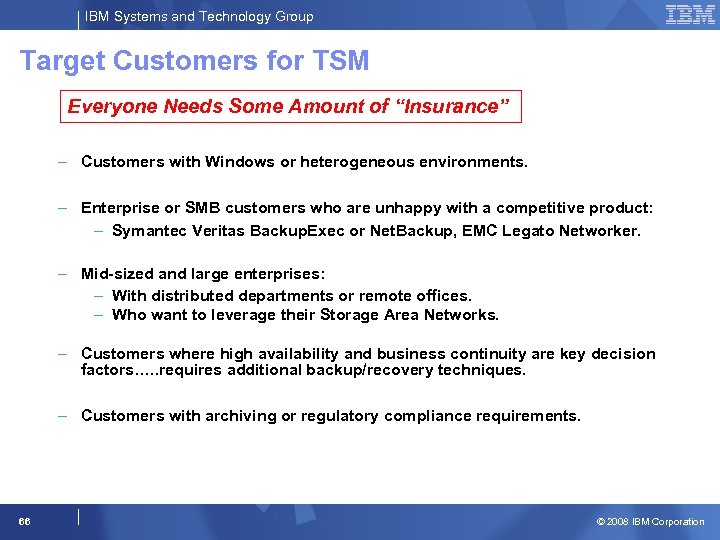
IBM Systems and Technology Group Target Customers for TSM Everyone Needs Some Amount of “Insurance” – Customers with Windows or heterogeneous environments. – Enterprise or SMB customers who are unhappy with a competitive product: – Symantec Veritas Backup. Exec or Net. Backup, EMC Legato Networker. – Mid-sized and large enterprises: – With distributed departments or remote offices. – Who want to leverage their Storage Area Networks. – Customers where high availability and business continuity are key decision factors…. . requires additional backup/recovery techniques. – Customers with archiving or regulatory compliance requirements. 66 © 2008 IBM Corporation
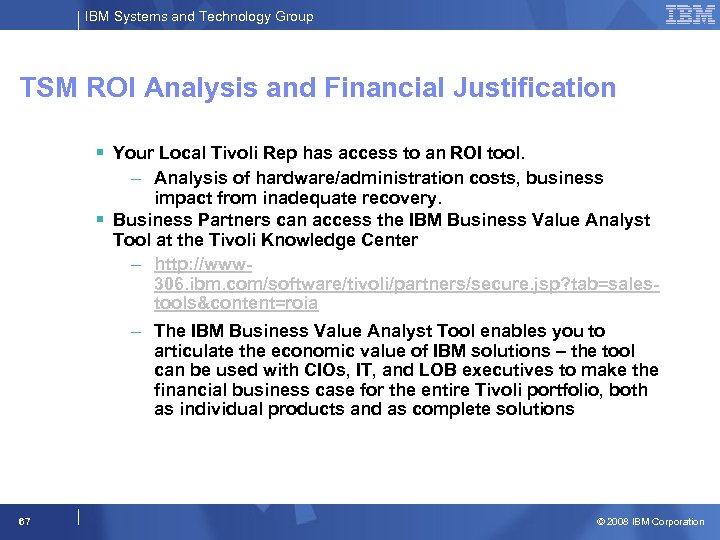
IBM Systems and Technology Group TSM ROI Analysis and Financial Justification § Your Local Tivoli Rep has access to an ROI tool. – Analysis of hardware/administration costs, business impact from inadequate recovery. § Business Partners can access the IBM Business Value Analyst Tool at the Tivoli Knowledge Center – http: //www 306. ibm. com/software/tivoli/partners/secure. jsp? tab=salestools&content=roia – The IBM Business Value Analyst Tool enables you to articulate the economic value of IBM solutions – the tool can be used with CIOs, IT, and LOB executives to make the financial business case for the entire Tivoli portfolio, both as individual products and as complete solutions 67 © 2008 IBM Corporation
IBM Systems and Technology Group Competition © 2008 IBM Corporation
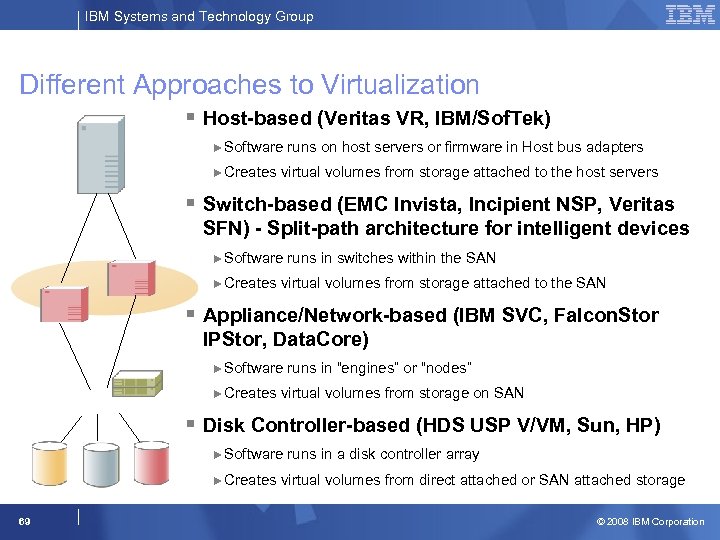
IBM Systems and Technology Group Different Approaches to Virtualization § Host-based (Veritas VR, IBM/Sof. Tek) ►Software ►Creates runs on host servers or firmware in Host bus adapters virtual volumes from storage attached to the host servers § Switch-based (EMC Invista, Incipient NSP, Veritas SFN) - Split-path architecture for intelligent devices ►Software ►Creates runs in switches within the SAN virtual volumes from storage attached to the SAN § Appliance/Network-based (IBM SVC, Falcon. Stor IPStor, Data. Core) ►Software ►Creates runs in “engines” or “nodes” virtual volumes from storage on SAN § Disk Controller-based (HDS USP V/VM, Sun, HP) ►Software ►Creates 69 runs in a disk controller array virtual volumes from direct attached or SAN attached storage © 2008 IBM Corporation
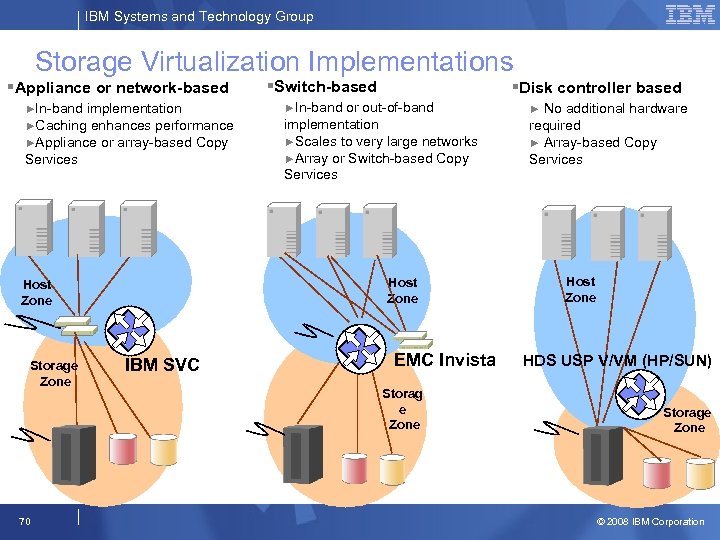
IBM Systems and Technology Group Storage Virtualization Implementations §Appliance or network-based ►In-band implementation ►Caching enhances performance ►Appliance or array-based Copy Services 70 §Disk controller based ►In-band or out-of-band implementation ►Scales to very large networks ►Array or Switch-based Copy Services Host Zone Storage Zone §Switch-based IBM SVC EMC Invista Storag e Zone No additional hardware required ► Array-based Copy Services ► Host Zone HDS USP V/VM (HP/SUN) Storage Zone © 2008 IBM Corporation
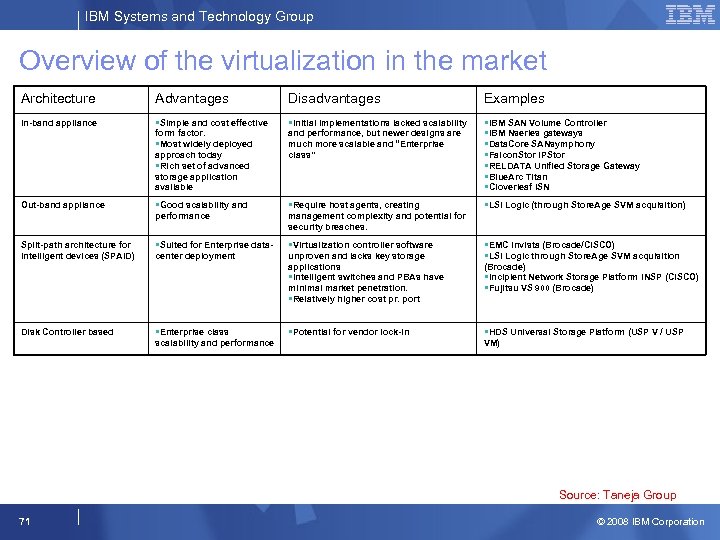
IBM Systems and Technology Group Overview of the virtualization in the market Architecture Advantages Disadvantages Examples In-band appliance §Simple and cost effective §Initial implementations lacked scalability form factor. §Most widely deployed approach today §Rich set of advanced storage application available and performance, but newer designs are much more scalable and “Enterprise class” §IBM SAN Volume Controller §IBM Nseries gateways §Data. Core SANsymphony §Falcon. Stor IPStor §RELDATA Unified Storage Gateway §Blue. Arc Titan §Cloverleaf i. SN §Good scalability and §Require host agents, creating performance management complexity and potential for security breaches. §Suited for Enterprise data- §Virtualization controller software center deployment unproven and lacks key storage applications §Intelligent switches and PBAs have minimal market penetration. §Relatively higher cost pr. port Out-band appliance Split-path architecture for intelligent devices (SPAID) Disk Controller based §Enterprise class scalability and performance §Potential for vendor lock-in §LSI Logic (through Store. Age SVM acquisition) §EMC Invista (Brocade/CISCO) §LSI Logic through Store. Age SVM acquisition (Brocade) §Incipient Network Storage Platform i. NSP (CISCO) §Fujitsu VS 900 (Brocade) §HDS Universal Storage Platform (USP V / USP VM) Source: Taneja Group 71 © 2008 IBM Corporation
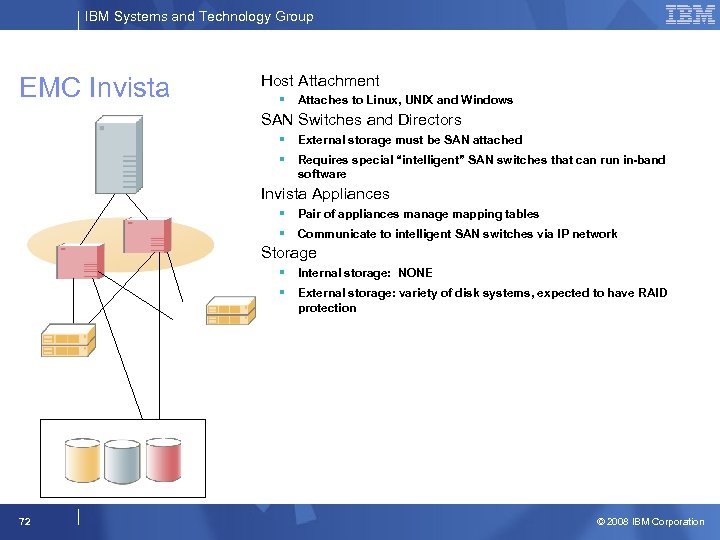
IBM Systems and Technology Group EMC Invista Host Attachment § Attaches to Linux, UNIX and Windows SAN Switches and Directors § External storage must be SAN attached § Requires special “intelligent” SAN switches that can run in-band software Invista Appliances § Pair of appliances manage mapping tables § Communicate to intelligent SAN switches via IP network Storage § § 72 Internal storage: NONE External storage: variety of disk systems, expected to have RAID protection © 2008 IBM Corporation
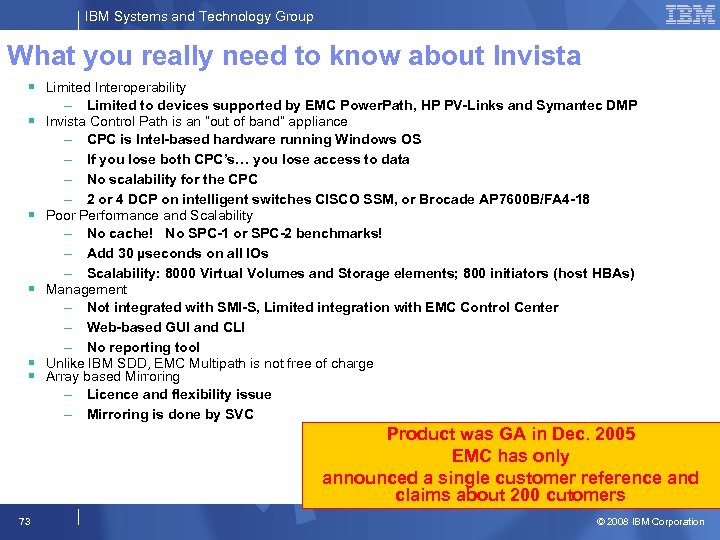
IBM Systems and Technology Group What you really need to know about Invista § Limited Interoperability § § § – Limited to devices supported by EMC Power. Path, HP PV-Links and Symantec DMP Invista Control Path is an “out of band” appliance – CPC is Intel-based hardware running Windows OS – If you lose both CPC’s… you lose access to data – No scalability for the CPC – 2 or 4 DCP on intelligent switches CISCO SSM, or Brocade AP 7600 B/FA 4 -18 Poor Performance and Scalability – No cache! No SPC-1 or SPC-2 benchmarks! – Add 30 µseconds on all IOs – Scalability: 8000 Virtual Volumes and Storage elements; 800 initiators (host HBAs) Management – Not integrated with SMI-S, Limited integration with EMC Control Center – Web-based GUI and CLI – No reporting tool Unlike IBM SDD, EMC Multipath is not free of charge Array based Mirroring – Licence and flexibility issue – Mirroring is done by SVC Product was GA in Dec. 2005 EMC has only announced a single customer reference and claims about 200 cutomers 73 © 2008 IBM Corporation
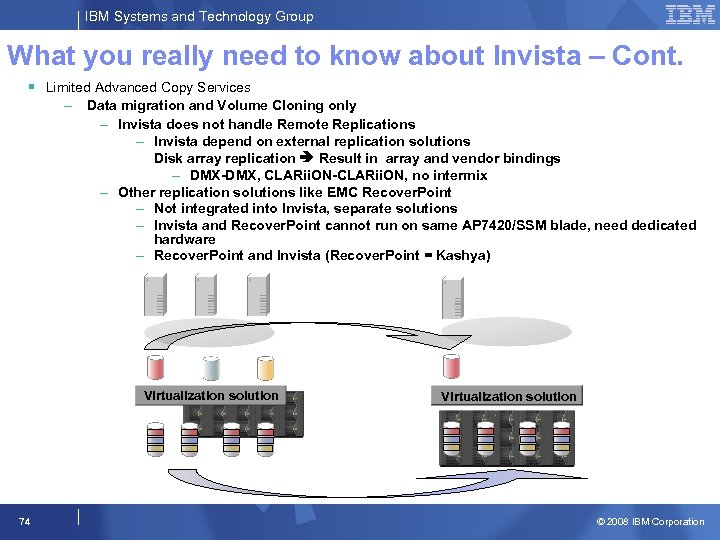
IBM Systems and Technology Group What you really need to know about Invista – Cont. § Limited Advanced Copy Services – Data migration and Volume Cloning only – Invista does not handle Remote Replications – Invista depend on external replication solutions Disk array replication Result in array and vendor bindings – DMX-DMX, CLARii. ON-CLARii. ON, no intermix – Other replication solutions like EMC Recover. Point – Not integrated into Invista, separate solutions – Invista and Recover. Point cannot run on same AP 7420/SSM blade, need dedicated hardware – Recover. Point and Invista (Recover. Point = Kashya) Virtualization solution 74 Virtualization solution © 2008 IBM Corporation
IBM Systems and Technology Group Review questions • • 75 How is SVC priced and who is the major competitor? • It is priced by TB and EMC Invista • It is tier priced and HP True Copy • It is processor based priced and HDS Tagamastore • One time charge and Sun Planet What the 4 major components of TPPC? • Date, Disk, Fabric, and Replication • Data, disk, fabric, provisioning • Disk, tape, fabric, and virtualization • Disk, energy management, fabric, and virtualization Tivoli Storage Manager support the ability to set policies for storage of data based on access needs, performance, and cost. What is that function called ? • Data Deduplication • Hierarchical Storage Management (HSM) • Storage Virtualization • Global Mirroring Name 2 key benefits of SVC • Data deduplication and low price • Non disruptive data migration and utilization of non IBM replication services • Non disruptive data migration and elimination of non IBM replication services • Price and support of tape systems © 2008 IBM Corporation
Скачать презентацию IBM Systems and Technology Group IBM System Storage
885bdee6a2ee7bc86eeb1e0d7e7ab682.ppt