 Скачать презентацию IBM Research Artifacts in Business Processes Helping Workflow
d8c0508772cf7e5afd82a0bbdfbe22f6.ppt
- Количество слайдов: 34



IBM Research Artifacts in Business Processes: Helping Workflow become Declarative -- or –New Model New Questions Rick Hull hull@us. ibm. com Drawing on discussions and collaborations with Kumar Bhaskaran, Kamal Bhattacharya, Nathan Caswell, David Cohn, Christian Fritz, Santhosh Kumeran, Rong (Emily) Liu, Anil Nigem, Jianwen Su, Fred Wu, and others CAISE keynote, 20 June 2008 © 2008 IBM Corporation
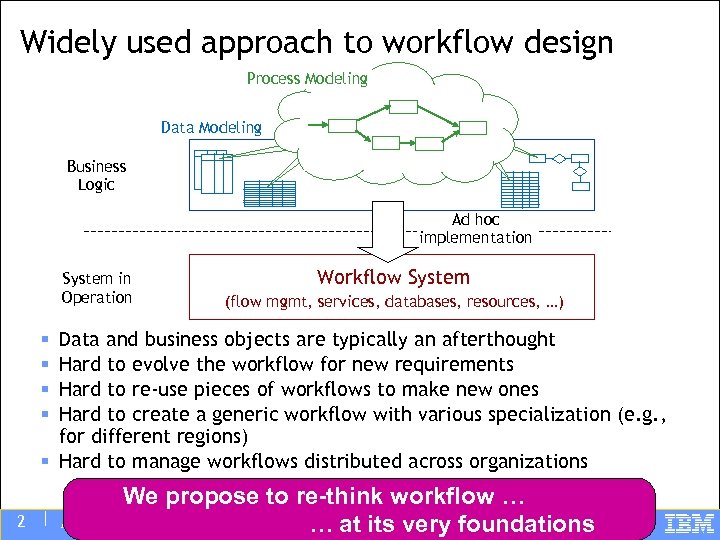
Widely used approach to workflow design Process Modeling Data Modeling Business Logic Ad hoc implementation System in Operation Workflow System (flow mgmt, services, databases, resources, …) Data and business objects are typically an afterthought Hard to evolve the workflow for new requirements Hard to re-use pieces of workflows to make new ones Hard to create a generic workflow with various specialization (e. g. , for different regions) § Hard to manage workflows distributed across organizations § § 2 | We propose to re-think workflow … | 20 its very foundations Artifact-Centric Business Processes… at June 2008 IBM Research Watson
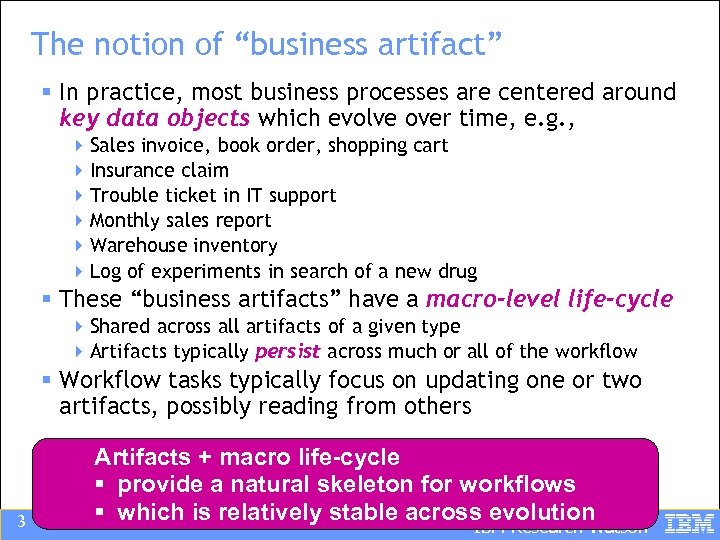
The notion of “business artifact” § In practice, most business processes are centered around key data objects which evolve over time, e. g. , 4 Sales invoice, book order, shopping cart 4 Insurance claim 4 Trouble ticket in IT support 4 Monthly sales report 4 Warehouse inventory 4 Log of experiments in search of a new drug § These “business artifacts” have a macro-level life-cycle 4 Shared across all artifacts of a given type 4 Artifacts typically persist across much or all of the workflow § Workflow tasks typically focus on updating one or two artifacts, possibly reading from others 3 | Artifacts + macro life-cycle § provide a natural skeleton for workflows § which is relatively stable across evolution Artifact-Centric Business Processes | 20 June 2008 IBM Research Watson
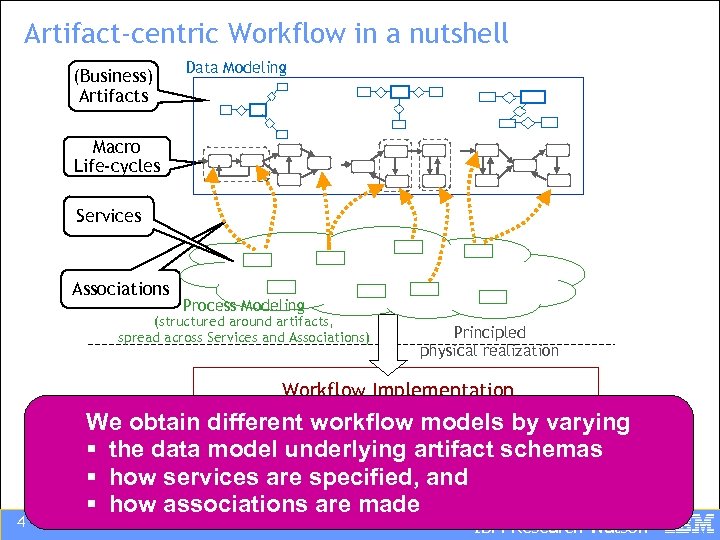
Artifact-centric Workflow in a nutshell (Business) Artifacts Data Modeling Macro Life-cycles Services Associations Process Modeling (structured around artifacts, spread across Services and Associations) Principled physical realization Workflow Implementation 4 (flow mgmt, services, databases, resources, …) We obtain different workflow models by varying § the data model underlying artifact schemas § how services are specified, and § how associations are made | | Artifact-Centric Business Processes 20 June 2008 IBM Research Watson
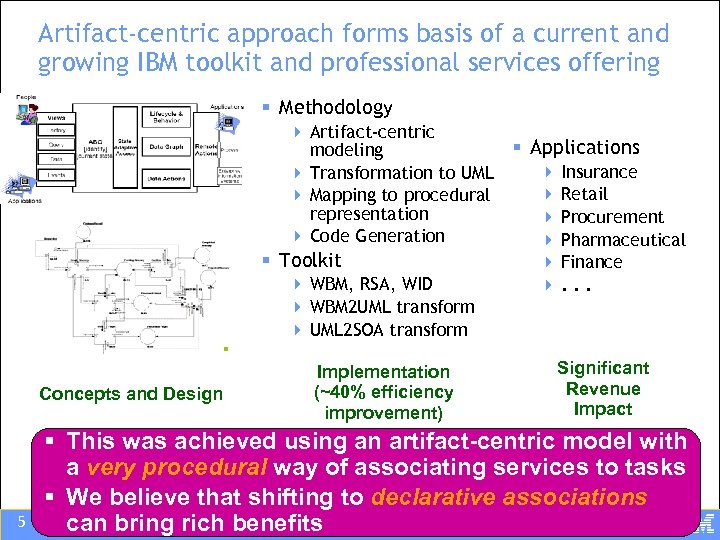
Artifact-centric approach forms basis of a current and growing IBM toolkit and professional services offering § Methodology 4 Artifact-centric § Applications modeling 4 Insurance 4 Transformation to UML 4 Retail 4 Mapping to procedural representation 4 Procurement 4 Code Generation 4 Pharmaceutical § Toolkit 4 Finance 4 WBM, RSA, WID 4. . . 4 WBM 2 UML transform 4 UML 2 SOA transform §Radically Simplified tools Concepts and Design 5 Implementation (~40% efficiency improvement) Significant Revenue Impact § This was achieved using an artifact-centric model with a very procedural way of associating services to tasks § We believe that shifting to declarative associations | Artifact-Centric Business Processes | 20 June 2008 can bring rich benefits IBM Research Watson
Outline § Artifact-centric workflow models § Research challenges and directions § Conclusions 6 | Artifact-Centric Business Processes | 20 June 2008 IBM Research Watson
Running Example: Distributed Enterprise Services (DES) § IT service provider 4 Providing IT services to a large enterprise 4 Which has many “small sites” 4 E. g. , fast foods, hotels, car rentals § IT services 4 Typical involve several or many steps 4 Steps might be performed by sub-contractors (or “vendors”) § Challenge: Find a systematic way to manage the different service offerings 4 May have varying number of tasks 4 May have regional differences (e. g. , regulations) 4 May deal with numerous vendors for the same task 7 | Artifact-Centric Business Processes | 20 June 2008 IBM Research Watson
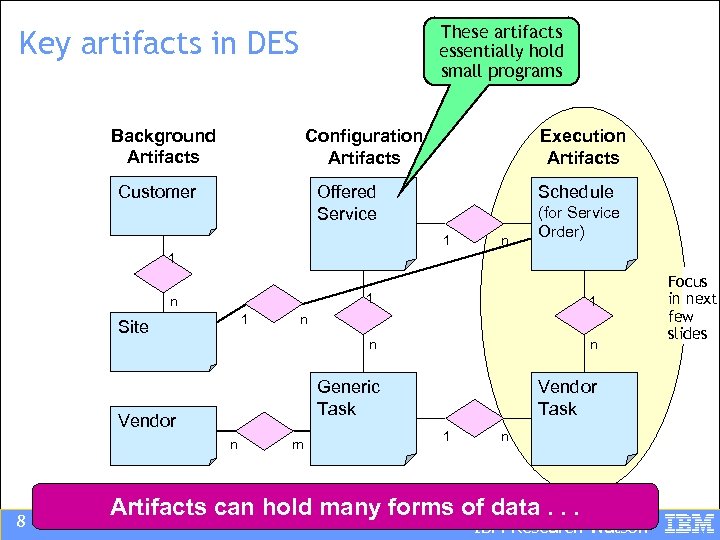
These artifacts essentially hold small programs Key artifacts in DES Background Artifacts Execution Artifacts Configuration Artifacts Customer Offered Service Schedule 1 n (for Service Order) 1 1 8 Vendor Task n Vendor n n Generic Task 1 Site 1 n n m 1 Artifacts can hold | | Artifact-Centric Business Processes many forms 20 June 2008 n of data. . . IBM Research Watson Focus in next few slides
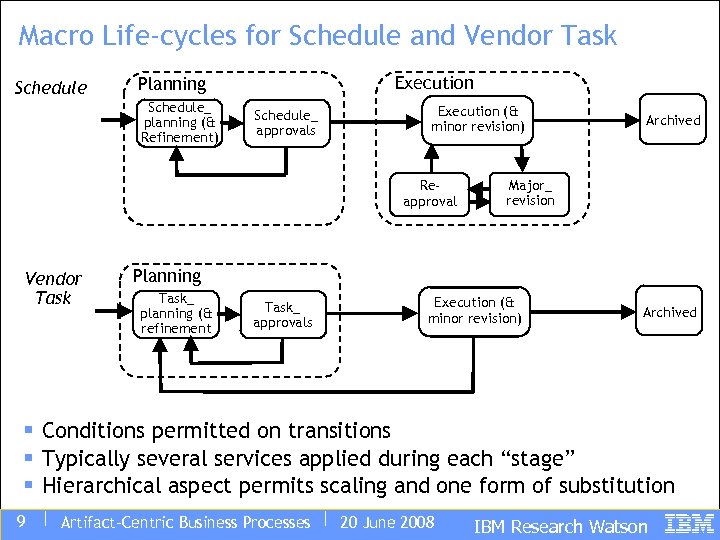
Macro Life-cycles for Schedule and Vendor Task Schedule Execution Planning Schedule_ planning (& Refinement) Schedule_ approvals Execution (& minor revision) Reapproval Vendor Task Archived Major_ revision Planning Task_ planning (& refinement Task_ approvals Execution (& minor revision) Archived § Conditions permitted on transitions § Typically several services applied during each “stage” § Hierarchical aspect permits scaling and one form of substitution 9 | Artifact-Centric Business Processes | 20 June 2008 IBM Research Watson
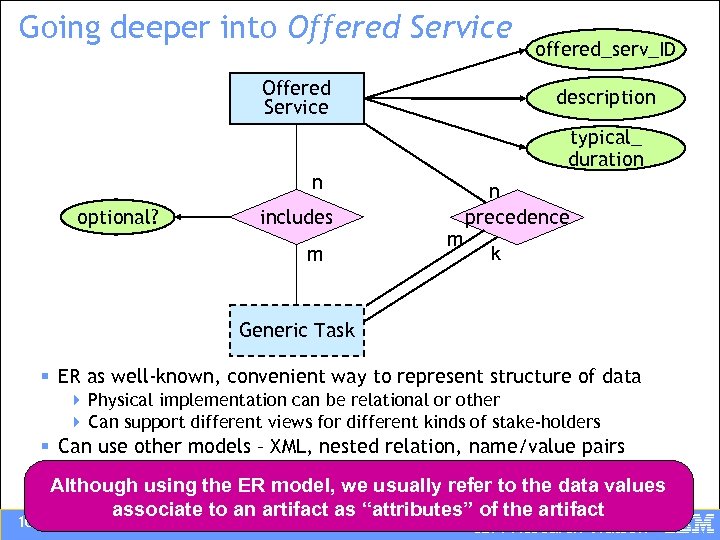
Going deeper into Offered Service offered_serv_ID description typical_ duration n optional? includes m m n precedence k Generic Task § ER as well-known, convenient way to represent structure of data 4 Physical implementation can be relational or other 4 Can support different views for different kinds of stake-holders § Can use other models – XML, nested relation, name/value pairs 10 Although using the ER model, we usually refer to the data values associate to an artifact as “attributes” of the artifact | | Artifact-Centric Business Processes 20 June 2008 IBM Research Watson
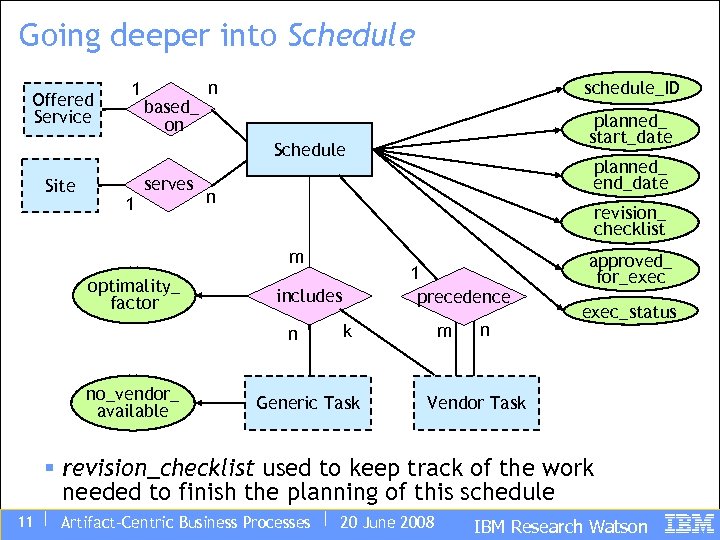
Going deeper into Schedule Offered Service 1 based_ on schedule_ID n planned_ start_date Schedule Site 1 serves n revision_ checklist m optimality_ factor 1 precedence includes n no_vendor_ available planned_ end_date k Generic Task m n approved_ for_exec_status Vendor Task § revision_checklist used to keep track of the work needed to finish the planning of this schedule 11 | Artifact-Centric Business Processes | 20 June 2008 IBM Research Watson
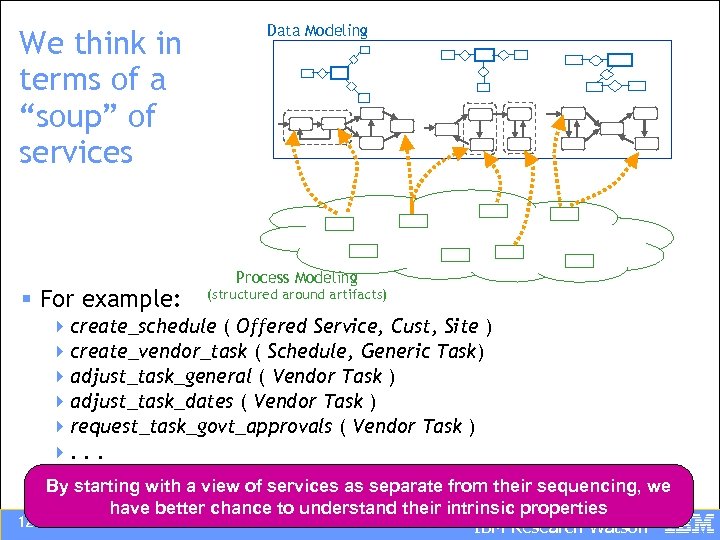
We think in terms of a “soup” of services § For example: Data Modeling Process Modeling (structured around artifacts) 4 create_schedule ( Offered Service, Cust, Site ) 4 create_vendor_task ( Schedule, Generic Task) 4 adjust_task_general ( Vendor Task ) 4 adjust_task_dates ( Vendor Task ) 4 request_task_govt_approvals ( Vendor Task ) 4. . . By starting with a view of services as separate from their sequencing, we have better chance to understand their intrinsic properties 12 | Artifact-Centric Business Processes | 20 June 2008 IBM Research Watson
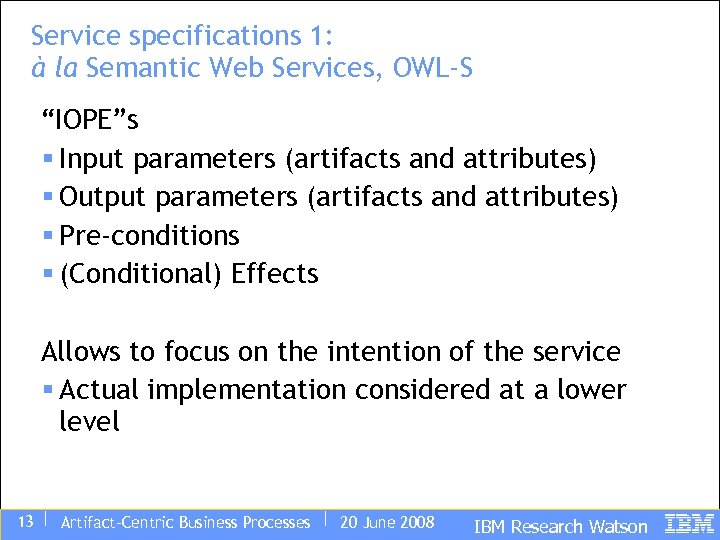
Service specifications 1: à la Semantic Web Services, OWL-S “IOPE”s § Input parameters (artifacts and attributes) § Output parameters (artifacts and attributes) § Pre-conditions § (Conditional) Effects Allows to focus on the intention of the service § Actual implementation considered at a lower level 13 | Artifact-Centric Business Processes | 20 June 2008 IBM Research Watson
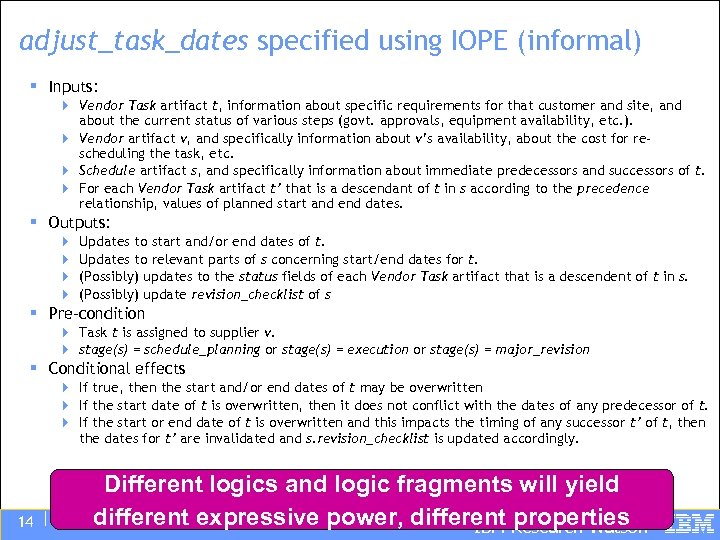
adjust_task_dates specified using IOPE (informal) § Inputs: 4 Vendor Task artifact t, information about specific requirements for that customer and site, and about the current status of various steps (govt. approvals, equipment availability, etc. ). 4 Vendor artifact v, and specifically information about v’s availability, about the cost for rescheduling the task, etc. 4 Schedule artifact s, and specifically information about immediate predecessors and successors of t. 4 For each Vendor Task artifact t’ that is a descendant of t in s according to the precedence relationship, values of planned start and end dates. § Outputs: 4 4 Updates to start and/or end dates of t. Updates to relevant parts of s concerning start/end dates for t. (Possibly) updates to the status fields of each Vendor Task artifact that is a descendent of t in s. (Possibly) update revision_checklist of s § Pre-condition 4 Task t is assigned to supplier v. 4 stage(s) = schedule_planning or stage(s) = execution or stage(s) = major_revision § Conditional effects 4 If true, then the start and/or end dates of t may be overwritten 4 If the start date of t is overwritten, then it does not conflict with the dates of any predecessor of t. 4 If the start or end date of t is overwritten and this impacts the timing of any successor t’ of t, then the dates for t’ are invalidated and s. revision_checklist is updated accordingly. 14 | Different logics and logic fragments will yield different expressive power, different Research Watson Artifact-Centric Business Processes | 20 June 2008 IBM properties
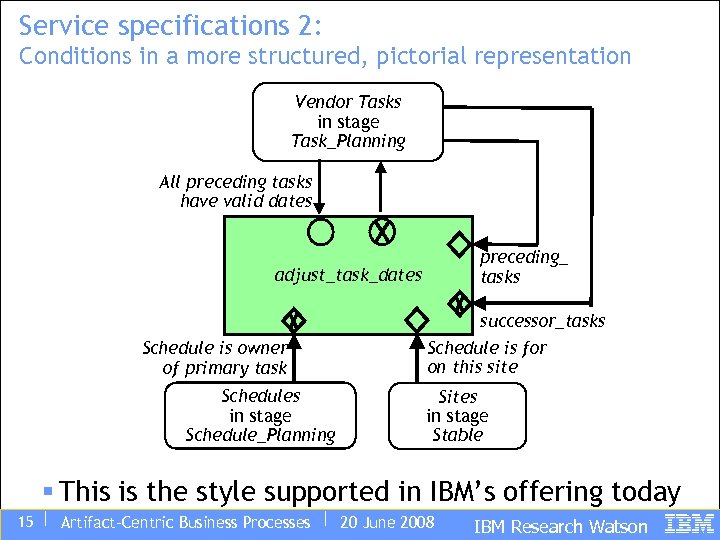
Service specifications 2: Conditions in a more structured, pictorial representation Vendor Tasks in stage Task_Planning All preceding tasks have valid dates preceding_ tasks adjust_task_dates Schedule is owner of primary task Schedules in stage Schedule_Planning successor_tasks Schedule is for on this site Sites in stage Stable § This is the style supported in IBM’s offering today 15 | Artifact-Centric Business Processes | 20 June 2008 IBM Research Watson
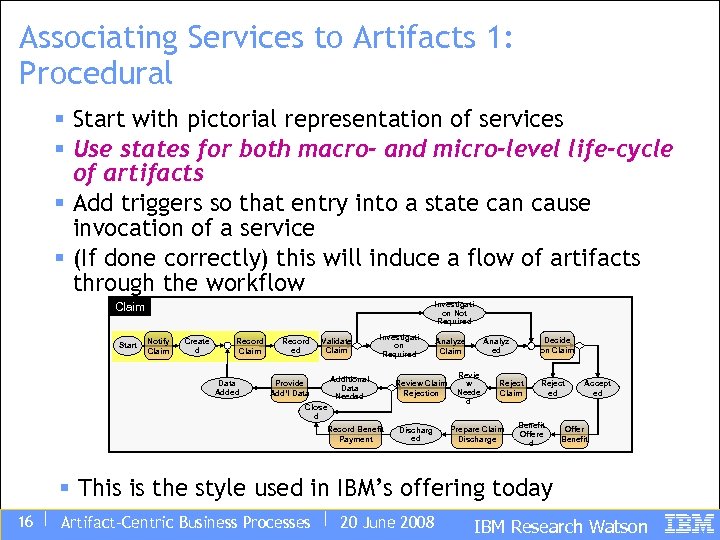
Associating Services to Artifacts 1: Procedural § Start with pictorial representation of services § Use states for both macro- and micro-level life-cycle of artifacts § Add triggers so that entry into a state can cause invocation of a service § (If done correctly) this will induce a flow of artifacts through the workflow Claim Start Investigati on Not Required Notify Claim Create d Record Claim Data Added Record ed Validate Claim Provide Add’l Data Investigati on Required Additional Data Needed Review Claim Rejection Close d Record Benefit Payment Analyze Claim Discharg ed Decide on Claim Analyz ed Revie w Neede d Reject Claim Prepare Claim Discharge Reject ed Benefit Offere d Accept ed Offer Benefit § This is the style used in IBM’s offering today 16 | Artifact-Centric Business Processes | 20 June 2008 IBM Research Watson
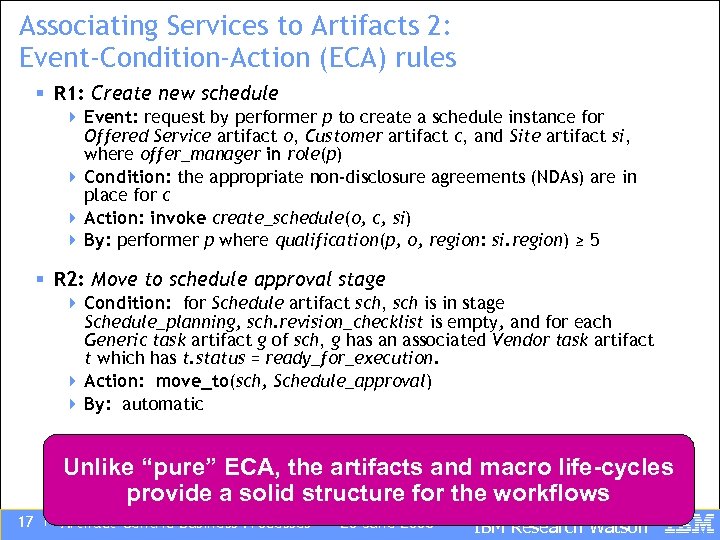
Associating Services to Artifacts 2: Event-Condition-Action (ECA) rules § R 1: Create new schedule 4 Event: request by performer p to create a schedule instance for Offered Service artifact o, Customer artifact c, and Site artifact si, where offer_manager in role(p) 4 Condition: the appropriate non-disclosure agreements (NDAs) are in place for c 4 Action: invoke create_schedule(o, c, si) 4 By: performer p where qualification(p, o, region: si. region) ≥ 5 § R 2: Move to schedule approval stage 4 Condition: for Schedule artifact sch, sch is in stage Schedule_planning, sch. revision_checklist is empty, and for each Generic task artifact g of sch, g has an associated Vendor task artifact t which has t. status = ready_for_execution. 4 Action: move_to(sch, Schedule_approval) 4 By: automatic . Unlike “pure” ECA, the artifacts and macro life-cycles. . . provide a solid structure for the workflows 17 | Artifact-Centric Business Processes | 20 June 2008 IBM Research Watson
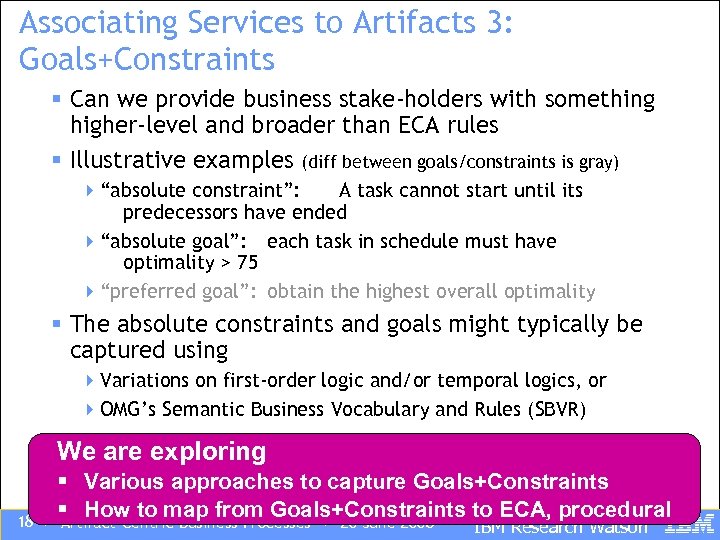
Associating Services to Artifacts 3: Goals+Constraints § Can we provide business stake-holders with something higher-level and broader than ECA rules § Illustrative examples (diff between goals/constraints is gray) 4 “absolute constraint”: A task cannot start until its predecessors have ended 4 “absolute goal”: each task in schedule must have optimality > 75 4 “preferred goal”: obtain the highest overall optimality § The absolute constraints and goals might typically be captured using 4 Variations on first-order logic and/or temporal logics, or 4 OMG’s Semantic Business Vocabulary and Rules (SBVR) We are exploring 18 § Various approaches to capture Goals+Constraints | § How to map from Goals+Constraints to ECA, procedural | Artifact-Centric Business Processes 20 June 2008 IBM Research Watson
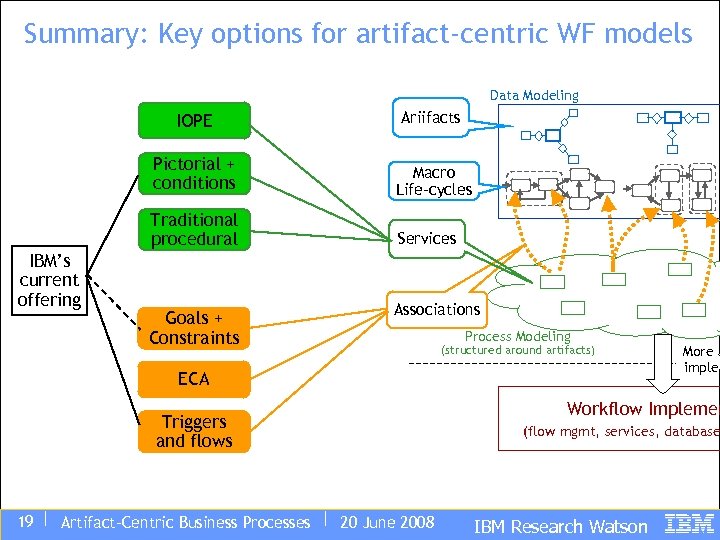
Summary: Key options for artifact-centric WF models Data Modeling IOPE Pictorial + conditions Macro Life-cycles Traditional procedural IBM’s current offering Ariifacts Services Goals + Constraints Associations Process Modeling (structured around artifacts) ECA Triggers and flows 19 | Artifact-Centric Business Processes | 20 June 2008 More s implem Workflow Implemen (flow mgmt, services, database IBM Research Watson
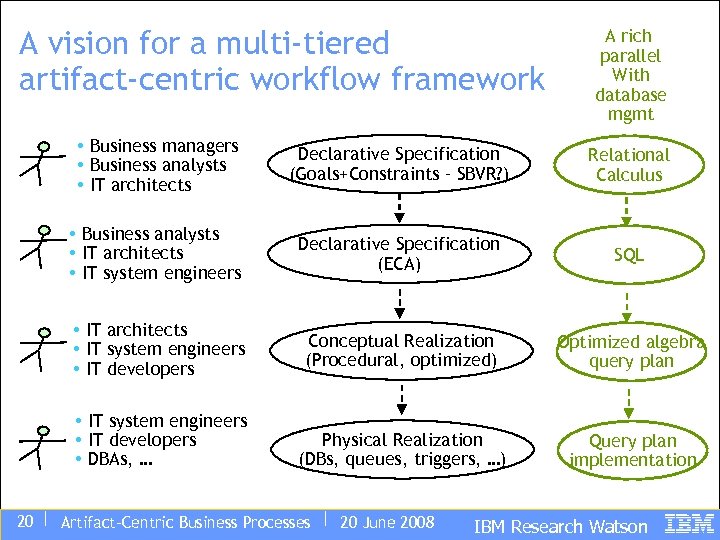
A vision for a multi-tiered artifact-centric workflow framework A rich parallel With database mgmt • Business managers • Business analysts • IT architects Declarative Specification (Goals+Constraints – SBVR? ) Relational Calculus • Business analysts • IT architects • IT system engineers Declarative Specification (ECA) SQL • IT architects • IT system engineers • IT developers Conceptual Realization (Procedural, optimized) Optimized algebra query plan • IT system engineers • IT developers • DBAs, … Physical Realization (DBs, queues, triggers, …) Query plan implementation 20 | Artifact-Centric Business Processes | 20 June 2008 IBM Research Watson
Outline § Artifact-centric workflow models § Research challenges and directions § Conclusions 21 | Artifact-Centric Business Processes | 20 June 2008 IBM Research Watson
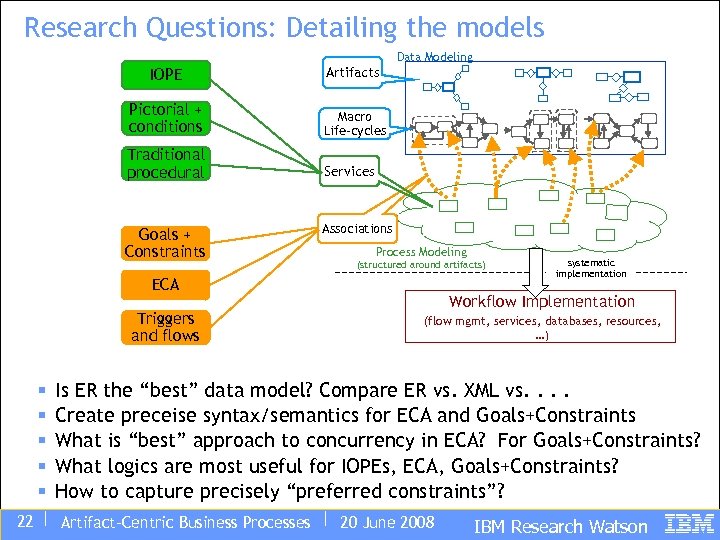
Research Questions: Detailing the models Data Modeling IOPE Artifacts Pictorial + conditions Macro Life-cycles Traditional procedural Services Goals + Constraints Associations Process Modeling (structured around artifacts) ECA Triggers and flows § § § systematic implementation Workflow Implementation (flow mgmt, services, databases, resources, …) Is ER the “best” data model? Compare ER vs. XML vs. . Create preceise syntax/semantics for ECA and Goals+Constraints What is “best” approach to concurrency in ECA? For Goals+Constraints? What logics are most useful for IOPEs, ECA, Goals+Constraints? How to capture precisely “preferred constraints”? 22 | Artifact-Centric Business Processes | 20 June 2008 IBM Research Watson
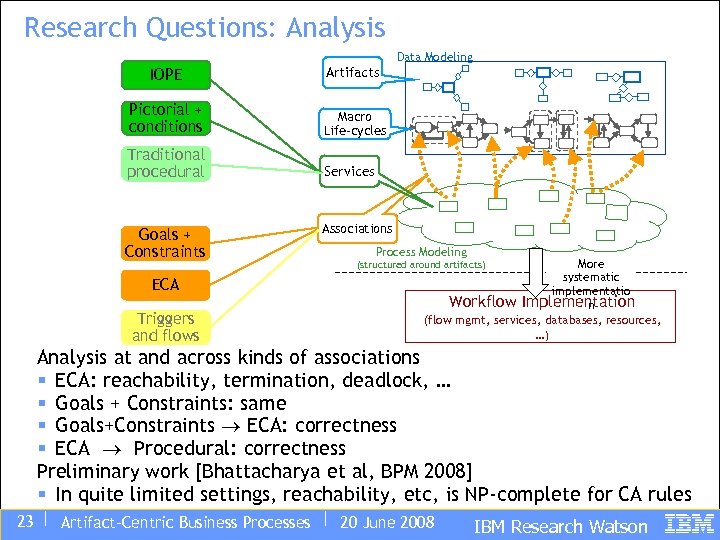
Research Questions: Analysis Data Modeling IOPE Artifacts Pictorial + conditions Macro Life-cycles Traditional procedural Services Goals + Constraints ECA Triggers and flows Associations Process Modeling More systematic implementatio Workflow Implementation n (flow mgmt, services, databases, resources, …) (structured around artifacts) Analysis at and across kinds of associations § ECA: reachability, termination, deadlock, … § Goals + Constraints: same § Goals+Constraints ECA: correctness § ECA Procedural: correctness Preliminary work [Bhattacharya et al, BPM 2008] § In quite limited settings, reachability, etc, is NP-complete for CA rules 23 | Artifact-Centric Business Processes | 20 June 2008 IBM Research Watson
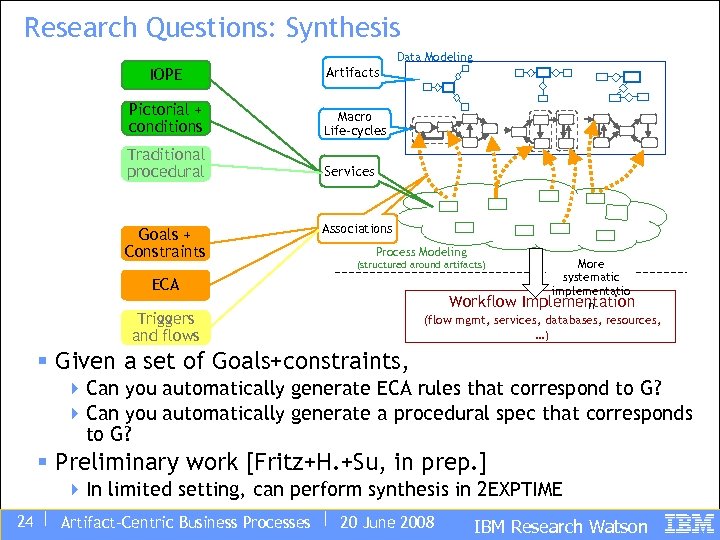
Research Questions: Synthesis Data Modeling IOPE Artifacts Pictorial + conditions Macro Life-cycles Traditional procedural Services Goals + Constraints Associations Process Modeling More systematic implementatio Workflow Implementation n (flow mgmt, services, databases, resources, …) (structured around artifacts) ECA Triggers and flows § Given a set of Goals+constraints, 4 Can you automatically generate ECA rules that correspond to G? 4 Can you automatically generate a procedural spec that corresponds to G? § Preliminary work [Fritz+H. +Su, in prep. ] 4 In limited setting, can perform synthesis in 2 EXPTIME 24 | Artifact-Centric Business Processes | 20 June 2008 IBM Research Watson
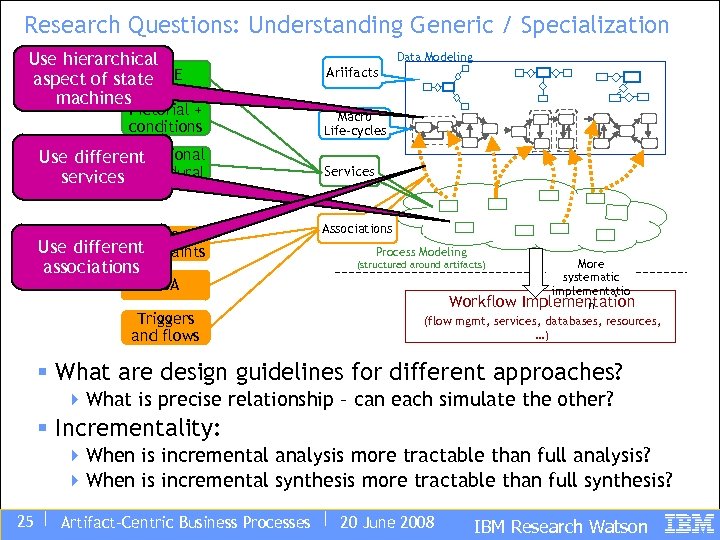
Research Questions: Understanding Generic / Specialization Use hierarchical IOPE aspect of state machines Pictorial + conditions Traditional Use different services procedural Goals + Use different Constraints associations ECA Triggers and flows Data Modeling Ariifacts Macro Life-cycles Services Associations Process Modeling More systematic implementatio Workflow Implementation n (flow mgmt, services, databases, resources, …) (structured around artifacts) § What are design guidelines for different approaches? 4 What is precise relationship – can each simulate the other? § Incrementality: 4 When is incremental analysis more tractable than full analysis? 4 When is incremental synthesis more tractable than full synthesis? 25 | Artifact-Centric Business Processes | 20 June 2008 IBM Research Watson
Outline § Artifact-centric workflow models § Research challenges and directions § Conclusions 26 | Artifact-Centric Business Processes | 20 June 2008 IBM Research Watson
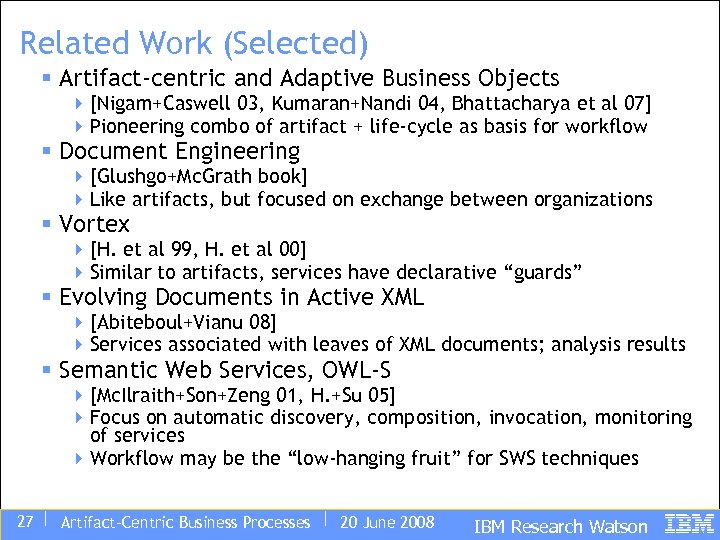
Related Work (Selected) § Artifact-centric and Adaptive Business Objects 4 [Nigam+Caswell 03, Kumaran+Nandi 04, Bhattacharya et al 07] 4 Pioneering combo of artifact + life-cycle as basis for workflow § Document Engineering 4 [Glushgo+Mc. Grath book] 4 Like artifacts, but focused on exchange between organizations § Vortex 4 [H. et al 99, H. et al 00] 4 Similar to artifacts, services have declarative “guards” § Evolving Documents in Active XML 4 [Abiteboul+Vianu 08] 4 Services associated with leaves of XML documents; analysis results § Semantic Web Services, OWL-S 4 [Mc. Ilraith+Son+Zeng 01, H. +Su 05] 4 Focus on automatic discovery, composition, invocation, monitoring of services 4 Workflow may be the “low-hanging fruit” for SWS techniques 27 | Artifact-Centric Business Processes | 20 June 2008 IBM Research Watson
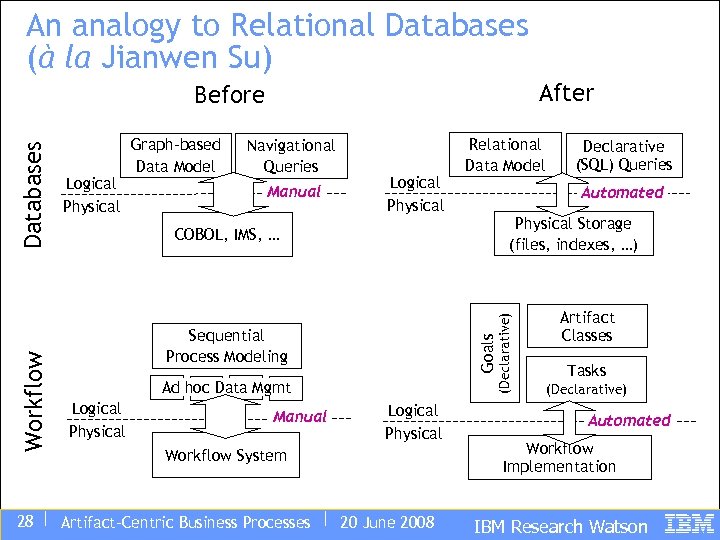
An analogy to Relational Databases (à la Jianwen Su) After Logical Physical Graph-based Data Model Navigational Queries Manual Logical Physical Relational Data Model Physical Storage (files, indexes, …) (Declarative) COBOL, IMS, … Sequential Process Modeling Ad hoc Data Mgmt Logical Physical Manual Logical Physical Declarative (SQL) Queries Automated Goals Workflow Databases Before Artifact Classes Tasks (Declarative) Automated Workflow System Workflow Implementation 28 | Artifact-Centric Business Processes | 20 June 2008 IBM Research Watson
University/Institute Collaborations << partial list >> Active § UC Santa Barbara § University of Zurich § FORTH in Crete § UC San Diego Emerging § University of Rome – La Sapienza § University of Balzano § Penn State § INRIA There is lots of research to be done, and we are eager to collaborate with academia/institutes 29 | Artifact-Centric Business Processes | 20 June 2008 IBM Research Watson
Summary § Artifact-centric provides a new basis for designing (and implementing) workflows that is 4 Easy for business stake holders to understand 4 Can enable flexibility in Evolution Component re-use Generic / specialized 4 Has already shown its value in the field § Artifact-centric can support a spectrum from procedural to declarative workflow specification 4 A declarative approach could dramatically simplify workflow design, evolution, specialization, component re-use, . . . 4 This framework raises many research questions 30 | Artifact-Centric Business Processes | 20 June 2008 IBM Research Watson
Backup slides § In artifact-centric workflow, is the challenge of synthesizing procedural workflows from high-level goals+constraints a “low-hanging fruit” for techniques from (and advances to) semantic web services? 31 | Artifact-Centric Business Processes | 20 June 2008 IBM Research Watson
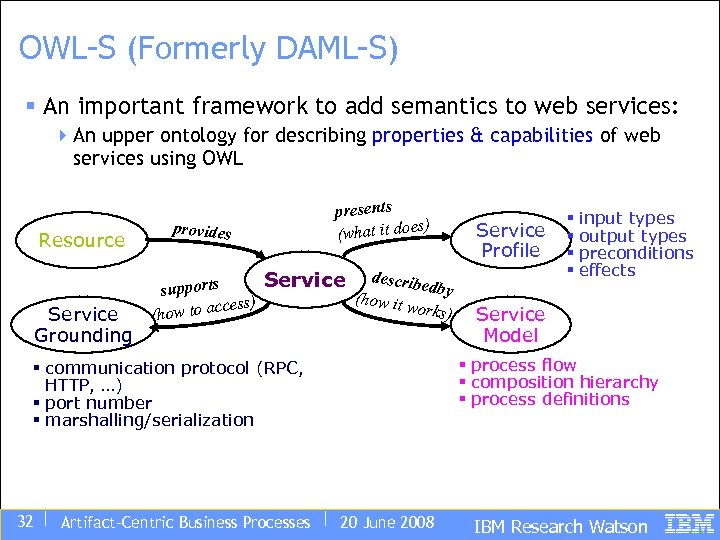
OWL-S (Formerly DAML-S) § An important framework to add semantics to web services: 4 An upper ontology for describing properties & capabilities of web services using OWL Resource Service Grounding provides presents ) (what it does Service describedby upports s (how it ) works) to access (how § communication protocol (RPC, HTTP, …) § port number § marshalling/serialization 32 | Artifact-Centric Business Processes | 20 June 2008 Service Profile § § input types output types preconditions effects Service Model § process flow § composition hierarchy § process definitions IBM Research Watson
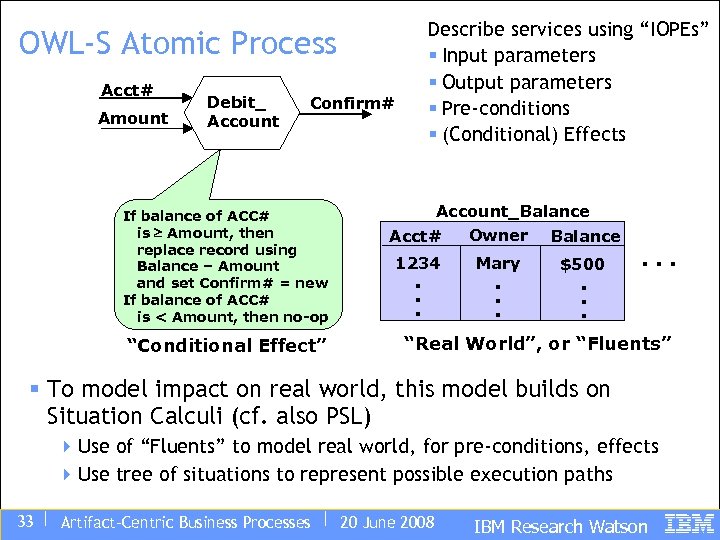
Describe services using “IOPEs” § Input parameters § Output parameters § Pre-conditions § (Conditional) Effects OWL-S Atomic Process Confirm# “Conditional Effect” Account_Balance Owner Balance Acct# 1234 Mary $500 . . . If balance of ACC# is Amount, then replace record using Balance – Amount and set Confirm# = new If balance of ACC# is < Amount, then no-op . . . Amount Debit_ Account . . . Acct# “Real World”, or “Fluents” § To model impact on real world, this model builds on Situation Calculi (cf. also PSL) 4 Use of “Fluents” to model real world, for pre-conditions, effects 4 Use tree of situations to represent possible execution paths 33 | Artifact-Centric Business Processes | 20 June 2008 IBM Research Watson
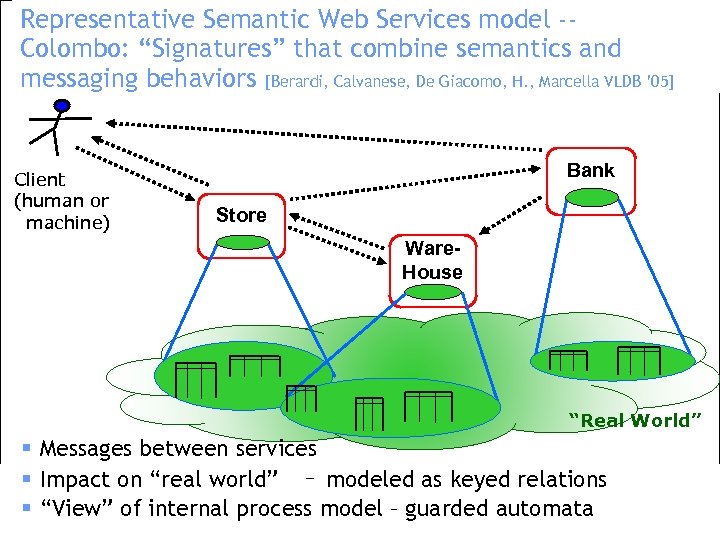
Representative Semantic Web Services model -Colombo: “Signatures” that combine semantics and messaging behaviors [Berardi, Calvanese, De Giacomo, H. , Marcella VLDB ’ 05] Client (human or machine) Bank Store Ware. House “Real World” § Messages between services § Impact on “real world” – modeled as keyed relations § “View” of internal process model – guarded automata | 34 | Artifact-Centric Business Processes 20 June 2008 IBM Research Watson
Скачать презентацию IBM Research Artifacts in Business Processes Helping Workflow
d8c0508772cf7e5afd82a0bbdfbe22f6.ppt