 Скачать презентацию IBM Government Programs Movement of service providers —
c34a967be6c10a78f8c291b189dc6fa7.ppt
- Количество слайдов: 7



IBM Government Programs Movement of service providers - Intra Company Transfers Jolanta Jaworska Government Programs Executive IBM Poland Geneva, September 22, 2008 | © 2008 IBM Corporation
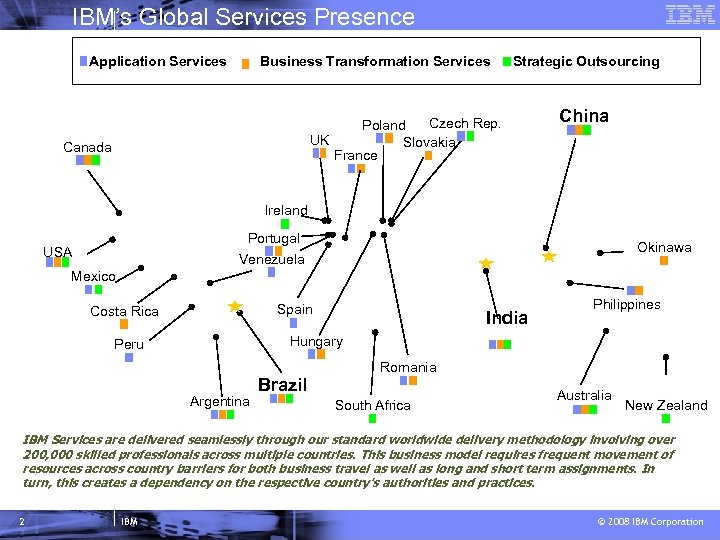
IBM’s Global Services Presence Application Services Business Transformation Services Strategic Outsourcing Czech Rep. Poland UK Slovakia France Canada China Ireland Portugal Venezuela USA Okinawa Mexico Spain Costa Rica India Philippines Hungary Peru Argentina Brazil Romania South Africa Australia New Zealand IBM Services are delivered seamlessly through our standard worldwide delivery methodology involving over 200, 000 skilled professionals across multiple countries. This business model requires frequent movement of resources across country barriers for both business travel as well as long and short term assignments. In turn, this creates a dependency on the respective country’s authorities and practices. 2 IBM © 2008 IBM Corporation
Facts about movement of workforce § Movement of workforce in a globally operating company is a part of daily operations § Growing employees willigness and ability to find a jobs far from home land § Talent goes where talent is needed § Internal company job posting is part of the culture and principles § The opportrunities for temporary foreign assignment are the form of company recognition and retention programs § Sending high potentials abroad to gain experience of another culture and working styles, sometimes is mandatory if they aspiring to the executive role, § Lower barriers for mobilty lead to less permanent immigration in the long term ( eg, Irish and now Polish case), § Complementary role of mobile skills (with technical, industry and other "horizontal" expertise) to address gaps in local skills with intimate market and customer knowledge 3 IBM © 2008 IBM Corporation
IBM inbound and outbound assignee models q Inbound Assignee model ( from developed economies to growing) § Development opportunities in a high growth market like Asia, Eastern Europe, South America § Provide leadership in selected areas, and „groom” future leaders § More than 60% of assignees are accompanied by spouses § Around 40% of inbound assignees are accompanied by children § Coming mainly from USA, Europe, Australia - aproximately 200 yearly q. Outbound Assignee Model ( from growing economies to developed) § Global Development Opportunities for future leaders from growth countries § Program Managers or technical professionals working on global delivery projects üTransition work – short term assignments üOnsite team members – longer term assignments § Going to Europe and USA – aprox 2000 yearly 4 IBM © 2008 IBM Corporation
The main barriers and restrictions faced by companies in relation to the admission of ICTs are as follows: § Admission Criteria / Definition of ICTs ( qualifications, salary level, labour market test) § Application Process (Separate Documents – Work Permit, Visa & Residence Permit : ØProcessing Time ØProcess ØFees ØSupporting Documents ØValidity ØRenewal Process § Scope of Work Permit - for individual countries, ØSpecific Regions ØClient Limitation ØVisa Restrictions 5 IBM © 2008 IBM Corporation
Inbound International assignees challenges §long visa and work permitt processing time – 3 months and up , same applies to renevals. Additional cost & impacts frequent business travelers. §Foreign Regional Registration Office’s Requirement of presence of young children for registration §complex process for visa registration, requirement for plenty of company legalized certificates and outbound International assignees challenges § minimum compensation tresholds, authorities requesting IBM Pay slip minimum salary, vs. local country salary components and assignment provisions § requirement for legalization of assignees certificates (birth/marriage/educational/police) from the place they were issued. § strict submission (2 x/year) & processing dates (6 months) results in lengthy lead times for obtaining Work permits. §Long lead times in processing Foreign Tax Credits, and no communication regarding completion of assessments. § 6 IBM © 2008 IBM Corporation
Recommendations that would support business development and economic growth § Enable reform of regulation through simplification, which increases job mobility § Provide a regulatory proposals that allows business to grow and operate in a timely and cost-effective manner. § Promote & support knowledge based economy - right skills in the right place at the right time, § Draw on technological skills rather than low wages - encourage private investment in R&D and skills development, § Avoid barriers to businesses embracing a global enterprise model that allows deployment of skills and other assets globally and in the most competitive way § Promote mobility and flexibility of workforce, 7 IBM © 2008 IBM Corporation
Скачать презентацию IBM Government Programs Movement of service providers —
c34a967be6c10a78f8c291b189dc6fa7.ppt