


IB Extended Essay
What is it? • The IB Extended Essay (or EE) is a 4, 000 word structured scientific research that you write under the supervision of an advisor (an IB teacher at your school), which counts towards your IB Diploma
How to get A grade? • Write About Something You Enjoy Because You'll Be Spending a Lot of Time on It. • Chose a Topic That Is Not Too Broad, But Not Too Narrow. • Choose an Advisor Who Is Very Familiar With Your Topic and Who Seems Excited About It. • Choose an Advisor Who Will Push You to Be Your Best. • Make Sure Your Essay Has a Clear Structure and Flow. • Start Writing Sooner Rather Than Later!
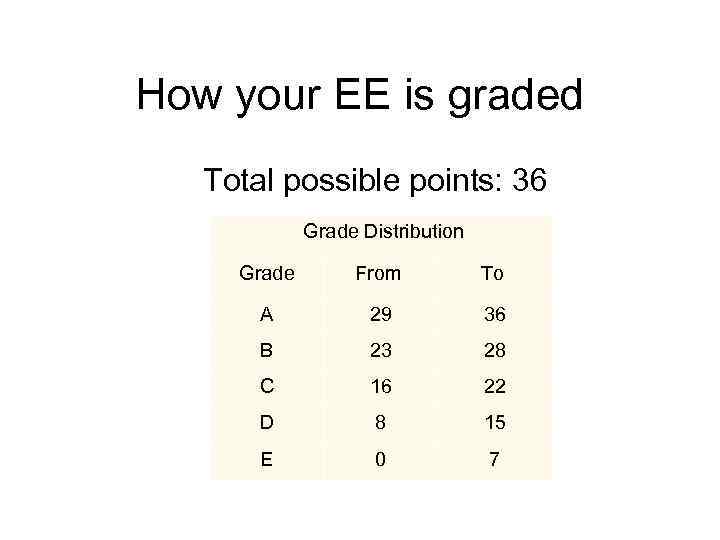
How your EE is graded Total possible points: 36 Grade Distribution Grade From To A 29 36 B 23 28 C 16 22 D 8 15 E 0 7
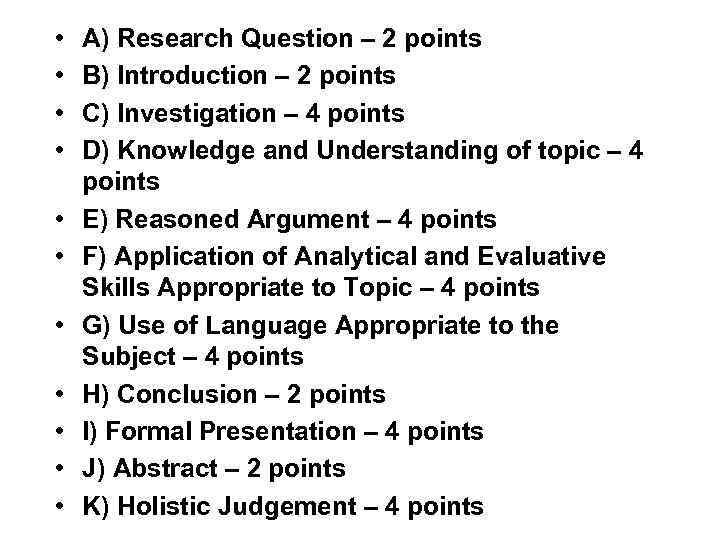
• • • A) Research Question – 2 points B) Introduction – 2 points C) Investigation – 4 points D) Knowledge and Understanding of topic – 4 points E) Reasoned Argument – 4 points F) Application of Analytical and Evaluative Skills Appropriate to Topic – 4 points G) Use of Language Appropriate to the Subject – 4 points H) Conclusion – 2 points I) Formal Presentation – 4 points J) Abstract – 2 points K) Holistic Judgement – 4 points
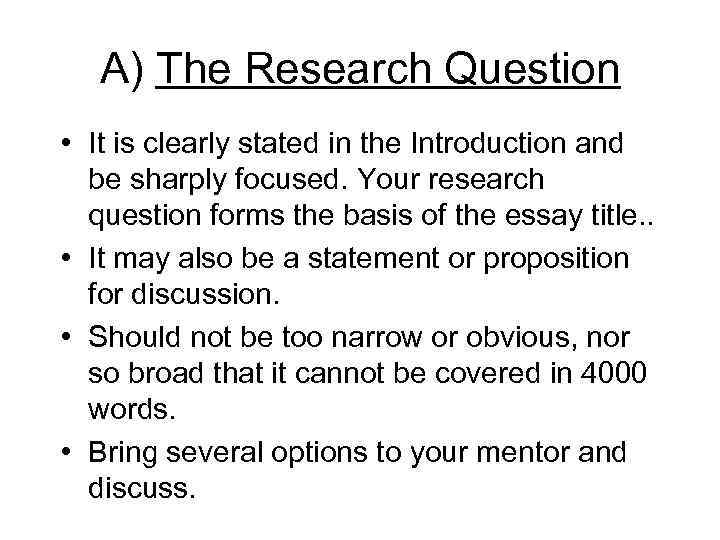
A) The Research Question • It is clearly stated in the Introduction and be sharply focused. Your research question forms the basis of the essay title. . • It may also be a statement or proposition for discussion. • Should not be too narrow or obvious, nor so broad that it cannot be covered in 4000 words. • Bring several options to your mentor and discuss.
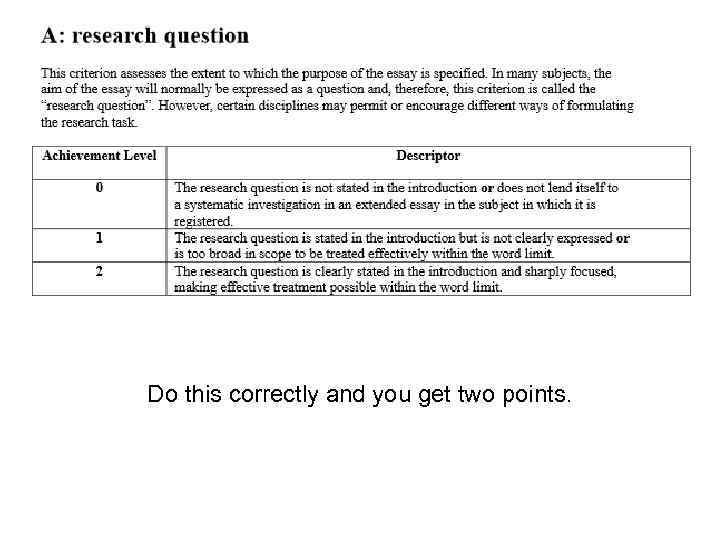
Do this correctly and you get two points.
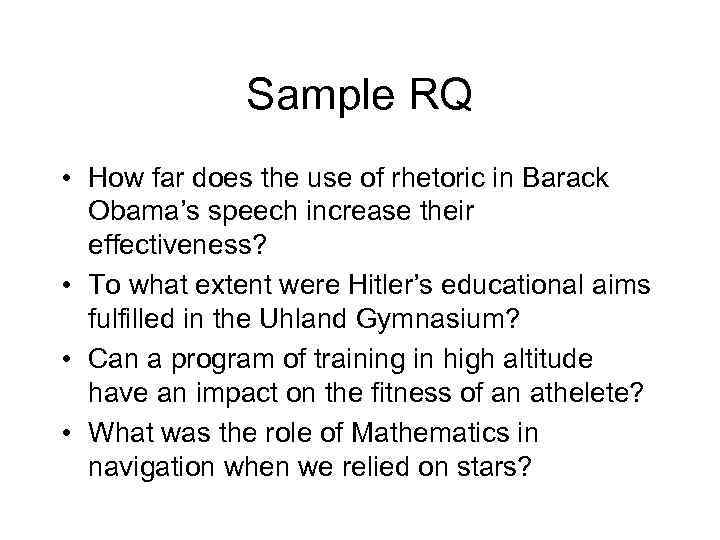
Sample RQ • How far does the use of rhetoric in Barack Obama’s speech increase their effectiveness? • To what extent were Hitler’s educational aims fulfilled in the Uhland Gymnasium? • Can a program of training in high altitude have an impact on the fitness of an athelete? • What was the role of Mathematics in navigation when we relied on stars?
B) Introduction Your introduction begins with your research question. Then you need two components: 1) Context. Include a summary of the current state of the field of study under investigation. In other words, briefly state what other people have said about this topic. 2) Significance. Explain the significance of your topic and why it is worthy of investigation.

Do this correctly and you get two more points.
C) Investigation • Find, read and use in your essay at least four academic sources. • If you can’t find at least four sources, don’t do this topic • Make sure your sources don’t all say the same thing. Otherwise there is no need for your interpretation. • Wikipedia, etc and popular publications do not gain you credit as sources, however Wikipedia can give you insight into sources. Go to the bottom of a Wikipedia page for the bibliography. Start there.
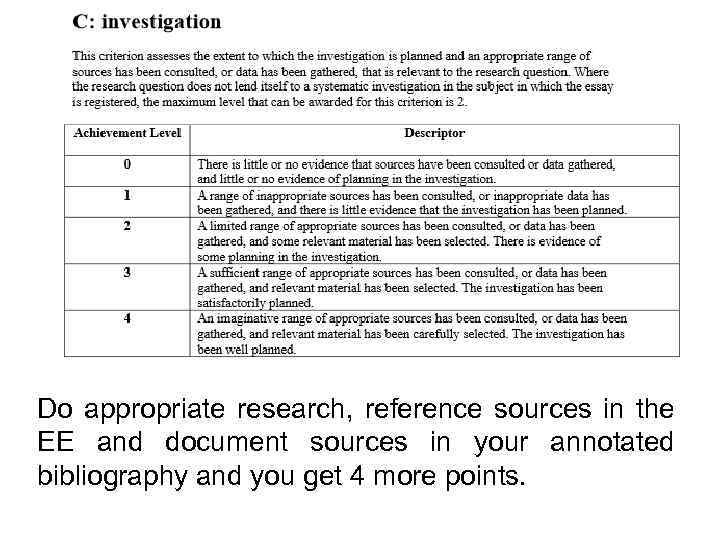
• O Do appropriate research, reference sources in the EE and document sources in your annotated bibliography and you get 4 more points.
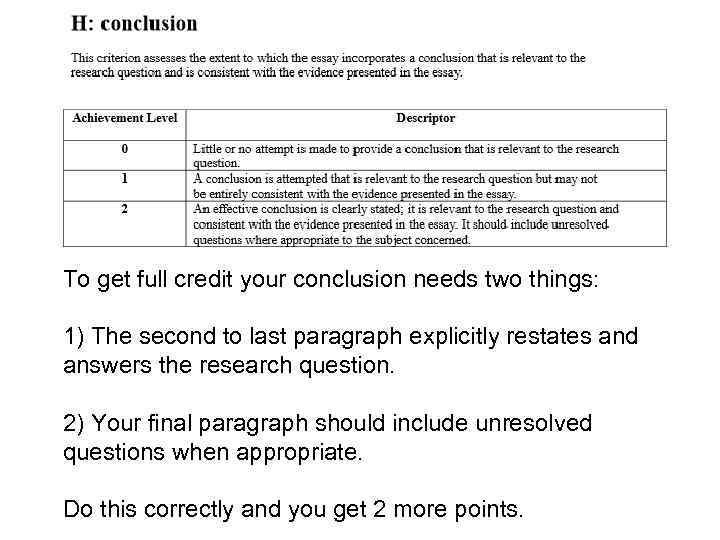
To get full credit your conclusion needs two things: 1) The second to last paragraph explicitly restates and answers the research question. 2) Your final paragraph should include unresolved questions when appropriate. Do this correctly and you get 2 more points.
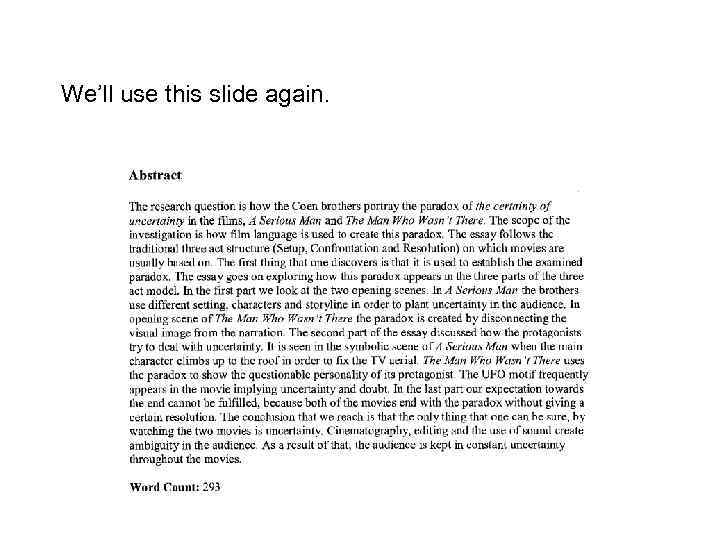
Criterion J – The Abstract Signpost by writing: Abstract Then the abstract begins. Your abstract must contain: 1) the research question that was investigated, quoted verbatim 2) How the investigation was undertaken and the scope of the investigation. 3) The conclusions you reached. 4) Drop down a couple of spaces and add your word count (should be equal to or less than 300).
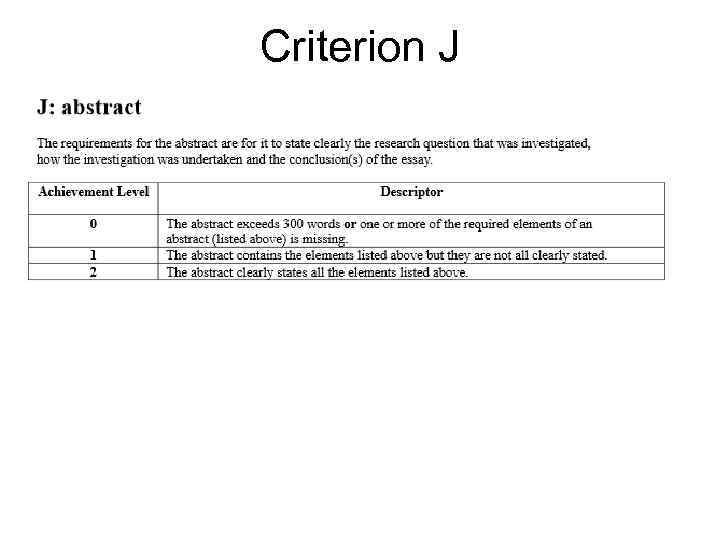
Criterion J
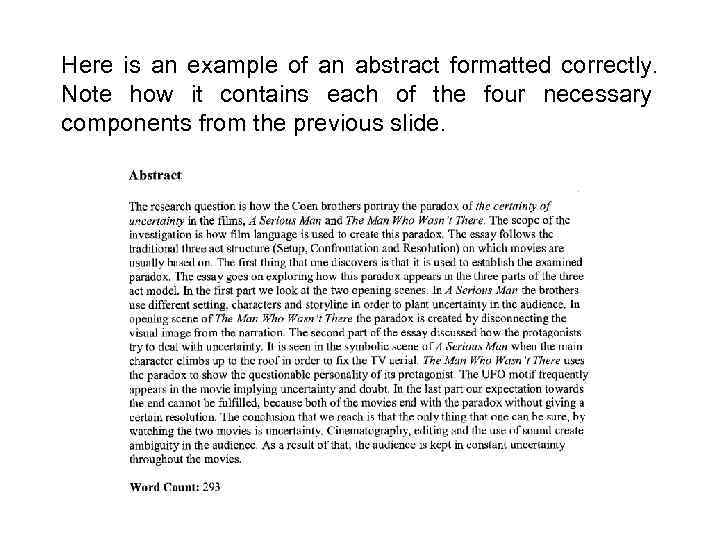
Here is an example of an abstract formatted correctly. Note how it contains each of the four necessary components from the previous slide.
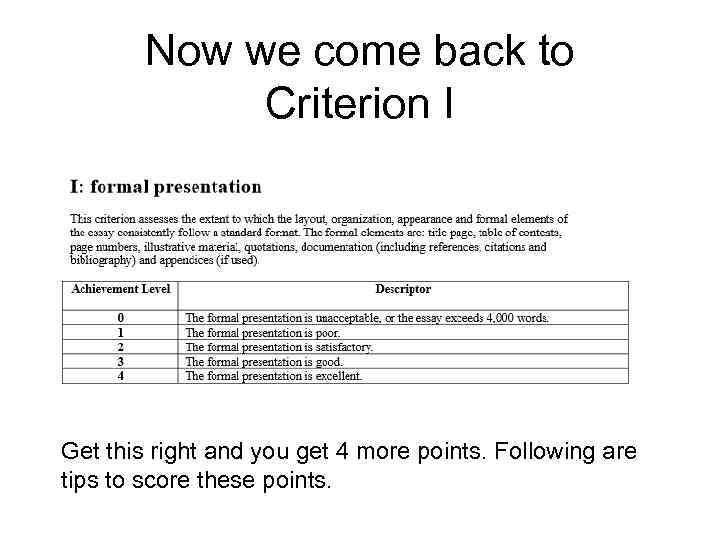
Now we come back to Criterion I Get this right and you get 4 more points. Following are tips to score these points.
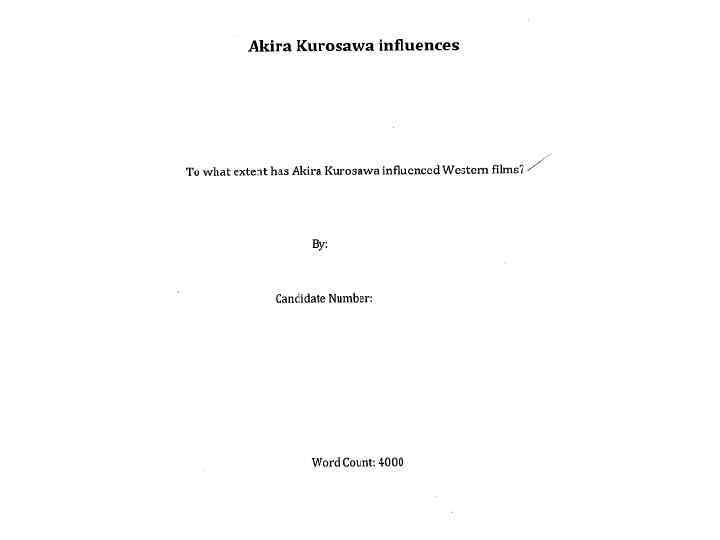
To get full credit for I: Formal Presentation • You have included: – A title page that includes the essay title and the research question – The title page also contains your name, your session number and the essay word count. Only count words in the essay itself. The abstract, bibliography and so forth are not part of the word count. See next slide for an example

The next page has your abstract.
We’ll use this slide again.
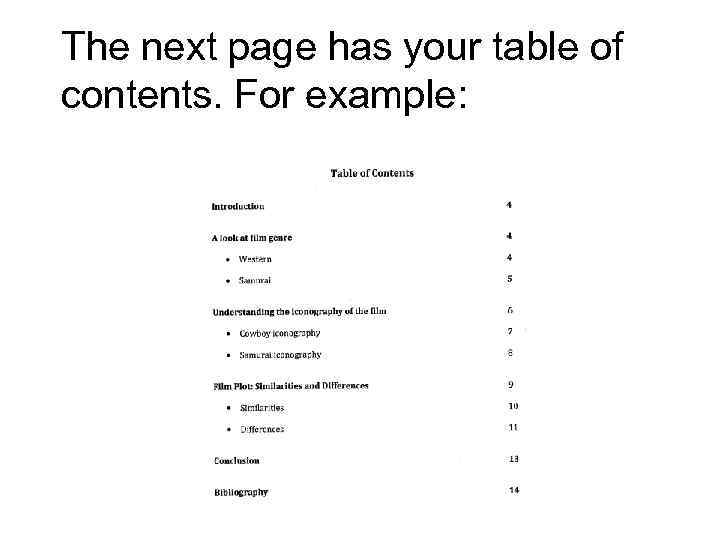
The next page has your table of contents. For example:
Your essay starts on the next page, beginning with your introduction. Signpost your introduction like this: Introduction
Lastly, to get full credit for criterion I, all pages need to be numbered, your session number should be in the header or footer, and you should be consistent with your citation method (MLA). The final pages of your essay contain your bibliography and appendices (if any).
Summary of Criterion I First page: title page Second page: abstract Third page: table of contents Fourth page: Introduction. The introduction is an item listed on the table of contents. The essay itself then follows. Sub-headings are also listed in the To. C. Final paragraphs contain your conclusion. Last pages: bibliography (mandantory) and appendices (if appropriate) All pages: numbered and include your session number in header/footer.
Furthermore • Use 12 point font • Use a readable font. This isn’t the place to show your creativity. • Double space unless otherwise instructed. Follow MLA guidelines. • Use appropriate margins • Use consistent pagination

Other helpful hints
Structure • Plan the outline headings for the essay in the form of an outline. This outline is the spine of your essay. • Essays without spines are gelatinous blobs. That is a bad thing. • Have your mentor approve your outline before you start writing.

You must have a Bibliography! • Failure to comply with this requirement will be viewed as plagiarism and will, therefore, be treated as a case of malpractice.
The Word Count • Maximum length 4000 words not including: – – – – – the abstract the contents page maps, charts, diagrams, annotated illustrations Labels equations, formulas and calculations citations/references footnotes or endnotes the bibliography Appendices (if any)
Appendices • The Appendices should not include information of direct relevance to the analysis and argument in the main body of the essay. • Unless raw data is used unprocessed as part of the argument, the raw data should go in the Appendices.
Plagiarism check Be sure to upload your final draft to Anti. Plagiarism app to check for any red flags. Once you have done this turn your work in to the EE supervisor. The EE supervisior will turn in your essay to the IB Coordinator.
Do it on holidays • https: //ibpublishing. ibo. org/extendedess ay/apps/dpapp/index. html? doc=d_0_ee yyy_gui_1602_1_e&part=1&chapter=1 • Choose possible subjects and topics (min 3 topics) • Examine other materials (in VK group)
