


 Скачать презентацию IAEA Training Material on Radiation Protection in Diagnostic
55aa19ac3ddc7478244d81fb57ef9cdf.ppt
- Количество слайдов: 30
 IAEA Training Material on Radiation Protection in Diagnostic and Interventional Radiology Adapted for Regional Training Course on RP of Patients for Radiographers Accra, Ghana, 11 -15 July 2011 RADIATION PROTECTION IN DIAGNOSTIC AND INTERVENTIONAL RADIOLOGY L 01. Overview of Radiation Protection in Diagnostic & Interventional Radiology Motivation for the Course IAEA International Atomic Energy Agency
 Introduction • An overview of medical uses of radiation • Radiation protection issues in diagnostic & interventional radiology IAEA Introduction to Radiation Protection in Diagnostic Radiology 2
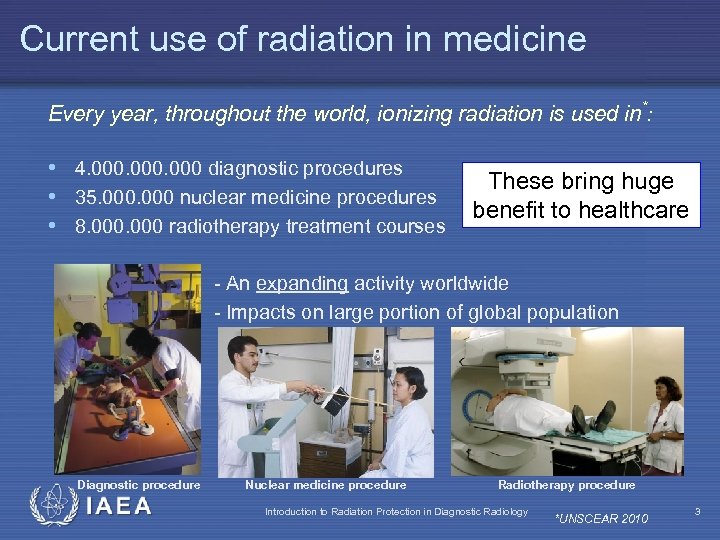 Current use of radiation in medicine Every year, throughout the world, ionizing radiation is used in*: • 4. 000 diagnostic procedures • 35. 000 nuclear medicine procedures • 8. 000 radiotherapy treatment courses These bring huge benefit to healthcare - An expanding activity worldwide - Impacts on large portion of global population Diagnostic procedure IAEA Nuclear medicine procedure Radiotherapy procedure Introduction to Radiation Protection in Diagnostic Radiology *UNSCEAR 2010 3
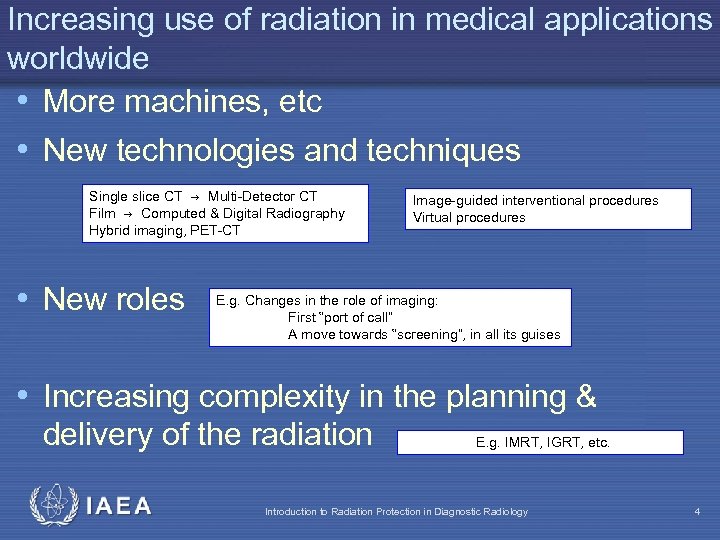 Increasing use of radiation in medical applications worldwide • More machines, etc • New technologies and techniques Single slice CT → Multi-Detector CT Film → Computed & Digital Radiography Hybrid imaging, PET-CT • New roles Image-guided interventional procedures Virtual procedures E. g. Changes in the role of imaging: First “port of call” A move towards “screening”, in all its guises • Increasing complexity in the planning & delivery of the radiation IAEA E. g. IMRT, IGRT, etc. Introduction to Radiation Protection in Diagnostic Radiology 4
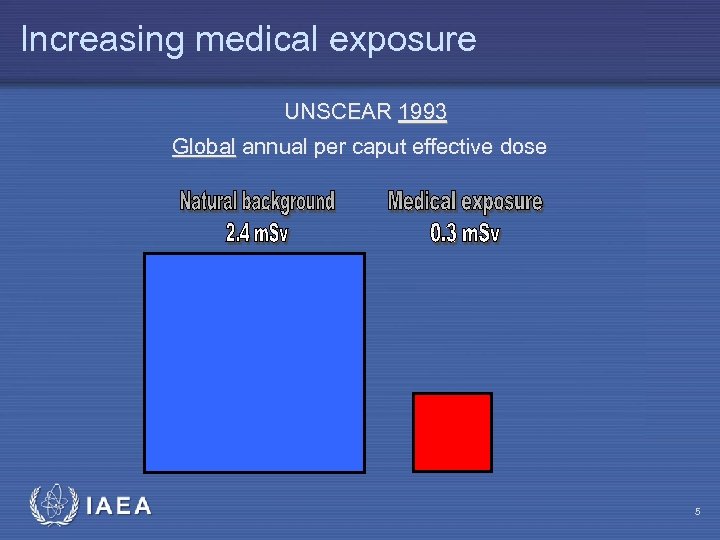 Increasing medical exposure UNSCEAR 1993 Global annual per caput effective dose IAEA 5
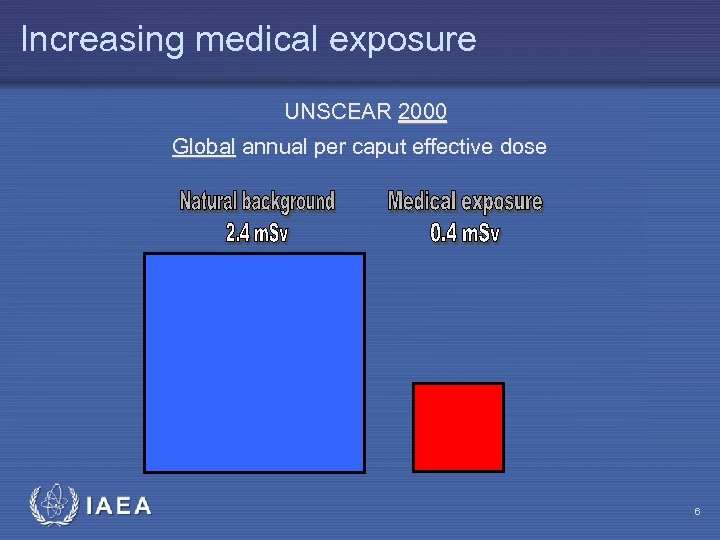 Increasing medical exposure UNSCEAR 2000 Global annual per caput effective dose IAEA 6
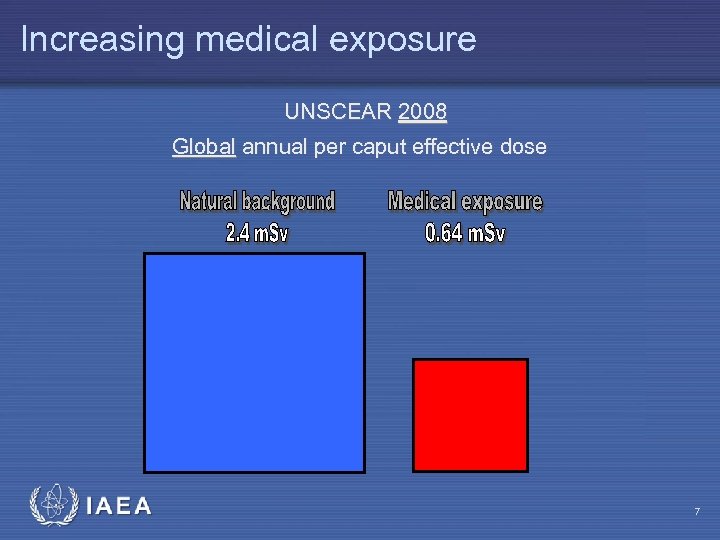 Increasing medical exposure UNSCEAR 2008 Global annual per caput effective dose IAEA 7
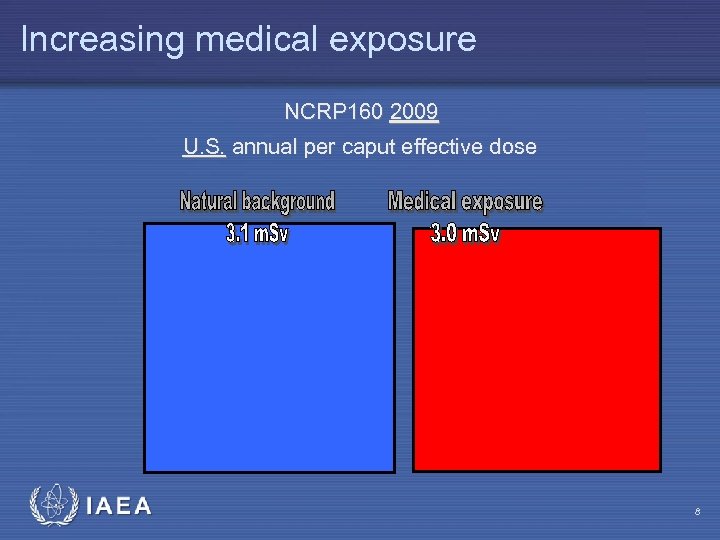 Increasing medical exposure NCRP 160 2009 U. S. annual per caput effective dose IAEA 8
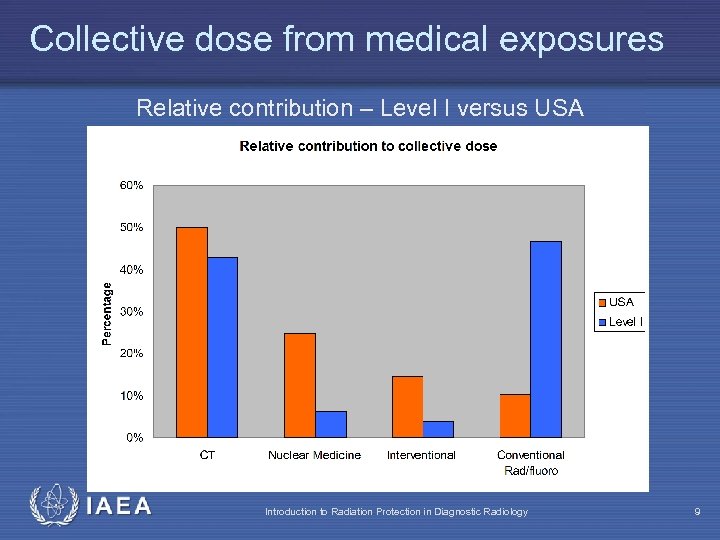 Collective dose from medical exposures Relative contribution – Level I versus USA IAEA Introduction to Radiation Protection in Diagnostic Radiology 9
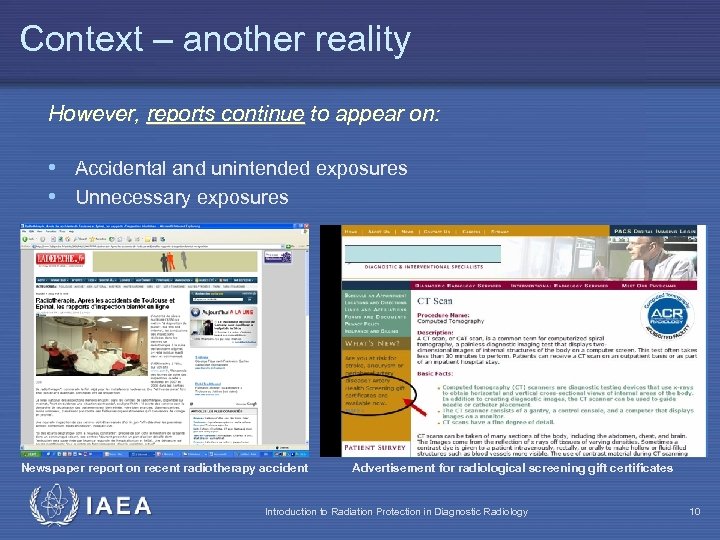 Context – another reality However, reports continue to appear on: • Accidental and unintended exposures • Unnecessary exposures Newspaper report on recent radiotherapy accident IAEA Advertisement for radiological screening gift certificates Introduction to Radiation Protection in Diagnostic Radiology 10
 Is this increasing use of radiation in medicine cause for concern? How do patient doses compare with other sources of exposure? IAEA Introduction to Radiation Protection in Diagnostic Radiology 11
 Radiation from Natural Sources • Normally 1 -3 m. Sv/year • Global average is estimated to be 2. 4 m. Sv per year (UNSCEAR) • In areas of high background, > 10 m. Sv/year IAEA Introduction to Radiation Protection in Diagnostic Radiology 12
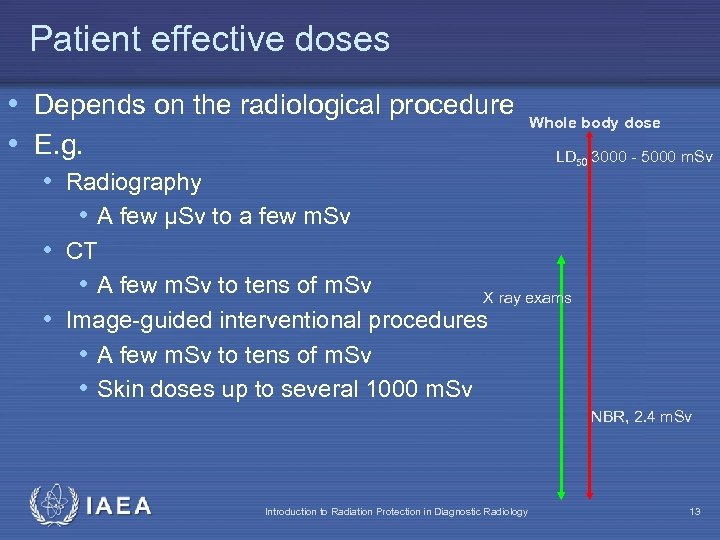 Patient effective doses • Depends on the radiological procedure • E. g. Whole body dose LD 50 3000 - 5000 m. Sv • Radiography • A few μSv to a few m. Sv • CT • A few m. Sv to tens of m. Sv X ray exams • Image-guided interventional procedures • A few m. Sv to tens of m. Sv • Skin doses up to several 1000 m. Sv NBR, 2. 4 m. Sv IAEA Introduction to Radiation Protection in Diagnostic Radiology 13
 What are some of the RP issues in diagnostic and interventional radiology? IAEA Introduction to Radiation Protection in Diagnostic Radiology 14
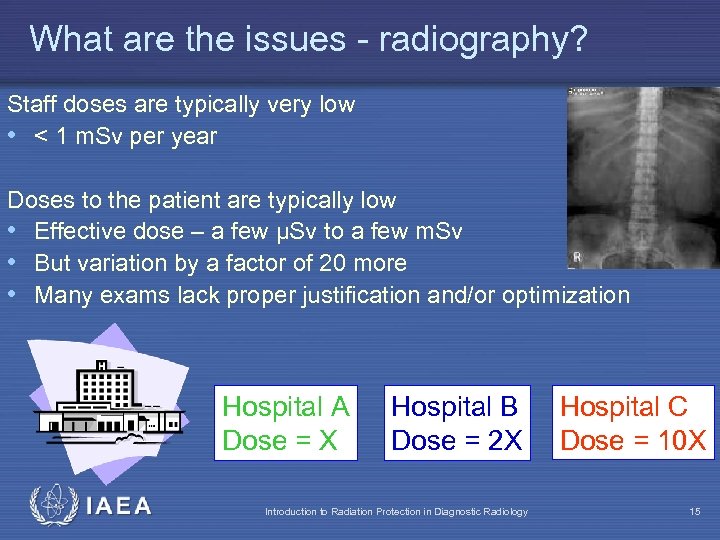 What are the issues - radiography? Staff doses are typically very low • < 1 m. Sv per year Doses to the patient are typically low • Effective dose – a few μSv to a few m. Sv • But variation by a factor of 20 more • Many exams lack proper justification and/or optimization Hospital A Dose = X IAEA Hospital B Dose = 2 X Introduction to Radiation Protection in Diagnostic Radiology Hospital C Dose = 10 X 15
 Radiography • Diagnostic reference levels (DRLs) • Very effective tool in optimization • Concept introduced in the 1990 s • Implementation in Member States is very uneven • How many African countries have • Established DRLs; and • Use them in practice? IAEA Introduction to Radiation Protection in Diagnostic Radiology 16
 In radiographic practice, does it happen? • • Unjustified exposures - Yes Wrong patient - Yes Wrong body part - Yes Lack of optimization - Yes • Lack of calibration – Yes • Lack of QA – Yes • DRLs not used - Yes IAEA Introduction to Radiation Protection in Diagnostic Radiology 17
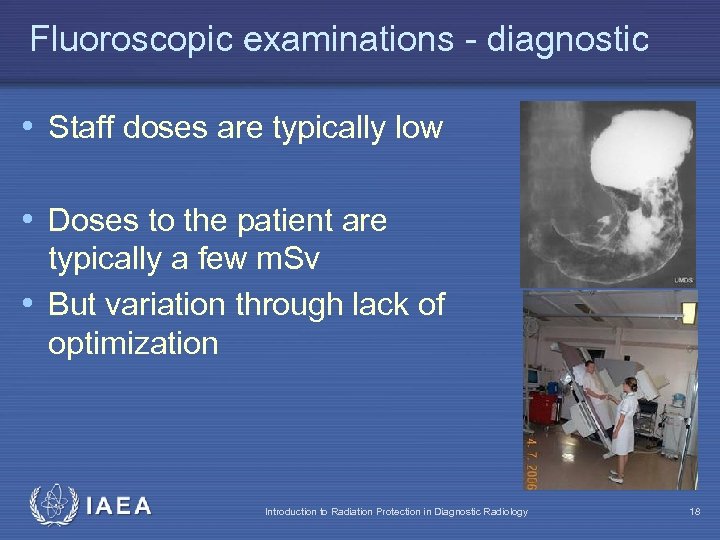 Fluoroscopic examinations - diagnostic • Staff doses are typically low • Doses to the patient are typically a few m. Sv • But variation through lack of optimization IAEA Introduction to Radiation Protection in Diagnostic Radiology 18
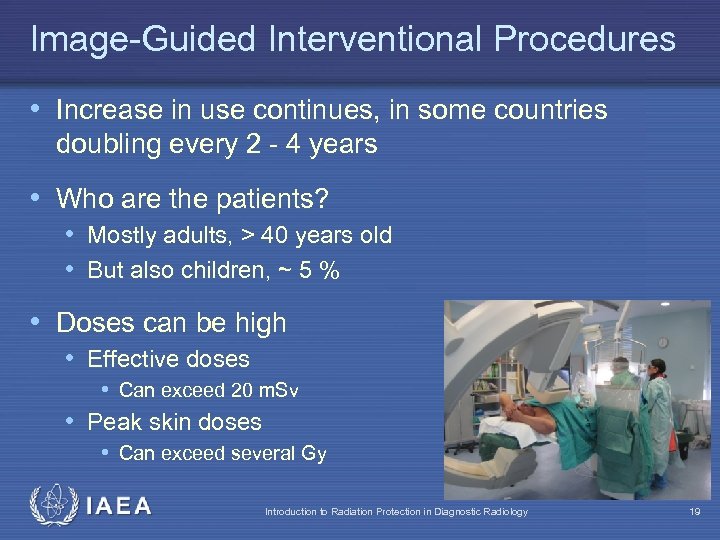 Image-Guided Interventional Procedures • Increase in use continues, in some countries doubling every 2 - 4 years • Who are the patients? • Mostly adults, > 40 years old • But also children, ~ 5 % • Doses can be high • Effective doses • Can exceed 20 m. Sv • Peak skin doses • Can exceed several Gy IAEA Introduction to Radiation Protection in Diagnostic Radiology 19
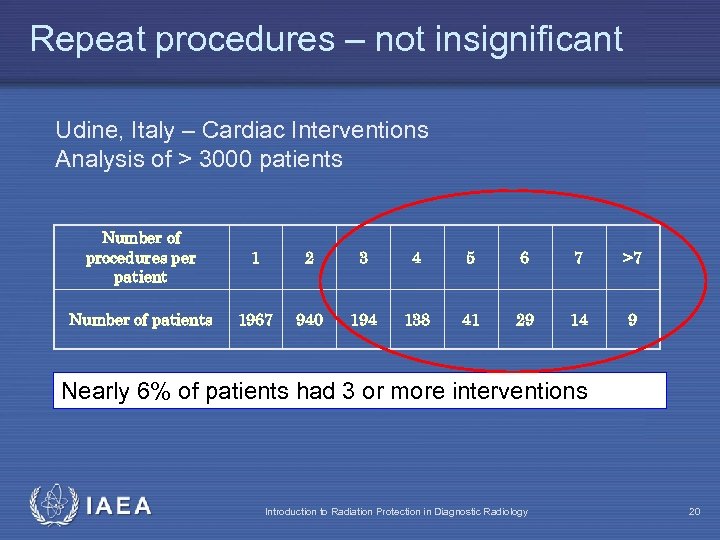 Repeat procedures – not insignificant Udine, Italy – Cardiac Interventions Analysis of > 3000 patients Number of procedures per patient 1 2 3 4 5 6 7 >7 Number of patients 1967 940 194 138 41 29 14 9 Nearly 6% of patients had 3 or more interventions IAEA Introduction to Radiation Protection in Diagnostic Radiology 20
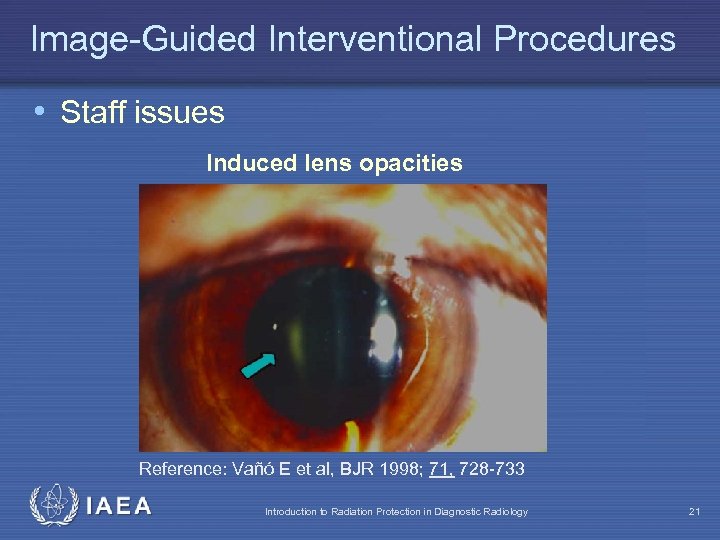 Image-Guided Interventional Procedures • Staff issues Induced lens opacities Reference: Vañó E et al, BJR 1998; 71, 728 -733 IAEA Introduction to Radiation Protection in Diagnostic Radiology 21
 Image-Guided Interventional Procedures • • • Increasing frequency High doses Paediatric patients Repeat rate not insignificant Radiation protection issues for staff IAEA Introduction to Radiation Protection in Diagnostic Radiology 22
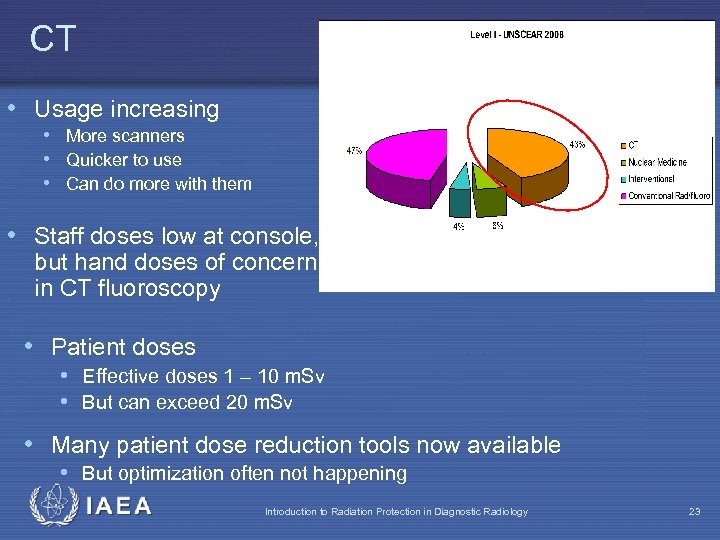 CT • Usage increasing • More scanners • Quicker to use • Can do more with them • Staff doses low at console, but hand doses of concern in CT fluoroscopy • Patient doses • Effective doses 1 – 10 m. Sv • But can exceed 20 m. Sv • Many patient dose reduction tools now available • But optimization often not happening IAEA Introduction to Radiation Protection in Diagnostic Radiology 23
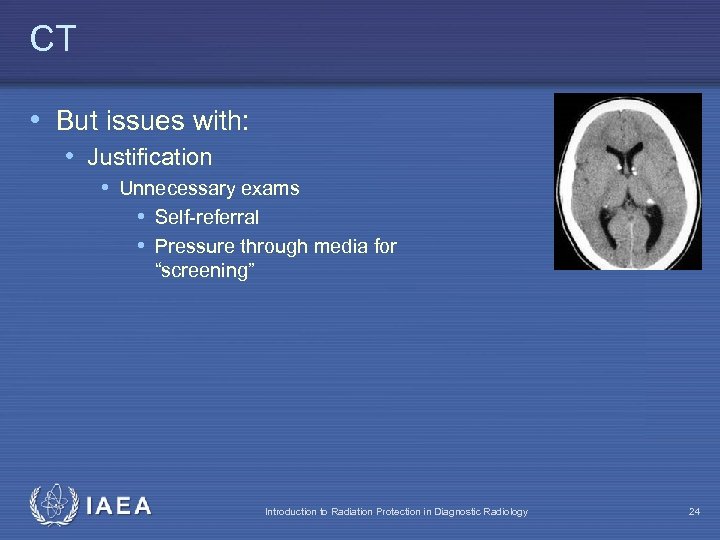 CT • But issues with: • Justification • Unnecessary exams • Self-referral • Pressure through media for “screening” IAEA Introduction to Radiation Protection in Diagnostic Radiology 24
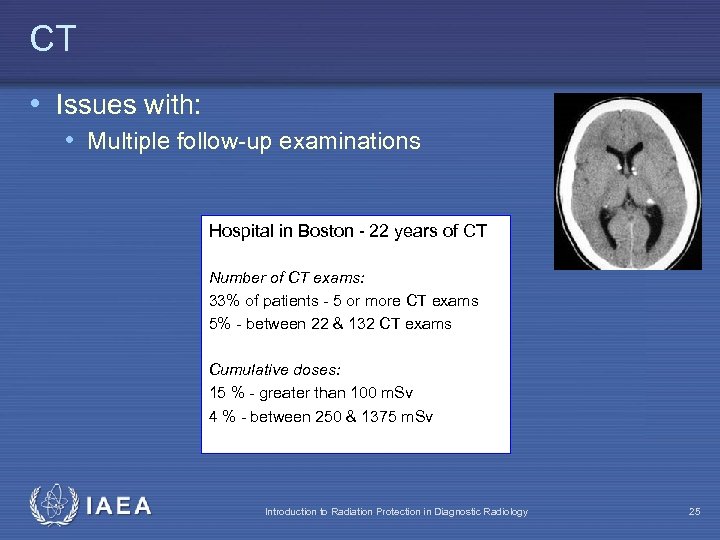 CT • Issues with: • Multiple follow-up examinations Hospital in Boston - 22 years of CT Number of CT exams: 33% of patients - 5 or more CT exams 5% - between 22 & 132 CT exams Cumulative doses: 15 % - greater than 100 m. Sv 4 % - between 250 & 1375 m. Sv IAEA Introduction to Radiation Protection in Diagnostic Radiology 25
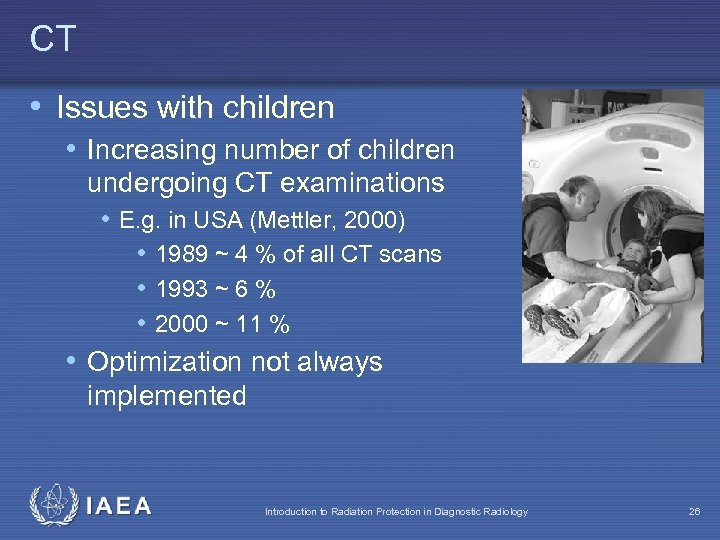 CT • Issues with children • Increasing number of children undergoing CT examinations • E. g. in USA (Mettler, 2000) • 1989 ~ 4 % of all CT scans • 1993 ~ 6 % • 2000 ~ 11 % • Optimization not always implemented IAEA Introduction to Radiation Protection in Diagnostic Radiology 26
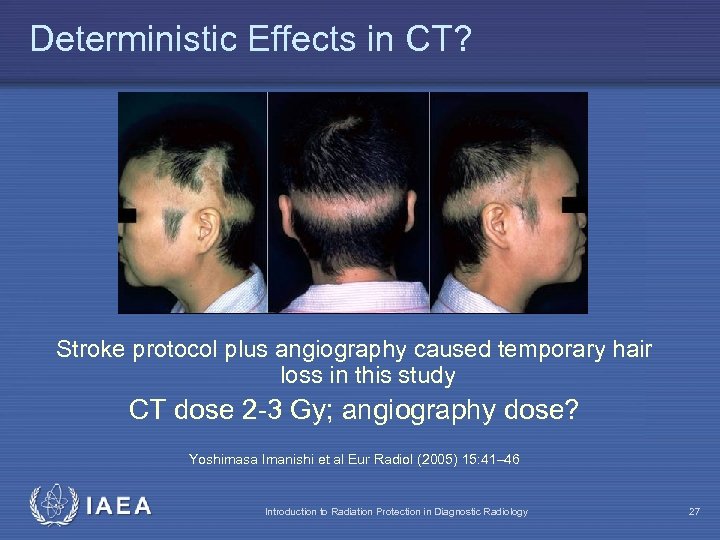 Deterministic Effects in CT? Stroke protocol plus angiography caused temporary hair loss in this study CT dose 2 -3 Gy; angiography dose? Yoshimasa Imanishi et al Eur Radiol (2005) 15: 41– 46 IAEA Introduction to Radiation Protection in Diagnostic Radiology 27
 Principles of radiation protection • Justification • Optimization • Dose limitation (not for patients) In Practice: • Unjustified examinations are ≈ 20 -50% • Optimization can bring down patient doses by about 50% IAEA Introduction to Radiation Protection in Diagnostic Radiology 28
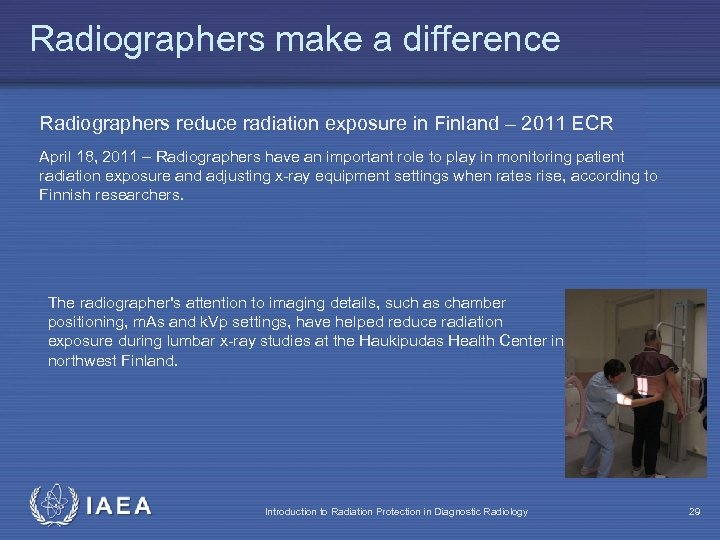 Radiographers make a difference Radiographers reduce radiation exposure in Finland – 2011 ECR April 18, 2011 – Radiographers have an important role to play in monitoring patient radiation exposure and adjusting x-ray equipment settings when rates rise, according to Finnish researchers. The radiographer's attention to imaging details, such as chamber positioning, m. As and k. Vp settings, have helped reduce radiation exposure during lumbar x-ray studies at the Haukipudas Health Center in northwest Finland. IAEA Introduction to Radiation Protection in Diagnostic Radiology 29
 Summary 1. Medical uses of radiation are increasing, bringing great benefit 2. But there is a need to reduce unnecessary exposures 3. Radiographers have a key role to play IAEA Introduction to Radiation Protection in Diagnostic Radiology 30