


 Скачать презентацию I Slavery A The Un-United States
672690f5bcb5288337c69fd54d092ed5.ppt
- Количество слайдов: 16
 I. Slavery
 A. The Un-United States • After the Revolutionary War, the country was divided by a single issue: Slavery • Post-war attitude toward slavery – – North: South: wanted free states (no longer needed slaves) Needed slaves (economy) Loved the group, but hated the individual Hated the group, but loved the individual • Sectionalism develops within the country • Most slaves are brought from Africa and sold to the south by northerners – Most common port was NYC
 B. Slavery and the Constitution • Does the Constitution recognize slavery? • Does the Constitution protect slavery? • 3/5 Compromise – Settled a census dispute on how slaves were counted – Each slave would count as 3/5 of a person – Why was this such a big deal? • Commerce Compromise (international slave trade) – Congress would re-evaluate the IST in 20 years – IST outlawed in 1808 • Fugitive Slave Law – State government’s responsibility to return escaped slaves to their owners – Why was this not effective?
 C. Plantations of the Upper & Lower South • Upper South: – Soil Exhaustion (cotton, tobacco, food) – Needed fewer slaves – Older slaves were freed – Laws were passed to protect the slaves and restrict emancipation • Lower South: – Sugar and Rice were mainly grown. Some cotton. – Conditions were worse in the lower south (heat/work) – Being “sold south” was very bad for a slave. Could be used as punishment or threat
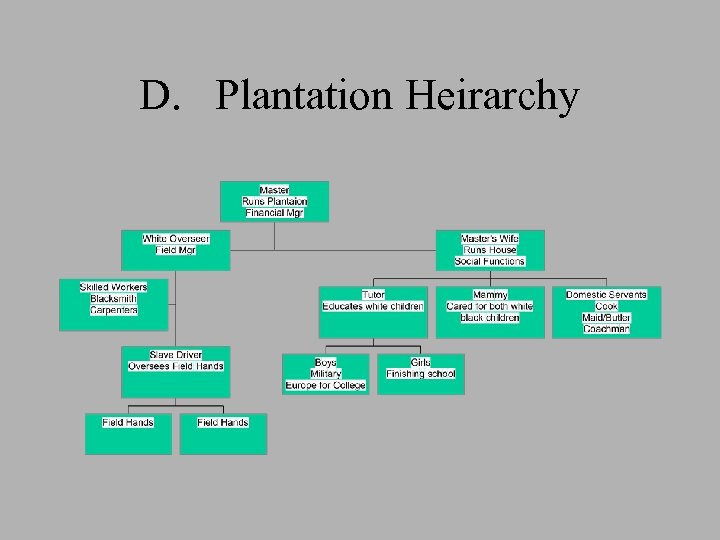 D. Plantation Heirarchy
 E. Two event that solidified slavery • Invention of the Cotton Gin - 1793 • Eli Whitney (CT) • Before the Gin, only Long-staple cotton grown – Needed wet areas on the coast (GA & SC) • After the Gin, short staple cotton (lint) was grown • Deseeding – Before gin: 1 lb in 10 hours – After gin: 1000 lbs in 10 hours • Outlawing of the International slave trade • Escalates the value of slaves • Value of slaves – 1810: $900 – 1860: $1500 • Breeding instead of buying
 F. Evils of Slavery • Treated humans as animals – Slave auctions • No respect for family units – Children & Marriages • • No political rights No legal rights Cruelty by masters and overseers Adults treated as children Intolerable working conditions Intolerable living conditions Morally wrong – (Lincoln and Republican Party)
 G. Defenses for Slavery • Better off in America than the jungles of Africa – Receive better care • Christianization • Civilized • Slaves don’t want to leave – Especially house workers • Biblical approval of slavery – Philemon • Slaves were biologically and mentally inferior
 H. Slave Codes • Illegal for slaves to learn to read and write • Illegal to attend church without a white person present • Must have a written pass to leave home • Restrictions on manumissions – Manumissions: granting a slave freedom for serving in the military • Enforced by Slave patrols
 I. Nat Turner • Learned to read and write & became very intelligent (was a slave preacher) • Believed he was a prophet for God against slavery • Had several visions that led to his revolt • After an eclipse & atmospheric disturbance, Turner rose up to fight • August 21, 1831: Turner & 6 men raided his master’s house and killed the family • Turner’s force grew to 40 slaves – In all 55 white people were killed
 • 200 slaves were killed because of Turner’s revolt – Most had nothing to do with the revolt • Turner was captured on October 30 • He was tried & convicted on November 5 • November 11: Turner was hanged and skinned then put on public display
 J. The Underground RR • Led slaves to freedom from the south • Primarily the work of the Quakers – Levi Coffin was the unofficial President – Thomas Garrett • Ran through 14 states • 3, 000 conductors rescued over 100, 000 slaves • They followed the north star • What type of terrain would they use • Waterways were hard for dogs to track
 Railroad Vocabulary • • • Freight Lines Stations Conductors Brakemen • • • Slaves Routes Safe house Guides Safe house owners
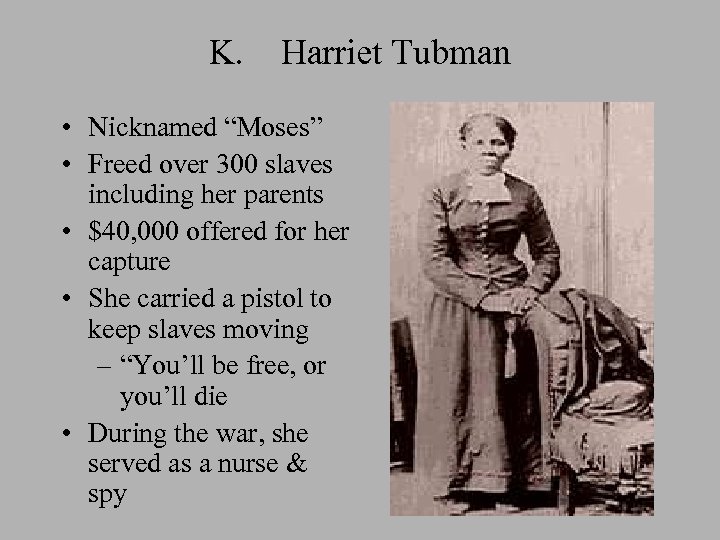 K. Harriet Tubman • Nicknamed “Moses” • Freed over 300 slaves including her parents • $40, 000 offered for her capture • She carried a pistol to keep slaves moving – “You’ll be free, or you’ll die • During the war, she served as a nurse & spy
 L. Two Different Worlds: South • Purely agricultural • Cotton gin & southern expansion made slavery profitable • 5 ½ Million southerners – Only 26% owned slaves – 46, 000 owned 20 or more – Less than 3000 owned 100 or more – 12 owned 500 or more (10 in the same district in MS) • Slave owners were the political and social power in the south • Owning slaves was the road to status and success – Southern American Dream
 Two different worlds: North • Immigration and technology make slavery obsolete • Immigrants become cheap labor • By 1820: only 3, 000 slaves in the north • Textile mills ran on southern cotton • 140, 000 factories employed 1 ½ million workers • Produced $2 billion worth of goods • Slavery goes from a political to a moral issue