 Скачать презентацию I m just a bill sittin here on on
c6390b0d2455dfa2205e4256491d773b.ppt
- Количество слайдов: 14



“I’m just a bill, sittin’ here on on Capitol Hill!” 1
Who can propose a law? • Anyone can suggest an idea for a law. – Lobbyists, interest groups, the President, voters writing their Congressman, etc… • However, – Only Members of Congress can take a proposed law (a bill) to the House of Representatives or the Senate with the hopes of making it a law. 2
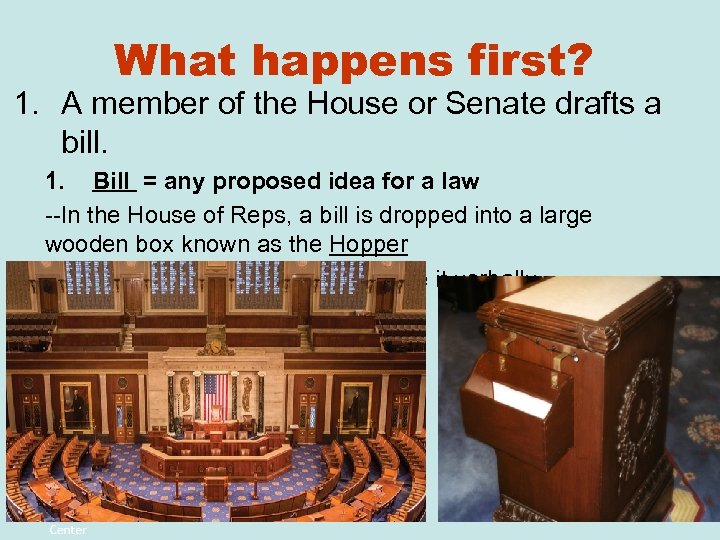
What happens first? 1. A member of the House or Senate drafts a bill. 1. Bill = any proposed idea for a law --In the House of Reps, a bill is dropped into a large wooden box known as the Hopper --In the Senate, members announce it verbally 3
Stages of law making 2. The bill is then assigned a number that begins with: • • H. R. = House of Representatives S =Senate • For example: H. R. 3261: “Stop Online Piracy Act” 3. Each chamber’s leader them send the bill to the appropriate standing committee within that house of 4
The Standing Committee • Standing committees study only bills related to their general topic • such as education, agriculture or science. • The committee chair assigns the bill to the necessary subcommittee. – Example: • Bills limiting the amount of chickens you can raise would go to a livestock subcommittee within the Agriculture standing committee. 5
The Subcommittee • Most of the discussion in Congress takes place here in these subcommittees – including supporters and opponents, changes, writing a whole new bill, etc. • The subcommittee then decides whether to schedule a bill for discussion within the whole standing committee. • The subcommittee may also decide to stop action on a bill at which point the bill then dies. 6
The Standing Committee • The subcommittee takes the bill back to the standing committee where it is discussed again. • The Standing Committee votes on whether to send the bill to the full House or Senate. – Concern: If a Standing Committee sends too many bills to be voted on, the ones they really want passed might be over looked. • The bill is then sent to the full House or 7
The Floor (whole House or Senate) • The bill is placed on the calendar of the House or Senate until it is scheduled for full floor discussion. 8
Debate on the House floor • The House is chaired by the Speaker of the House • The Speaker determines who speaks first in the debate – A member speaks who is for the bill – Then one who is against the bill • Once debating is over, the bill goes to vote. 9
Debate on the Senate floor • The Senate is chaired by the Vice President. • Let’s suppose a bill passes the House of Reps. It then goes to the Senate and goes through the same basic process: Standing committee, subcommittee, etc. It then goes to the floor for a debate…… • There are no time limits to debate in the Senate. This unlimited talking in the Senate is a tradition known as a filibuster. Members may speak for as long as they 10
What happens next? • Both the House and the Senate must pass exact forms of a bill, otherwise, a conference committee is formed with members of both chambers deciding on the precise wording. • If it passes both houses, it is sent to the POTUS to be signed into law. 11
The President has 4 options for bills that pass Congress: 1. Sign into law. He can sign the bill, which then becomes a law. 2. Law without signature. He can let the bill sit on his desk for 10 days without signing it while Congress is in session. 1. The bill then becomes a law. 2. This shows the public he was not for the law 12
The President - continued 3. Veto. He can choose to not sign the bill, so it will not become a law. * The vetoed bill is then sent back to Congress. If the vetoed bill gets a 2/3 rd positive vote from both the House and the Senate, it still becomes a law (checks and balances) 4. Pocket veto. If, after 10 days, he has not signed it and Congress is no longer in session, the bill does not become a law. 13
Isn’t it hard to make a bill into a law? • FYI – Last year • 1, 172 bills introduced to become Congress – Only 112 became laws! 14
Скачать презентацию I m just a bill sittin here on on
c6390b0d2455dfa2205e4256491d773b.ppt