


 Скачать презентацию I Introductions l We will cover in this
134e30c70a920e94cc7e9a4b299935c9.ppt
- Количество слайдов: 36
 I. Introductions l We will cover in this presentation l Aircraft electrical installation Materials l Tools l Techniques l Recommended practices l
 II. Qualifier l For l the Lawyers among us Information discussed here does not supersede or replace government regulations or specifications or the manufacturers’ instructions
 III. New AC 43. 13 -1 B l FAA Advisory Circular Publication documenting recommended techniques for aircraft maintenance and repair l It is an advisory circular not a rule l Paragraph 11 and 12 deal with Electrical and Avionics
 III. New AC 43. 13 1 B l How to get it l l You can download it free from the FAA (www. faa. gov) use “quick find” search for “advisory circulars” then “ac 43. 13 1 b” NOTE: It is a “PDF” file so you will need Adobe Reader (www. adobe. com/products/acrobat/readstep 2. html) if you don’t already have it. l l If you download it you will not want to print the whole document, it is several hundred pages long Or you can buy a hard copy from most aviation book sellers or pilot shops
 IV. Wire l Auto and Marine vs. Aircraft wire l Auto wire Is not usually “tinned” or plated with a corrosion resistant coating like tin, nickel or silver l Wire made for automobile applications often has PVC or vinyl insulation which will burn and produce poisonous fumes l l Marine wire l Good quality Marine wire is often tinned but often uses PVC insulation
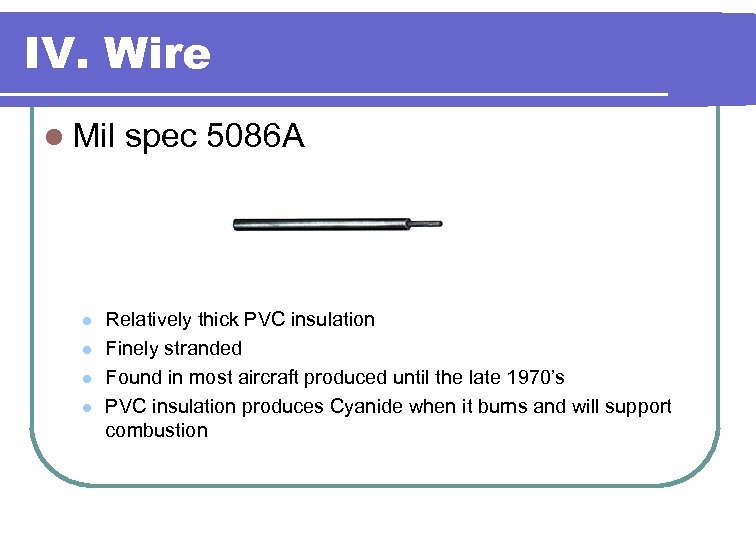 IV. Wire l Mil spec 5086 A l l Relatively thick PVC insulation Finely stranded Found in most aircraft produced until the late 1970’s PVC insulation produces Cyanide when it burns and will support combustion
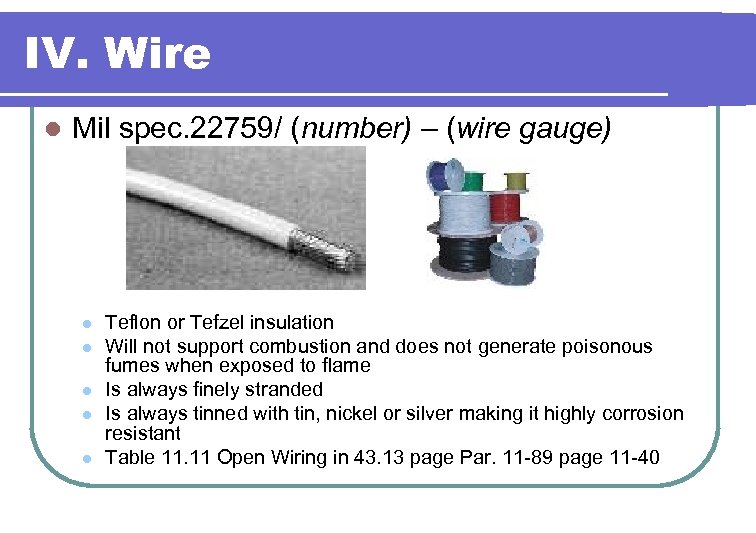 IV. Wire l Mil spec. 22759/ (number) – (wire gauge) l l l Teflon or Tefzel insulation Will not support combustion and does not generate poisonous fumes when exposed to flame Is always finely stranded Is always tinned with tin, nickel or silver making it highly corrosion resistant Table 11. 11 Open Wiring in 43. 13 page Par. 11 -89 page 11 -40
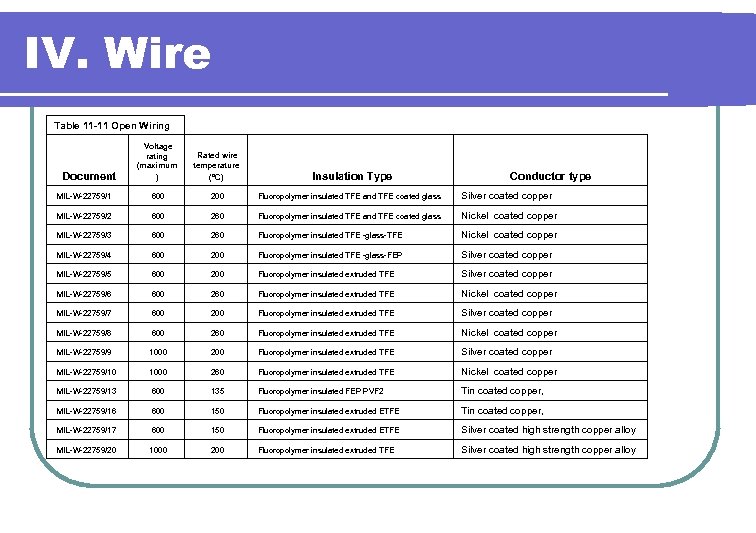 IV. Wire Table 11 -11 Open Wiring Voltage Document rating (maximum ) Rated wire temperature (°C) Insulation Type Conductor type MIL-W-22759/1 600 200 Fluoropolymer insulated TFE and TFE coated glass Silver coated copper MIL-W-22759/2 600 260 Fluoropolymer insulated TFE and TFE coated glass Nickel coated copper MIL-W-22759/3 600 260 Fluoropolymer insulated TFE -glass-TFE Nickel coated copper MIL-W-22759/4 600 200 Fluoropolymer insulated TFE -glass-FEP Silver coated copper MIL-W-22759/5 600 200 Fluoropolymer insulated extruded TFE Silver coated copper MIL-W-22759/6 600 260 Fluoropolymer insulated extruded TFE Nickel coated copper MIL-W-22759/7 600 200 Fluoropolymer insulated extruded TFE Silver coated copper MIL-W-22759/8 600 260 Fluoropolymer insulated extruded TFE Nickel coated copper MIL-W-22759/9 1000 200 Fluoropolymer insulated extruded TFE Silver coated copper MIL-W-22759/10 1000 260 Fluoropolymer insulated extruded TFE Nickel coated copper MIL-W-22759/13 600 135 Fluoropolymer insulated FEP PVF 2 Tin coated copper, MIL-W-22759/16 600 150 Fluoropolymer insulated extruded ETFE Tin coated copper, MIL-W-22759/17 600 150 Fluoropolymer insulated extruded ETFE Silver coated high strength copper alloy MIL-W-22759/20 1000 200 Fluoropolymer insulated extruded TFE Silver coated high strength copper alloy
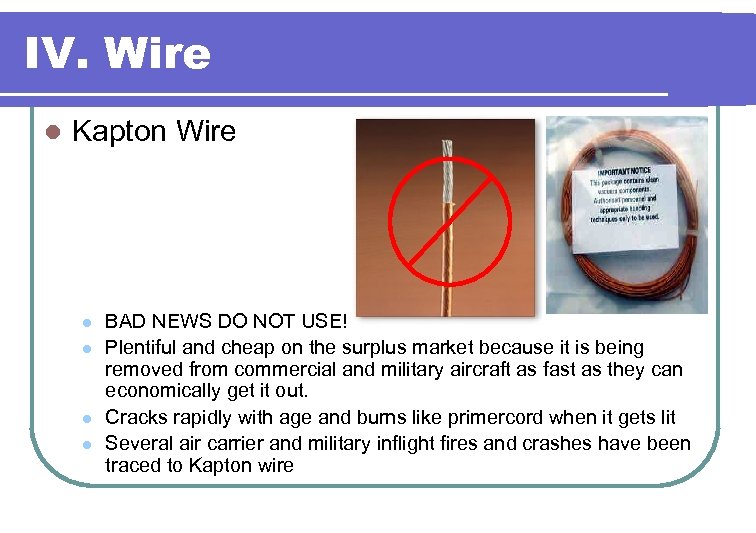 IV. Wire l Kapton Wire l l BAD NEWS DO NOT USE! Plentiful and cheap on the surplus market because it is being removed from commercial and military aircraft as fast as they can economically get it out. Cracks rapidly with age and burns like primercord when it gets lit Several air carrier and military inflight fires and crashes have been traced to Kapton wire
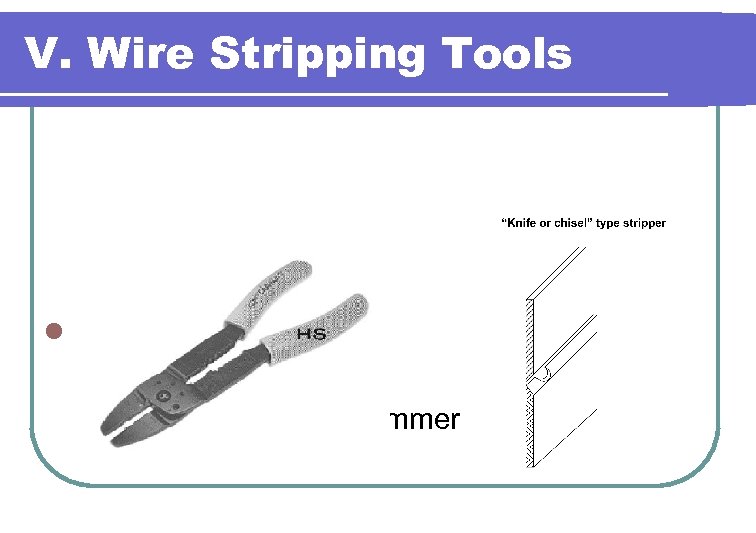 V. Wire Stripping Tools l Strippers Knife type l Make a good tack hammer l
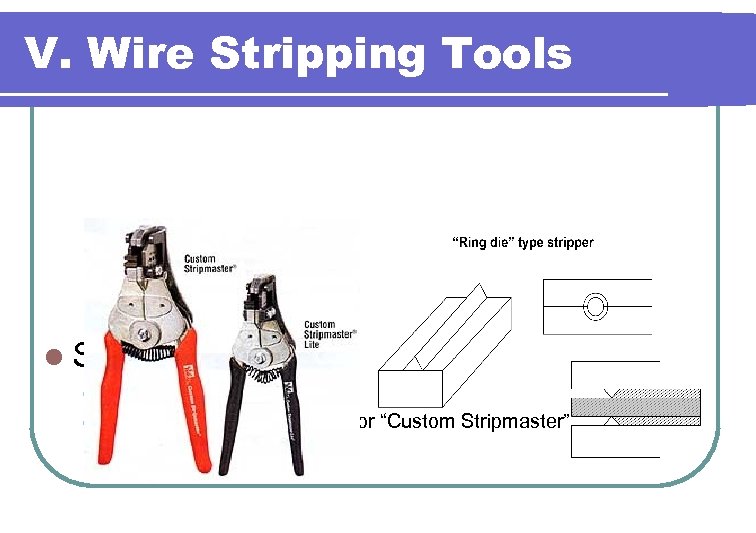 V. Wire Stripping Tools l Strippers l l “Ring Die” type Ideal Tool Co. “Stripmaster” or “Custom Stripmaster”
 V. Wire Stripping Tools l Strippers “Ring Die” type come in several varieties l Be careful of the surplus strippers designed for Kapton wire l The relief for the insulation is smaller because of the thinner insulation on Kapton wire and will not work well on 22759 wire l The dies are changeable in Stripmasters l
 VI. Terminating and Splicing l Crimping vs. Soldering Solid wire is highly susceptible to damage from vibration l Houses do not vibrate (much), this is why house wiring is solid or has very large strands l Aircraft wire is very finely stranded to make it vibration damage resistant l
 VI. Terminating and Splicing l Crimping vs. Soldering makes it a solid wire for an indeterminate distance beyond the soldered joint or terminal l A termination using the correct type of crimp terminal crimped with the correct crimper is the most reliable and longest lasting connection for a wire in an aircraft application l
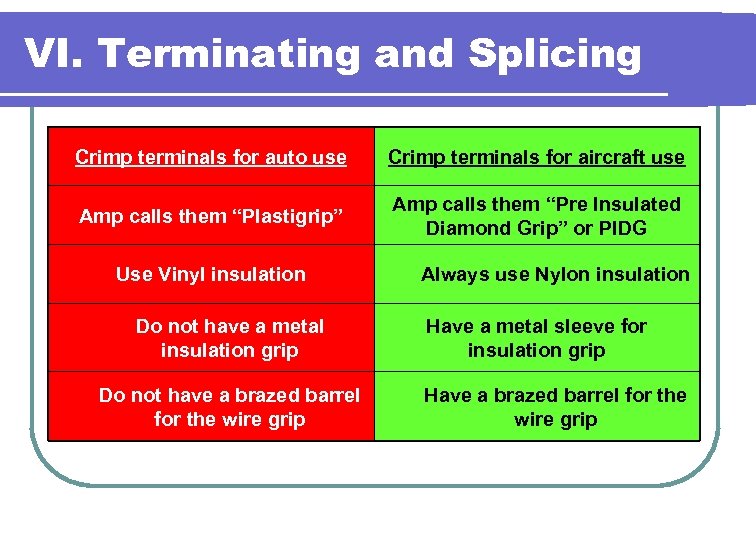 VI. Terminating and Splicing Crimp terminals for auto use Crimp terminals for aircraft use Amp calls them “Plastigrip” Amp calls them “Pre Insulated Diamond Grip” or PIDG Use Vinyl insulation Do not have a metal insulation grip Do not have a brazed barrel for the wire grip Always use Nylon insulation Have a metal sleeve for insulation grip Have a brazed barrel for the wire grip
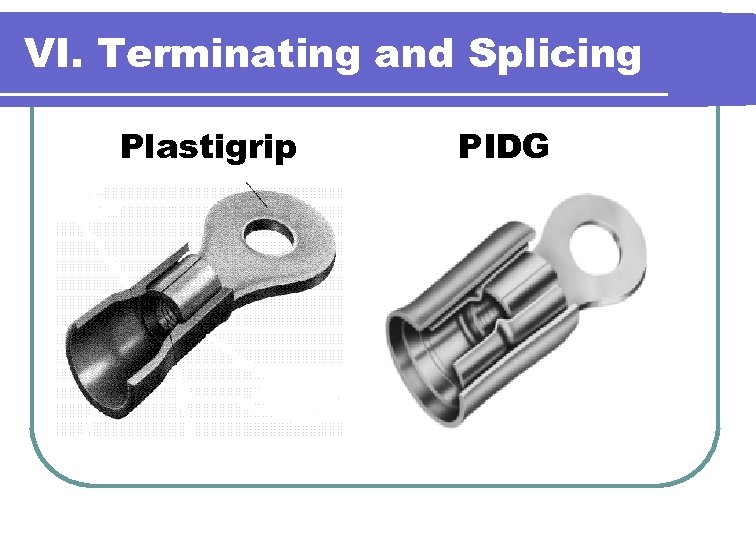 VI. Terminating and Splicing Plastigrip PIDG
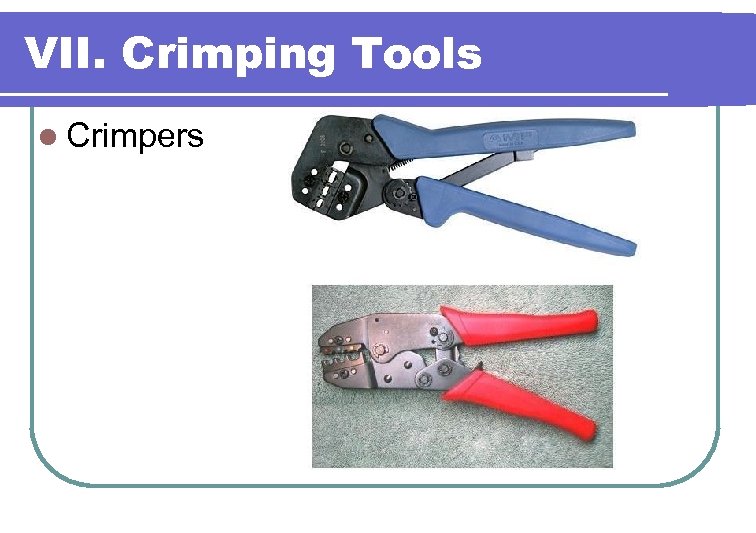
 VII. Crimping Tools l Crimpers l l Crimp depth is important so the wire isn’t damaged in the crimping process “Tack hammers” do not give predictable crimp depth and crimp one grip area at a time The wire grip and insulation grip must both be crimped at the same time for a proper termination Ratcheting dual die crimpers give a predictable crimp depth and crimp both the insulation grip and the wire grip at the same time to the correct depth
 VII. Crimping Tools l Crimpers
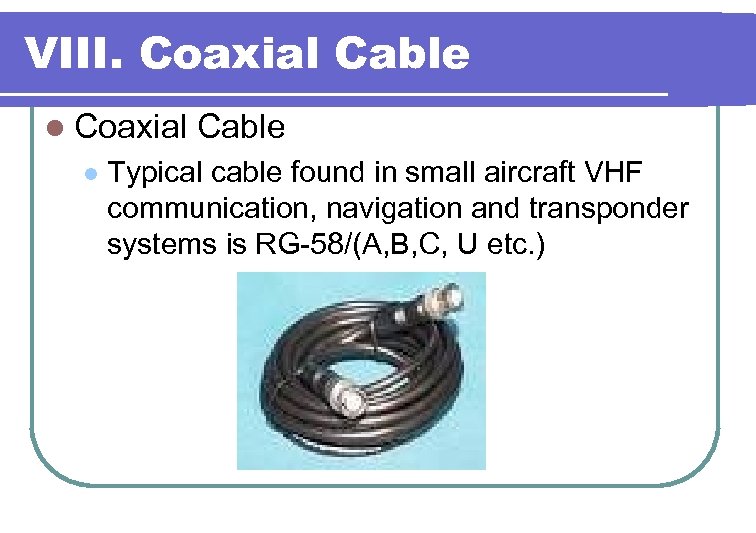 VIII. Coaxial Cable l Typical cable found in small aircraft VHF communication, navigation and transponder systems is RG-58/(A, B, C, U etc. )
 VIII. Coaxial Cable l RG-58/(letter) Has black PVC insulation , stranded inner conductor with clear nylon or polyethylene insulation l Cheaper versions of this cable (CB Cable) are not ‘tinned” and have a bare copper outer braid and are highly susceptible to corrosion l Is fine cable other than the “PVC burning thing” until it gets about 5 to 7 years old l
 VIII. Coaxial Cable l RG-58/(letter) Gets brittle with age and begins cracking and absorbing moisture l Coaxial cable is used in systems where constant impedance for the length of the cable is vital. When it absorbs moisture it changes the impedance of the cable l
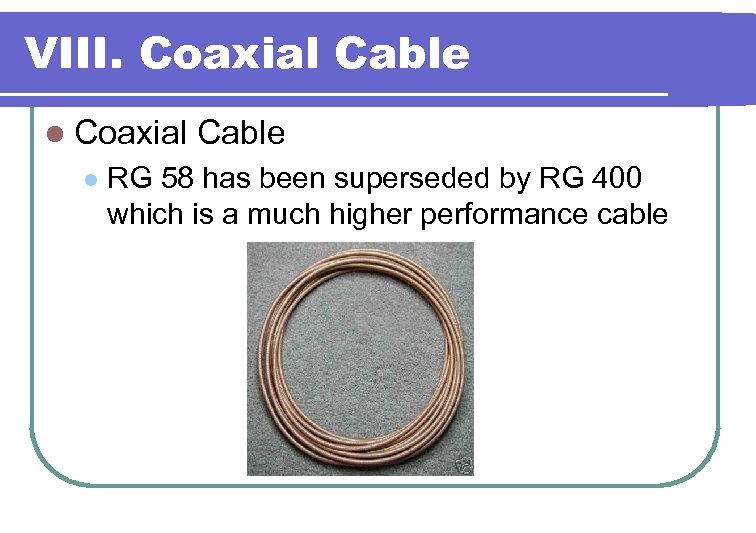 VIII. Coaxial Cable l RG 58 has been superseded by RG 400 which is a much higher performance cable
 VIII. Coaxial Cable l RG 400 Has translucent gold colored Teflon insulation, silver tinned double outer braid and stranded tinned inner conductor with Teflon insulation l Silver tinned outer braid and inner conductor make RG 400 highly corrosion resistant l Does not become brittle or crack with age due to Teflon insulation l Is slightly more expensive l
 VIII. Coaxial Cable l Coaxial Cable Termination l l l All connectors made for RG 58 will fit RG 400. Crimp connectors are the preferred connectors for our applications Crimps are easier to attach properly and are more vibration resistant than “clamp type” A good quality crimper for these connectors can be purchased for less than $25 Buy some extra connectors and cable, you will need to practice
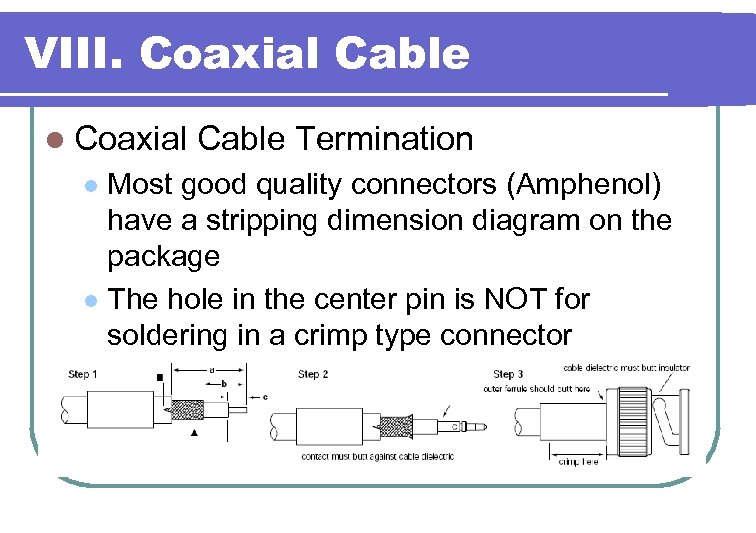 VIII. Coaxial Cable l Coaxial Cable Termination Most good quality connectors (Amphenol) have a stripping dimension diagram on the package l The hole in the center pin is NOT for soldering in a crimp type connector l
 IX. Wire Support & Securing l Ty Wraps Come in many varieties not all of which are appropriate for aircraft use l Vinyl vs Nylon and telling the difference l Metal tab vs plastic tab l High heat areas l Minimize blood loss, use flush cutting side cutters to cut off the tails l
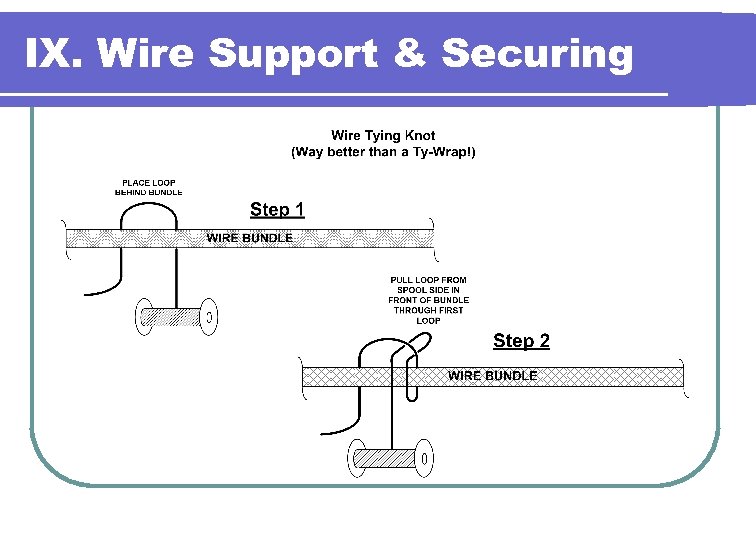
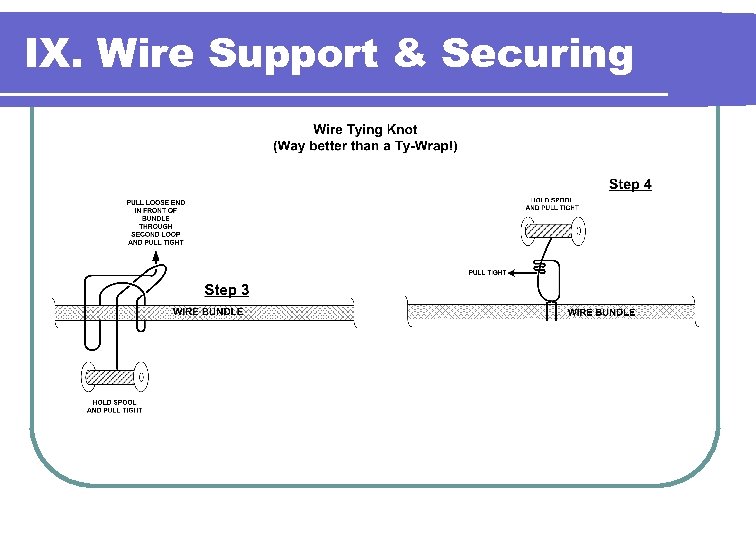
 IX. Wire Support & Securing l Lacing Cord l l l Better than Ty Wraps because it is easier on the wire. Comes in several varieties, waxed, unwaxed, nomex for hot areas etc Bundle lacing shown in AC 43. 13 is good but has drawbacks when maintenance or modification is required it all comes unraveled! The skilled technicians at NASA have a better way! The knot I am going to show you takes the place of individual Ty Wraps Has been used on military aircraft and spacecraft for many years
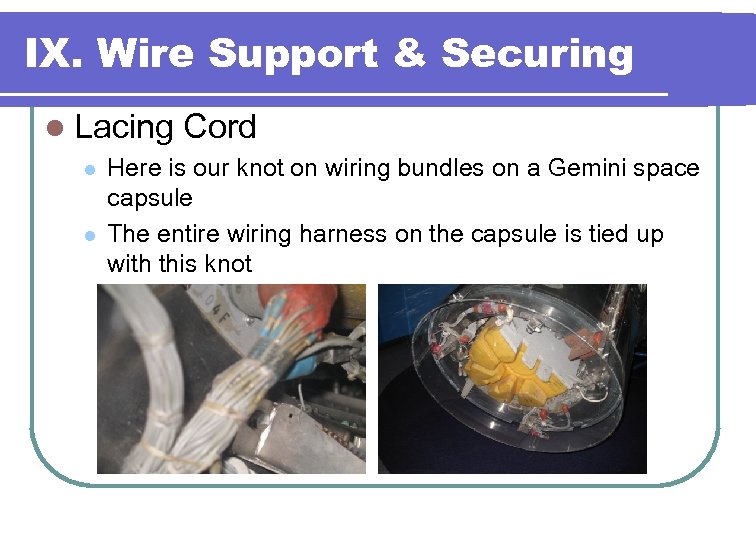 IX. Wire Support & Securing l Lacing Cord l l Here is our knot on wiring bundles on a Gemini space capsule The entire wiring harness on the capsule is tied up with this knot
 IX. Wire Support & Securing
 IX. Wire Support & Securing
 IX. Wire Support & Securing l Clamps l l l Adel Clamps MS 2919 -XX-X http: //www. aeroelectric. com/articles/adel. html Color code: generally black color is for cool areas and red or orange is for hot areas Nylon Clamps not for hot areas Same caution applies as for nylon and vinyl Ty Wraps Spacing
 X. Wire Bundle Routing l Separate Noisy Bundles from Quiet ones Route high current (flap and landing gear motors, landing lights, starters etc. ) or noise producing (strobes) circuits as far as possible away from instrumentation, audio and data circuits l Six inches is good but farther is better l
 X. Wire Bundle Routing l Crossing Angle If you have to cross an audio, instrumentation or data cable with a high current or noisy circuit do it at 90 degrees l This minimizes the electrical coupling between the two l
 XI. Wire Protection l Strain relief and environmental protection l l l l Heat shrink tubing is great but has some limitations Regular heat shrink can actually trap moisture under it Special types of heat shrink are available with gel inside to make it waterproof Most inexpensive heat shrink is PVC which can burn and make cyanide gas Heat shrink for aircraft use is made from Polyolefin Protect sharp edges with chafe protection Give yourself service loops at the ends of wires
 XII. Wire Marking l Mark everything so you can find it later l Mark both ends of a circuit and if it is a long one every 3 or so feet along the way if it is accessible l White heat shrink with lettering by ball point pen or fine point sharpie works great l Clear heat shrink with paper underneath for marking is also slick way to do this
 THE END That’s all Folks! Come on up and try what I just showed you