


 Скачать презентацию I have a special favor to ask of
8168364f798c5fd0a36313342bdceb37.ppt
- Количество слайдов: 48

 I have a special favor to ask of all those who look at these notes in advance… Thank you for your attention and now back to our show…
 Yes, there is a Plan! Little by little, I have introduced you to some of the major ideas of physics. All semester has been building up to Energy. Once I finish Energy, I might lecture a bit on nuclear energy, but the rest of the semester is applications. “Case Studies. ” I spent a lot of time on ozone depletion. I could have covered the whole topic in two sentences. Instead, I sacrificed a lot of class time exploring the process of discovery and the complexity of the science. The upcoming “Case Studies” are just as complex, but I will devote less class time to them.
 Then give the piece of paper to someone else in the class— someone you don’t know.
 Do you remember this homework assignment ? What did you find out about the Energy Patrol? How much money did it save? Is it wise to give kids keys to the building? Why don’t more institutions have an Energy Patrol? Why doesn’t every human on earth do something like this?
 Way back in Lecture 8 I told you about the Law of Conservation of Energy… …and gave you this to think about…
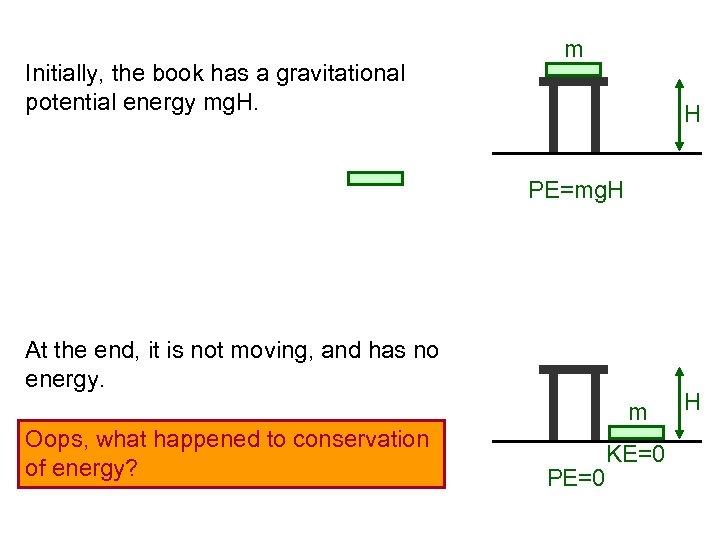 Initially, the book has a gravitational potential energy mg. H. m H PE=mg. H At the end, it is not moving, and has no energy. m Oops, what happened to conservation of energy? PE=0 KE=0 H
 Energy is conserved. You just have to include all forms of energy.
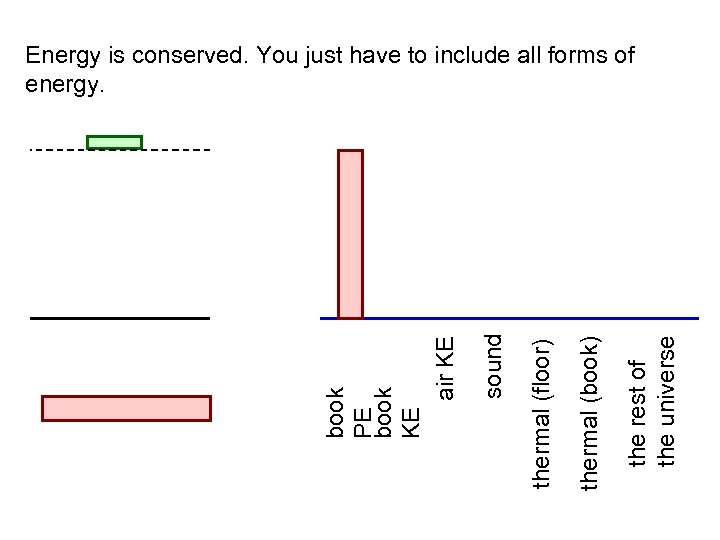 the rest of the universe thermal (book) thermal (floor) sound book PE book KE air KE Energy is conserved. You just have to include all forms of energy.
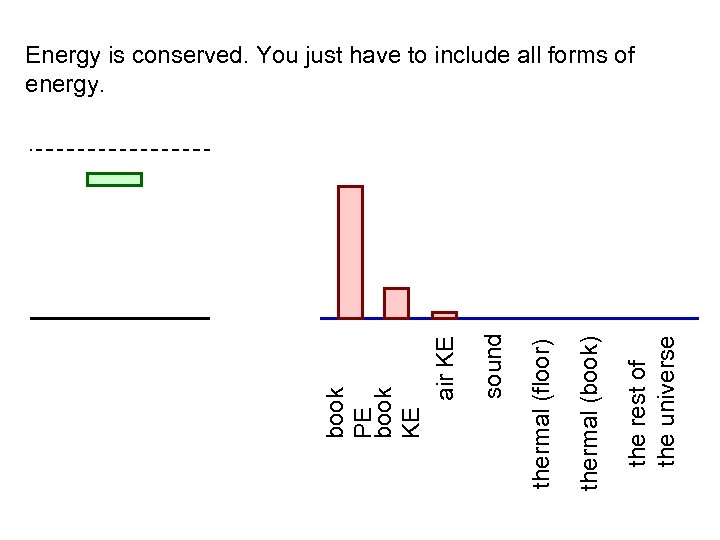 the rest of the universe thermal (book) thermal (floor) sound book PE book KE air KE Energy is conserved. You just have to include all forms of energy.
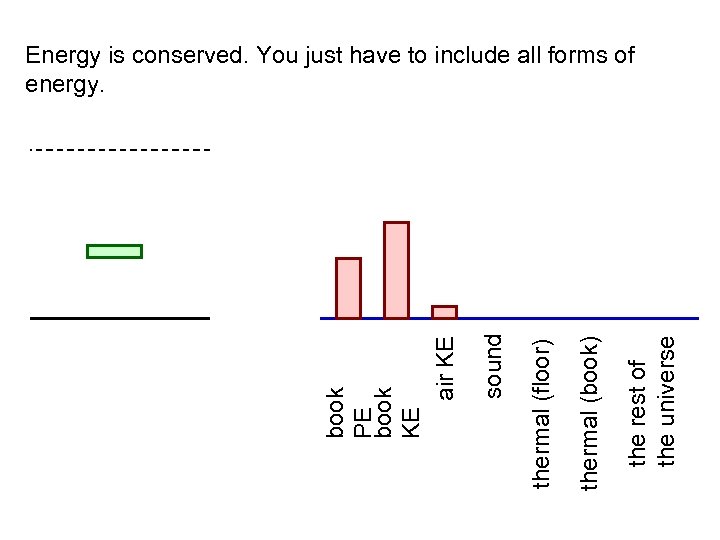 the rest of the universe thermal (book) thermal (floor) sound book PE book KE air KE Energy is conserved. You just have to include all forms of energy.
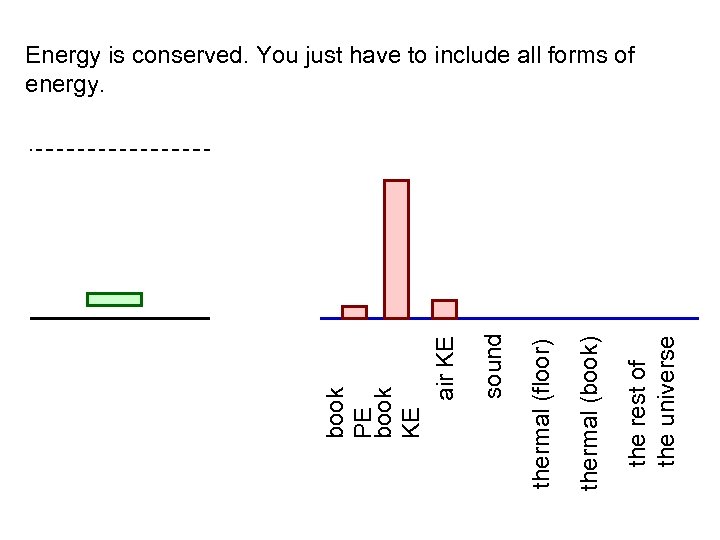 the rest of the universe thermal (book) thermal (floor) sound book PE book KE air KE Energy is conserved. You just have to include all forms of energy.
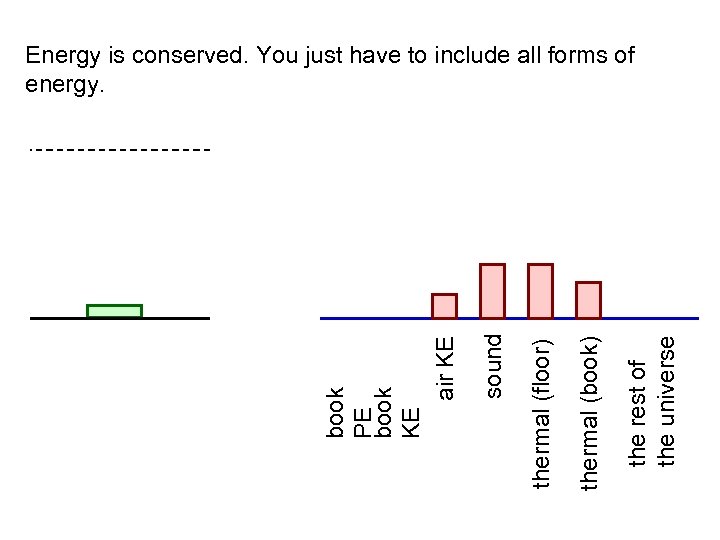 the rest of the universe thermal (book) thermal (floor) sound book PE book KE air KE Energy is conserved. You just have to include all forms of energy.
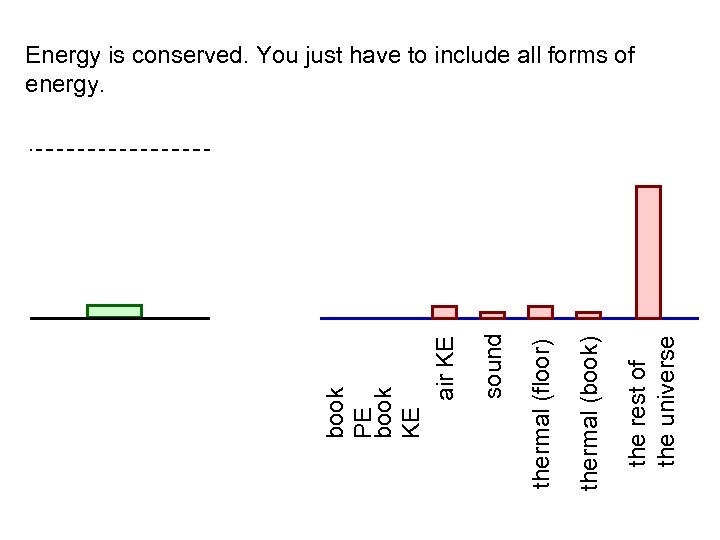 the rest of the universe thermal (book) thermal (floor) sound book PE book KE air KE Energy is conserved. You just have to include all forms of energy.
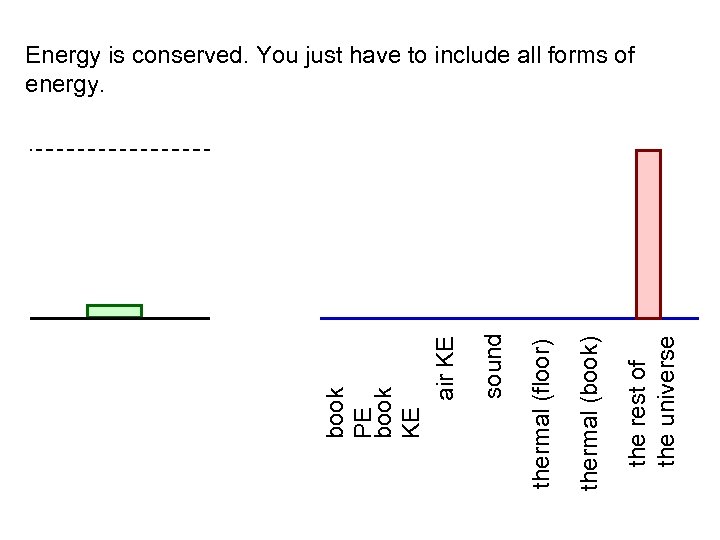 the rest of the universe thermal (book) thermal (floor) sound book PE book KE air KE Energy is conserved. You just have to include all forms of energy.
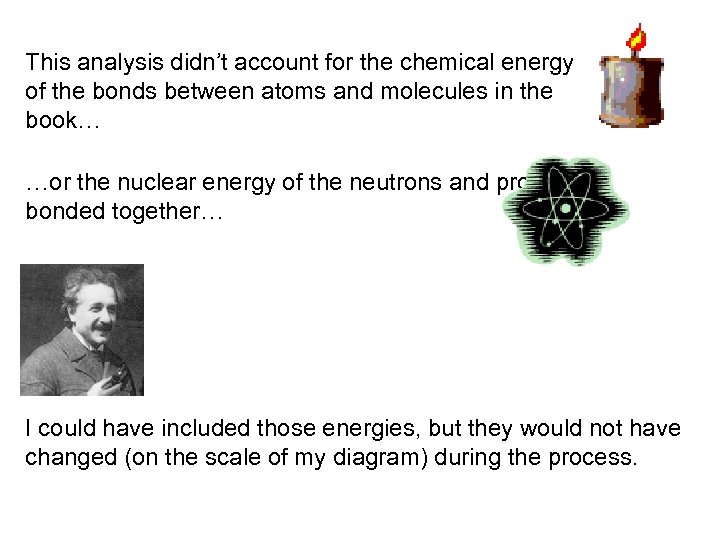 This analysis didn’t account for the chemical energy of the bonds between atoms and molecules in the book… …or the nuclear energy of the neutrons and protons bonded together… I could have included those energies, but they would not have changed (on the scale of my diagram) during the process.
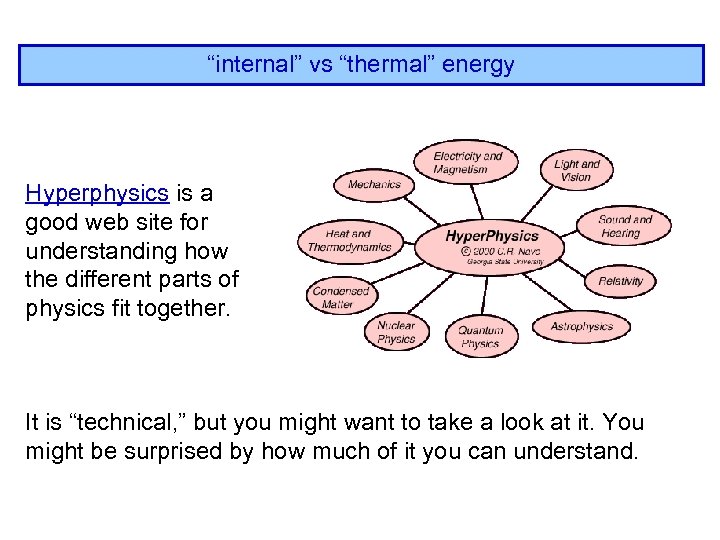 “internal” vs “thermal” energy Hyperphysics is a good web site for understanding how the different parts of physics fit together. It is “technical, ” but you might want to take a look at it. You might be surprised by how much of it you can understand.
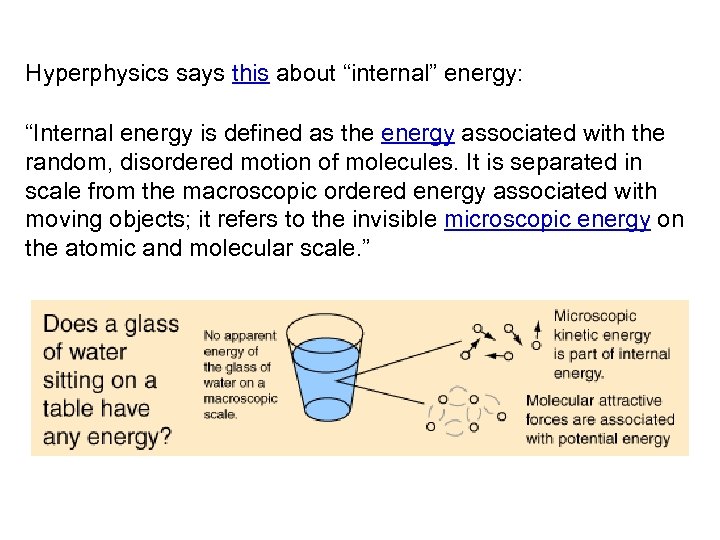 Hyperphysics says this about “internal” energy: “Internal energy is defined as the energy associated with the random, disordered motion of molecules. It is separated in scale from the macroscopic ordered energy associated with moving objects; it refers to the invisible microscopic energy on the atomic and molecular scale. ”
 Hyperphysics says this about “thermal” energy: “The average translational kinetic energy possessed by free particles … is sometimes called thermal energy per particle. ” I may use the terms loosely in speaking, but thermal energy refers to the kinetic energy of particles too tiny for you to see… and internal energy includes both the kinetic and potential energy of particles too tiny for you to see. In my discussion of the falling book, “should” I have included potential energies resulting from the deformation of book and floor?
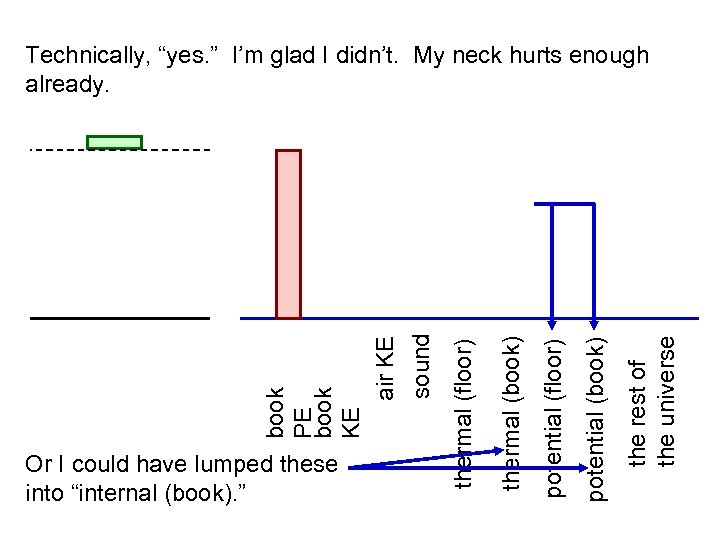 the rest of the universe potential (book) potential (floor) thermal (book) Or I could have lumped these into “internal (book). ” thermal (floor) book PE book KE air KE sound Technically, “yes. ” I’m glad I didn’t. My neck hurts enough already.
 Reviewing what I have talked about so far: I defined energy as the capability of doing work, and defined work in terms of a force moving a mass through some distance. If your body were equally efficient at running and walking, you would burn as many calories walking a mile as running a mile. We found that there are two main forms of energy, kinetic and potential, and I implied that I could categorize all kinds of energy into one of those two forms.
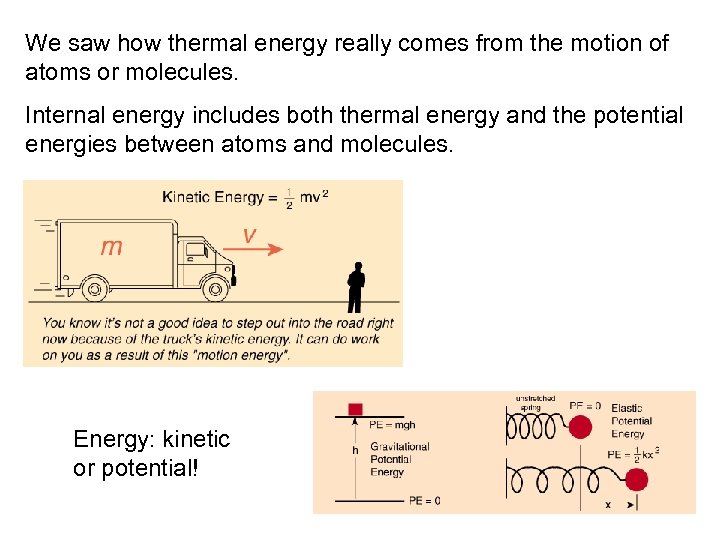 We saw how thermal energy really comes from the motion of atoms or molecules. Internal energy includes both thermal energy and the potential energies between atoms and molecules. Energy: kinetic or potential!
 While you are waiting for the rest of the class, consider your response to this simple question: Imagine a cauldron of boiling oil. Would you, for $20, 000, allow me to place a single drop of this boiling oil on your hand? (I’ll count the yes’s and no’s. )
 Would you, for $20, 000, allow me to pour (all at once!) the entire contents of the cauldron of boiling oil on your hand? (Again, I’ll count the yes’s and no’s. ) If—as I suspect will be true—you vote mostly for the $10, 000 and the single drop, and reject overwhelmingly the $10, 000 and the entire cauldron, then you understand the difference between temperature and heat… …even though I suspect many—or most—of you to equate heat and temperature in your definitions.
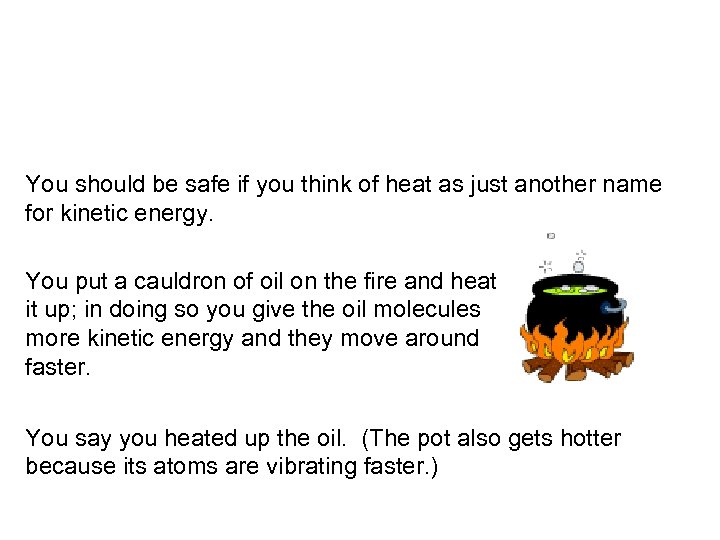 You should be safe if you think of heat as just another name for kinetic energy. You put a cauldron of oil on the fire and heat it up; in doing so you give the oil molecules more kinetic energy and they move around faster. You say you heated up the oil. (The pot also gets hotter because its atoms are vibrating faster. )
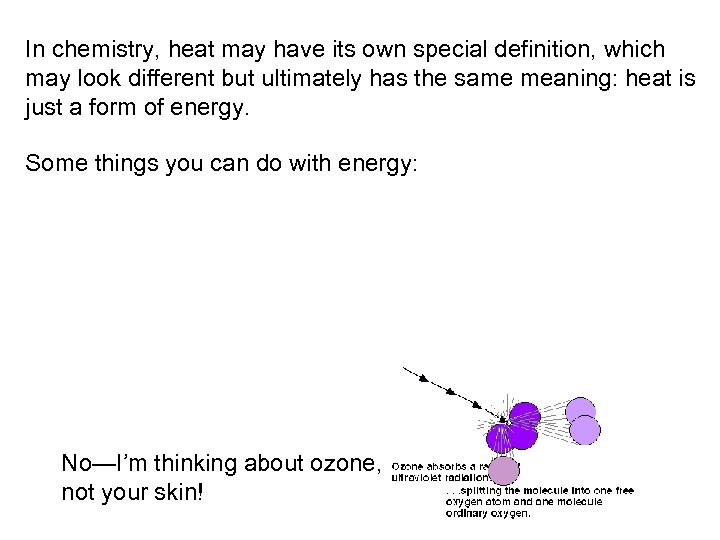 In chemistry, heat may have its own special definition, which may look different but ultimately has the same meaning: heat is just a form of energy. Some things you can do with energy: No—I’m thinking about ozone, not your skin!
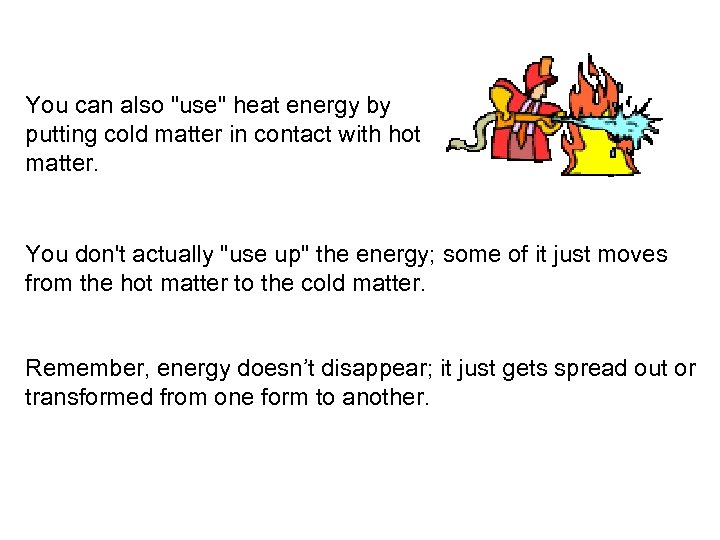 You can also "use" heat energy by putting cold matter in contact with hot matter. You don't actually "use up" the energy; some of it just moves from the hot matter to the cold matter. Remember, energy doesn’t disappear; it just gets spread out or transformed from one form to another.
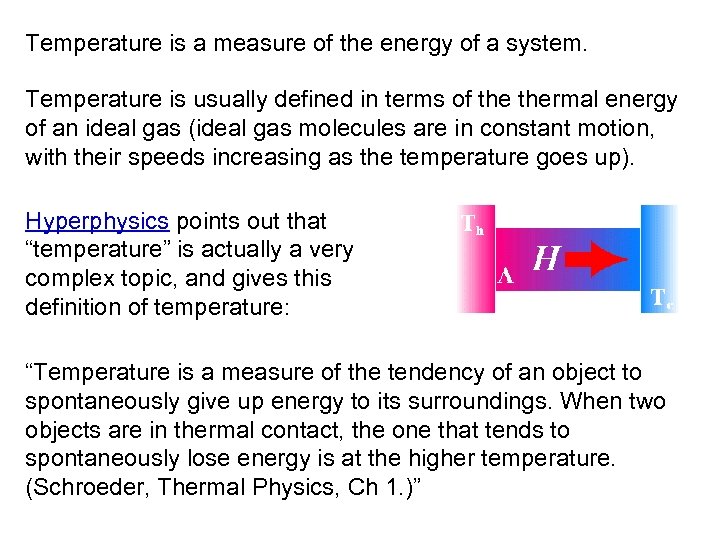 Temperature is a measure of the energy of a system. Temperature is usually defined in terms of thermal energy of an ideal gas (ideal gas molecules are in constant motion, with their speeds increasing as the temperature goes up). Hyperphysics points out that “temperature” is actually a very complex topic, and gives this definition of temperature: “Temperature is a measure of the tendency of an object to spontaneously give up energy to its surroundings. When two objects are in thermal contact, the one that tends to spontaneously lose energy is at the higher temperature. (Schroeder, Thermal Physics, Ch 1. )”
 When you measure the temperature of something with a thermometer, you actually measure the local energy content of the molecules that are in contact with thermometer bulb. Let me finish this section on work and energy by reminding you again of the law of conservation of energy. You "use" energy but you don't "use it up. " If we never use up energy, we can never run out of energy, so what's all this fuss I hear about the need for energy conservation?
 The fuss is not about conserving energy; it is about conserving substances which store useful forms of energy. I will discuss thermodynamics soon. You will see that whenever we use energy to do something useful, we have taken a useful form of energy (such as the energy stored in oil) and converted some of it into a less useful form of energy (such as wasted heat). Everything we do, the mere act of living and breathing, results in consumption of the useful forms of energy in the universe.
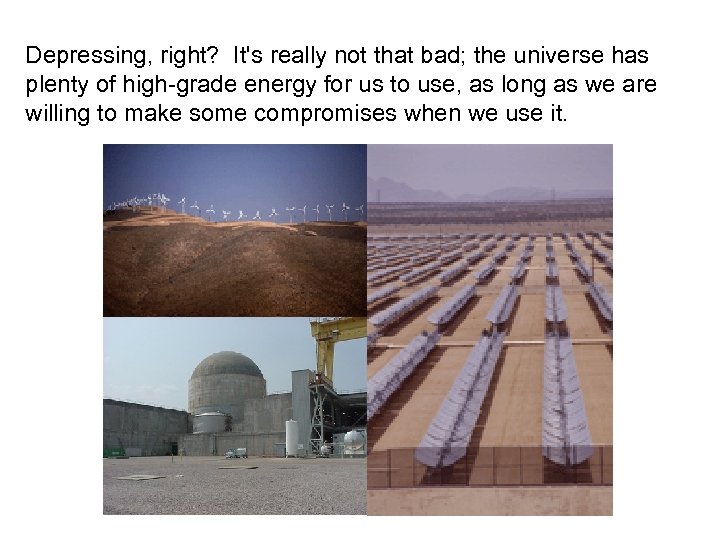 Depressing, right? It's really not that bad; the universe has plenty of high-grade energy for us to use, as long as we are willing to make some compromises when we use it.
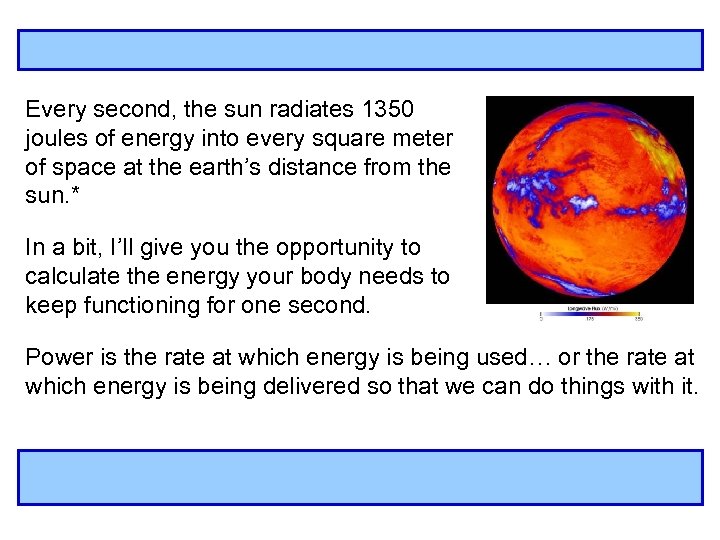 Every second, the sun radiates 1350 joules of energy into every square meter of space at the earth’s distance from the sun. * In a bit, I’ll give you the opportunity to calculate the energy your body needs to keep functioning for one second. Power is the rate at which energy is being used… or the rate at which energy is being delivered so that we can do things with it.
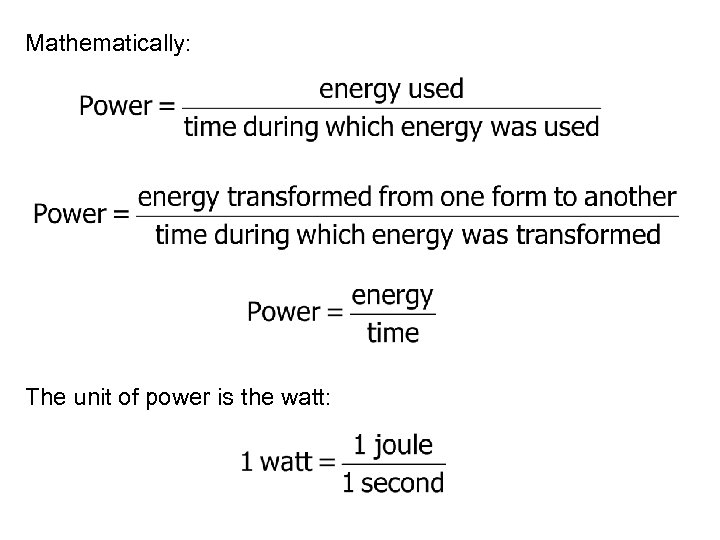 Mathematically: The unit of power is the watt:
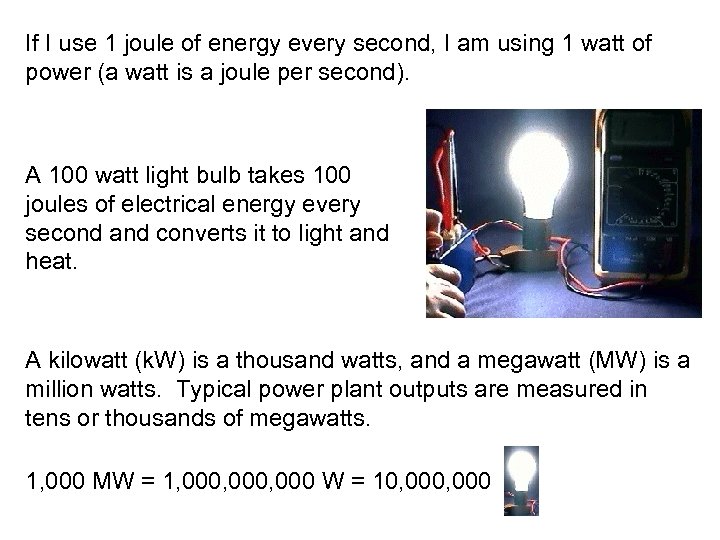 If I use 1 joule of energy every second, I am using 1 watt of power (a watt is a joule per second). A 100 watt light bulb takes 100 joules of electrical energy every second and converts it to light and heat. A kilowatt (k. W) is a thousand watts, and a megawatt (MW) is a million watts. Typical power plant outputs are measured in tens or thousands of megawatts. 1, 000 MW = 1, 000, 000 W = 10, 000
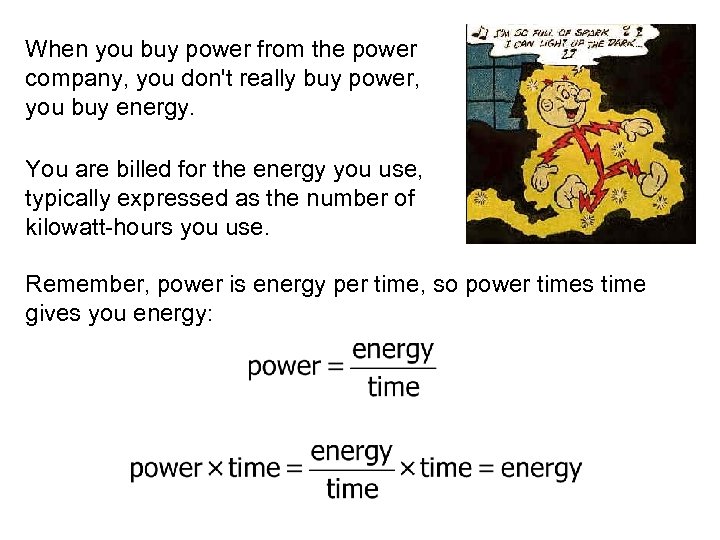 When you buy power from the power company, you don't really buy power, you buy energy. You are billed for the energy you use, typically expressed as the number of kilowatt-hours you use. Remember, power is energy per time, so power times time gives you energy:
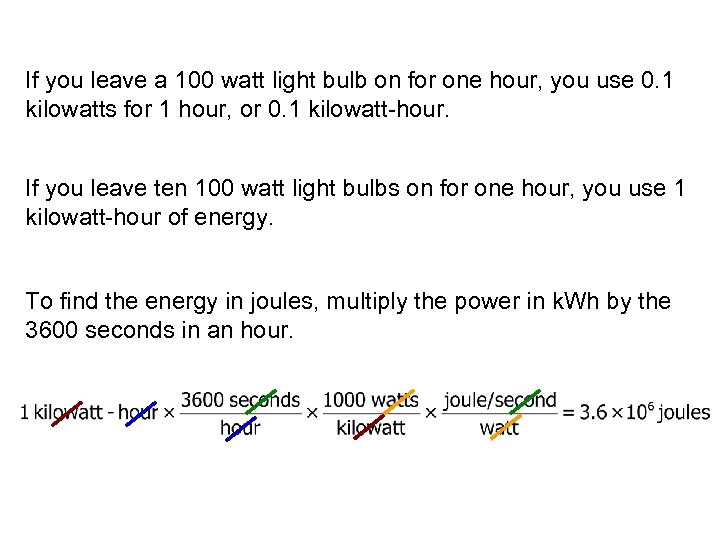 If you leave a 100 watt light bulb on for one hour, you use 0. 1 kilowatts for 1 hour, or 0. 1 kilowatt-hour. If you leave ten 100 watt light bulbs on for one hour, you use 1 kilowatt-hour of energy. To find the energy in joules, multiply the power in k. Wh by the 3600 seconds in an hour.
 There are three choices for this assignment. Each one begins on a separate slide. Handy fact: a calorie is a measure of energy. One calorie is equivalent to 4. 19 joules of energy—a “physics” calorie. A “food” Calorie is equal to 1000 calories.
 Research plus simple calculation. Look up your utility bills for the last year (or a reasonable length of time if you can't find a year's worth). How many kilowatt-hours of electricity did you use? The next part is easy math. However, this is supposed to be a “nonmathematical” course. Therefore, you may, if you wish, write “No Math!” on you paper and turn it in without the math. Using the fact that a kilowatt is 1000 watts and a watt is a joule per second, how many joules of energy did you use? If your utility bill has enough information, find out how much you were charged per kilowatt-hour, and calculate how much you were charged per joule.
 Interesting, but simple calculation. Are you worth a light bulb? A calorie is a measure of energy. One calorie is equivalent to 4. 19 joules of energy. A food calorie is equal to 1000 calories. Suppose your body uses 2000 food calories of energy per day. If all that energy could be made to light up a light bulb all day long, what wattage bulb could you light up?
 Interesting diet calculation. It will take 2 slides to present this choice. I saw a diet infomercial quite a few years back. I only saw it once, and I think I know why. It was a new miracle diet. You had to buy the diet plan, of course, but the idea was simple. According to this diet, all you have to do to lose substantial amounts of weight is drink a few glasses of ice water a day. The reasoning goes like this: your body takes in the ice water and heats it up to body temperature. That "burns" calories. The claim was that it "burned" enough calories to result in substantial weight loss.
 One pound of fat is equivalent to 3500 kilocalories. (Caution: the Calorie, with a capital "C, " that you read about in diet books is actually 1000 calories, or one kilocalorie. )
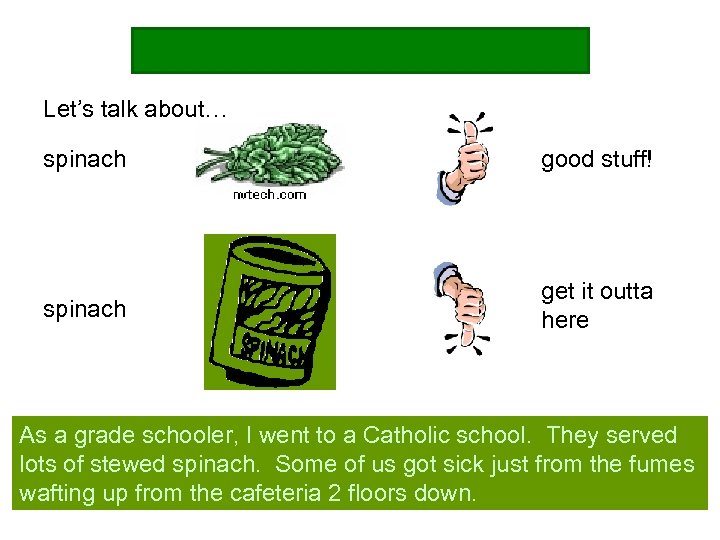 Let’s talk about… spinach good stuff! spinach get it outta here As a grade schooler, I went to a Catholic school. They served lots of stewed spinach. Some of us got sick just from the fumes wafting up from the cafeteria 2 floors down.
 The nuns made us “clean our plate” at lunch. It had something to do with the starving children in China. They would inspect our trays as we passed through the “dump the trash” line. What to do on spinach day? Stuff it in your empty milk carton and hope the nuns didn’t inspect it? Sit next to the one kid in class who liked stewed spinach, * and see how much you could pass off to him?
 What does this have to do with thermodynamics? Physics faculty tend to think of thermodynamics as the stewed spinach of college physics courses. The wierd faculty member who actually likes teaching that stuff is a treasured friend whenever it comes time to give out teaching assignments. Just thought you might want to know* that before we start this discussion of thermodynamics.
 I told you earlier that heat is just a form of energy. That may or may not seem obvious to you, but for a long time it was not a "given" for scientists. It took until the middle part of the 1800's before an experiment could be devised to show that heat is a form of energy. Because I am going to lecture on heat transfer, let's talk for a minute about how heat can be transferred from one place to another.
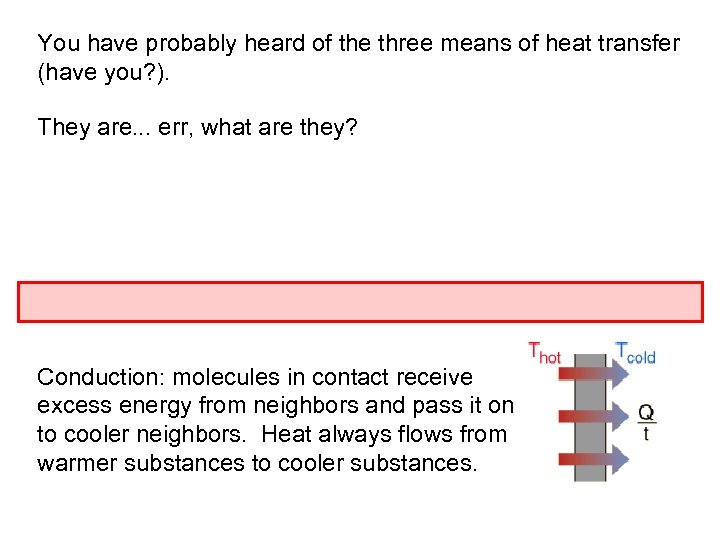 You have probably heard of the three means of heat transfer (have you? ). They are. . . err, what are they? Conduction: molecules in contact receive excess energy from neighbors and pass it on to cooler neighbors. Heat always flows from warmer substances to cooler substances.
 Let’s demonstrate conduction, convection, and radiation.