 Скачать презентацию i Alt Lab 2004 Infrastructure Session San Francisco
9ae0cdd90c2e738519a0395ef2de1e7d.ppt
- Количество слайдов: 31



i Alt Lab 2004 Infrastructure Session San Francisco, July 20 -22 2004 edu. Source and LORNET Gilbert Paquette, CIRTA, TELUQ and Griff Richards, SFU www. edusource. ca www. lornet. org
What is Edu. Source? A test bed for a network of Learning Objects Repositories Suite of Tools, Community of Practice, CANCORE profile Founded on international standards (W 3 C and IMS) and an open source approach An 18 months, CANARIE founded project (4, 25 M$) Terminated since March 2004; a community of developpers/users to be maintained through LORNET and other initiatives
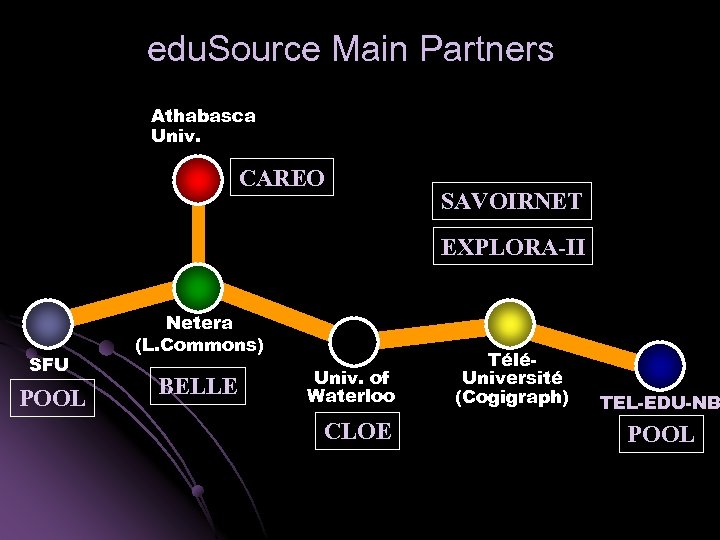
edu. Source Main Partners Athabasca Univ. CAREO SAVOIRNET EXPLORA-II SFU POOL Netera (L. Commons) BELLE Univ. of Waterloo CLOE TéléUniversité (Cogigraph) TEL-EDU-NB POOL
Specs/Standards/Profiles Metadata Formats IEEE LOM Dublin Core (DC) CANCORE Communication Protocols OAI, Z 39. 50 Web Services SOAP, WSDL, UDDI Implementation Specifications IMS DRI (Interoperability) IMS CP (Content Packaging) IMS LD (Learning Design) ODRL (Digital Rights)
edu. Source Results Cancore 2. 0 DRM Model LOR Communities of Practices edu. Source suite of tools Architecture Documents Three Ways to Access Resources: Network search, e. RIB, Repository and Platform connection ECL connector and gateway, Common Search Component, edu. Source Registry Services, e. RIB tools Software Specifications for Learning Design, LD content packaging and DRM To be developed in LORNET
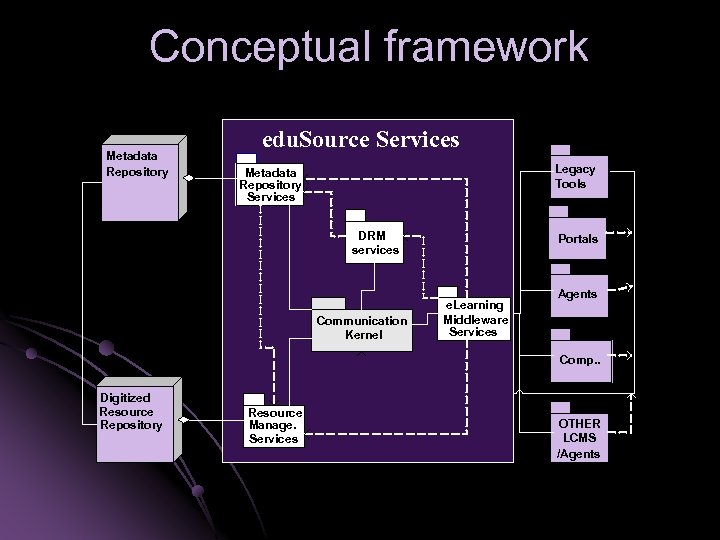
Conceptual framework Metadata Repository edu. Source Services Legacy Tools Metadata Repository Services DRM services Communication Kernel Portals e. Learning Middleware Services Agents Comp. . Digitized Resource Repository Resource Manage. Services OTHER LCMS /Agents
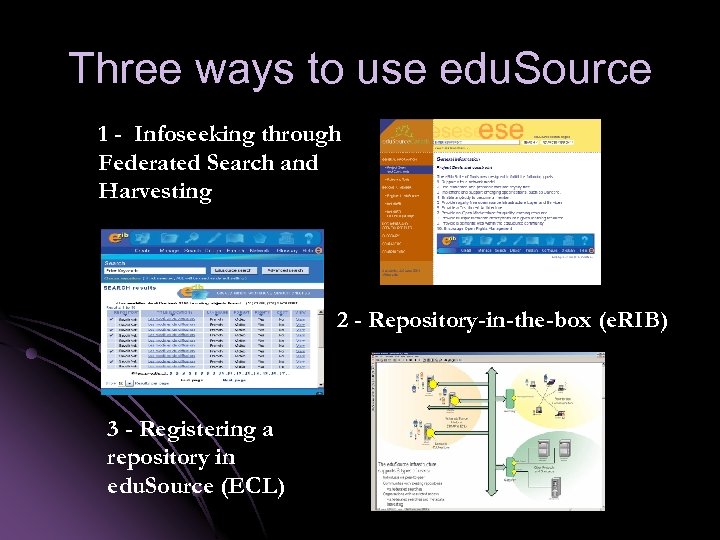
Three ways to use edu. Source 1 - Infoseeking through Federated Search and Harvesting 2 - Repository-in-the-box (e. RIB) 3 - Registering a repository in edu. Source (ECL)
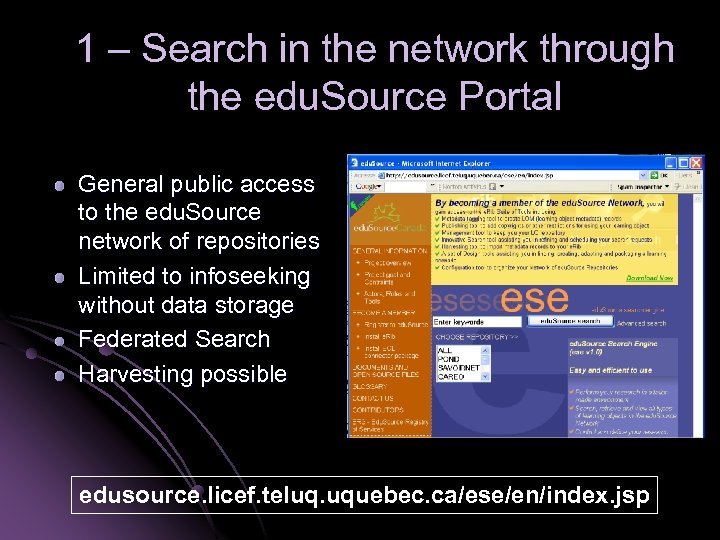
1 – Search in the network through the edu. Source Portal General public access to the edu. Source network of repositories Limited to infoseeking without data storage Federated Search Harvesting possible edusource. licef. teluq. uquebec. ca/ese/en/index. jsp
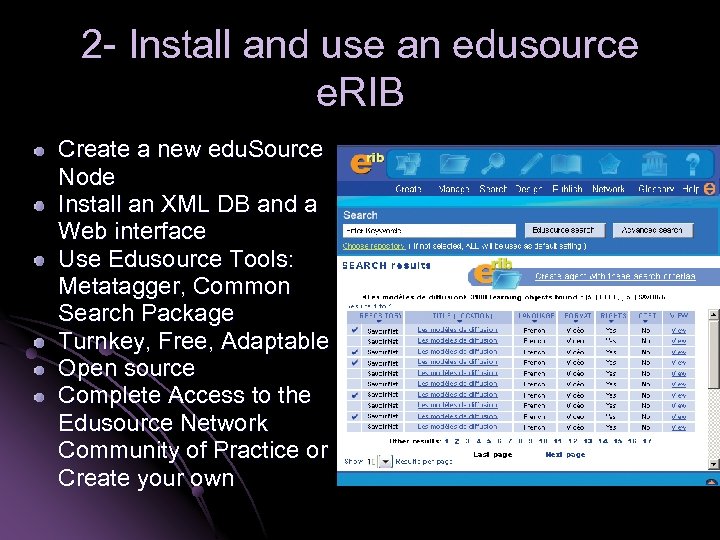
2 - Install and use an edusource e. RIB Create a new edu. Source Node Install an XML DB and a Web interface Use Edusource Tools: Metatagger, Common Search Package Turnkey, Free, Adaptable Open source Complete Access to the Edusource Network Community of Practice or Create your own
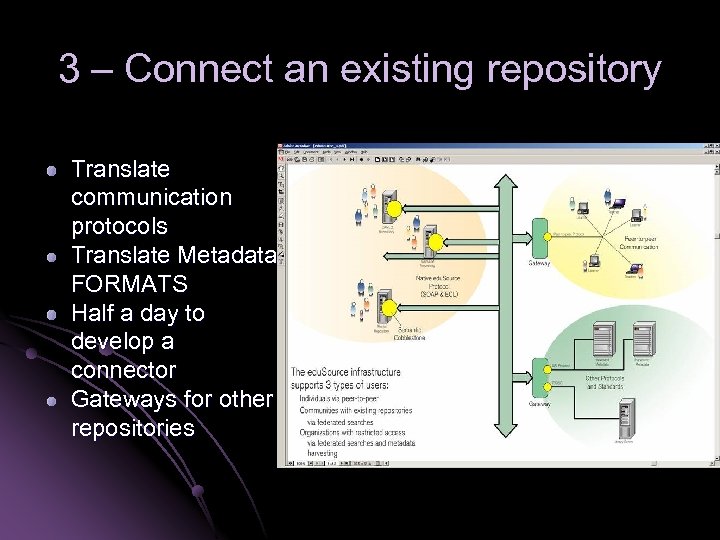
3 – Connect an existing repository Translate communication protocols Translate Metadata FORMATS Half a day to develop a connector Gateways for other repositories
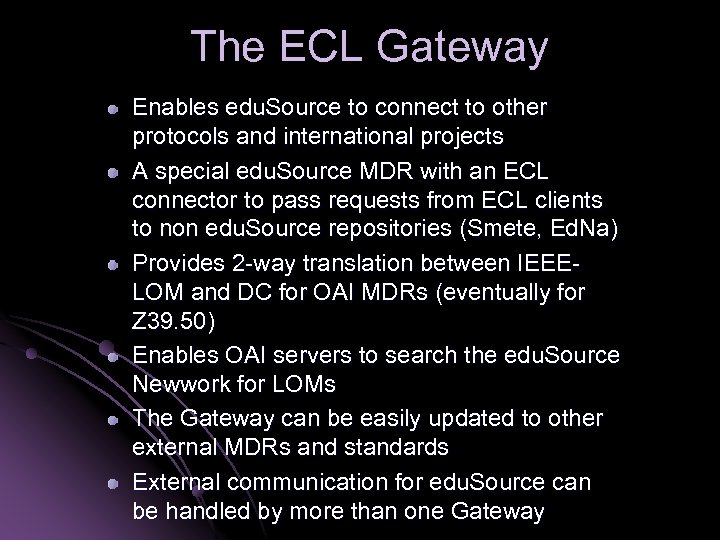
The ECL Gateway Enables edu. Source to connect to other protocols and international projects A special edu. Source MDR with an ECL connector to pass requests from ECL clients to non edu. Source repositories (Smete, Ed. Na) Provides 2 -way translation between IEEELOM and DC for OAI MDRs (eventually for Z 39. 50) Enables OAI servers to search the edu. Source Newwork for LOMs The Gateway can be easily updated to other external MDRs and standards External communication for edu. Source can be handled by more than one Gateway
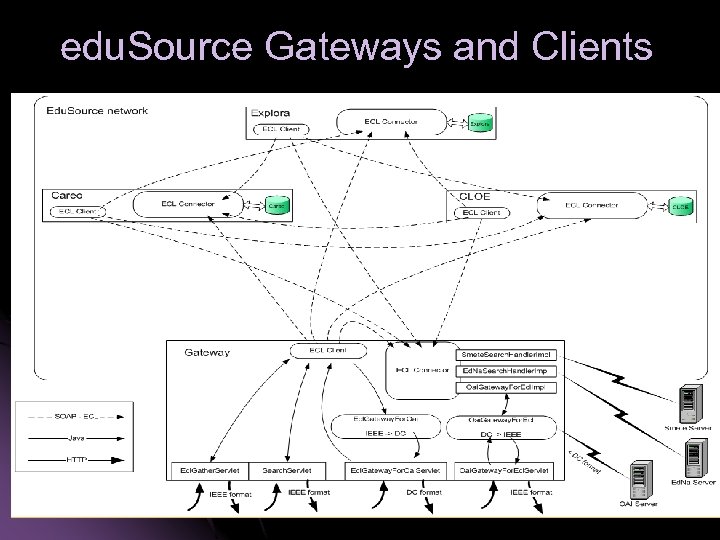
edu. Source Gateways and Clients
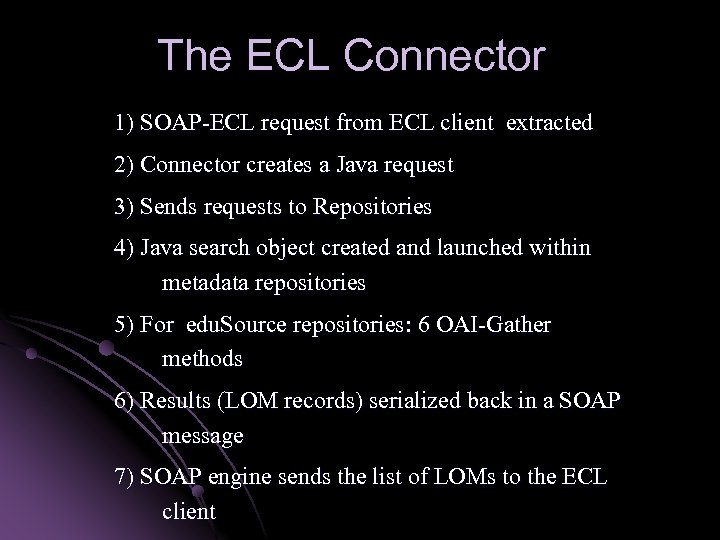
The ECL Connector 1) SOAP-ECL request from ECL client extracted 2) Connector creates a Java request 3) Sends requests to Repositories 4) Java search object created and launched within metadata repositories 5) For edu. Source repositories: 6 OAI-Gather methods 6) Results (LOM records) serialized back in a SOAP message 7) SOAP engine sends the list of LOMs to the ECL client
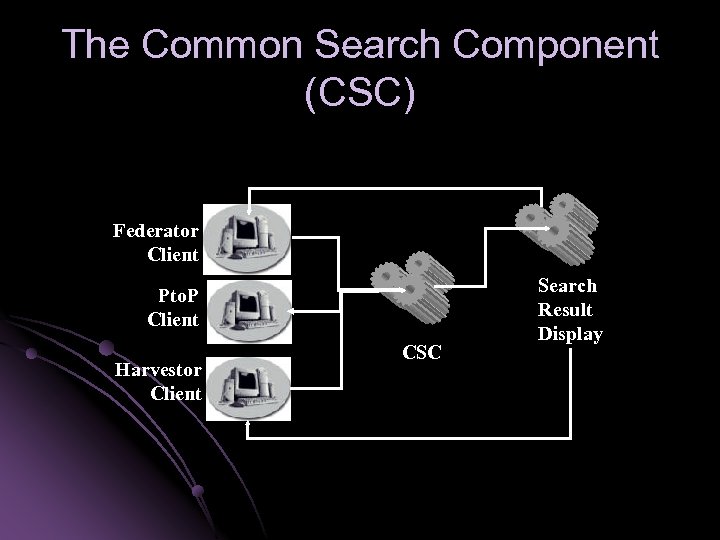
The Common Search Component (CSC) Federator Client Pto. P Client Harvestor Client CSC Search Result Display
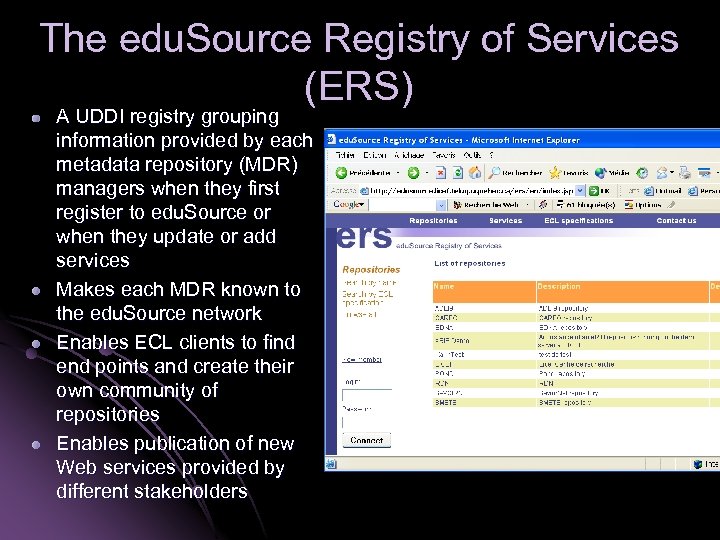
The edu. Source Registry of Services (ERS) A UDDI registry grouping information provided by each metadata repository (MDR) managers when they first register to edu. Source or when they update or add services Makes each MDR known to the edu. Source network Enables ECL clients to find end points and create their own community of repositories Enables publication of new Web services provided by different stakeholders
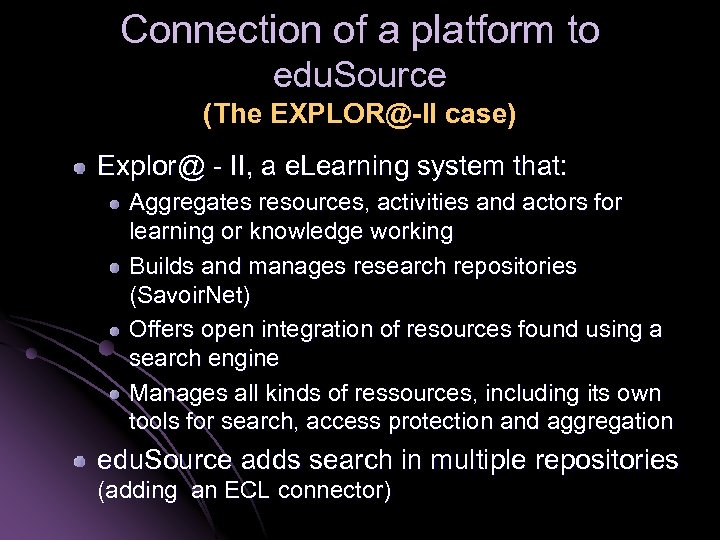
Connection of a platform to edu. Source (The EXPLOR@-II case) Explor@ - II, a e. Learning system that: Aggregates resources, activities and actors for learning or knowledge working Builds and manages research repositories (Savoir. Net) Offers open integration of resources found using a search engine Manages all kinds of ressources, including its own tools for search, access protection and aggregation edu. Source adds search in multiple repositories (adding an ECL connector)
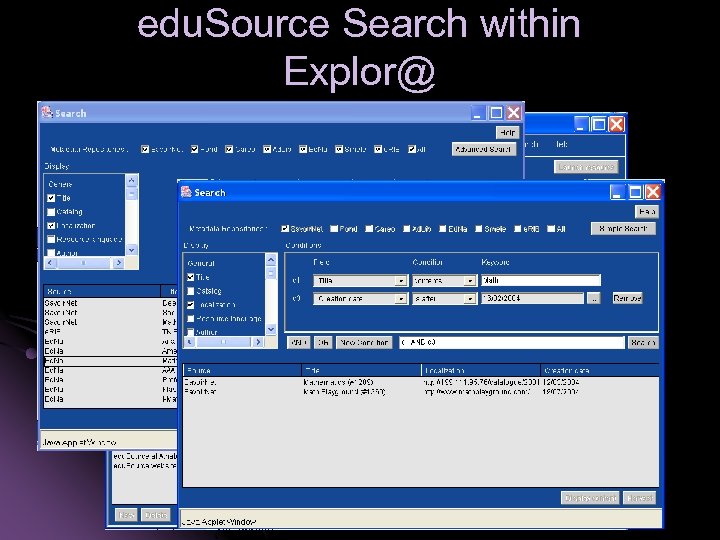
edu. Source Search within Explor@
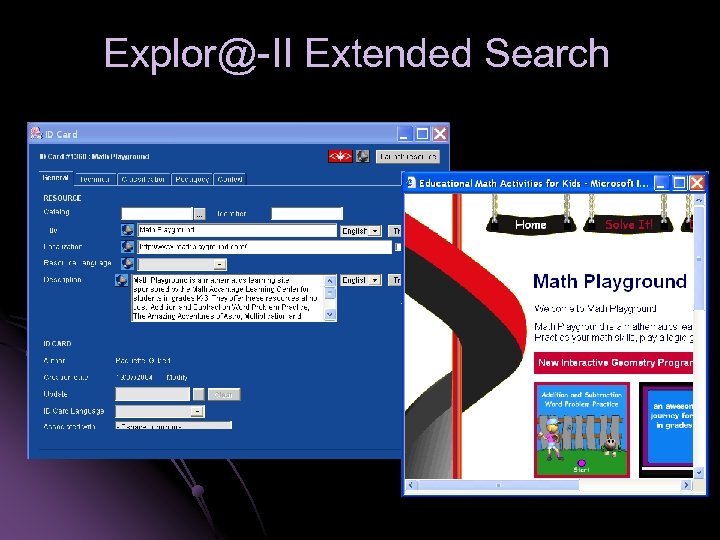
Explor@-II Extended Search
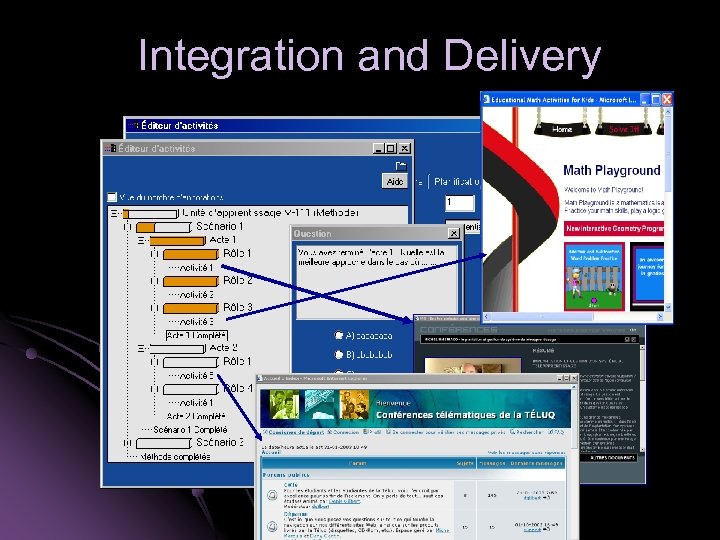
Integration and Delivery
LORNET: A major Canadian Initiative in Learning and Semantic Web technologies Over 8 M $ in 5 years on learning and knowledgebased technologies Joint research with 27 industrial partners and organizations A team of 129 researchers, students and professionals. Consolidation of 7 research labs and centers and 4 Research Chairs Convergence of complementary research areas Interaction with leading international projects: OKI, IMS, CETIS, COLIS, Kaleidoscope
LORNET Industrial Partners ETraffic Solutions Neptec FDO-Axion PDS Bell Canada BCcampus BMO, Institute for learning CAE Hydro-Québec Immersion Canada Infotel Group Recombo SGI Canada Technologies Cogigraph Inc. Knexa Credo Interactive Inc. CRIM TR Labs-Saskatchewan Mentor-AGTI Vestec
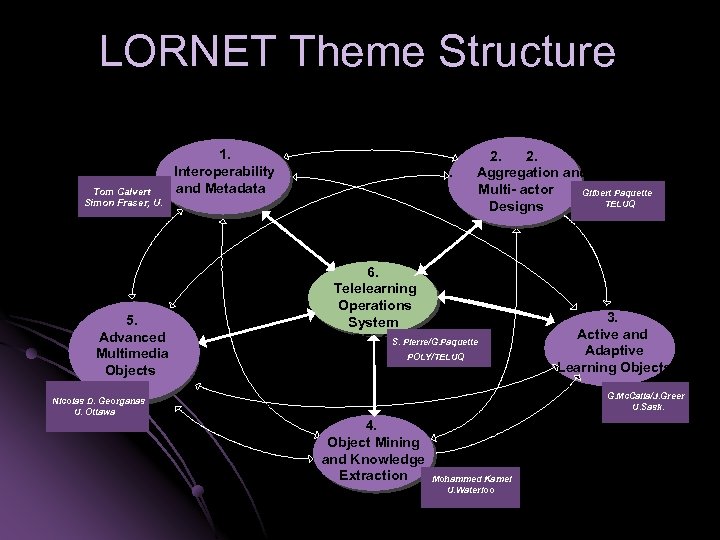
LORNET Theme Structure Tom Calvert Simon Fraser, U. 5. Advanced Multimedia Objects 1. Interoperability and Metadata 3. 2. 2. Aggregation and Multi- actor Gilbert Paquette TELUQ Designs 6. Telelearning Operations System (TELOS Pierre/G. Paquette S. POLY/TELUQ 3. Active and Adaptive Learning Objects G. Mc. Calla/J. Greer U. Sask. Nicolas D. Georganas U. Ottawa 4. Object Mining and Knowledge Extraction Mohammed Kamel U. Waterloo
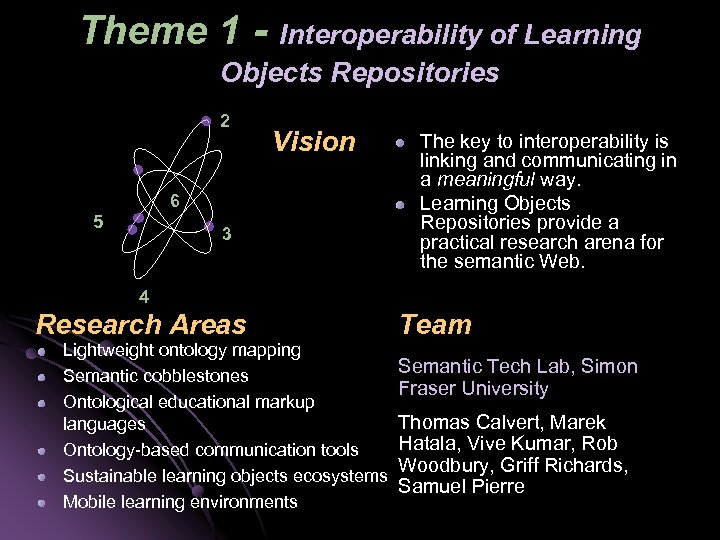
Theme 1 - Interoperability of Learning Objects Repositories 2 Vision 6 5 3 The key to interoperability is linking and communicating in a meaningful way. Learning Objects Repositories provide a practical research arena for the semantic Web. 4 Research Areas Lightweight ontology mapping Semantic cobblestones Ontological educational markup languages Ontology-based communication tools Sustainable learning objects ecosystems Mobile learning environments Team Semantic Tech Lab, Simon Fraser University Thomas Calvert, Marek Hatala, Vive Kumar, Rob Woodbury, Griff Richards, Samuel Pierre
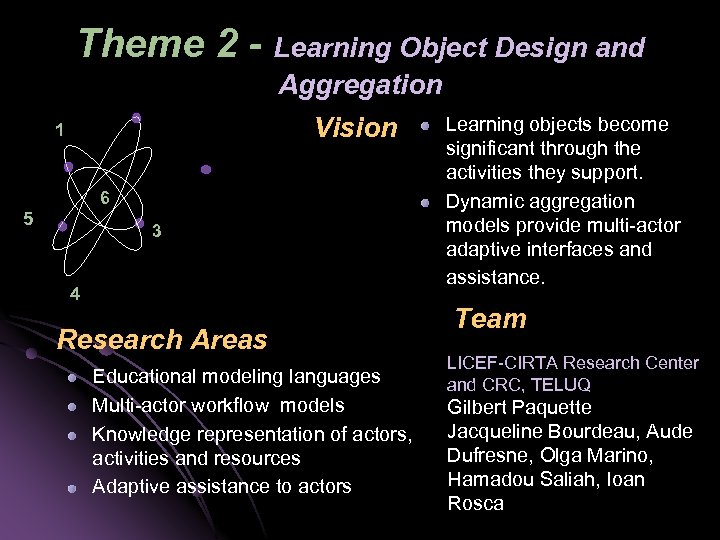
Theme 2 - Learning Object Design and Aggregation Vision 1 6 5 3 4 Research Areas Educational modeling languages Multi-actor workflow models Knowledge representation of actors, activities and resources Adaptive assistance to actors Learning objects become significant through the activities they support. Dynamic aggregation models provide multi-actor adaptive interfaces and assistance. Team LICEF-CIRTA Research Center and CRC, TELUQ Gilbert Paquette Jacqueline Bourdeau, Aude Dufresne, Olga Marino, Hamadou Saliah, Ioan Rosca
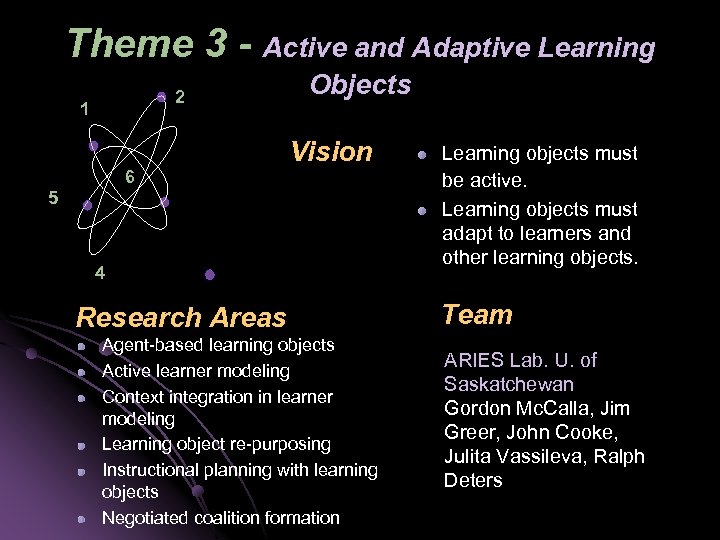
Theme 3 - Active and Adaptive Learning 2 1 6 Objects Vision 5 4 Research Areas Agent-based learning objects Active learner modeling Context integration in learner modeling Learning object re-purposing Instructional planning with learning objects Negotiated coalition formation Learning objects must be active. Learning objects must adapt to learners and other learning objects. Team ARIES Lab. U. of Saskatchewan Gordon Mc. Calla, Jim Greer, John Cooke, Julita Vassileva, Ralph Deters
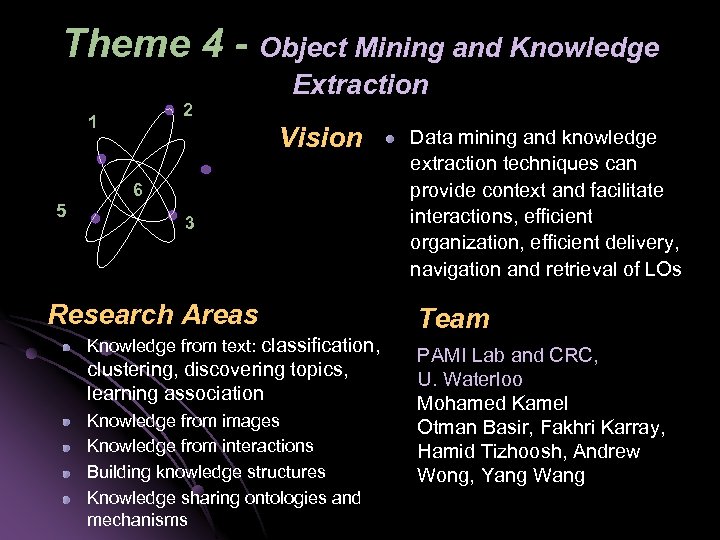
Theme 4 - Object Mining and Knowledge Extraction 2 1 Vision 6 5 3 Research Areas Knowledge from text: classification, clustering, discovering topics, learning association Knowledge from images Knowledge from interactions Building knowledge structures Knowledge sharing ontologies and mechanisms Data mining and knowledge extraction techniques can provide context and facilitate interactions, efficient organization, efficient delivery, navigation and retrieval of LOs Team PAMI Lab and CRC, U. Waterloo Mohamed Kamel Otman Basir, Fakhri Karray, Hamid Tizhoosh, Andrew Wong, Yang Wang
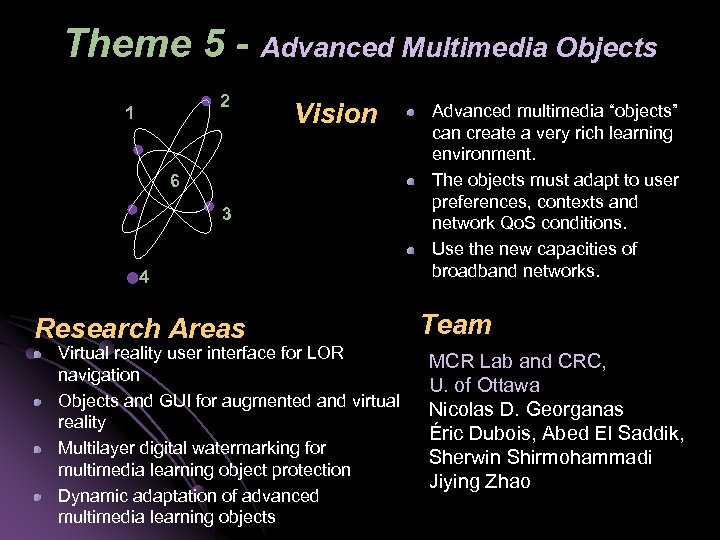
Theme 5 - Advanced Multimedia Objects 2 1 Vision 6 3 4 Research Areas Virtual reality user interface for LOR navigation Objects and GUI for augmented and virtual reality Multilayer digital watermarking for multimedia learning object protection Dynamic adaptation of advanced multimedia learning objects Advanced multimedia “objects” can create a very rich learning environment. The objects must adapt to user preferences, contexts and network Qo. S conditions. Use the new capacities of broadband networks. Team MCR Lab and CRC, U. of Ottawa Nicolas D. Georganas Éric Dubois, Abed El Saddik, Sherwin Shirmohammadi Jiying Zhao
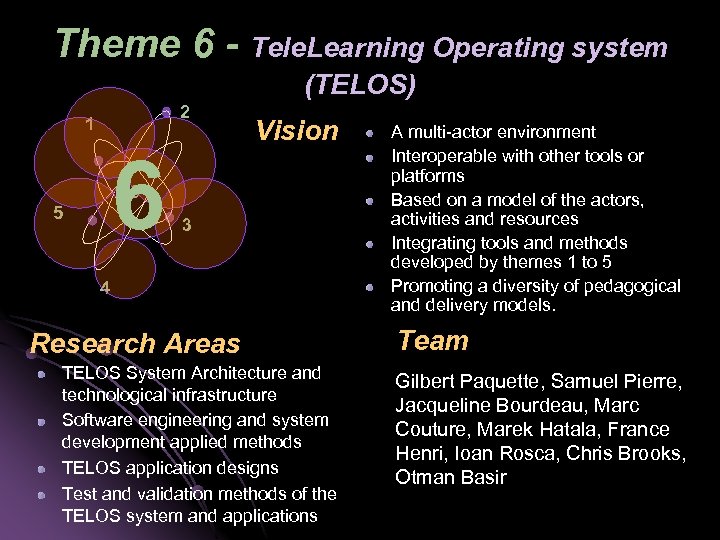
Theme 6 - Tele. Learning Operating system (TELOS) 2 1 6 Vision 6 5 3 4 Research Areas TELOS System Architecture and technological infrastructure Software engineering and system development applied methods TELOS application designs Test and validation methods of the TELOS system and applications A multi-actor environment Interoperable with other tools or platforms Based on a model of the actors, activities and resources Integrating tools and methods developed by themes 1 to 5 Promoting a diversity of pedagogical and delivery models. Team Gilbert Paquette, Samuel Pierre, Jacqueline Bourdeau, Marc Couture, Marek Hatala, France Henri, Ioan Rosca, Chris Brooks, Otman Basir
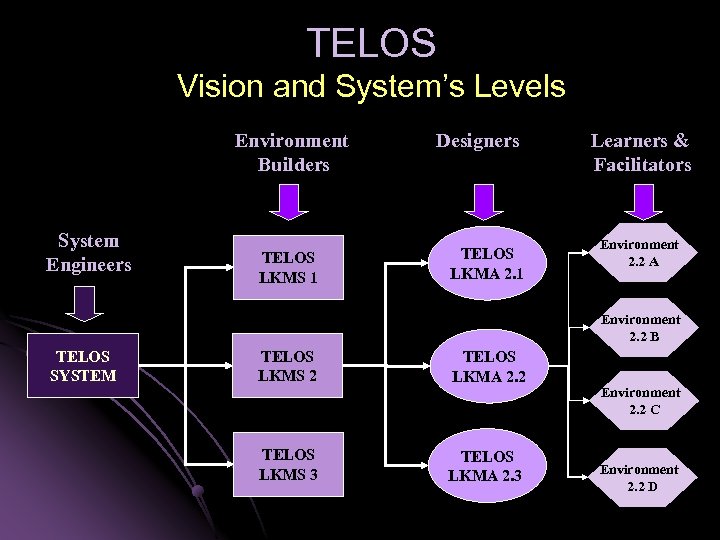
TELOS Vision and System’s Levels Environment Builders System Engineers TELOS LKMS 1 Designers TELOS LKMA 2. 1 Learners & Facilitators Environment 2. 2 A Environment 2. 2 B TELOS SYSTEM TELOS LKMS 2 TELOS LKMS 3 TELOS LKMA 2. 2 TELOS LKMA 2. 3 Environment 2. 2 C Environment 2. 2 D
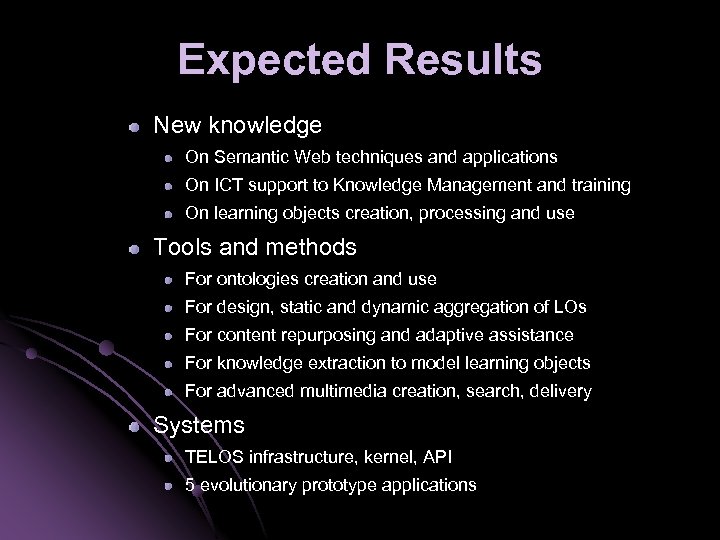
Expected Results New knowledge On Semantic Web techniques and applications On ICT support to Knowledge Management and training On learning objects creation, processing and use Tools and methods For ontologies creation and use For design, static and dynamic aggregation of LOs For content repurposing and adaptive assistance For knowledge extraction to model learning objects For advanced multimedia creation, search, delivery Systems TELOS infrastructure, kernel, API 5 evolutionary prototype applications
Alti. Lab 2004 Demo Session. IMS San Francisco, July 20 -22 2004 Interoperability Results from edu. Source and LORNET Gilbert Paquette, TELUQ and Griff Richards, SFU www. edusource. ca www. lornet. org
Скачать презентацию i Alt Lab 2004 Infrastructure Session San Francisco
9ae0cdd90c2e738519a0395ef2de1e7d.ppt