 Скачать презентацию I Agency Overview Page 3 II Subprime Lending
be9ecf46b90383e9f26fc103dd6fca22.ppt
- Количество слайдов: 17




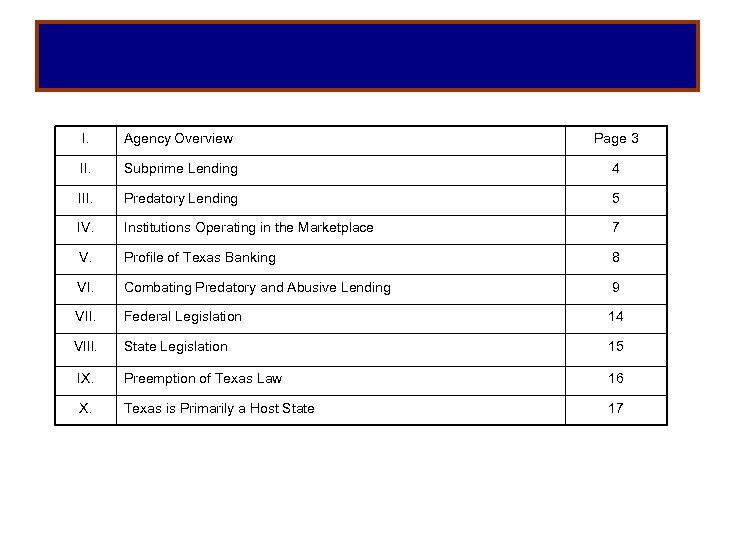
I. Agency Overview Page 3 II. Subprime Lending 4 III. Predatory Lending 5 IV. Institutions Operating in the Marketplace 7 V. Profile of Texas Banking 8 VI. Combating Predatory and Abusive Lending 9 VII. Federal Legislation 14 VIII. State Legislation 15 IX. Preemption of Texas Law 16 X. Texas is Primarily a Host State 17
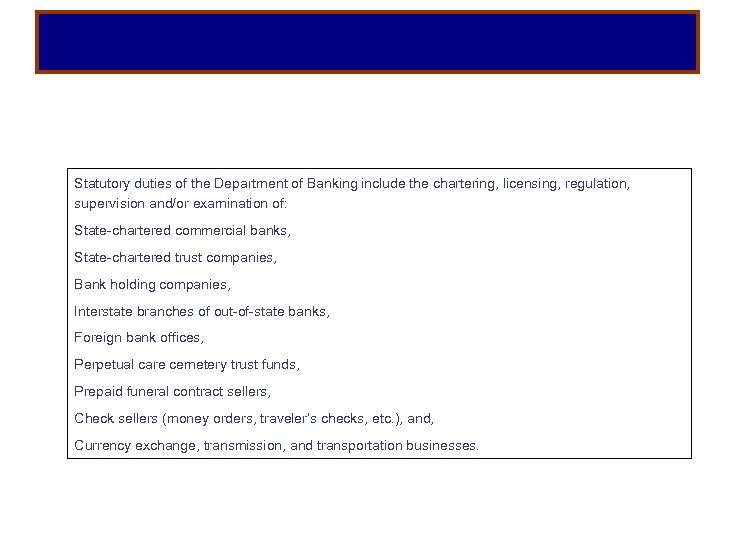
Statutory duties of the Department of Banking include the chartering, licensing, regulation, supervision and/or examination of: State-chartered commercial banks, State-chartered trust companies, Bank holding companies, Interstate branches of out-of-state banks, Foreign bank offices, Perpetual care cemetery trust funds, Prepaid funeral contract sellers, Check sellers (money orders, traveler’s checks, etc. ), and, Currency exchange, transmission, and transportation businesses.


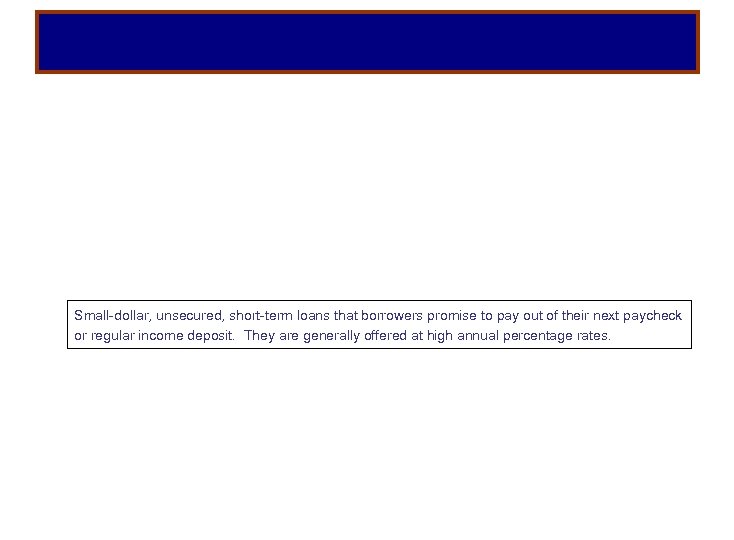
Small-dollar, unsecured, short-term loans that borrowers promise to pay out of their next paycheck or regular income deposit. They are generally offered at high annual percentage rates.

Through the supervisory process, the Department will deter or prohibit predatory and abusive lending practices. These practices would be discovered through on-site examinations, the review of federal agency compliance reports, consumer complaints, or on-site involvement by a supervisor or conservator. Through current Texas law, the Texas Department of Banking has the ability to act on any cases of predatory lending that occurs in Texas chartered banks. Enforcement actions can be taken during or following an on-site examination, as a result of an application submitted to the agency, following a consumer complaint, or at any time the agency feels that action is appropriate and needed.
The Texas Department of Banking maintains a toll-free consumer complaint hotline. By statute, all state-chartered banks must provide customers information about how to file a complaint with the Department. In the last fiscal year, Department personnel handled over 3, 000 consumer complaints and inquiries. In all complaint situations, we ask that the consumer file a written account of what happened and include supporting documents. After receiving the consumer’s complaint and supporting documents, a consumer complaint specialist will research the specific law that relates to the fact situation. We then forward a summary of the complaint written by the Department’s specialist, along with a copy of the consumer’s filed complaint, to the lender. The lender prepares a written response to the consumer’s complaint, which they send to us. Our consumer complaint specialist then reviews the lender’s response and determines if the lender has violated banking law or Department policies with respect to handling of the consumer’s account. The specialist would also determine if the lender has acted unreasonably or unethically in its dealings with the customer. In a possible predatory lending situation, where false advertising, deceptive trade practices, misleading lending practices, exorbitant fees, or excessive interest (which may or may not be in violation of the state’s usury caps) are determined to exist, the Department’s legal counsel and senior management would be consulted. Other Department personnel, such as field examiners, would then be brought in to perform an on-site review of the lending facility to determine if any other consumers are affected and if any other circumstances of predatory lending might exist. If the fact scenario supports an allegation of predatory lending, then the complaint and all supporting documents would be forwarded to the Texas Attorney General for prosecution.
In the last fiscal year, we have received only a few isolated complaints by consumers indicating possible predatory lending practices in our state-chartered banks and trust companies. One related to proper disclosure of the annual percentage rate. In addition, during the course of an on-site examination, we discovered and took action to prohibit a high cost automobile financing scheme. In the fiscal year, we have recovered $37, 803 for Texas consumers.
Many consumers with minor credit problems or difficulties stemming from unique circumstances wrongly believe that their loan choices are limited only to high-cost lenders, and consequently they do not compare rates of multiple lenders before agreeing to a loan. We believe that consumers that have a high level of financial literacy are more likely to make sound economic choices for themselves and their families. Clearly, improving the financial education of the most common victims of predatory lending, especially lower income households, is important. Consumers need to be educated about the issues that will affect their credit report and the options that are available to them. The United States Treasury Department has determined that financial institutions may accept Matricula Consular cards as identification, making it easier for Mexican immigrants to obtain banking services. Many banks along the border now accept the Matricula Consular as one form of primary identification.
“Money Smart” program – The FDIC started this program to help adults outside of the financial mainstream enhance their financial skills and create positive banking relationships. It includes a set of ten instructor-led training modules covering basic financial topics. The FDIC provides the curriculum free of charge, and banks are increasingly able to provide training to their customers. Training material is available in several different languages. A Federal Reserve Bank program entitled “Don’t Borrow Trouble” helps consumers avoid being the victim of predatory lenders. Other Federal Reserve Bank financial education programs include “Building Wealth: A Beginner's Guide to Securing Your Financial Future” and “There’s a Lot to Learn about Money. ” The Jump$tart Coalition for Personal Financial Literacy seeks to improve the personal financial literacy of young adults. Jump$tart's purpose is to evaluate the financial literacy of young adults; develop, disseminate, and encourage the use of standards for grades K-12; and promote the teaching of personal finance.
Equal Credit Opportunity Act (Regulation B) – Makes it illegal to discriminate against borrowers due to their race. Truth in Lending Act (Regulation Z) – Requires accurate disclosure of finance charges and annual percentage rate. Fair Credit Reporting Act – Requires the lender to provide notice to the consumer when it declines an application for credit or takes other adverse action. If adverse action is taken based upon information received from a reporting agency, the consumer must be notified. Community Reinvestment Act (Part 345) – Evidence of illegal or predatory lending practices can negatively impact the bank’s CRA rating and performance. Conversely, programs that include a financial education component about how to avoid abusive loans will improve the CRA rating and performance for a bank. Federal Trade Commission Act (FTC Act) – Makes unfair and deceptive trade practices illegal. Fair Debt Collection Practices Act (FDCPA) – A bank may face reputation risk if a third party debt collector violates FDCPA when collecting the loan.
Home Equity Loan Provisions (Texas Constitution) – Contains a number of consumer safeguards for home equity loans. High Cost Home Loan Disclosure – Requires that additional disclosures be made for high cost home loans. Usury Ceilings (Title 4, Texas Finance Code) – Sets interest rate ceilings for consumer loans. Collection Practices and Credit Information (Title 5, Texas Finance Code) – Places restrictions on collection practices and the use of credit information.

 Скачать презентацию I Agency Overview Page 3 II Subprime Lending
be9ecf46b90383e9f26fc103dd6fca22.ppt