 Скачать презентацию I 3 N REPORT 5 th IABIN Council
0b999a1bddff9b78f67bf69f1529b0df.ppt
- Количество слайдов: 45



I 3 N REPORT 5 th IABIN Council Meeting Punta del Este, Uruguay, 9 May 2007 Andrea Grosse, I 3 N Coordinator, and TWG members: Sean Townsend, I 3 N-Jamaica Lead Sergio Zalba, I 3 N-Argentina Lead Silvia Ziller, I 3 N-Brazil Lead
This week’s 5 I 3 N meetings 1. 2. 3. 4. 5. I 3 N-Uruguay I 3 N South American Sub-regional I 3 N TWG I 3 N Caribbean lunch Council • Report progress, request feedback, obtain guidance • Provide opportunity for Focal Points to meet with I 3 N participants
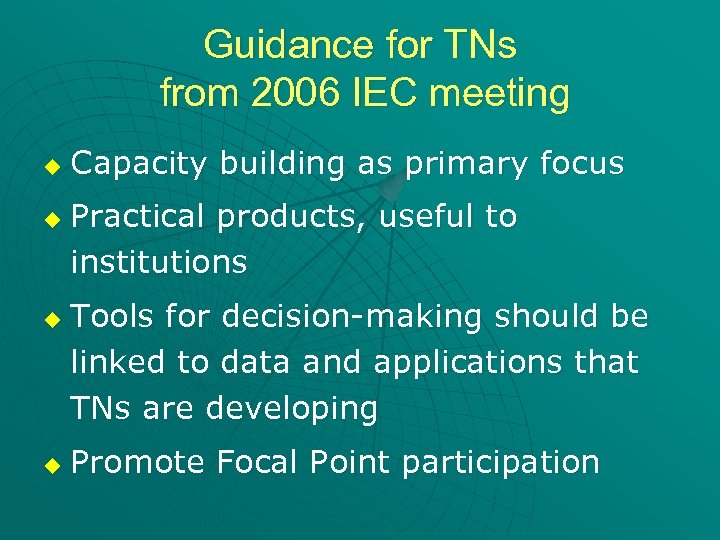
Guidance for TNs from 2006 IEC meeting u u Capacity building as primary focus Practical products, useful to institutions Tools for decision-making should be linked to data and applications that TNs are developing Promote Focal Point participation
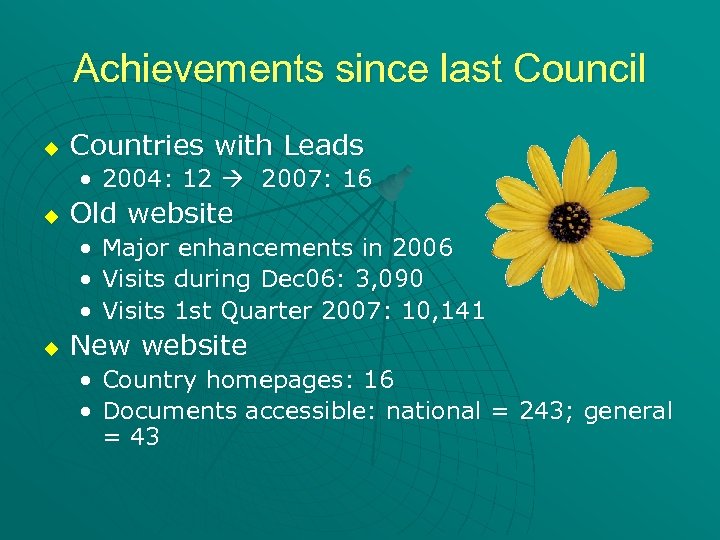
Achievements since last Council u Countries with Leads • 2004: 12 2007: 16 u Old website • • • u Major enhancements in 2006 Visits during Dec 06: 3, 090 Visits 1 st Quarter 2007: 10, 141 New website • • Country homepages: 16 Documents accessible: national = 243; general = 43
Achievements (2) u u u Tools • Search engine updated • New I 3 N database template • Country Web System template • Manuals online • Risk assessment tool • Pathways assessment tool Concepts / tools training • People trained: Dec 06 = 503; Mar 07 = 524 • IABIN countries: Dec 06 = 16; Mar 07 = 16 • All countries: Dec 06 = 25; Mar 07 = 34 Content grants 2006: 9
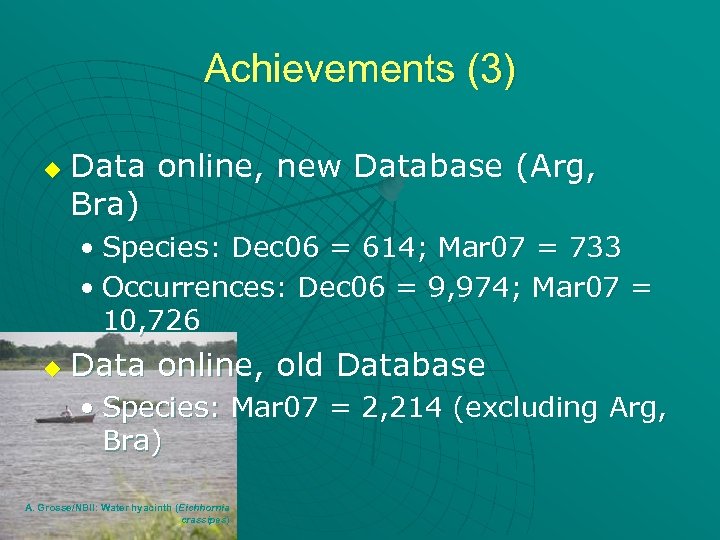
Achievements (3) u Data online, new Database (Arg, Bra) • Species: Dec 06 = 614; Mar 07 = 733 • Occurrences: Dec 06 = 9, 974; Mar 07 = 10, 726 u Data online, old Database • Species: Mar 07 = 2, 214 (excluding Arg, Bra) A. Grosse/NBII: Water hyacinth (Eichhornia crassipes)
Achievements (4) u I 3 N list server subscribers • Old list, Oct 06 = 287 • New list, Apr 07 = 280 (518 = iabinfriends) u Outreach • Presentations at international conferences = 7 • Papers published: >= 13; peer reviewed >= 2
Achievements (5) u Pilots in Asia, Africa: 3 workshops • Thank you Horus Institute, GISIN, TNC, Univ. Nac. del Sur, GISP, CABI! u Global collaborations • GISP, GISIN, TNC, CABI, PBIF, GEOSS, TDWG, ISSG/GISD, ASEAN u Countries additional products: many!
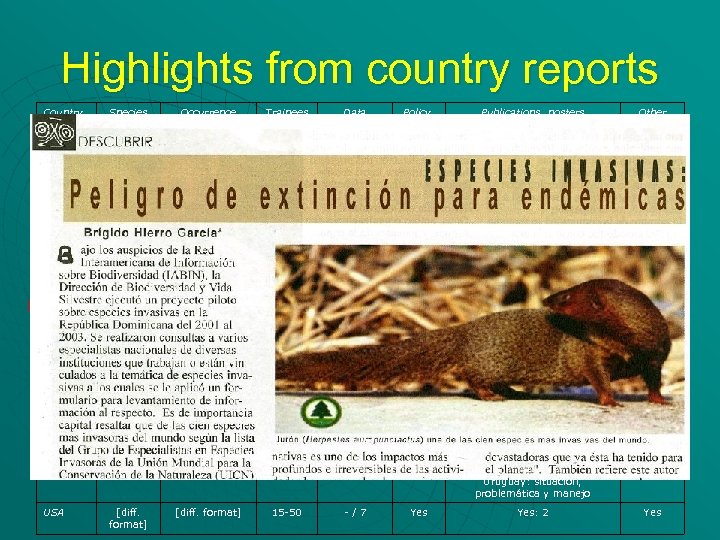
Highlights from country reports Country Species (06 / 07) Occurrence records (06/07) Trainees (06 / 07) Data providers (pers/instit) Policy, mgt, etc Publications, posters Arg 407/452 450/1087 5 238 Yes Bra 267 / 281 9524 / 9639 -- 613 / 260 Yes Informe Nacional sobre espécies exóticas invasoras -- Col -- / 368 [diff. format] -- / 230 [diff. format] -- 45 / -- Yes: 3 Yes Co. R -- -- -- Yes: 1 -- Do. R 138 / 138 -- / 342 -- 112 / 24 Yes: 2; article listing the benefits of I 3 N activities to the country Yes Jam 83 / 84 247 / 271 21 30 / 12 Yes 2 posters, 2 brochures Yes Mex -- -- Yes None reported Yes Per -- -- 35 -- Yes Poster -- Par -- / 23 -- / 77 -- 11 / 6 Yes None reported Uru 107 / 170 911 / 1306 -- 19 / 7 Yes: 3; scientific article that Yes: contains a reference to I 3 N: Especies acuáticas exóticas en Uruguay: situación, problemática y manejo -- USA [diff. format] 15 -50 -/7 Yes: 2 Yes: 3 Other products --
2007 Deliverables (highlights) Tools and Standards u Marine habitat terms u Template for national invasive species strategies u Fielded searches u Risk assessment tool u Pathway assessment tool u Helpdesk Collaboration and Communications u Spanish and Portuguese Web pages u Toolkit for FP & Leads Project Management u Sub-regional meeting u New I 3 N Leads u Overview of data administrator role u Liaising with PAIGH, TNC, GISP and GISIN, CABI (ASEAN, GEOSS, PBIF, TDWG) Capacity Building u Addition of marine case studies u $ Follow up activities u Reach out to indigenous people’s organizations u Delivery of workshops in 4 countries Content Grants u Award 4 – 6 grants
Tools Objectives u Develop standard IAS information in each country • Species profiles, locations, status, impact, control, projects, experts, references u Help countries to organize their information • National biodiversity informatics systems are complemented by I 3 N • Can provide first IAS system or help standardize national and subnational databases u u Offer a tool to aid IAS management at national level, facilitating collaboration and making information accessible to managers Promote and facilitate IAS information exchange among countries
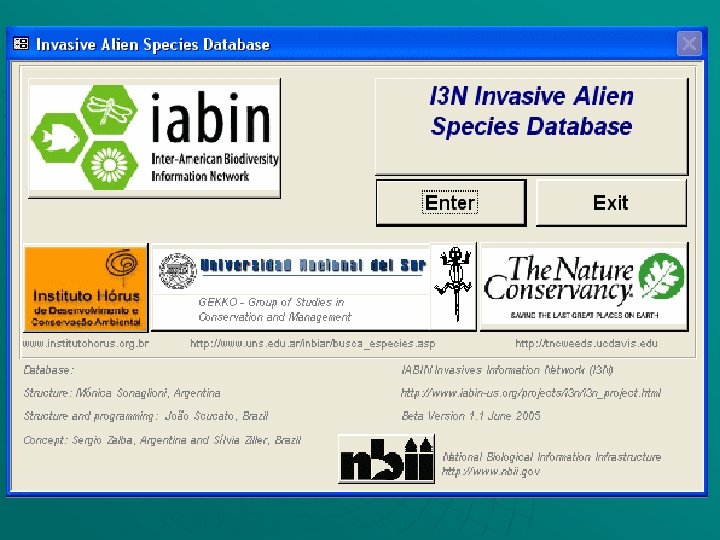
I 3 N Database on Invasive Alien Species u u Portuguese, Spanish, English interface Creates standardized records • Customized with vocabulary for habitat types and political subdivision specific to your country u u u Automated output (XML-tagged) for sharing information with other systems Free Internet hosting Technical, conceptual, and strategic support (Helpdesk)
I 3 N Web-Based Country Information System Public portal, with fielded search function u Intranet system u • Unlimited number of authorized data providers can input/edit data online • Entries do not become public until accepted by administrator u Administration level (I 3 N National Lead / DB Administrator, control information release to the public)
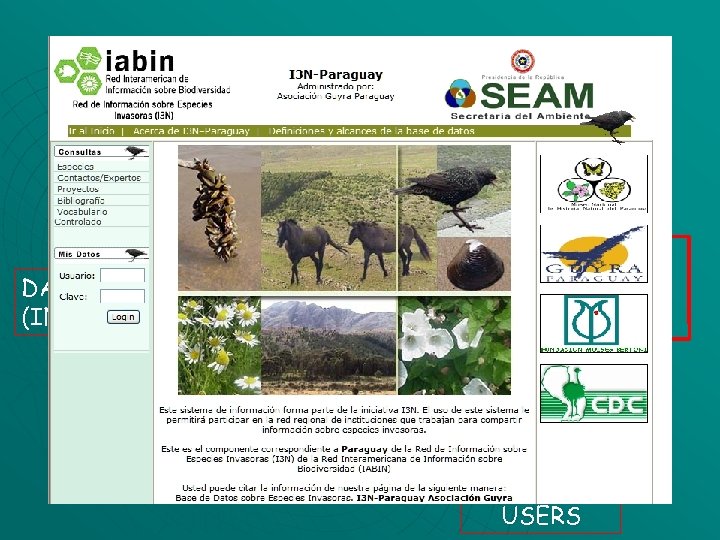
Country Information System DATABASE ADMINISTRATOR DATA PROVIDERS (INTRANET) DATABASE INFORMATION ON-LINE USERS
Standards u u u General IABIN standards (4 th IABIN Council, Panama 2004) Controlled vocabulary lists developed by I 3 N (based on discussions with the IUCN-ISSG Global Invasive Species Database, IABIN Standards and Protocols Working Group, GISIN, TDWG, NBII) Integrated Taxonomic Information System (ITIS) Dublin Core (for metadata on resources found on the Web) National classifications are used for habitats/ecosystems
Data Quality of data depends on data providers and National Leads u Data quality policy will be proposed by a contractor and reviewed by TWG u • Consider GBIF data quality policy • PATN data quality expert and GISD Lead will be contacted for input
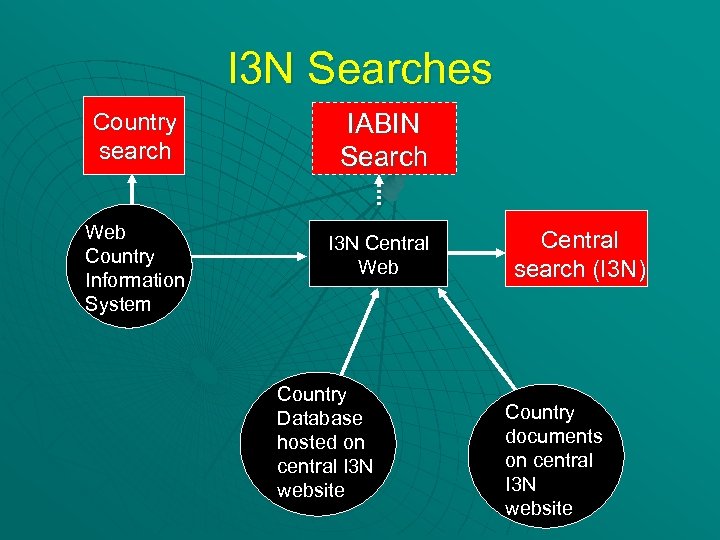
I 3 N Searches Country search Web Country Information System IABIN Search I 3 N Central Web Country Database hosted on central I 3 N website Central search (I 3 N) Country documents on central I 3 N website
Future Tools u Mapping occurrence records • I 3 N-TWG discussions; awaiting guidance from Secretariat and IT-TWG • I 3 N-Paraguay (Guyra Paraguay) prototype tool • Pan American Institute on Geography and History (PAIGH/IPGH) expert (J. Klaver) invited to TWG u brings a geospatial and Pan-American geography point of view
Risk and pathways analysis tools u Uses I 3 N data and controlled vocabulary u Will use data from PATN & SSTN u Support prevention, early detection and control u Enable governments to determine management priorities based on I 3 N data u Results can be used in national IAS strategies, reports and policy development
Data content creation u Pilot projects • Funding from USGS & US State Dept. • Initial I 3 N Database - “Cataloger” in 2002 u GEF project from 2005 • New I 3 N Database (USGS funds) • I 3 N Country Web Information System u u Training workshop tested at intl. biodiversity conference, Brazil Contractor identified cap. building needs
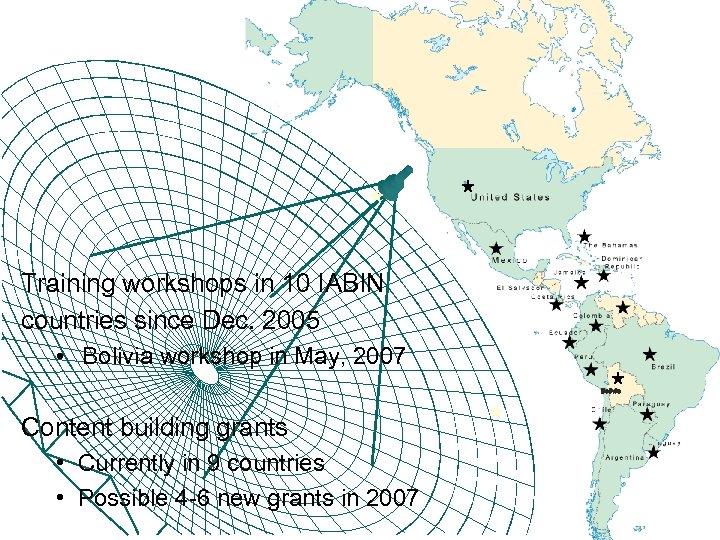
Training workshops in 10 IABIN countries since Dec. 2005 • Bolivia workshop in May, 2007 Bolivia Content building grants • Currently in 9 countries • Possible 4 -6 new grants in 2007
Capacity Building u u Support I 3 N National Leads and Focal Points in raising awareness using IAS data Support for Focal Points for decisionmaking in their agencies and national institutions using I 3 N and partners tools • Future outreach toolkit on CD u Knowledgeable experts in IAS are available on a limited basis to train government officials and other specialists in IAS information management and I 3 N tools
Links to global/regional initiatives u u The Nature Conservancy - South America Invasive Species Program The Global Invasive Species Programme (GISP) • Letter of agreement signed during TWG Meeting • Workshops in Africa and Asia u ISSG/GISD – Global Invasive Species Database • Agreed standards for database (New Zealand) u GISIN - Search interface, standards, workshops Denmark, Argentina, Great Britain, Malaysia, China, Morocco, Zambia, New Zealand, Germany, USA
Links to global/regional initiatives u Bio. Net u PAIGH - Pan-American Institute of Geography and History – expertise for mapping, exploring possibilities for joint training u PBIF - Pacific Biodiversity Information Facility u GEOSS - Global Earth Obs. System of Systems u TDWG - Taxonomic Databases Working Group of International Union of Biological Scientists u u ASEAN – Association of South East Asian Nations USAID, US State Department (USA) Nature. Serve (USA) Integrated Taxonomic Information System (ITIS)
Links to national initiatives 16 GOVERNMENTS SUPPORTING NATIONAL LEADS u u u Horus Institute (Brazil) u Von Humboldt Institute (Colombia) u Universidad Ricardo Palma (Perú) u Universidad de la República (Uruguay) u CONABIO (Mexico) u National Biological Information Infrastructure, U. S. Geological Survey Collaboration at strategic and technical levels: tools dissemination, training, standards, tools development GEKKO/Universidad Nacional del Sur (Argentina) Guyra Paraguay (Paraguay) In. Bio (Costa Rica) Institute of Jamaica (Jamaica) CRIA (Brazil) Jatun Sacha (Ecuador) u
GISP Model for a National Invasive Species Strategy Policy approach u Benefits to countries and Focal Points u Brings vision for the future u Brings light into action for the near future, before the COP 9 in-depth review on invasive alien species u Highlight results at COP 9, May 2008 u Improves opportunities for regional cooperation u
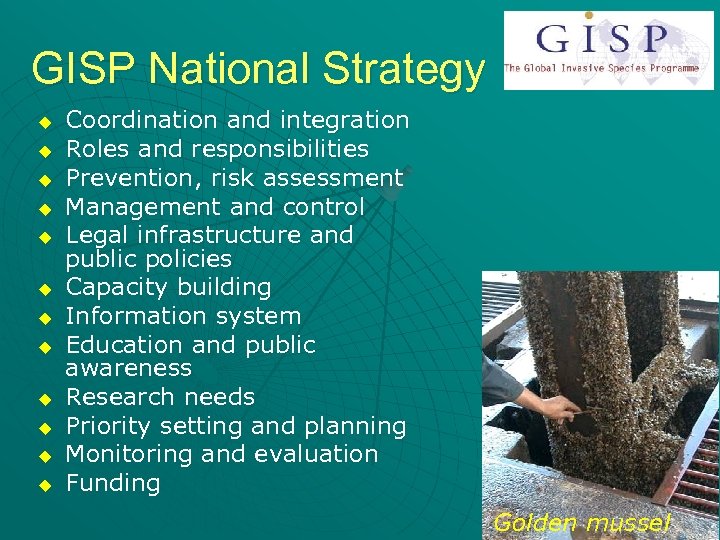
GISP National Strategy u u u Coordination and integration Roles and responsibilities Prevention, risk assessment Management and control Legal infrastructure and public policies Capacity building Information system Education and public awareness Research needs Priority setting and planning Monitoring and evaluation Funding Golden mussel
GISP National Strategy u Synergy with I 3 N: benefits to I 3 N • Cofinancing for GEF grant • Joint workshops • Feedback from users to I 3 N tools • The National Strategy is the context for I 3 N tools used in decision-making • Other complementary tools will be developed in the future to benefit I 3 N participants
Indigenous peoples u u The IABIN Project Appraisal Document highlights the need to conduct capacity building and support for indigenous peoples and local communities to access scientific data and technologies Paraguay database includes vocabulary in Guarani NBII and I 3 N led a workshop at the National Tribal Conference on Invasive Species, US, 2006 Issue discussed in Technical Working Group Meetings in Costa Rica, 2006, and Uruguay, 2007
Structure of I 3 N u u u CI (NBII) coordinates activities TWG advisors to CI on technical matters as well as keep the Focal point and Lead informed of development in I 3 N National Leads (16 countries) liaise with secretariat, CI, TWG, data providers, database administrators & other IABIN TNs u Database Administrator monitor and finetune the performance of the database u Data providers develop, manage, and submit data to Leads
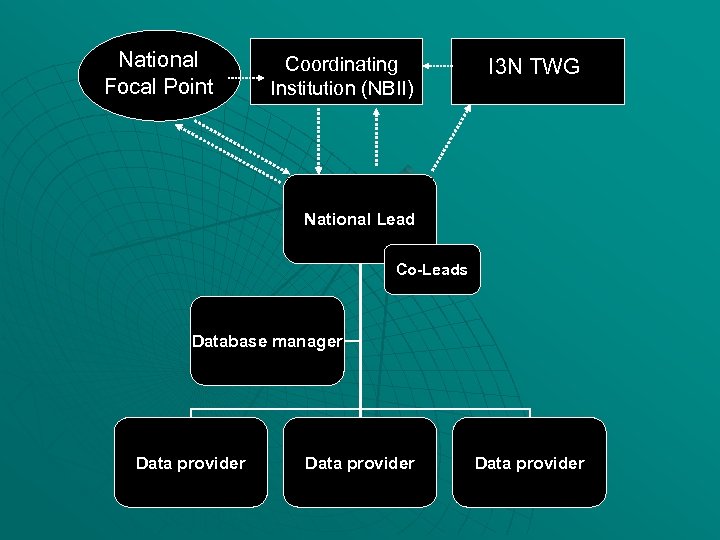
National Focal Point Coordinating Institution (NBII) I 3 N TWG National Lead Co-Leads Database manager Data provider
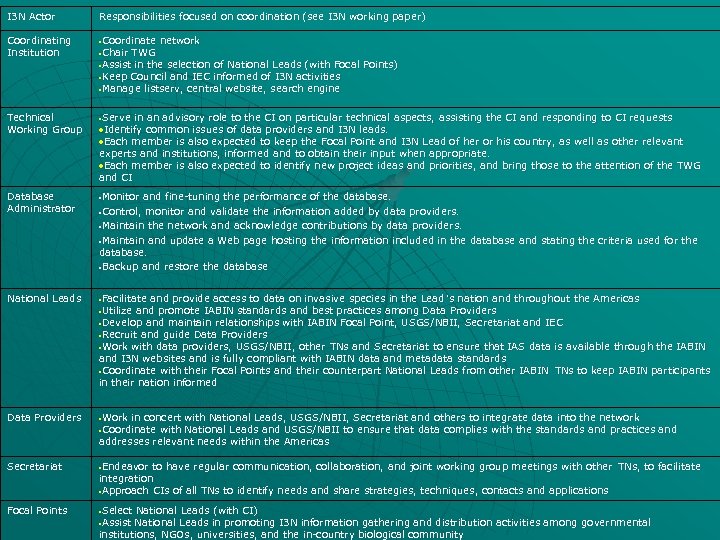
I 3 N Actor Responsibilities focused on coordination (see I 3 N working paper) Coordinating Institution Coordinate Technical Working Group Serve Database Administrator §Monitor National Leads Facilitate Data Providers Work Secretariat Endeavor Focal Points Select network TWG Assist in the selection of National Leads (with Focal Points) Keep Council and IEC informed of I 3 N activities Manage listserv, central website, search engine Chair in an advisory role to the CI on particular technical aspects, assisting the CI and responding to CI requests Identify common issues of data providers and I 3 N leads. Each member is also expected to keep the Focal Point and I 3 N Lead of her or his country, as well as other relevant experts and institutions, informed and to obtain their input when appropriate. Each member is also expected to identify new project ideas and priorities, and bring those to the attention of the TWG and CI and fine-tuning the performance of the database. monitor and validate the information added by data providers. §Maintain the network and acknowledge contributions by data providers. §Maintain and update a Web page hosting the information included in the database and stating the criteria used for the database. §Backup and restore the database §Control, and provide access to data on invasive species in the Lead ’s nation and throughout the Americas and promote IABIN standards and best practices among Data Providers Develop and maintain relationships with IABIN Focal Point, USGS/NBII, Secretariat and IEC Recruit and guide Data Providers Work with data providers, USGS/NBII, other TNs and Secretariat to ensure that IAS data is available through the IABIN and I 3 N websites and is fully compliant with IABIN data and metadata standards Coordinate with their Focal Points and their counterpart National Leads from other IABIN TNs to keep IABIN participants in their nation informed Utilize in concert with National Leads, USGS/NBII, Secretariat and others to integrate data into the network with National Leads and USGS/NBII to ensure that data complies with the standards and practices and addresses relevant needs within the Americas Coordinate to have regular communication, collaboration, and joint working group meetings with other TNs, to facilitate TNs, integration Approach CIs of all TNs to identify needs and share strategies, techniques, contacts and applications National Leads (with CI) National Leads in promoting I 3 N information gathering and distribution activities among governmental institutions, NGOs, universities, and the in-country biological community Assist
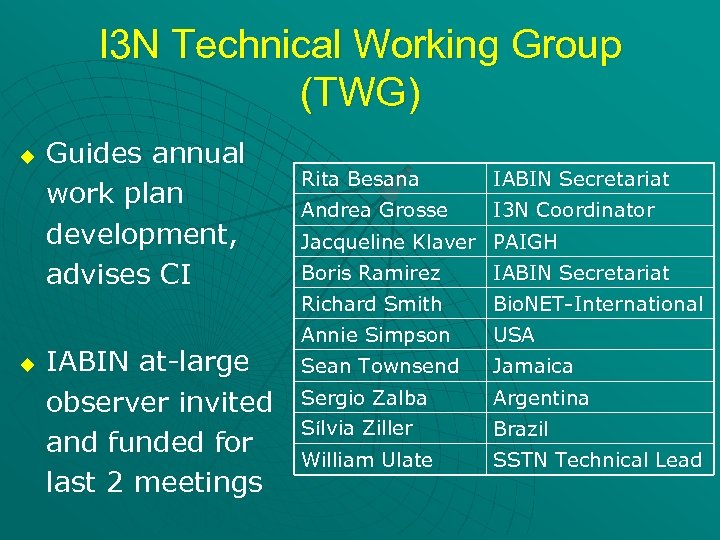
I 3 N Technical Working Group (TWG) u u Guides annual work plan development, advises CI IABIN at-large observer invited and funded for last 2 meetings Rita Besana IABIN Secretariat Andrea Grosse I 3 N Coordinator Jacqueline Klaver PAIGH Boris Ramirez IABIN Secretariat Richard Smith Bio. NET-International Annie Simpson USA Sean Townsend Jamaica Sergio Zalba Sílvia Ziller Argentina William Ulate SSTN Technical Lead Brazil
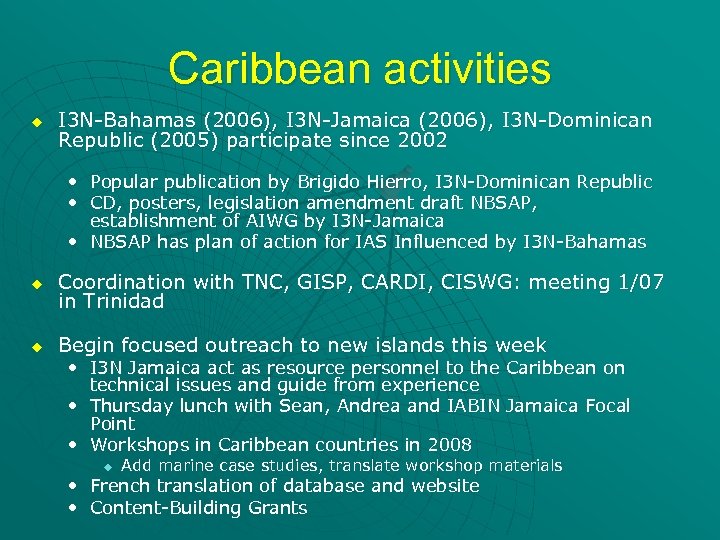
Caribbean activities u I 3 N-Bahamas (2006), I 3 N-Jamaica (2006), I 3 N-Dominican Republic (2005) participate since 2002 • Popular publication by Brigido Hierro, I 3 N-Dominican Republic • CD, posters, legislation amendment draft NBSAP, establishment of AIWG by I 3 N-Jamaica • NBSAP has plan of action for IAS Influenced by I 3 N-Bahamas u Coordination with TNC, GISP, CARDI, CISWG: meeting 1/07 in Trinidad u Begin focused outreach to new islands this week • I 3 N Jamaica act as resource personnel to the Caribbean on technical issues and guide from experience • Thursday lunch with Sean, Andrea and IABIN Jamaica Focal Point • Workshops in Caribbean countries in 2008 u Add marine case studies, translate workshop materials • French translation of database and website • Content-Building Grants
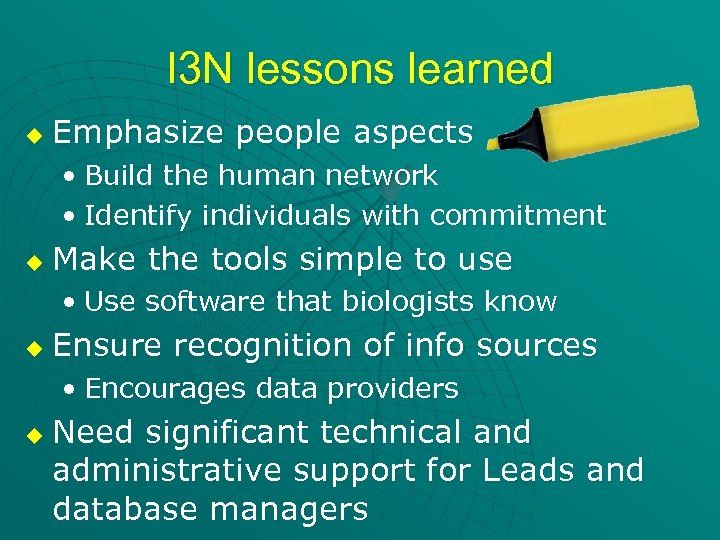
I 3 N lessons learned u Emphasize people aspects • Build the human network • Identify individuals with commitment u Make the tools simple to use • Use software that biologists know u Ensure recognition of info sources • Encourages data providers u Need significant technical and administrative support for Leads and database managers
How I 3 N supports country efforts Workshops u Mini-grants for post-workshop meeting u • Thank you Francisco! Grants u Input to national strategy template u Follow up communication & tech support u
How I 3 N works with other TNs and Catalog u Joint meetings • Sent representatives to TWG meetings of SSTN, PTN • Concurrent meetings (7 -8 May); CIs invited • IABIN at-large observers invited and funded for last 2 TWG meetings u I 3 N IT Lead is also IT Lead for IABIN Catalog and member of IABIN IT TWG
How I 3 N works with other TNs and Catalog (2) u SSTN: representative invited to I 3 N TWG u ETN: I 3 N Coordinator organizes GEOSS ecosystems mapping task (component of ETN) u PTN: CI representatives are also members of I 3 N CI u PATN: I 3 N risk analysis tool will include PATN data
I 3 N needs from Council Encourage countries to join I 3 N and designate national Leads u Provide guidance on facilitating information vs. advocacy u
I 3 N needs from Focal Points Appoint your national I 3 N Lead u Support your Lead u • Advocate data standardization and sharing • Support travel of Lead to meetings • Ask agencies, universities, NGOs to send data to I 3 N Database Manager • Keep Lead informed of relevant initiatives • Facilitate interaction of Lead with other governmental bodies that deal with management of invasive species
I 3 N needs from Focal Points (2) Help create IAS national strategy u Help ensure continued maintenance of DB u Suggest additional tools for decision-making u Disseminate posters, fact sheets, toolkit to governmental institutions, NGOs, universities, and the in-country biological community u
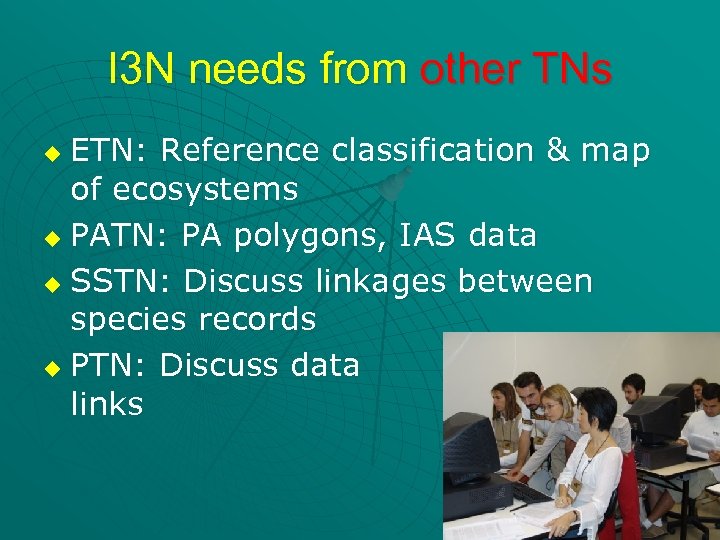
I 3 N needs from other TNs ETN: Reference classification & map of ecosystems u PATN: PA polygons, IAS data u SSTN: Discuss linkages between species records u PTN: Discuss data links u
Our Vision: Slow the spread of IAS! u u u u All countries use & maintain I 3 N Database, Web System, or standards Key national data providers work with Leads Data are online and public Agencies use I 3 N data & tools for analyses, reports, action plans Decision-makers use information on control and prevention methods Countries exchange info on shared species Global organizations value I 3 N data
 Скачать презентацию I 3 N REPORT 5 th IABIN Council
0b999a1bddff9b78f67bf69f1529b0df.ppt