


 Скачать презентацию Hysterical Raisins or What did you do in
1e5e5fabe726257d2a1aabb22fea2883.ppt
- Количество слайдов: 30
 Hysterical Raisins, or What did you do in the OSI Wars, Daddy? …!mcvax!fulcrum!igb igb@uk. co. fulcrum /I=IG/S=Batten/OU=Fulcrum/O=BT Axion/PRMD=UK. CO. BT/ADMD=GOLD 400/C=GB/
 The Obligatory Pitch • Fujitsu Telecommunications – Main provider of optical access to BT – Main provider of x. DSL to BT – 21 CN Access (one of two) – Long legacy, including TPON, M 6000, LA 30, Sync. Mux and those little red and white tents you see in the street.
 My Point of View • At the time, I was running Mail and WAN services for a telecomms and computer manufacturer. • I was also providing some of the development effort in that field. • I was always involved at one remove. • I’m covering 89 -92, when OSI lost and the Internet won.
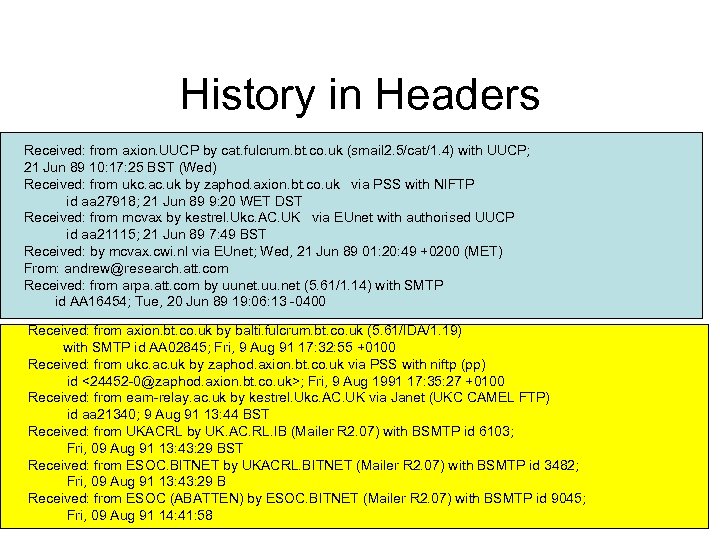 History in Headers Received: from axion. UUCP by cat. fulcrum. bt. co. uk (smail 2. 5/cat/1. 4) with UUCP; 21 Jun 89 10: 17: 25 BST (Wed) Received: from ukc. ac. uk by zaphod. axion. bt. co. uk via PSS with NIFTP id aa 27918; 21 Jun 89 9: 20 WET DST Received: from mcvax by kestrel. Ukc. AC. UK via EUnet with authorised UUCP id aa 21115; 21 Jun 89 7: 49 BST Received: by mcvax. cwi. nl via EUnet; Wed, 21 Jun 89 01: 20: 49 +0200 (MET) From: andrew@research. att. com Received: from arpa. att. com by uunet. uu. net (5. 61/1. 14) with SMTP id AA 16454; Tue, 20 Jun 89 19: 06: 13 -0400 Received: from axion. bt. co. uk by balti. fulcrum. bt. co. uk (5. 61/IDA/1. 19) with SMTP id AA 02845; Fri, 9 Aug 91 17: 32: 55 +0100 Received: from ukc. ac. uk by zaphod. axion. bt. co. uk via PSS with niftp (pp) id <24452 -0@zaphod. axion. bt. co. uk>; Fri, 9 Aug 1991 17: 35: 27 +0100 Received: from earn-relay. ac. uk by kestrel. Ukc. AC. UK via Janet (UKC CAMEL FTP) id aa 21340; 9 Aug 91 13: 44 BST Received: from UKACRL by UK. AC. RL. IB (Mailer R 2. 07) with BSMTP id 6103; Fri, 09 Aug 91 13: 43: 29 BST Received: from ESOC. BITNET by UKACRL. BITNET (Mailer R 2. 07) with BSMTP id 3482; Fri, 09 Aug 91 13: 43: 29 B Received: from ESOC (ABATTEN) by ESOC. BITNET (Mailer R 2. 07) with BSMTP id 9045; Fri, 09 Aug 91 14: 41: 58
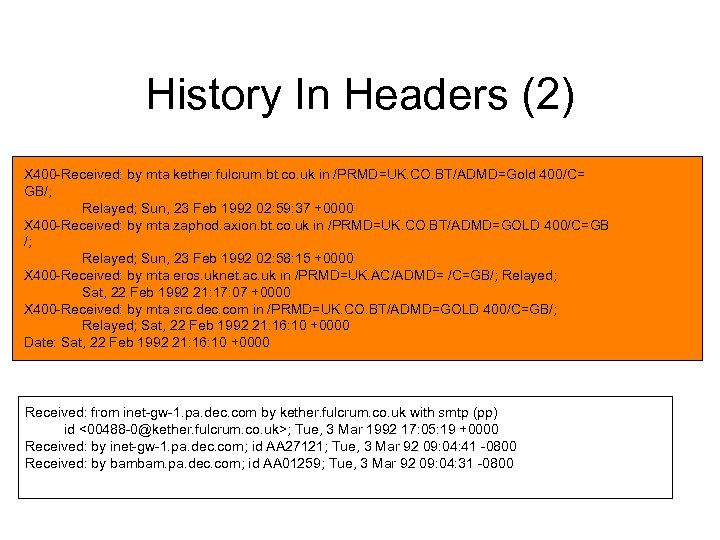 History In Headers (2) X 400 -Received: by mta kether. fulcrum. bt. co. uk in /PRMD=UK. CO. BT/ADMD=Gold 400/C= GB/; Relayed; Sun, 23 Feb 1992 02: 59: 37 +0000 X 400 -Received: by mta zaphod. axion. bt. co. uk in /PRMD=UK. CO. BT/ADMD=GOLD 400/C=GB /; Relayed; Sun, 23 Feb 1992 02: 58: 15 +0000 X 400 -Received: by mta eros. uknet. ac. uk in /PRMD=UK. AC/ADMD= /C=GB/; Relayed; Sat, 22 Feb 1992 21: 17: 07 +0000 X 400 -Received: by mta src. dec. com in /PRMD=UK. CO. BT/ADMD=GOLD 400/C=GB/; Relayed; Sat, 22 Feb 1992 21: 16: 10 +0000 Date: Sat, 22 Feb 1992 21: 16: 10 +0000 Received: from inet-gw-1. pa. dec. com by kether. fulcrum. co. uk with smtp (pp) id <00488 -0@kether. fulcrum. co. uk>; Tue, 3 Mar 1992 17: 05: 19 +0000 Received: by inet-gw-1. pa. dec. com; id AA 27121; Tue, 3 Mar 92 09: 04: 41 -0800 Received: by bambam. pa. dec. com; id AA 01259; Tue, 3 Mar 92 09: 04: 31 -0800
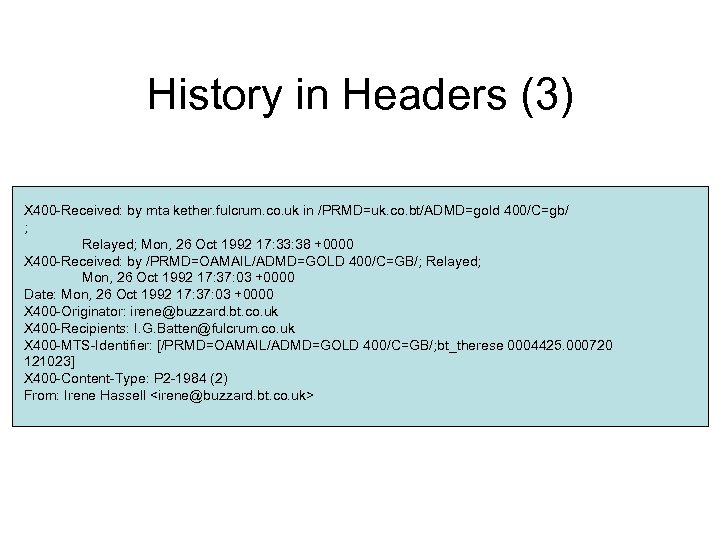 History in Headers (3) X 400 -Received: by mta kether. fulcrum. co. uk in /PRMD=uk. co. bt/ADMD=gold 400/C=gb/ ; Relayed; Mon, 26 Oct 1992 17: 33: 38 +0000 X 400 -Received: by /PRMD=OAMAIL/ADMD=GOLD 400/C=GB/; Relayed; Mon, 26 Oct 1992 17: 37: 03 +0000 Date: Mon, 26 Oct 1992 17: 37: 03 +0000 X 400 -Originator: irene@buzzard. bt. co. uk X 400 -Recipients: I. G. Batten@fulcrum. co. uk X 400 -MTS-Identifier: [/PRMD=OAMAIL/ADMD=GOLD 400/C=GB/; bt_therese 0004425. 000720 121023] X 400 -Content-Type: P 2 -1984 (2) From: Irene Hassell
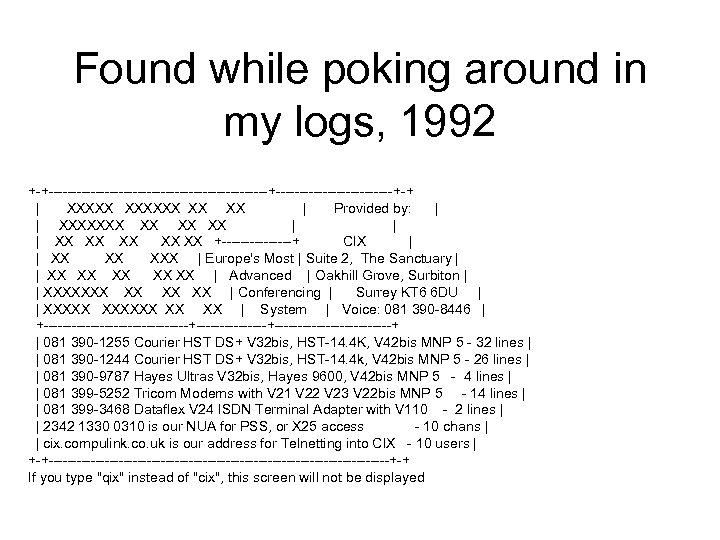 Found while poking around in my logs, 1992 +-+------------------------+-------------+-+ | XXXXXX XX XX | Provided by: | | XXXXXXX XX | | | XX XX XX +--------+ CIX | | XX XX XXX | Europe's Most | Suite 2, The Sanctuary | | XX XX XX | Advanced | Oakhill Grove, Surbiton | | XXXXXXX XX | Conferencing | Surrey KT 6 6 DU | | XXXXXX XX XX | System | Voice: 081 390 -8446 | +----------------+--------------------+ | 081 390 -1255 Courier HST DS+ V 32 bis, HST-14. 4 K, V 42 bis MNP 5 - 32 lines | | 081 390 -1244 Courier HST DS+ V 32 bis, HST-14. 4 k, V 42 bis MNP 5 - 26 lines | | 081 390 -9787 Hayes Ultras V 32 bis, Hayes 9600, V 42 bis MNP 5 - 4 lines | | 081 399 -5252 Tricom Modems with V 21 V 22 V 23 V 22 bis MNP 5 - 14 lines | | 081 399 -3468 Dataflex V 24 ISDN Terminal Adapter with V 110 - 2 lines | | 2342 1330 0310 is our NUA for PSS, or X 25 access - 10 chans | | cix. compulink. co. uk is our address for Telnetting into CIX - 10 users | +-+-------------------------------------+-+ If you type "qix" instead of "cix", this screen will not be displayed
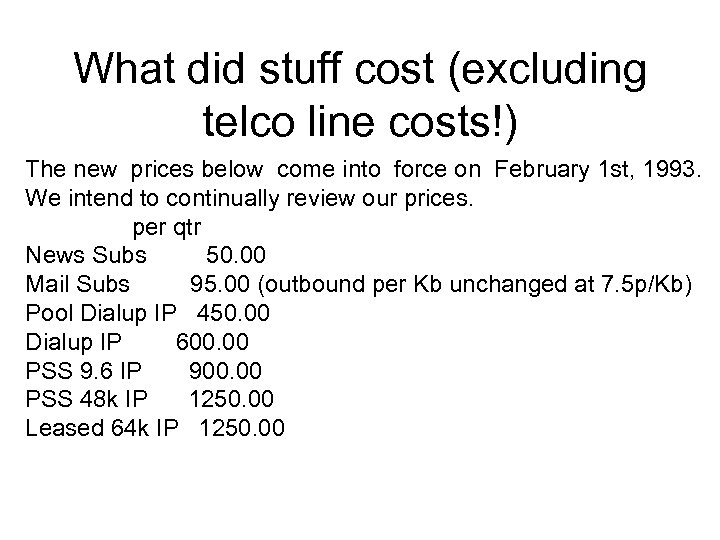 What did stuff cost (excluding telco line costs!) The new prices below come into force on February 1 st, 1993. We intend to continually review our prices. per qtr News Subs 50. 00 Mail Subs 95. 00 (outbound per Kb unchanged at 7. 5 p/Kb) Pool Dialup IP 450. 00 Dialup IP 600. 00 PSS 9. 6 IP 900. 00 PSS 48 k IP 1250. 00 Leased 64 k IP 1250. 00
 What was OSI? • Complete, soup-to-nuts networking solution. • Several lower layers, several transport layers, very complex upper layers. • Main players were telcos, research bodies and national standards bodies. • I’m going to use email (X. 400) as the defining protocol, because FTAM, JTAM et al were never used in production outside niche environments.
 Why did OSI Fail? • An object lesson in the arrogance of standards bodies? • A triumph for rough cons ensus and running code? • Proof of the wonders of the IP stack? • The power of the market at work?
 What did UK networking look like? • Academia: coloured books over Nx 64 or possibly 2 M, Internet post-Shoestring Project (1993? ) • Business: Coloured Books via PSS (very UUCP over dialup (still rare), pretty rare!), Internet post-91. • General public: you must be joking.
 Who was doing mail? • Academia: peer-to-peer with NIFTP • Big Business: peer-to-peer or peer-tohub with NIFTP • Smaller Business: UUCP by nightly dialup • Plus any amount of ad hoc stuff.
 Who were the providers in the 80 s? • ARPAnet for SERC-funded bodies: UCL -CS. ARPA (Steve K, Irene H) • Kent for the rest: (Peter C, Peter H, Ian H) • There was a link from RAL to WISCVM via Bitnet, but it wasn’t reliable and it did EBCDIC conversion!
 What was driving OSI in the UK? • JNT insisted that JANET would transition from Coloured Books to OSI. • Telcos saw it as an opportunity to hold their share. • Government was talked into it by EU and telcos. • Big Business was pushed by government. • No one gave a toss about SME and consumers. • TCP was not universal at the time.
 Addressing • Even email addresses weren’t standard. – igb@uk. co. bt. fulcrum – igb@fulcrum. bt. co. uk – …!mcvax!fulcrum!igb – /I=IG/S=Batten/OU=Fulcrum/O=BT Axion/PRMD=UK. CO. BT/ADMD=GOLD 400/C=GB/ (or something)
 In passing… • One amusing side-line of the period was that the uk. ac. bham. cs vs cs. bham. ac. uk dispute was still rumbling when Czechoslovakia came into email. • Suddenly, ad hoc solutions stopped working. • Imperial, Strathclyde and others adopted `dcs’ instead of `cs’. • But not merely did Greybook die, Czechoslovakia split up!
 What else was out there? • Coloured Books were known to be UKonly and dying. • UUCP still had a huge following. Honey. Dan. Ber had made it respectable, pathalias made it usable. • TCP/IP wasn’t bundled with most operating systems, even Unix ones. • XNS, SNA, DECNet…every vendor…
 What was the threat? • The claim was that all datacomms on government funded or provided networks would be via OSI. • No-one understood OSI well enough to implement, except for the hardcore. • Everyone sensible wanted an Internet connection, but “it will never catch on” My Wife (she said the same of SMS, mind you).
 Was this stuff taken seriously? • Yes. – People were seriously discussing how to, for example, run Usenet via X. 400 mailing lists (presentation at UKUUG conference at UKC, 1988). • It was assumed that all internal email systems would be X. 400. – There were few open alternatives. – P 7 Message Store looked a good alternative to POP, P 7 Plus to IMAP, both of which were fairly rare.
 What would Email have looked like? • Telcos would run email, just like they ran the PSTN. • There was no serious discussion of email for the masses: this was purely a business to business play. • The main stakeholders were providers, not consumers.
 What was the Software? • ISODE: Marshall Rose, Steve Kille, Julian Onions, et al. • PP: Steve, Julian, et al. • Plus any amount of broken or semi-functional vendor stacks, which their heart wasn’t in. • The reputation for bloat was ill-deserved, by the way: we ran PP on a Sun IPC. • And paradoxically, PP was and is probably the best SMTP mailer there’s ever been!
 What was happening IP-wise? • Let’s do this by UKUUG winter conference! – Cardiff ‘ 89: Andrew Findlay advocates X and NFS over WAN, while the JNT state that IP is proprietary and not to be used. – Cambridge ‘ 90: Peter Houlder announces 64 K Internet for £ 25 K plus the circuit to UKC. Peter Dawe talks about the UKIC. Sun 4/330 s are given to Universities to run PP, ready for transition. – Herriot-Watt ‘ 91: Peter H has had about ten takers, but can’t buy a Cisco AGS as the University sees no future in the Internet…
 What about UUCP? • GBNet had over 500 customers • Anyone with a trailblazer modem could meet all the geeks wanted, but they most dialup email was best-efforts via willing volunteers (axion, stc, fulcrum)
 Who was using OSI? • X. 400 worked-ish, and small numbers of companies were using it in low volume. • X. 500 for practical purposes had failed, so there was no directory. Manual download of PRMD information. • DNS was now working well (no hosts. txt file!), so the failure of X. 500 looked unforgivable. • Fulcrum was taking all its email via X. 400(88). I believe we were the only ones!
 So what killed OSI? • Lower layers: – multiple, non-interworking transport services. – caused by pandering to various telco interests with various legacy estate – incomprehensible addressing structures
 The Killers, Named • Upper Layers – “Profiles” which meant that multiple implementations of the same standard could be non-interworking – Standards written without regard to implementation – Standards codifying low-quality research, not highquality experience. – Incomprehensible addressing structures – The failure of X. 500 – The `need’ to interwork Telex, fax, Videotex…
 The role of the standards bodies • A desire to cover all cases, in all scenarios. • A refusal to say no to any stakeholder. • No realisation of how the world was going (away from incumbent telcos, towards market liberalisation) • Never again would anyone push an unproven standard. Until SNMP, HTML 3. 0…
 The role of government • Perhaps in the Cold War, government could say “there’s no business like our business” • But in the 90 s and beyond, government followed the market, not vice versa • So outside the Mo. D, the government had to follow business.
 The rise of The Internet • It’s about content, dummy. • Having an Internet connection let you speak to real users, OSI just meant talking about OSI. – Amateur Radio vs CB. So says G 1 FVC • Anyone could implement TCP/IP for their OS, but OSI was close to impossible. • Demon and KA 9 Q together probably provided several nails for the OSI coffin. • Tim Berners-Lee hammered them in.
 It’s not dead yet, Jim • TL/1 over OSI is still the default management technology for SDH transmission kit, in an exchange near you. • X. 400 has acquired a raft of security extras, and PP is still heavily used in that space. • Exchange (I’m dimly aware of the concept, although I’ve never used it) is under the hood an X. 400 MHS.