


 Скачать презентацию Hypernucleus Formation in High-Energy Nuclear Collisions T Gaitanos
c2b1fc722110c3ee723326c380cf8a78.ppt
- Количество слайдов: 10
 Hypernucleus Formation in High-Energy Nuclear Collisions T. Gaitanos, H. Lenske, U. Mosel Introduction The Giessen-BUU (Gi. BUU) transport model Formation of fragments and hyperfragments Applications Heavy-Ion-Collisions (A+A@3 AGe. V) Final remarks & outlook DPG-Frühjahrstagung, 12 -16 März 2007 mit dem Fachverband: Hadronen und Kerne work supported by BMBF
 Introduction… At high hyperons may play an important role in neutronstars Consequence: modified EOS modified masses and radii… Knowledge of the Y-N and YY interaction? So far mainly from nuclear structure single- hypernuclei near stability region Info on hyperons in neutron rich matter/nuclei needed Study of hypernucleus in reactions exotic Hypernuclei Wakai, Bando, Sano, PRC 38(1988)748, Wakai, NPA 547(1992)89 c, and others… Hypernucleus production accessible in reactions (future experiments): Heavy-Ion-Collisions (Hyp. HI-project, GSI) Hyp. HI-project Main topic of this talk Antiproton-Nucleus (PANDA-project, GSI) PANDA-project Outlook, in progress…
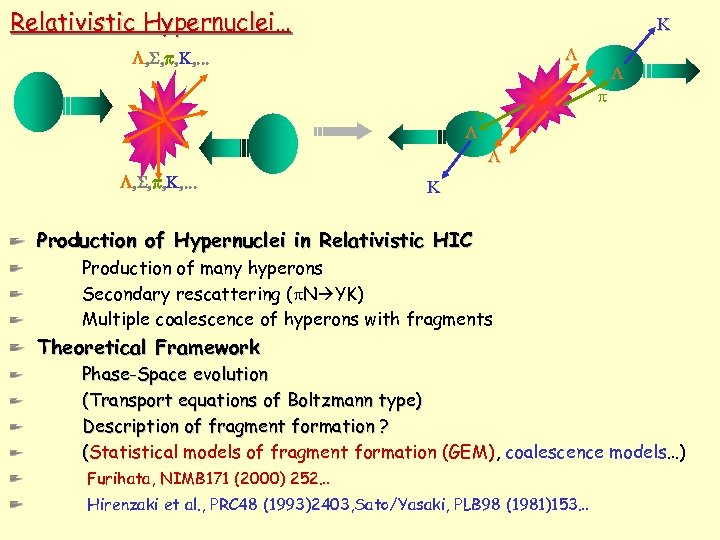 Relativistic Hypernuclei… K L, S, p, K, . . . p p L, S, p, K, . . . K Production of Hypernuclei in Relativistic HIC Production of many hyperons Secondary rescattering (p. N YK) Multiple coalescence of hyperons with fragments Theoretical Framework Phase-Space evolution (Transport equations of Boltzmann type) Description of fragment formation ? (Statistical models of fragment formation (GEM), coalescence models…) Furihata, NIMB 171 (2000) 252… Hirenzaki et al. , PRC 48 (1993)2403, Sato/Yasaki, PLB 98 (1981)153…
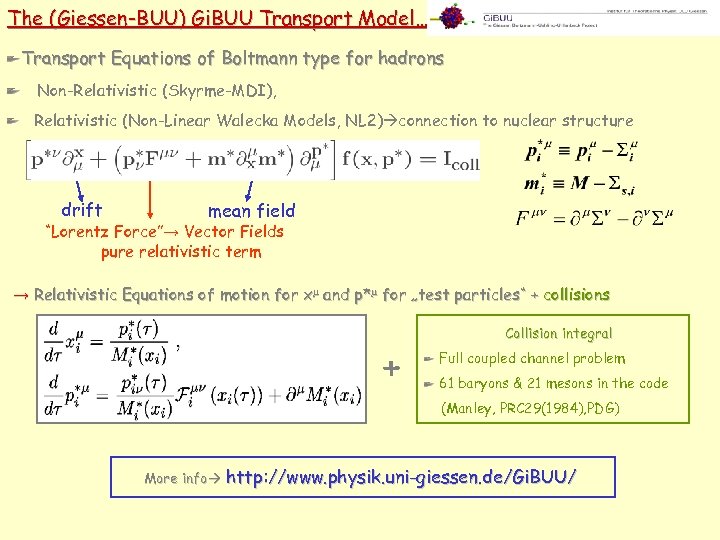 The (Giessen-BUU) Gi. BUU Transport Model… Transport Equations of Boltmann type for hadrons Non-Relativistic (Skyrme-MDI), Relativistic (Non-Linear Walecka Models, NL 2) connection to nuclear structure drift mean field “Lorentz Force”→ Vector Fields pure relativistic term → Relativistic Equations of motion for xm and p*m for „test particles“ + collisions + Collision integral Full coupled channel problem 61 baryons & 21 mesons in the code (Manley, PRC 29(1984), PDG) More info http: //www. physik. uni-giessen. de/Gi. BUU/
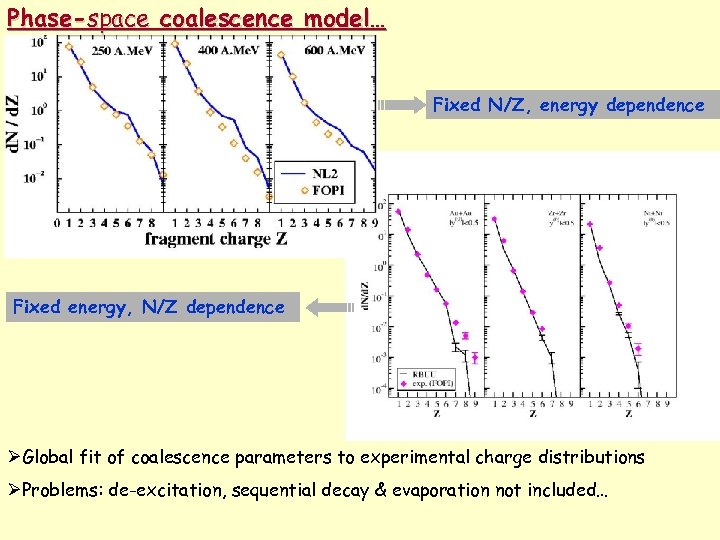 Phase-space coalescence model… Fixed N/Z, energy dependence Fixed energy, N/Z dependence ØGlobal fit of coalescence parameters to experimental charge distributions ØProblems: de-excitation, sequential decay & evaporation not included…
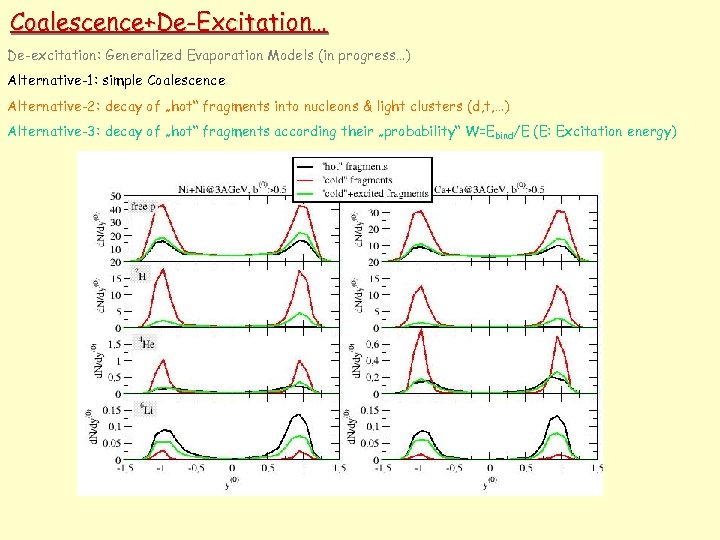 Coalescence+De-Excitation… De-excitation: Generalized Evaporation Models (in progress…) Alternative-1: simple Coalescence Alternative-2: decay of „hot“ fragments into nucleons & light clusters (d, t, …) Alternative-3: decay of „hot“ fragments according their „probability“ W=Ebind/E (E: Excitation energy)
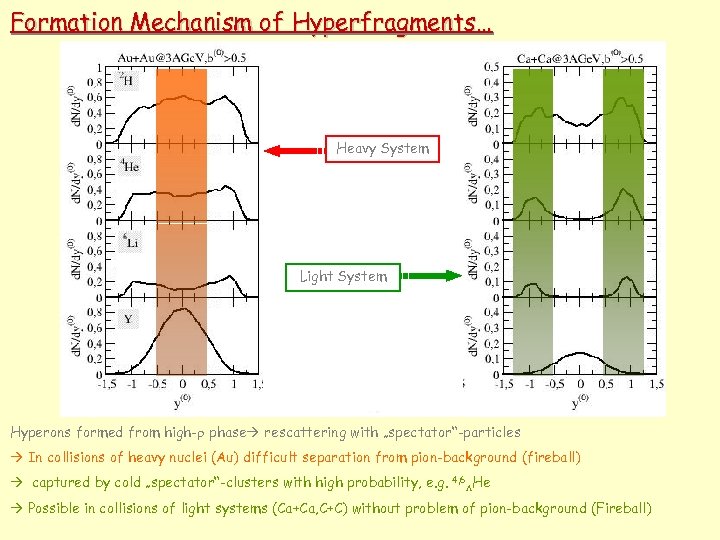 Formation Mechanism of Hyperfragments… Heavy System Light System Hyperons formed from high- phase rescattering with „spectator“-particles In collisions of heavy nuclei (Au) difficult separation from pion-background (fireball) captured by cold „spectator“-clusters with high probability, e. g. 4, 6 He Possible in collisions of light systems (Ca+Ca, C+C) without problem of pion-background (Fireball)
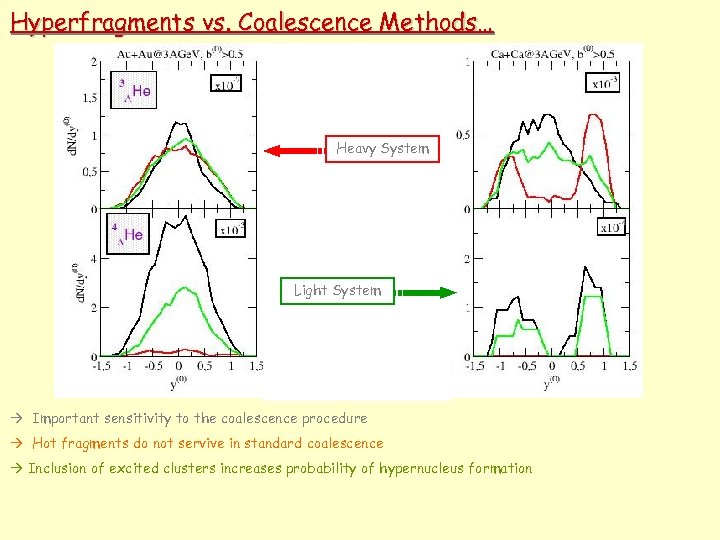 Hyperfragments vs. Coalescence Methods… Heavy System Light System Important sensitivity to the coalescence procedure Hot fragments do not servive in standard coalescence Inclusion of excited clusters increases probability of hypernucleus formation
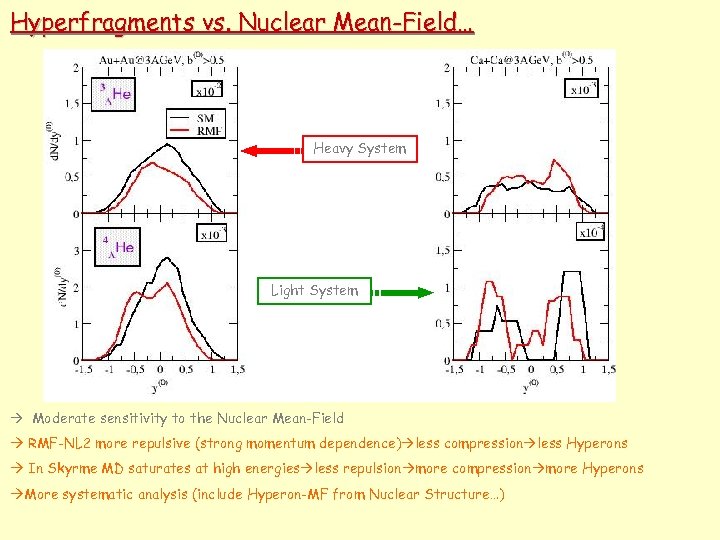 Hyperfragments vs. Nuclear Mean-Field… Heavy System Light System Moderate sensitivity to the Nuclear Mean-Field RMF-NL 2 more repulsive (strong momentum dependence) less compression less Hyperons In Skyrme MD saturates at high energies less repulsion more compression more Hyperons More systematic analysis (include Hyperon-MF from Nuclear Structure…)
 Conclusions & Outlook… Hypernucleus Formation in Relativistic HIC Hypernucleus production with moderate probabilities Particularly important separation from “coctail”-background in collisions of light systems Sensitivities Phase-Space Coalescence (needs comparison with data!) Mean-Field dynamics moderately affects Hypernucleus production In progress More sophisticated models of Nuclear Structure (Density-Dependent Hadronic Field Theory for Baryons…) Performe same Analysis also for Antiproton-Nucleus Collisions (PANDA) Inclusion of Evaporation Models (GEM) important… Inclusion of Nucleon-Antinucleon cross sections…