 Скачать презентацию Hygiene of the inhabited places Soil and health
e9303138e0f1fd1e5a1bf6f26f397cd1.ppt
- Количество слайдов: 55



Hygiene of the inhabited places. Soil and health. Problems of protecting the soil. Hygiene of dwelling. Microclimate, heating, ventilation Hygiene of natural and artificial illumination in apartments. .
1. Introduction. 2. Soil and health. Problems of protecting the soil. 3. Hygiene of dwelling. Microclimate, heating, ventilation. 4. Hygiene of natural and artificial illumination in apartments

Soil may be defined as the fine earth covering land surfaces that has the important function of serving as a substratum of plain, animal, and human life. Soil essence of our being. Soil by volume, on the average consists of 45% mineral, 25% water, 25% air and 5% organic matter (both living and dead organisms).

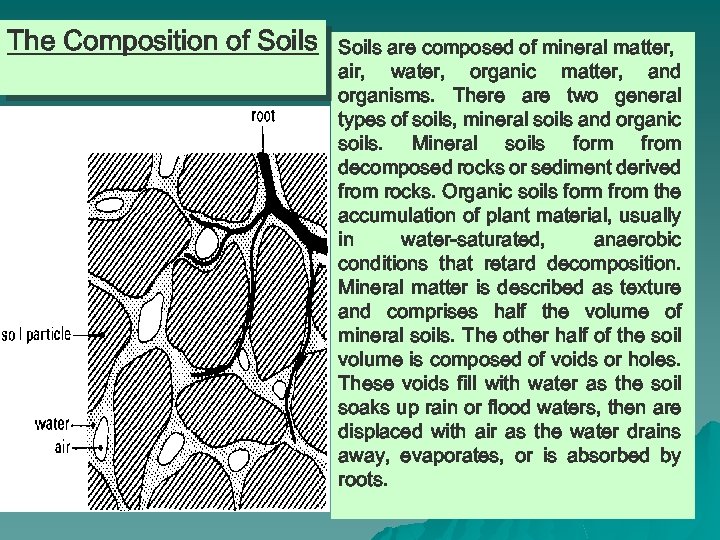
The Composition of Soils are composed of mineral matter, air, water, organic matter, and organisms. There are two general types of soils, mineral soils and organic soils. Mineral soils form from decomposed rocks or sediment derived from rocks. Organic soils form from the accumulation of plant material, usually in water-saturated, anaerobic conditions that retard decomposition. Mineral matter is described as texture and comprises half the volume of mineral soils. The other half of the soil volume is composed of voids or holes. These voids fill with water as the soil soaks up rain or flood waters, then are displaced with air as the water drains away, evaporates, or is absorbed by roots.

Both plants and animals help to create a soil. As they die, organic matter incorporates with the weathered parent material and becomes part of the soil. Eastern Mole Nemotode (Round Worm) Amoeba Root Fungus Bacteria Night Crawler Beetle Mite

There are many functions provided by soil that are important to human beings. Soil is necessary for: v dwellings vhighways vairports vrecreation areas v it also provides road fill v material for water retention structures vand fulfils many other essential functions.
Soil pollution is associated mainly with: • 1. The use of chemicals, such as fertilizers and growth-regulating agents, in agriculture; 3. The dumping on land of domestic refuse and solids resulting from the treatment of sewage and industrial wastes. 2. The dumping on land of large masses of waste materials from the mining of coal and minerals and the smelting of metals. Toxic or harmful substances can be leached out of such materials and enter the soil; 4. The soil is thus becoming increasingly polluted with chemicals, including heavy metals and products of the petroleum industry, which can reach the food chain, surface water, or ground water, and ultimately be ingested by man.
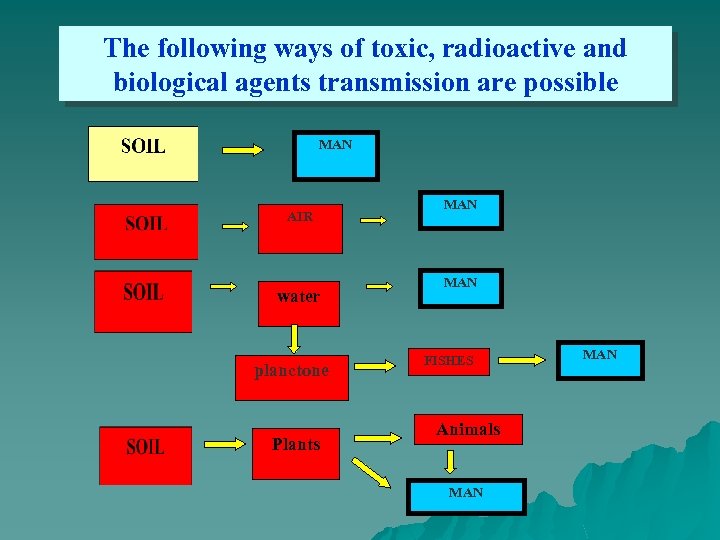
The following ways of toxic, radioactive and biological agents transmission are possible MAN AIR water planctone Plants MAN FISHES Animals MAN
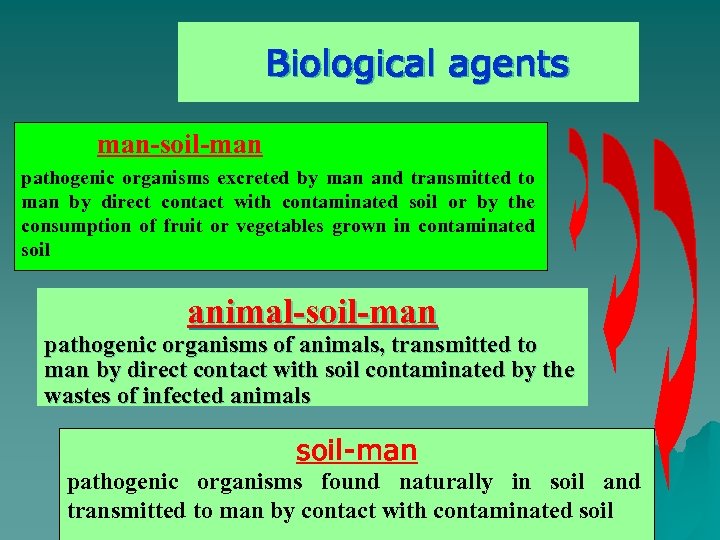
Biological agents man-soil-man pathogenic organisms excreted by man and transmitted to man by direct contact with contaminated soil or by the consumption of fruit or vegetables grown in contaminated soil animal-soil-man pathogenic organisms of animals, transmitted to man by direct contact with soil contaminated by the wastes of infected animals soil-man pathogenic organisms found naturally in soil and transmitted to man by contact with contaminated soil
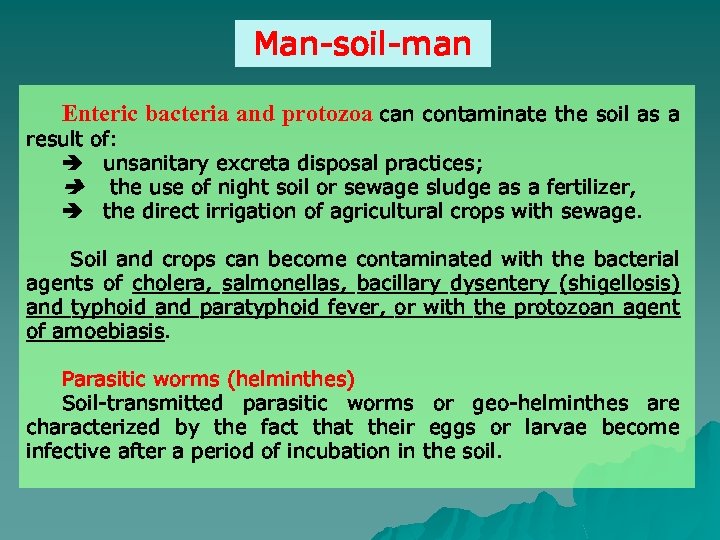
Man-soil-man Enteric bacteria and protozoa can contaminate the soil as a result of: unsanitary excreta disposal practices; the use of night soil or sewage sludge as a fertilizer, the direct irrigation of agricultural crops with sewage. Soil and crops can become contaminated with the bacterial agents of cholera, salmonellas, bacillary dysentery (shigellosis) and typhoid and paratyphoid fever, or with the protozoan agent of amoebiasis. Parasitic worms (helminthes) Soil-transmitted parasitic worms or geo-helminthes are characterized by the fact that their eggs or larvae become infective after a period of incubation in the soil.
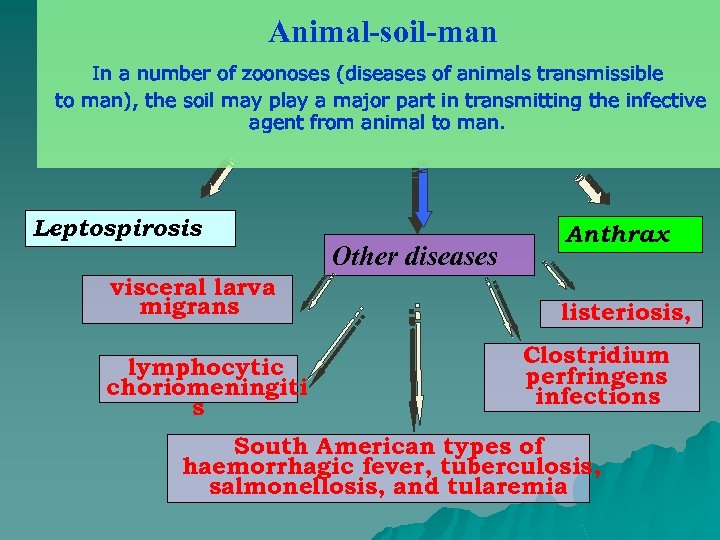
Animal-soil-man In a number of zoonoses (diseases of animals transmissible to man), the soil may play a major part in transmitting the infective agent from animal to man. Leptospirosis visceral larva migrans lymphocytic choriomeningiti s Other diseases Anthrax listeriosis, Clostridium perfringens infections South American types of haemorrhagic fever, tuberculosis, salmonellosis, and tularemia
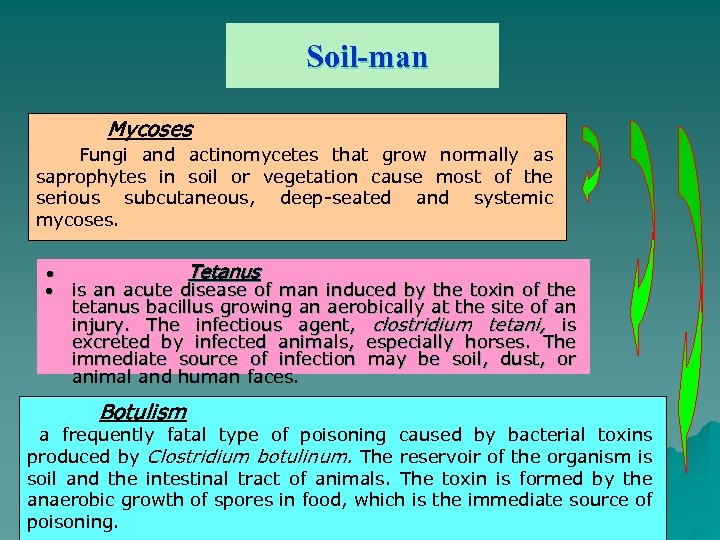
Soil-man Mycoses Fungi and actinomycetes that grow normally as saprophytes in soil or vegetation cause most of the serious subcutaneous, deep-seated and systemic mycoses. • • Tetanus is an acute disease of man induced by the toxin of the tetanus bacillus growing an aerobically at the site of an injury. The infectious agent, clostridium tetani, is excreted by infected animals, especially horses. The immediate source of infection may be soil, dust, or animal and human faces. Botulism a frequently fatal type of poisoning caused by bacterial toxins produced by Clostridium botulinum. The reservoir of the organism is soil and the intestinal tract of animals. The toxin is formed by the anaerobic growth of spores in food, which is the immediate source of poisoning.
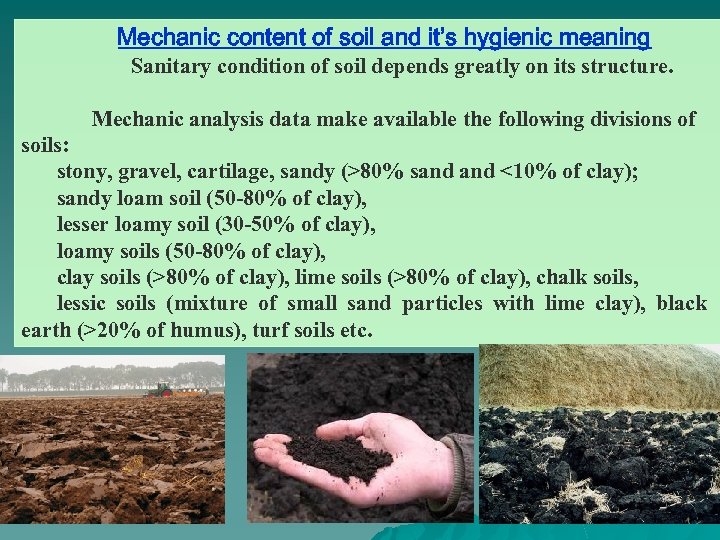
Mechanic content of soil and it’s hygienic meaning Sanitary condition of soil depends greatly on its structure. Mechanic analysis data make available the following divisions of soils: stony, gravel, cartilage, sandy (>80% sand <10% of clay); sandy loam soil (50 -80% of clay), lesser loamy soil (30 -50% of clay), loamy soils (50 -80% of clay), clay soils (>80% of clay), lime soils (>80% of clay), chalk soils, lessic soils (mixture of small sand particles with lime clay), black earth (>20% of humus), turf soils etc.
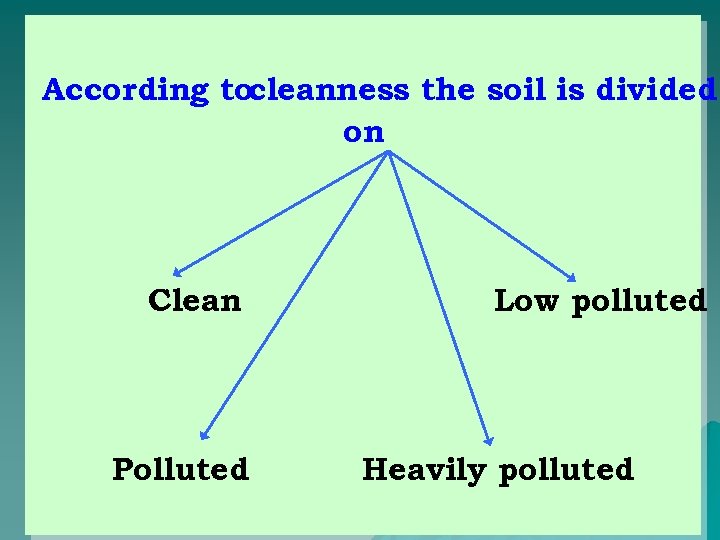
According tocleanness the soil is divided on Clean Polluted Low polluted Heavily polluted

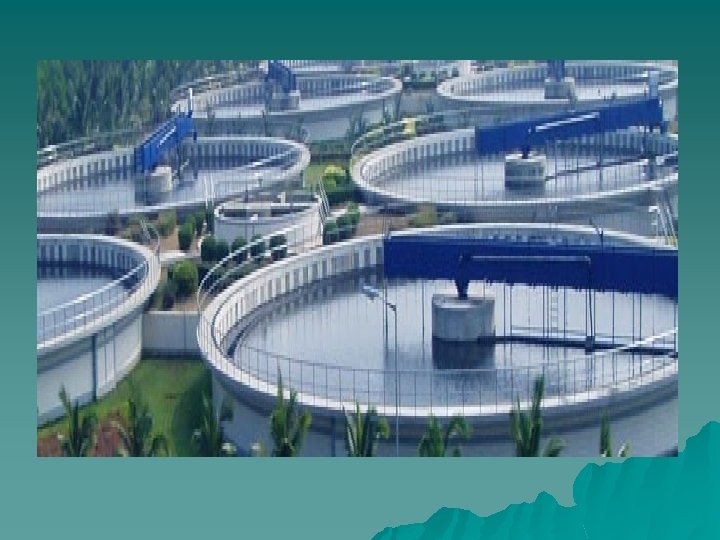
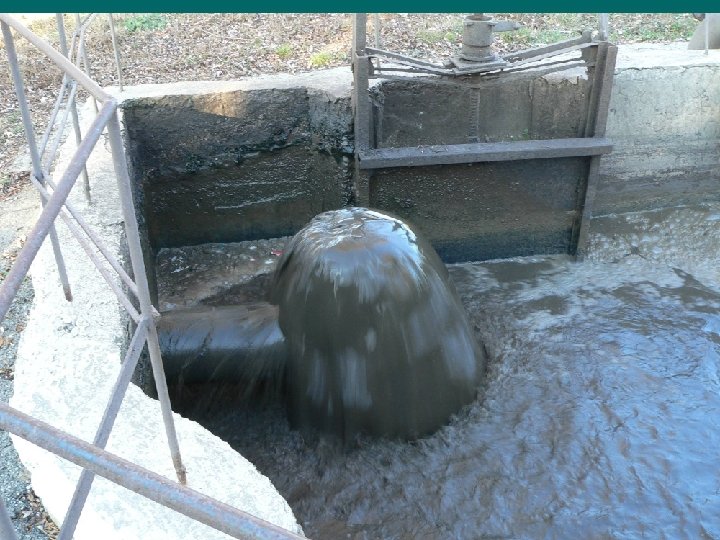
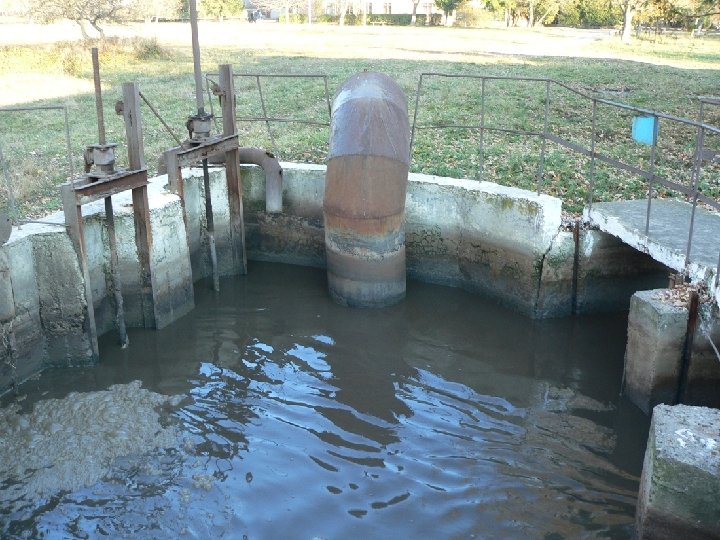
Sewage
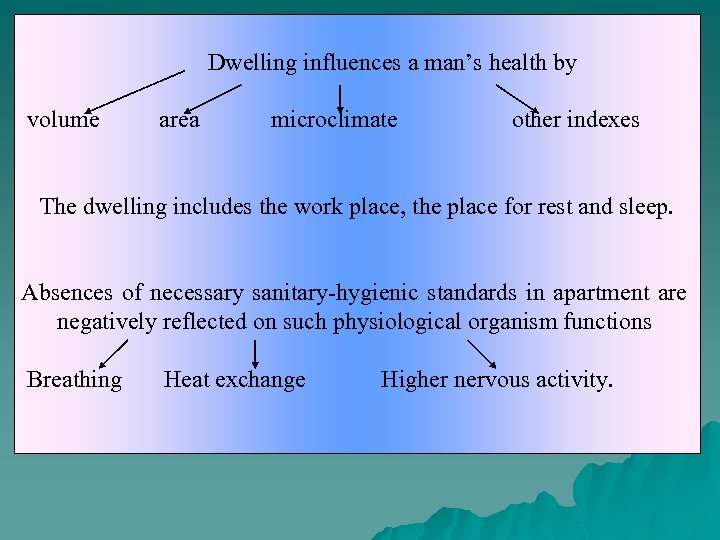
Dwelling influences a man’s health by volume area microclimate other indexes The dwelling includes the work place, the place for rest and sleep. Absences of necessary sanitary-hygienic standards in apartment are negatively reflected on such physiological organism functions Breathing Heat exchange Higher nervous activity.
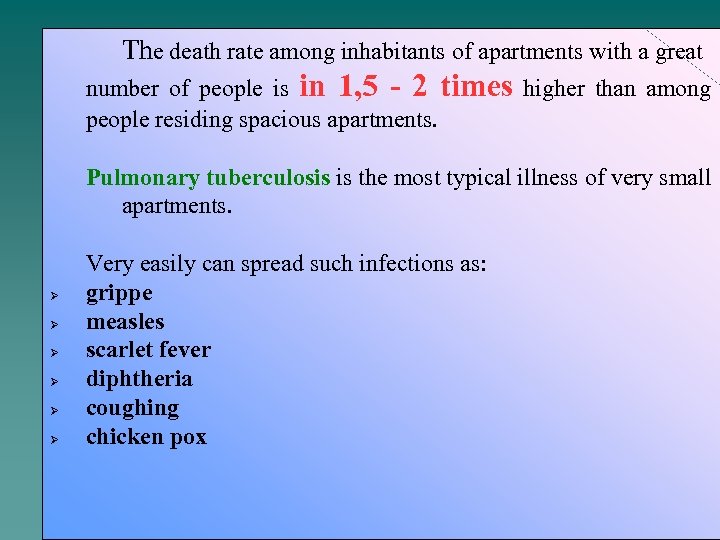
The death rate among inhabitants of apartments with a great number of people is in 1, 5 - 2 times higher than among people residing spacious apartments. Pulmonary tuberculosis is the most typical illness of very small apartments. Very easily can spread such infections as: grippe measles scarlet fever diphtheria coughing chicken pox
The dwelling, which corresponds to hygienic norms, is : • ought to be sufficiently spacious, • dry, • to have a favorable microclimate, • clean air, • to be well lighted by sunrays.
The dwelling functions for people are: satisfaction of physiological needs (sleeping, personal hygiene, eating, physical training and sport) communication and cultural activity (rest, entertainments, communication of family members) education and bringing up of children housekeeping (cooking, cleaning, washing) professional activity, self-education, amateur activities.
Microclimate of dwelling places Temperature In winter temperature in apartment has to be 18 -20 0 C (for moderate latitude). Relative humidity (with air temperature 18 -200 С) has to be 40 -60 %. Speed of air has to be not more then 0, 2 -0, 3 m/s Acceptable microclimate - person can wear light clothes and shoes, stay for a long time without many moves and have no unpleasant feelings such as freezing or overheating.
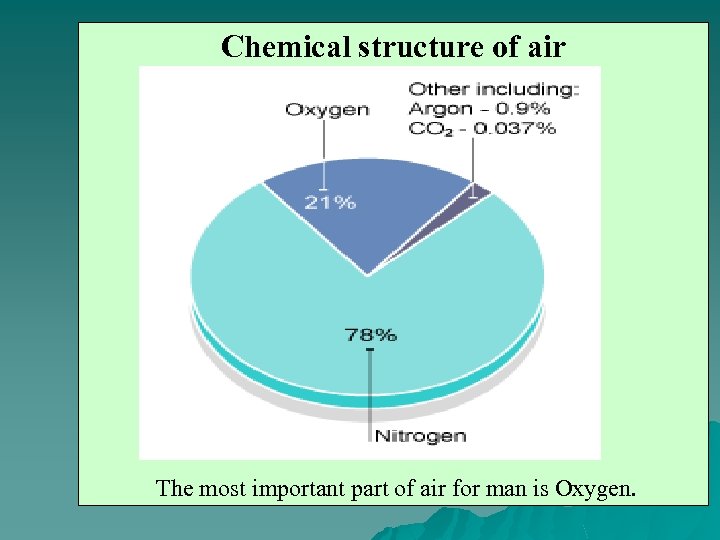
Chemical structure of air The most important part of air for man is Oxygen.
Carbon dioxide Contents of carbon dioxide gas in atmospheric air is relatively permanent - 0, 03 -0, 04 %. СО 2 does not congest in air and excludes from it with rainfalls (1 l of rain-water contains about 1 -2 ml СО 2), reacts with seawater, forming carbon dioxide salts and, usually, collapses by chlorophyll plants. A concentration of СО 2 in air in closed, badly ventilated dwellings rises up because of peoples’ breathing.
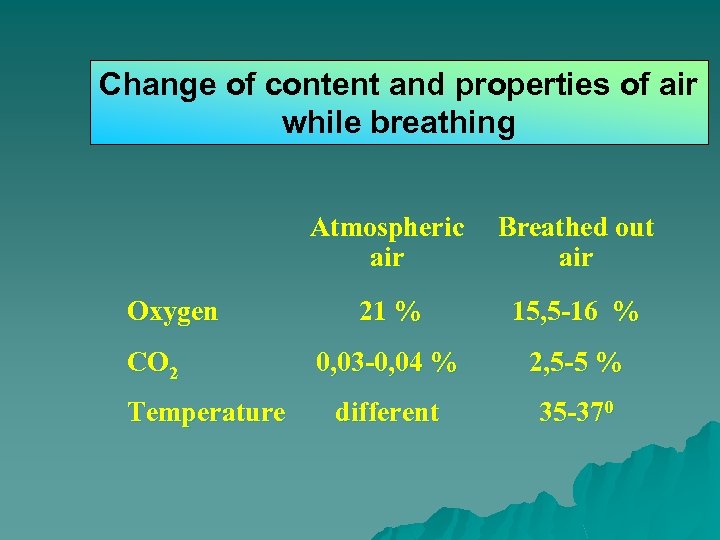
Change of content and properties of air while breathing Atmospheric Breathed out air Oxygen СО 2 Temperature 21 % 15, 5 -16 % 0, 03 -0, 04 % 2, 5 -5 % different 35 -370
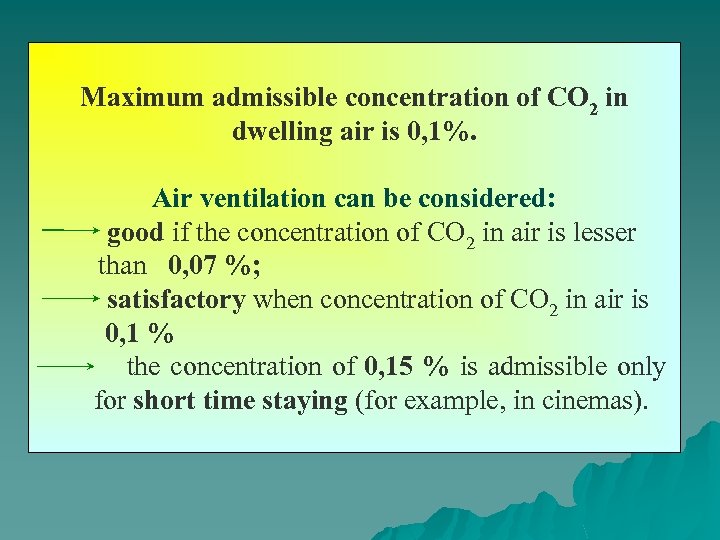
Maximum admissible concentration of СО 2 in dwelling air is 0, 1%. Air ventilation can be considered: good if the concentration of СО 2 in air is lesser than 0, 07 %; satisfactory when concentration of СО 2 in air is 0, 1 % the concentration of 0, 15 % is admissible only for short time staying (for example, in cinemas).
Carbon Monoxide (CO) Carbon monoxide is an odorless, colorless and toxic gas. At lower levels of exposure, CO causes mild effects that are often mistaken for the flu. These symptoms include: headaches, dizziness, disorientation, nausea fatigue.

Levels CO in Homes Admissible concentration of carbon oxide gas in house is 0, 002 mg per liter of air. • Middle amount of carbon oxide gas in air attached to yellow flame is 0, 045 mg per litre of air. Middle amount of carbon oxide gas in air attached to blue flame is 0, 001 mg per litre of air. •
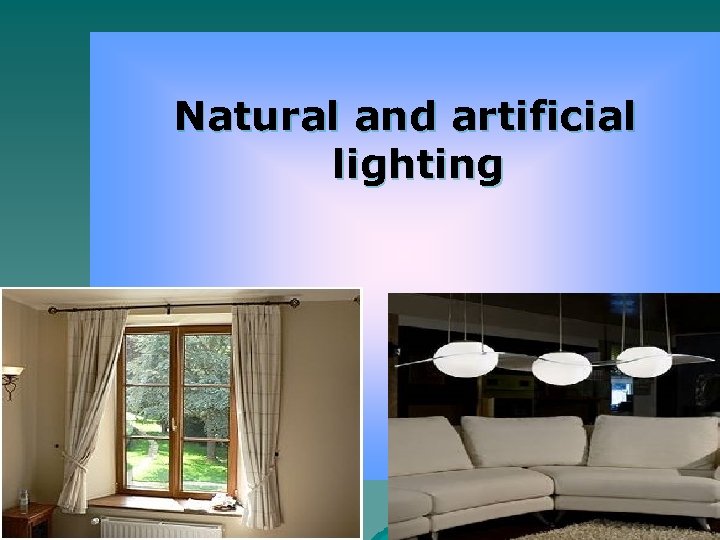
Natural and artificial lighting
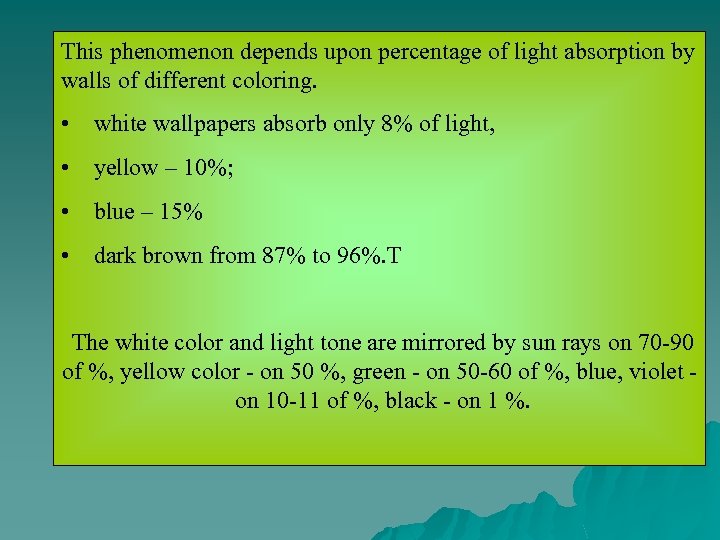
This phenomenon depends upon percentage of light absorption by walls of different coloring. • white wallpapers absorb only 8% of light, • yellow – 10%; • blue – 15% • dark brown from 87% to 96%. T The white color and light tone are mirrored by sun rays on 70 -90 of %, yellow color - on 50 %, green - on 50 -60 of %, blue, violet - on 10 -11 of %, black - on 1 %.
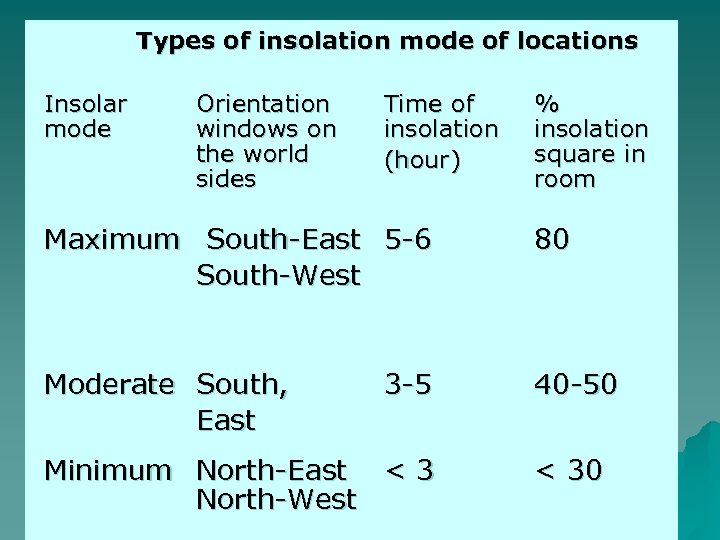
Types of insolation mode of locations Insolar mode Orientation windows on the world sides Maximum South-East South-West Moderate South, East Time of insolation (hour) % insolation square in room 5 -6 80 3 -5 40 -50 Minimum North-East < 3 North-West < 30
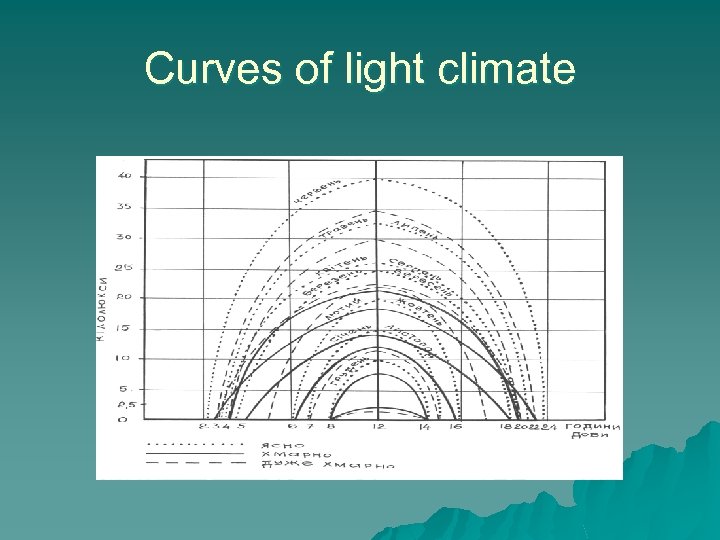
Curves of light climate
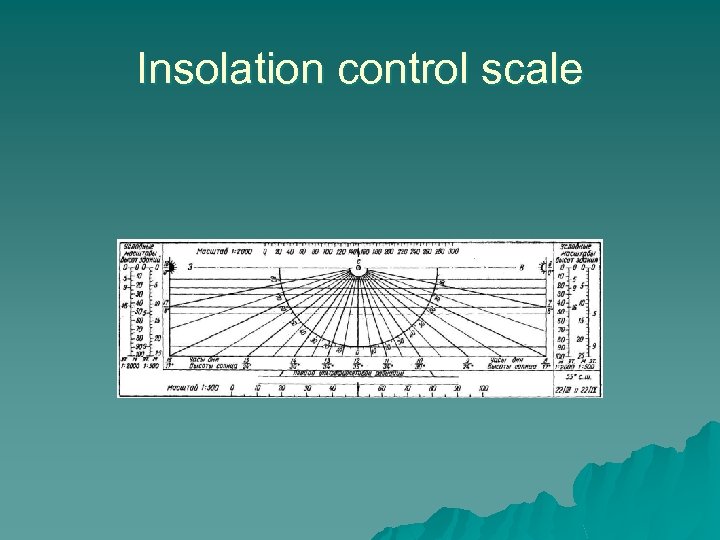
Insolation control scale
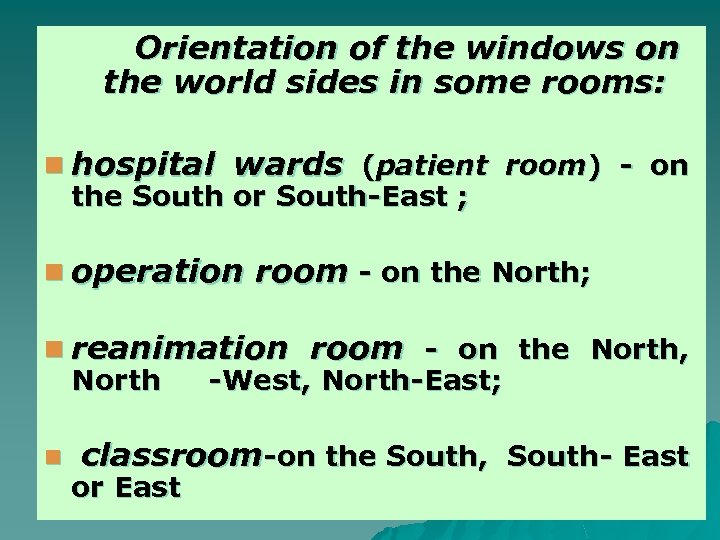
Orientation of the windows on the world sides in some rooms: hospital wards (patient room) - on the South or South-East ; operation room - on the North; reanimation room - on the North, North -West, North-East; classroom-on the South, South- East or East
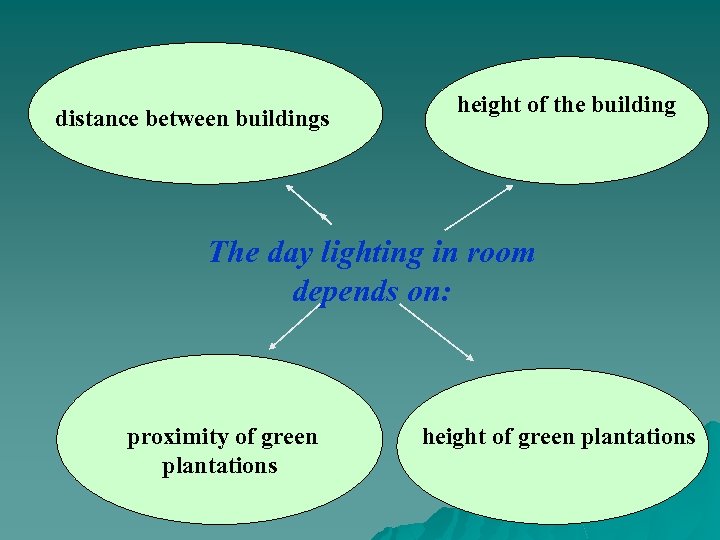
distance between buildings height of the building The day lighting in room depends on: proximity of green plantations height of green plantations
Factors that influences on intensity and duration of daylight of rooms are: 1. The size of the windows, 2. Form of the windows, 3. Disposition of the windows. The upper edge of windows is necessary to be as higher as it is possible.
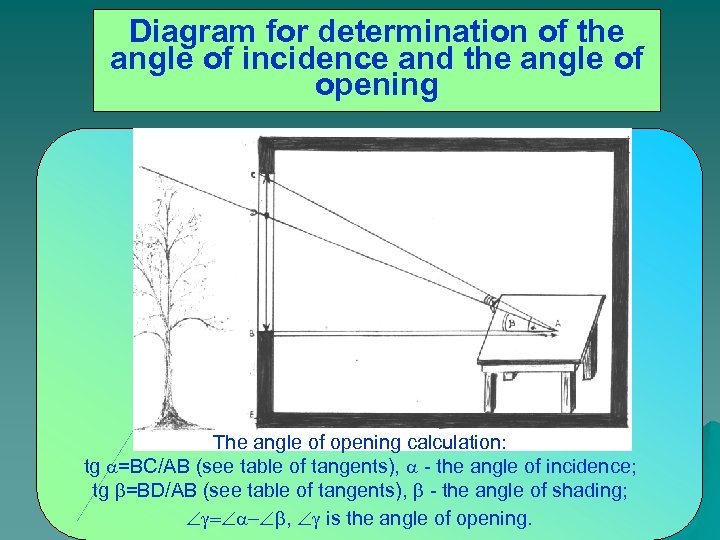
Diagram for determination of the angle of incidence and the angle of opening The angle of opening calculation: tg =BC/AB (see table of tangents), - the angle of incidence; tg =BD/AB (see table of tangents), - the angle of shading; , is the angle of opening.
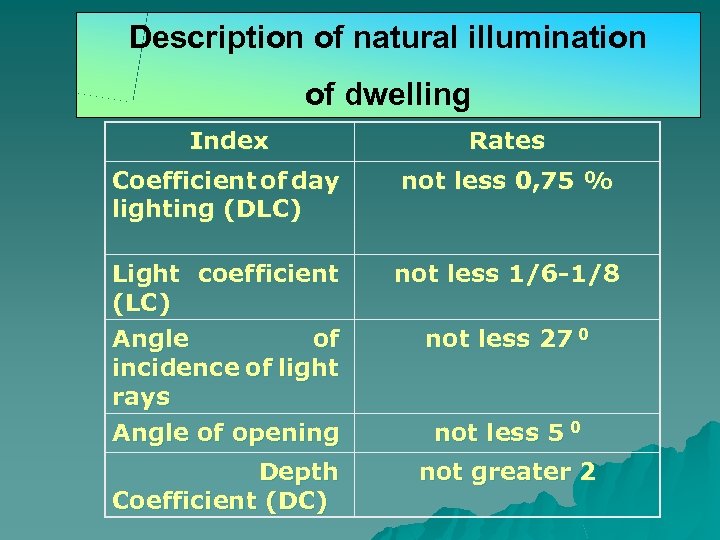
Description of natural illumination of dwelling Index Rates Coefficient of day lighting (DLC) not less 0, 75 % Light coefficient (LC) Angle of incidence of light rays Angle of opening not less 1/6 -1/8 Depth Coefficient (DC) not greater 2 not less 27 0 not less 5 0
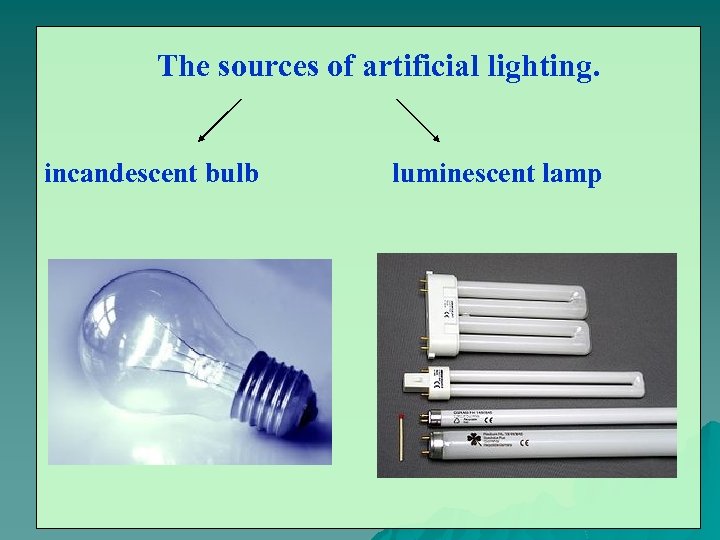
The sources of artificial lighting. incandescent bulb luminescent lamp
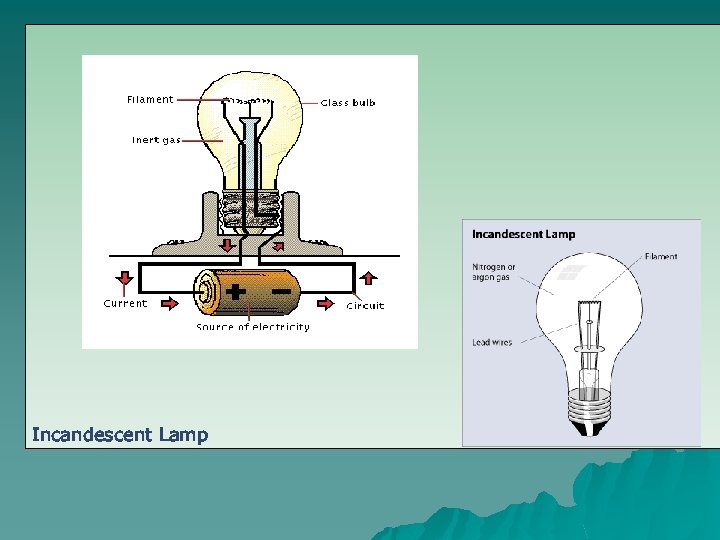
Incandescent Lamp
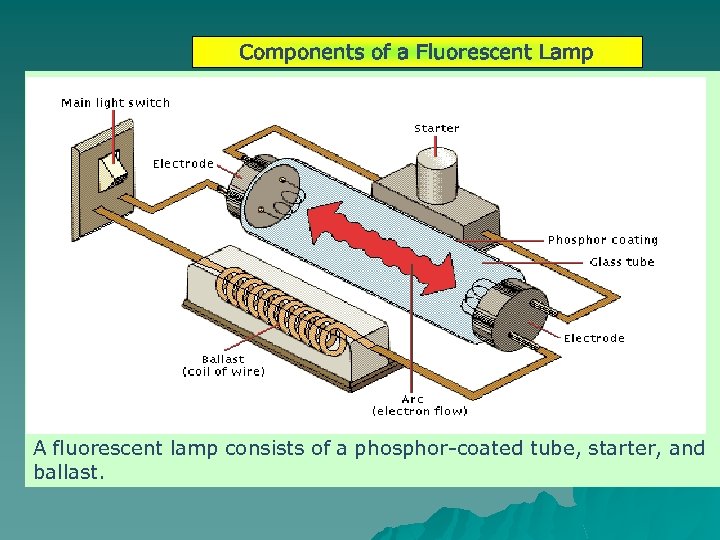
Components of a Fluorescent Lamp A fluorescent lamp consists of a phosphor-coated tube, starter, and ballast.
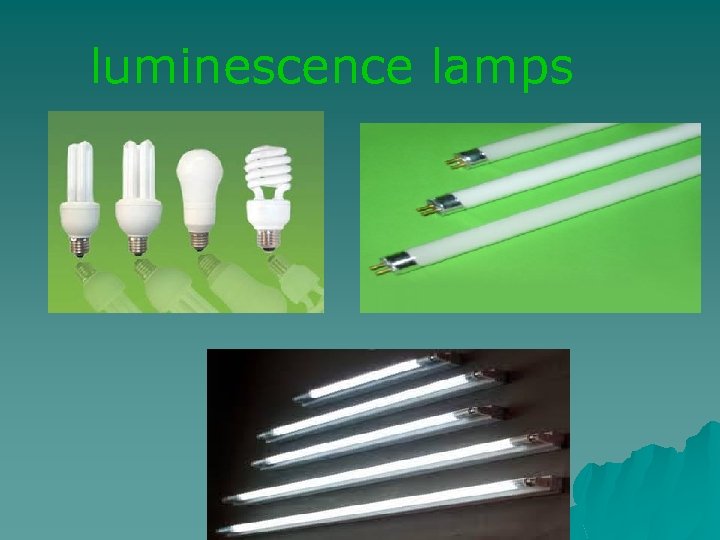
luminescence lamps
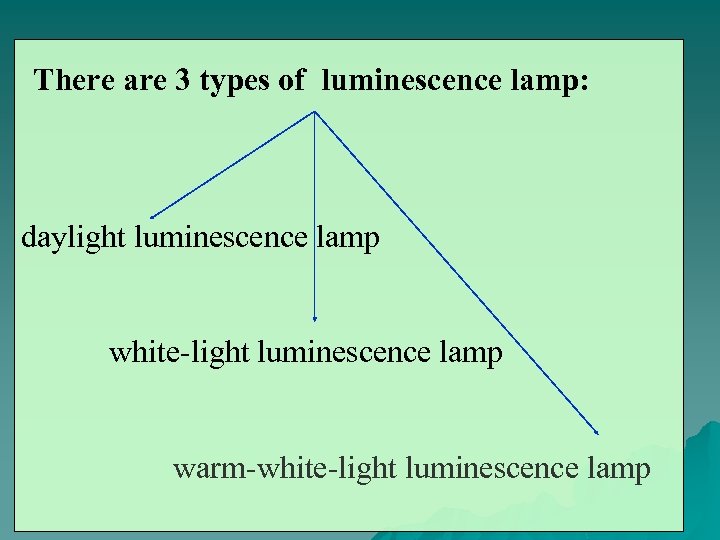
There are 3 types of luminescence lamp: daylight luminescence lamp white-light luminescence lamp warm-white-light luminescence lamp
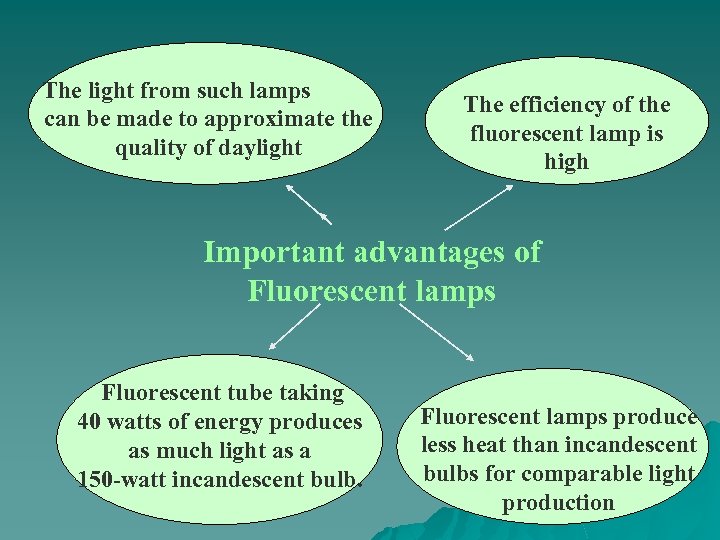
The light from such lamps can be made to approximate the quality of daylight The efficiency of the fluorescent lamp is high Important advantages of Fluorescent lamps Fluorescent tube taking 40 watts of energy produces as much light as a 150 -watt incandescent bulb. Fluorescent lamps produce less heat than incandescent bulbs for comparable light production
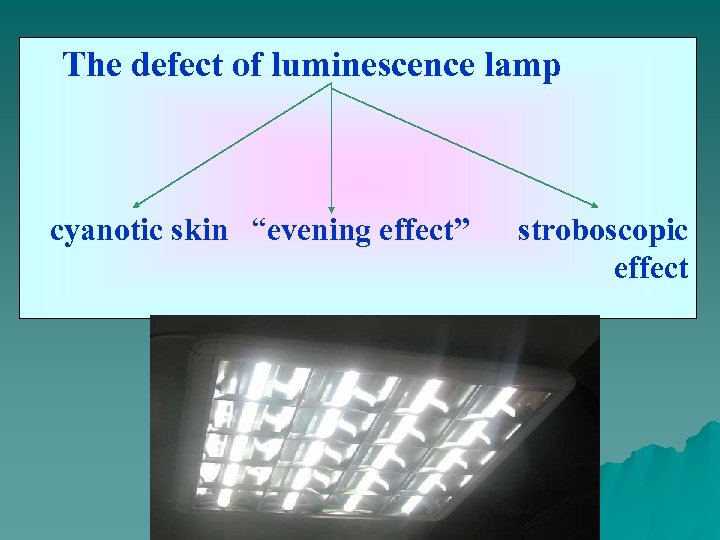
The defect of luminescence lamp cyanotic skin “evening effect” stroboscopic effect
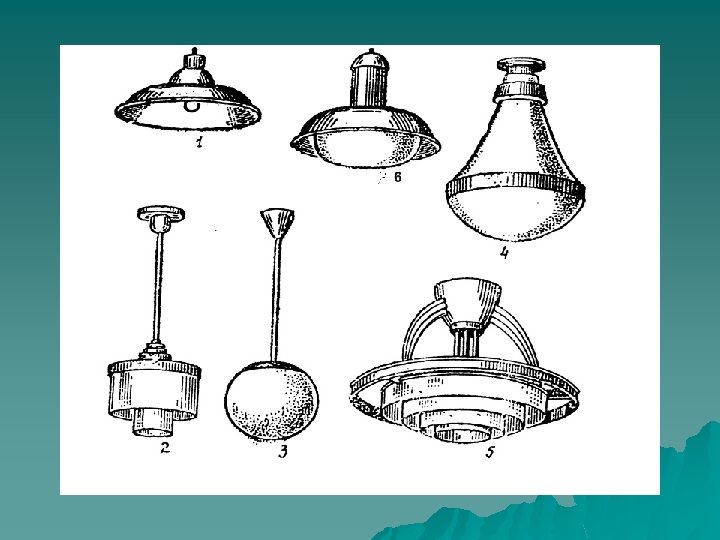
Fluorescent lamps
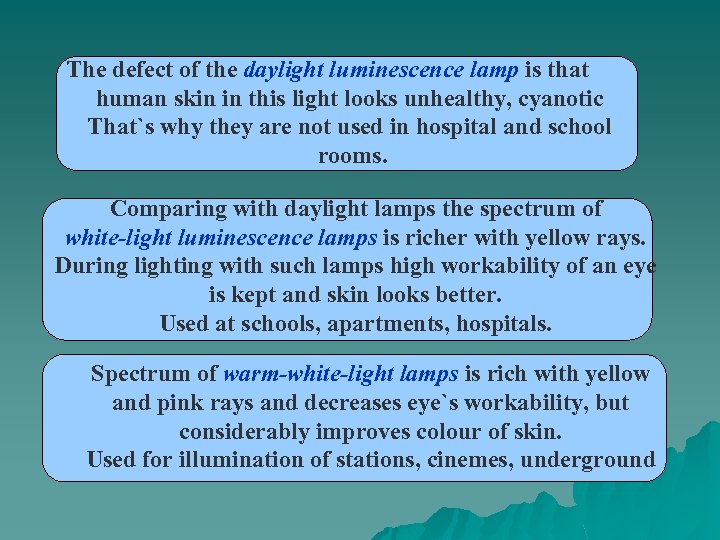
The defect of the daylight luminescence lamp is that human skin in this light looks unhealthy, cyanotic That`s why they are not used in hospital and school rooms. Comparing with daylight lamps the spectrum of white-light luminescence lamps is richer with yellow rays. During lighting with such lamps high workability of an eye is kept and skin looks better. Used at schools, apartments, hospitals. Spectrum of warm-white-light lamps is rich with yellow and pink rays and decreases eye`s workability, but considerably improves colour of skin. Used for illumination of stations, cinemes, underground
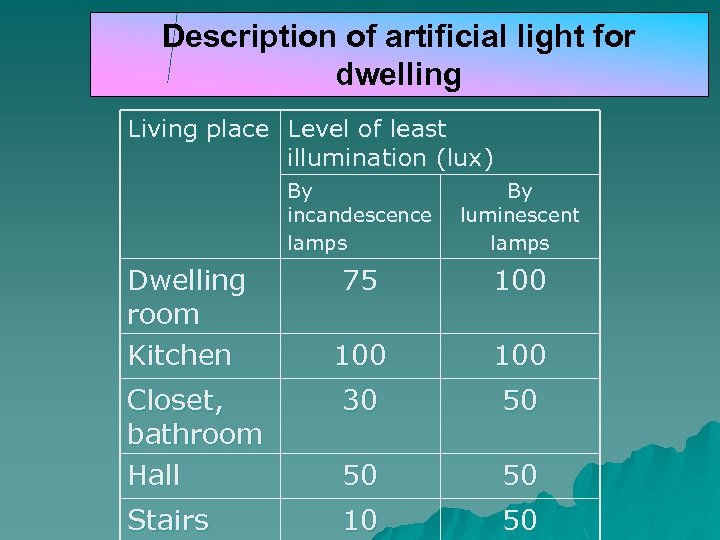
Description of artificial light for dwelling Living place Level of least illumination (lux) By incandescence lamps By luminescent lamps 75 100 100 Closet, bathroom Hall 30 50 50 50 Stairs 10 50 Dwelling room Kitchen
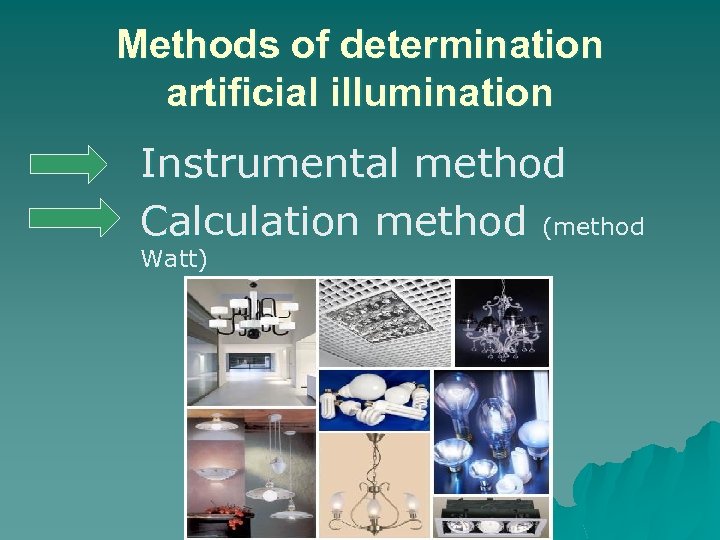
Mеthods of determination artificial illumination Instrumental method Calculation method (method Watt)
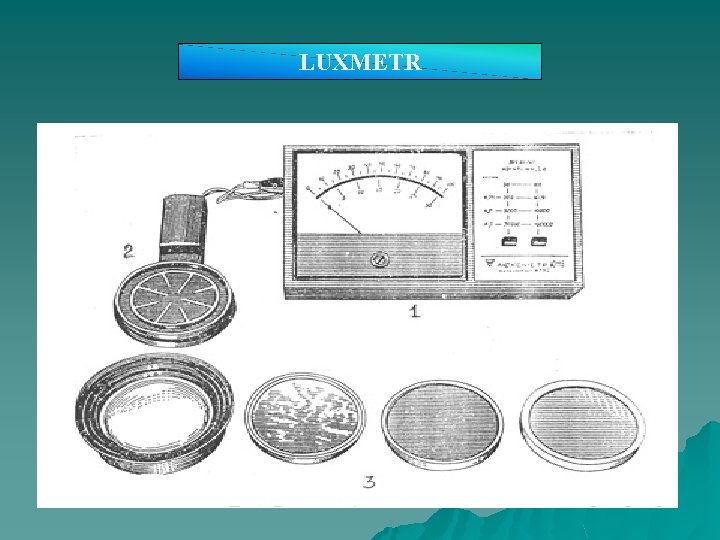
LUXMETR
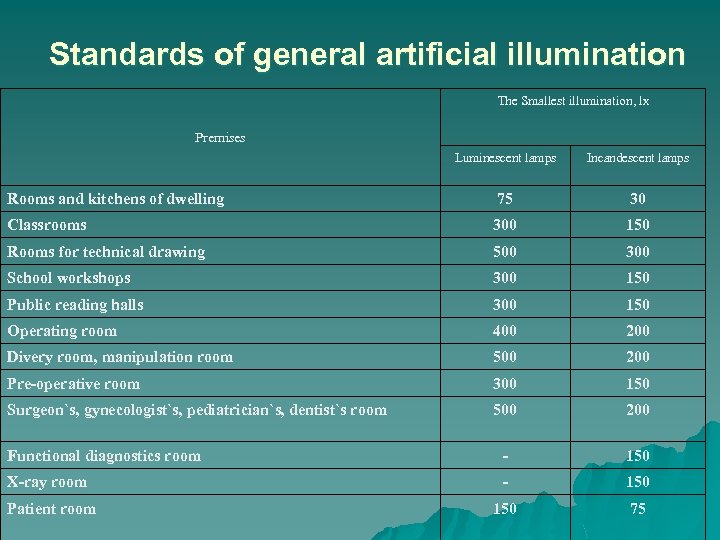
Standards of general artificial illumination The Smallest illumination, lx Premises Luminescent lamps Incandescent lamps Rooms and kitchens of dwelling 75 30 Classrooms 300 150 Rooms for technical drawing 500 300 School workshops 300 150 Public reading halls 300 150 Operating room 400 200 Divery room, manipulation room 500 200 Pre-operative room 300 150 Surgeon`s, gynecologist`s, pediatrician`s, dentist`s room 500 200 Functional diagnostics room - 150 X-ray room - 150 75 Patient room

thank you for your attention!
Скачать презентацию Hygiene of the inhabited places Soil and health
e9303138e0f1fd1e5a1bf6f26f397cd1.ppt