


 Скачать презентацию HYGIA Design and Application of New Techniques of
7ce30c12b724bfc032b1aa3b152608cb.ppt
- Количество слайдов: 13
 HYGIA: Design and Application of New Techniques of Artificial Intelligence for the Acquisition and Use of Represented Medical Knowledge as Care Pathways David Riaño María Taboada Marcos Begoña Martínez Albert Alonso
 Outline Summary of the project Consortium Objectives Achievements The ten remaining Tasks Conclusions TIN 2006 -15453 -c 04 jsp. TIN 2009, Friday Feb 20 th 2009, Madrid • • •
 Summary of the Project TIN 2006 -15453 -c 04 jsp. TIN 2009, Friday Feb 20 th 2009, Madrid • Clinical practice guidelines (CPG) reflect the best scientific evidence for clinical handling of patients with a concrete pathology. They have a direct impact in the quality and standardization of health-care but their application is below the desirable level. • In order to increase their use, Care Pathways (CPs) operative versions of CPGs in a certain segment of patients and concrete healthcare context are set out. • In this project we propose the use of Intelligent Systems in the processes of acquiring, formalizing, adapting, using and assessing knowledge models that describe CPs. • Electronic CPs are obtained and used by intelligent agents to facilitate health-care decision making.
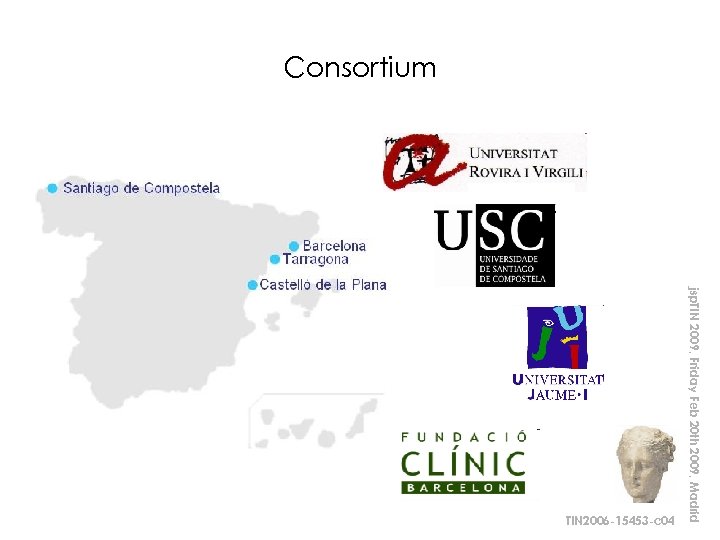 Consortium jsp. TIN 2009, Friday Feb 20 th 2009, Madrid TIN 2006 -15453 -c 04
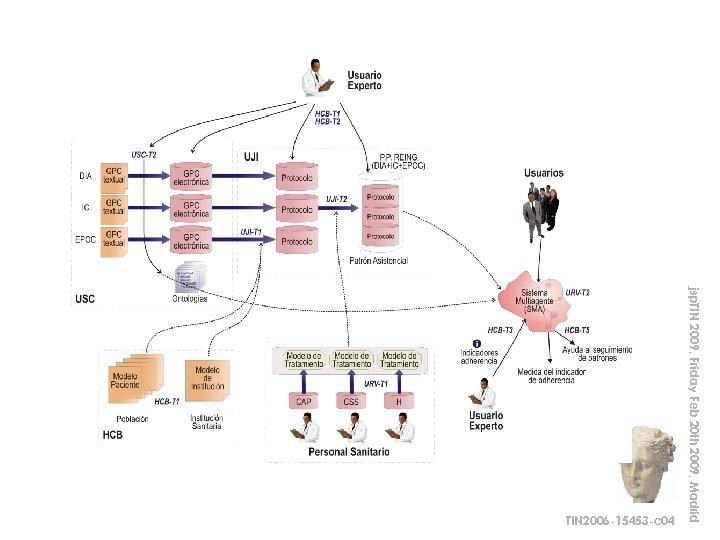
 Objectives TIN 2006 -15453 -c 04 jsp. TIN 2009, Friday Feb 20 th 2009, Madrid O 1. Design and implementation of a set of tools to automate, as far as possible, the knowledge acquisition from textual CPG documents. O 2. Proposal of a methodological framework to develop electronic protocols from electronic CPGs. O 3. Proposal of a methodological framework to develop CPs from electronic protocols and other additional resources, such as the data stored in hospital databases. O 4. New inductive learning algorithms to generate health-care knowledge from data of medical interventions stored in hospital databases, and using ontologies providing the semantics of the medical domain of the guideline. O 5. Utilization of these knowledge structures or CPs for health-care decision support by means of a multi-agent system (MAS) that interprets this knowledge within the institutional context in which the medical activity is carried out. O 6. Identification and evaluation of the adherence degree by health-care professionals to multi-pathology CPs resulting from the technologies integrated in the project, applied to a programme for chronic patient care.
 jsp. TIN 2009, Friday Feb 20 th 2009, Madrid TIN 2006 -15453 -c 04
 Achievements I • Knowledge-Engineering approaches based on Natural Language Processing techniques, terminologies and ontologies – Acquisition of ontology concepts from GPC documents – Automated generation of ontology relationships • Automated recognition of some diagnosis relationships • Automated recognition of some therapy relationships • Verification and validation on CHF and COPD GPCs TIN 2006 -15453 -c 04 jsp. TIN 2009, Friday Feb 20 th 2009, Madrid • Automated recognition of diagnosis entities • Automated recognition of therapy entities • Verification and validation on CHF and COPD GPCs
 Achievements II • Methodologies for knowledge engineering – Analysis of alternatives to represent electronic CPGs, protocols and CPs – A CP-oriented approach to obtain protocols from CPGs – A CP-oriented approach to obtain CPs from protocols – These contemplate: • Knowledge acquisition of a CP for the prevention of exacerbations in stable COPD and CHF patients • Development of electronic CPs that support the management of comorbidities. This is the result of 1) development of general protocols for each condition considered and 2) analysis of historical data TIN 2006 -15453 -c 04 jsp. TIN 2009, Friday Feb 20 th 2009, Madrid • Definition of reusable CP fragments • Methodological guidelines to integrate electronic CP fragments using CPG tools • Strategies to apply formal methods to the integration of CP fragments
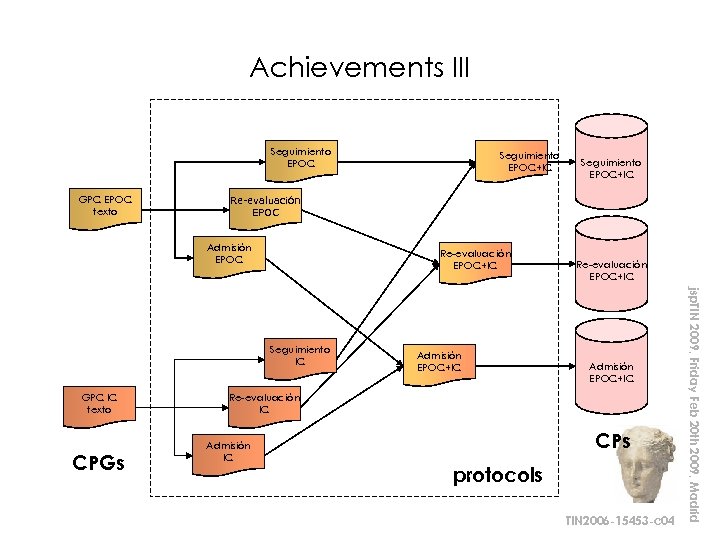 Achievements III Seguimiento EPOC GPC EPOC texto Re-evaluación EPOC+IC Admisión EPOC+IC Re-evaluación IC Admisión IC CPs protocols TIN 2006 -15453 -c 04 jsp. TIN 2009, Friday Feb 20 th 2009, Madrid Seguimiento IC CPGs Seguimiento EPOC+IC Re-evaluación EPOC Admisión EPOC GPC IC texto Seguimiento EPOC+IC
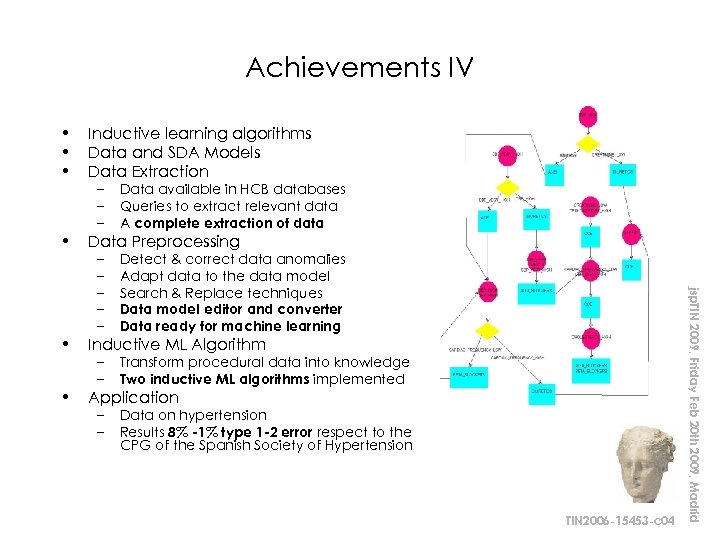 Achievements IV • • • Inductive learning algorithms Data and SDA Models Data Extraction • Data Preprocessing • Inductive ML Algorithm • Application – – – – Detect & correct data anomalies Adapt data to the data model Search & Replace techniques Data model editor and converter Data ready for machine learning Transform procedural data into knowledge Two inductive ML algorithms implemented Data on hypertension Results 8% -1% type 1 -2 error respect to the CPG of the Spanish Society of Hypertension TIN 2006 -15453 -c 04 jsp. TIN 2009, Friday Feb 20 th 2009, Madrid – – – Data available in HCB databases Queries to extract relevant data A complete extraction of data
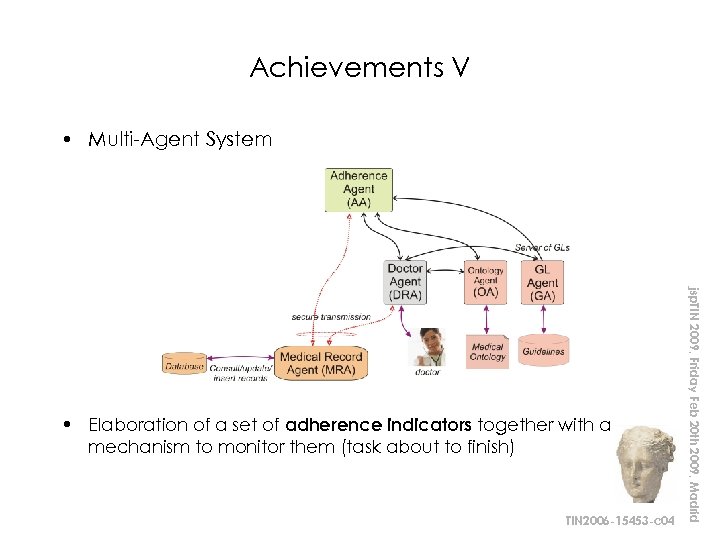 Achievements V • Multi-Agent System TIN 2006 -15453 -c 04 jsp. TIN 2009, Friday Feb 20 th 2009, Madrid • Elaboration of a set of adherence indicators together with a mechanism to monitor them (task about to finish)
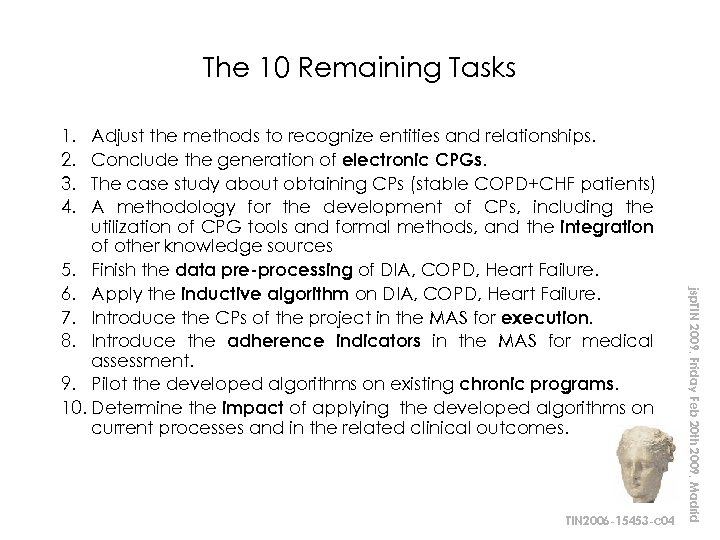 The 10 Remaining Tasks 1. 2. 3. 4. TIN 2006 -15453 -c 04 jsp. TIN 2009, Friday Feb 20 th 2009, Madrid Adjust the methods to recognize entities and relationships. Conclude the generation of electronic CPGs. The case study about obtaining CPs (stable COPD+CHF patients) A methodology for the development of CPs, including the utilization of CPG tools and formal methods, and the integration of other knowledge sources 5. Finish the data pre-processing of DIA, COPD, Heart Failure. 6. Apply the inductive algorithm on DIA, COPD, Heart Failure. 7. Introduce the CPs of the project in the MAS for execution. 8. Introduce the adherence indicators in the MAS for medical assessment. 9. Pilot the developed algorithms on existing chronic programs. 10. Determine the impact of applying the developed algorithms on current processes and in the related clinical outcomes.
 Conclusions • Generation of actionable knowledge in healthcare – From text to knowledge • it is possible to extract ontologies • there are methodologies to ease knowledge engineering – From data to knowledge – Making knowledge actionable • on-line: formal knowledge as a way to supervise healthcare actions • off-line: formal knowledge as a way to adherence analysis to standards TIN 2006 -15453 -c 04 jsp. TIN 2009, Friday Feb 20 th 2009, Madrid • it is possible to induce correct from healthcare databases • filtering the data can provide alterative views of healthcare processes