


 Скачать презентацию Hydrologic and Water Quality Modeling of the Chesapeake
8eddf88558bc821797cf35582ce90559.ppt
- Количество слайдов: 1
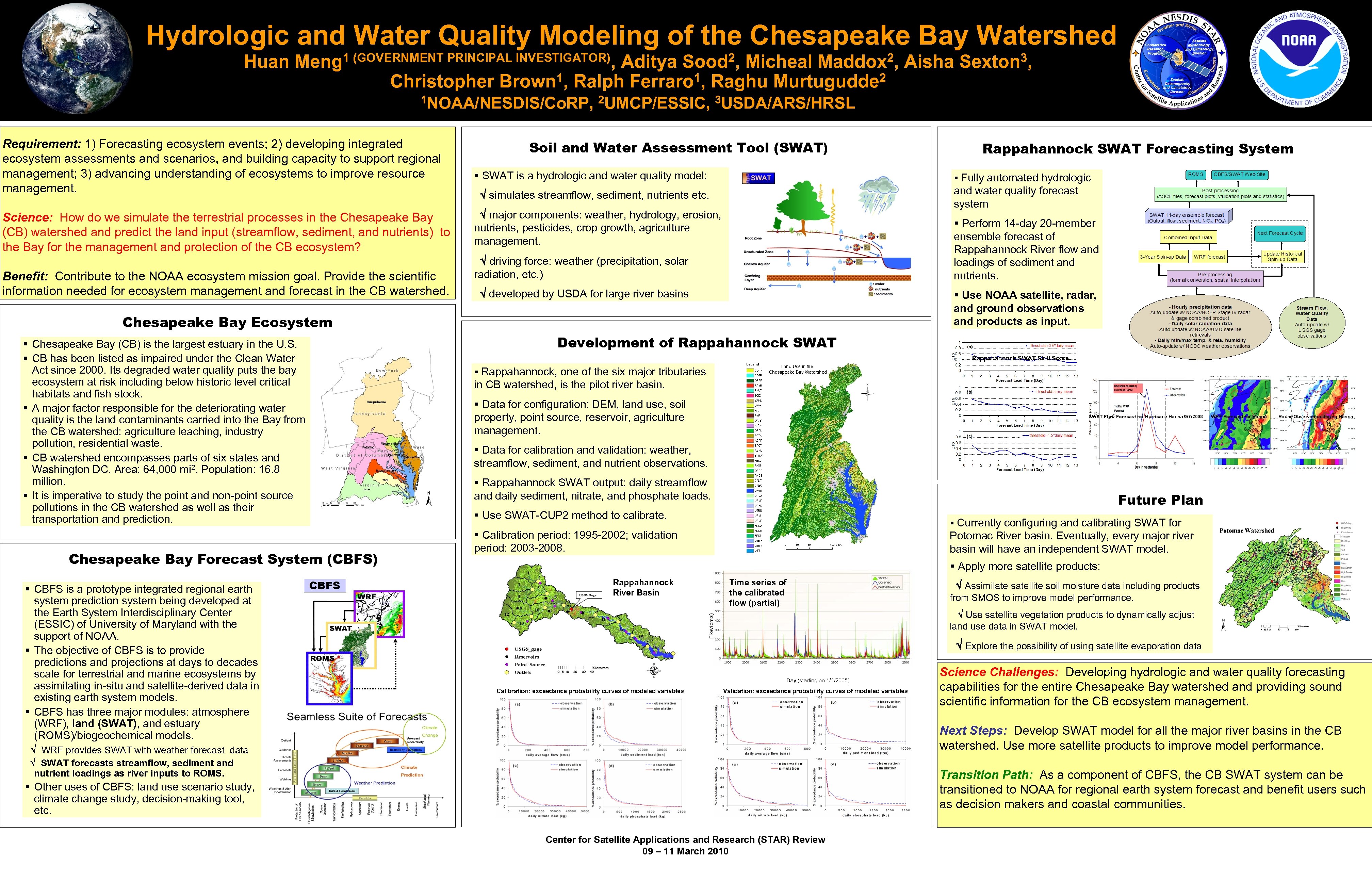 Hydrologic and Water Quality Modeling of the Chesapeake Bay Watershed Huan 1 (GOVERNMENT PRINCIPAL INVESTIGATOR), Meng 2, Sood 2, Maddox Aditya Micheal Aisha 1, Ralph Ferraro 1, Raghu Murtugudde 2 Christopher Brown 3, Sexton 1 NOAA/NESDIS/Co. RP, 2 UMCP/ESSIC, 3 USDA/ARS/HRSL Requirement: 1) Forecasting ecosystem events; 2) developing integrated ecosystem assessments and scenarios, and building capacity to support regional management; 3) advancing understanding of ecosystems to improve resource management. Science: How do we simulate the terrestrial processes in the Chesapeake Bay (CB) watershed and predict the land input (streamflow, sediment, and nutrients) to the Bay for the management and protection of the CB ecosystem? Benefit: Contribute to the NOAA ecosystem mission goal. Provide the scientific information needed for ecosystem management and forecast in the CB watershed. Soil and Water Assessment Tool (SWAT) § SWAT is a hydrologic and water quality model: § Fully automated hydrologic and water quality forecast system simulates streamflow, sediment, nutrients etc. major components: weather, hydrology, erosion, nutrients, pesticides, crop growth, agriculture management. § Perform 14 -day 20 -member ensemble forecast of Rappahannock River flow and loadings of sediment and nutrients. driving force: weather (precipitation, solar radiation, etc. ) developed by USDA for large river basins § Use NOAA satellite, radar, and ground observations and products as input. Chesapeake Bay Ecosystem Chesapeake Bay Forecast System (CBFS) § CBFS is a prototype integrated regional earth system prediction system being developed at the Earth System Interdisciplinary Center (ESSIC) of University of Maryland with the support of NOAA. § The objective of CBFS is to provide predictions and projections at days to decades scale for terrestrial and marine ecosystems by assimilating in-situ and satellite-derived data in existing earth system models. § CBFS has three major modules: atmosphere (WRF), land (SWAT), and estuary (ROMS)/biogeochemical models. Development of Rappahannock SWAT Skill Score § Rappahannock, one of the six major tributaries in CB watershed, is the pilot river basin. § Data for configuration: DEM, land use, soil property, point source, reservoir, agriculture management. SWAT Flow Forecast for Hurricane Hanna 9/7/2008 WRF Forecast for Hanna Radar Observation during Hanna § Data for calibration and validation: weather, streamflow, sediment, and nutrient observations. § Rappahannock SWAT output: daily streamflow and daily sediment, nitrate, and phosphate loads. Future Plan § Use SWAT-CUP 2 method to calibrate. § Currently configuring and calibrating SWAT for § Calibration period: 1995 -2002; validation period: 2003 -2008. Potomac River basin. Eventually, every major river basin will have an independent SWAT model. § Apply more satellite products: Rappahannock River Basin Time series of the calibrated flow (partial) Assimilate satellite soil moisture data including products from SMOS to improve model performance. Use satellite vegetation products to dynamically adjust land use data in SWAT model. Flow(cms) § Chesapeake Bay (CB) is the largest estuary in the U. S. § CB has been listed as impaired under the Clean Water Act since 2000. Its degraded water quality puts the bay ecosystem at risk including below historic level critical habitats and fish stock. § A major factor responsible for the deteriorating water quality is the land contaminants carried into the Bay from the CB watershed: agriculture leaching, industry pollution, residential waste. § CB watershed encompasses parts of six states and Washington DC. Area: 64, 000 mi 2. Population: 16. 8 million. § It is imperative to study the point and non-point source pollutions in the CB watershed as well as their transportation and prediction. Rappahannock SWAT Forecasting System Explore the possibility of using satellite evaporation data Day (starting on 1/1/2005) Calibration: exceedance probability curves of modeled variables Validation: exceedance probability curves of modeled variables Science Challenges: Developing hydrologic and water quality forecasting capabilities for the entire Chesapeake Bay watershed and providing sound scientific information for the CB ecosystem management. Next Steps: Develop SWAT model for all the major river basins in the CB watershed. Use more satellite products to improve model performance. WRF provides SWAT with weather forecast data SWAT forecasts streamflow, sediment and nutrient loadings as river inputs to ROMS. Transition Path: As a component of CBFS, the CB SWAT system can be transitioned to NOAA for regional earth system forecast and benefit users such as decision makers and coastal communities. § Other uses of CBFS: land use scenario study, climate change study, decision-making tool, etc. Center for Satellite Applications and Research (STAR) Review 09 – 11 March 2010