 Скачать презентацию Hydrogen in Reykjavik Iceland since 1999 — Jón Björn
Hydrogen in Reykjavik.pptx
- Количество слайдов: 62



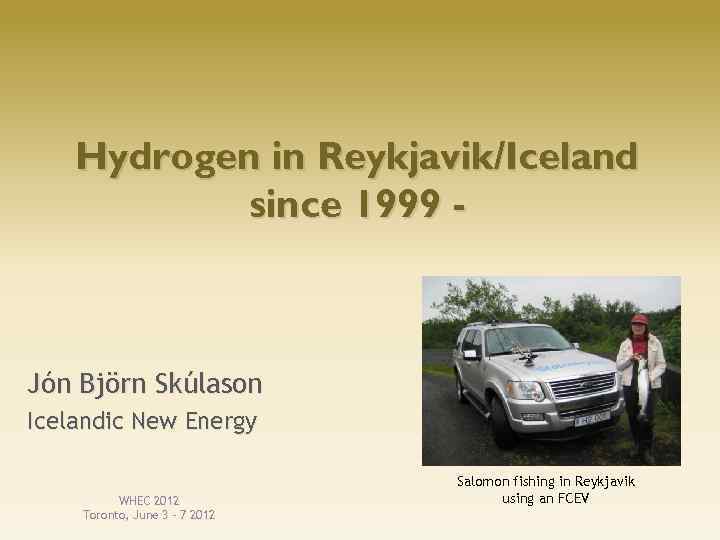
Hydrogen in Reykjavik/Iceland since 1999 - Jón Björn Skúlason Icelandic New Energy WHEC 2012 Toronto, June 3 – 7 2012 Salomon fishing in Reykjavik using an FCEV
Government of Iceland First policy measures towards hydrogen in 1998 Current position: Actions since 2000~: ◦ Iceland an international platform for hydrogen research ◦ Create the worlds first hydrogen/el-mobility economy ◦ ◦ ◦ Revocked all taxes on H 2 vehicles Supported project with financial support Was a founding member of the IPHE Created a one of the first Roadmaps on H 2 Hydrogen technology promoted by government and President at all opportunities ◦ Major of Reykjavik used an FCEV for an extensive period Icelandic New Energy
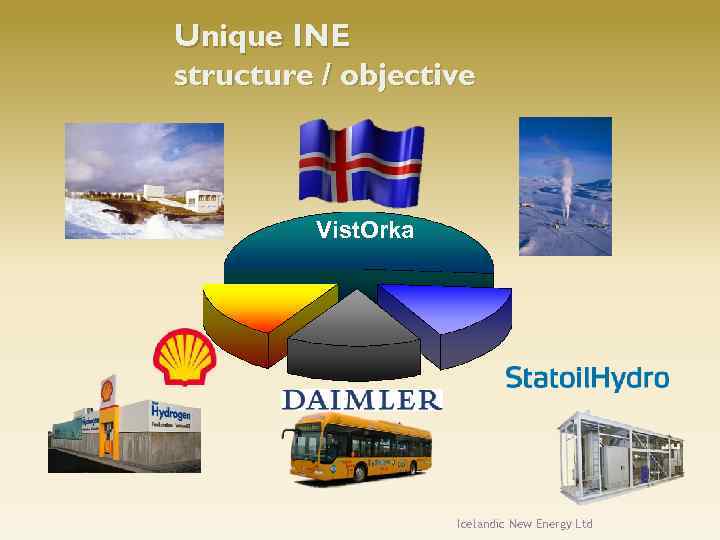
Unique INE structure / objective Vist. Orka Icelandic New Energy Ltd
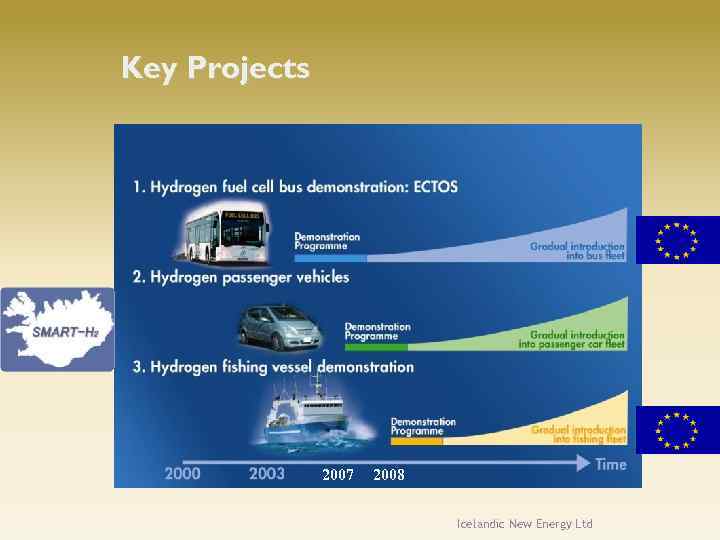
Key Projects 2007 2008 Icelandic New Energy Ltd
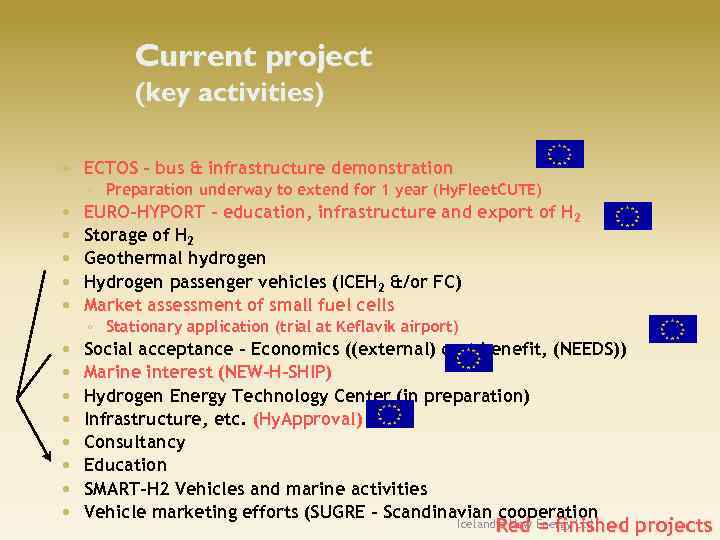
Current project (key activities) ECTOS – bus & infrastructure demonstration ◦ Preparation underway to extend for 1 year (Hy. Fleet. CUTE) EURO-HYPORT – education, infrastructure and export of H 2 Storage of H 2 Geothermal hydrogen Hydrogen passenger vehicles (ICEH 2 &/or FC) Market assessment of small fuel cells ◦ Stationary application (trial at Keflavik airport) Social acceptance – Economics ((external) cost benefit, (NEEDS)) Marine interest (NEW-H-SHIP) Hydrogen Energy Technology Center (in preparation) Infrastructure, etc. (Hy. Approval) Consultancy Education SMART-H 2 Vehicles and marine activities Vehicle marketing efforts (SUGRE – Scandinavian cooperation Red = finished projects Icelandic New Energy Ltd
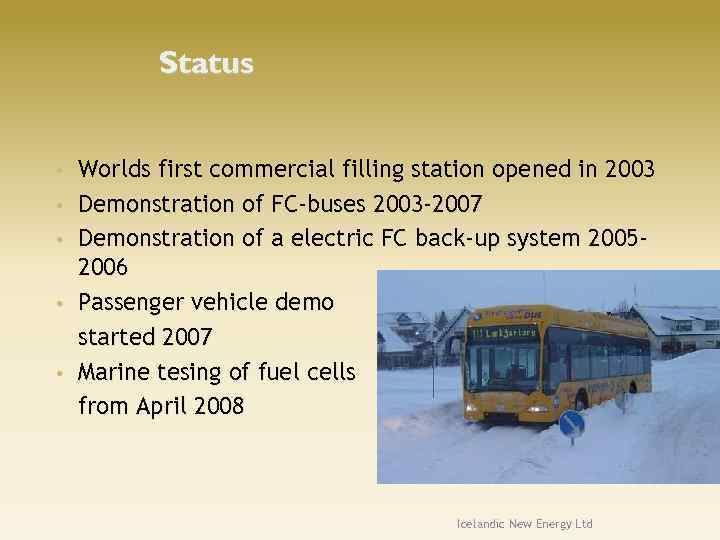
Status • • • Worlds first commercial filling station opened in 2003 Demonstration of FC-buses 2003 -2007 Demonstration of a electric FC back-up system 20052006 Passenger vehicle demo started 2007 Marine tesing of fuel cells from April 2008 Icelandic New Energy Ltd
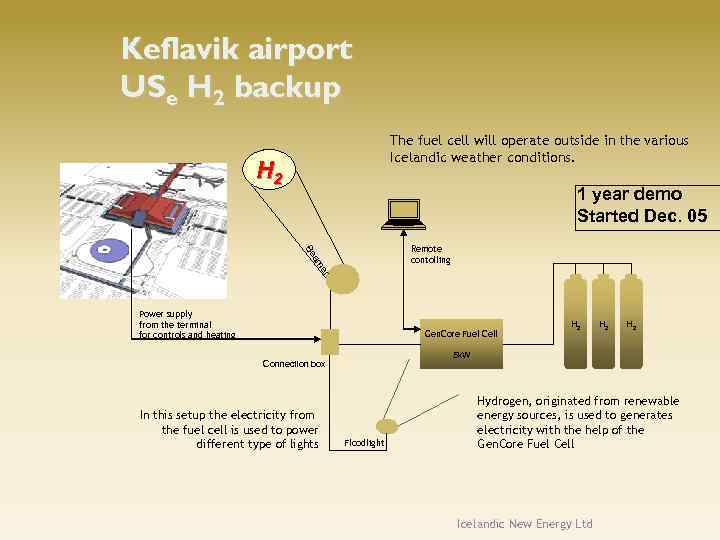
Keflavik airport USe H 2 backup The fuel cell will operate outside in the various Icelandic weather conditions. H 2 1 year demo Started Dec. 05 er am Be Remote contolling Power supply from the terminal for controls and heating Gen. Core Fuel Cell H 2 5 k. W Connection box In this setup the electricity from the fuel cell is used to power different type of lights H 2 Floodlight Hydrogen, originated from renewable energy sources, is used to generates electricity with the help of the Gen. Core Fuel Cell Icelandic New Energy Ltd
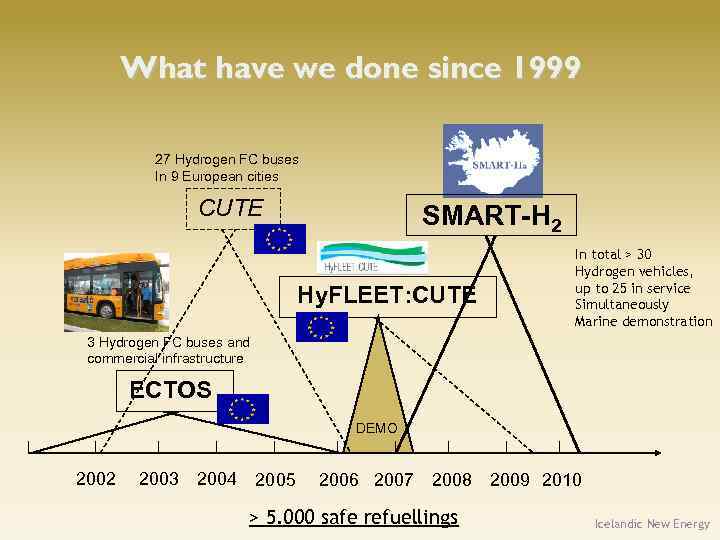
What have we done since 1999 27 Hydrogen FC buses In 9 European cities CUTE SMART-H 2 Hy. FLEET: CUTE In total > 30 Hydrogen vehicles, up to 25 in service Simultaneously Marine demonstration 3 Hydrogen FC buses and commercial infrastructure ECTOS DEMO 2002 2003 2004 2005 2006 2007 2008 > 5. 000 safe refuellings 2009 2010 Icelandic New Energy
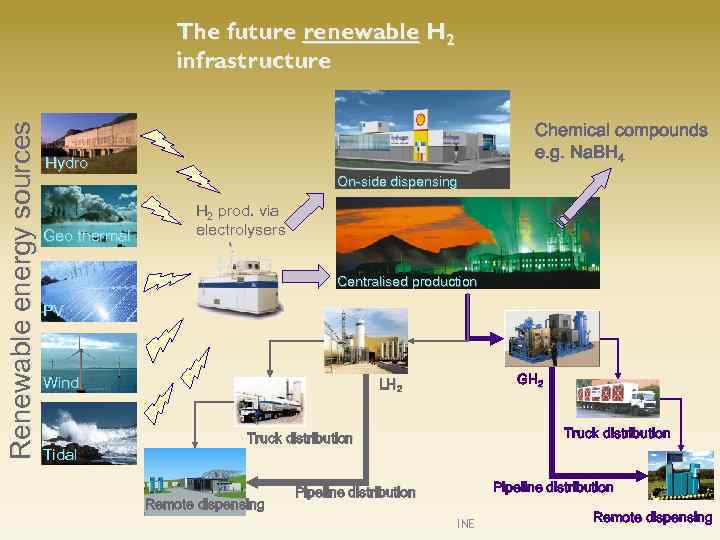
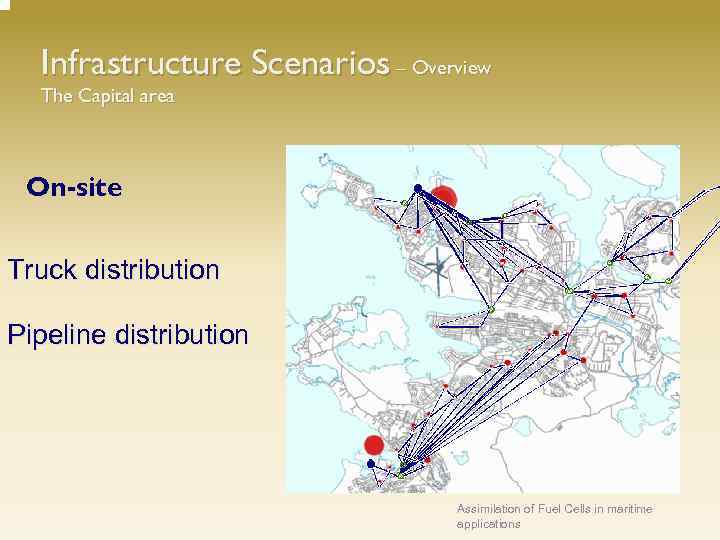
Renewable energy sources The future renewable H 2 infrastructure Chemical compounds e. g. Na. BH 4 Hydro Geo thermal On-side dispensing H 2 prod. via electrolysers Centralised production PV Wind Tidal GH 2 LH 2 Truck distribution Remote dispensing Pipeline distribution INE Remote dispensing
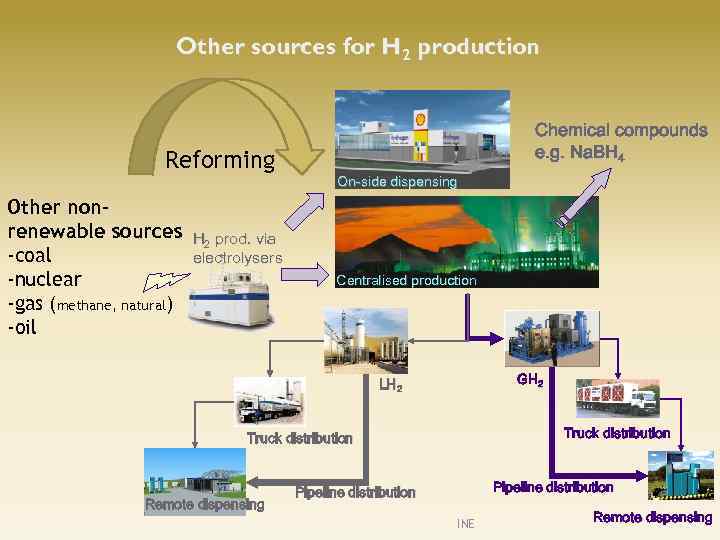
Other sources for H 2 production Reforming Other nonrenewable sources -coal -nuclear -gas (methane, natural) -oil Chemical compounds e. g. Na. BH 4 On-side dispensing H 2 prod. via electrolysers Centralised production GH 2 LH 2 Truck distribution Remote dispensing Pipeline distribution INE Remote dispensing
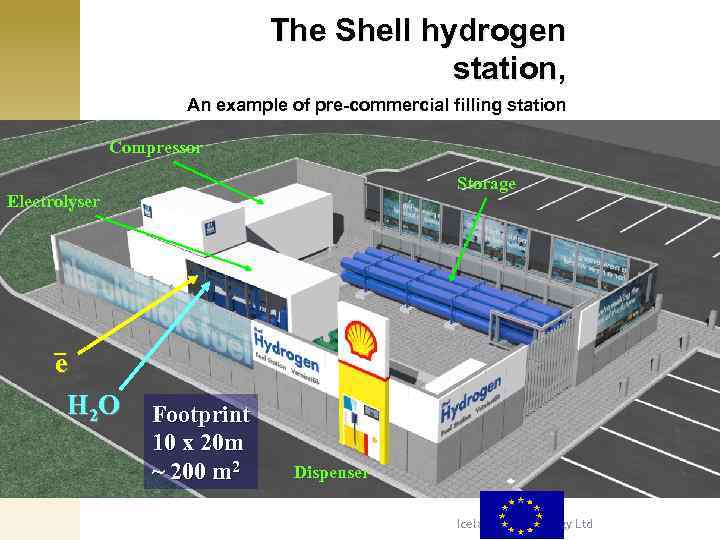
The Shell hydrogen station, An example of pre-commercial filling station Compressor Storage Electrolyser e H 2 O Footprint 10 x 20 m ~ 200 m 2 Dispenser Icelandic New Energy Ltd
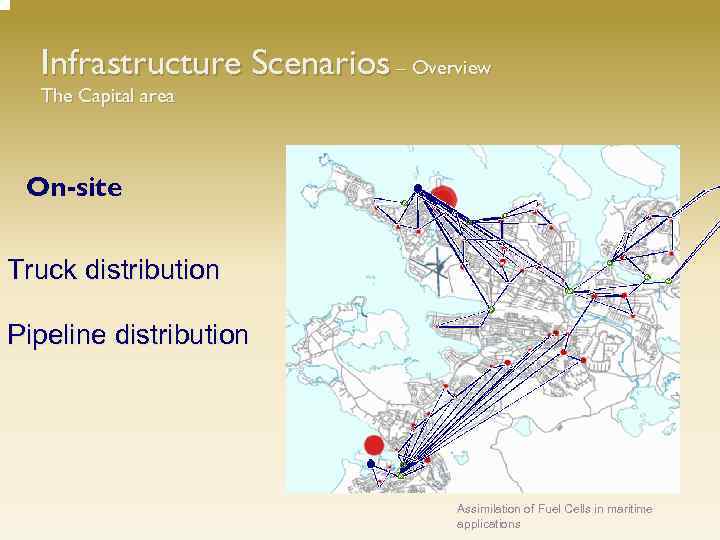
Infrastructure Scenarios – Overview The Capital area On-site Truck distribution Pipeline distribution Assimilation of Fuel Cells in maritime applications
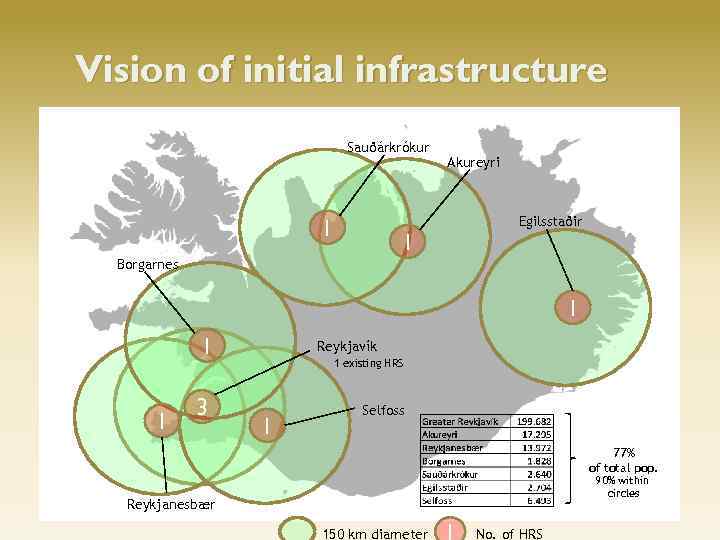
Vision of initial infrastructure Sauðárkrókur 1 1 Akureyri Egilsstaðir Borgarnes 1 1 1 3 Reykjavík 1 existing HRS 1 Selfoss 77% of total pop. 90% within circles Reykjanesbær 150 km diameter No. of HRS
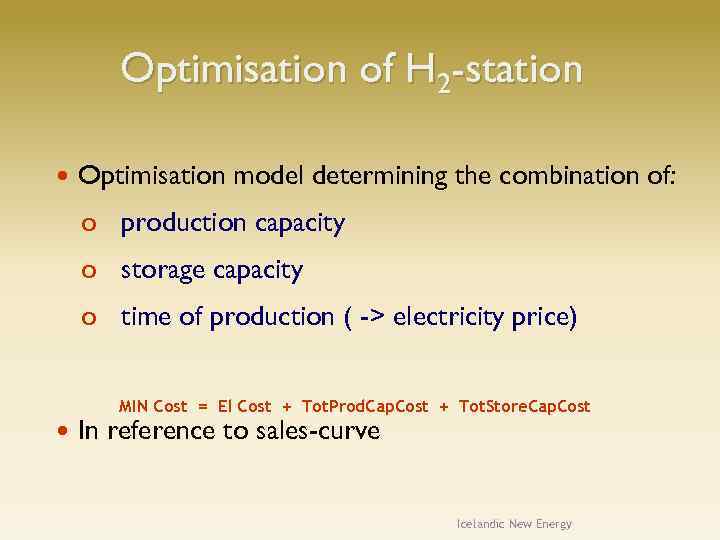
Optimisation of H 2 -station Optimisation model determining the combination of: o production capacity o storage capacity o time of production ( -> electricity price) MIN Cost = El Cost + Tot. Prod. Cap. Cost + Tot. Store. Cap. Cost In reference to sales-curve Icelandic New Energy
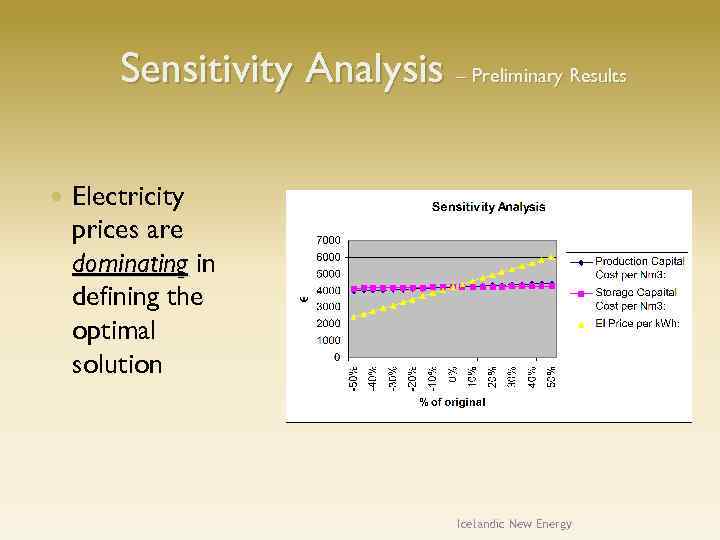
Sensitivity Analysis – Preliminary Results Electricity prices are dominating in defining the optimal solution Icelandic New Energy
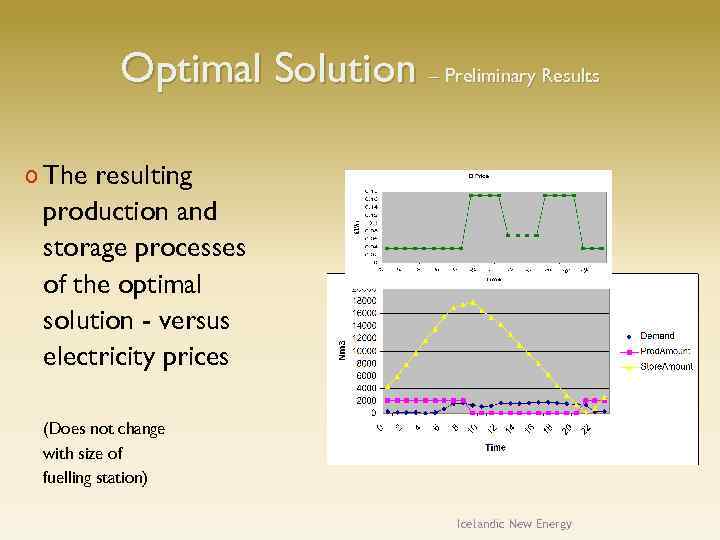
Optimal Solution – Preliminary Results o The resulting production and storage processes of the optimal solution - versus electricity prices (Does not change with size of fuelling station) Icelandic New Energy
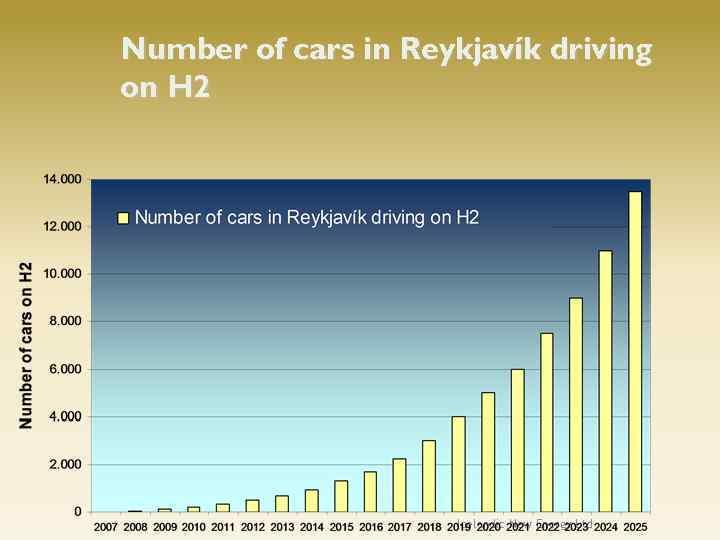
Number of cars in Reykjavík driving on H 2 Icelandic New Energy Ltd
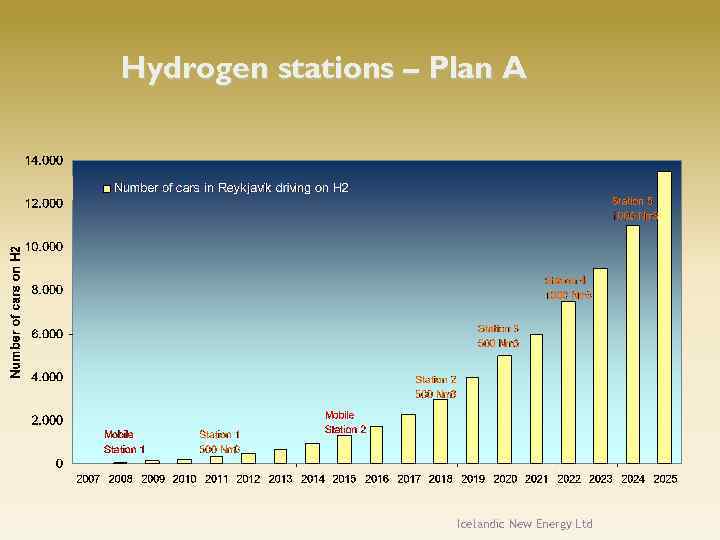
Hydrogen stations – Plan A Icelandic New Energy Ltd
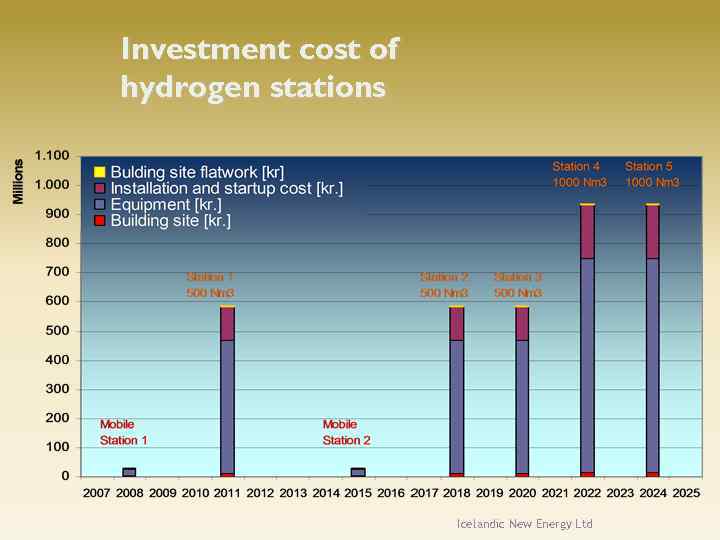
Investment cost of hydrogen stations Icelandic New Energy Ltd
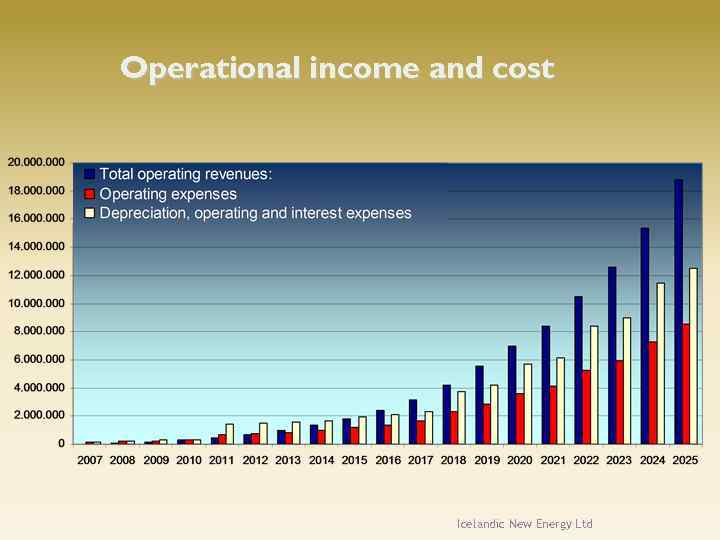
Operational income and cost Income ◦ The only income will be from sale of hydrogen ◦ In the calculation it is estimated that price of hydrogen will be 9, 6 € incl. VAT per kg, ~ 7, 7 € without VAT Icelandic New Energy Ltd
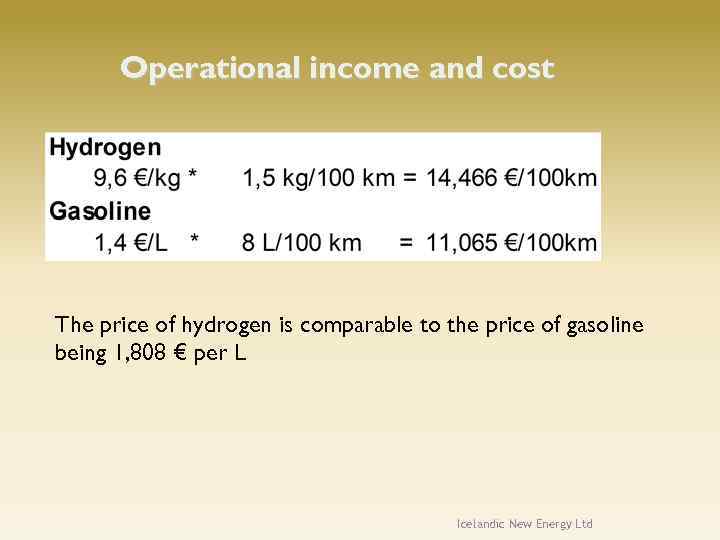
Operational income and cost The price of hydrogen is comparable to the price of gasoline being 1, 808 € per L Icelandic New Energy Ltd
Operational income and cost Icelandic New Energy Ltd
Break even Icelandic New Energy Ltd
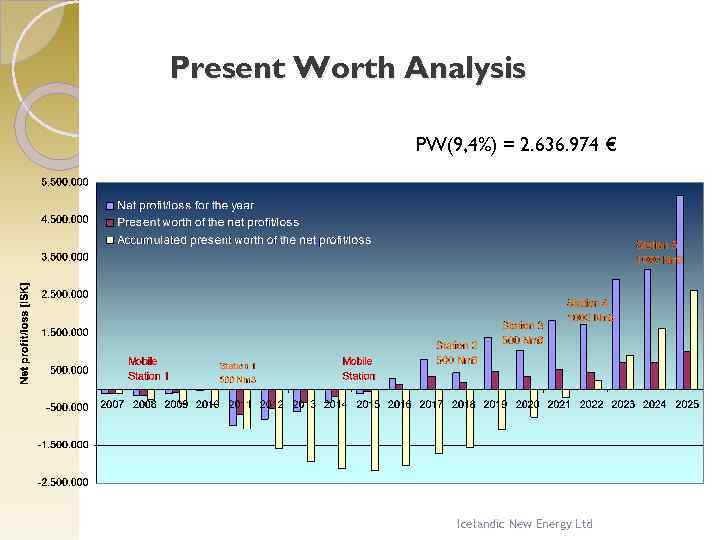
Present Worth Analysis PW(9, 4%) = 2. 636. 974 € Icelandic New Energy Ltd
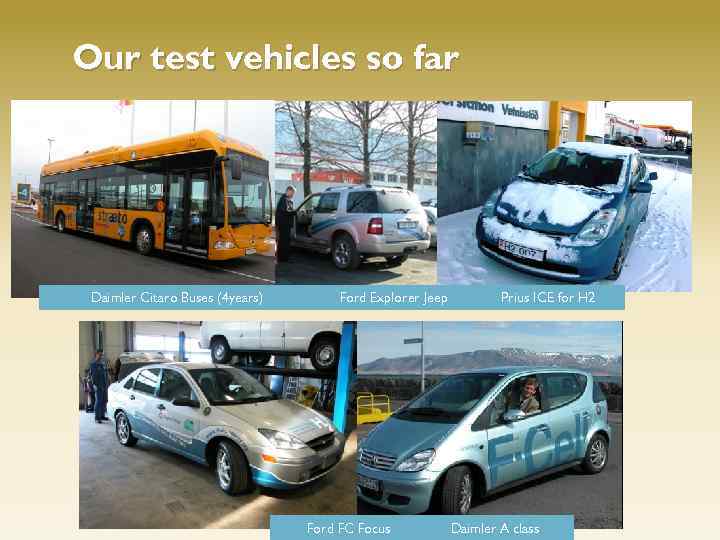
Our test vehicles so far Daimler Citaro Buses (4 years) Ford Explorer Jeep Ford FC Focus Prius ICE for H 2 25 Daimler A class
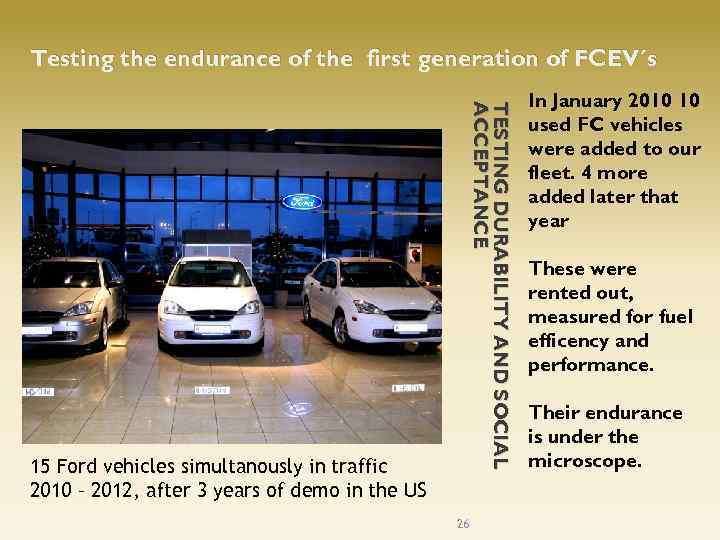
Testing the endurance of the first generation of FCEV´s TESTING DURABILITY AND SOCIAL ACCEPTANCE 15 Ford vehicles simultanously in traffic 2010 – 2012, after 3 years of demo in the US 26 In January 2010 10 used FC vehicles were added to our fleet. 4 more added later that year These were rented out, measured for fuel efficency and performance. Their endurance is under the microscope.
Key research activities Alternative fuels (spec. H 2) Most emphasis on non-technical research: ◦ Social Public acceptance Expectations Social surveys ◦ Economic Cost Accepted cost Infrastructure build up and operational cost Vehicle operation costs ◦ Environment LCA WTW The following slides are examples of outcome of studies Icelandic New Energy
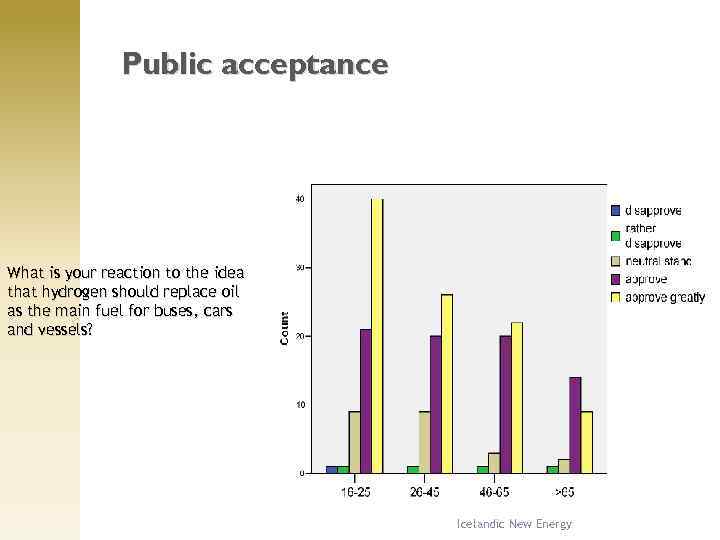
Public acceptance What is your reaction to the idea that hydrogen should replace oil as the main fuel for buses, cars and vessels? Icelandic New Energy
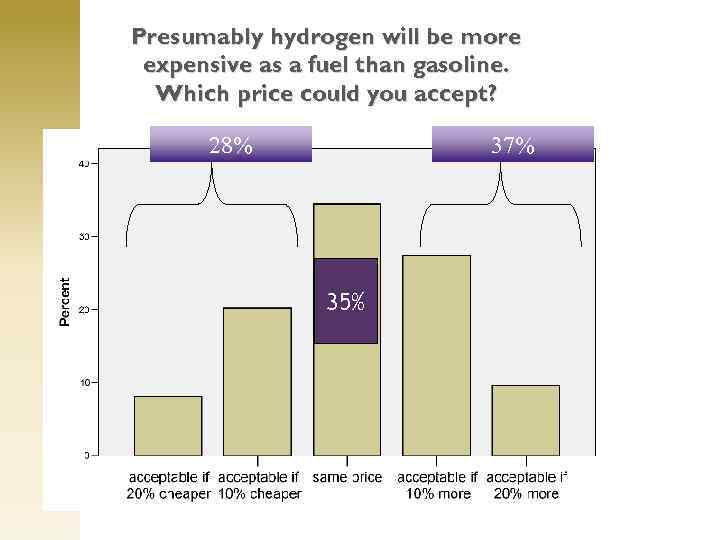
Presumably hydrogen will be more expensive as a fuel than gasoline. Which price could you accept? 28% 37% 35%
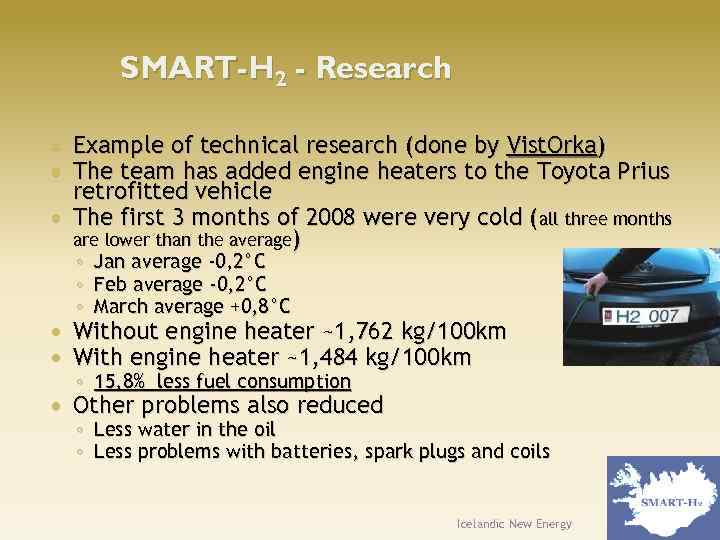
SMART-H 2 - Research Example of technical research (done by Vist. Orka) The team has added engine heaters to the Toyota Prius retrofitted vehicle The first 3 months of 2008 were very cold (all three months are lower than the average) ◦ Jan average -0, 2°C ◦ Feb average -0, 2°C ◦ March average +0, 8°C Without engine heater ~1, 762 kg/100 km With engine heater ~1, 484 kg/100 km Other problems also reduced ◦ 15, 8% less fuel consumption ◦ Less water in the oil ◦ Less problems with batteries, spark plugs and coils Icelandic New Energy 30
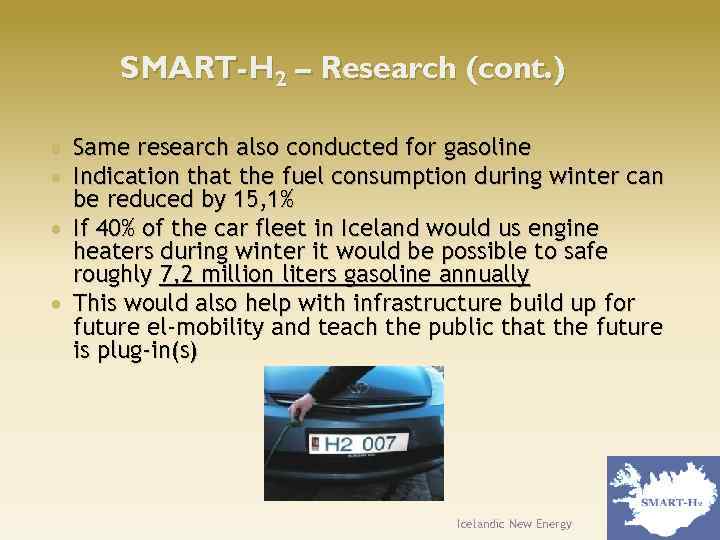
SMART-H 2 – Research (cont. ) Same research also conducted for gasoline Indication that the fuel consumption during winter can be reduced by 15, 1% If 40% of the car fleet in Iceland would us engine heaters during winter it would be possible to safe roughly 7, 2 million liters gasoline annually This would also help with infrastructure build up for future el-mobility and teach the public that the future is plug-in(s) Icelandic New Energy 31
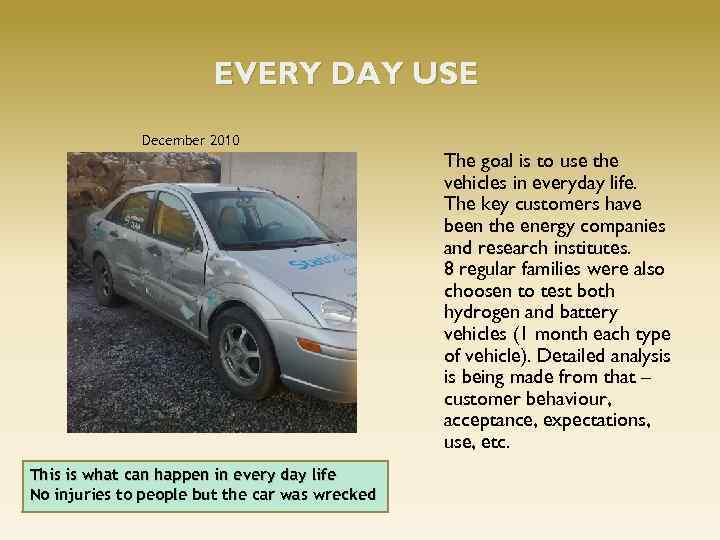
EVERY DAY USE December 2010 The goal is to use the vehicles in everyday life. The key customers have been the energy companies and research institutes. 8 regular families were also choosen to test both hydrogen and battery vehicles (1 month each type of vehicle). Detailed analysis is being made from that – customer behaviour, acceptance, expectations, use, etc. This is what can happen in every day life No injuries to people but the car was wrecked
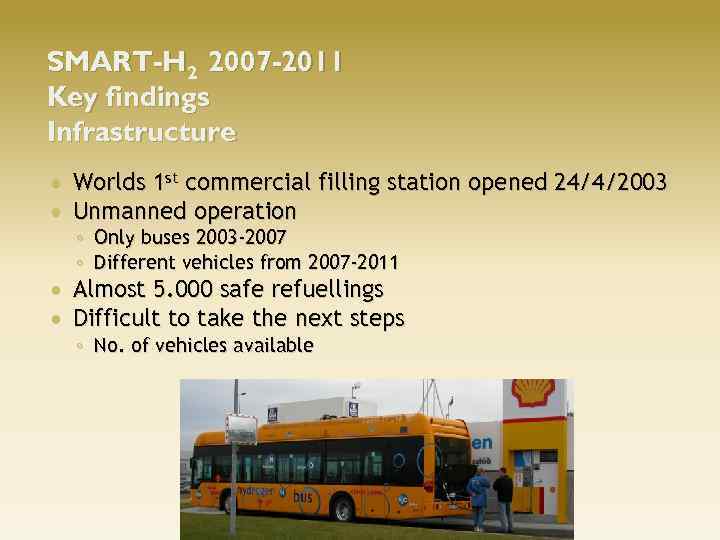
SMART-H 2 2007 -2011 Key findings Infrastructure Worlds 1 st commercial filling station opened 24/4/2003 Unmanned operation Almost 5. 000 safe refuellings Difficult to take the next steps ◦ Only buses 2003 -2007 ◦ Different vehicles from 2007 -2011 ◦ No. of vehicles available Icelandic New Energy
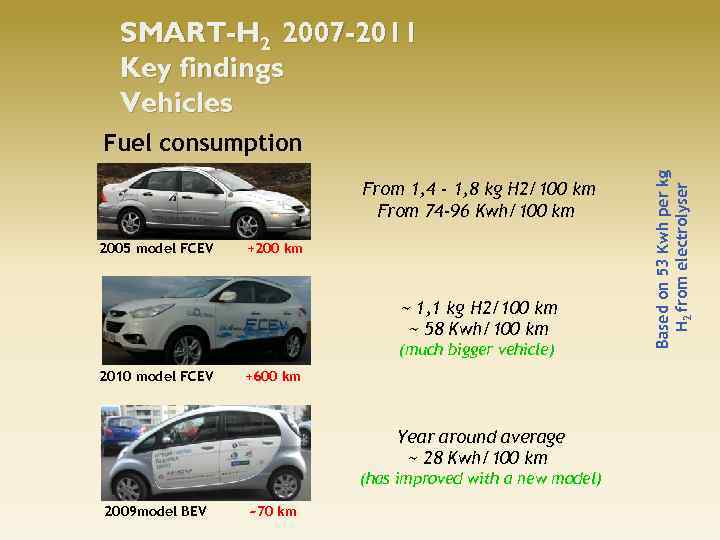
SMART-H 2 2007 -2011 Key findings Vehicles From 1, 4 - 1, 8 kg H 2/100 km From 74 -96 Kwh/100 km 2005 model FCEV +200 km ~ 1, 1 kg H 2/100 km ~ 58 Kwh/100 km (much bigger vehicle) 2010 model FCEV +600 km Year around average ~ 28 Kwh/100 km (has improved with a new model) 2009 model BEV ~70 km Based on 53 Kwh per kg H 2 from electrolyser Fuel consumption
SMART-H 2 2007 -2010 Key findings In general people are very happy with both technologies Expectations are very high for battery vehicles ◦ People expect short refuelling time and long range (much different from the capability of the technology) Boat operators have different demand from vehicle operators – high reliability and much lower tolerance towards failures. Technology needs to mature more and become cheaper before being able to compete with conventional technology FCEV´s have been running much better than expected and lifetime is much better than expected Infrastructure has now been commercially operated for 9 years – more reliable than expected
SMART-H 2 2007 -2010 Key findings (cont. ) Commercialisation of hydrogen technologies have taken longer than expected – has had negative impact on funding bodies and government officials ◦ Not enough stamina Local education has been extreamly important – know how of the different technologies very high ◦ Strong emphasis has been on using local labour Project coordination and management is complicated and it is extreamly important that everyone understands each other roles ◦ Communicaiton failures are difficult to handle Cost was underestimated in all aspects, specifically regarding maintenance, training and coordination Difficult to plan the future as commercialistation is still not there though it is forcasted to happen within the next 4 -5 years
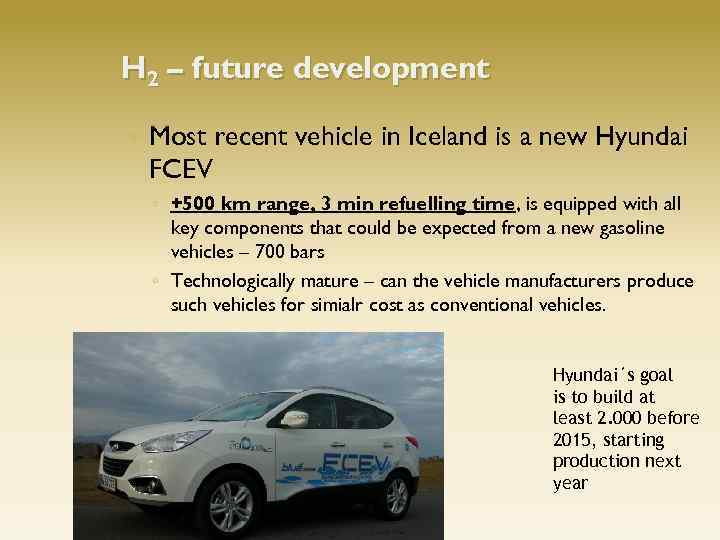
H 2 – future development Most recent vehicle in Iceland is a new Hyundai FCEV ◦ +500 km range, 3 min refuelling time, is equipped with all key components that could be expected from a new gasoline vehicles – 700 bars ◦ Technologically mature – can the vehicle manufacturers produce such vehicles for simialr cost as conventional vehicles. Hyundai´s goal is to build at least 2. 000 before 2015, starting production next year
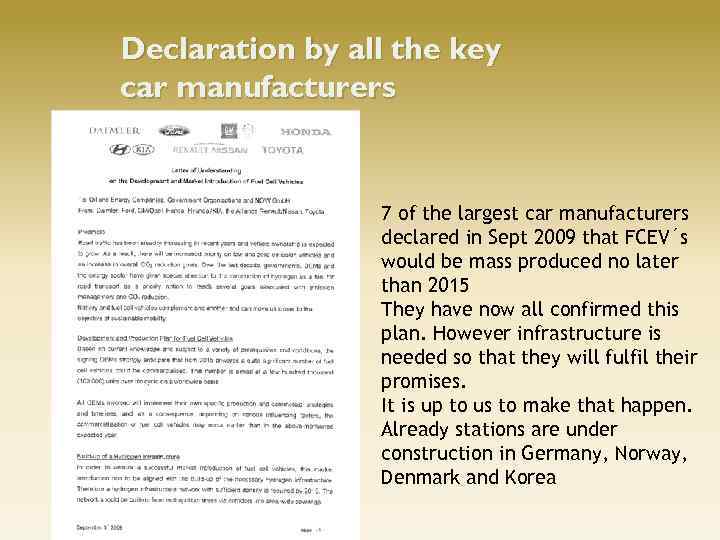
Declaration by all the key car manufacturers 7 of the largest car manufacturers declared in Sept 2009 that FCEV´s would be mass produced no later than 2015 They have now all confirmed this plan. However infrastructure is needed so that they will fulfil their promises. It is up to us to make that happen. Already stations are under construction in Germany, Norway, Denmark and Korea
Next steps by the OEM´s Almost all the car manufacturers have restated their goal to produce vehicles in 2015 Key regions, like Germany, California, the Nordic countries, Korea and Japan are planning a large scale built up of hydrogen infrastructure Infrastructure and vehicles must be built hand in hand to make economic sense Thousands of FCEV´s are expected to be built annually from 2015 onwards
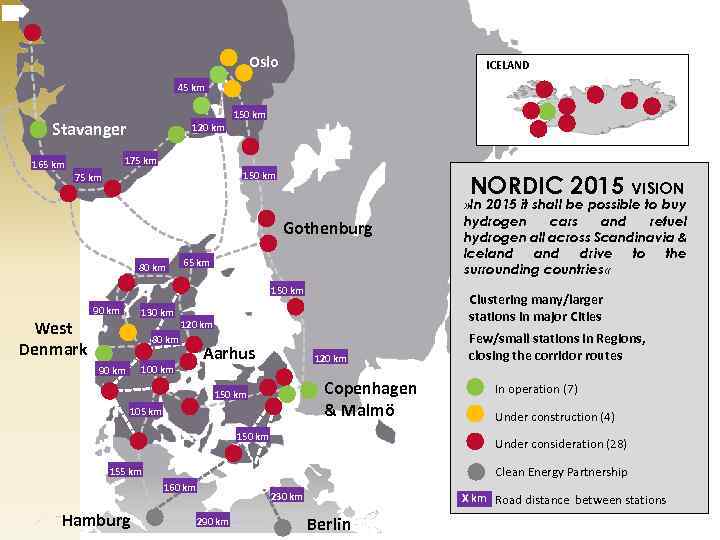
Oslo ICELAND 45 km 150 km Stavanger 120 km 175 km 165 km 150 km 75 km NORDIC 2015 VISION Gothenburg 80 km 65 km 150 km 90 km 130 km West Denmark 100 km 90 km Clustering many/larger stations in major Cities 120 km 80 km Aarhus 120 km Copenhagen & Malmö 150 km 105 km 150 km Few/small stations in Regions, closing the corridor routes In operation (7) Under construction (4) Under consideration (28) Clean Energy Partnership 155 km 160 km Hamburg » In 2015 it shall be possible to buy hydrogen cars and refuel hydrogen all across Scandinavia & Iceland drive to the surrounding countries « X km Road distance between stations 230 km 290 km Berlin
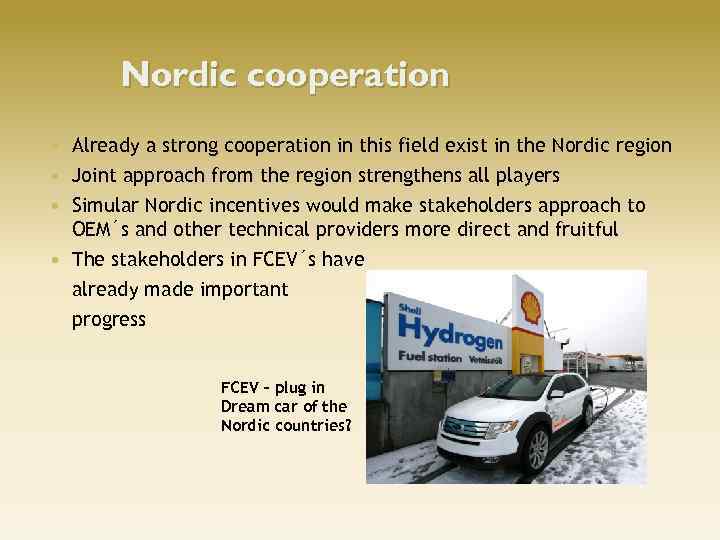
Nordic cooperation Already a strong cooperation in this field exist in the Nordic region Joint approach from the region strengthens all players Simular Nordic incentives would make stakeholders approach to OEM´s and other technical providers more direct and fruitful The stakeholders in FCEV´s have already made important progress FCEV – plug in Dream car of the Nordic countries?
Scandinavian cooperation Scandinavia proudly presents the largest H 2 vehicle fleet in Europe Hy. Nor and INE have a Mo. U – information exchange Network projects between all Scandinavian countries ◦ North Atlantic Hydrogen Association (NAHA) ◦ Scandinavian Hydrogen Highway Partnership (SHHP) Joint approach ◦ Vehicle manufacturers ◦ Potential customers Jointly we seek more partners for our RD&D projects Icelandic New Energy

Example of Nordic cooperation Key players in the Nordic countries signed an Mo. U, Jan 31 st 2011, with Hyundai for deployment of FCEV in the Nordic countries in 2011 -2015
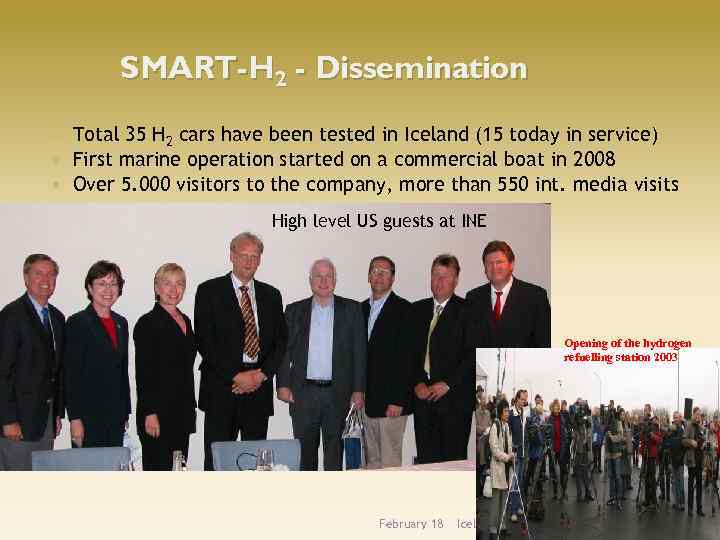
SMART-H 2 - Dissemination Total 35 H 2 cars have been tested in Iceland (15 today in service) First marine operation started on a commercial boat in 2008 Over 5. 000 visitors to the company, more than 550 int. media visits High level US guests at INE Opening of the hydrogen refuelling station 2003 February 18 Icelandic New Energy 44
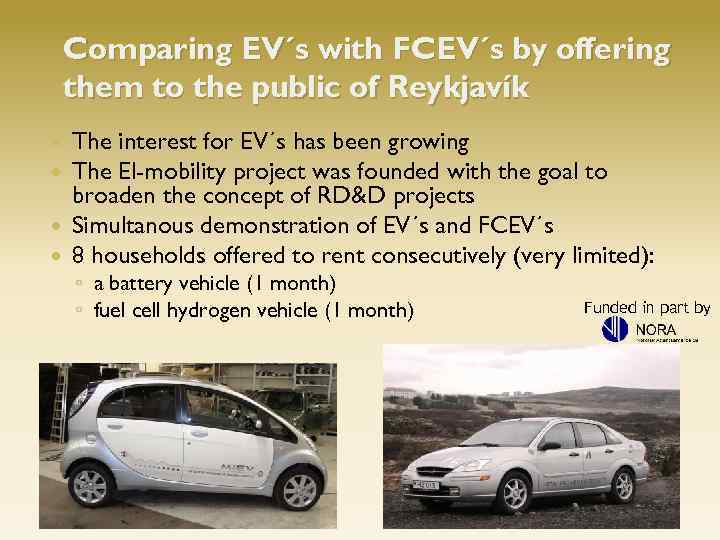
Comparing EV´s with FCEV´s by offering them to the public of Reykjavík The interest for EV´s has been growing The El-mobility project was founded with the goal to broaden the concept of RD&D projects Simultanous demonstration of EV´s and FCEV´s 8 households offered to rent consecutively (very limited): ◦ a battery vehicle (1 month) ◦ fuel cell hydrogen vehicle (1 month) Funded in part by
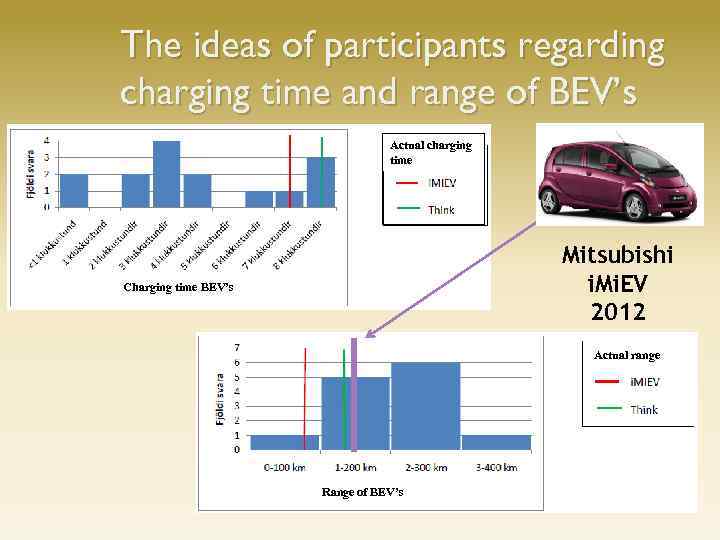
The ideas of participants regarding charging time and range of BEV’s Actual charging time Mitsubishi i. Mi. EV 2012 Charging time BEV’s Actual range Raundrægi: Range of BEV’s
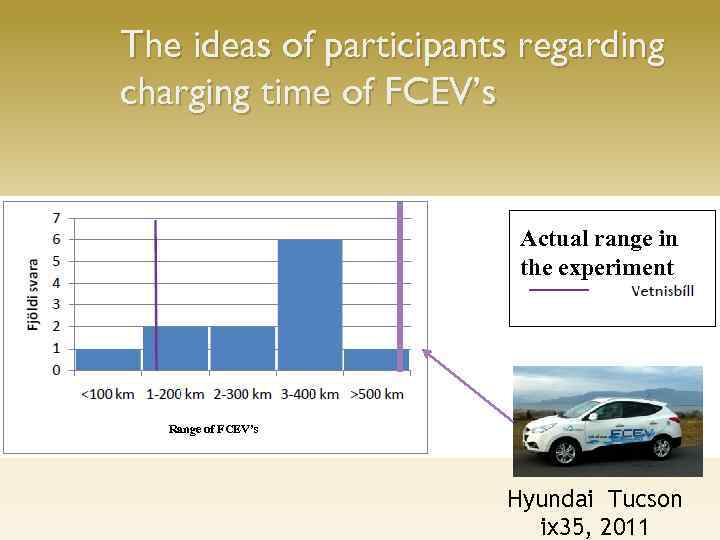
The ideas of participants regarding charging time of FCEV’s Actual range in the experiment Range of FCEV’s Hyundai Tucson ix 35, 2011
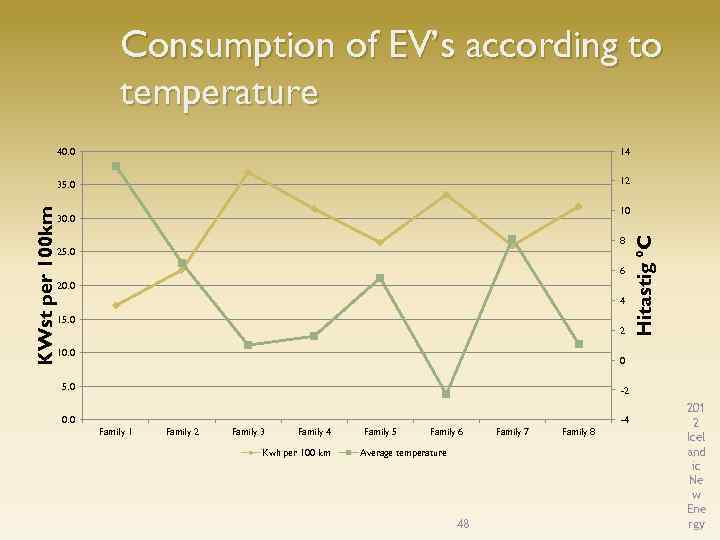
Consumption of EV’s according to temperature 14 35. 0 12 10 30. 0 8 25. 0 6 20. 0 4 15. 0 2 10. 0 Hitastig °C KWst per 100 km 40. 0 0 5. 0 -2 0. 0 -4 Family 1 Family 2 Family 3 Family 4 Kwh per 100 km Family 5 Family 6 Average temperature 48 Family 7 Family 8 201 2 Icel and ic Ne w Ene rgy
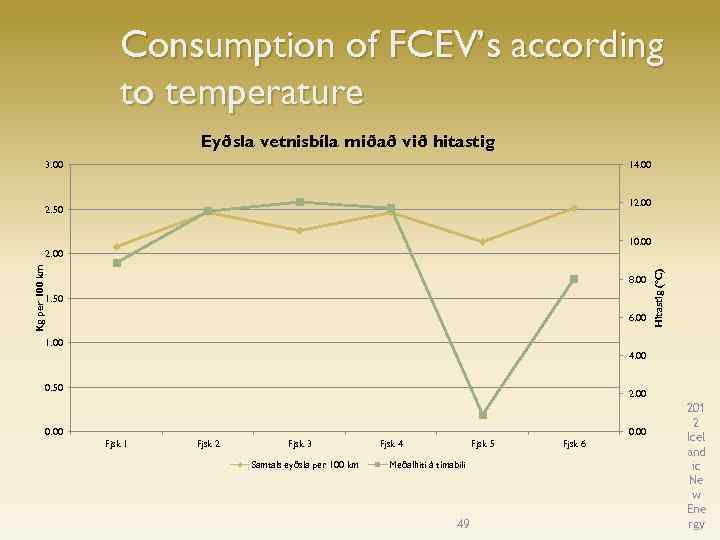
Consumption of FCEV’s according to temperature Eyðsla vetnisbíla miðað við hitastig 3. 00 14. 00 12. 00 2. 50 10. 00 8. 00 1. 50 6. 00 Hitastig (°C) Kg per 100 km 2. 00 1. 00 4. 00 0. 50 2. 00 0. 00 Fjsk 1 Fjsk 2 Fjsk 3 Samtals eyðsla per 100 km Fjsk 4 Fjsk 5 Meðalhiti á tímabili 49 Fjsk 6 201 2 Icel and ic Ne w Ene rgy
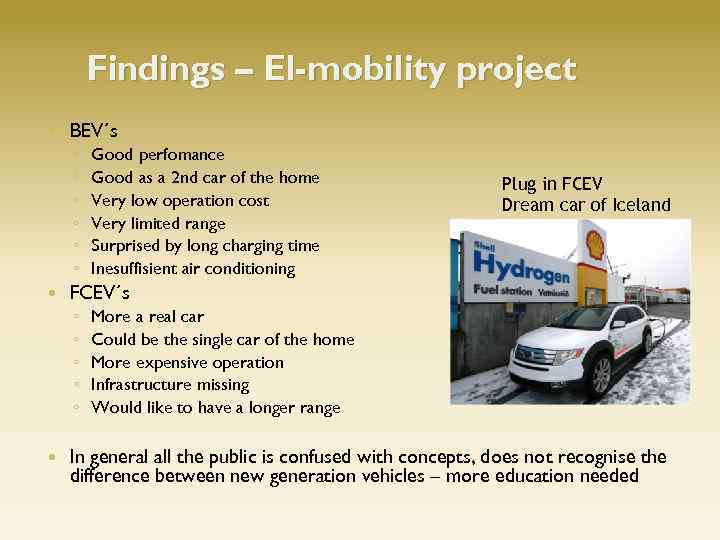
Findings – El-mobility project BEV´s ◦ ◦ ◦ Plug in FCEV Dream car of Iceland FCEV´s ◦ ◦ ◦ Good perfomance Good as a 2 nd car of the home Very low operation cost Very limited range Surprised by long charging time Inesuffisient air conditioning More a real car Could be the single car of the home More expensive operation Infrastructure missing Would like to have a longer range In general all the public is confused with concepts, does not recognise the difference between new generation vehicles – more education needed
Confusion The public is very confused what is happening regarding alternative vehicles Terminology of different technologies ◦ ◦ ◦ Battery Hybrid / Plug-in hybrid Methane (possibly plug-in in the future) Hydrogen (possibly plug-in in the future) More. . . . Most people want electric mobility ◦ Expectations are very high ◦ During the battery hype over the last few years statements have been made about simplisity of fast refuelling, 10 -20 min, range similar to fossil fuel vehicles or at least 400 km ◦ Will this affect the marketing of the first battery generation vehicles? ◦ 8 hour refuelling / 100 km range Icelandic New Energy 51
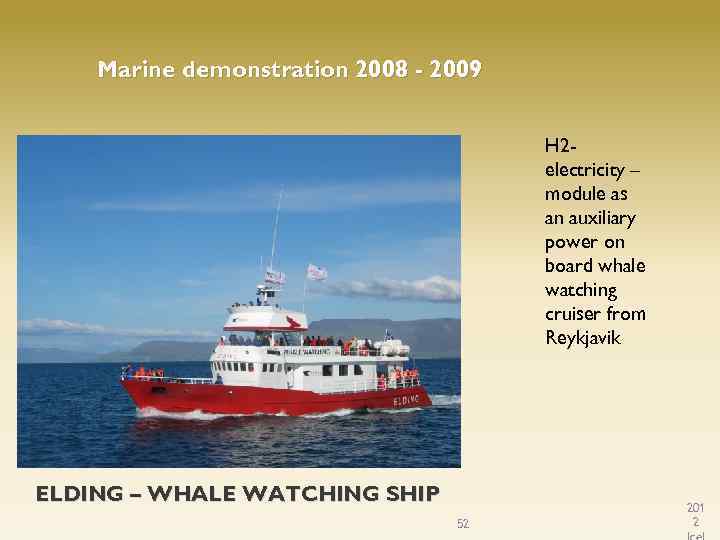
Marine demonstration 2008 - 2009 H 2 electricity – module as an auxiliary power on board whale watching cruiser from Reykjavik ELDING – WHALE WATCHING SHIP 52 201 2
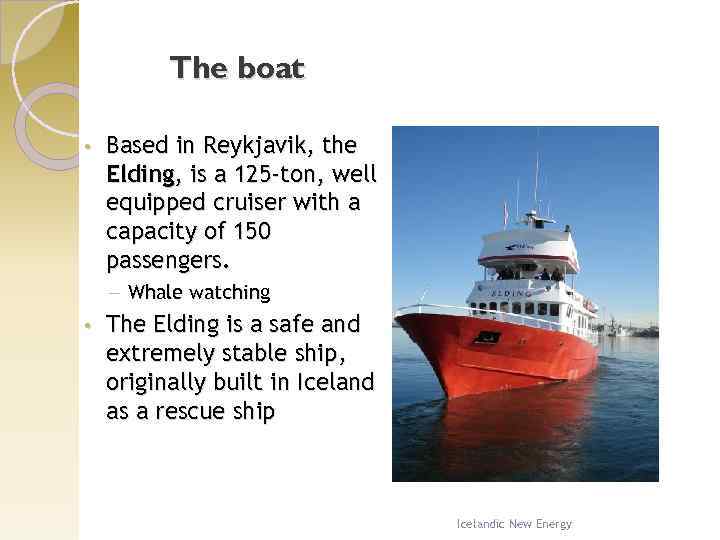
The boat • Based in Reykjavik, the Elding, is a 125 -ton, well equipped cruiser with a capacity of 150 passengers. – Whale watching • The Elding is a safe and extremely stable ship, originally built in Iceland as a rescue ship Icelandic New Energy
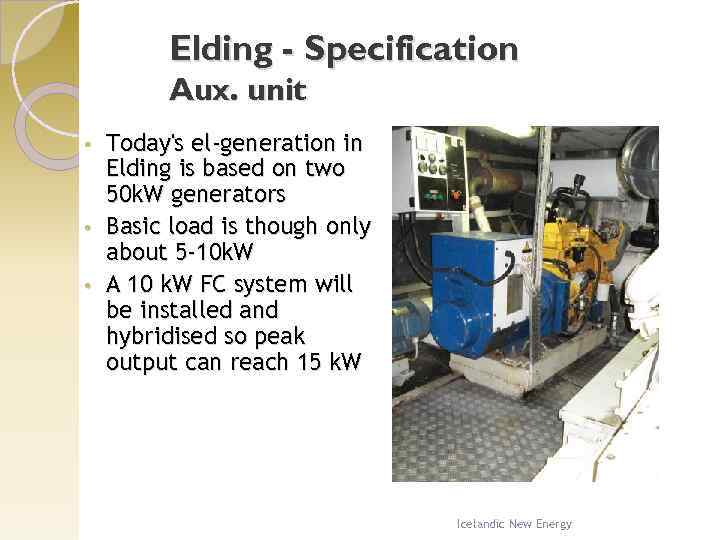
Elding - Specification Aux. unit Today's el-generation in Elding is based on two 50 k. W generators • Basic load is though only about 5 -10 k. W • A 10 k. W FC system will be installed and hybridised so peak output can reach 15 k. W • Icelandic New Energy
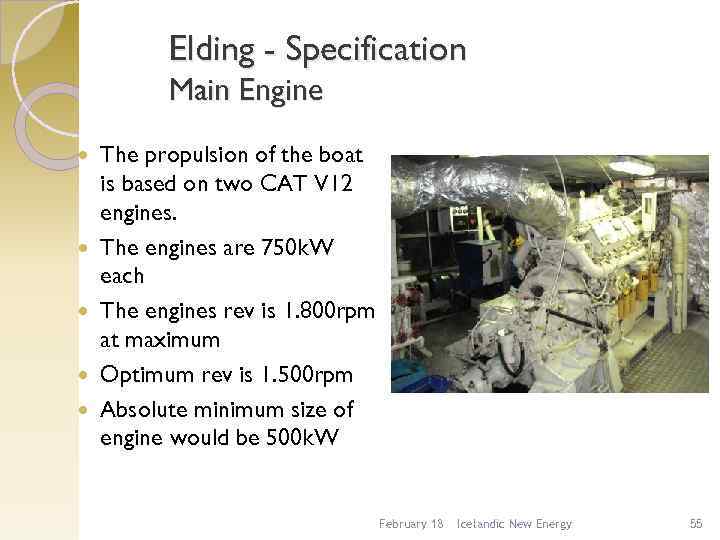
Elding - Specification Main Engine The propulsion of the boat is based on two CAT V 12 engines. The engines are 750 k. W each The engines rev is 1. 800 rpm at maximum Optimum rev is 1. 500 rpm Absolute minimum size of engine would be 500 k. W February 18 Icelandic New Energy 55
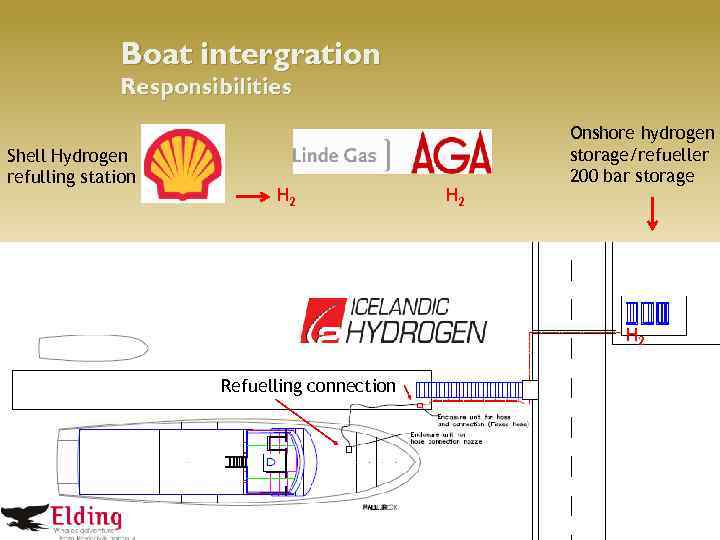
Boat intergration Responsibilities Shell Hydrogen refulling station H 2 Onshore hydrogen storage/refueller 200 bar storage H 2 Refuelling connection
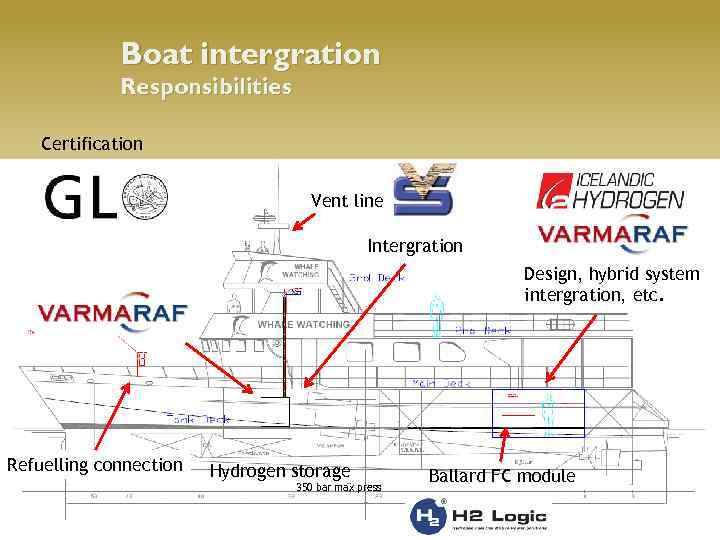
Boat intergration Responsibilities Certification Vent line Intergration Design, hybrid system intergration, etc. Refuelling connection Hydrogen storage 350 bar max press Ballard FC module
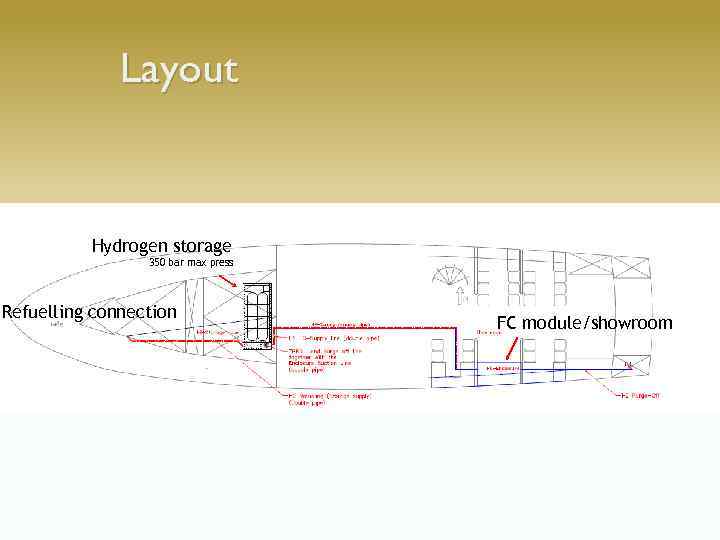
Layout Hydrogen storage 350 bar max press Refuelling connection FC module/showroom
Infrastructure Scenarios – Overview The Capital area On-site Truck distribution Pipeline distribution Assimilation of Fuel Cells in maritime applications
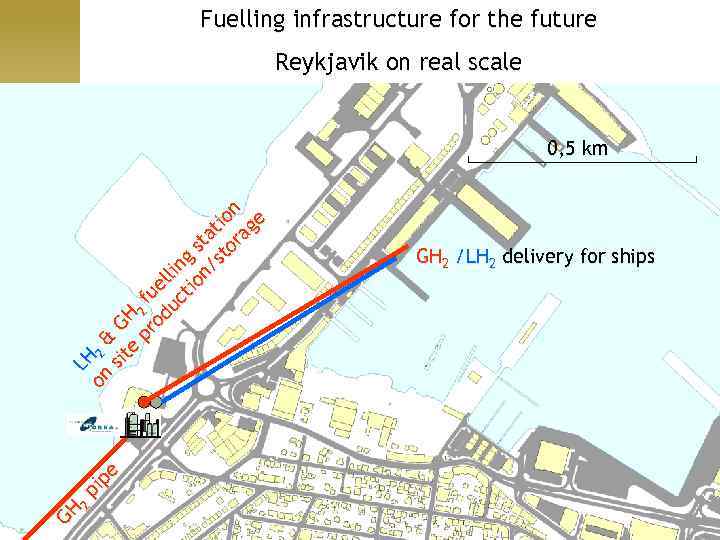
Fuelling infrastructure for the future Reykjavik on real scale GH 2 /LH 2 delivery for ships GH 2 pi pe LH on 2 & s it G e H 2 pr fu od e l uc lin tio g n/ sta st tio or n ag e 0, 5 km May, 2005 Assimilation of Fuel Cells in maritime applications
Conclusions We have a commited government both national and municipal (Reykjavík) Already we have the highest use of renewable energy in the world 80% of the total energy consumption By using hydrogen and electrifying transport Reykjavik/Iceland can be a role model for the rest of the world how renewable energy can replace fossil fuels With your support and participation Iceland can be a 100% sustainable island showcasing renewable use in all aspects of society It is a unique setting – are you up for it

Reykjavík today & also for future generations Icelandic New Energy
Скачать презентацию Hydrogen in Reykjavik Iceland since 1999 — Jón Björn
Hydrogen in Reykjavik.pptx