


 Скачать презентацию Hydroelectricity Hydroelectricity is the term referring to
англ.pptx
- Количество слайдов: 5
 Hydroelectricity
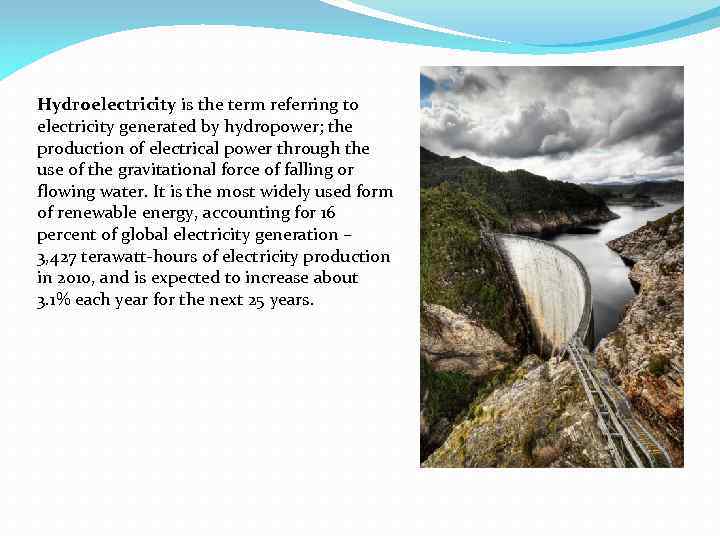 Hydroelectricity is the term referring to electricity generated by hydropower; the production of electrical power through the use of the gravitational force of falling or flowing water. It is the most widely used form of renewable energy, accounting for 16 percent of global electricity generation – 3, 427 terawatt-hours of electricity production in 2010, and is expected to increase about 3. 1% each year for the next 25 years.
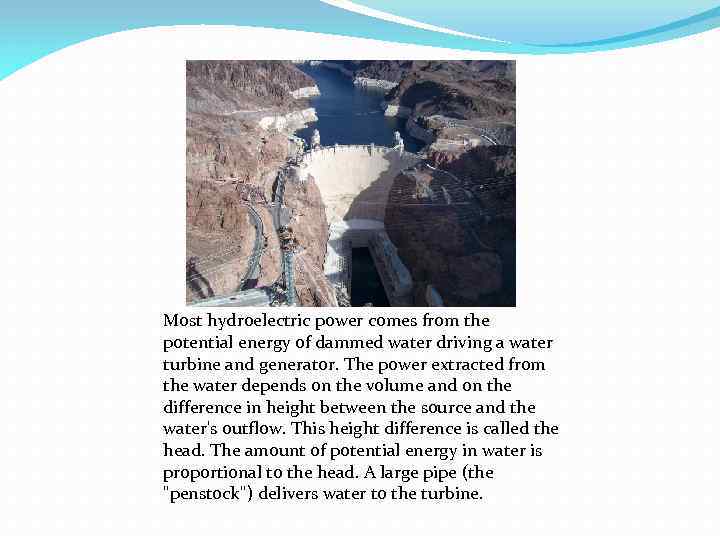 Most hydroelectric power comes from the potential energy of dammed water driving a water turbine and generator. The power extracted from the water depends on the volume and on the difference in height between the source and the water's outflow. This height difference is called the head. The amount of potential energy in water is proportional to the head. A large pipe (the "penstock") delivers water to the turbine.
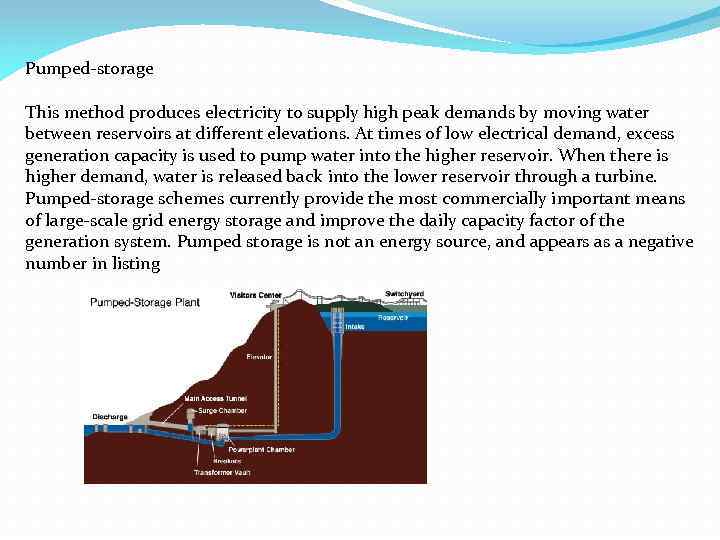 Pumped-storage This method produces electricity to supply high peak demands by moving water between reservoirs at different elevations. At times of low electrical demand, excess generation capacity is used to pump water into the higher reservoir. When there is higher demand, water is released back into the lower reservoir through a turbine. Pumped-storage schemes currently provide the most commercially important means of large-scale grid energy storage and improve the daily capacity factor of the generation system. Pumped storage is not an energy source, and appears as a negative number in listing
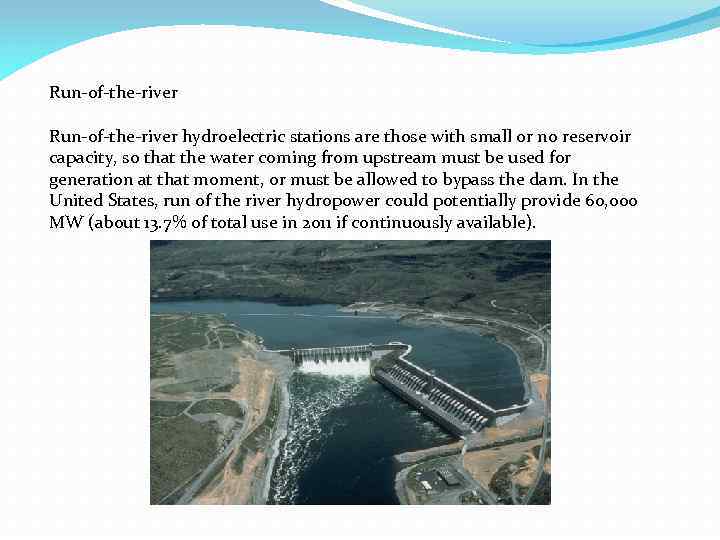 Run-of-the-river hydroelectric stations are those with small or no reservoir capacity, so that the water coming from upstream must be used for generation at that moment, or must be allowed to bypass the dam. In the United States, run of the river hydropower could potentially provide 60, 000 MW (about 13. 7% of total use in 2011 if continuously available).