 Скачать презентацию Hydrodynamics stability and temperature P Ván Department of
1ec25380c4589111de14dd3eeb18c6a7.ppt
- Количество слайдов: 17



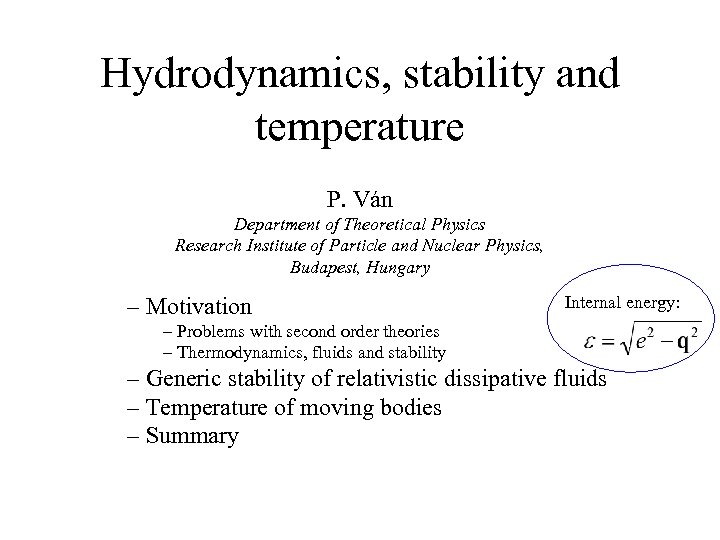
Hydrodynamics, stability and temperature P. Ván Department of Theoretical Physics Research Institute of Particle and Nuclear Physics, Budapest, Hungary – Motivation Internal energy: – Problems with second order theories – Thermodynamics, fluids and stability – Generic stability of relativistic dissipative fluids – Temperature of moving bodies – Summary
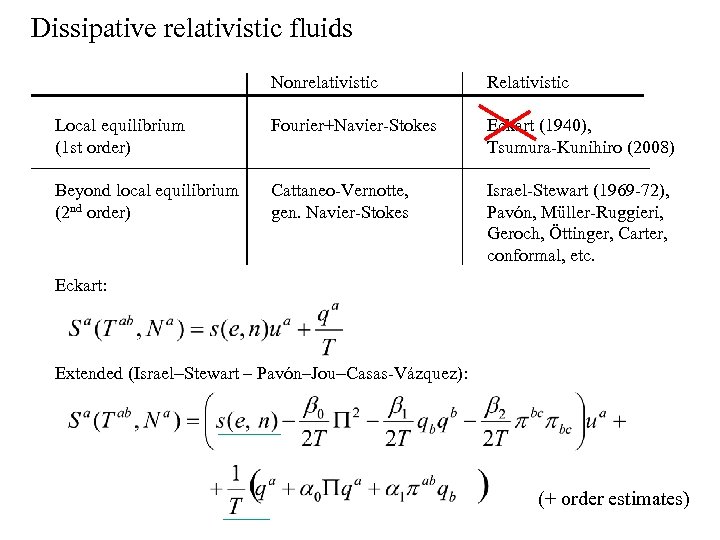
Dissipative relativistic fluids Nonrelativistic Relativistic Local equilibrium (1 st order) Fourier+Navier-Stokes Eckart (1940), Tsumura-Kunihiro (2008) Beyond local equilibrium (2 nd order) Cattaneo-Vernotte, gen. Navier-Stokes Israel-Stewart (1969 -72), Pavón, Müller-Ruggieri, Geroch, Öttinger, Carter, conformal, etc. Eckart: Extended (Israel–Stewart – Pavón–Jou–Casas-Vázquez): (+ order estimates)
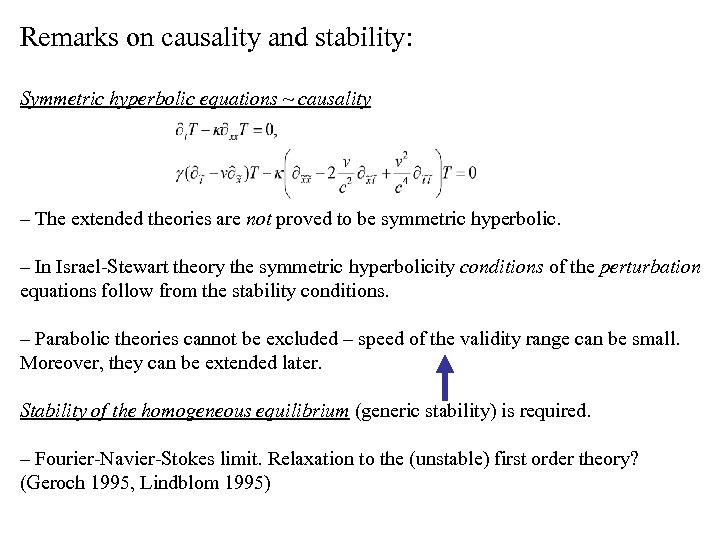
Remarks on causality and stability: Symmetric hyperbolic equations ~ causality – The extended theories are not proved to be symmetric hyperbolic. – In Israel-Stewart theory the symmetric hyperbolicity conditions of the perturbation equations follow from the stability conditions. – Parabolic theories cannot be excluded – speed of the validity range can be small. Moreover, they can be extended later. Stability of the homogeneous equilibrium (generic stability) is required. – Fourier-Navier-Stokes limit. Relaxation to the (unstable) first order theory? (Geroch 1995, Lindblom 1995)
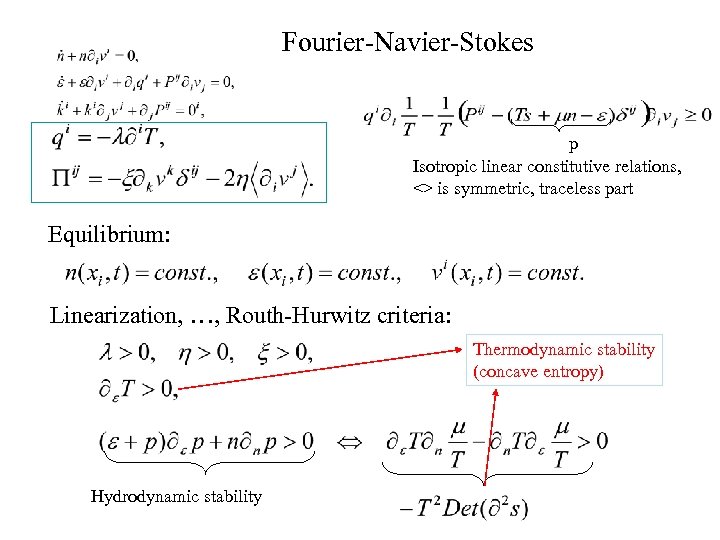
Fourier-Navier-Stokes p Isotropic linear constitutive relations, <> is symmetric, traceless part Equilibrium: Linearization, …, Routh-Hurwitz criteria: Thermodynamic stability (concave entropy) Hydrodynamic stability
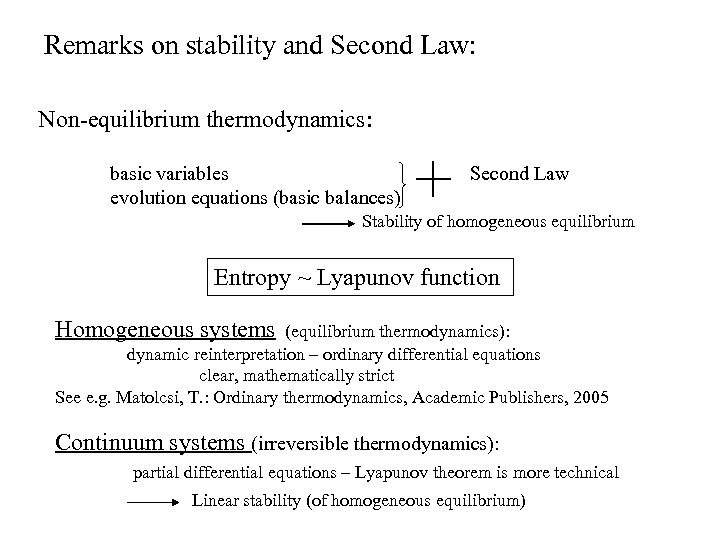
Remarks on stability and Second Law: Non-equilibrium thermodynamics: basic variables evolution equations (basic balances) Second Law Stability of homogeneous equilibrium Entropy ~ Lyapunov function Homogeneous systems (equilibrium thermodynamics): dynamic reinterpretation – ordinary differential equations clear, mathematically strict See e. g. Matolcsi, T. : Ordinary thermodynamics, Academic Publishers, 2005 Continuum systems (irreversible thermodynamics): partial differential equations – Lyapunov theorem is more technical Linear stability (of homogeneous equilibrium)
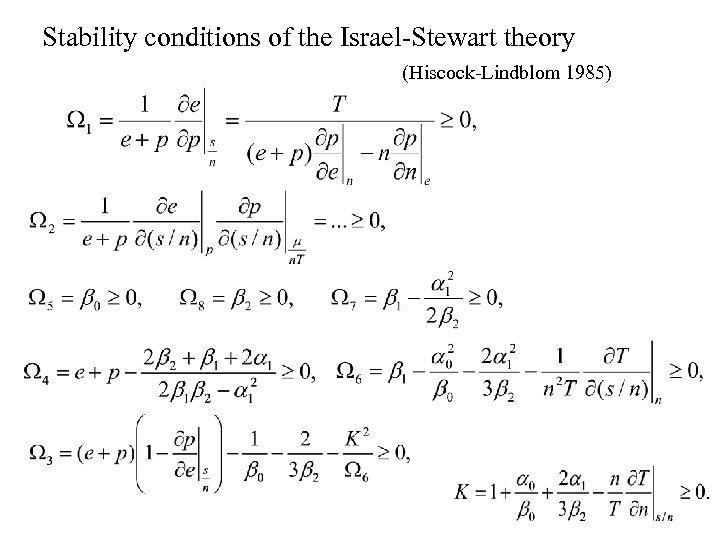
Stability conditions of the Israel-Stewart theory (Hiscock-Lindblom 1985)
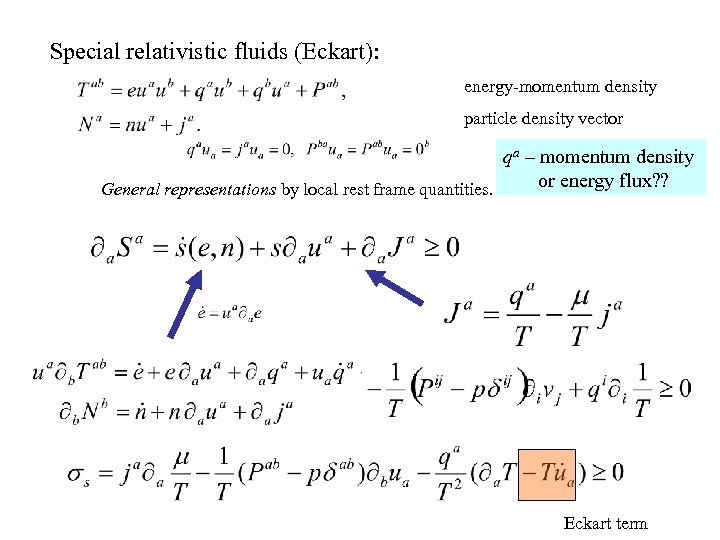
Special relativistic fluids (Eckart): energy-momentum density particle density vector qa – momentum density or energy flux? ? General representations by local rest frame quantities. Eckart term
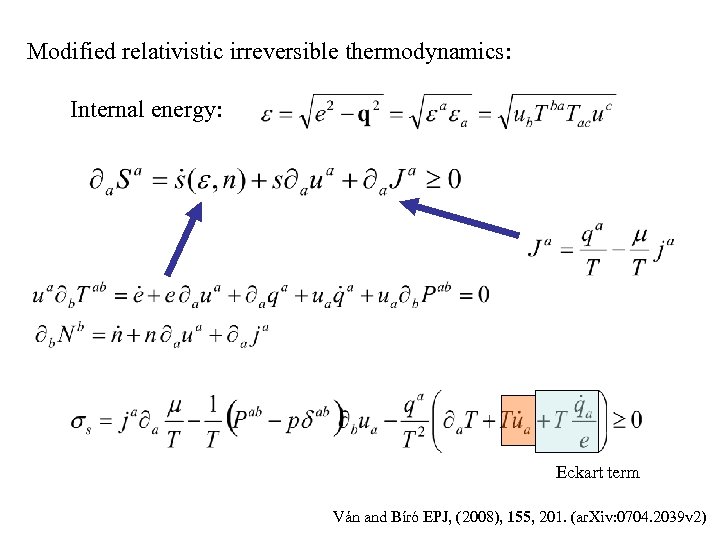
Modified relativistic irreversible thermodynamics: Internal energy: Eckart term Ván and Bíró EPJ, (2008), 155, 201. (ar. Xiv: 0704. 2039 v 2)
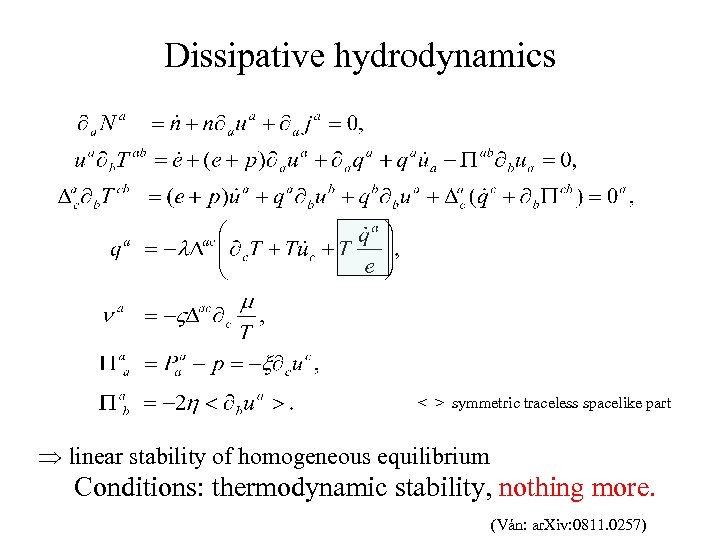
Dissipative hydrodynamics < > symmetric traceless spacelike part Þ linear stability of homogeneous equilibrium Conditions: thermodynamic stability, nothing more. (Ván: ar. Xiv: 0811. 0257)
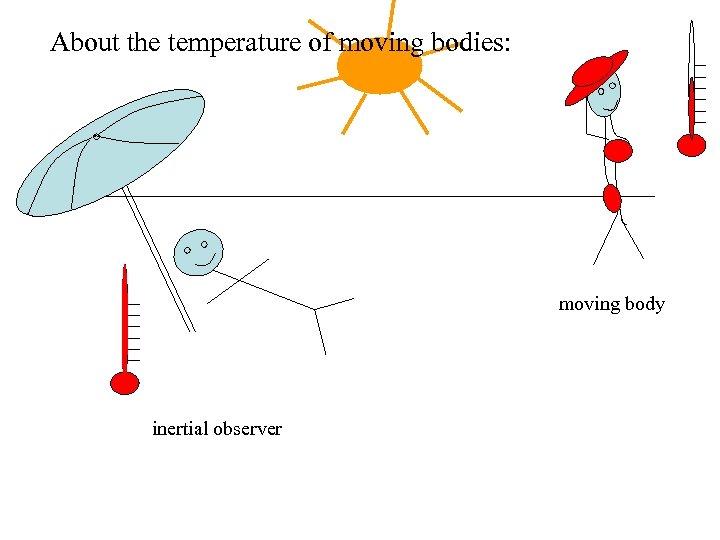
About the temperature of moving bodies: moving body inertial observer
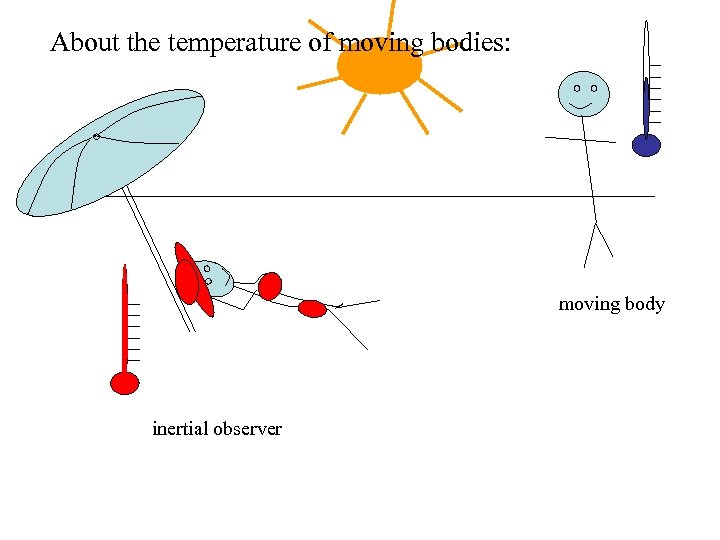
About the temperature of moving bodies: moving body inertial observer
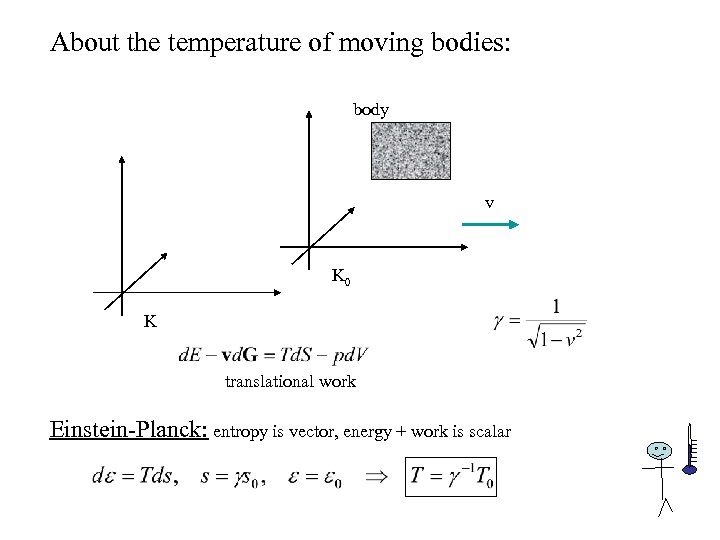
About the temperature of moving bodies: body v K 0 K translational work Einstein-Planck: entropy is vector, energy + work is scalar
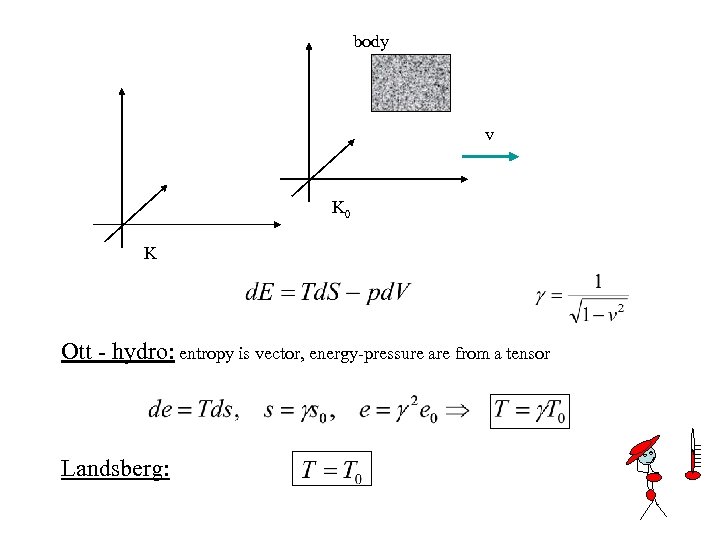
body v K 0 K Ott - hydro: entropy is vector, energy-pressure are from a tensor Landsberg:
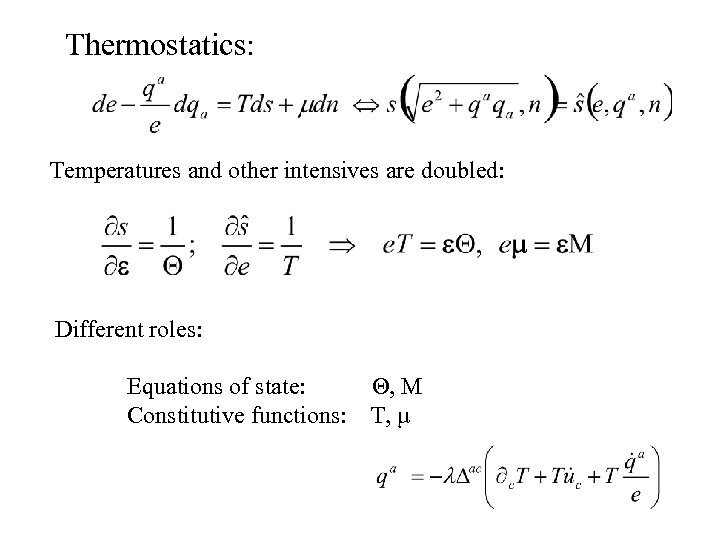
Thermostatics: Temperatures and other intensives are doubled: Different roles: Equations of state: Constitutive functions: Θ, M T, μ
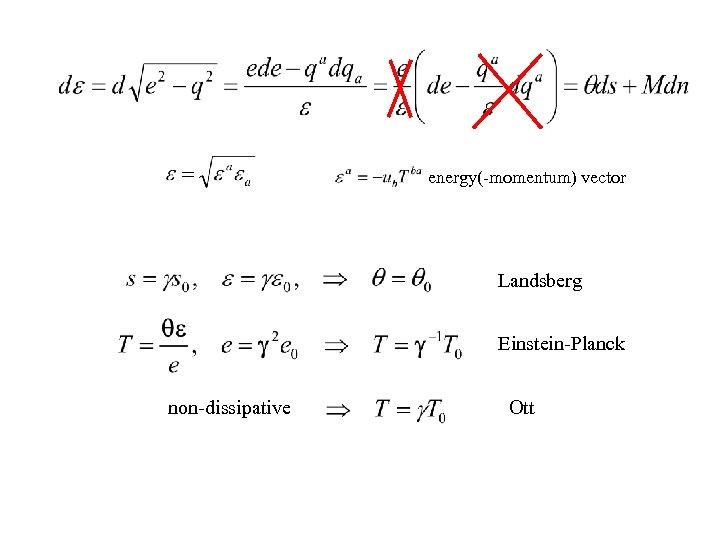
energy(-momentum) vector Landsberg Einstein-Planck non-dissipative Ott
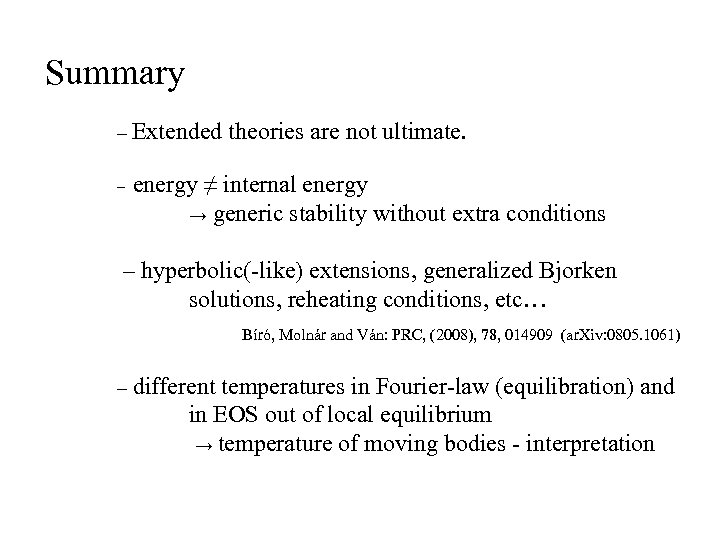
Summary – Extended – theories are not ultimate. energy ≠ internal energy → generic stability without extra conditions – hyperbolic(-like) extensions, generalized Bjorken solutions, reheating conditions, etc… Bíró, Molnár and Ván: PRC, (2008), 78, 014909 (ar. Xiv: 0805. 1061) – different temperatures in Fourier-law (equilibration) and in EOS out of local equilibrium → temperature of moving bodies - interpretation

Thank you for your attention!
Скачать презентацию Hydrodynamics stability and temperature P Ván Department of
1ec25380c4589111de14dd3eeb18c6a7.ppt