


 Скачать презентацию Hydraulics hy drau lics h drólliks noun study of
Lesson 14 - Hydraulics.ppt
- Количество слайдов: 22
![Hydraulics hy·drau·lics [h drólliks ] noun study of fluids: the study of water or](https://present5.com/presentation/38030945_137431102/image-1.jpg "Hydraulics hy·drau·lics [h drólliks ] noun study of fluids: the study of water or") Hydraulics hy·drau·lics [h drólliks ] noun study of fluids: the study of water or other fluids at rest or in motion, especially with respect to engineering applications
Hydraulics hy·drau·lics [h drólliks ] noun study of fluids: the study of water or other fluids at rest or in motion, especially with respect to engineering applications
 Objectives • • Behavior of liquids & theory of operation Basic hydraulic system components Advantages & disadvantages of hydraulics Electrohydraulic systems including speed gears & steering gears
 Introduction/Uses • Hydraulics used in many applications: • • • Steering/control systems (rudder, planes) Deck machinery (anchor windlass, capstans, winches) Masts & antennae on submarines Weapons systems (loading & launching) Other: elevators, presses
 Hydraulic Theory • Hydraulics • • • Covers the physical behavior of liquids in motion Pressurized oil used to gain mechanical advantage and perform work Important Properties • • • Shapelessness Incompressibility Transmission of Force
 Important Properties • “Shapelessness” • • Incompressibility • • • Liquids have no neutral form Conform to shape of container Easily transferred through piping from one location to another Liquids are essentially incompressible Once force is removed, liquid returns to original volume (no permanent distortion) Transmission of Force • Force is transmitted equally & undiminished in every direction -> vessel filled with pressure
 Hydraulic Theory • Pascal’s Law • • • Magnitude of force transferred is in direct proportion to the surface area (F = P*A) Pressure = Force/Area Liquid properties enable large objects (rudder, planes, etc) to be moved smoothly
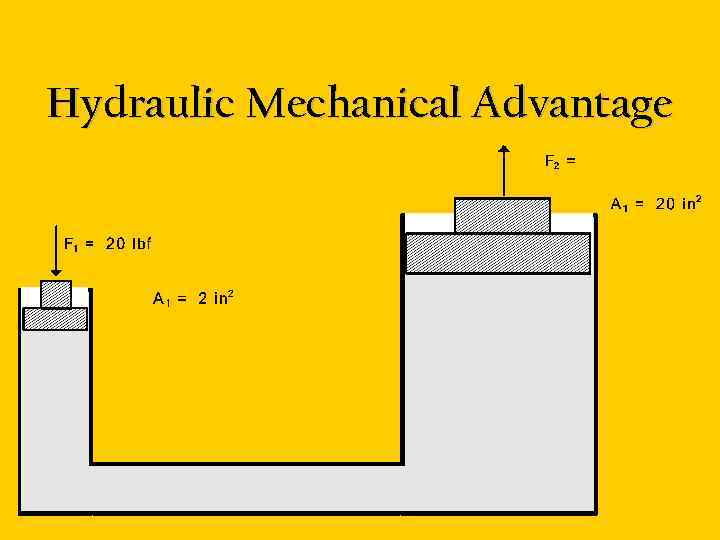 Hydraulic Mechanical Advantage
 Basic Hydraulic System • Hydraulic Fluid • • Pressure Source • • Hydraulic pump (A-end of system) Pressure user • • Usually oil (2190 TEP) Hydraulic motor (B-end of system) Piping system (w/ valves, tanks, etc) • Get fluid from A-end to B-end
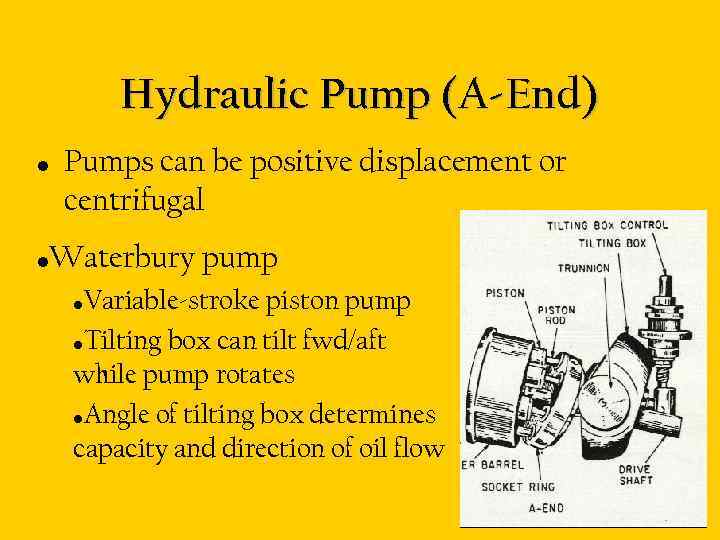 Hydraulic Pump (A-End) • • Pumps can be positive displacement or centrifugal Waterbury pump Variable-stroke piston pump • Tilting box can tilt fwd/aft while pump rotates • Angle of tilting box determines capacity and direction of oil flow •
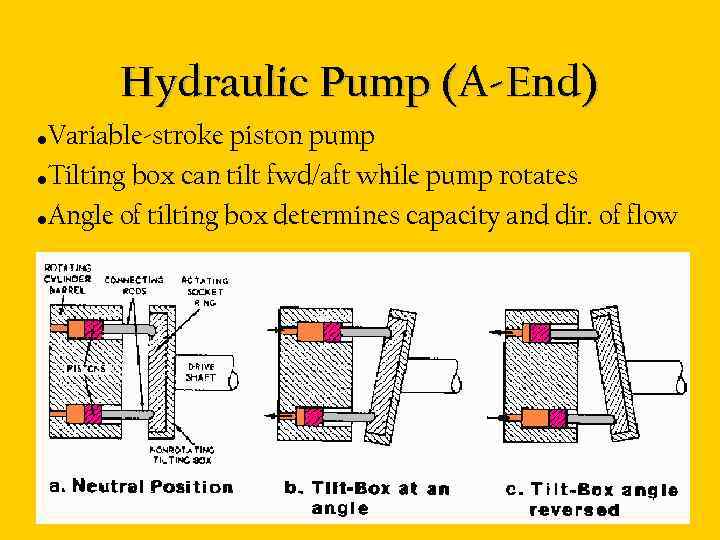 Hydraulic Pump (A-End) Variable-stroke piston pump • Tilting box can tilt fwd/aft while pump rotates • Angle of tilting box determines capacity and dir. of flow •
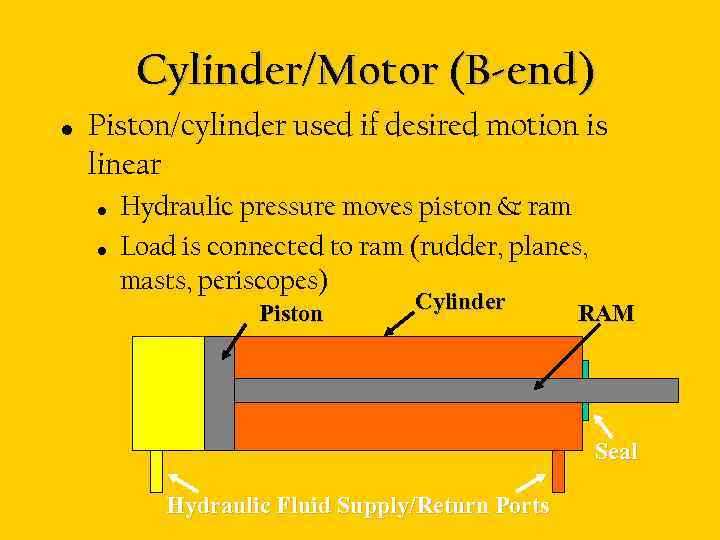 Cylinder/Motor (B-end) • Piston/cylinder used if desired motion is linear • • Hydraulic pressure moves piston & ram Load is connected to ram (rudder, planes, masts, periscopes) Piston Cylinder RAM Seal Hydraulic Fluid Supply/Return Ports
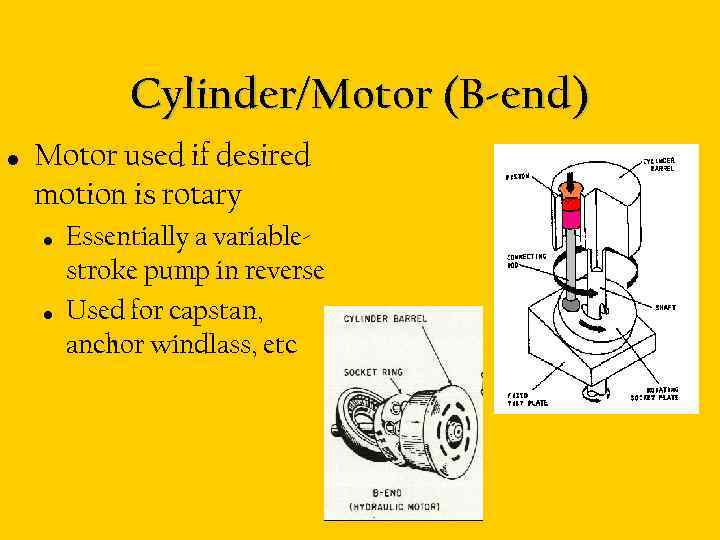 Cylinder/Motor (B-end) • Motor used if desired motion is rotary • • Essentially a variablestroke pump in reverse Used for capstan, anchor windlass, etc
 Piping System • • • Has to withstand excessive pressure Valves, filters, & HX’s all necessary Accumulators • • Holds system under pressure (w/out contin. pump) Provides hydraulics when pump off/lost Compensates for leakage/makeup volume Types: piston, bladder, & direct contact
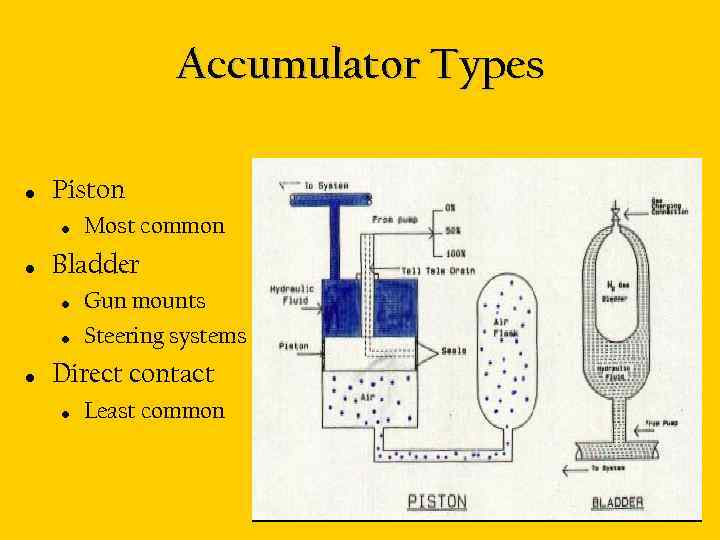 Accumulator Types • Piston • • Bladder • • • Most common Gun mounts Steering systems Direct contact • Least common
 Advantages • Convenient power transfer • • Flexibility • • Few moving parts Low losses over long distances Little wear Distribute force in multiple directions Safe and reliable for many uses Can be stored under pressure for long periods Variable speed control • Quick response (linear and rotary)
 Disadvantages • • Requires positive confinement (to give shape) Fire/explosive hazard if leaks or ruptures Filtration critical - must be free of debris Manpower intensive to clean up
 Electrohydraulic Drive System • • Uses hydraulics to transfer power from electric motor to load Rotary: Waterbury pump connected to rotary piston hydraulic motor (speed gear) • • • Tilting box of A-end controls direction/speed of B-end Adv: high starting torque, reversibility, high power-toweight ratio ex: Electrohydraulic Speed Gear or Steering Gear • capstan, anchor windlass, cranes, elevator, ammo hoist
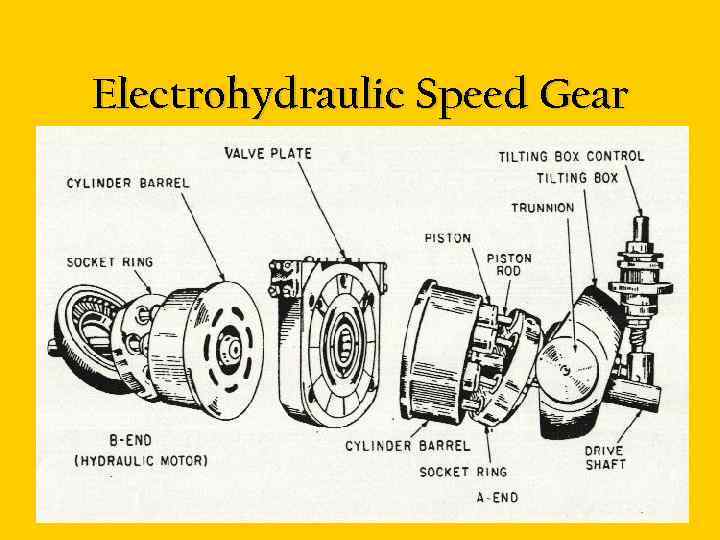 Electrohydraulic Speed Gear
 Electrohydraulic Steering Gear • • Same as speed gear except B-end is a hydraulic cylinder to produce linear motion Waterbury pumps connected by piping to hydraulic ram cylinder • • • Various methods for connecting rams to tillers Two pumps for redundancy & reliability Movement of steering wheel through hydraulic system moves rudder
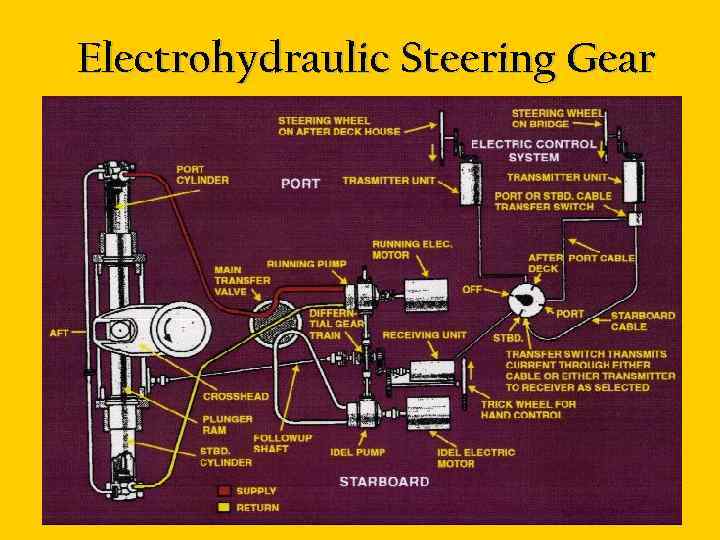 Electrohydraulic Steering Gear
 Control of System • Remote control • • • Normal method Control from bridge Emergency • • Take local control Manually position control surface/rudder
 Questions?