 Скачать презентацию Hybrid Systems Modeling Analysis Control Review and Vistas
7bb08a3221484c35be65b4c65f9b1a87.ppt
- Количество слайдов: 56



Hybrid Systems Modeling, Analysis, Control Review and Vistas of Research Shankar Sastry
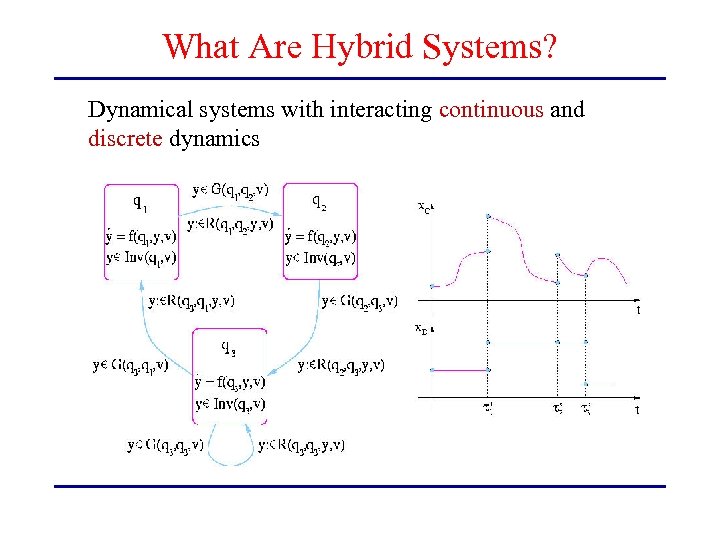
What Are Hybrid Systems? Dynamical systems with interacting continuous and discrete dynamics
Why Hybrid Systems? • Modeling abstraction of – Continuous systems with phased operation (e. g. walking robots, mechanical systems with collisions, circuits with diodes) – Continuous systems controlled by discrete inputs (e. g. switches, valves, digital computers) – Coordinating processes (multi-agent systems) • Important in applications – Hardware verification/CAD, real time software – Manufacturing, chemical process control, – communication networks, multimedia • Large scale, multi-agent systems – Automated Highway Systems (AHS) – Air Traffic Management Systems (ATM) – Uninhabited Aerial Vehicles (UAV), Power Networks
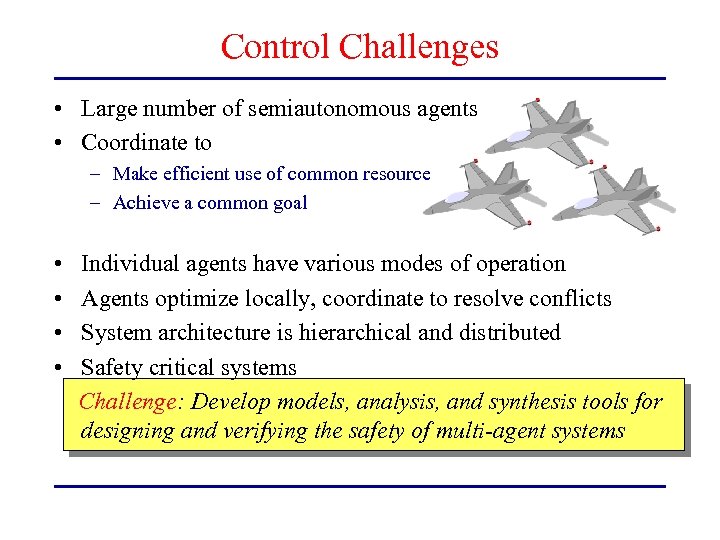
Control Challenges • Large number of semiautonomous agents • Coordinate to – Make efficient use of common resource – Achieve a common goal • • Individual agents have various modes of operation Agents optimize locally, coordinate to resolve conflicts System architecture is hierarchical and distributed Safety critical systems Challenge: Develop models, analysis, and synthesis tools for designing and verifying the safety of multi-agent systems
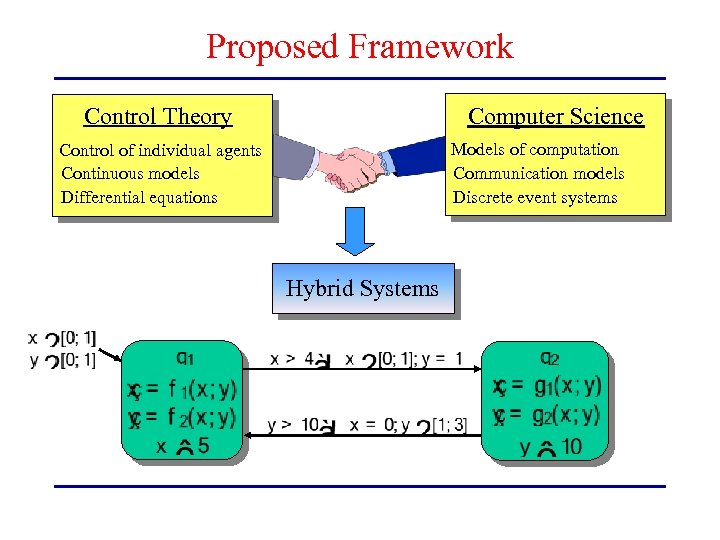
Proposed Framework Control Theory Computer Science Models of computation Communication models Discrete event systems Control of individual agents Continuous models Differential equations Hybrid Systems
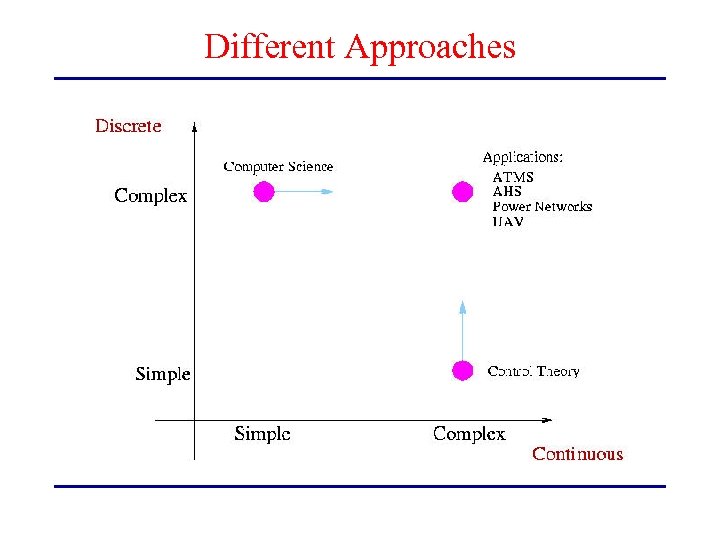
Different Approaches
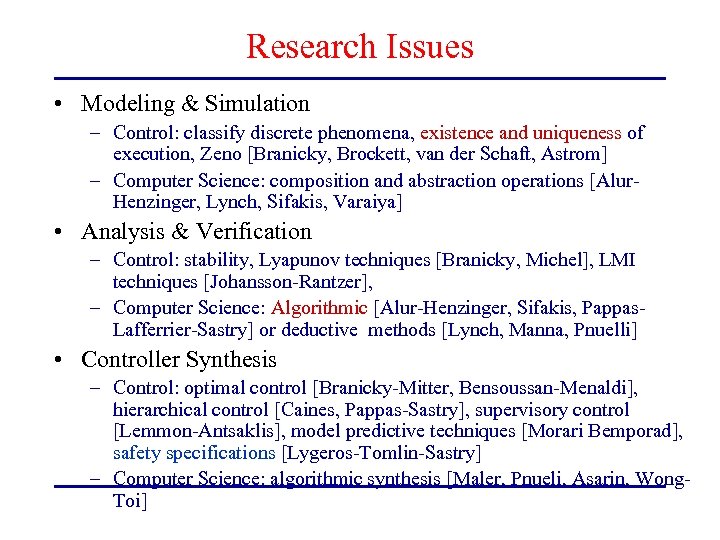
Research Issues • Modeling & Simulation – Control: classify discrete phenomena, existence and uniqueness of execution, Zeno [Branicky, Brockett, van der Schaft, Astrom] – Computer Science: composition and abstraction operations [Alur. Henzinger, Lynch, Sifakis, Varaiya] • Analysis & Verification – Control: stability, Lyapunov techniques [Branicky, Michel], LMI techniques [Johansson-Rantzer], – Computer Science: Algorithmic [Alur-Henzinger, Sifakis, Pappas. Lafferrier-Sastry] or deductive methods [Lynch, Manna, Pnuelli] • Controller Synthesis – Control: optimal control [Branicky-Mitter, Bensoussan-Menaldi], hierarchical control [Caines, Pappas-Sastry], supervisory control [Lemmon-Antsaklis], model predictive techniques [Morari Bemporad], safety specifications [Lygeros-Tomlin-Sastry] – Computer Science: algorithmic synthesis [Maler, Pnueli, Asarin, Wong. Toi]
Air Traffic Management Systems • Studied by NEXTOR and NASA • Increased demand for secure air travel – Higher aircraft density/operator workload – Severe degradation in adverse conditions – Safe operations close to urban areas • Technological advances: Guidance, Navigation & Control – GPS, advanced avionics, on-board electronics – Communication capabilities – Air Traffic Controller (ATC) computation capabilities • Greater demand possibilities for automation – Operator assistance – Decentralization – Free/flexible flight
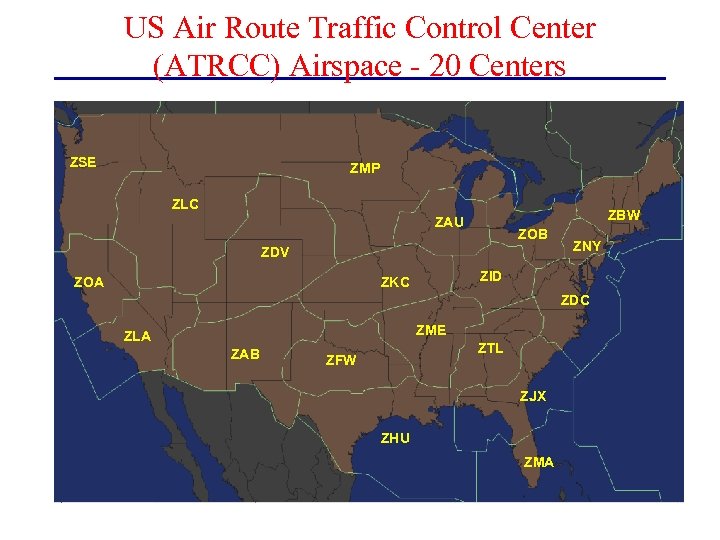
US Air Route Traffic Control Center (ATRCC) Airspace - 20 Centers ZSE ZMP ZLC ZBW ZAU ZOB ZDV ZOA ZNY ZID ZKC ZDC ZME ZLA ZAB ZTL ZFW ZJX ZHU ZMA
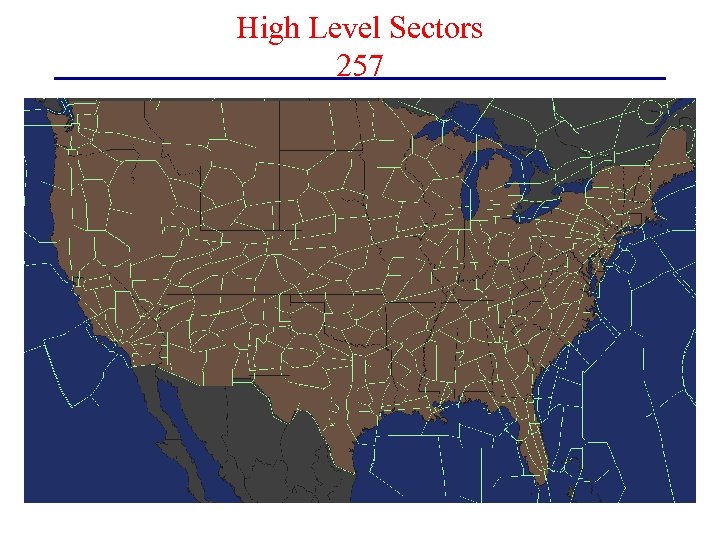
High Level Sectors 257
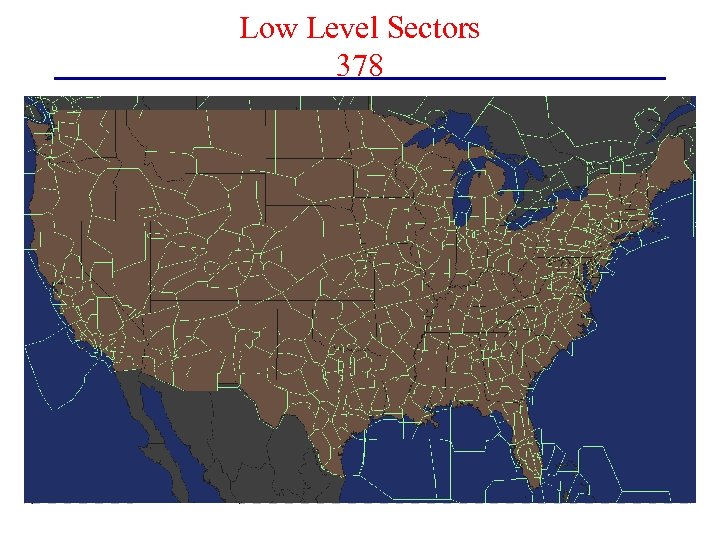
Low Level Sectors 378
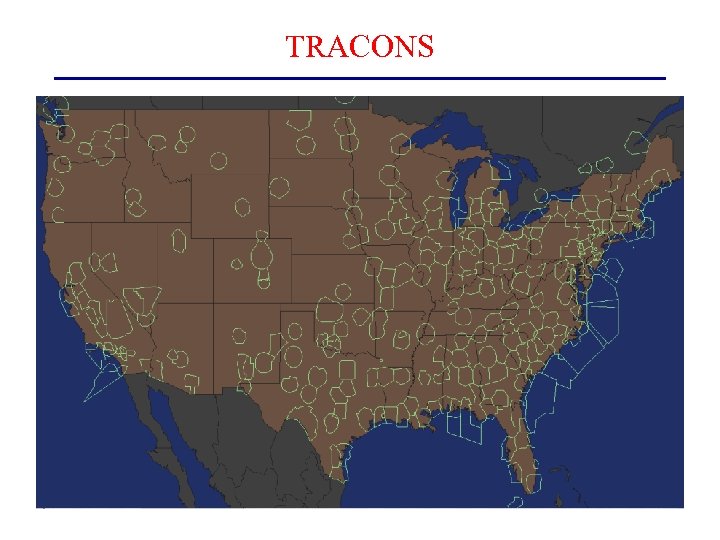
TRACONS
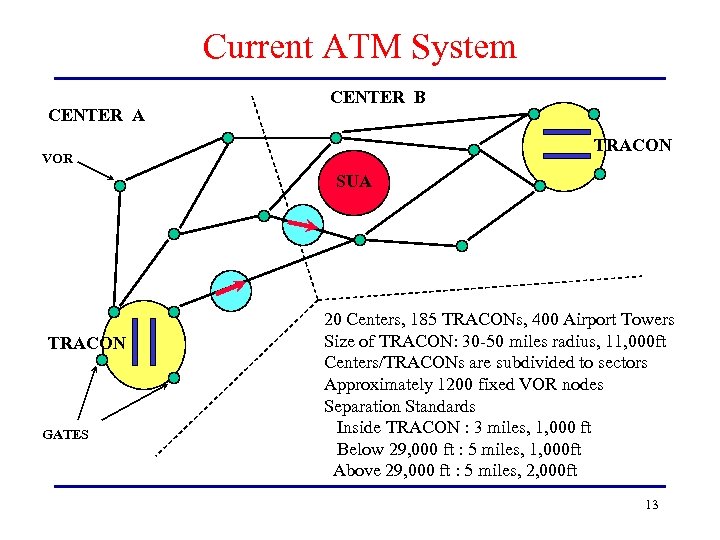
Current ATM System CENTER A CENTER B TRACON VOR SUA TRACON GATES 20 Centers, 185 TRACONs, 400 Airport Towers Size of TRACON: 30 -50 miles radius, 11, 000 ft Centers/TRACONs are subdivided to sectors Approximately 1200 fixed VOR nodes Separation Standards Inside TRACON : 3 miles, 1, 000 ft Below 29, 000 ft : 5 miles, 1, 000 ft Above 29, 000 ft : 5 miles, 2, 000 ft 13
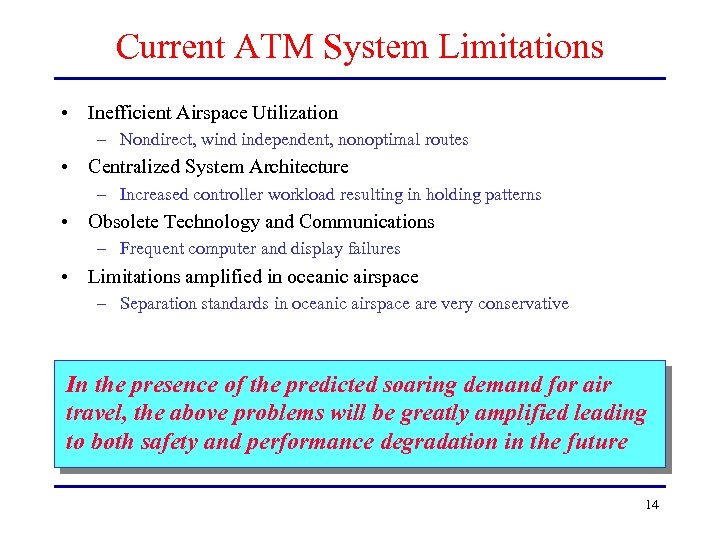
Current ATM System Limitations • Inefficient Airspace Utilization – Nondirect, wind independent, nonoptimal routes • Centralized System Architecture – Increased controller workload resulting in holding patterns • Obsolete Technology and Communications – Frequent computer and display failures • Limitations amplified in oceanic airspace – Separation standards in oceanic airspace are very conservative In the presence of the predicted soaring demand for air travel, the above problems will be greatly amplified leading to both safety and performance degradation in the future 14
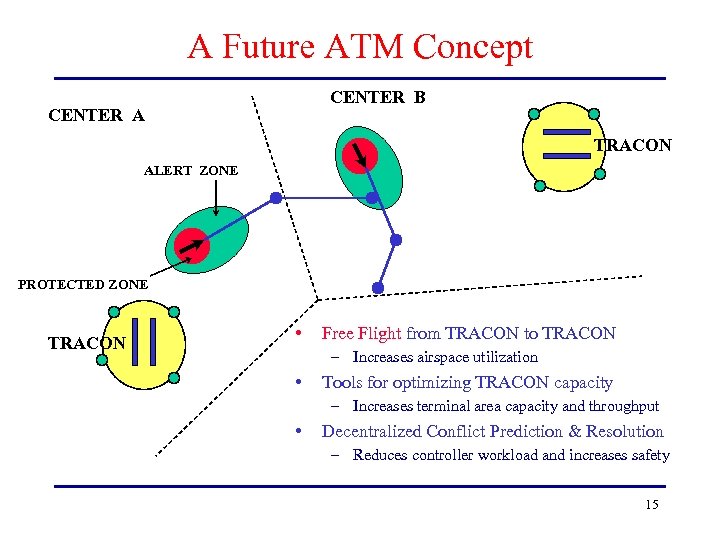
A Future ATM Concept CENTER B CENTER A TRACON ALERT ZONE PROTECTED ZONE TRACON • Free Flight from TRACON to TRACON – Increases airspace utilization • Tools for optimizing TRACON capacity – Increases terminal area capacity and throughput • Decentralized Conflict Prediction & Resolution – Reduces controller workload and increases safety 15
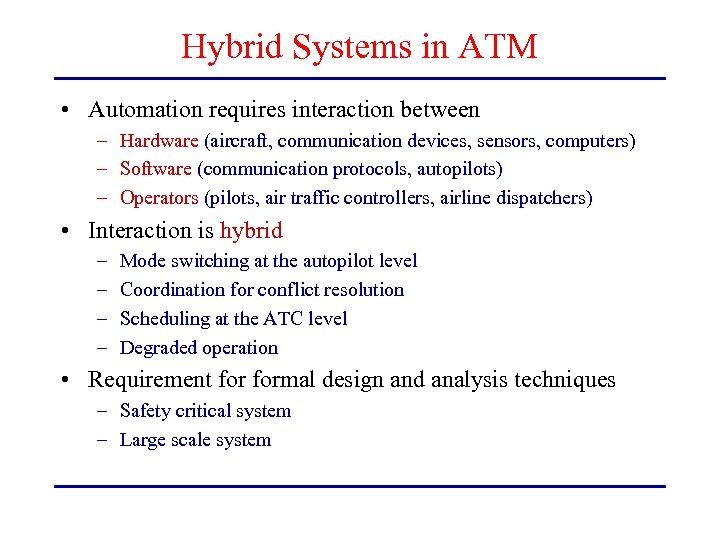
Hybrid Systems in ATM • Automation requires interaction between – Hardware (aircraft, communication devices, sensors, computers) – Software (communication protocols, autopilots) – Operators (pilots, air traffic controllers, airline dispatchers) • Interaction is hybrid – – Mode switching at the autopilot level Coordination for conflict resolution Scheduling at the ATC level Degraded operation • Requirement formal design and analysis techniques – Safety critical system – Large scale system
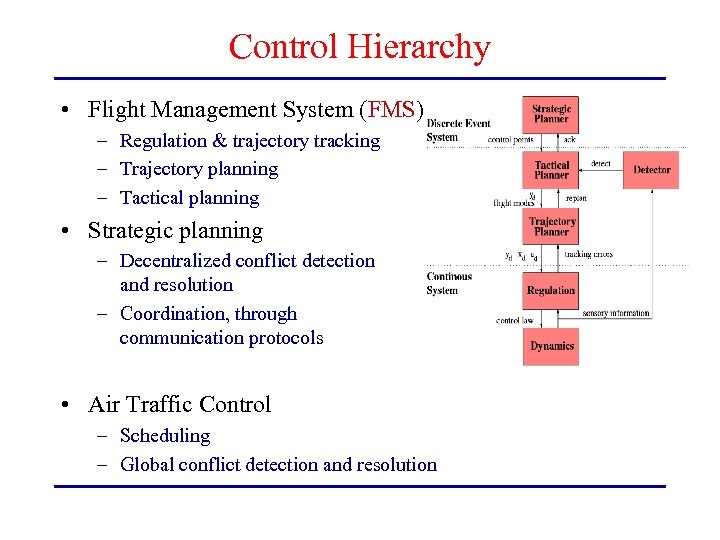
Control Hierarchy • Flight Management System (FMS) – Regulation & trajectory tracking – Trajectory planning – Tactical planning • Strategic planning – Decentralized conflict detection and resolution – Coordination, through communication protocols • Air Traffic Control – Scheduling – Global conflict detection and resolution
Hybrid Research Issues • Hierarchy design • FMS level – Mode switching – Aerodynamic envelope protection • Strategic level – Design of conflict resolution maneuvers – Implementation by communication protocols • ATC level – Scheduling algorithms (e. g. for take-offs and landings) – Global conflict resolution algorithms • Software verification • Probabilistic analysis and degraded modes of operation
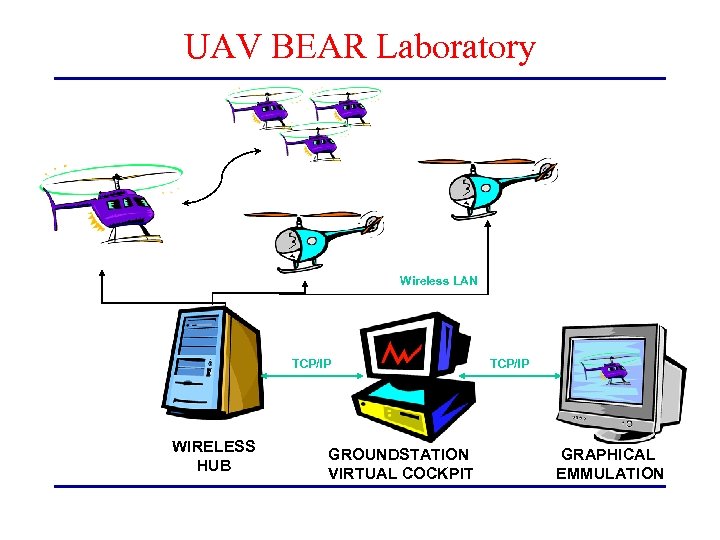
UAV BEAR Laboratory Wireless LAN TCP/IP WIRELESS HUB GROUNDSTATION VIRTUAL COCKPIT TCP/IP GRAPHICAL EMMULATION
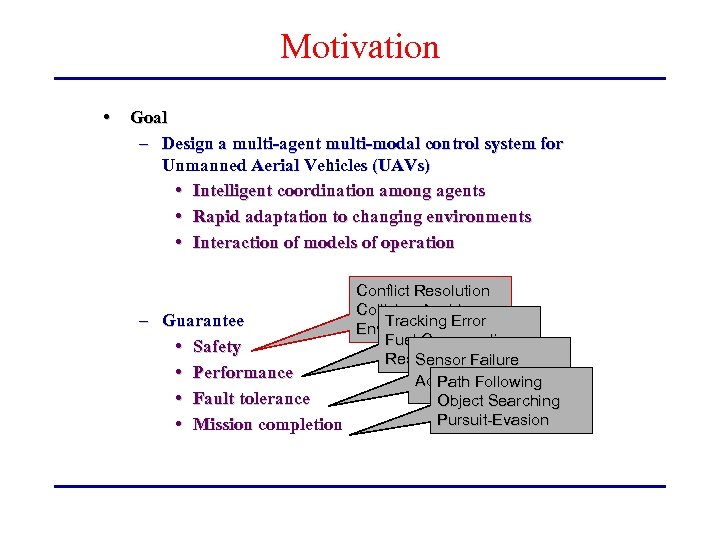
Motivation • Goal – Design a multi-agent multi-modal control system for Unmanned Aerial Vehicles (UAVs) • Intelligent coordination among agents • Rapid adaptation to changing environments • Interaction of models of operation Conflict Resolution Collision Avoidance Tracking Error – Guarantee Envelope Protection Fuel Consumption • Safety Response Time Sensor Failure • Performance Actuator. Following Path Failure • Fault tolerance Object Searching Pursuit-Evasion • Mission completion
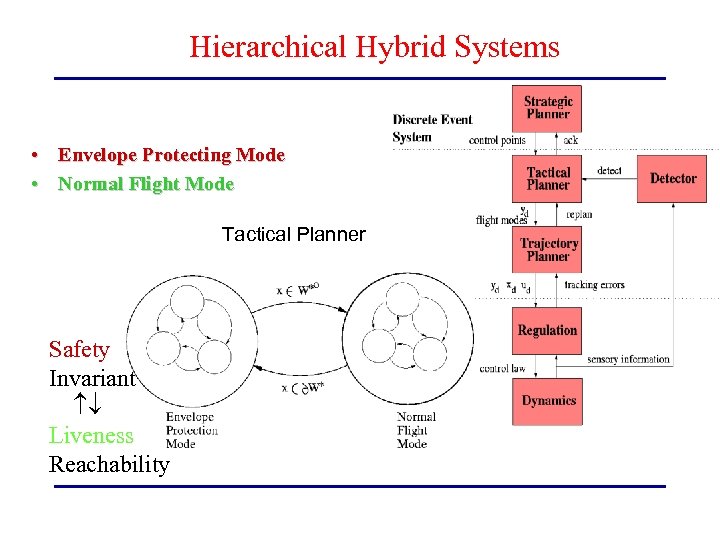
Hierarchical Hybrid Systems • Envelope Protecting Mode • Normal Flight Mode Tactical Planner Safety Invariant Liveness Reachability
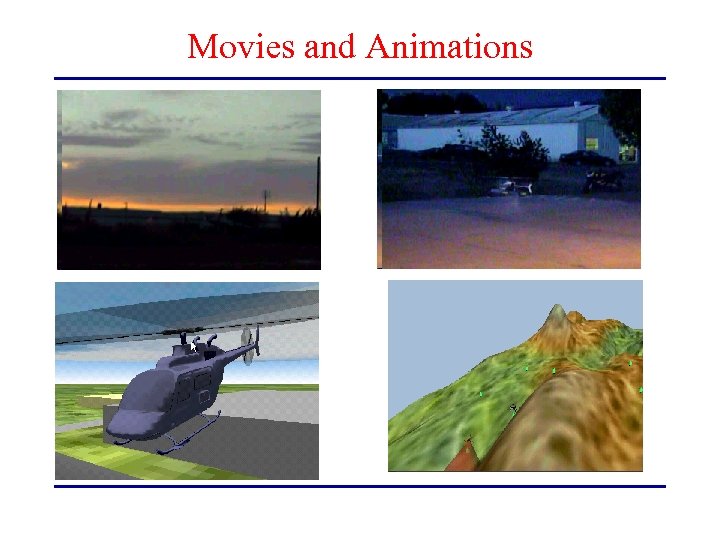
Movies and Animations
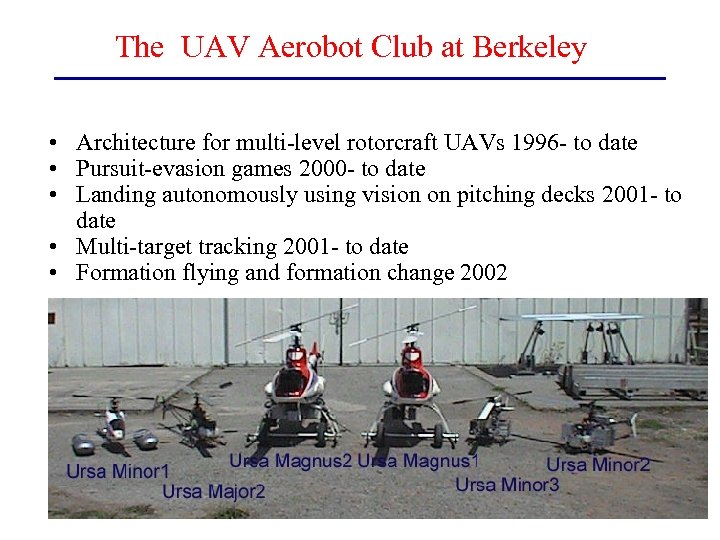
The UAV Aerobot Club at Berkeley • Architecture for multi-level rotorcraft UAVs 1996 - to date • Pursuit-evasion games 2000 - to date • Landing autonomously using vision on pitching decks 2001 - to date • Multi-target tracking 2001 - to date • Formation flying and formation change 2002
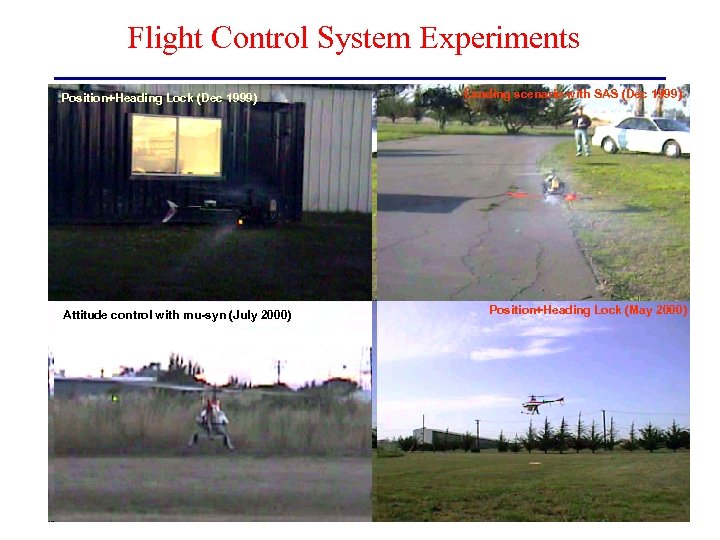
Flight Control System Experiments Position+Heading Lock (Dec 1999) Attitude control with mu-syn (July 2000) Landing scenario with SAS (Dec 1999) Position+Heading Lock (May 2000)
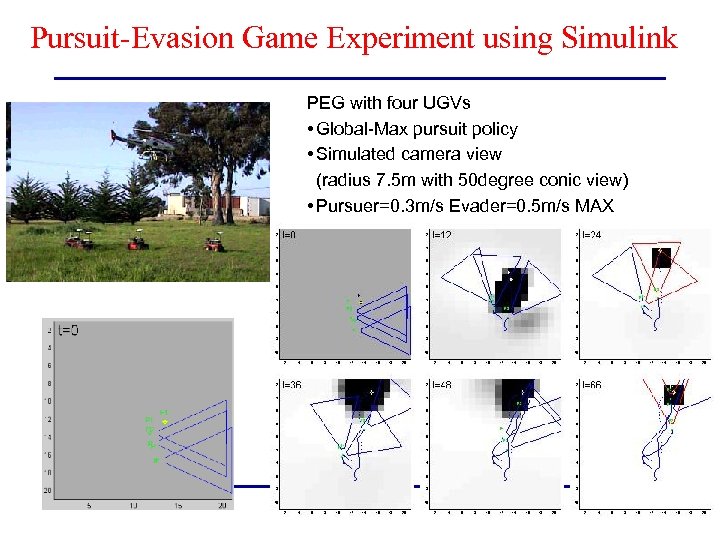
Pursuit-Evasion Game Experiment using Simulink PEG with four UGVs • Global-Max pursuit policy • Simulated camera view (radius 7. 5 m with 50 degree conic view) • Pursuer=0. 3 m/s Evader=0. 5 m/s MAX
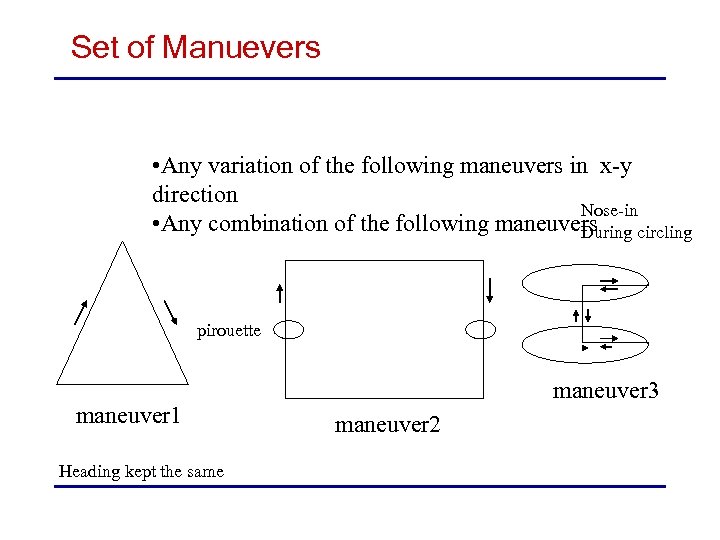
Set of Manuevers • Any variation of the following maneuvers in x-y direction Nose-in • Any combination of the following maneuvers During circling pirouette maneuver 1 Heading kept the same maneuver 3 maneuver 2
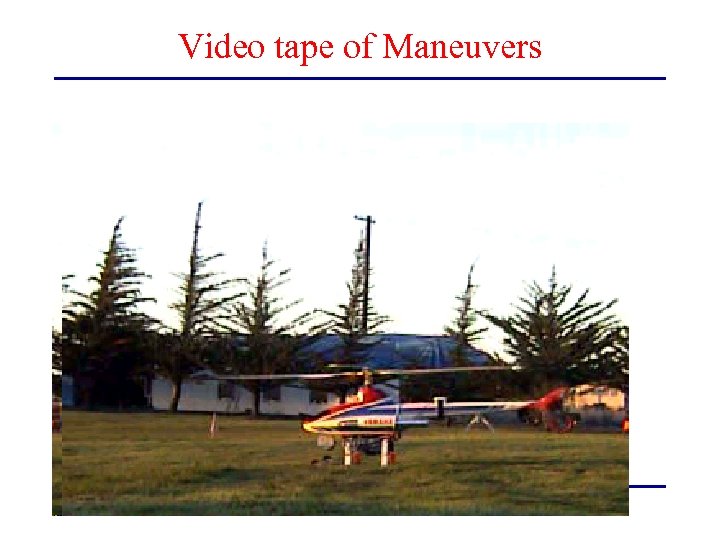
Video tape of Maneuvers
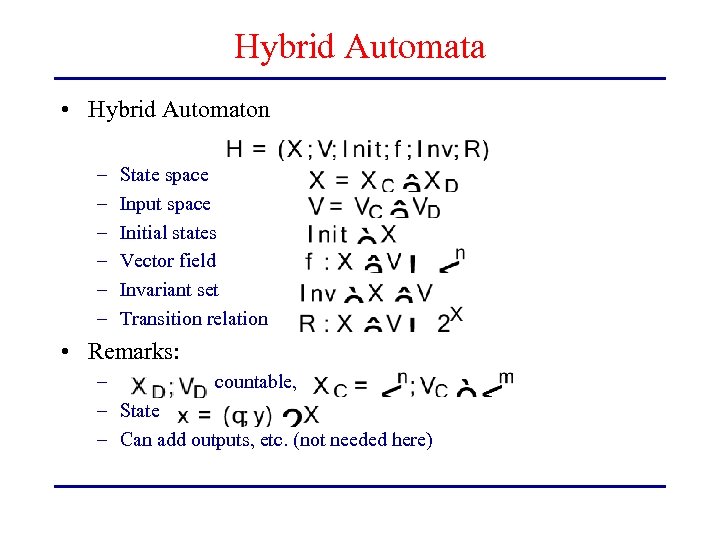
Hybrid Automata • Hybrid Automaton – – – State space Input space Initial states Vector field Invariant set Transition relation • Remarks: – countable, – State – Can add outputs, etc. (not needed here)
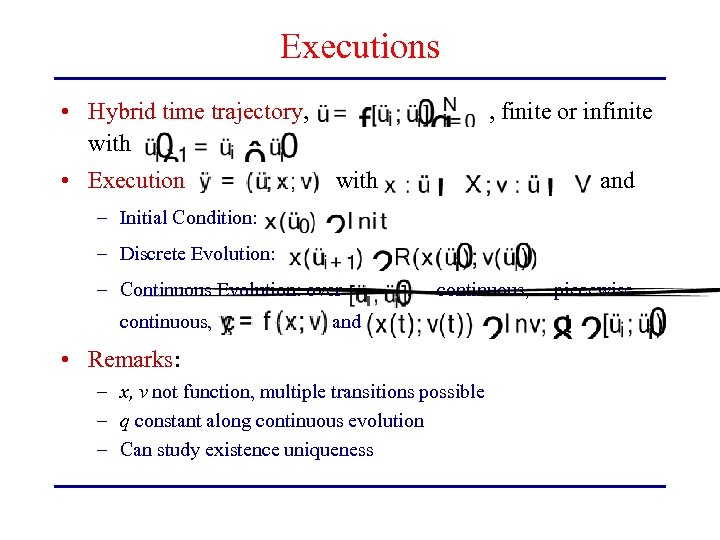
Executions • Hybrid time trajectory, with • Execution , finite or infinite with and – Initial Condition: – Discrete Evolution: – Continuous Evolution: over continuous, , continuous, and • Remarks: – x, v not function, multiple transitions possible – q constant along continuous evolution – Can study existence uniqueness piecewise
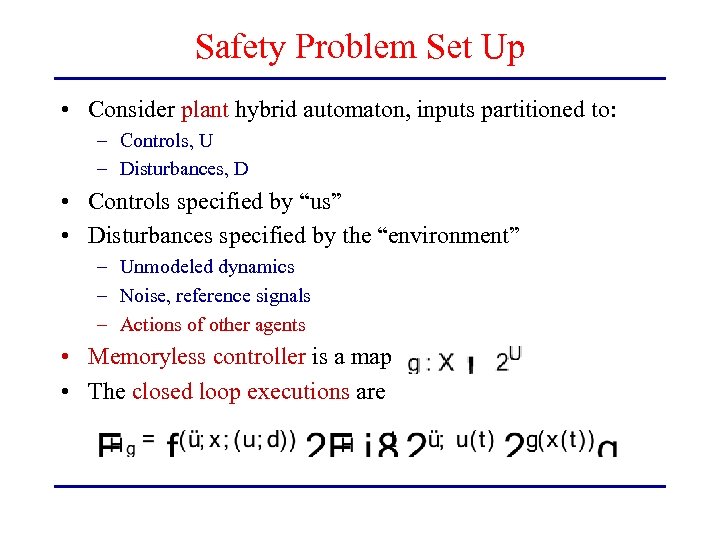
Safety Problem Set Up • Consider plant hybrid automaton, inputs partitioned to: – Controls, U – Disturbances, D • Controls specified by “us” • Disturbances specified by the “environment” – Unmodeled dynamics – Noise, reference signals – Actions of other agents • Memoryless controller is a map • The closed loop executions are
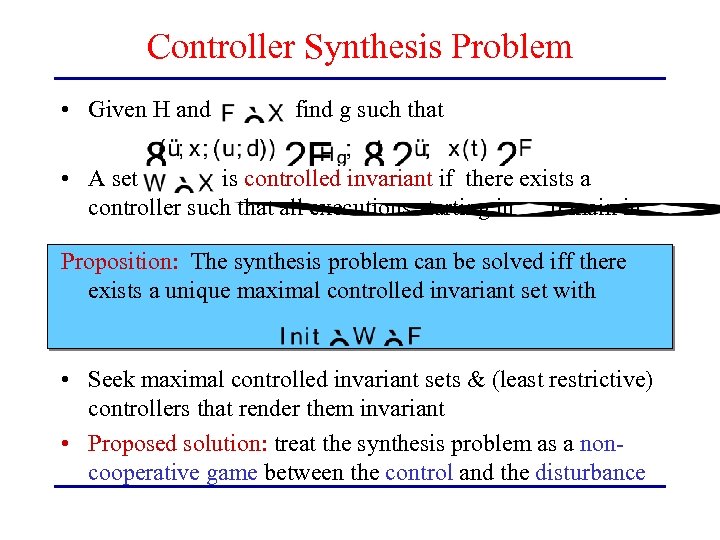
Controller Synthesis Problem • Given H and find g such that • A set is controlled invariant if there exists a controller such that all executions starting in remain in Proposition: The synthesis problem can be solved iff there exists a unique maximal controlled invariant set with • Seek maximal controlled invariant sets & (least restrictive) controllers that render them invariant • Proposed solution: treat the synthesis problem as a noncooperative game between the control and the disturbance
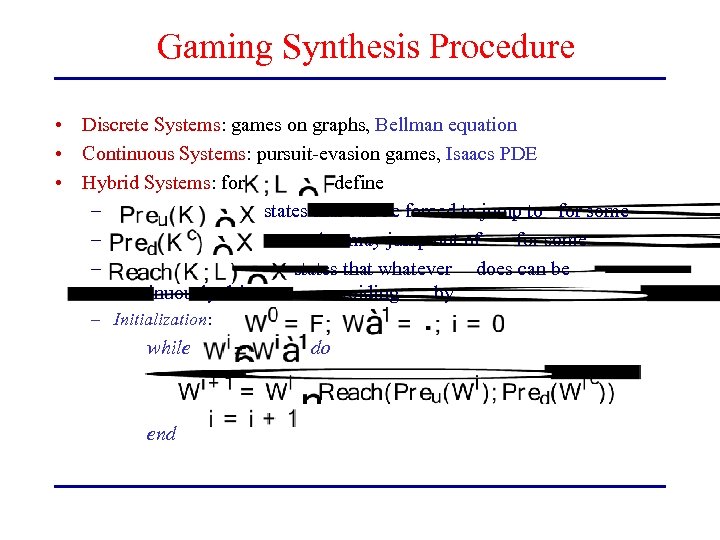
Gaming Synthesis Procedure • Discrete Systems: games on graphs, Bellman equation • Continuous Systems: pursuit-evasion games, Isaacs PDE • Hybrid Systems: for define – states that can be forced to jump to for some – states that may jump out of for some – states that whatever does can be continuously driven to avoiding by – Initialization: while end do
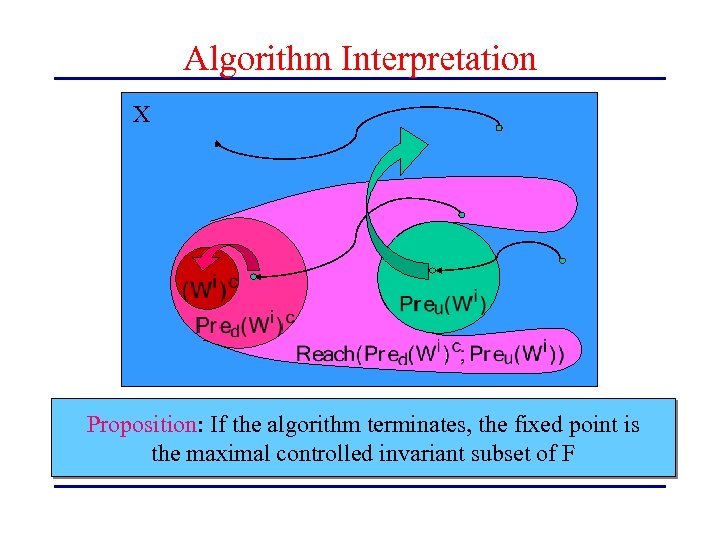
Algorithm Interpretation X Proposition: If the algorithm terminates, the fixed point is the maximal controlled invariant subset of F
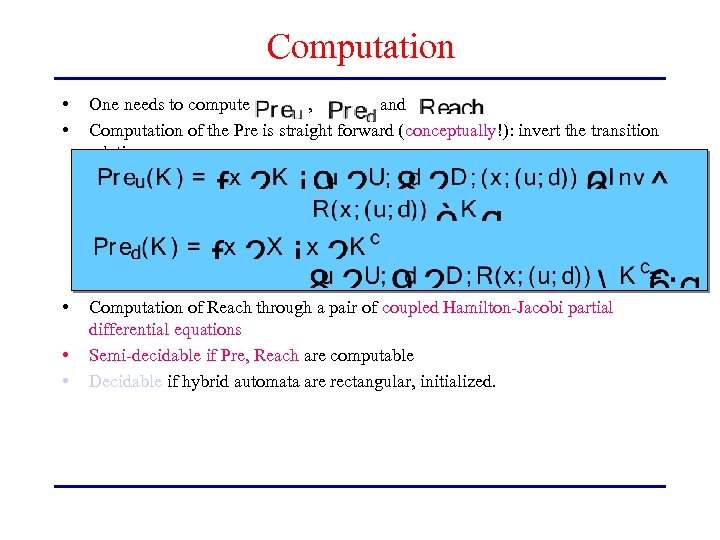
Computation • • One needs to compute , and Computation of the Pre is straight forward (conceptually!): invert the transition relation • Computation of Reach through a pair of coupled Hamilton-Jacobi partial differential equations Semi-decidable if Pre, Reach are computable Decidable if hybrid automata are rectangular, initialized. • •
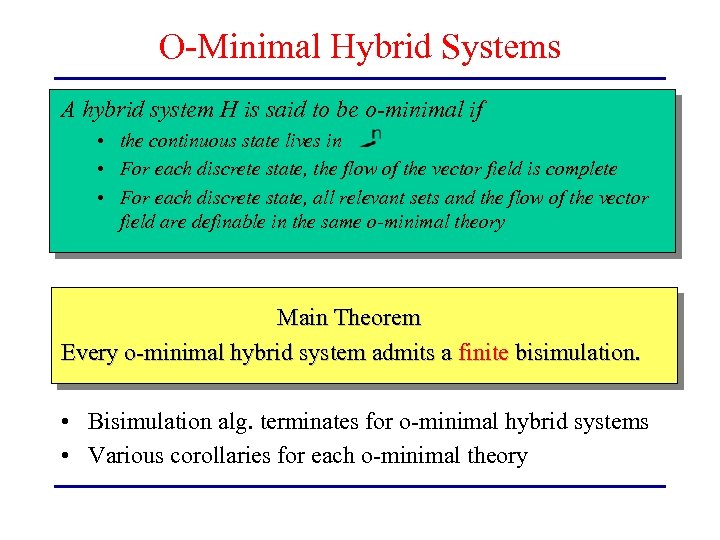
O-Minimal Hybrid Systems A hybrid system H is said to be o-minimal if • the continuous state lives in • For each discrete state, the flow of the vector field is complete • For each discrete state, all relevant sets and the flow of the vector field are definable in the same o-minimal theory Main Theorem Every o-minimal hybrid system admits a finite bisimulation. • Bisimulation alg. terminates for o-minimal hybrid systems • Various corollaries for each o-minimal theory
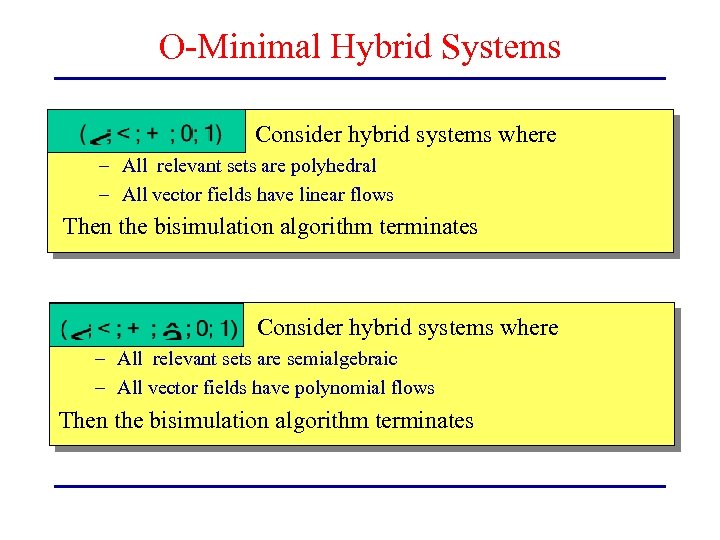
O-Minimal Hybrid Systems Consider hybrid systems where – All relevant sets are polyhedral – All vector fields have linear flows Then the bisimulation algorithm terminates Consider hybrid systems where – All relevant sets are semialgebraic – All vector fields have polynomial flows Then the bisimulation algorithm terminates
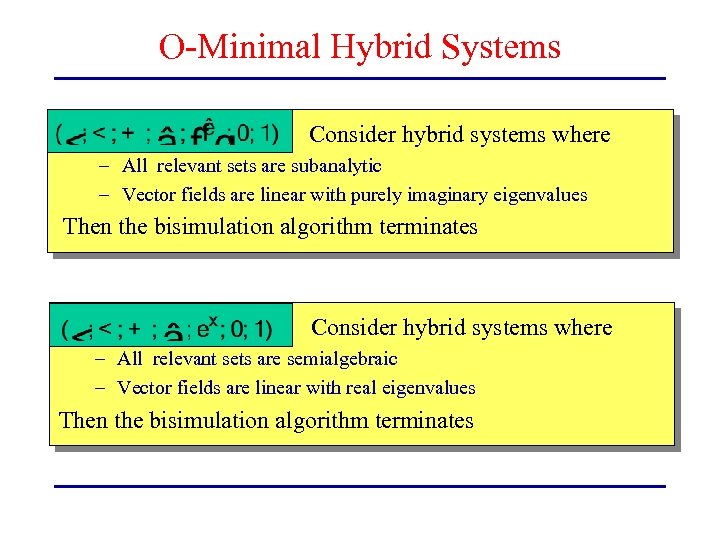
O-Minimal Hybrid Systems Consider hybrid systems where – All relevant sets are subanalytic – Vector fields are linear with purely imaginary eigenvalues Then the bisimulation algorithm terminates Consider hybrid systems where – All relevant sets are semialgebraic – Vector fields are linear with real eigenvalues Then the bisimulation algorithm terminates
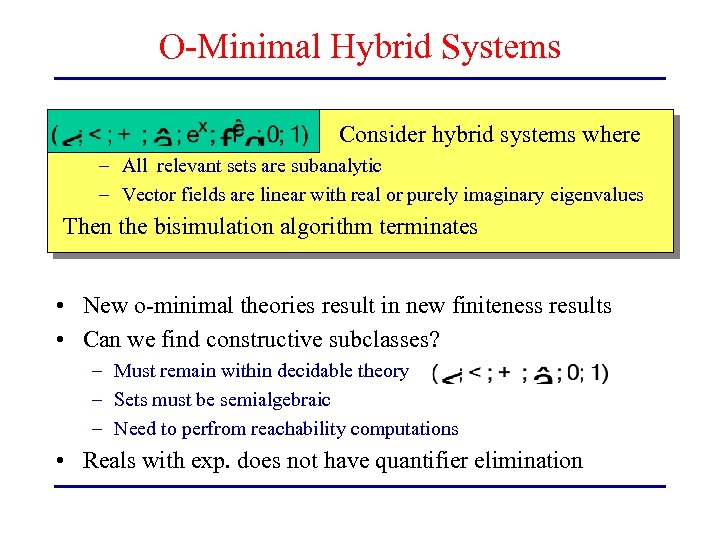
O-Minimal Hybrid Systems Consider hybrid systems where – All relevant sets are subanalytic – Vector fields are linear with real or purely imaginary eigenvalues Then the bisimulation algorithm terminates • New o-minimal theories result in new finiteness results • Can we find constructive subclasses? – Must remain within decidable theory – Sets must be semialgebraic – Need to perfrom reachability computations • Reals with exp. does not have quantifier elimination
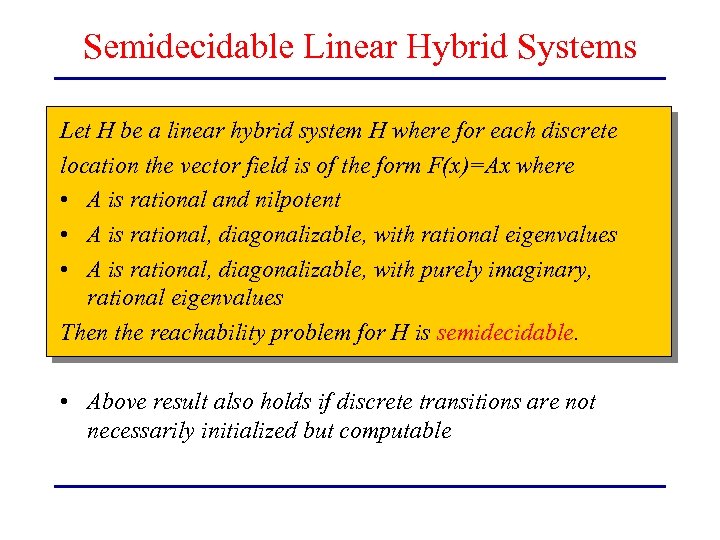
Semidecidable Linear Hybrid Systems Let H be a linear hybrid system H where for each discrete location the vector field is of the form F(x)=Ax where • A is rational and nilpotent • A is rational, diagonalizable, with rational eigenvalues • A is rational, diagonalizable, with purely imaginary, rational eigenvalues Then the reachability problem for H is semidecidable. • Above result also holds if discrete transitions are not necessarily initialized but computable
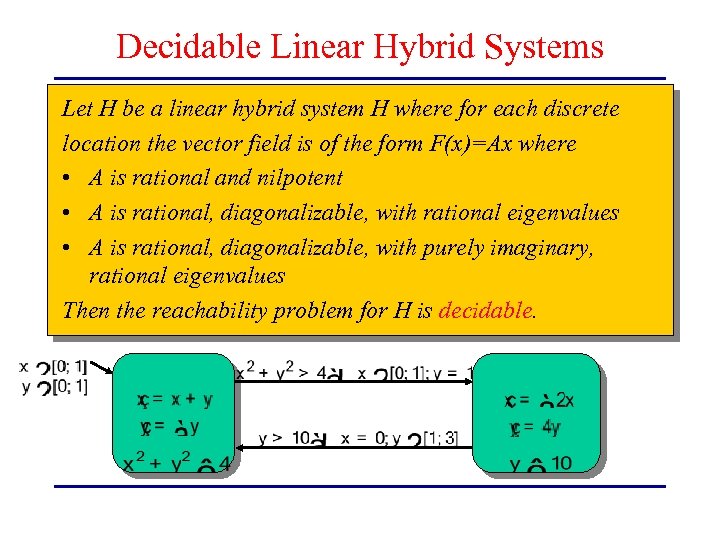
Decidable Linear Hybrid Systems Let H be a linear hybrid system H where for each discrete location the vector field is of the form F(x)=Ax where • A is rational and nilpotent • A is rational, diagonalizable, with rational eigenvalues • A is rational, diagonalizable, with purely imaginary, rational eigenvalues Then the reachability problem for H is decidable.
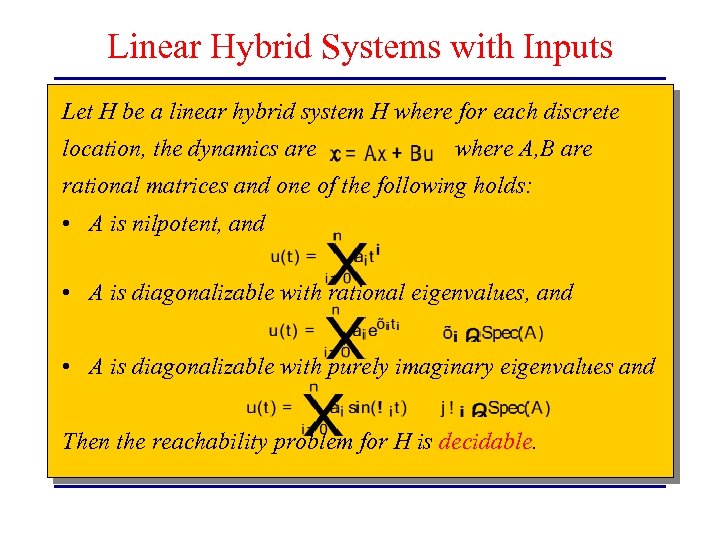
Linear Hybrid Systems with Inputs Let H be a linear hybrid system H where for each discrete location, the dynamics are where A, B are rational matrices and one of the following holds: • A is nilpotent, and • A is diagonalizable with rational eigenvalues, and • A is diagonalizable with purely imaginary eigenvalues and Then the reachability problem for H is decidable.
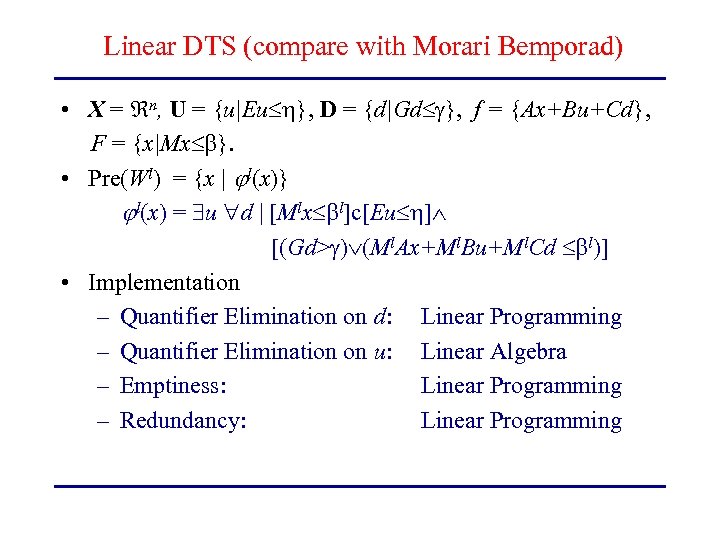
Linear DTS (compare with Morari Bemporad) • X = n, U = {u|Eu }, D = {d|Gd }, f = {Ax+Bu+Cd}, F = {x|Mx }. • Pre(Wl) = {x | l(x)} l(x) = u d | [Mlx l]c[Eu ] [(Gd> ) (Ml. Ax+Ml. Bu+Ml. Cd l)] • Implementation – Quantifier Elimination on d: Linear Programming – Quantifier Elimination on u: Linear Algebra – Emptiness: Linear Programming – Redundancy: Linear Programming
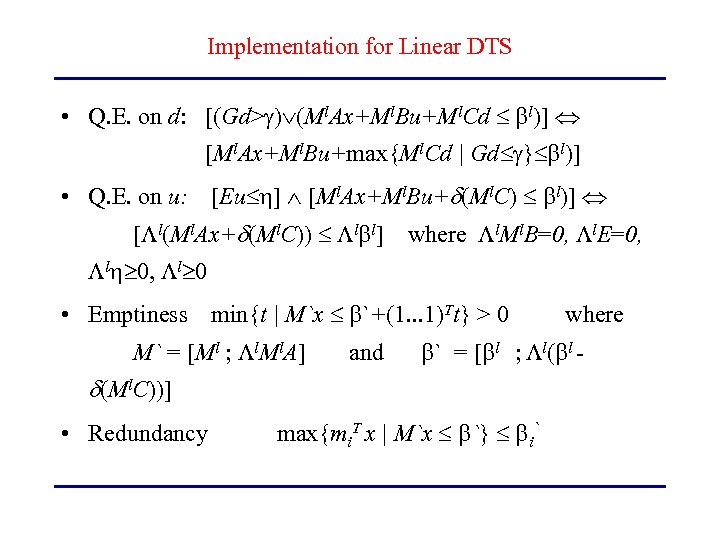
Implementation for Linear DTS • Q. E. on d: [(Gd> ) (Ml. Ax+Ml. Bu+Ml. Cd l)] [Ml. Ax+Ml. Bu+max{Ml. Cd | Gd } l)] • Q. E. on u: [Eu ] [Ml. Ax+Ml. Bu+ (Ml. C) l)] [ l(Ml. Ax+ (Ml. C)) l l] where l. Ml. B=0, l. E=0, l 0 • Emptiness min{t | M`x `+(1. . . 1)Tt} > 0 M` = [Ml ; l. Ml. A] and ` = [ l ; l( l - (Ml. C))] • Redundancy where max{mi. T x | M`x `} i`
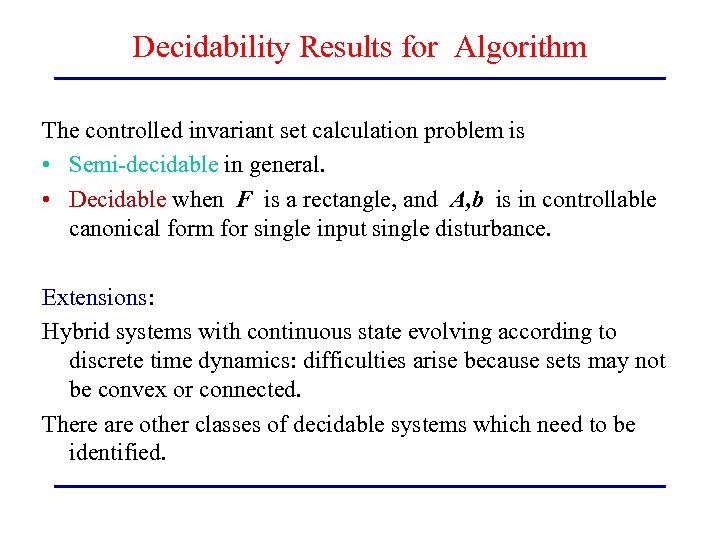
Decidability Results for Algorithm The controlled invariant set calculation problem is • Semi-decidable in general. • Decidable when F is a rectangle, and A, b is in controllable canonical form for single input single disturbance. Extensions: Hybrid systems with continuous state evolving according to discrete time dynamics: difficulties arise because sets may not be convex or connected. There are other classes of decidable systems which need to be identified.
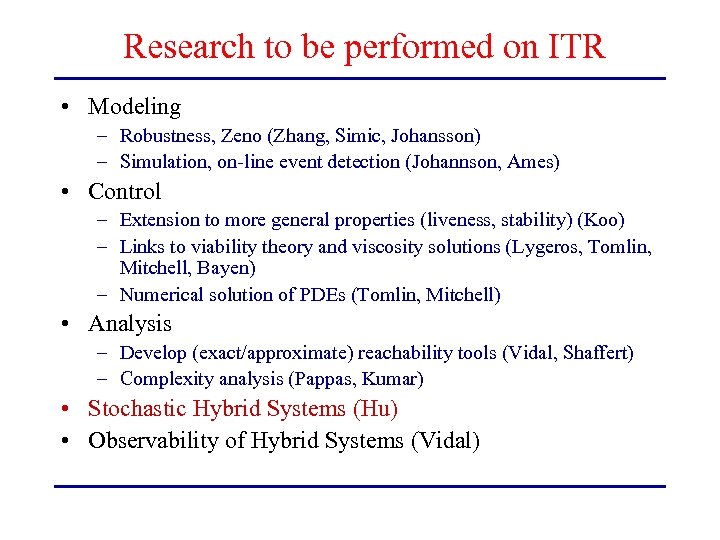
Research to be performed on ITR • Modeling – Robustness, Zeno (Zhang, Simic, Johansson) – Simulation, on-line event detection (Johannson, Ames) • Control – Extension to more general properties (liveness, stability) (Koo) – Links to viability theory and viscosity solutions (Lygeros, Tomlin, Mitchell, Bayen) – Numerical solution of PDEs (Tomlin, Mitchell) • Analysis – Develop (exact/approximate) reachability tools (Vidal, Shaffert) – Complexity analysis (Pappas, Kumar) • Stochastic Hybrid Systems (Hu) • Observability of Hybrid Systems (Vidal)
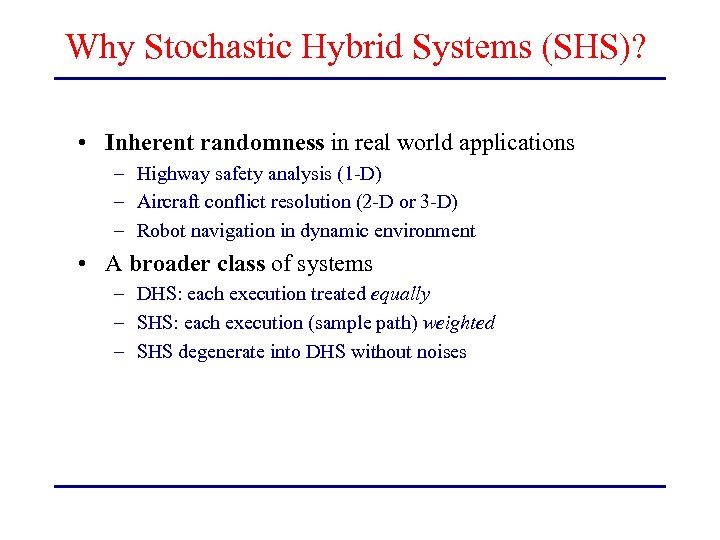
Why Stochastic Hybrid Systems (SHS)? • Inherent randomness in real world applications – Highway safety analysis (1 -D) – Aircraft conflict resolution (2 -D or 3 -D) – Robot navigation in dynamic environment • A broader class of systems – DHS: each execution treated equally – SHS: each execution (sample path) weighted – SHS degenerate into DHS without noises
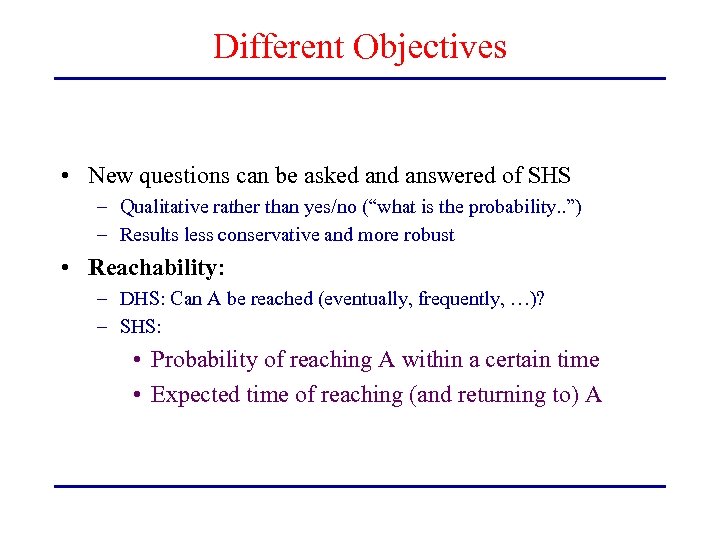
Different Objectives • New questions can be asked answered of SHS – Qualitative rather than yes/no (“what is the probability. . ”) – Results less conservative and more robust • Reachability: – DHS: Can A be reached (eventually, frequently, …)? – SHS: • Probability of reaching A within a certain time • Expected time of reaching (and returning to) A
Different Objectives • Stability Analysis • DHS: equilibrium and stability – Solutions stay close to an equilibrium as t ? • SHS: invariant distribution and stochastic stability – Recurrence: Return to the same state in finite time with probability 1? – Positive recurrence: Expected time to return to the same state is finite? – Ergodicity: Distribution converges to invariant distribution as t ?
Formulation of SHS • • • A set of discrete states and open domains Boundary of each domain is partitioned into guards Dynamics inside each domain governed by a SDE Stop upon hitting domain boundary Jump to a new discrete state according to the stopped position (guards) • Reset randomly in the new domain
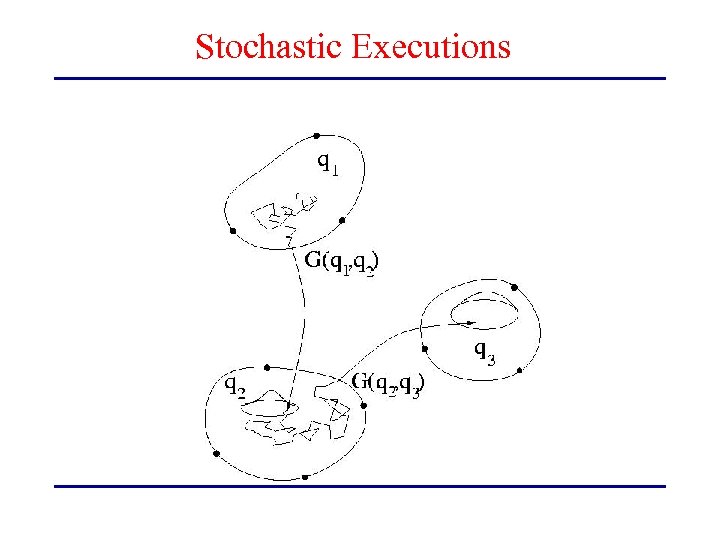
Stochastic Executions
Embedded Markov Chain (MC) • Look at the time instances jumps occur: { n, n=1, 2, . . . } and the states at these instances: (Qn , Xn)=(Q( n), X( n)) • Memoriless property: – {(Qn , Xn)} is a Markov Chain – If the reset maps are independent of the continuous states, then {Qn} is a Markov Chain • Embedded Markov Chain – They are samplings of the stochastic executions – They capture many sample path properties of the stochastic executions and are more computational tractable
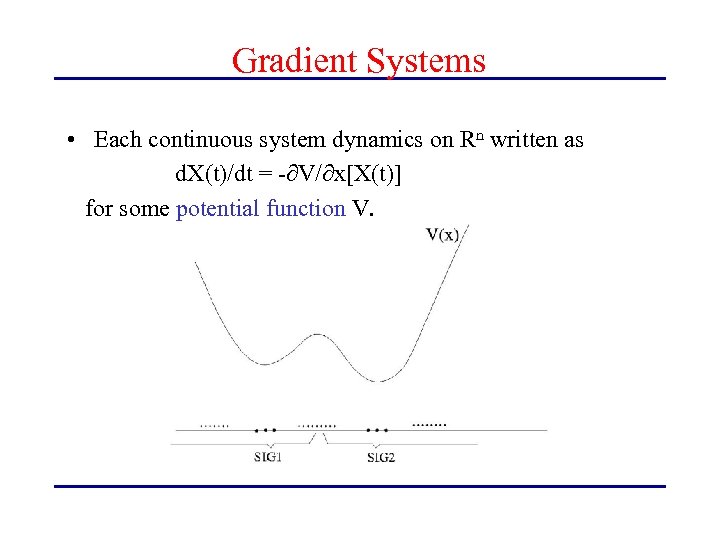
Gradient Systems • Each continuous system dynamics on Rn written as d. X(t)/dt = - V/ x[X(t)] for some potential function V.
![Gradient System with Noise • For the SDE d. X(t)/dt = - V/ x[X(t)]+wt](https://present5.com/presentation/7bb08a3221484c35be65b4c65f9b1a87/image-54.jpg "Gradient System with Noise • For the SDE d. X(t)/dt = - V/ x[X(t)]+wt")
Gradient System with Noise • For the SDE d. X(t)/dt = - V/ x[X(t)]+wt , its embedded MC has a strongly interacting group of states near the bottom of each valley of V

Stochastic Stability of MC {Qn} • A MC is called – recurrent if starting from an arbitrary initial state, it will return to the same state in finite time with probability 1 – positive recurrent if the expected time of returning to any initial state is finite – ergodic if starting from an arbitrary initial distribution, the state distribution converges to a unique equilibrium distribution. • Question: How is the stochastic stability of the embedded MC {Qn} related to the potential function V?
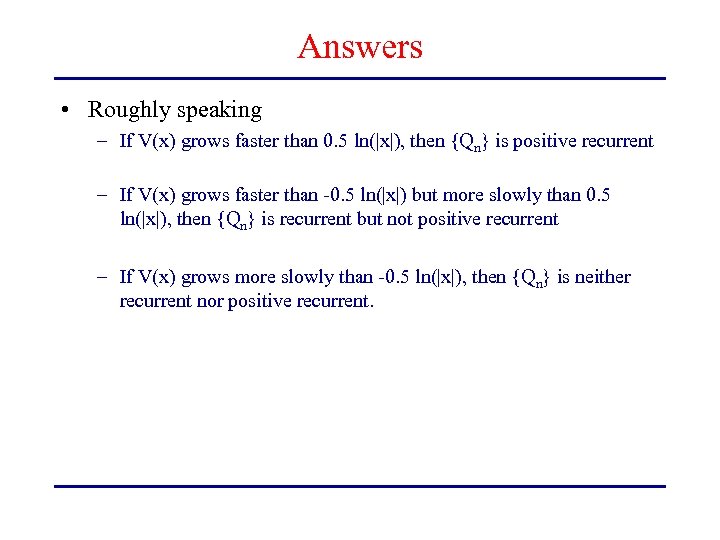
Answers • Roughly speaking – If V(x) grows faster than 0. 5 ln(|x|), then {Qn} is positive recurrent – If V(x) grows faster than -0. 5 ln(|x|) but more slowly than 0. 5 ln(|x|), then {Qn} is recurrent but not positive recurrent – If V(x) grows more slowly than -0. 5 ln(|x|), then {Qn} is neither recurrent nor positive recurrent.
Скачать презентацию Hybrid Systems Modeling Analysis Control Review and Vistas
7bb08a3221484c35be65b4c65f9b1a87.ppt