 Скачать презентацию Hybrid Rice Development in Pakistan Assessment of Limitations
4f48061edae6d4c464bd814872bc65af.ppt
- Количество слайдов: 34



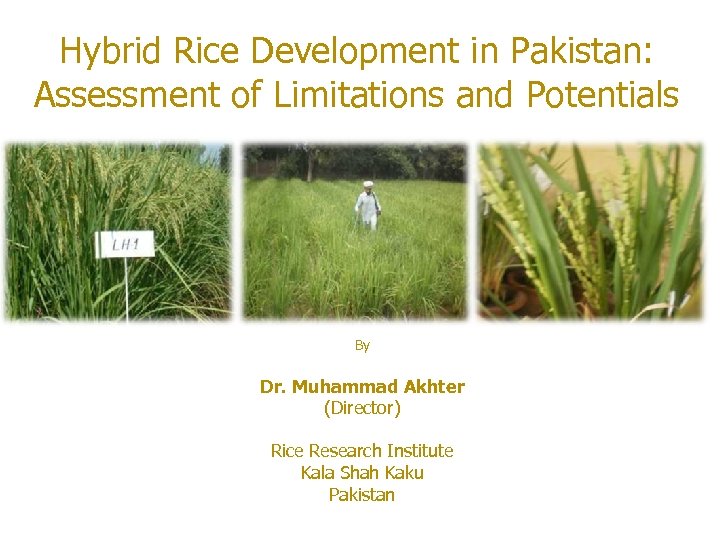
Hybrid Rice Development in Pakistan: Assessment of Limitations and Potentials By Dr. Muhammad Akhter (Director) Rice Research Institute Kala Shah Kaku Pakistan 1
Introduction - Rice ü ü Rice holds 2 nd position in food and cash crops of Pakistan It contributes 6. 4% of the value added in Agriculture It accounts for 10% of the total cropped area and 18% of the acreage under food crops Pakistan earns about US$ 2. 00 billion foreign exchange annually from the export of rice
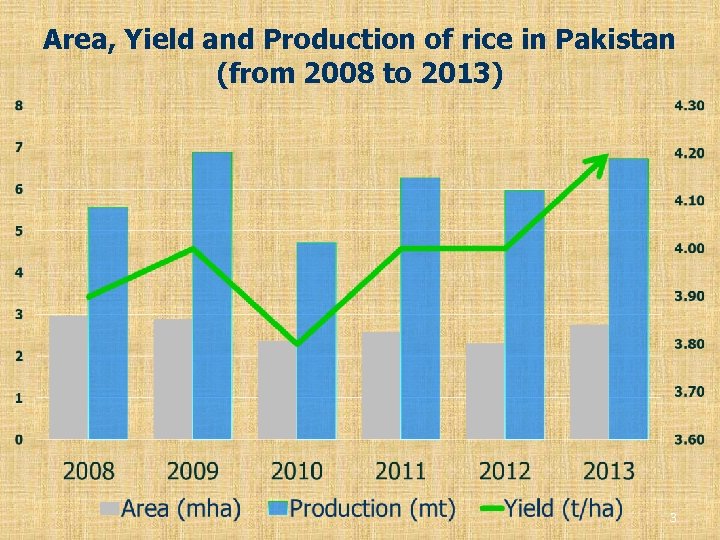
Area, Yield and Production of rice in Pakistan (from 2008 to 2013) 3
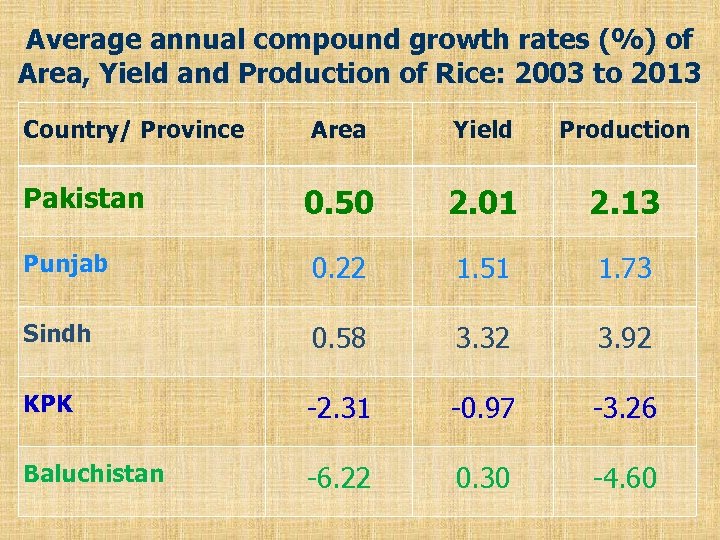
Average annual compound growth rates (%) of Area, Yield and Production of Rice: 2003 to 2013 Country/ Province Area Yield Production 0. 50 2. 01 2. 13 Punjab 0. 22 1. 51 1. 73 Sindh 0. 58 3. 32 3. 92 KPK -2. 31 -0. 97 -3. 26 Baluchistan -6. 22 0. 30 -4. 60 Pakistan
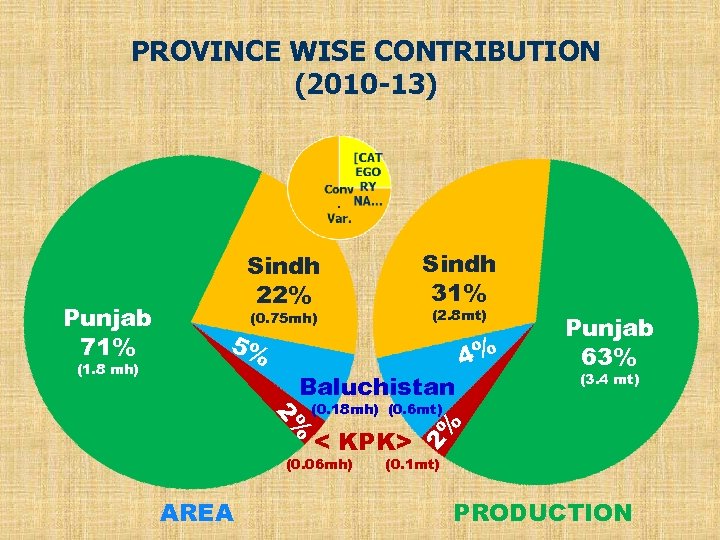
PROVINCE WISE CONTRIBUTION (2010 -13) (1. 8 mh) (2. 8 mt) (0. 75 mh) 5% Baluchistan 4% Punjab 63% (3. 4 mt) 2% (0. 18 mh) (0. 6 mt) < KPK> (0. 06 mh) AREA 2% Punjab 71% Sindh 31% Sindh 22% (0. 1 mt) PRODUCTION
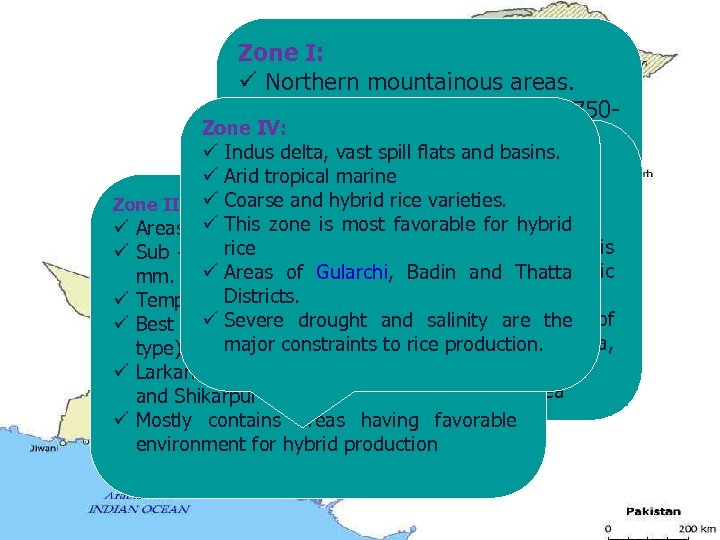
Zone I: ZONE ü Northern mountainous areas. I ü Sub humid; monsoon with 750 Zone IV: 1000 mm rain fall in summer. Zone II: ü Indus delta, vast spill flats and basins. ü Cold tolerant It lies between Ravi and Chanab. ü Arid tropical marine i. e. japonica type ZONE rice varieties The climate is sub humid, sub-tropical. Zone III ü Coarse and hybrid rice varieties. II Average rainfall is 400 -700 mm. ü This Areas most favorable for hybrid ü zone is included are Swat and ü Areas lying on the west bank of river Indus. ü rice with average rainfall of 100 Rice growing season is ü Sub - tropical Khaghan valley. fairly long and is ü ü suitable for cultivation of and Thatta mm. ü Areas of Gularchi, Badin basmati aromatic rice. Districts. Temperature is very high during rice season ZONE The famous rice bowl called “Kalar ü Severe drought and salinity are the Best suitable for medium long grain (IRRI Tract” of the Punjab lies in this zone i. e. Sheikhupura, major constraints to rice production. type) rice varieties. III Gujranwala, Sialkot and Lahore. Larkana, Jacobabad, Nasirabad, Jaffarabad ü Frequent floods damages the rice area and Shikarpur Districts. Mostly contains areas having favorable ZONE environment for hybrid production IV
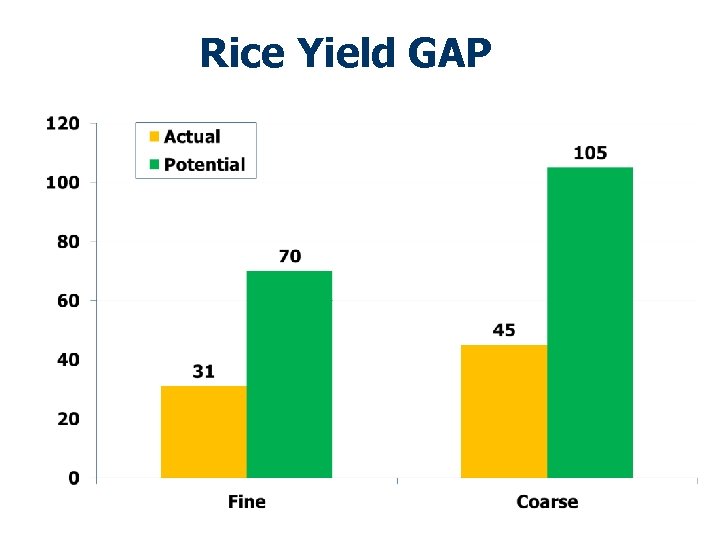
Rice Yield GAP
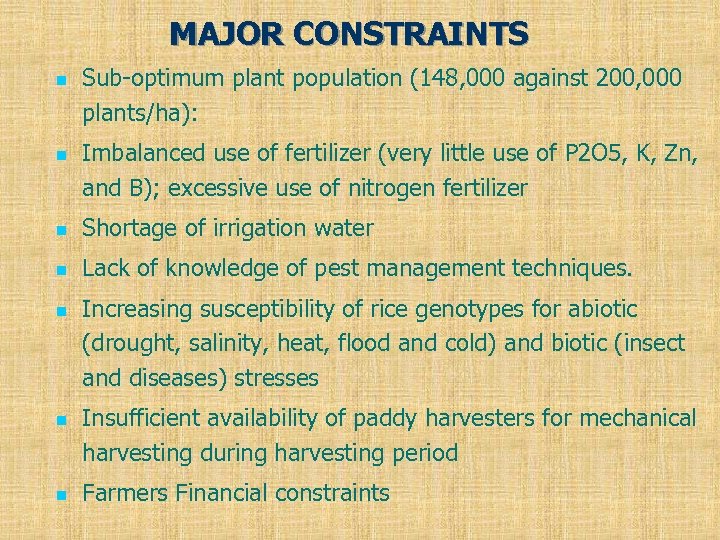
MAJOR CONSTRAINTS n n Sub-optimum plant population (148, 000 against 200, 000 plants/ha): Imbalanced use of fertilizer (very little use of P 2 O 5, K, Zn, and B); excessive use of nitrogen fertilizer n Shortage of irrigation water n Lack of knowledge of pest management techniques. n n n Increasing susceptibility of rice genotypes for abiotic (drought, salinity, heat, flood and cold) and biotic (insect and diseases) stresses Insufficient availability of paddy harvesters for mechanical harvesting during harvesting period Farmers Financial constraints
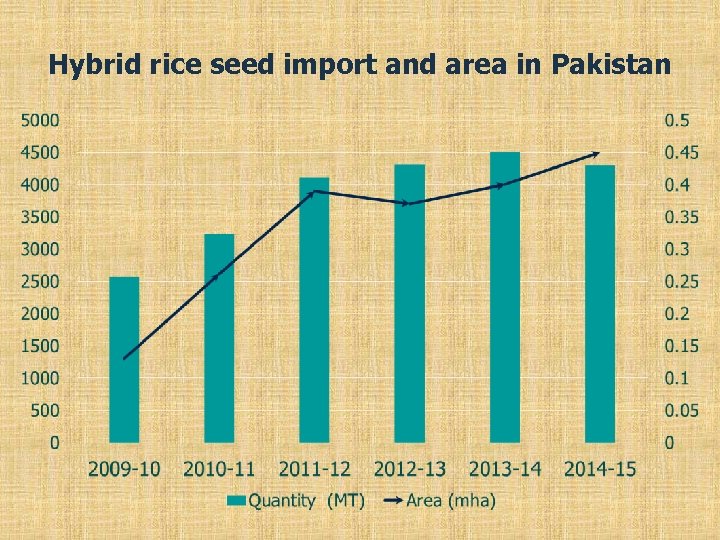
Hybrid rice seed import and area in Pakistan
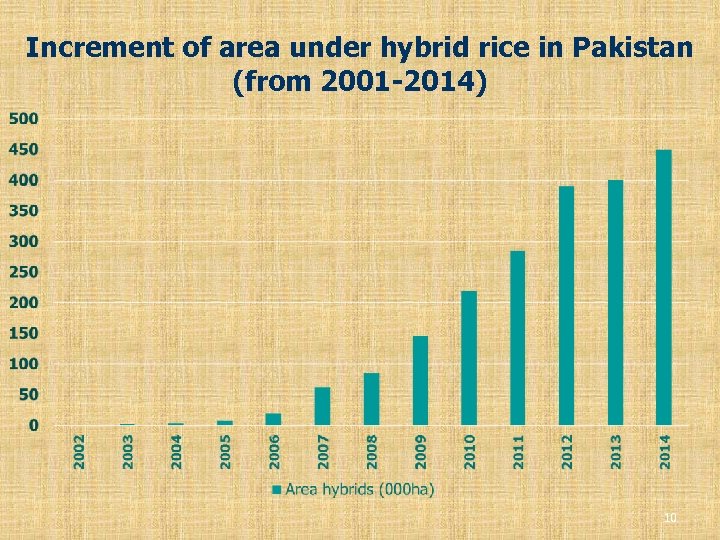
Increment of area under hybrid rice in Pakistan (from 2001 -2014) 10
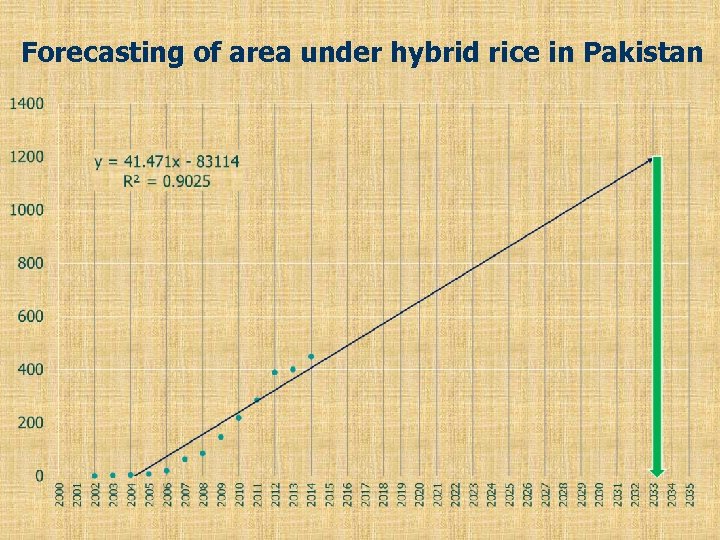
Forecasting of area under hybrid rice in Pakistan
Hybrid rice Development in Pakistan In the public sector: ü RRI, KSK initiated a time-based hybrid rice program in collaboration with IRRI in late nineties. ü ü ü In 2000, strengthened by the Government with the approval of project entitled “Development of Hybrid Rice in the Punjab. ” The institute is maintaining 22 exotic /local including two CMS lines in Basmati background. CMS lines (WA source) have out crossing rate range 15 -46% which is quite low for getting good heterotic combination.
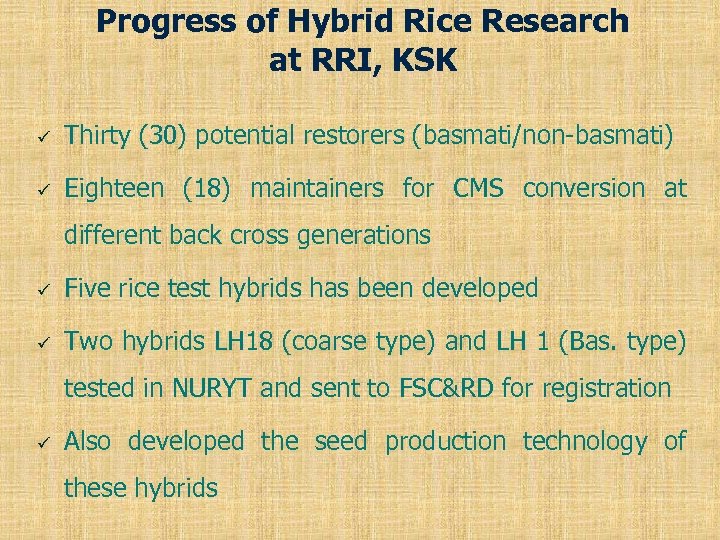
Progress of Hybrid Rice Research at RRI, KSK ü Thirty (30) potential restorers (basmati/non-basmati) ü Eighteen (18) maintainers for CMS conversion at different back cross generations ü Five rice test hybrids has been developed ü Two hybrids LH 18 (coarse type) and LH 1 (Bas. type) tested in NURYT and sent to FSC&RD for registration ü Also developed the seed production technology of these hybrids
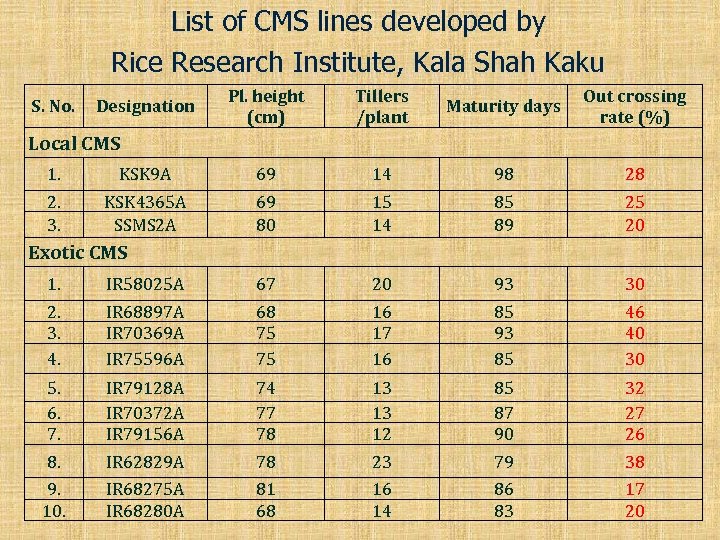
List of CMS lines developed by Rice Research Institute, Kala Shah Kaku S. No. Designation Pl. height (cm) Tillers /plant Maturity days Out crossing rate (%) Local CMS 1. KSK 9 A 69 14 98 28 2. 3. KSK 4365 A SSMS 2 A 69 80 15 14 85 89 25 20 Exotic CMS 1. IR 58025 A 67 20 93 30 2. 3. 4. IR 68897 A IR 70369 A IR 75596 A 68 75 75 16 17 16 85 93 85 46 40 30 5. 6. 7. IR 79128 A IR 70372 A IR 79156 A 74 77 78 13 13 12 85 87 90 32 27 26 8. IR 62829 A 78 23 79 38 9. 10. IR 68275 A IR 68280 A 81 68 16 14 86 83 17 20
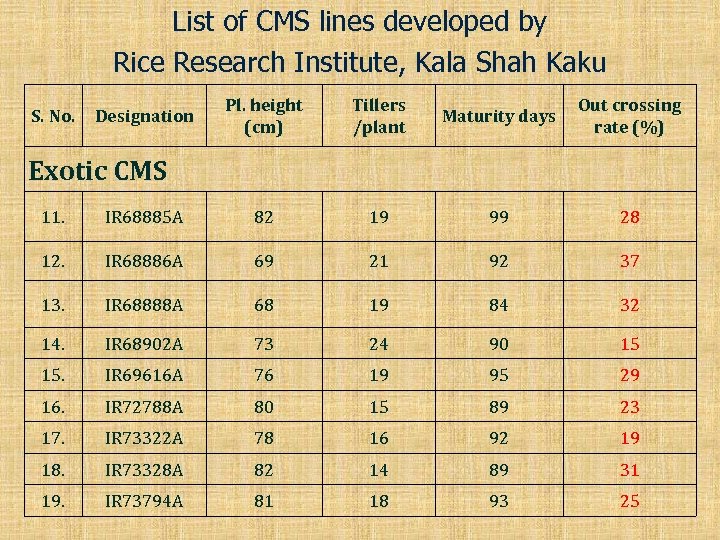
List of CMS lines developed by Rice Research Institute, Kala Shah Kaku S. No. Designation Pl. height (cm) Tillers /plant Maturity days Out crossing rate (%) Exotic CMS 11. IR 68885 A 82 19 99 28 12. IR 68886 A 69 21 92 37 13. IR 68888 A 68 19 84 32 14. IR 68902 A 73 24 90 15 15. IR 69616 A 76 19 95 29 16. IR 72788 A 80 15 89 23 17. IR 73322 A 78 16 92 19 18. IR 73328 A 82 14 89 31 19. IR 73794 A 81 18 93 25
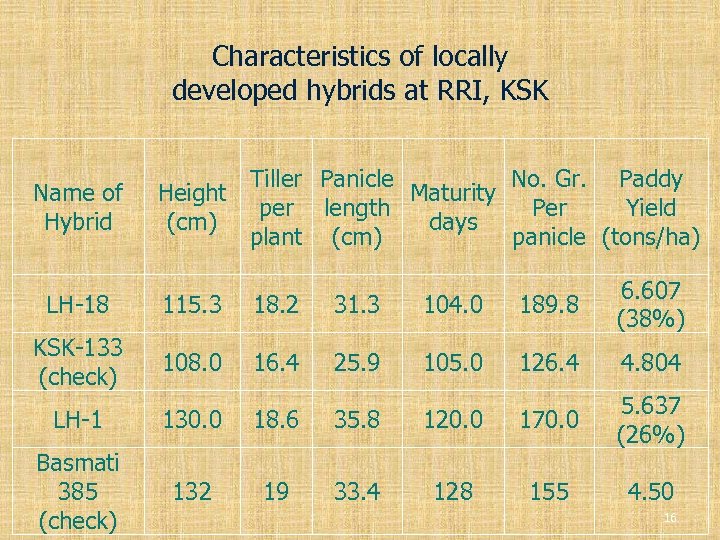
Characteristics of locally developed hybrids at RRI, KSK Name of Hybrid Tiller Panicle No. Gr. Paddy Height Maturity per length Per Yield (cm) days plant (cm) panicle (tons/ha) LH-18 115. 3 18. 2 31. 3 104. 0 189. 8 KSK-133 (check) 6. 607 (38%) 108. 0 16. 4 25. 9 105. 0 126. 4 4. 804 LH-1 130. 0 18. 6 35. 8 120. 0 170. 0 Basmati 385 (check) 5. 637 (26%) 132 19 33. 4 128 155 4. 50 16
Hybrid rice in Pakistan (Cont…) In the private sector: ü ü Guard Agricultural and Services Pvt. imported Chinese rice hybrids (japonica types) i. e. GNY-50 and GNY-53. Another EMKAY Seed also started work on HR with the collaboration of Chinese Hybrid seed is being produced (5% of the total requirement) in lower Sindh (zone IV) with the help of Chinese experts yielding of 2. 50 t/ha (~200 ha annually). Whereas 95 % of the total requirement is being imported from China by the private sector Insufficient supply of seed of A-line to private sector from China restricts enhancement of area for seed production Hybrid seed production in zone II and III is inconsistent due to high temperature and fluctuating weather conditions from year to year.
Approval system of Hybrid rice in Pakistan ü ü ü Federal seed certification & registration department (FSC&RD) develop a procedure for the import and selling of hybrid rice seed Importers have to provide hybrid rice seed samples for two years testing in the adaptability trials After two years testing in the adaptability trials, Variety Evaluation Committee (VEC) gives recommendation to national seed council for the approval of rice hybrids in Pakistan In provinces, the provincial seed council approves the hybrids/ varieties in their respective provinces So far, eighty five (85) rice hybrids have been approved by the committee for general cultivation in Pakistan
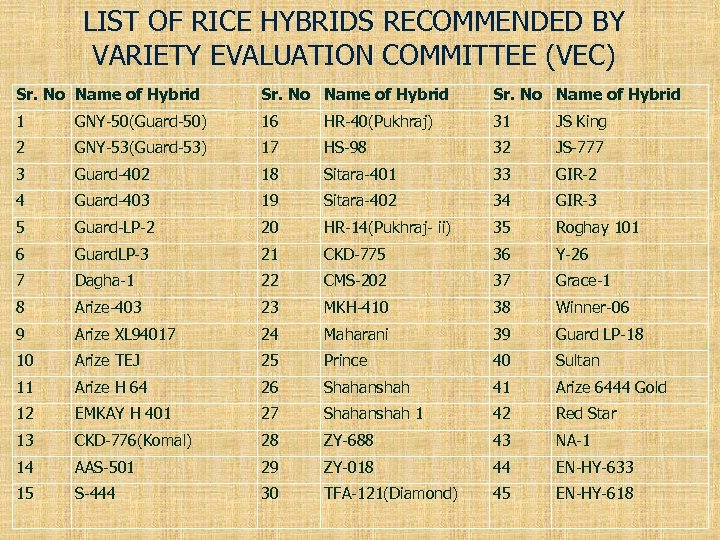
LIST OF RICE HYBRIDS RECOMMENDED BY VARIETY EVALUATION COMMITTEE (VEC) Sr. No Name of Hybrid 1 GNY-50(Guard-50) 16 HR-40(Pukhraj) 31 JS King 2 GNY-53(Guard-53) 17 HS-98 32 JS-777 3 Guard-402 18 Sitara-401 33 GIR-2 4 Guard-403 19 Sitara-402 34 GIR-3 5 Guard-LP-2 20 HR-14(Pukhraj- ii) 35 Roghay 101 6 Guard. LP-3 21 CKD-775 36 Y-26 7 Dagha-1 22 CMS-202 37 Grace-1 8 Arize-403 23 MKH-410 38 Winner-06 9 Arize XL 94017 24 Maharani 39 Guard LP-18 10 Arize TEJ 25 Prince 40 Sultan 11 Arize H 64 26 Shahanshah 41 Arize 6444 Gold 12 EMKAY H 401 27 Shahanshah 1 42 Red Star 13 CKD-776(Komal) 28 ZY-688 43 NA-1 14 AAS-501 29 ZY-018 44 EN-HY-633 15 S-444 30 TFA-121(Diamond) 45 EN-HY-618
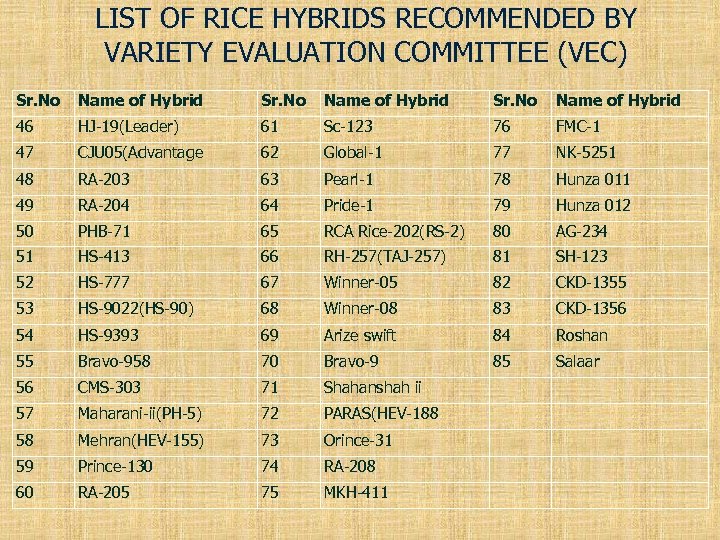
LIST OF RICE HYBRIDS RECOMMENDED BY VARIETY EVALUATION COMMITTEE (VEC) Sr. No Name of Hybrid 46 HJ-19(Leader) 61 Sc-123 76 FMC-1 47 CJU 05(Advantage 62 Global-1 77 NK-5251 48 RA-203 63 Pearl-1 78 Hunza 011 49 RA-204 64 Pride-1 79 Hunza 012 50 PHB-71 65 RCA Rice-202(RS-2) 80 AG-234 51 HS-413 66 RH-257(TAJ-257) 81 SH-123 52 HS-777 67 Winner-05 82 CKD-1355 53 HS-9022(HS-90) 68 Winner-08 83 CKD-1356 54 HS-9393 69 Arize swift 84 Roshan 55 Bravo-958 70 Bravo-9 85 Salaar 56 CMS-303 71 Shahanshah ii 57 Maharani-ii(PH-5) 72 PARAS(HEV-188 58 Mehran(HEV-155) 73 Orince-31 59 Prince-130 74 RA-208 60 RA-205 75 MKH-411
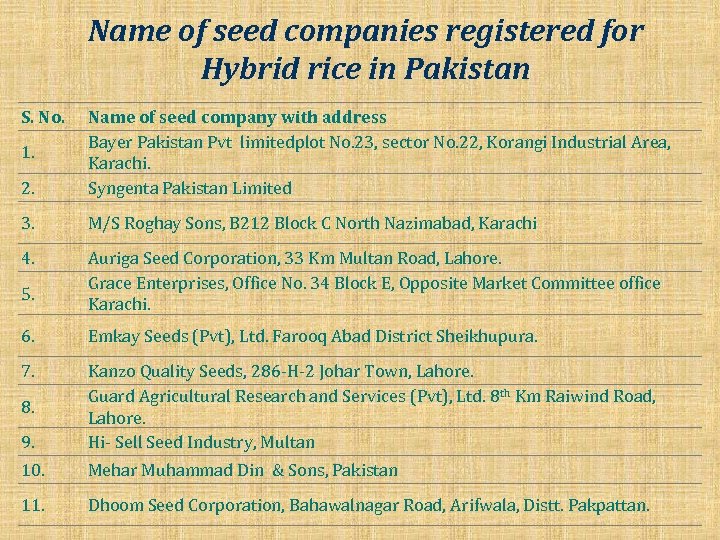
Name of seed companies registered for Hybrid rice in Pakistan S. No. 2. Name of seed company with address Bayer Pakistan Pvt limitedplot No. 23, sector No. 22, Korangi Industrial Area, Karachi. Syngenta Pakistan Limited 3. M/S Roghay Sons, B 212 Block C North Nazimabad, Karachi 4. Auriga Seed Corporation, 33 Km Multan Road, Lahore. Grace Enterprises, Office No. 34 Block E, Opposite Market Committee office Karachi. 1. 5. 6. Emkay Seeds (Pvt), Ltd. Farooq Abad District Sheikhupura. 7. 9. Kanzo Quality Seeds, 286 -H-2 Johar Town, Lahore. Guard Agricultural Research and Services (Pvt), Ltd. 8 th Km Raiwind Road, Lahore. Hi- Sell Seed Industry, Multan 10. Mehar Muhammad Din & Sons, Pakistan 11. Dhoom Seed Corporation, Bahawalnagar Road, Arifwala, Distt. Pakpattan. 8.
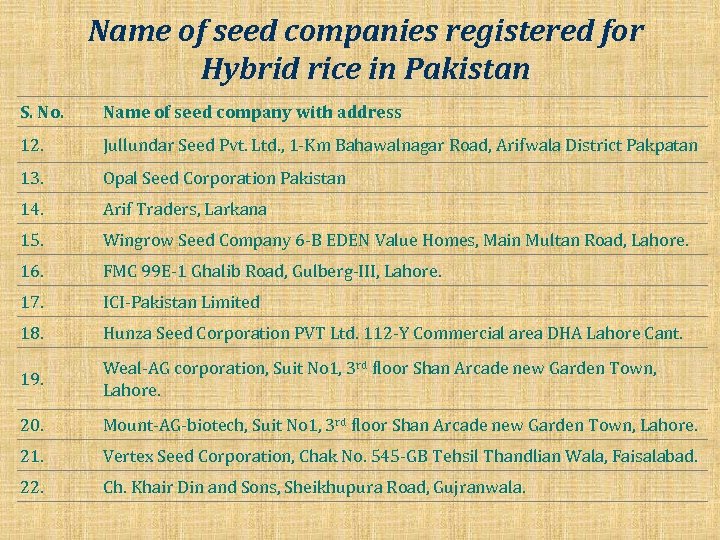
Name of seed companies registered for Hybrid rice in Pakistan S. No. Name of seed company with address 12. Jullundar Seed Pvt. Ltd. , 1 -Km Bahawalnagar Road, Arifwala District Pakpatan 13. Opal Seed Corporation Pakistan 14. Arif Traders, Larkana 15. Wingrow Seed Company 6 -B EDEN Value Homes, Main Multan Road, Lahore. 16. FMC 99 E-1 Ghalib Road, Gulberg-III, Lahore. 17. ICI-Pakistan Limited 18. Hunza Seed Corporation PVT Ltd. 112 -Y Commercial area DHA Lahore Cant. 19. Weal-AG corporation, Suit No 1, 3 rd floor Shan Arcade new Garden Town, Lahore. 20. Mount-AG-biotech, Suit No 1, 3 rd floor Shan Arcade new Garden Town, Lahore. 21. Vertex Seed Corporation, Chak No. 545 -GB Tehsil Thandlian Wala, Faisalabad. 22. Ch. Khair Din and Sons, Sheikhupura Road, Gujranwala.
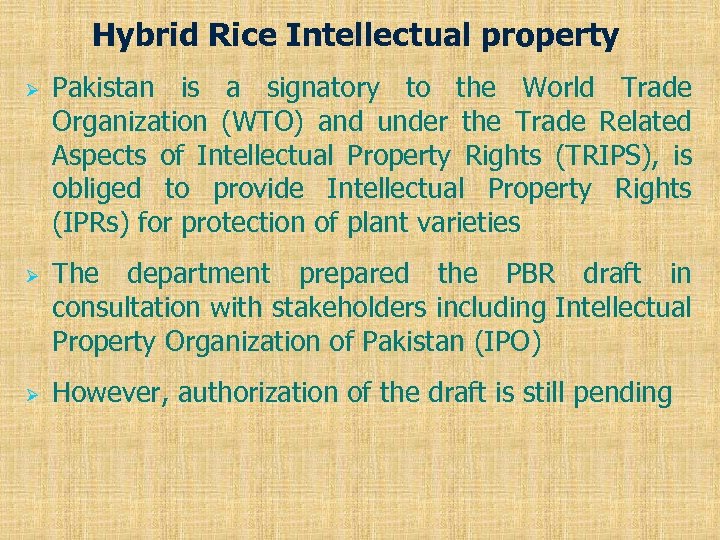
Hybrid Rice Intellectual property Ø Ø Ø Pakistan is a signatory to the World Trade Organization (WTO) and under the Trade Related Aspects of Intellectual Property Rights (TRIPS), is obliged to provide Intellectual Property Rights (IPRs) for protection of plant varieties The department prepared the PBR draft in consultation with stakeholders including Intellectual Property Organization of Pakistan (IPO) However, authorization of the draft is still pending
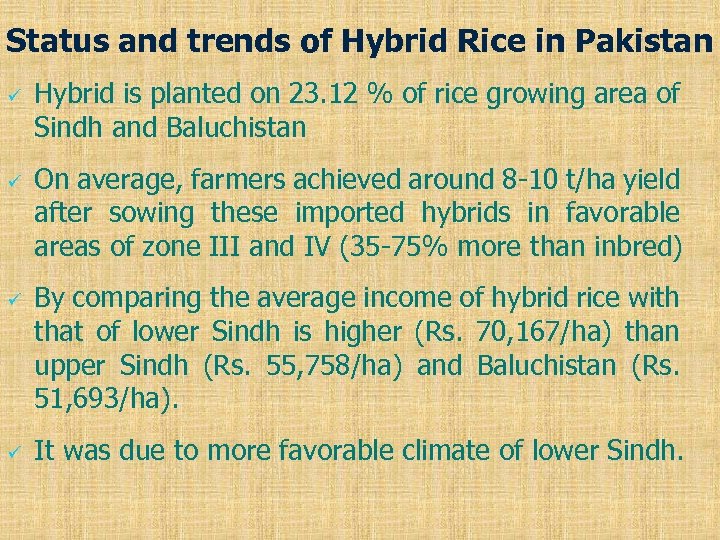
Status and trends of Hybrid Rice in Pakistan ü ü Hybrid is planted on 23. 12 % of rice growing area of Sindh and Baluchistan On average, farmers achieved around 8 -10 t/ha yield after sowing these imported hybrids in favorable areas of zone III and IV (35 -75% more than inbred) By comparing the average income of hybrid rice with that of lower Sindh is higher (Rs. 70, 167/ha) than upper Sindh (Rs. 55, 758/ha) and Baluchistan (Rs. 51, 693/ha). It was due to more favorable climate of lower Sindh.
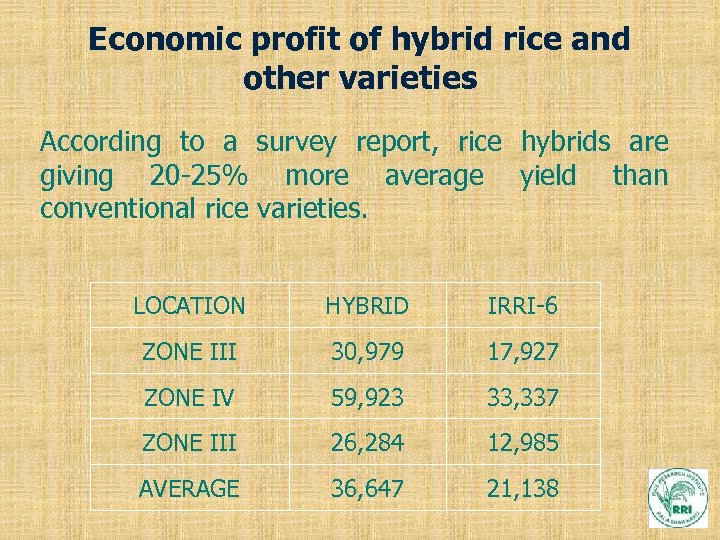
Economic profit of hybrid rice and other varieties According to a survey report, rice hybrids are giving 20 -25% more average yield than conventional rice varieties. LOCATION HYBRID IRRI-6 ZONE III 30, 979 17, 927 ZONE IV 59, 923 33, 337 ZONE III 26, 284 12, 985 AVERAGE 36, 647 21, 138 25
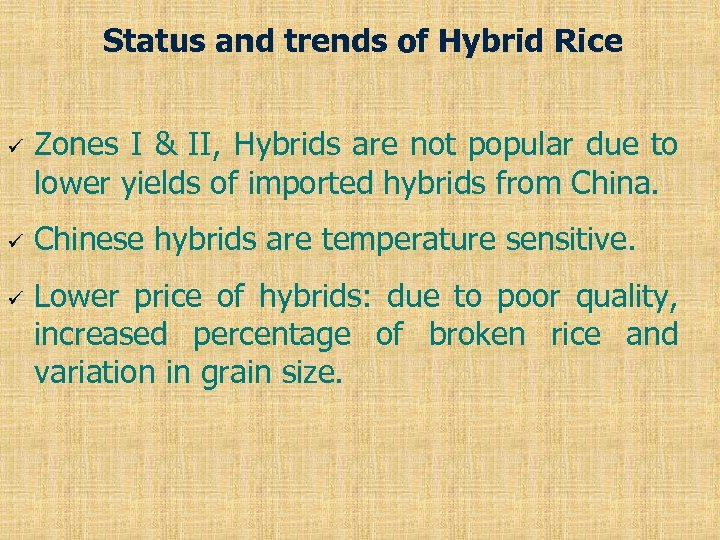
Status and trends of Hybrid Rice ü ü ü Zones I & II, Hybrids are not popular due to lower yields of imported hybrids from China. Chinese hybrids are temperature sensitive. Lower price of hybrids: due to poor quality, increased percentage of broken rice and variation in grain size.
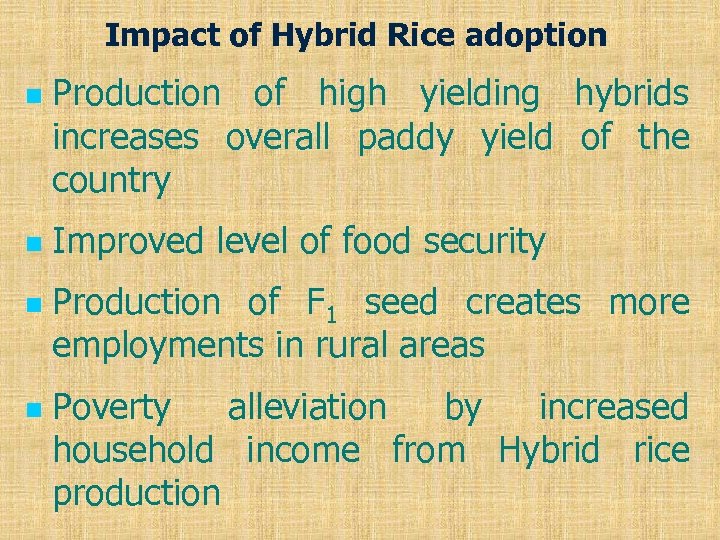
Impact of Hybrid Rice adoption n n Production of high yielding hybrids increases overall paddy yield of the country Improved level of food security Production of F 1 seed creates more employments in rural areas Poverty alleviation by increased household income from Hybrid rice production
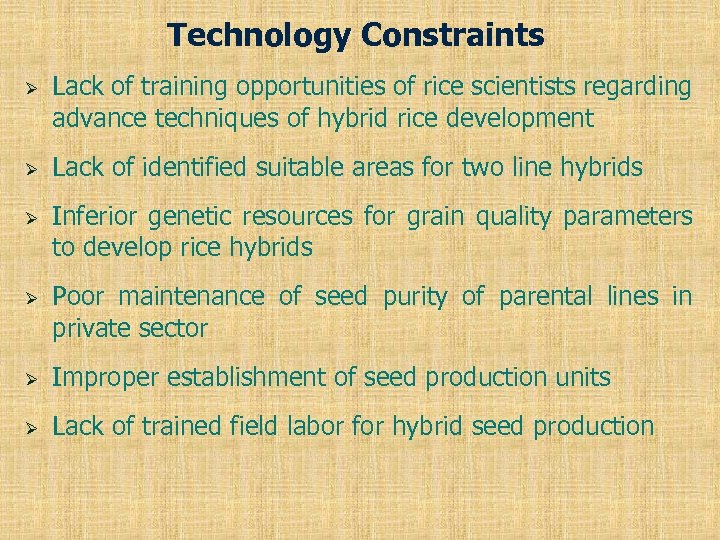
Technology Constraints Ø Ø Lack of training opportunities of rice scientists regarding advance techniques of hybrid rice development Lack of identified suitable areas for two line hybrids Inferior genetic resources for grain quality parameters to develop rice hybrids Poor maintenance of seed purity of parental lines in private sector Ø Improper establishment of seed production units Ø Lack of trained field labor for hybrid seed production
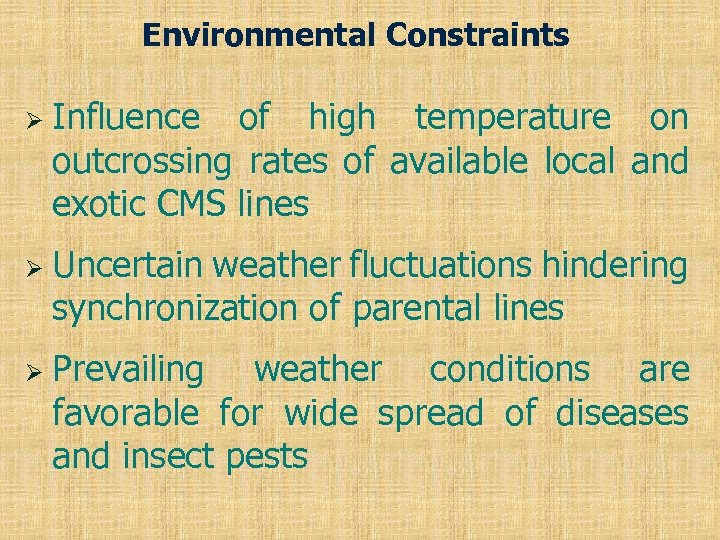
Environmental Constraints Ø Ø Ø Influence of high temperature on outcrossing rates of available local and exotic CMS lines Uncertain weather fluctuations hindering synchronization of parental lines Prevailing weather conditions are favorable for wide spread of diseases and insect pests
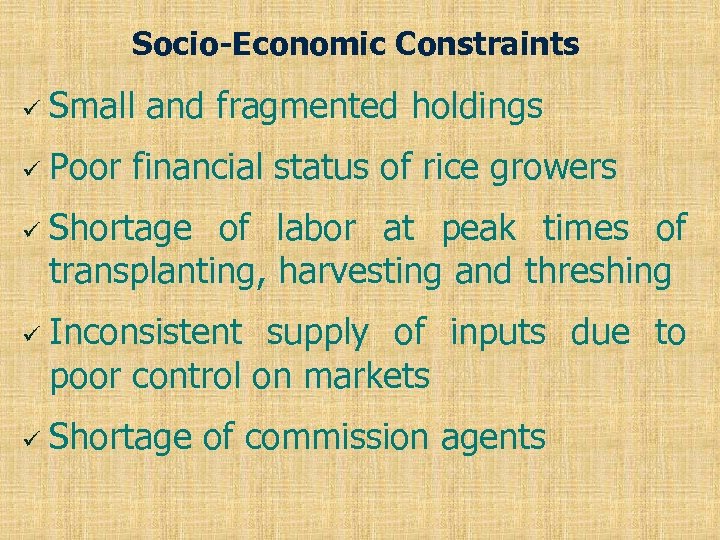
Socio-Economic Constraints ü Small and fragmented holdings ü Poor financial status of rice growers ü ü ü Shortage of labor at peak times of transplanting, harvesting and threshing Inconsistent supply of inputs due to poor control on markets Shortage of commission agents
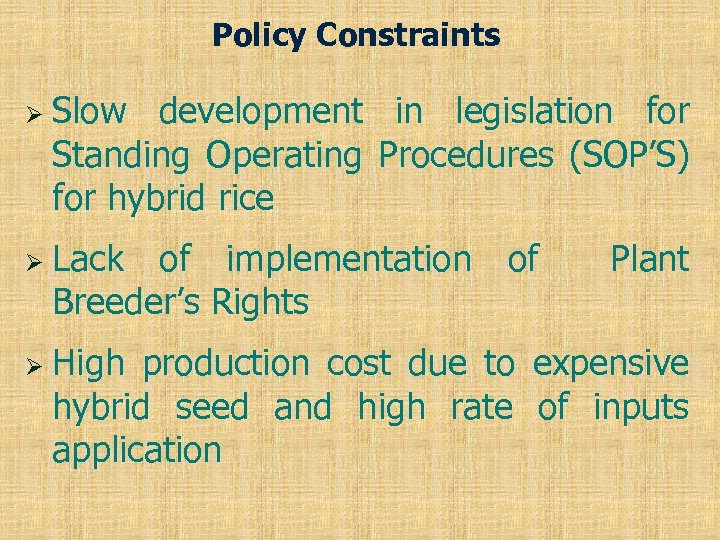
Policy Constraints Ø Ø Ø Slow development in legislation for Standing Operating Procedures (SOP’S) for hybrid rice Lack of implementation of Plant Breeder’s Rights High production cost due to expensive hybrid seed and high rate of inputs application
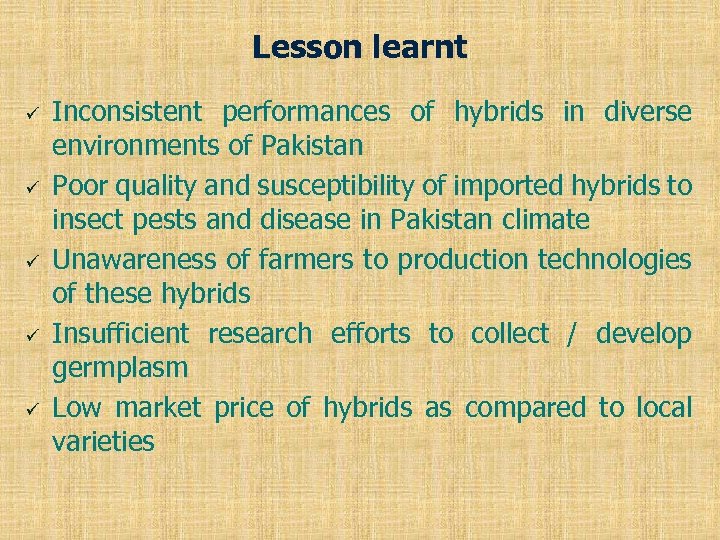
Lesson learnt ü ü ü Inconsistent performances of hybrids in diverse environments of Pakistan Poor quality and susceptibility of imported hybrids to insect pests and disease in Pakistan climate Unawareness of farmers to production technologies of these hybrids Insufficient research efforts to collect / develop germplasm Low market price of hybrids as compared to local varieties
A way forward… ü Promotion of hybrid rice through a mega project at National level with the collaboration of provinces for ü ü ü Human resource development ü ü Strengthening of genetic material Encouragement of public private partnership Legislation / promulgation of plant breeder’s rights for the protection of genetic material Approval and implementation of Standing Operating Procedures (SOP’S) for hybrid rice
A way forward… ü ü Incorporation of resistant genes against Bacterial Leaf Blight (BLB), Brown Leaf Spot (BLS), Salinity, Flood tolerance and Grain discoloration China may be persuade to issue non GMO certificate on rice hybrid Construction of warehouses to store the carry over hybrid seed in Pakistan Development of proper marketing standards for seed quality and price
Скачать презентацию Hybrid Rice Development in Pakistan Assessment of Limitations
4f48061edae6d4c464bd814872bc65af.ppt