 Скачать презентацию Hybrid network traffic engineering system HNTES Zhenzhen Yan
b49211ce39042821d4122c3d41bef021.ppt
- Количество слайдов: 27



Hybrid network traffic engineering system (HNTES) Zhenzhen Yan, Zhengyang Liu, Chris Tracy, Malathi Veeraraghavan University of Virginia and ESnet March 1 -2, 2012 mvee@virginia. edu, ctracy@es. net Project web site: http: //www. ece. virginia. edu/mv/research/DOE 09/index. html Thanks to the US DOE ASCR program office and NSF for UVA grants DE-SC 002350, DE-SC 0007341, OCI-1127340 and ESnet grant DE-AC 02 -05 CH 11231 1
Problem statement • A hybrid network supports both IP-routed and circuit services on: – Separate networks as in ESnet 4, or – An integrated network as in ESnet 5 • A hybrid network traffic engineering system (HNTES) is designed to move science data flows off the IP-routed network to circuits • Problem statement: Design HNTES The “What” question 2

Two reasons for using circuits 1. Offer scientists rate-guaranteed connectivity 2. Isolate science flows from general-purpose flows Reason Circuit scope Rate-guaranteed service Science flow isolation End-to-end (inter-domain) ✔ ✔ Per provider (intra-domain) ✖ ✔ Should we mine trouble ticket logs to quantify the negative impact of science flows on “beta” flows? The “Why” question 3
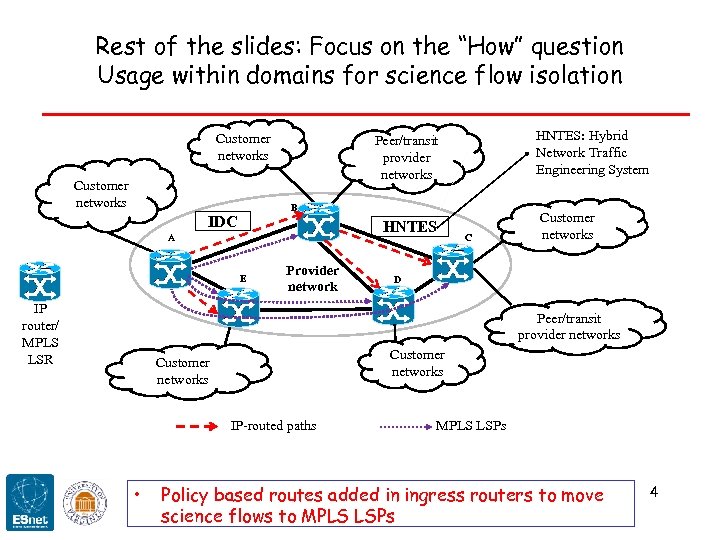
Rest of the slides: Focus on the “How” question Usage within domains for science flow isolation Customer networks B IDC HNTES A E IP router/ MPLS LSR HNTES: Hybrid Network Traffic Engineering System Peer/transit provider networks Provider network C Customer networks D Peer/transit provider networks Customer networks IP-routed paths • MPLS LSPs Policy based routes added in ingress routers to move science flows to MPLS LSPs 4
HNTES Design questions • What type of flows should be redirected off the IP-routed network? • What are key components of a hybrid network traffic engineering system? • Evaluate design 5
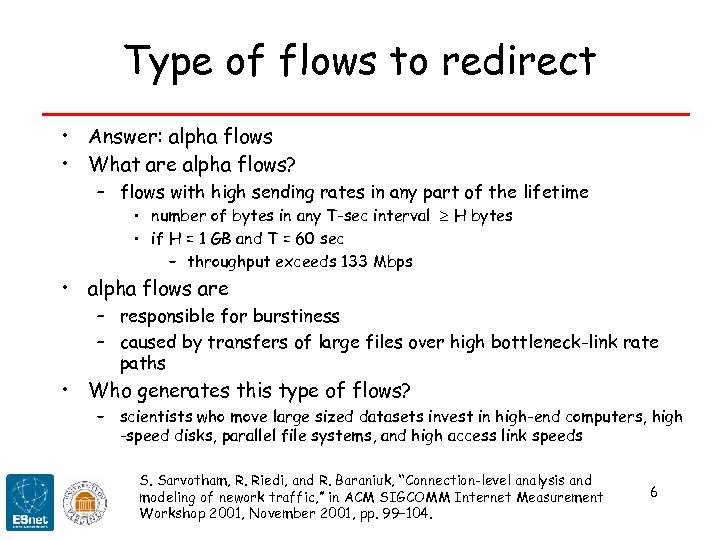
Type of flows to redirect • Answer: alpha flows • What are alpha flows? – flows with high sending rates in any part of the lifetime • number of bytes in any T-sec interval H bytes • if H = 1 GB and T = 60 sec – throughput exceeds 133 Mbps • alpha flows are – responsible for burstiness – caused by transfers of large files over high bottleneck-link rate paths • Who generates this type of flows? – scientists who move large sized datasets invest in high-end computers, high -speed disks, parallel file systems, and high access link speeds S. Sarvotham, R. Riedi, and R. Baraniuk, “Connection-level analysis and modeling of nework traffic, ” in ACM SIGCOMM Internet Measurement Workshop 2001, November 2001, pp. 99– 104. 6
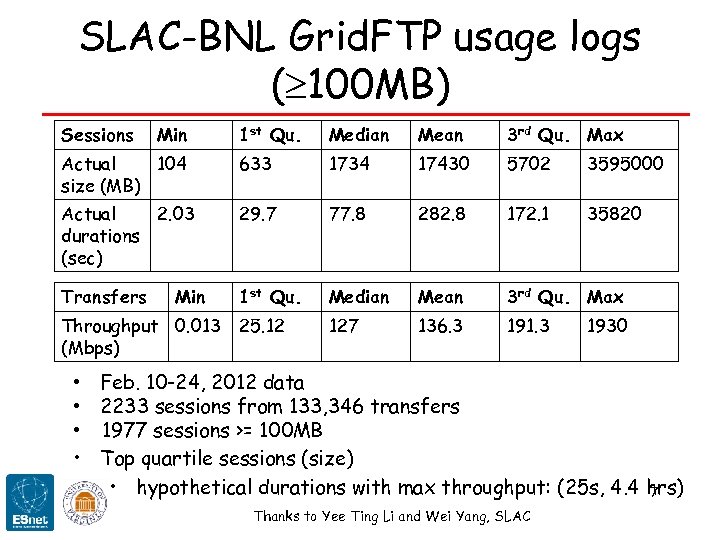
SLAC-BNL Grid. FTP usage logs ( 100 MB) Sessions Min 1 st Qu. Median Mean 3 rd Qu. Max Actual 104 size (MB) 633 1734 17430 5702 3595000 Actual 2. 03 durations (sec) 29. 7 77. 8 282. 8 172. 1 35820 Transfers 1 st Qu. Median Mean 3 rd Qu. Max 25. 12 127 136. 3 191. 3 Min Throughput 0. 013 (Mbps) 1930 • Feb. 10 -24, 2012 data • 2233 sessions from 133, 346 transfers • 1977 sessions >= 100 MB • Top quartile sessions (size) • hypothetical durations with max throughput: (25 s, 4. 4 hrs) 7 Thanks to Yee Ting Li and Wei Yang, SLAC
Design questions • What type of flows should be redirected off the IP-routed network? Ø What are key components of a hybrid network traffic engineering system? • Evaluate design 8
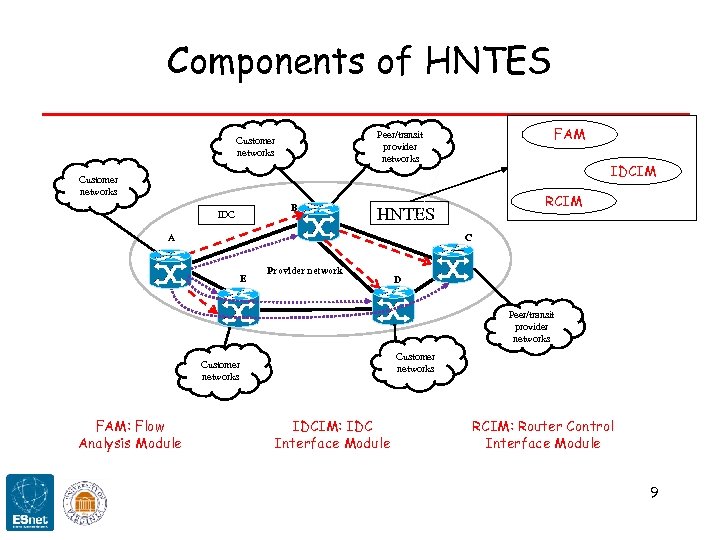
Components of HNTES FAM Peer/transit provider networks Customer networks IDCIM Customer networks B IDC RCIM HNTES A C E Provider network D Peer/transit provider networks Customer networks FAM: Flow Analysis Module IDCIM: IDC Interface Module RCIM: Router Control Interface Module 9
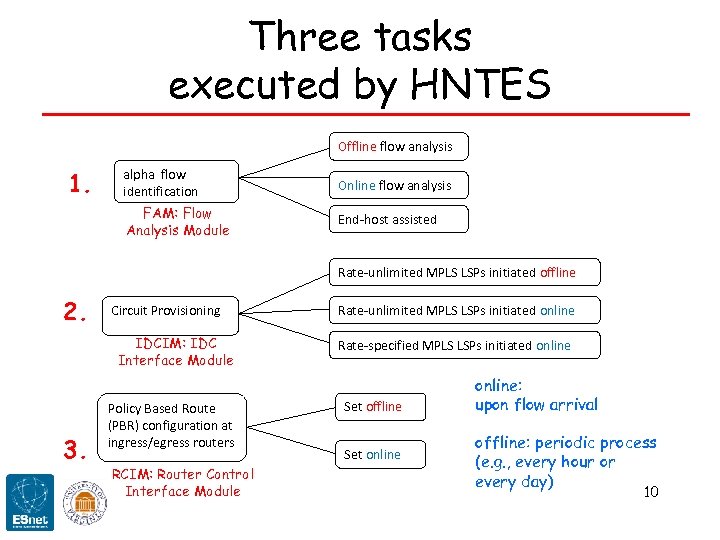
Three tasks executed by HNTES Offline flow analysis 1. alpha flow identification Online flow analysis FAM: Flow Analysis Module End-host assisted Rate-unlimited MPLS LSPs initiated offline 2. Circuit Provisioning IDCIM: IDC Interface Module 3. Policy Based Route (PBR) configuration at ingress/egress routers RCIM: Router Control Interface Module Rate-unlimited MPLS LSPs initiated online Rate-specified MPLS LSPs initiated online Set offline Set online: upon flow arrival offline: periodic process (e. g. , every hour or every day) 10
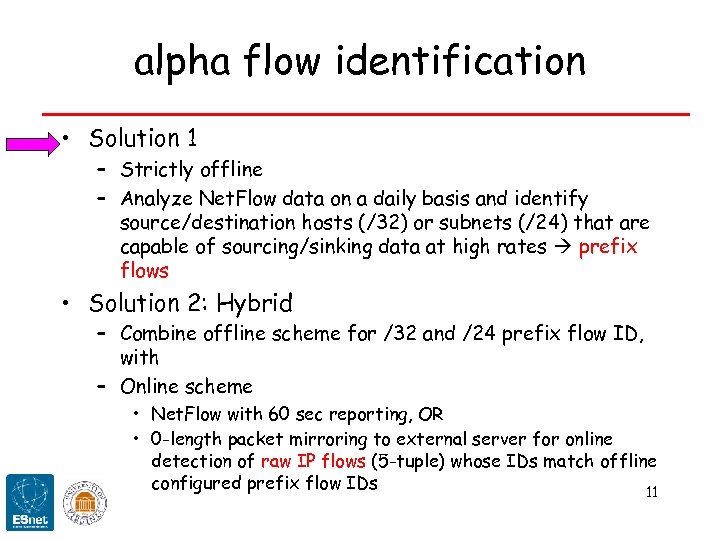
alpha flow identification • Solution 1 – Strictly offline – Analyze Net. Flow data on a daily basis and identify source/destination hosts (/32) or subnets (/24) that are capable of sourcing/sinking data at high rates prefix flows • Solution 2: Hybrid – Combine offline scheme for /32 and /24 prefix flow ID, with – Online scheme • Net. Flow with 60 sec reporting, OR • 0 -length packet mirroring to external server for online detection of raw IP flows (5 -tuple) whose IDs match offline configured prefix flow IDs 11
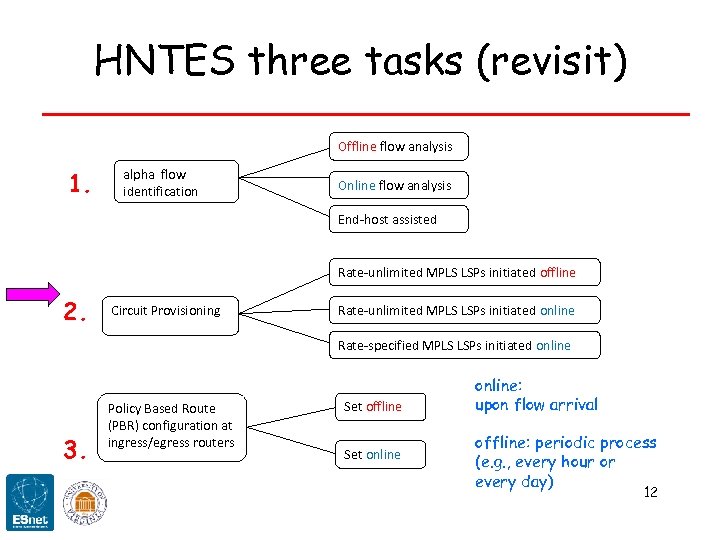
HNTES three tasks (revisit) Offline flow analysis 1. alpha flow identification Online flow analysis End-host assisted Rate-unlimited MPLS LSPs initiated offline 2. Circuit Provisioning Rate-unlimited MPLS LSPs initiated online Rate-specified MPLS LSPs initiated online 3. Policy Based Route (PBR) configuration at ingress/egress routers Set offline Set online: upon flow arrival offline: periodic process (e. g. , every hour or every day) 12
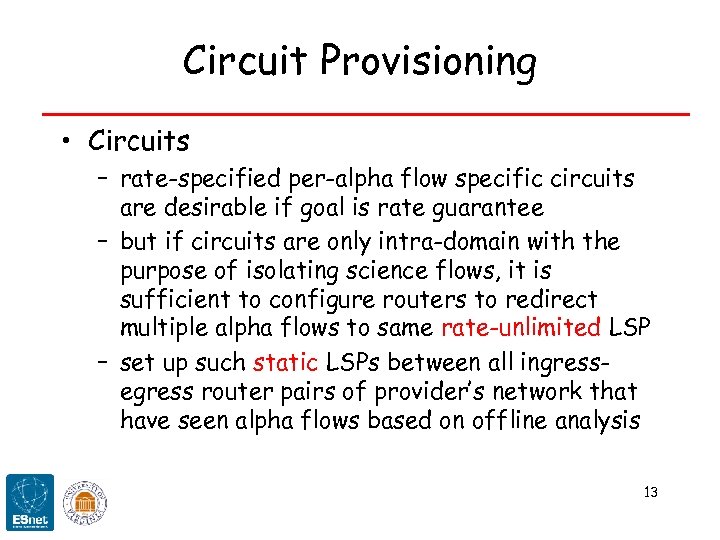
Circuit Provisioning • Circuits – rate-specified per-alpha flow specific circuits are desirable if goal is rate guarantee – but if circuits are only intra-domain with the purpose of isolating science flows, it is sufficient to configure routers to redirect multiple alpha flows to same rate-unlimited LSP – set up such static LSPs between all ingressegress router pairs of provider’s network that have seen alpha flows based on offline analysis 13
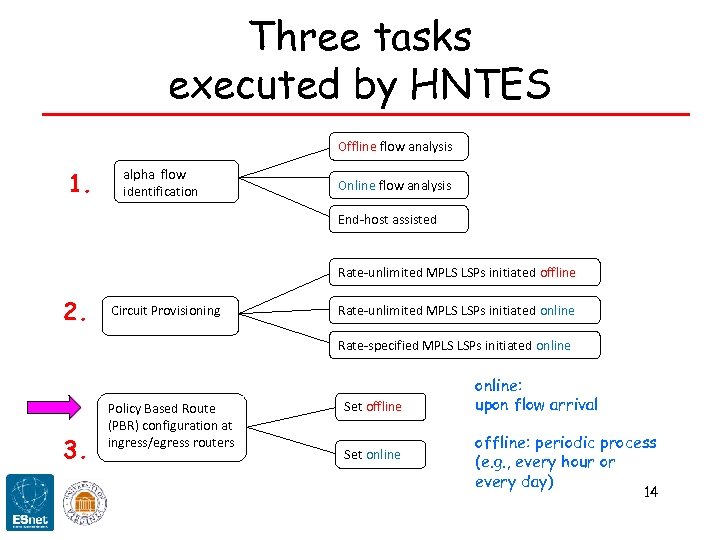
Three tasks executed by HNTES Offline flow analysis 1. alpha flow identification Online flow analysis End-host assisted Rate-unlimited MPLS LSPs initiated offline 2. Circuit Provisioning Rate-unlimited MPLS LSPs initiated online Rate-specified MPLS LSPs initiated online 3. Policy Based Route (PBR) configuration at ingress/egress routers Set offline Set online: upon flow arrival offline: periodic process (e. g. , every hour or every day) 14
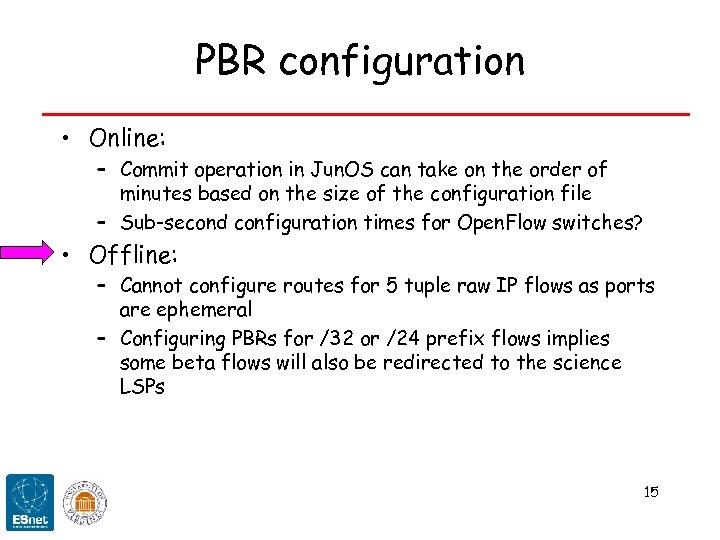
PBR configuration • Online: – Commit operation in Jun. OS can take on the order of minutes based on the size of the configuration file – Sub-second configuration times for Open. Flow switches? • Offline: – Cannot configure routes for 5 tuple raw IP flows as ports are ephemeral – Configuring PBRs for /32 or /24 prefix flows implies some beta flows will also be redirected to the science LSPs 15
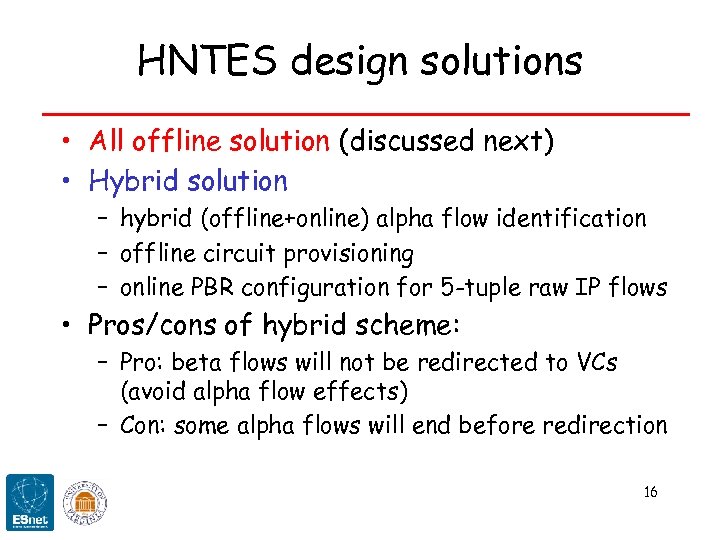
HNTES design solutions • All offline solution (discussed next) • Hybrid solution – hybrid (offline+online) alpha flow identification – offline circuit provisioning – online PBR configuration for 5 -tuple raw IP flows • Pros/cons of hybrid scheme: – Pro: beta flows will not be redirected to VCs (avoid alpha flow effects) – Con: some alpha flows will end before redirection 16
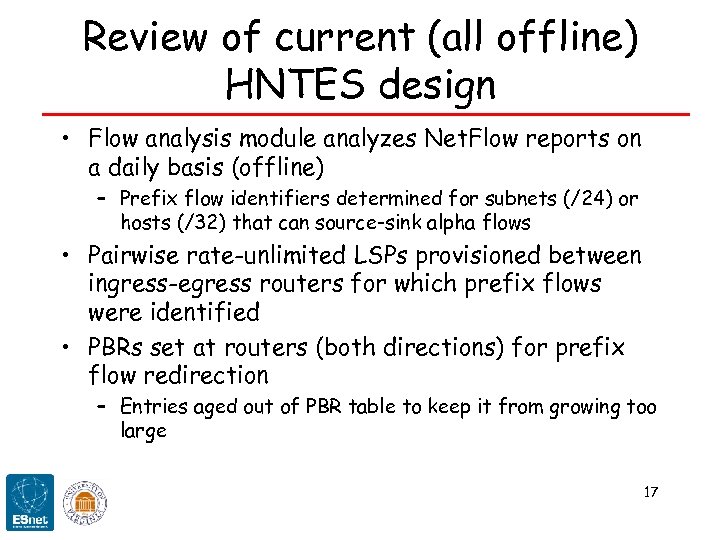
Review of current (all offline) HNTES design • Flow analysis module analyzes Net. Flow reports on a daily basis (offline) – Prefix flow identifiers determined for subnets (/24) or hosts (/32) that can source-sink alpha flows • Pairwise rate-unlimited LSPs provisioned between ingress-egress routers for which prefix flows were identified • PBRs set at routers (both directions) for prefix flow redirection – Entries aged out of PBR table to keep it from growing too large 17
Design questions • What type of flows should be redirected off the IP-routed network? • What are key components of a hybrid network traffic engineering system? Ø Evaluate design 18
Hypothesis • Key assumption in offline solution: – Computing systems that run the high-speed file transfer applications will likely have static public IP addresses, which means that prefix flow identifier based offline mechanisms will be effective in redirecting alpha flows. – Flows with previously unseen prefix flow identifiers will appear but such occurrences will be relatively rare 19
Net. Flow data analysis • Net. Flow data over 7 months (May-Nov 2011) collected at ESnet site PE router • Three steps – UVA wrote R analysis and anonymization programs – ESnet executed on Net. Flow data – Joint analysis of results 20
alpha flow identification algorithm • alpha flows: high rate flows – Net. Flow reports: subset where bytes sent in 1 minute > H bytes (1 GB) – Raw IP flows: 5 tuple based aggregation of Net. Flow reports on a daily basis – Prefix flows: /32 and /24 src/dst IP aggregation on a daily basis • Age out PBR entries – if for “A” aggregation intervals, no raw IP flows corresponding to a prefix flow appear 21
Analysis Study effectiveness of offline solution: – determine on a per-day basis, the percentage of bytes that came from flows that were not redirected because their prefix flow identifiers were not in the PBR table 22
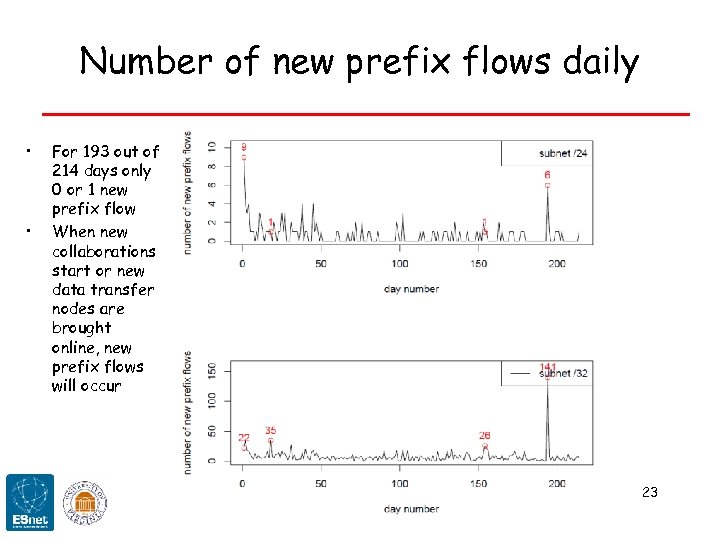
Number of new prefix flows daily • • For 193 out of 214 days only 0 or 1 new prefix flow When new collaborations start or new data transfer nodes are brought online, new prefix flows will occur 23
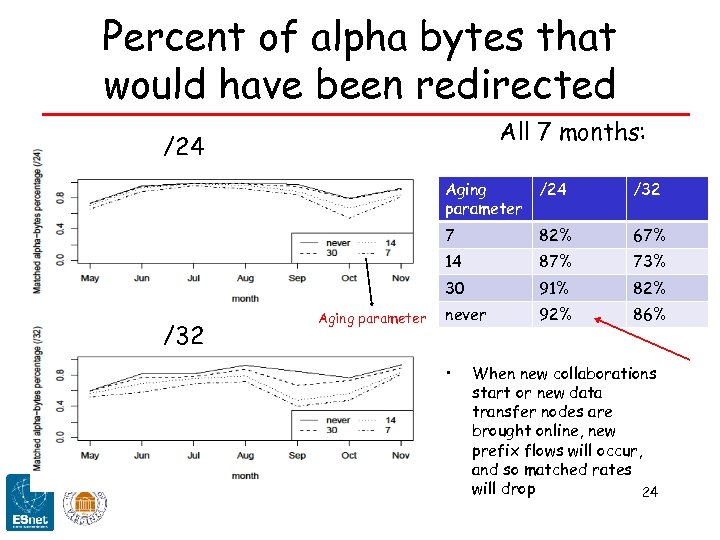
Percent of alpha bytes that would have been redirected All 7 months: /24 Aging parameter 82% 67% 14 87% 73% 30 /32 7 Aging parameter /24 91% 82% never 92% 86% • When new collaborations start or new data transfer nodes are brought online, new prefix flows will occur, and so matched rates will drop 24
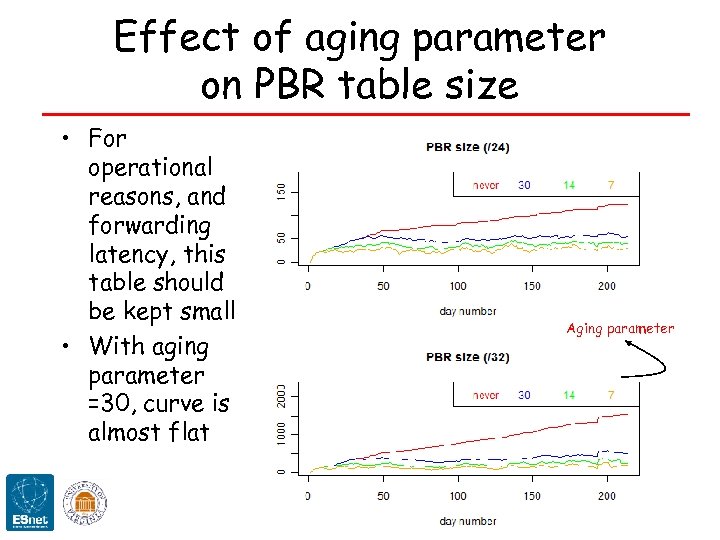
Effect of aging parameter on PBR table size • For operational reasons, and forwarding latency, this table should be kept small • With aging parameter =30, curve is almost flat Aging parameter 25
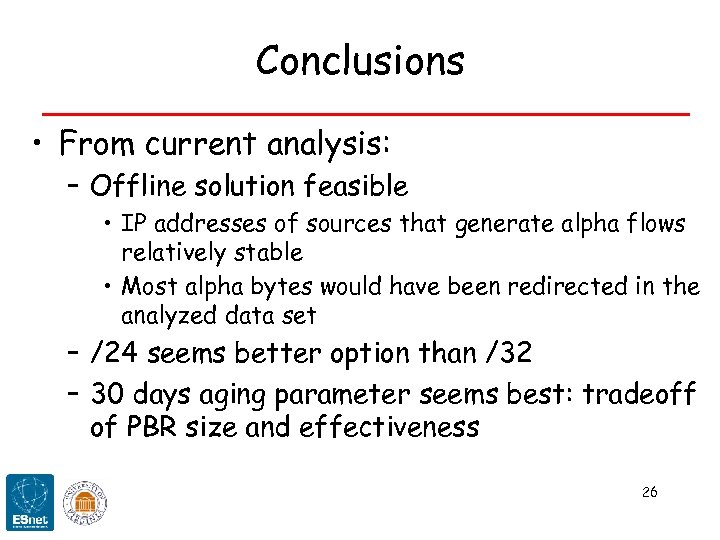
Conclusions • From current analysis: – Offline solution feasible • IP addresses of sources that generate alpha flows relatively stable • Most alpha bytes would have been redirected in the analyzed data set – /24 seems better option than /32 – 30 days aging parameter seems best: tradeoff of PBR size and effectiveness 26
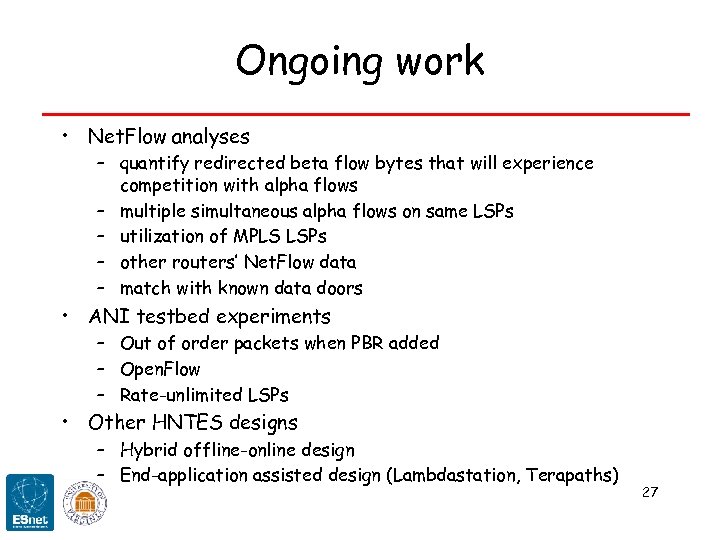
Ongoing work • Net. Flow analyses – quantify redirected beta flow bytes that will experience competition with alpha flows – multiple simultaneous alpha flows on same LSPs – utilization of MPLS LSPs – other routers’ Net. Flow data – match with known data doors • ANI testbed experiments – Out of order packets when PBR added – Open. Flow – Rate-unlimited LSPs • Other HNTES designs – Hybrid offline-online design – End-application assisted design (Lambdastation, Terapaths) 27
Скачать презентацию Hybrid network traffic engineering system HNTES Zhenzhen Yan
b49211ce39042821d4122c3d41bef021.ppt