 Скачать презентацию Hybrid Controller for Renewable Energy Power Plant in
7d2a945893f9662e51ea3a9667bd5489.ppt
- Количество слайдов: 32



Hybrid Controller for Renewable Energy Power Plant in Stand-alone sites Dr. Prabodh Bajpai Assistant Professor Electrical Engineering Department, IIT Kharagpur 1 1
Outline Introduction Technology aspects Benefit to the Industry Commercialization prospective 2 Hybrid Controller for Renewable Energy Power Plant in Stand-alone sites
Introduction Ø Uncontrolled Renewable energy sources essentially have random behaviors. eg: Solar, Wind, etc. Ø Power production from Uncontrolled sources is independent of human intervention Ø Hybrid power systems may contain controlled and uncontrolled energy sources and energy storage elements with appropriate control systems Ø Stand-alone hybrid power systems take advantage of the complementary nature in profile of the renewable energy sources Ø Hybrid power systems ensure continuous and reliable power production 3 Hybrid Controller for Renewable Energy Power Plant in Stand-alone sites
Possible Renewable Hybrid Energy Systems 1) Wind/PV/FC/electrolyzer/ battery system 2) Micro-turbine/FC system 3) Microturbine/wind system 4) Gas-turbine/FC system 5) Diesel/FC system 6) PV/battery 7) PV/FC/electrolyzer 8) PV/FC/electrolyzer/battery system 9) FC/battery, or supercapacitor system 10) Wind/FC system 11) Wind/diesel system 12) Wind/PV/battery system 13) PV/diesel system 14) Diesel/wind/PV system 15) PV/FC/ SMES system Wind and solar power generation are two of the most promising renewable power generation technologies. 4 4 Hybrid Controller for Renewable Energy Power Plant in Stand-alone sites
DG/Battery Hybrid Solution: Merits Ø Easy to install and low cost on site construction Ø Highly integrated intelligent hybrid power system for control and protection Ø Inclusion of battery back up reduces the DG size ØSaving in diesel and reduction in maintenance of diesel generator ØReduced operating time and enhanced DG life Ø Specially designed deep cycle battery available in market ØRechargeable in a short time, ØLong cycle life under STC, ØHigh Do. D (Depth of Discharge) 5 5 Hybrid Controller for Renewable Energy Power Plant in Stand-alone sites
DG based Hybrid Solution : Demerits DG as energy source has problems of : v Pollution v air, noise, heat v Dependence of fuel v world-wide increase of oil prices; limited resources in future v Transport to the sites v long distances and cost intensive transports v Storage of the fuel at site v safety problems - explosions, vandalism v No unattended operation is possible v high personnel cost v High maintenance cost and limited life-time of DG Hybrid Controller for Renewable Energy Power Plant in Stand-alone sites 6
Hybrid Renewable Energy Systems On the other hand, the proposed renewable energy based system helps in: v Decrease environmental pollution v Reduction of air emission v v v Energy saving v Reduces production and purchase of fossil fuels Abatement of global warming v CO 2 and other green house gases are not produced Socioeconomic development v Develops employment opportunities in rural areas Fuel supply diversity v Diversity of energy carriers and suppliers Distributed power generation v Reduces requirement for transmission lines within the electricity grid Hybrid Controller for Renewable Energy Power Plant in Stand-alone sites 7
Challenges Site dependence of renewable sources ØSite survey with long term data acquisition & forecasting Hybrid renewable energy system design ØConfiguration and sizing of the hybrid system components with the objectives: ØSupplying the power reliably under varying atmospheric conditions ØMinimizing the total cost of the system ØMaximizing the system efficiency by efficient energy flow management strategies ØOptimization through simulation studies under real operating conditions for a reasonable tradeoff among conflicting design objectives 8 Hybrid Controller for Renewable Energy Power Plant in Stand-alone sites
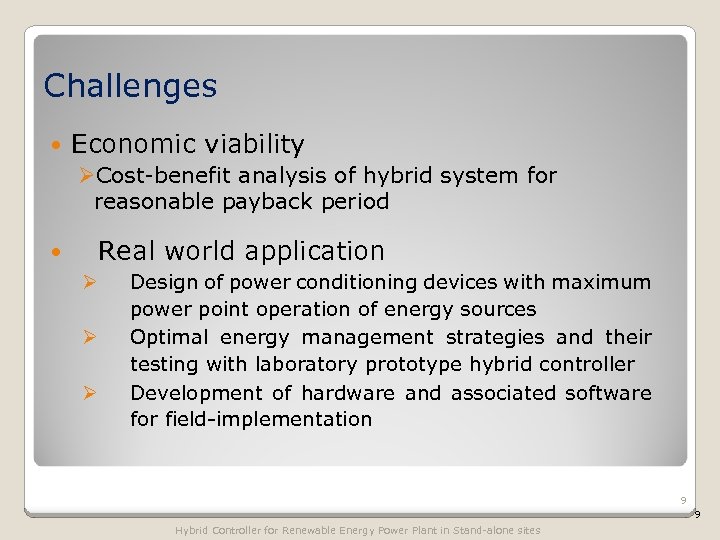
Challenges Economic viability ØCost-benefit analysis of hybrid system for reasonable payback period Real world application Ø Ø Ø Design of power conditioning devices with maximum power point operation of energy sources Optimal energy management strategies and their testing with laboratory prototype hybrid controller Development of hardware and associated software for field-implementation 9 9 Hybrid Controller for Renewable Energy Power Plant in Stand-alone sites
Technology aspects 10 Hybrid Controller for Renewable Energy Power Plant in Stand-alone sites
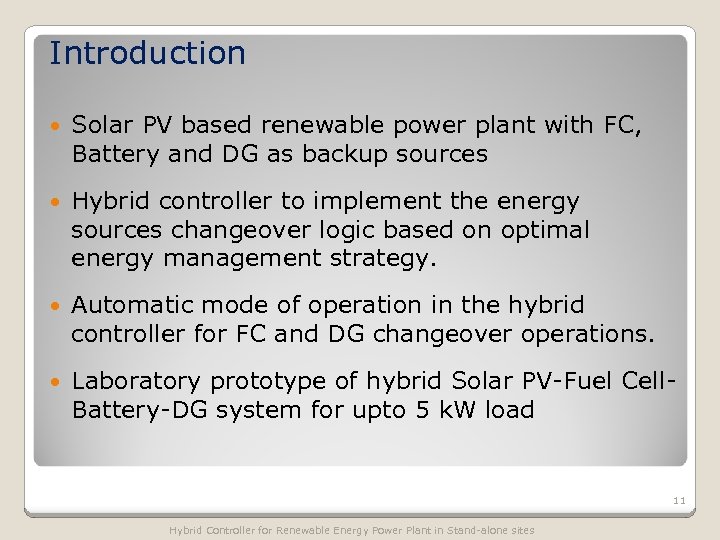
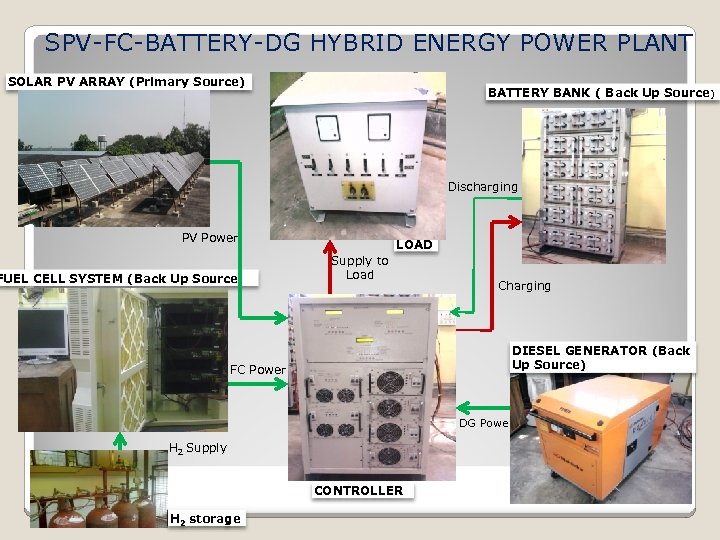
Introduction Solar PV based renewable power plant with FC, Battery and DG as backup sources Hybrid controller to implement the energy sources changeover logic based on optimal energy management strategy. Automatic mode of operation in the hybrid controller for FC and DG changeover operations. Laboratory prototype of hybrid Solar PV-Fuel Cell. Battery-DG system for upto 5 k. W load 11 Hybrid Controller for Renewable Energy Power Plant in Stand-alone sites
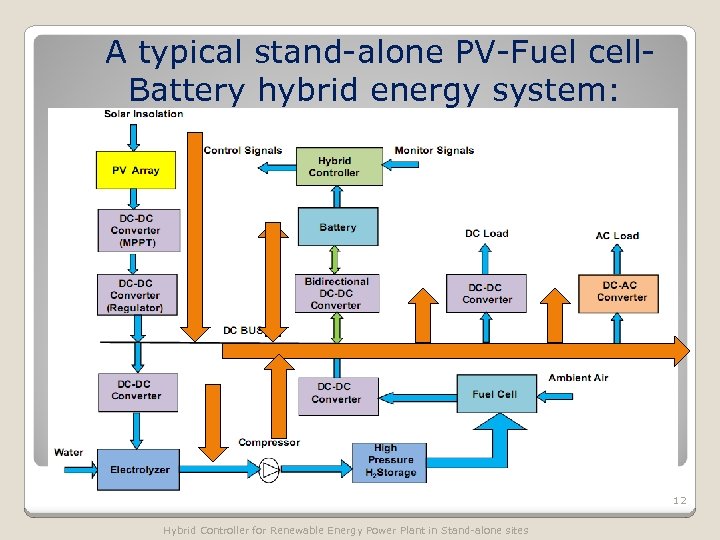
A typical stand-alone PV-Fuel cell. Battery hybrid energy system: 12 Hybrid Controller for Renewable Energy Power Plant in Stand-alone sites
System Development Robustness of the controller to fluctuating weather conditions and load demand is being rigorously tested, monitored and documented. Hybrid controller comprises of: ◦ Solar DSCAM (master controller) and two slave controllers, the Fuel Cell DSCAM and DG DSCAM ◦ Individual power conditioning units for SPV, Fuel Cell and DG system to provide regulated DC output on the DC bus. • The master and slave controllers interact to provide switching and control signals for the converter units. 13 Hybrid Controller for Renewable Energy Power Plant in Stand-alone sites
SPV-FC-BATTERY-DG HYBRID ENERGY POWER PLANT SOLAR PV ARRAY (Primary Source) BATTERY BANK ( Back Up Source) Discharging PV Power FUEL CELL SYSTEM (Back Up Source) LOAD Supply to Load Charging DIESEL GENERATOR (Back Up Source) FC Power DG Power H 2 Supply CONTROLLER H 2 storage
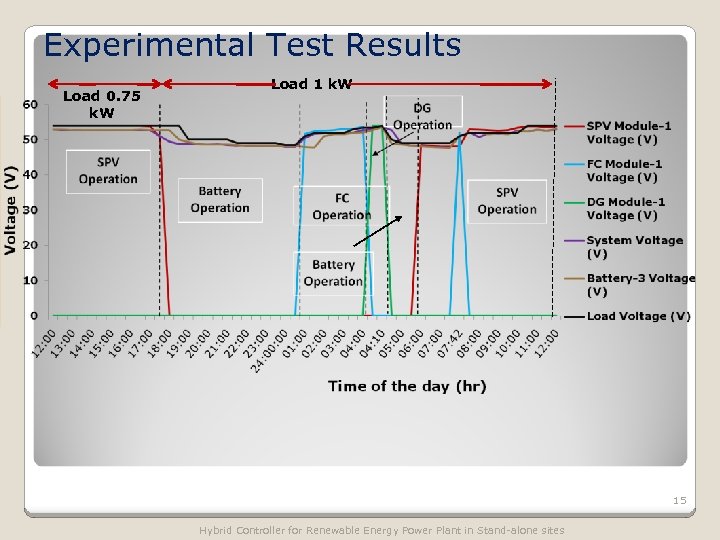
Experimental Test Results Load 0. 75 k. W Load 1 k. W 15 Hybrid Controller for Renewable Energy Power Plant in Stand-alone sites
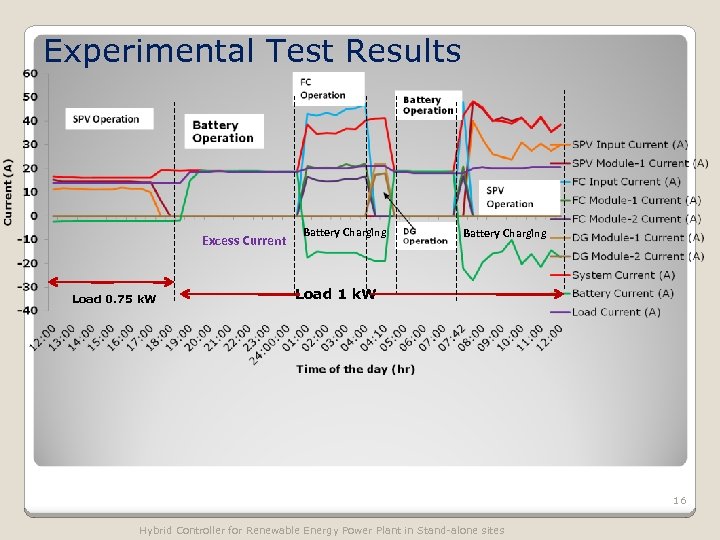
Experimental Test Results Excess Current Load 0. 75 k. W Battery Charging Load 1 k. W 16 Hybrid Controller for Renewable Energy Power Plant in Stand-alone sites
Merits of Topology Merits of solar PV charge controller and Fuel Cell charge controller ◦ Optimal charging of the batteries and maximum power extraction from solar PV and FC ◦ Supervisory functions to prevent damage to the battery ◦ Effective interface to inter connect Solar PV modules, Fuel Cell, Battery Bank and the load ◦ Battery reaches a high state of charge under all operating conditions ◦ Work in tandem with the SMPS based power plant to optimize the charging capability of the FC/SPV and protect the batteries from overcharge 17 Hybrid Controller for Renewable Energy Power Plant in Stand-alone sites
Important Features of Topology ◦ Use of solid-state devices to control the charging current to the battery and supply power to the load simultaneously ◦ Blocking devices to prevent reverse current flow from the battery to the FC/SPV during cloudy days or other charging modes ◦ Lightning / transient protection to protect the control circuitry from damage due to excessive voltage ◦ Programmable charging capacity, change over settings and peak power point ◦ Programmable maximum power point tracking (MPPT) logic with the built in embedded logic controller 18 Hybrid Controller for Renewable Energy Power Plant in Stand-alone sites
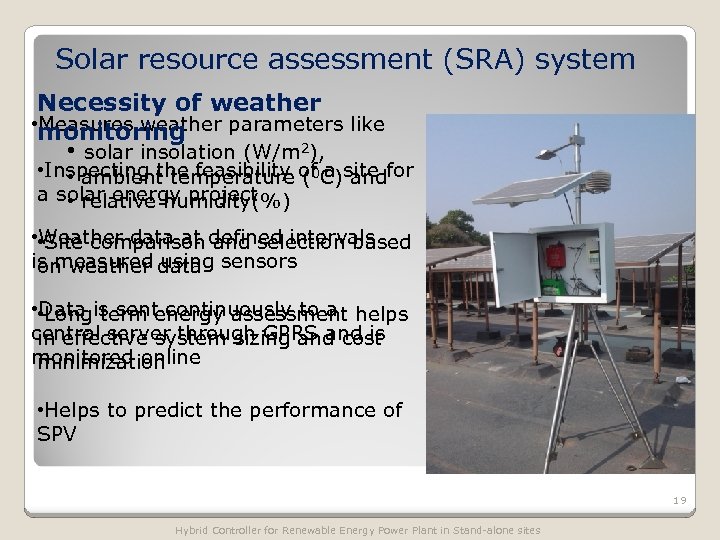
Solar resource assessment (SRA) system Necessity of weather • monitoring Measures weather parameters like • solar insolation (W/m 2), • Inspecting the feasibility of a site for • ambient temperature (0 C) and a solar energy project • relative humidity(%) • • Site comparison and selection based Weather data at defined intervals is measured using sensors on weather data • • Long term energy assessment helps Data is sent continuously to a central server through GPRS and is in effective system sizing and cost monitored online minimization • Helps to predict the performance of SPV 19 Hybrid Controller for Renewable Energy Power Plant in Stand-alone sites
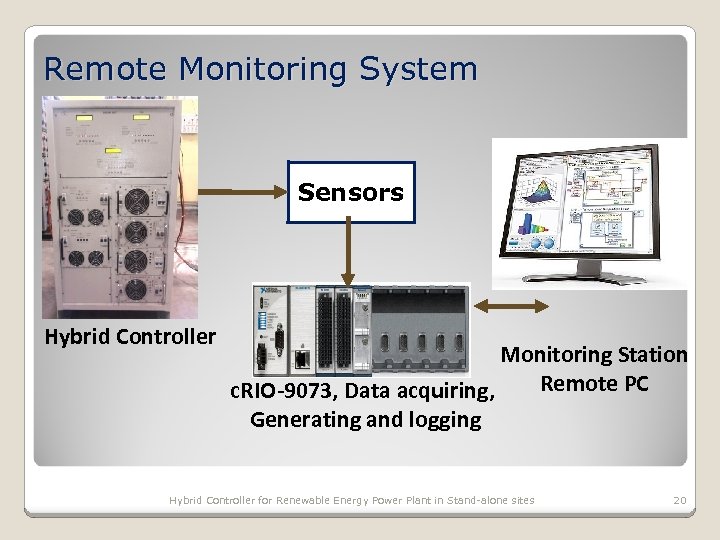
Remote Monitoring System Sensors Hybrid Controller Monitoring Station Remote PC c. RIO-9073, Data acquiring, Generating and logging Hybrid Controller for Renewable Energy Power Plant in Stand-alone sites 20

Benefit to Industry Hybrid Controller for Renewable Energy Power Plant in Standalone sites 21
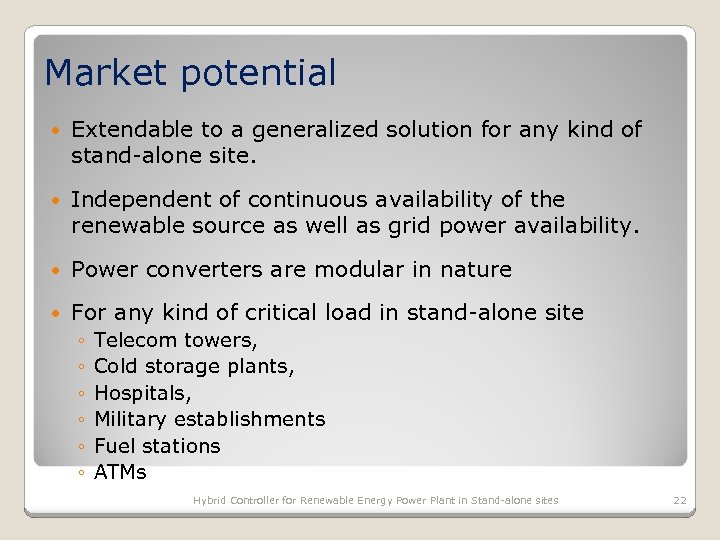
Market potential Extendable to a generalized solution for any kind of stand-alone site. Independent of continuous availability of the renewable source as well as grid power availability. Power converters are modular in nature For any kind of critical load in stand-alone site ◦ ◦ ◦ Telecom towers, Cold storage plants, Hospitals, Military establishments Fuel stations ATMs Hybrid Controller for Renewable Energy Power Plant in Stand-alone sites 22
Commercialization prospective Hybrid Controller for Renewable Energy Power Plant in Standalone sites 23
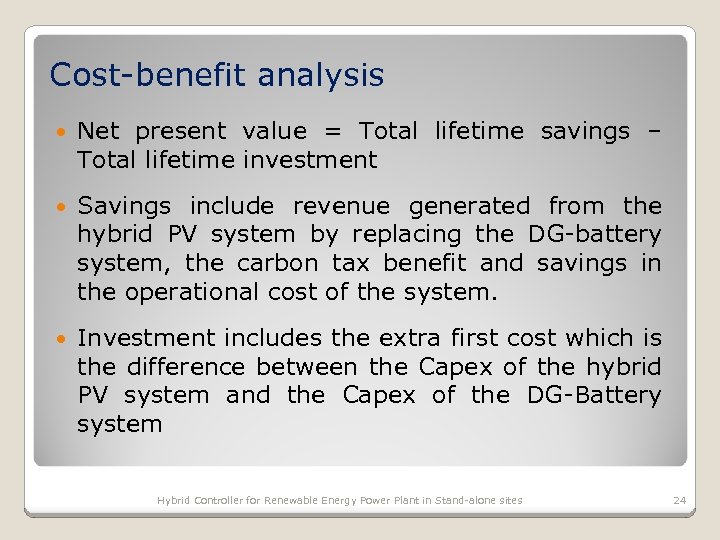
Cost-benefit analysis Net present value = Total lifetime savings – Total lifetime investment Savings include revenue generated from the hybrid PV system by replacing the DG-battery system, the carbon tax benefit and savings in the operational cost of the system. Investment includes the extra first cost which is the difference between the Capex of the hybrid PV system and the Capex of the DG-Battery system Hybrid Controller for Renewable Energy Power Plant in Stand-alone sites 24
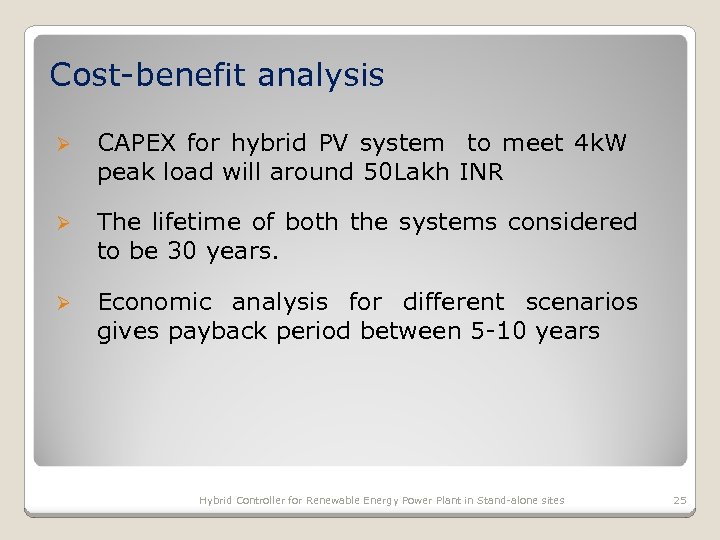
Cost-benefit analysis Ø CAPEX for hybrid PV system to meet 4 k. W peak load will around 50 Lakh INR Ø The lifetime of both the systems considered to be 30 years. Ø Economic analysis for different scenarios gives payback period between 5 -10 years Hybrid Controller for Renewable Energy Power Plant in Stand-alone sites 25
Real world application Proof of concept verified with a laboratory prototype Field site testing with stand-alone load application needs to be done The Technology Transfer may take place as per One Time License Payment or Revenue Sharing Model or any other criteria mutually agreed Hybrid Controller for Renewable Energy Power Plant in Stand-alone sites 26

Hybrid Controller for Renewable Energy Power Plant in Standalone sites 27
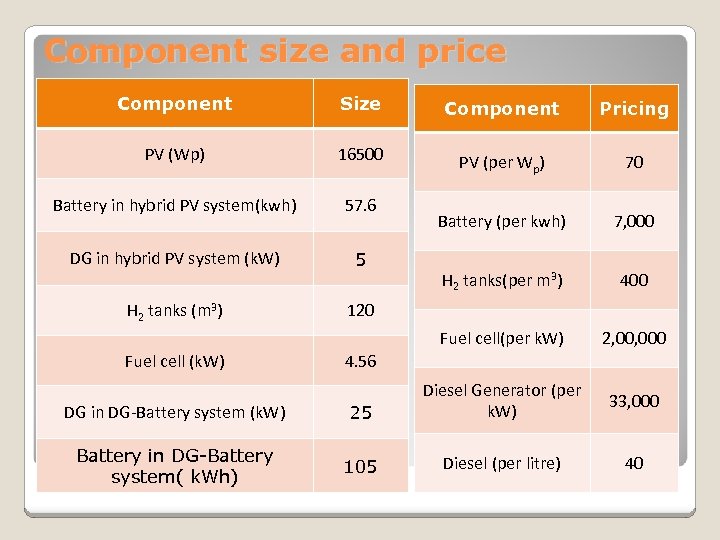
Component size and price Component Size Component Pricing PV (Wp) 16500 PV (per Wp) 70 Battery in hybrid PV system(kwh) 57. 6 Battery (per kwh) 7, 000 DG in hybrid PV system (k. W) 5 H 2 tanks(per m 3) 400 H 2 tanks (m 3) 120 Fuel cell(per k. W) 2, 000 33, 000 40 Fuel cell (k. W) 4. 56 DG in DG-Battery system (k. W) 25 Diesel Generator (per k. W) Battery in DG-Battery system( k. Wh) 105 Diesel (per litre)
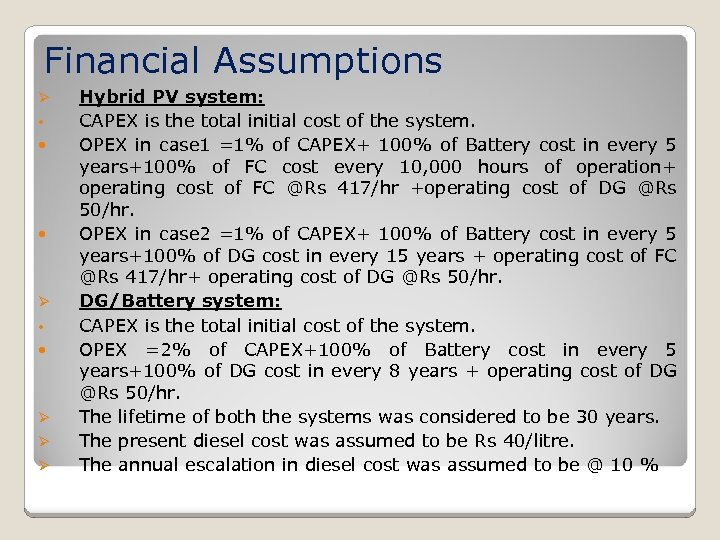
Financial Assumptions Ø • Ø Ø Ø Hybrid PV system: CAPEX is the total initial cost of the system. OPEX in case 1 =1% of CAPEX+ 100% of Battery cost in every 5 years+100% of FC cost every 10, 000 hours of operation+ operating cost of FC @Rs 417/hr +operating cost of DG @Rs 50/hr. OPEX in case 2 =1% of CAPEX+ 100% of Battery cost in every 5 years+100% of DG cost in every 15 years + operating cost of FC @Rs 417/hr+ operating cost of DG @Rs 50/hr. DG/Battery system: CAPEX is the total initial cost of the system. OPEX =2% of CAPEX+100% of Battery cost in every 5 years+100% of DG cost in every 8 years + operating cost of DG @Rs 50/hr. The lifetime of both the systems was considered to be 30 years. The present diesel cost was assumed to be Rs 40/litre. The annual escalation in diesel cost was assumed to be @ 10 %
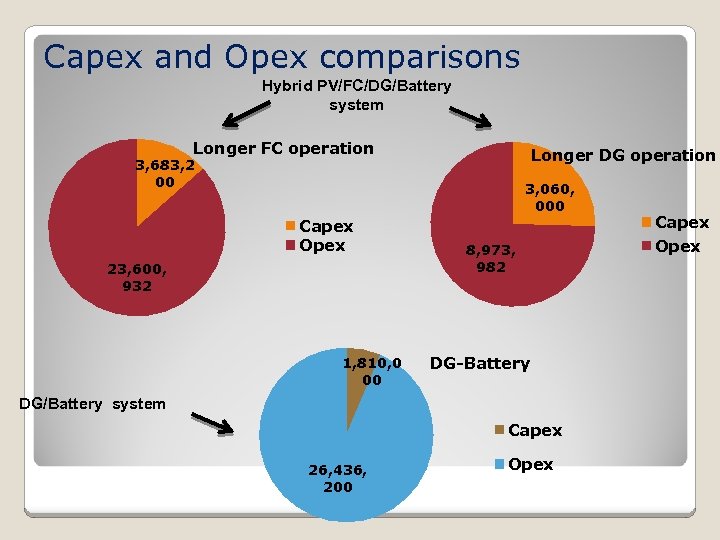
Capex and Opex comparisons Hybrid PV/FC/DG/Battery system Longer FC operation Longer DG operation 3, 683, 2 00 3, 060, 000 Capex Opex 23, 600, 932 1, 810, 0 00 8, 973, 982 DG-Battery DG/Battery system Capex 26, 436, 200 Opex Capex Opex
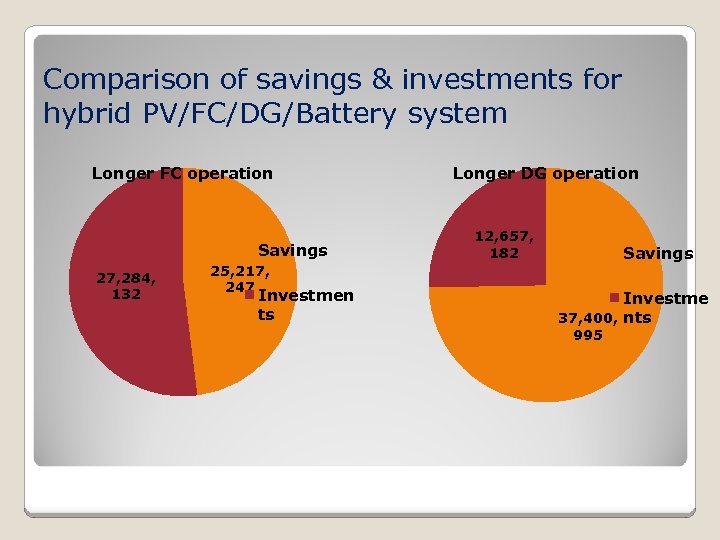
Comparison of savings & investments for hybrid PV/FC/DG/Battery system Longer FC operation Savings 27, 284, 132 25, 217, 247 Investmen ts Longer DG operation 12, 657, 182 Savings Investme 37, 400, nts 995
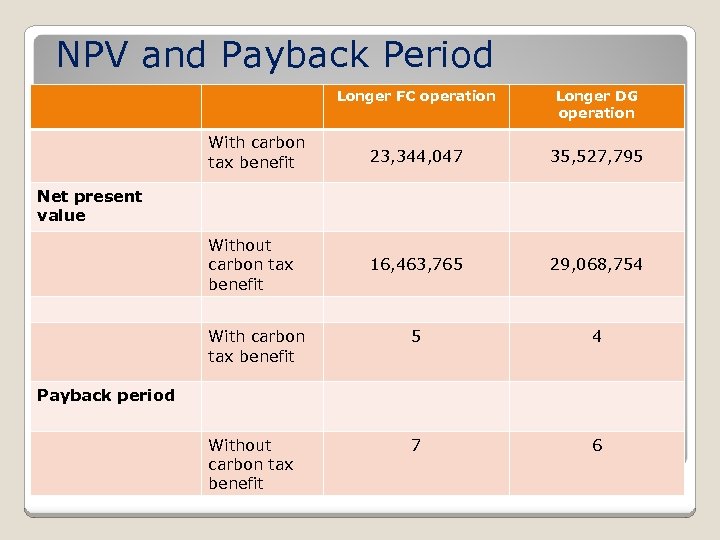
NPV and Payback Period Longer FC operation Longer DG operation With carbon tax benefit 23, 344, 047 35, 527, 795 Without carbon tax benefit 16, 463, 765 29, 068, 754 With carbon tax benefit 5 4 Without carbon tax benefit 7 6 Net present value Payback period
Скачать презентацию Hybrid Controller for Renewable Energy Power Plant in
7d2a945893f9662e51ea3a9667bd5489.ppt