


 Скачать презентацию Hungary The Hungarian peoples were formed on
dede25339cb5e3ade9b1baaeb38c534d.ppt
- Количество слайдов: 17
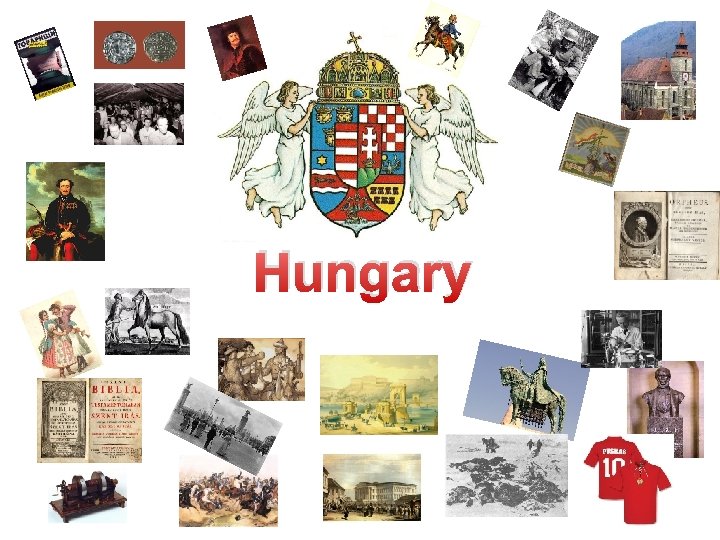 Hungary
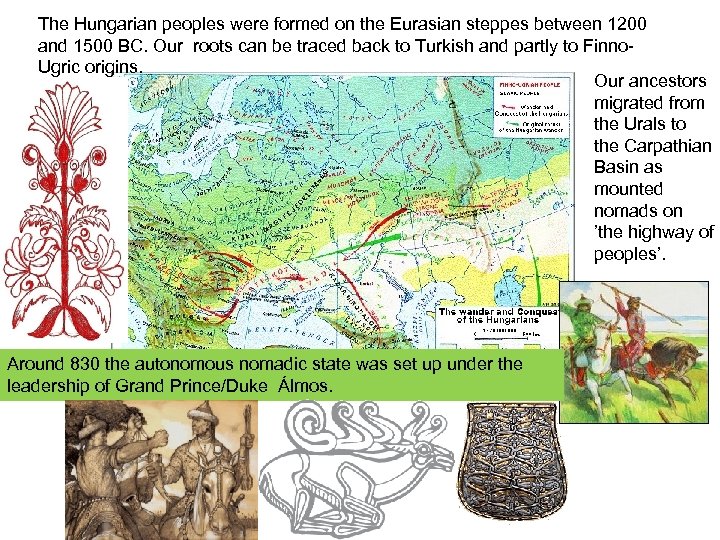 The Hungarian peoples were formed on the Eurasian steppes between 1200 and 1500 BC. Our roots can be traced back to Turkish and partly to Finno. Ugric origins. Our ancestors migrated from the Urals to the Carpathian Basin as mounted nomads on ’the highway of peoples’. Around 830 the autonomous nomadic state was set up under the leadership of Grand Prince/Duke Álmos.
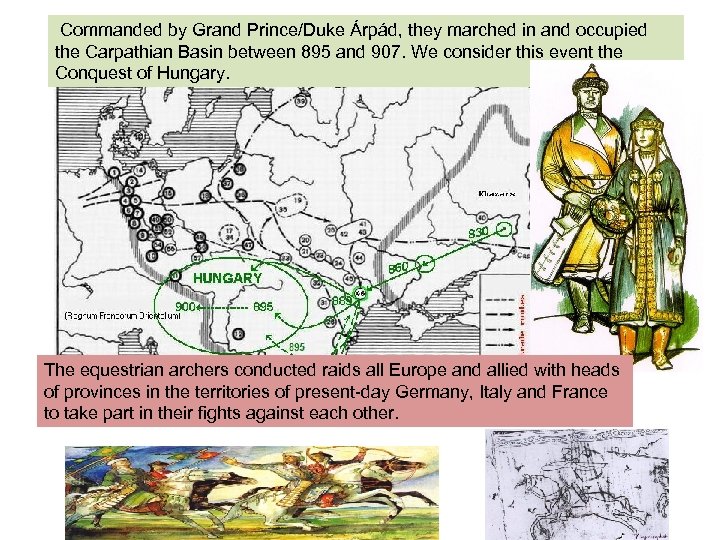 Commanded by Grand Prince/Duke Árpád, they marched in and occupied the Carpathian Basin between 895 and 907. We consider this event the Conquest of Hungary. The equestrian archers conducted raids all Europe and allied with heads of provinces in the territories of present-day Germany, Italy and France to take part in their fights against each other.
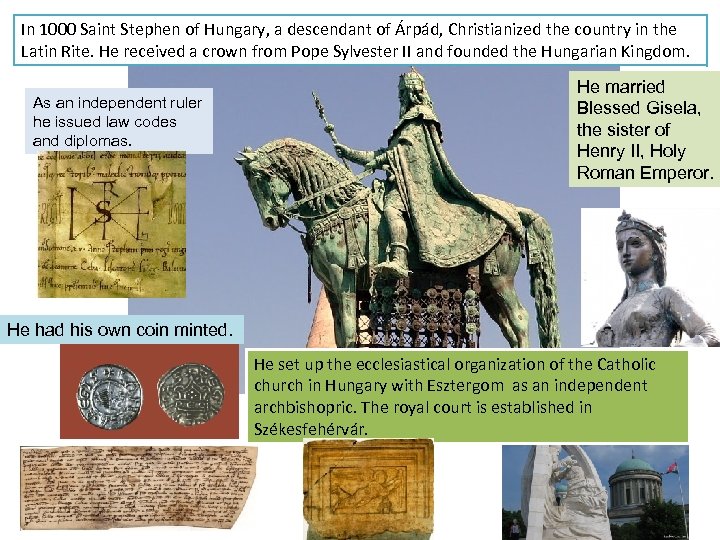 In 1000 Saint Stephen of Hungary, a descendant of Árpád, Christianized the country in the Latin Rite. He received a crown from Pope Sylvester II and founded the Hungarian Kingdom. As an independent ruler he issued law codes and diplomas. He married Blessed Gisela, the sister of Henry II, Holy Roman Emperor. He had his own coin minted. He set up the ecclesiastical organization of the Catholic church in Hungary with Esztergom as an independent archbishopric. The royal court is established in Székesfehérvár.
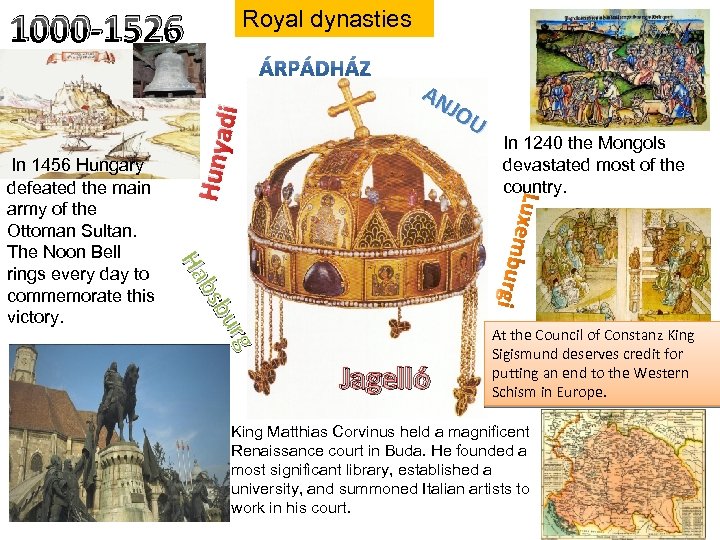 1000 -1526 AN JO U rg urg bu bsb bs Ha Ha In 1456 Hungary defeated the main army of the Ottoman Sultan. The Noon Bell rings every day to commemorate this victory. Hunya di Royal dynasties Jagelló In 1240 the Mongols devastated most of the country. At the Council of Constanz King Sigismund deserves credit for putting an end to the Western Schism in Europe. King Matthias Corvinus held a magnificent Renaissance court in Buda. He founded a most significant library, established a university, and summoned Italian artists to work in his court.
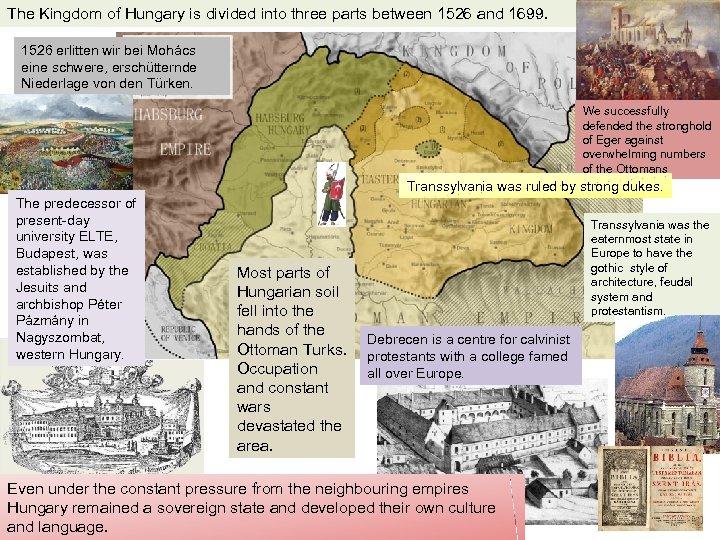 The Kingdom of Hungary is divided into three parts between 1526 and 1699. 1526 erlitten wir bei Mohács eine schwere, erschütternde Niederlage von den Türken. We successfully defended the stronghold of Eger against overwhelming numbers of the Ottomans Transsylvania was ruled by strong dukes. The predecessor of present-day university ELTE, Budapest, was established by the Jesuits and archbishop Péter Pázmány in Nagyszombat, western Hungary. Most parts of Hungarian soil fell into the hands of the Ottoman Turks. Occupation and constant wars devastated the area. Transsylvania was the eaternmost state in Europe to have the gothic style of architecture, feudal system and protestantism. Debrecen is a centre for calvinist protestants with a college famed all over Europe. Even under the constant pressure from the neighbouring empires Hungary remained a sovereign state and developed their own culture and language.
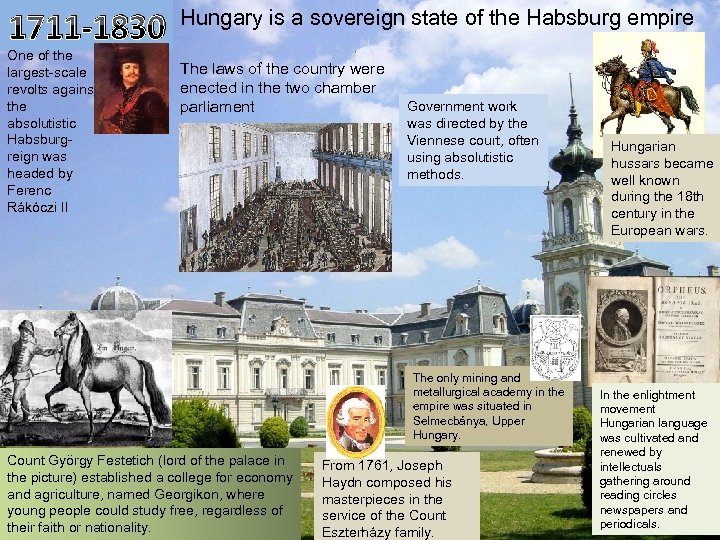 1711 -1830 One of the largest-scale revolts against the absolutistic Habsburgreign was headed by Ferenc Rákóczi II Hungary is a sovereign state of the Habsburg empire The laws of the country were enected in the two chamber parliament Government work was directed by the Viennese court, often using absolutistic methods. The only mining and metallurgical academy in the empire was situated in Selmecbánya, Upper Hungary. Count György Festetich (lord of the palace in the picture) established a college for economy and agriculture, named Georgikon, where young people could study free, regardless of their faith or nationality. From 1761, Joseph Haydn composed his masterpieces in the service of the Count Eszterházy family. Hungarian hussars became well known during the 18 th century in the European wars. In the enlightment movement Hungarian language was cultivated and renewed by intellectuals gathering around reading circles newspapers and periodicals.
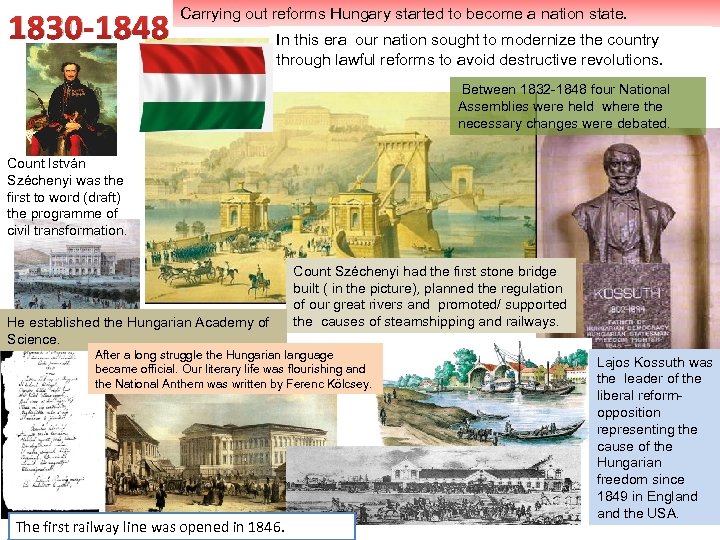 1830 -1848 Carrying out reforms Hungary started to become a nation state. In this era our nation sought to modernize the country through lawful reforms to avoid destructive revolutions. Between 1832 -1848 four National Assemblies were held where the necessary changes were debated. Count István Széchenyi was the first to word (draft) the programme of civil transformation. He established the Hungarian Academy of Science. Count Széchenyi had the first stone bridge built ( in the picture), planned the regulation of our great rivers and promoted/ supported the causes of steamshipping and railways. After a long struggle the Hungarian language became official. Our literary life was flourishing and the National Anthem was written by Ferenc Kölcsey. The first railway line was opened in 1846. Lajos Kossuth was the leader of the liberal reformopposition representing the cause of the Hungarian freedom since 1849 in England the USA.
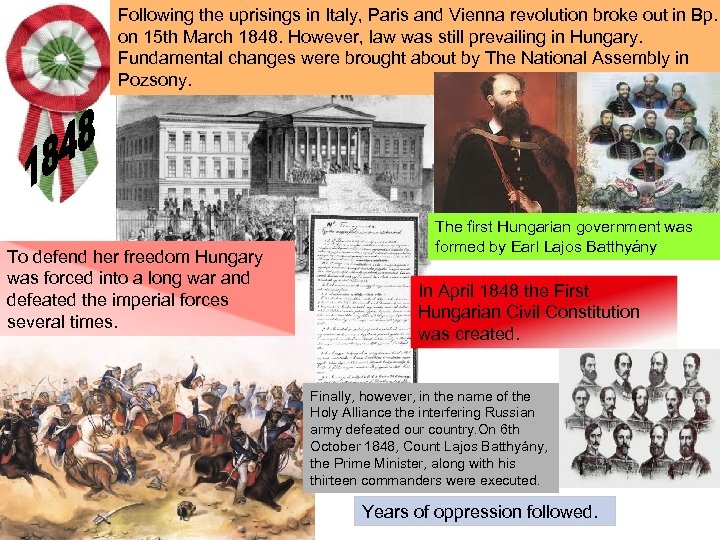 Following the uprisings in Italy, Paris and Vienna revolution broke out in Bp. on 15 th March 1848. However, law was still prevailing in Hungary. Fundamental changes were brought about by The National Assembly in Pozsony. To defend her freedom Hungary was forced into a long war and defeated the imperial forces several times. The first Hungarian government was formed by Earl Lajos Batthyány In April 1848 the First Hungarian Civil Constitution was created. Finally, however, in the name of the Holy Alliance the interfering Russian army defeated our country. On 6 th October 1848, Count Lajos Batthyány, the Prime Minister, along with his thirteen commanders were executed. Years of oppression followed.
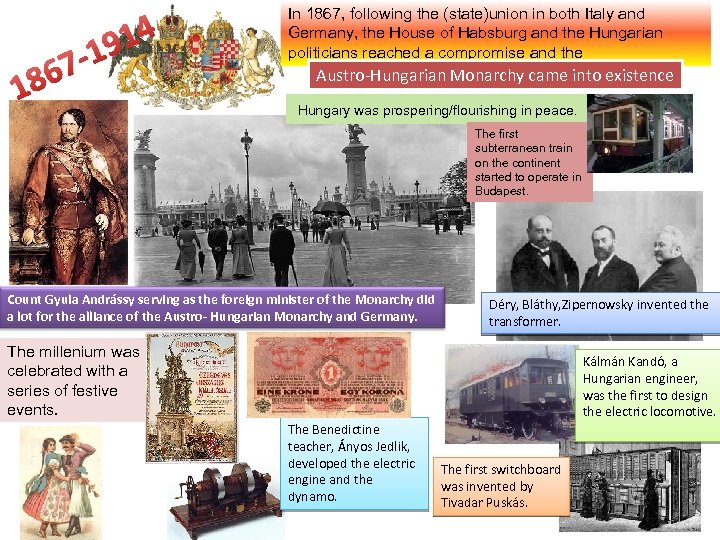 14 19 786 1 In 1867, following the (state)union in both Italy and Germany, the House of Habsburg and the Hungarian politicians reached a compromise and the Austro-Hungarian Monarchy came into existence Hungary was prospering/flourishing in peace. The first subterranean train on the continent started to operate in Budapest. Count Gyula Andrássy serving as the foreign minister of the Monarchy did a lot for the alliance of the Austro- Hungarian Monarchy and Germany. Déry, Bláthy, Zipernowsky invented the transformer. The millenium was celebrated with a series of festive events. Kálmán Kandó, a Hungarian engineer, was the first to design the electric locomotive. The Benedictine teacher, Ányos Jedlik, developed the electric engine and the dynamo. The first switchboard was invented by Tivadar Puskás.
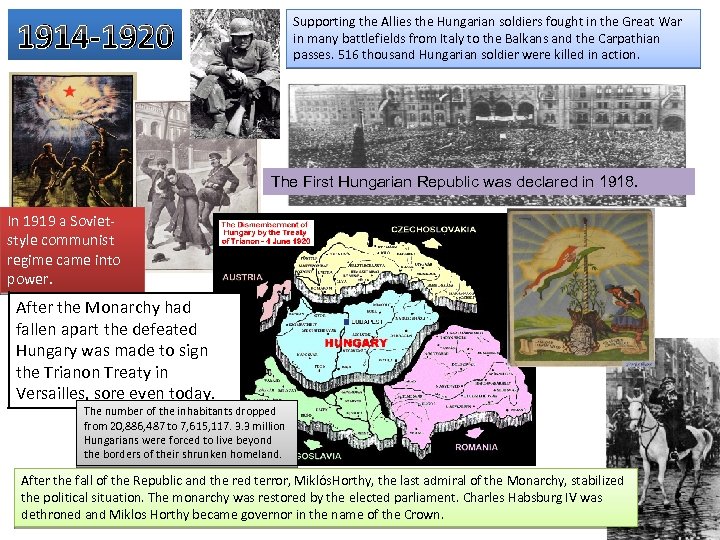 Supporting the Allies the Hungarian soldiers fought in the Great War in many battlefields from Italy to the Balkans and the Carpathian passes. 516 thousand Hungarian soldier were killed in action. 1914 -1920 The First Hungarian Republic was declared in 1918. In 1919 a Sovietstyle communist regime came into power. After the Monarchy had fallen apart the defeated Hungary was made to sign the Trianon Treaty in Versailles, sore even today. The number of the inhabitants dropped from 20, 886, 487 to 7, 615, 117. 3. 3 million Hungarians were forced to live beyond the borders of their shrunken homeland. After the fall of the Republic and the red terror, Miklós. Horthy, the last admiral of the Monarchy, stabilized the political situation. The monarchy was restored by the elected parliament. Charles Habsburg IV was dethroned and Miklos Horthy became governor in the name of the Crown.
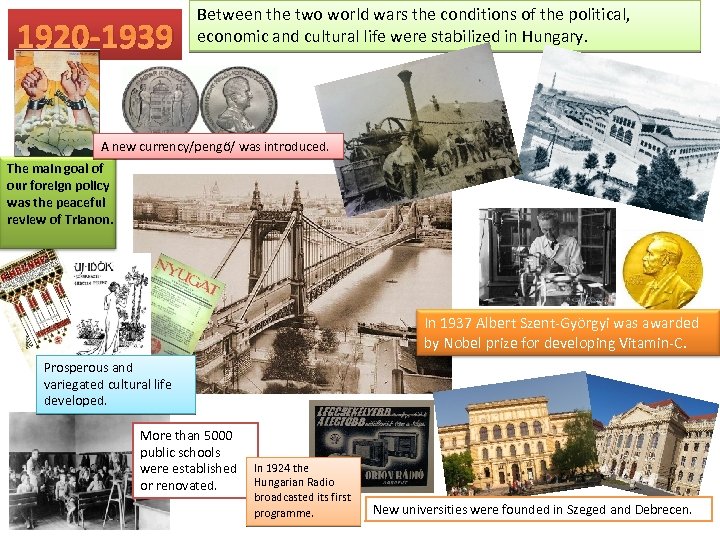 1920 -1939 Between the two world wars the conditions of the political, economic and cultural life were stabilized in Hungary. A new currency/pengő/ was introduced. The main goal of our foreign policy was the peaceful review of Trianon. In 1937 Albert Szent-Györgyi was awarded by Nobel prize for developing Vitamin-C. Prosperous and variegated cultural life developed. More than 5000 public schools were established or renovated. In 1924 the Hungarian Radio broadcasted its first programme. New universities were founded in Szeged and Debrecen.
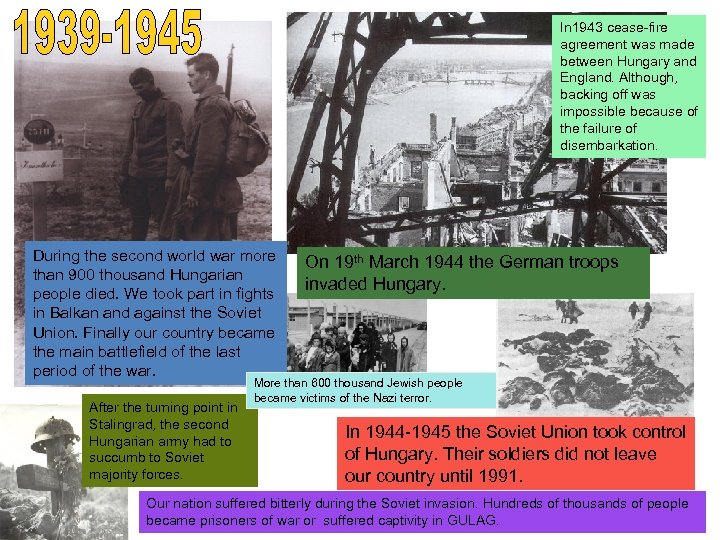 In 1943 cease-fire agreement was made between Hungary and England. Although, backing off was impossible because of the failure of disembarkation. During the second world war more than 900 thousand Hungarian people died. We took part in fights in Balkan and against the Soviet Union. Finally our country became the main battlefield of the last period of the war. After the turning point in Stalingrad, the second Hungarian army had to succumb to Soviet majority forces. On 19 th March 1944 the German troops invaded Hungary. More than 600 thousand Jewish people became victims of the Nazi terror. In 1944 -1945 the Soviet Union took control of Hungary. Their soldiers did not leave our country until 1991. Our nation suffered bitterly during the Soviet invasion. Hundreds of thousands of people became prisoners of war or suffered captivity in GULAG.
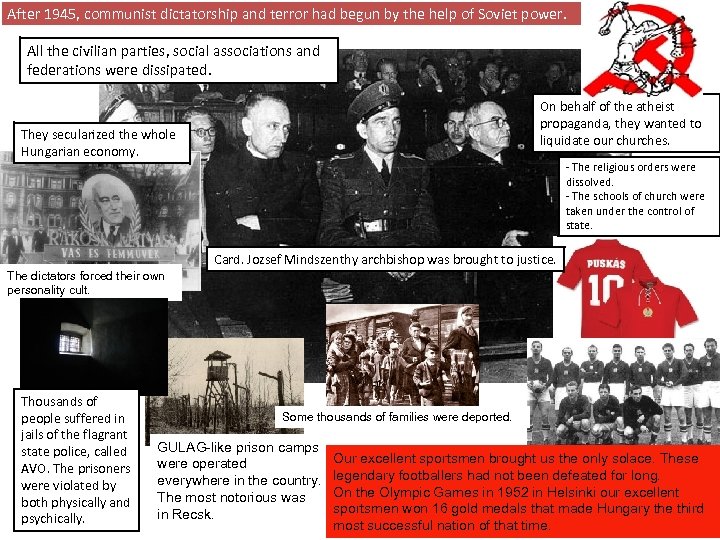 After 1945, communist dictatorship and terror had begun by the help of Soviet power. All the civilian parties, social associations and federations were dissipated. On behalf of the atheist propaganda, they wanted to liquidate our churches. They secularized the whole Hungarian economy. - The religious orders were dissolved. - The schools of church were taken under the control of state. Card. Jozsef Mindszenthy archbishop was brought to justice. The dictators forced their own personality cult. Thousands of people suffered in jails of the flagrant state police, called AVO. The prisoners were violated by both physically and psychically. Some thousands of families were deported. GULAG-like prison camps were operated everywhere in the country. The most notorious was in Recsk. Our excellent sportsmen brought us the only solace. These legendary footballers had not been defeated for long. On the Olympic Games in 1952 in Helsinki our excellent sportsmen won 16 gold medals that made Hungary the third most successful nation of that time.
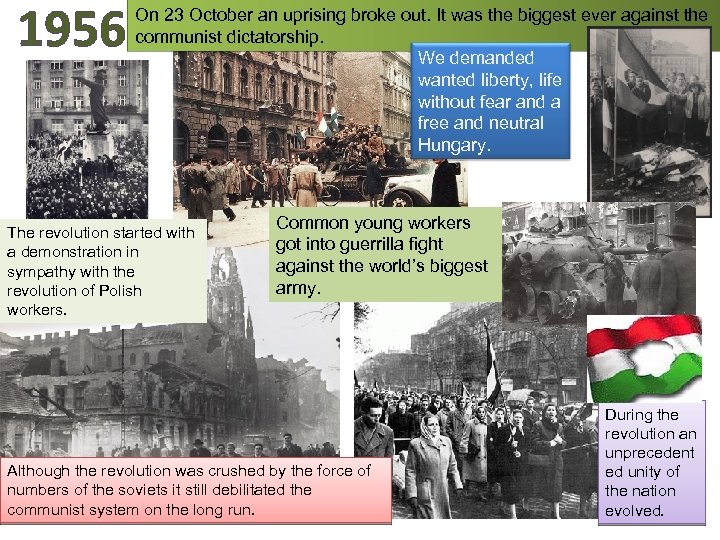 1956 On 23 October an uprising broke out. It was the biggest ever against the communist dictatorship. We demanded wanted liberty, life without fear and a free and neutral Hungary. The revolution started with a demonstration in sympathy with the revolution of Polish workers. Common young workers got into guerrilla fight against the world’s biggest army. Although the revolution was crushed by the force of numbers of the soviets it still debilitated the communist system on the long run. During the revolution an unprecedent ed unity of the nation evolved.
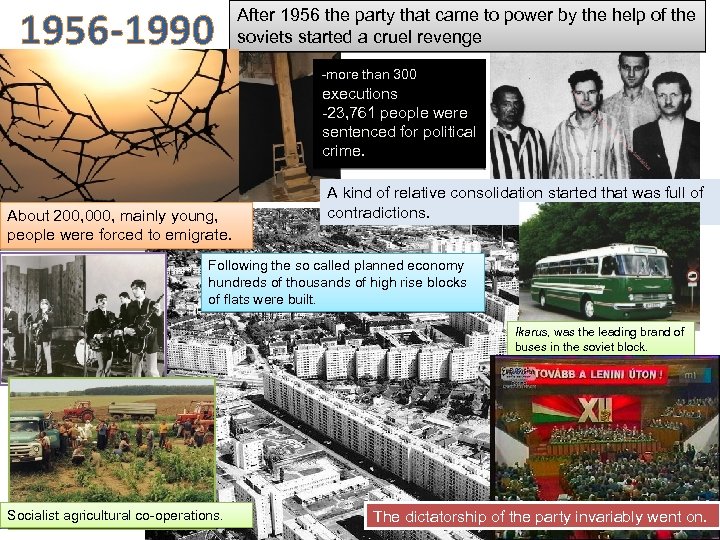 1956 -1990 After 1956 the party that came to power by the help of the soviets started a cruel revenge -more than 300 executions -23, 761 people were sentenced for political crime. About 200, 000, mainly young, people were forced to emigrate. A kind of relative consolidation started that was full of contradictions. Following the so called planned economy hundreds of thousands of high rise blocks of flats were built. Ikarus, was the leading brand of buses in the soviet block. Socialist agricultural co-operations. The dictatorship of the party invariably went on.
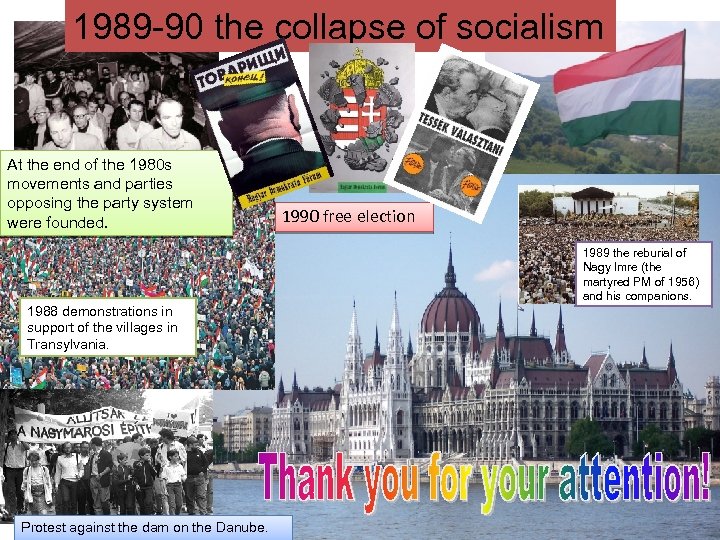 1989 -90 the collapse of socialism At the end of the 1980 s movements and parties opposing the party system were founded. 1990 free election 1989 the reburial of Nagy Imre (the martyred PM of 1956) and his companions. 1988 demonstrations in support of the villages in Transylvania. Protest against the dam on the Danube.