 Скачать презентацию HUNGARIAN CHAMBER OF AGRICULTURE The Hungarian Chamber of
05fe42f2e87c87817a7b4768ed6cd0ac.ppt
- Количество слайдов: 85



HUNGARIAN CHAMBER OF AGRICULTURE The Hungarian Chamber of Agriculture
Foundation of the Hungarian Chamber of Agriculture To decrease the economic role of the state the Hungarian Parliament adopted the Act XVI of 1994 on economic chambers. According to this legislation the Hungarian Chamber of Agriculture was founded on 20 December 1994 as a national public body performing public duties and having a legal person status. The Parliament adopted a new act on economic chambers on the 21 st of December of 1999 under No. CXXI. According to the provisions of this law the agricultural chambers were renewed in 2000.
Members of the Hungarian Chamber of Agriculture • The Budapest and territorial chambers are the members of the Hungarian Chamber of Agriculture. The 20 territorial chambers are also public bodies. Their members are the economic organisations with agricultural, forestry, fishery and hunting activity on voluntary basis including the related processing, trading and servicing activities, as well. • Nowadays the agricultural chambers have 11 000 voluntary members of which: one third is primary producer, one third is individual farmer and one third is economic organisation with legal entity. • The members represent 60 % of the total agricultural output.
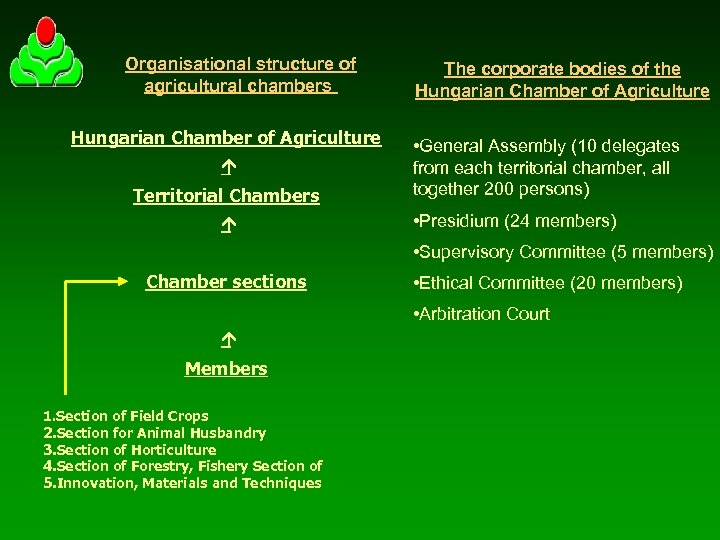
Organisational structure of agricultural chambers Hungarian Chamber of Agriculture á Territorial Chambers á The corporate bodies of the Hungarian Chamber of Agriculture • General Assembly (10 delegates from each territorial chamber, all together 200 persons) • Presidium (24 members) • Supervisory Committee (5 members) Chamber sections • Ethical Committee (20 members) • Arbitration Court á Members 1. Section of Field Crops 2. Section for Animal Husbandry 3. Section of Horticulture 4. Section of Forestry, Fishery Section of 5. Innovation, Materials and Techniques
The duties of the Hungarian Chamber of Agriculture • Takes part in the work of the National Council of Professional Training • In co-operation with the territorial chambers controls the practical training places • Co-ordinates the tasks related to the master examination and certificates • Keeps contact with the foreign agricultural chambers and international organisations • Develops the system of the member registration, • Prepares the rules related to the fair market behaviour • Organises exhibitions and fairs, • Develops the general rules of delivering and verification of certificates of origin and other documents necessary for trade • Represents its members in the state financial funds • Reports on the agricultural legislation and programme documents of the government and initiates amendments according to the rules of the law.
What does the Hungarian Chamber of Agriculture?
Advisory and information activities in Hungary in the frame of the Chambers of Agriculture • Hungarian Chamber of Agriculture: Free information given to the farmers about the CAP, the direct payments and about the subsidy possibilities in the framework of the New Hungarian Rural Development Program. • The Territorial Chambers of Agriculture: They are running the Territorial Advisory Centres, they give advise to the farmers based on the Council Regulation (EC) No 1698/2005 Article 24. • Meet the requirements of cross-compliance, • occupational safety standards based on Community legislation • help farmers and forest holders to improve the overall performance of their holding
The Action Groups of the Farm Information Service • A) Overall regulatory knowledge given to the farmers (subsidies, institutional requirements) • B) To draw the attention of the farmers: how to apply and what kind of requirements have to be met by the farmers when they apply for subsidies. • C) Other know-how (e. g. technological know-how)
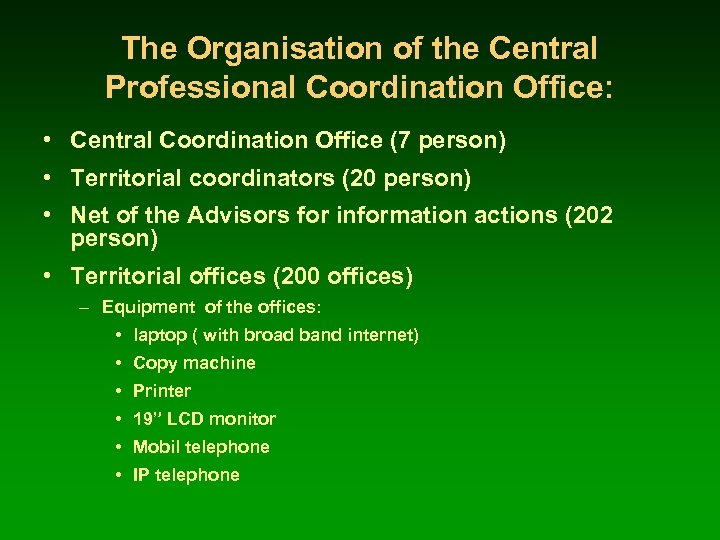
The Organisation of the Central Professional Coordination Office: • Central Coordination Office (7 person) • Territorial coordinators (20 person) • Net of the Advisors for information actions (202 person) • Territorial offices (200 offices) – Equipment of the offices: • laptop ( with broad band internet) • Copy machine • Printer • 19” LCD monitor • Mobil telephone • IP telephone
What do the Territorial Chambers of Agriculture?
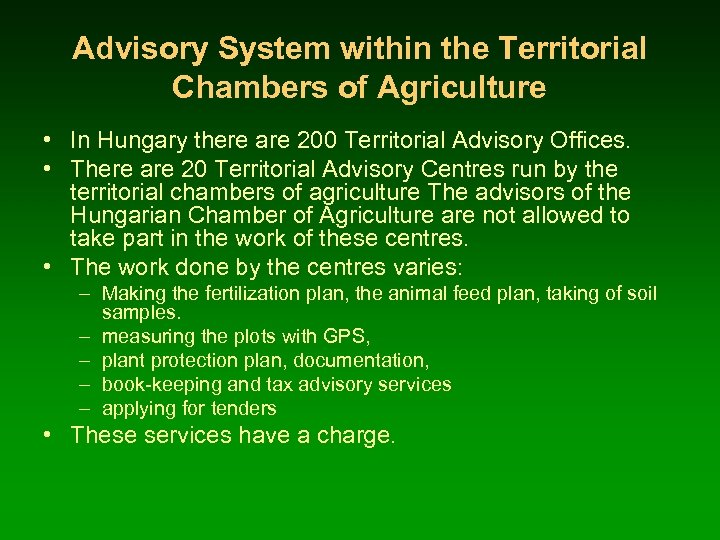
Advisory System within the Territorial Chambers of Agriculture • In Hungary there are 200 Territorial Advisory Offices. • There are 20 Territorial Advisory Centres run by the territorial chambers of agriculture The advisors of the Hungarian Chamber of Agriculture are not allowed to take part in the work of these centres. • The work done by the centres varies: – Making the fertilization plan, the animal feed plan, taking of soil samples. – measuring the plots with GPS, – plant protection plan, documentation, – book-keeping and tax advisory services – applying for tenders • These services have a charge.
Cooperation Possibilities
Cooperation Possibilities among the Chambers of Agricultures (Information, CC) • The realisation of cross compliance in the MS where it was applied before 2009 • To evaluate the most common problems, and the preparation method of the new member states. • The study of the methodology of the information of the farmers • The preparation of the Check List of the requirements of Cross Compliance • Experience exchange of the electronical applications.
Cooperation Possibilities among the Chambers of Agricultures (Advisors) • The practice of getting the farmers into the advisory system • The mutual study of the advisory work • The practice of the personal CC advise in the old member states • Advise given in electronic form
The Hungarian Chamber of Agriculture is member of the following more important national bodies: • National Jury of Quality Award • National Council of Standards • National Council of Regional Development • Committee for the Development of Trade and Economy • Hungarian Accreditation Committee • Jury of Biological Funds • National Council of Accreditation • National Council of Statistics • National Council for Game Management • National Council of Vocational Training • EU Integration Council • Council of Agri-Economy • Council of Hungarian Economy …
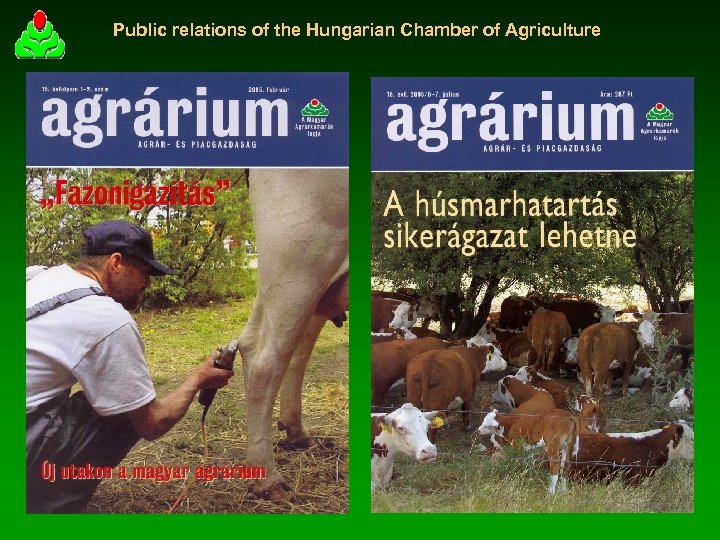
Public relations of the Hungarian Chamber of Agriculture
Hungarian agricultural advisory system
Farm Information Service in the Central Professional Coordination Office
Contents • • • Advisory system before FAS Setting up and the structure of FAS Advisory and information activities in Hungary in the framework of the Chambers of Agriculture • The Action Groups of the Farm Information Service
Advisory system before FAS • State-supported agricultural advisory activity was regulated only • Legal regulation on the List of Advisors • Legal regulation on subsidizing the advisory services • Structure of the advisory system – National Advisory Centre – Regional Advisory Centres (7) – Professional Centres (23 research institutes) – Service providers (mostly private enterpreneurs, some research or educational institutes, few companies employing registered advisors) • Ways of providing advice (one-to-one on farm, group-advisory service, demonstration on farm)
Setting up FAS • Principles – Observing EU regulations – Relying on the existing advisory system as much as possible – A smooth and cost effective transition – Involve stakeholders in the process of setting up FAS • Steps of setting up FAS (2005 – 2007) – Discussion groups (experts from MARD, National and – – – Regional Advisory Centres) Legal regulation on the structure and functioning of FAS Selecting advisory bodies (Territorial Advisory Centres) Legal regulation on supporting farmers that use advisory services (28 th June 2007)
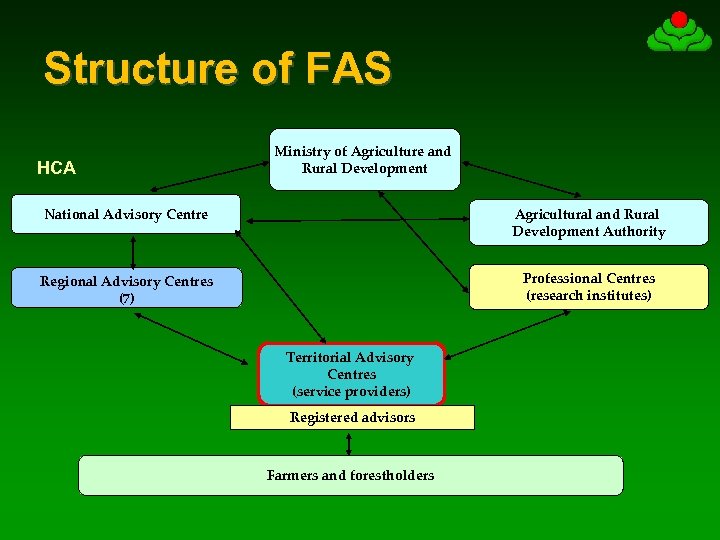
Structure of FAS HCA Ministry of Agriculture and Rural Development National Advisory Centre Agricultural and Rural Development Authority Regional Advisory Centres (7) Professional Centres (research institutes) Territorial Advisory Centres (service providers) Registered advisors Farmers and forestholders
Territorial Advisory Centres 83 organisations were selected via tender Main criteria: q professional experience and advisory activity referencies q no commercial interest q its advisory services covers all SMRs, GAEC and work safety in agriculture q possess the infrastructure necessary for advisory activity q operates advisory office(s) q providing advice to farmers via r registered advisors only Types of selected organisations • • • educational institutes county units of agricultural chamber research institutes advisory companies professional associations and consortiums of all the above
Advisory and information activities in Hungary in the framework of the Chambers of Agriculture • Hungarian Chamber of Agriculture: Free information is provided for the farmers about the CAP, the direct payments and about the subsidy possibilities in the framework of the New Hungarian Rural Development Program. • The Territorial Chambers of Agriculture: They are running the Territorial Advisory Centres, they give advise to the farmers based on the Council Regulation (EC) No 1698/2005 Article 24. • How to meet the requirements of cross-compliance, • occupational safety standards based on Community legislation • help farmers and forest holders to improve the overall performance of their holding
What are the tasks of the Hungarian Chamber of Agriculture?
FARM INFORMATION SERVICE IN THE CENTRAL PROFESSIONAL COORDINATION OFFICE
The Action Groups of the Farm Information Service • Overall regulatory knowledge provided for the farmers (subsidies, official requirements) • To draw the attention of the farmers to how to apply for subsidies, what kind of requirements have to be met by them when applying • Other know-how transfer (e. g. technological know-how)
Regulation know-how with the following content • Valid CAP measures (subsidies and other know-how) already announced • Mainly: • Single Area Payment Scheme and the directly connected area-based, supplementary national subsidies (Top-up) and the know-how of the electrical submission of requests, • Supplementary national subsidy based on the number of animals, • Direct subsidies allocated on historical base, • Non-economic information about the requirements of the Cross Compliance,
Regulation know-how with the following content • General, non-economic information about the requirements of the EU subsidies (simultaneously financed from different sources), • Rural development aimed, area and a number of animal based subsidies financed by the European Agricultural Fund for Rural Development, in consideration of the agri-environmental measures, • Modernisation of agricultural holdings, • Use of advisory services, advisory services • Aforestation of agricultural land
The main elements of the measures q. The aim of the measure, the conditions of involvement, (eligibility and selection criteria, requirements) q. The base of the subsidy and it’s measure, q. Misappropriation of the condition measures and it’s legal consequences, q. Certain issue of the process connected to the measure and it’s prospective time schedule (the requirements of the beneficiaries control, monitoring etc. )
Guidance and information provided in regard the participation Ø Information on: qthe timetable, deadline related to the measures, qthe deadlines of the related commitments, the commitment features, and the content, qthe difficulties and failures regarding to the participation process of the measure, methods dealing with the difficulties of interpretation, qmethods dealing with frequently arising failures, qfurther, detailed, specific knowledge, qgeneral information on the ongoing process!
Guidance and information provided in regard the participation Ø Providing free information material on the regulations (common- and national law, formerly announced drafts), communiqué/publications by the governing authority and by the Agricultural and Rural Development Authority. Ø Managing the prints q. Providing free prints and electrical access for the filling in q. Providing free guidelines, explanation, and assistance for the filling in Ø Further know-how transfer: q. Relating to the agricultural production, financing, marketing, diversification, research and innovation
Forms of realization Information provided in a unique customer service: • The Customer Service Office provides free of charge advise in 16 hours a week; • Additional affiliated customer services are provided at ü the local government; ü at the farms; ü as information session for a group. • Economic-specific advising does not belong to the scope of the duties (as advise about specific pest control, or soil planning in the frame of Nitrate regulation etc. – Territorial Advisory Centres)
Forms of realization • Information materials: Information materials Ø Information materials i. a. : booklets, specific brochures, publications, are made available at the Customer Service Offices • Active information activities: Ø Broad coverage through electrical and printed media, in all forms (daily, weekly, monthly, professional papers, television, and radio) § Operating and updating thematic web sites: thematic web sites § www. agrarkamara. hu § www. umvp. agrarkamara. hu
The Organisation of the Central Professional Coordination Office • Central Coordination Office (7 person) • Territorial coordinators (20 person) • Net of the Advisors for information actions (202 person) • Territorial offices (200 offices) – Equipment of the offices: • laptop ( with broad band internet) • Copy machine • Printer • 19” LCD monitor • Mobil telephone • IP telephone
The tasks of the Territorial Chambers of Agriculture
Advisory System within the Territorial Chambers of Agriculture • There are 83 Territorial Advisory Centres in Hungary. • There are 20 Territorial Advisory Centres run by the Territorial Chambers of Agriculture The advisors of the Hungarian Chamber of Agriculture are not allowed to take part in the work of these centres. • The work done by the centres varies: – Making the fertilization plan, the animal feed plan, taking soil samples. – measuring the plots with GPS, – plant protection plan, documentation, – book-keeping and tax advisory services – applying for tenders • These services have a charge.
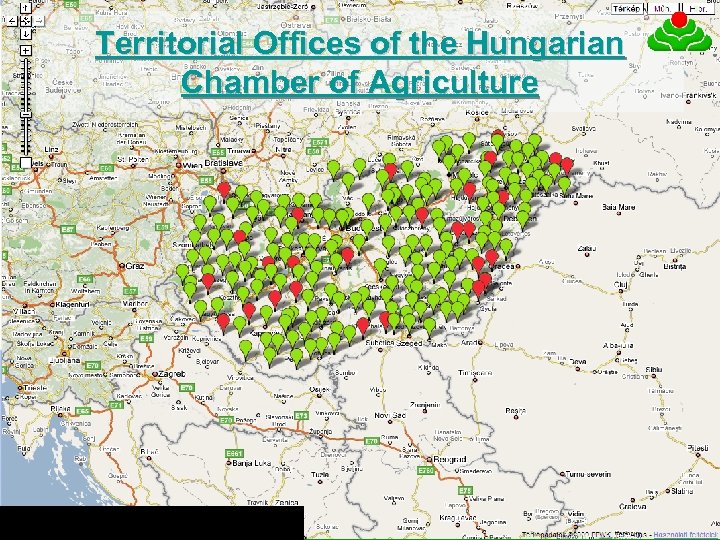
Territorial Offices of the Hungarian Chamber of Agriculture SOURCE: GOOGLEMAP

Call-Center Service q Advising through blue number (local access number) q Free measure-specific information via e-mail
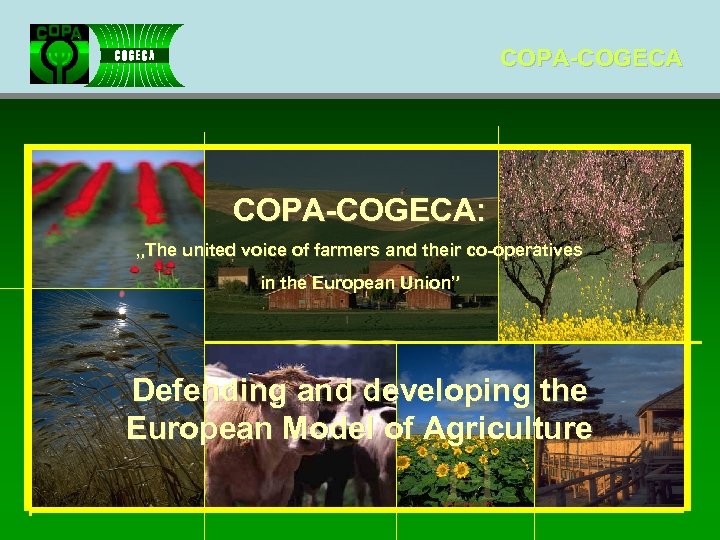
COPA-COGECA: „The united voice of farmers and their co-operatives in the European Union” Defending and developing the European Model of Agriculture
COPA-COGECA 1. What is COPA-COGECA?
COPA-COGECA COPA = Committee of Professional Agricultural Organisations in the European Union COGECA = General Confederation of Agricultural Cooperatives in the European Union
What is COPA-COGECA ? … 47 years of experience 1958 Creation of COPA 1959 Creation of COGECA 1962 Joint Secretariat
What is COPA-COGECA ? … two strong organisations § COPA-COGECA represents 15 million people on EU farm holdings either full-time or part-time working § and more than 40, 000 cooperatives § one of the biggest and most active interest representations in Brussels
What is COPA-COGECA ? … two strong organisations COGECA, now called the “General Confederation of Agricultural Cooperatives in the European Union”, currently represents the general and specific interests of some 40, 000 farmers’ cooperatives employing some 660, 000 people and with a global annual turnover in excess of three hundred billion euros throughout the enlarged Europe.
COPA-COGECA COPA: European agricultural union The Treaty of Rome establishing the European Economic Community signed on 25 March 1957 already contained the most important framework provisions of the Common Agricultural Policy (CAP). The relationship between the Community authorities and the representatives of the agricultural sector was left open by the Treaty, but the Commission expressed its desire for close cooperation at an early stage and invited representatives of agricultural organisations to attend the 1958 Stresa Conference as observers. Farmers themselves were convinced of the importance of the Community for their sector, and on 6 September 1958, the first European representative organisation, COPA, was created. One year later, on 24 September 1959, the agricultural cooperatives of the European Community created their European umbrella organisation, COGECA (General Confederation of Agricultural Cooperatives). COPA’s Secretariat was established in Brussels on 1 April 1959, merging with that of COGECA on 1 December 1962.
COPA-COGECA COPA: The force of European farmers When COPA (Committee of Professional Agricultural Organisations) first started out it had 13 member organisations from then six Member States. Today COPA is made up of 60 organisations from the countries of the European Union and 36 partner organisations from other European countries such as Iceland, Norway, Switzerland Turkey. This broad membership allows COPA to represent both the general and specific interests of farmers in the European Union. Since its inception, COPA has been recognised by the Community authorities as the organisation speaking on behalf of the European agricultural sector as a whole. COPA: Defence and development of the European model of multifunctional and sustainable agriculture
COPA-COGECA The objectives of COPA are: §to examine any matters related to the development of the Common Agricultural Policy §to represent the interests of the agricultural sector as a whole §to seek solutions which are of common interest, and §to maintain and develop relations with the Community authorities and with any other representative organisations or social partners established at European level.
COPA-COGECA COPA: An advisory, decision making and representative process The working structures of COPA are determined by three basic ideas: §to enable representatives of the European Union from the various agricultural production sectors and areas to discuss matters concerning their respective sector or area and to suggest solutions to the problems posed §to coordinate work in the overall context of agriculture, agricultural policy and policy in general §to represent all sectors and areas together.
COPA-COGECA In response, the first European organisation representing farmers, COPA (Committee of Professional Agricultural Organisations), was created on 6 September 1958. Shortly after, on 24 September 1959, the national agricultural cooperative organisations created their European umbrella organisation – COGECA (General Committee for Agricultural Cooperation in the European Union) – which also includes fisheries cooperatives. COGECA’ s Secretariat merged with that of COPA on 1 December 1962. When COGECA was created it was made up of 6 members. Since then, it has been enlarged by almost six and now has 35 full members and 4 affiliated members from the EU. COGECA also has 36 partner members. In line with the recent European Union enlargements, COPA and COGECA have together further reinforced their position as Europe’s strongest farming representative organisations.
COPA-COGECA Development of the European agricultural cooperative organisations COGECA’s most important objectives are to: § represent the general and specific interests of European agricultural, forestry, fisheries and agri-food co-operatives § promote the role of agricultural, forestry, fisheries and agri-food cooperatives § provide a platform for member organisations and cooperatives to hold political discussions and exchange views on policy issues § seek solutions on important issues of common interest and promote them facilitate and coordinate links between its members and its members’ offices in Brussels § promote discussions and exchanges of views with the Committee of Professional Agricultural Organisations in the European Union (COPA) in particular, as well as with other representative organisations at EU and international level.
COPA-COGECA Development of the European agricultural cooperative organisations COGECA as a lobby and a platform for inter-cooperative relationships COGECA is involved in shaping and further developing all Community policies that create important framework conditions for cooperative enterprises. COGECA fosters cooperation between cooperative enterprises at European level.
COPA-COGECA Cooperatives as joint enterprises of farmers as an opportunity for the future: Cooperatives came about among difficult economic and social circumstances in the 19 th century as an organisational form which could alleviate farmers’ structural deficiencies when operating as small independent entities. Cooperatives exist today in all EU Member States as well as in other European countries. Cooperatives are both associations of individual people and economic enterprises at the same time. Cooperatives are the extension of farming as they enable farmers to concentrate their power for the purpose of supplying inputs and material and collecting, processing and marketing members’ produce.
COPA-COGECA Cooperatives as joint enterprises of farmers as an opportunity for the future: Cooperatives’s activities are founded on the principles of economic democracy, transparency and solidarity among themselves and with their local rural community. Agricultural cooperatives play a vital role in adjusting their members’ production to the requirements of consumers and improving their economic effectiveness and positioning in the marketplace. Agricultural cooperatives actively contribute to guaranteeing environmentallyfriendly quality products that are made available throughout the whole supply chain.
COPA-COGECA Cooperatives as joint enterprises of farmers as an opportunity for the future: Agricultural cooperatives are important rural development operators, actively contributing to economic viability in rural areas, including less-favoured regions, by forming and operating the essential information, economic and service-related rural networks, which constitute the backbone of the European social landscape. They are therefore an important source of direct and indirect employment and of economic growth, thus helping to attain the goals of the Lisbon Strategy. Agricultural cooperatives in the EU are an important socio-economic element in the economy and society at large: § Over 50 % share in the supply of agricultural inputs § Over 60 % share in the collection, processing and marketing of agricultural products
COPA-COGECA’s tasks § To defend the general interests of agriculture § To maintain and develop relations with EU-institutions as well as with representative organisations at EU level § To look for solutions that are in the common interest
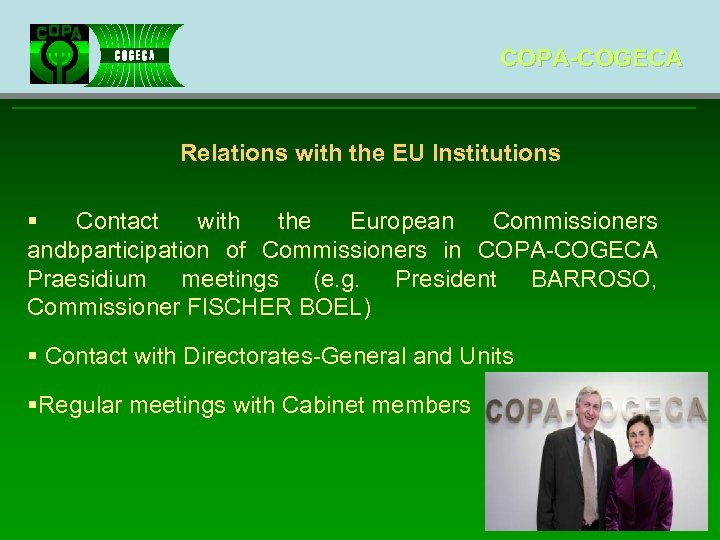
COPA-COGECA Relations with the EU Institutions § Contact with the European Commissioners andbparticipation of Commissioners in COPA-COGECA Praesidium meetings (e. g. President BARROSO, Commissioner FISCHER BOEL) § Contact with Directorates-General and Units §Regular meetings with Cabinet members
What is COPA-COGECA ? COPA-COGECA: some figures § COPA-COGECA has 73 Member Organisations from all 25 EU Member States § among which 34 Organisations from the new Member States § A joint Secretariat in Brussels with a staff of approx. 50 § 5 languages: ENG, FR, DE, ESP, IT
Internal organisational structure 2. How is COPA-COGECA organised?
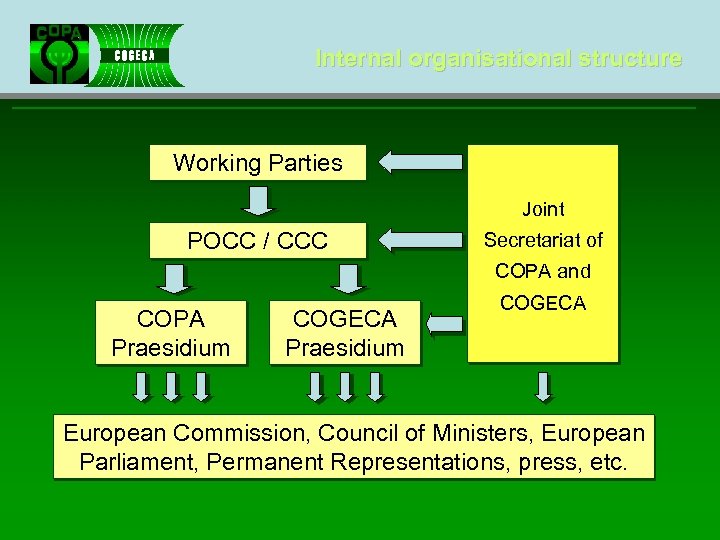
Internal organisational structure Working Parties Joint POCC / CCC Secretariat of COPA and COPA Praesidium COGECA European Commission, Council of Ministers, European Parliament, Permanent Representations, press, etc.
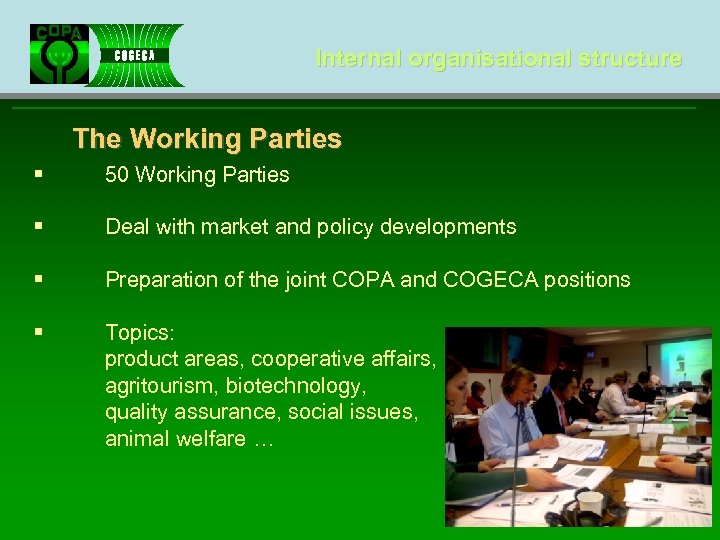
Internal organisational structure The Working Parties § 50 Working Parties § Deal with market and policy developments § Preparation of the joint COPA and COGECA positions § Topics: product areas, cooperative affairs, agritourism, biotechnology, quality assurance, social issues, animal welfare …
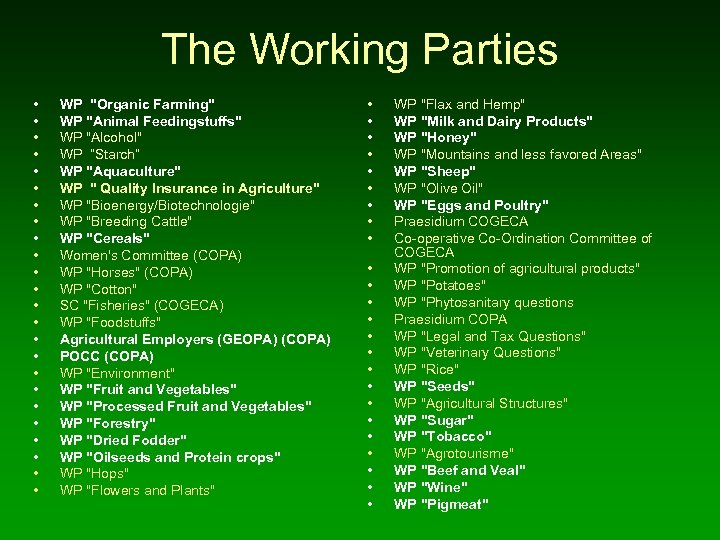
The Working Parties • • • • • • WP "Organic Farming" WP "Animal Feedingstuffs" WP "Alcohol" WP “Starch” WP "Aquaculture" WP " Quality Insurance in Agriculture" WP "Bioenergy/Biotechnologie" WP "Breeding Cattle" WP "Cereals" Women's Committee (COPA) WP "Horses" (COPA) WP "Cotton" SC "Fisheries" (COGECA) WP "Foodstuffs" Agricultural Employers (GEOPA) (COPA) POCC (COPA) WP "Environment" WP "Fruit and Vegetables" WP "Processed Fruit and Vegetables" WP "Forestry" WP "Dried Fodder" WP "Oilseeds and Protein crops" WP "Hops" WP "Flowers and Plants" • • • • • • WP "Flax and Hemp" WP "Milk and Dairy Products" WP "Honey" WP "Mountains and less favored Areas" WP "Sheep" WP "Olive Oil" WP "Eggs and Poultry" Praesidium COGECA Co-operative Co-Ordination Committee of COGECA WP "Promotion of agricultural products" WP "Potatoes" WP "Phytosanitary questions Praesidium COPA WP "Legal and Tax Questions" WP "Veterinary Questions" WP "Rice" WP "Seeds" WP "Agricultural Structures" WP "Sugar" WP "Tobacco" WP "Agrotourisme" WP "Beef and Veal" WP "Wine" WP "Pigmeat"
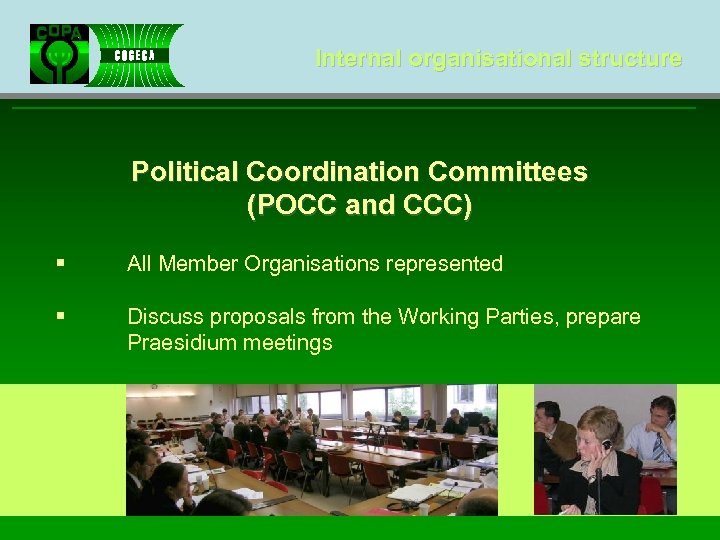
Internal organisational structure Political Coordination Committees (POCC and CCC) § All Member Organisations represented § Discuss proposals from the Working Parties, prepare Praesidium meetings
Internal organisational structure The Praesidium § Composed of the Presidents of the national Member Organisations (73) § COPA and COGECA each have a Praesidium, a Presidency and a President:
Relations with the EU Institutions 3. How does COPA-COGECA lobby on behalf of farmers and their cooperatives?
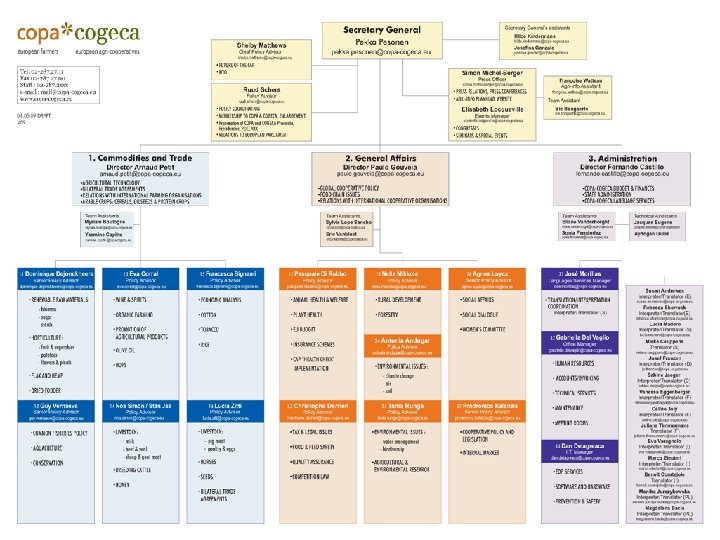
Internal organisational structure The Secretariat § In charge of the seamless and efficient running of the organisation § Secretary-General: Franz-Josef FEITER § Approx. 50 staff members § 15 interpreters and translators 4 Departments: Commodities Cooperatives General Affairs Administration
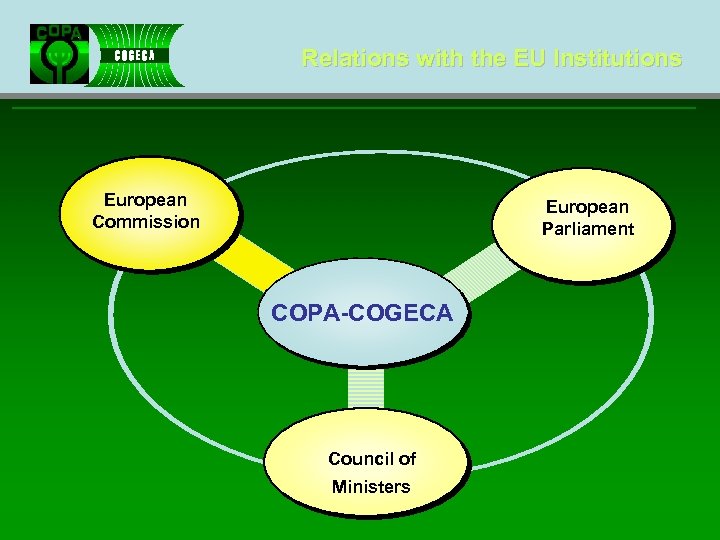
Relations with the EU Institutions European Commission European Parliament COPA-COGECA Council of Ministers
Relations with the European Commission The Advisory Groups at the Commission § Regular and active participation of COPA-COGECA representatives in these Advisory Group meetings § Presentation of COPA-COGECA position on the basis of the results of the Working Party § COPA-COGECA representatives are Chairmen of the Commission Advisory Groups
The Advisory Groups of DG AGRI • AG on Cereals, Oilseeds and Proteins – Version Cereals – Version Oilseeds & Proteins • • • • AG Dried Fodder AG Starch AG Seeds AG on Sugar AG on Rice AG on Energy and Non-Food Crops AG on Cotton AG on Flax & Hemp AG on Milk AG on Beef AG on Sheepmeat and Goatmeat AG on Pigmeat AG on Poultrymeat and Eggs • • AG on Beekeeping AG on Fruit and Vegetables – Version Fresh – Version Processed • • • • AG on Flowers and Ornamental Plants AG on Wine-growing AG on Spirit Drinks AG on Olives and Derived Products AG on Hops AG on Tobacco AG on Forestry and Cork AG on Quality of Agric Production AG on Organic Farming AG on Promotion of Agricultural Products AG on Rural Development AG on Women in Rural Areas AG on Agriculture & Environment
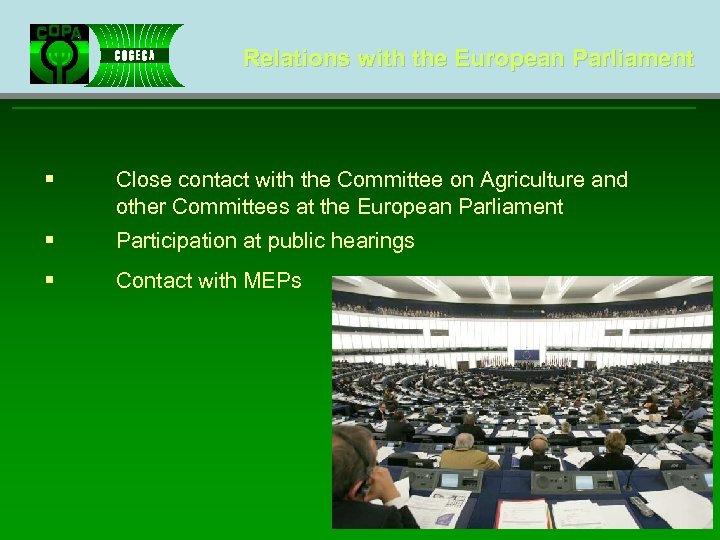
Relations with the European Parliament § Close contact with the Committee on Agriculture and other Committees at the European Parliament § Participation at public hearings § Contact with MEPs
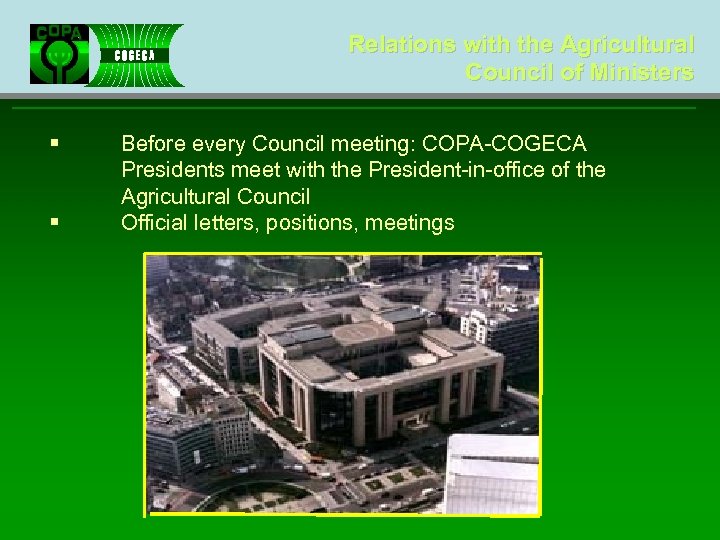
Relations with the Agricultural Council of Ministers § § Before every Council meeting: COPA-COGECA Presidents meet with the President-in-office of the Agricultural Council Official letters, positions, meetings
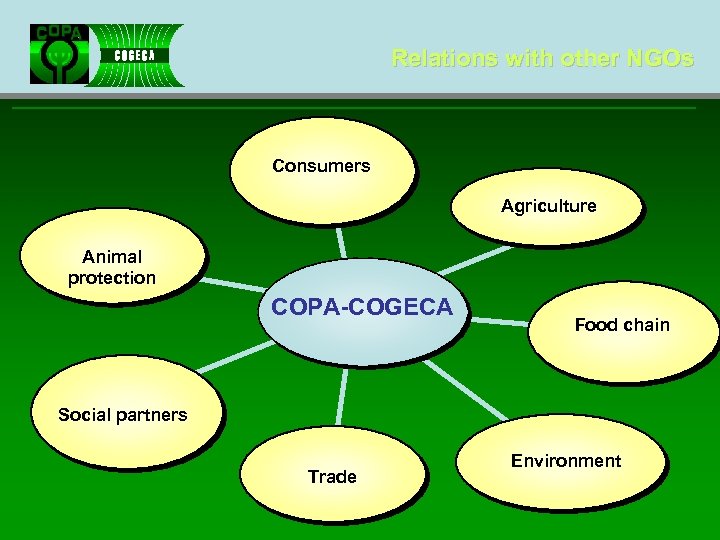
Relations with other NGOs Consumers Agriculture Animal protection COPA-COGECA Food chain Social partners Trade Environment
Current issues in 2006 Products and Markets § Valorisation of raw materials; § Reforme of CMO of wine; § Reforme of CMO of Fruits and vegetables; § New regulation for organic Farming; § Open a reflexion on rebalancing the power in food chain industry
Current issues in 2006 horizontal issues § CAP simplification; § WTO negociation; § Health check on CAP reformed in 2002; § Mid-term review on Financial perspectives 2007 -2013 and CAP reform
COPA-COGECA PR instruments § Regular contact with the press, press releases and press conferences § Comprehensive website: www. copa cogeca. eu § Briefings and panels of experts § AGRI INFO - Intranet for members
COPA-COGECA Basic rules for successful lobbying 1. Build and maintain a communication and information network 2. Pinpoint new issues and developments as fast as possible 3. Develop a common position 4. Set up an action plan and schedule and identify key people
COPA-COGECA National coordination § Is responsible for compiling the national positions about the issues discussed in COPA-COGECA. § Finds the experts to working parties, § Organises and follows the communication between COPA -COGECA secretariate and experts, § Distributes the info from Brussels to the COPA-COGECA members organsiations in the home country. The info is distributed by mailing lists, newsletters, rural newspapers and magazins and special events (seminars, workshops, round tables).
COPA-COGECA Permanent representative § Represents position of his country in working parties; § Takes parts in various events, § Communicates and negotiates with representatives form other member states, ataches of agriculture and members of EP; § Writes weekly reports and articles for national newspapers; § Informs employer organizations about the actualities and vice versa.
COPA-COGECA Problems of representation for new member states § The financing of international project is provided by government – therefore opinion cannot contradict governmental one; § Financing is too small; § Farmers and organizations are showing too little interest for international actualities – they are too concerned with a national laws; § Farmers care more about everyday issues than about the future.
Thank you for your attention! agrarkamara. hu www. copa-cogeca. be
Скачать презентацию HUNGARIAN CHAMBER OF AGRICULTURE The Hungarian Chamber of
05fe42f2e87c87817a7b4768ed6cd0ac.ppt