 Скачать презентацию Humanitarian Assistance in Peacekeeping Operations Roy Brennen Center
6b62c87e27a3c548f14d90a7c6c7e942.ppt
- Количество слайдов: 20



Humanitarian Assistance in Peacekeeping Operations Roy Brennen Center of Excellence Roy. brennen@coe-dmha. org
Objectives • Provide overview of the “NGO community” • Provide insight into NGO planning process and program cycles. • Identify selected coordination mechanisms.
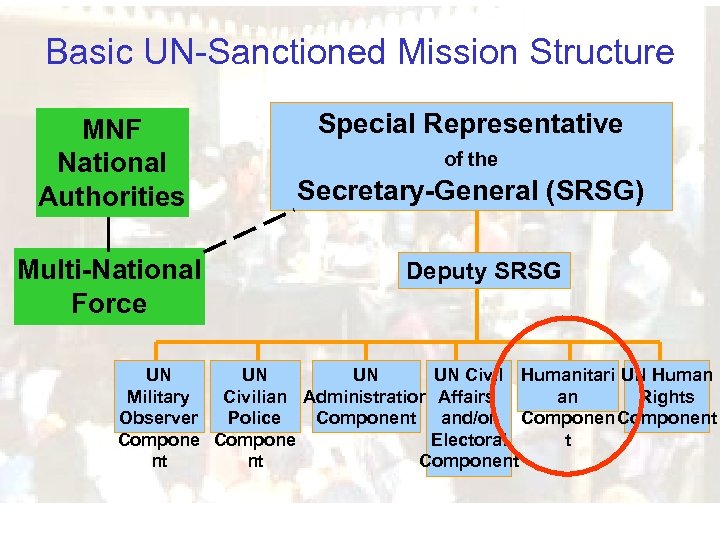
Basic UN-Sanctioned Mission Structure MNF National Authorities Multi-National Force Special Representative of the Secretary-General (SRSG) Deputy SRSG UN UN Civil Humanitari UN Human Military Civilian Administration Affairs an Rights Observer Police Component and/or Component Compone Electoral t nt nt Component
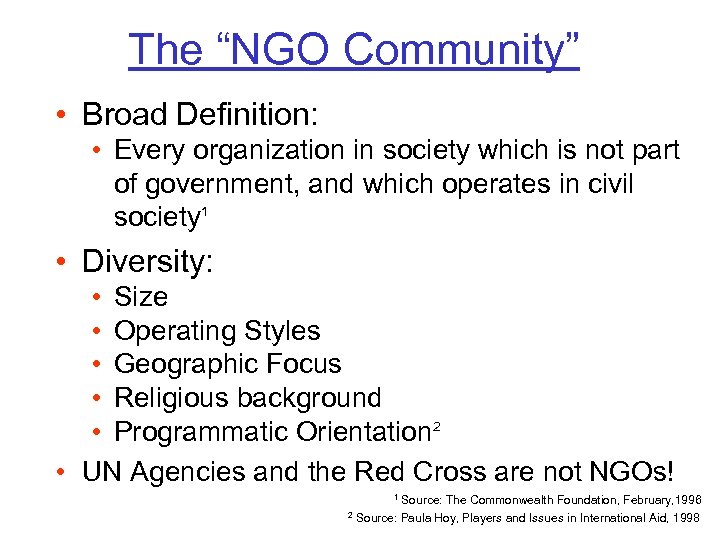
The “NGO Community” • Broad Definition: • Every organization in society which is not part of government, and which operates in civil society 1 • Diversity: • Size • Operating Styles • Geographic Focus • Religious background • Programmatic Orientation 2 • UN Agencies and the Red Cross are not NGOs! Source: The Commonwealth Foundation, February, 1996 2 Source: Paula Hoy, Players and Issues in International Aid, 1998 1
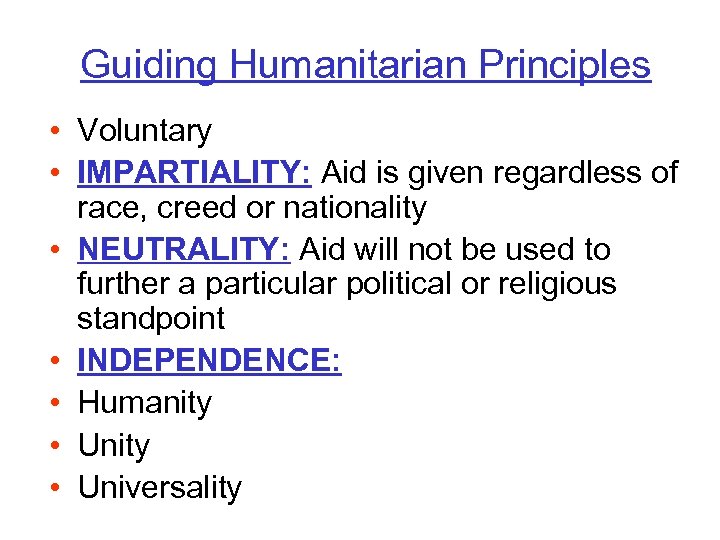
Guiding Humanitarian Principles • Voluntary • IMPARTIALITY: Aid is given regardless of race, creed or nationality • NEUTRALITY: Aid will not be used to further a particular political or religious standpoint • INDEPENDENCE: • Humanity • Universality
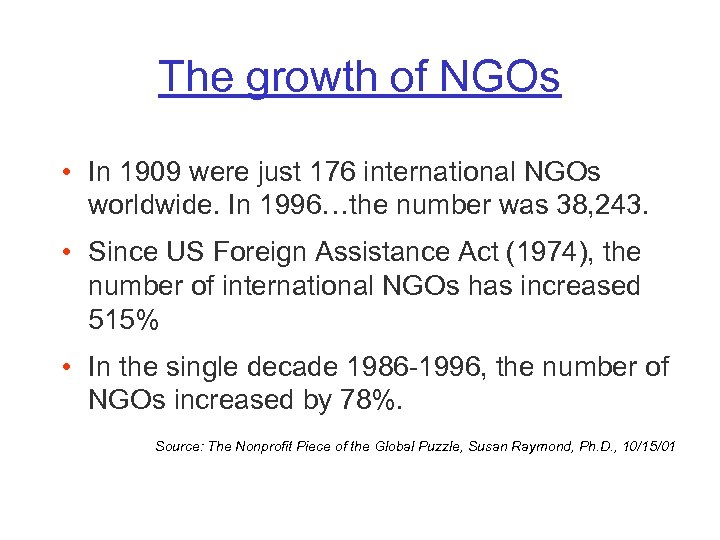
The growth of NGOs • In 1909 were just 176 international NGOs worldwide. In 1996…the number was 38, 243. • Since US Foreign Assistance Act (1974), the number of international NGOs has increased 515% • In the single decade 1986 -1996, the number of NGOs increased by 78%. Source: The Nonprofit Piece of the Global Puzzle, Susan Raymond, Ph. D. , 10/15/01
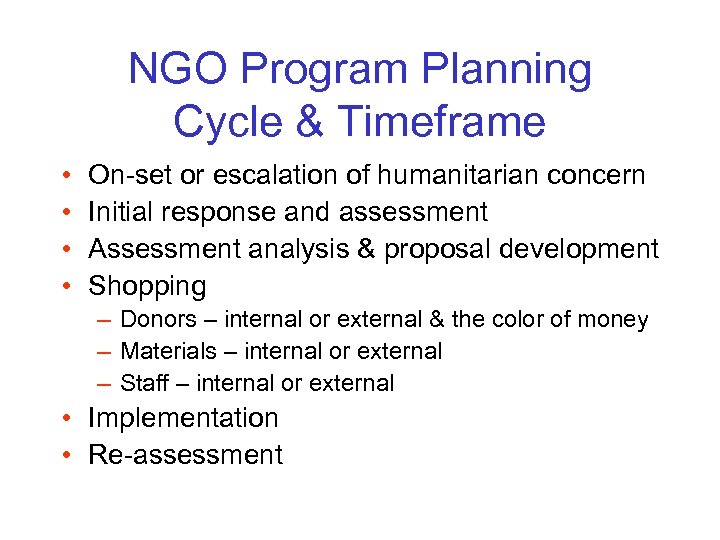
NGO Program Planning Cycle & Timeframe • • On-set or escalation of humanitarian concern Initial response and assessment Assessment analysis & proposal development Shopping – Donors – internal or external & the color of money – Materials – internal or external – Staff – internal or external • Implementation • Re-assessment
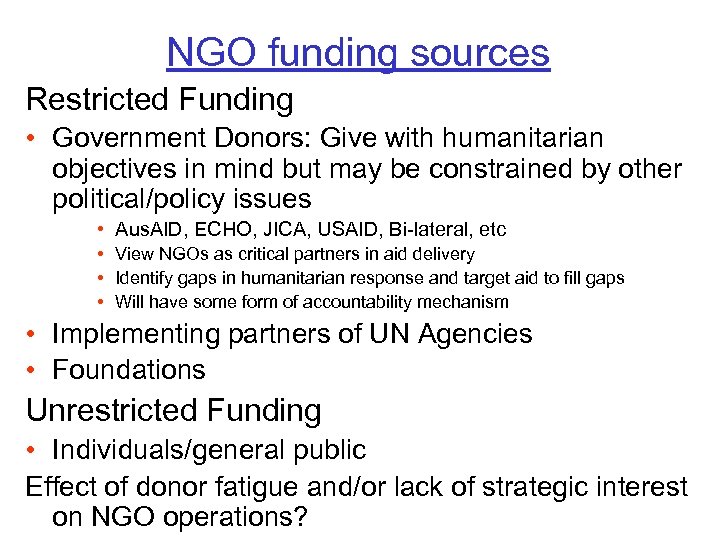
NGO funding sources Restricted Funding • Government Donors: Give with humanitarian objectives in mind but may be constrained by other political/policy issues • Aus. AID, ECHO, JICA, USAID, Bi-lateral, etc • View NGOs as critical partners in aid delivery • Identify gaps in humanitarian response and target aid to fill gaps • Will have some form of accountability mechanism • Implementing partners of UN Agencies • Foundations Unrestricted Funding • Individuals/general public Effect of donor fatigue and/or lack of strategic interest on NGO operations?
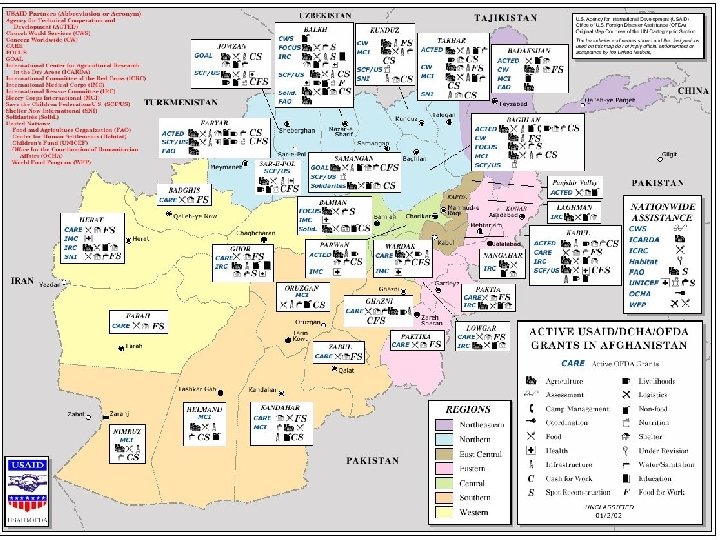
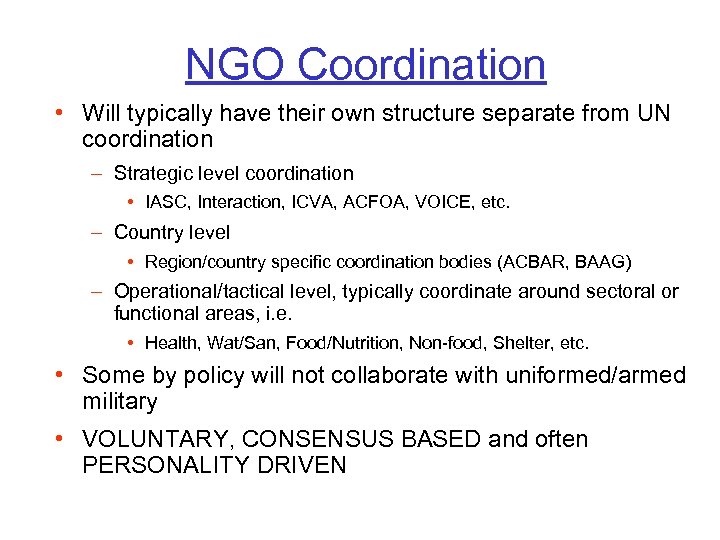
NGO Coordination • Will typically have their own structure separate from UN coordination – Strategic level coordination • IASC, Interaction, ICVA, ACFOA, VOICE, etc. – Country level • Region/country specific coordination bodies (ACBAR, BAAG) – Operational/tactical level, typically coordinate around sectoral or functional areas, i. e. • Health, Wat/San, Food/Nutrition, Non-food, Shelter, etc. • Some by policy will not collaborate with uniformed/armed military • VOLUNTARY, CONSENSUS BASED and often PERSONALITY DRIVEN
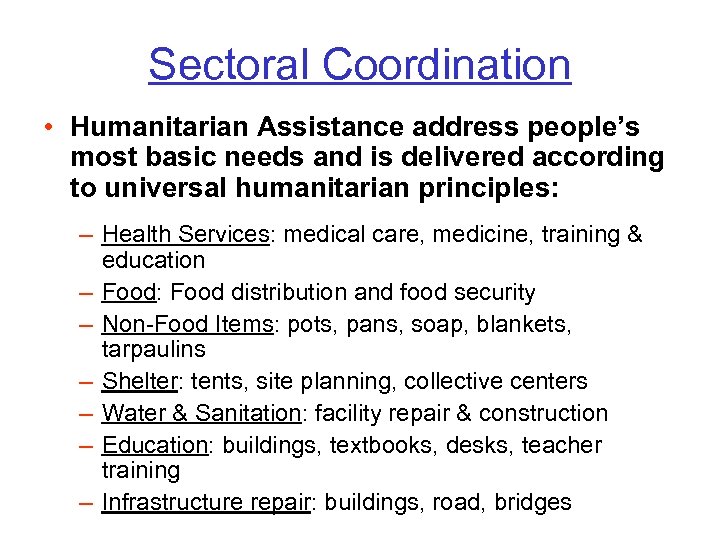
Sectoral Coordination • Humanitarian Assistance address people’s most basic needs and is delivered according to universal humanitarian principles: – Health Services: medical care, medicine, training & education – Food: Food distribution and food security – Non-Food Items: pots, pans, soap, blankets, tarpaulins – Shelter: tents, site planning, collective centers – Water & Sanitation: facility repair & construction – Education: buildings, textbooks, desks, teacher training – Infrastructure repair: buildings, road, bridges
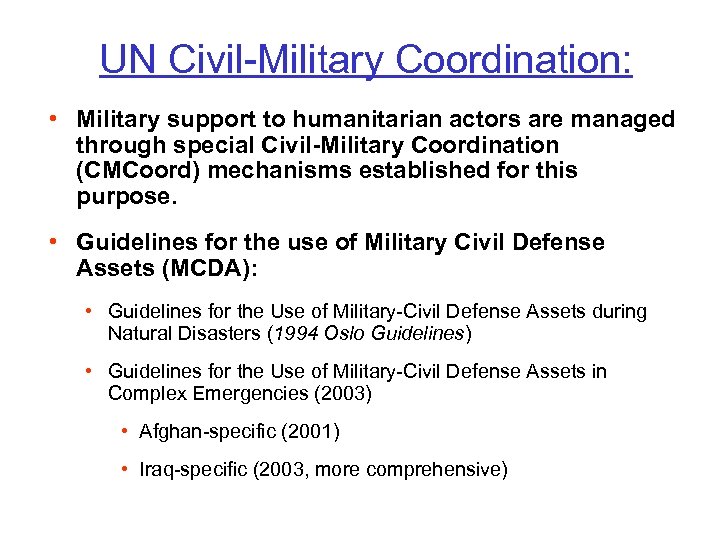
UN Civil-Military Coordination: • Military support to humanitarian actors are managed through special Civil-Military Coordination (CMCoord) mechanisms established for this purpose. • Guidelines for the use of Military Civil Defense Assets (MCDA): • Guidelines for the Use of Military-Civil Defense Assets during Natural Disasters (1994 Oslo Guidelines) • Guidelines for the Use of Military-Civil Defense Assets in Complex Emergencies (2003) • Afghan-specific (2001) • Iraq-specific (2003, more comprehensive)
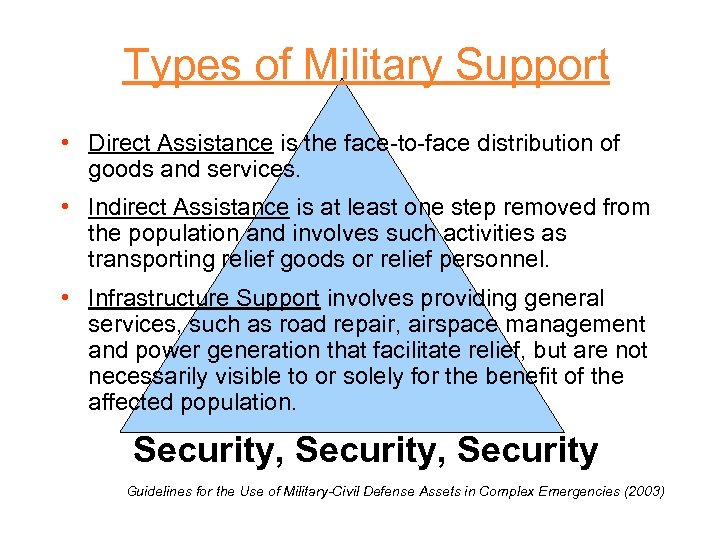
Types of Military Support • Direct Assistance is the face-to-face distribution of goods and services. • Indirect Assistance is at least one step removed from the population and involves such activities as transporting relief goods or relief personnel. • Infrastructure Support involves providing general services, such as road repair, airspace management and power generation that facilitate relief, but are not necessarily visible to or solely for the benefit of the affected population. Security, Security Guidelines for the Use of Military-Civil Defense Assets in Complex Emergencies (2003)
Military Civic Action and support to Civilian Humanitarian Operations
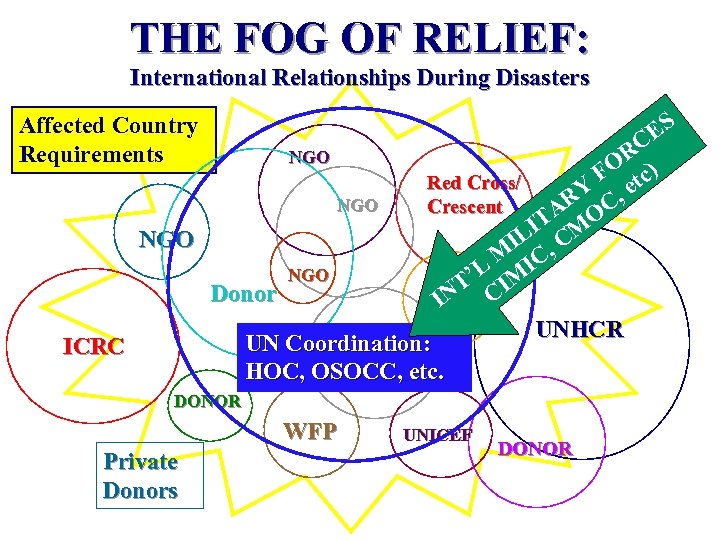
THE FOG OF RELIEF: International Relationships During Disasters Affected Country Requirements ES C OR c) F t Red Cross/ e RY C, NGO Crescent TA MO LI C NGO I M IC, L NGO T’ CIM Donor IN NGO UNHCR UN Coordination: ICRC NGO HOC, OSOCC, etc. NGO DONOR WFP Private Donors UNICEF DONOR
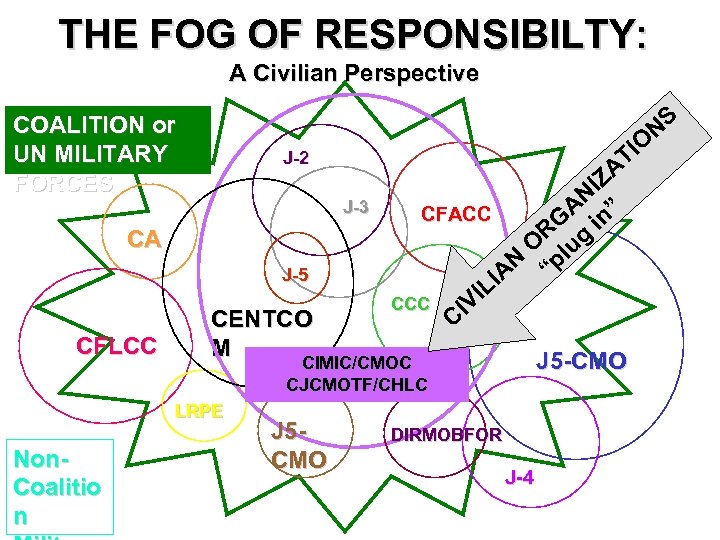
THE FOG OF RESPONSIBILTY: A Civilian Perspective NS COALITION or UN MILITARY FORCES J-3 CA J-5 CFLCC CENTCO M ZA NI ” A n CFACC RG g i O lu AN “p LI I CCC IV C J 5 -CMO CIMIC/CMOC CJCMOTF/CHLC LRPE Non. Coalitio n IO T J-2 J 5 CMO DIRMOBFOR J-4
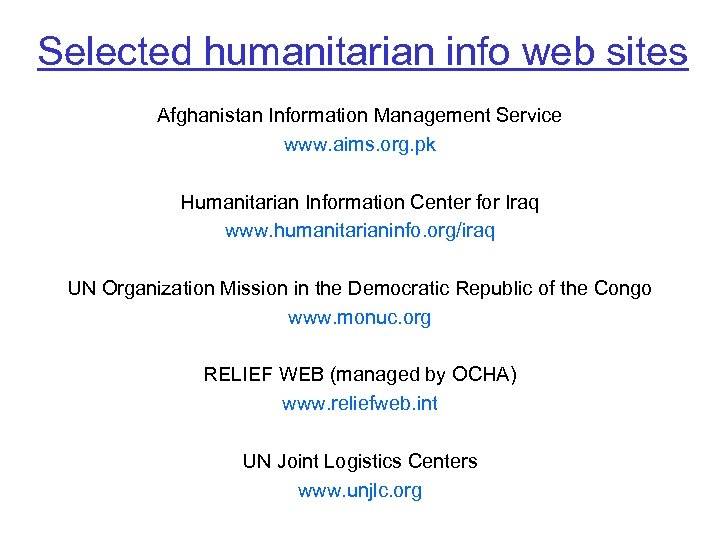
Selected humanitarian info web sites Afghanistan Information Management Service www. aims. org. pk Humanitarian Information Center for Iraq www. humanitarianinfo. org/iraq UN Organization Mission in the Democratic Republic of the Congo www. monuc. org RELIEF WEB (managed by OCHA) www. reliefweb. int UN Joint Logistics Centers www. unjlc. org
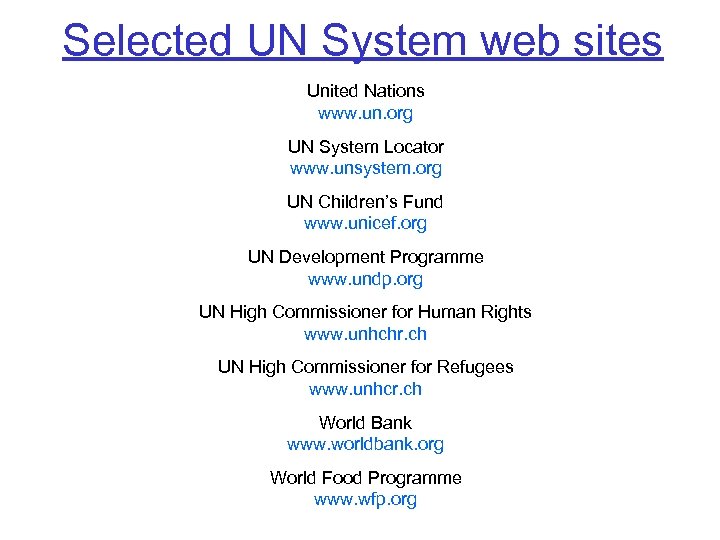
Selected UN System web sites United Nations www. un. org UN System Locator www. unsystem. org UN Children’s Fund www. unicef. org UN Development Programme www. undp. org UN High Commissioner for Human Rights www. unhchr. ch UN High Commissioner for Refugees www. unhcr. ch World Bank www. worldbank. org World Food Programme www. wfp. org
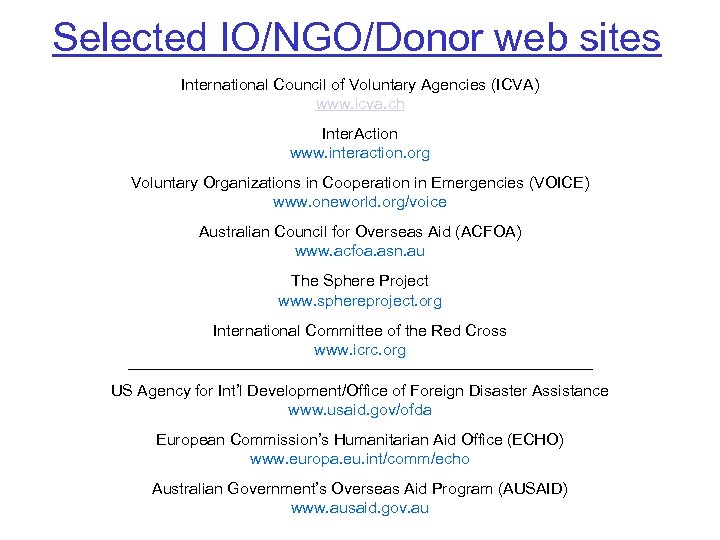
Selected IO/NGO/Donor web sites International Council of Voluntary Agencies (ICVA) www. icva. ch Inter. Action www. interaction. org Voluntary Organizations in Cooperation in Emergencies (VOICE) www. oneworld. org/voice Australian Council for Overseas Aid (ACFOA) www. acfoa. asn. au The Sphere Project www. sphereproject. org International Committee of the Red Cross www. icrc. org _______________________________________________ US Agency for Int’l Development/Office of Foreign Disaster Assistance www. usaid. gov/ofda European Commission’s Humanitarian Aid Office (ECHO) www. europa. eu. int/comm/echo Australian Government’s Overseas Aid Program (AUSAID) www. ausaid. gov. au

QUESTIONS
Скачать презентацию Humanitarian Assistance in Peacekeeping Operations Roy Brennen Center
6b62c87e27a3c548f14d90a7c6c7e942.ppt