


 Скачать презентацию HUMANE Winter School 2005 How to Organize for
67cebdf7c25d8ec97cf27be8dbdd8e62.ppt
- Количество слайдов: 21
 HUMANE Winter School 2005 How to Organize for High Quality Services: Shared Service Centres Prof. Dr. J. Strikwerda Business School – University of Amsterdam Nolan Norton Institute j. strikwerda@uva. nl 11 November 2005 16 -03 -05 J. Strikwerda
 Topics of this Key Note w What is a shared service centre? w How to organize shared service centres within the organization of a university? w The governance of shared service centres w What is quality of services? w Change management 16 -03 -05 J. Strikwerda 2
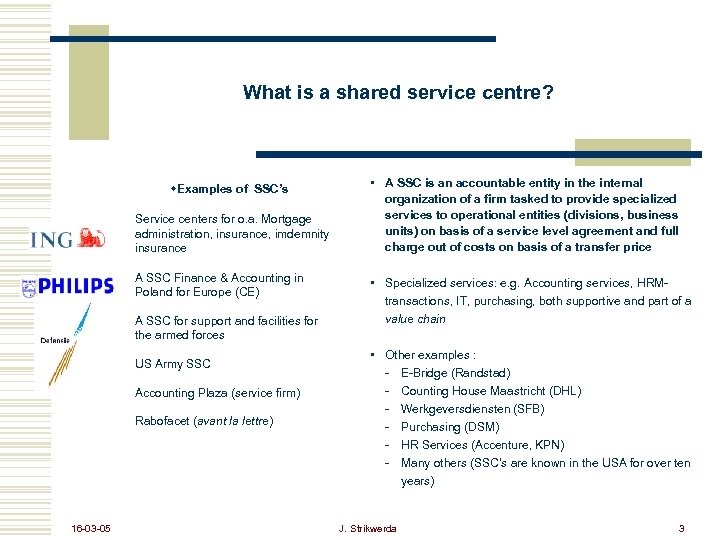 What is a shared service centre? w. Examples of SSC’s Service centers for o. a. Mortgage administration, insurance, imdemnity insurance A SSC Finance & Accounting in Poland for Europe (CE) A SSC for support and facilities for the armed forces US Army SSC Accounting Plaza (service firm) Rabofacet (avant la lettre) 16 -03 -05 • A SSC is an accountable entity in the internal organization of a firm tasked to provide specialized services to operational entities (divisions, business units) on basis of a service level agreement and full charge out of costs on basis of a transfer price • Specialized services: e. g. Accounting services, HRMtransactions, IT, purchasing, both supportive and part of a value chain • Other examples : - E-Bridge (Randstad) - Counting House Maastricht (DHL) - Werkgeversdiensten (SFB) - Purchasing (DSM) - HR Services (Accenture, KPN) - Many others (SSC’s are known in the USA for over ten years) J. Strikwerda 3
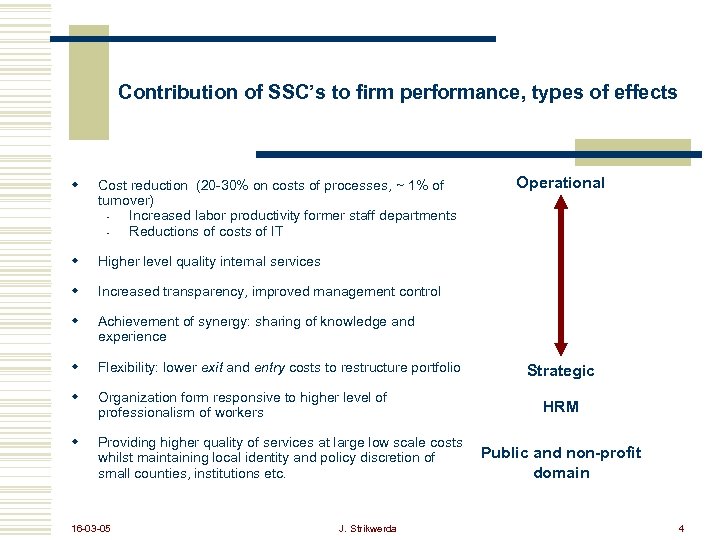 Contribution of SSC’s to firm performance, types of effects w Cost reduction (20 -30% on costs of processes, ~ 1% of turnover) Increased labor productivity former staff departments Reductions of costs of IT w Higher level quality internal services w Increased transparency, improved management control w Achievement of synergy: sharing of knowledge and experience w Flexibility: lower exit and entry costs to restructure portfolio w Organization form responsive to higher level of professionalism of workers w Providing higher quality of services at large low scale costs, whilst maintaining local identity and policy discretion of small counties, institutions etc. Operational 16 -03 -05 J. Strikwerda Strategic HRM Public and non-profit domain 4
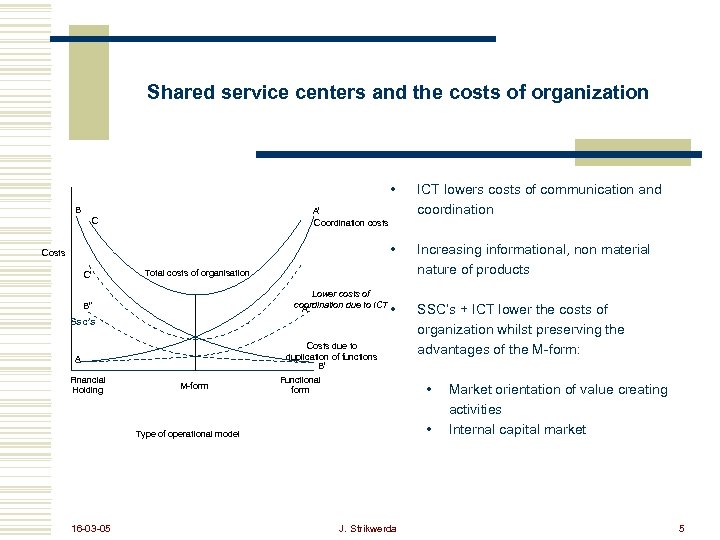 Shared service centers and the costs of organization • • B Costs • SSC’s + ICT lower the costs of organization whilst preserving the advantages of the M-form: Total costs of organisation Lower costs of coordination due to ICT A” B” Ssc’s Costs due to duplication of functions B’ A Financial Holding Increasing informational, non material nature of products A’ Coordination costs C C’ ICT lowers costs of communication and coordination M-form Functional form • • Type of operational model 16 -03 -05 J. Strikwerda Market orientation of value creating activities Internal capital market 5
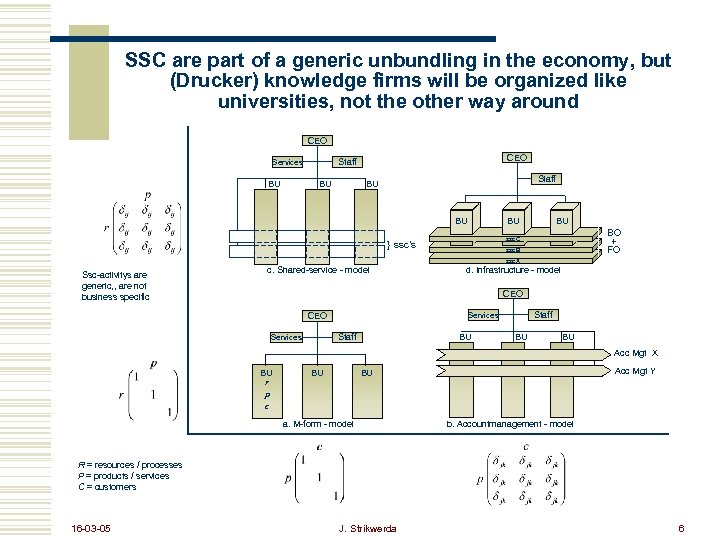 SSC are part of a generic unbundling in the economy, but (Drucker) knowledge firms will be organized like universities, not the other way around CEO BU CEO Staff Services BU Staff BU BU BO + FO ssc C } ssc’s ssc B ssc A Ssc-activitys are generic, , are not business specific c. Shared-service - model d. Infrastructure - model CEO BU Staff Services CEO BU BU Acc Mgt X BU r p c BU Acc Mgt Y BU a. M-form - model b. Accountmanagement - model R = resources / processes P = products / services C = customers 16 -03 -05 J. Strikwerda 6
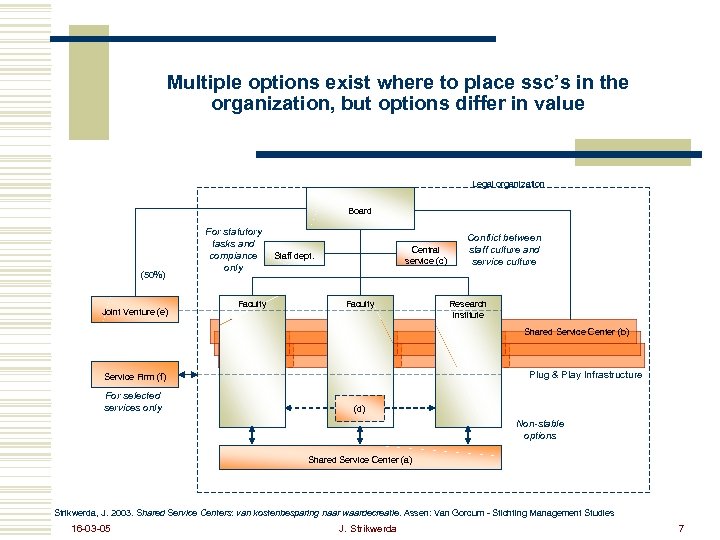 Multiple options exist where to place ssc’s in the organization, but options differ in value Legal organization Board (50%) Joint Venture (e) For statutory tasks and compiance only Faculty Central service (c) Staff dept. Faculty Conflict between staff culture and service culture Research Institute Shared Service Center (b) Plug & Play Infrastructure Service Firm (f) For selected services only (d) Non-stable options Shared Service Center (a) Strikwerda, J. 2003. Shared Service Centers: van kostenbesparing naar waardecreatie. Assen: Van Gorcum - Stichting Management Studies 16 -03 -05 J. Strikwerda 7
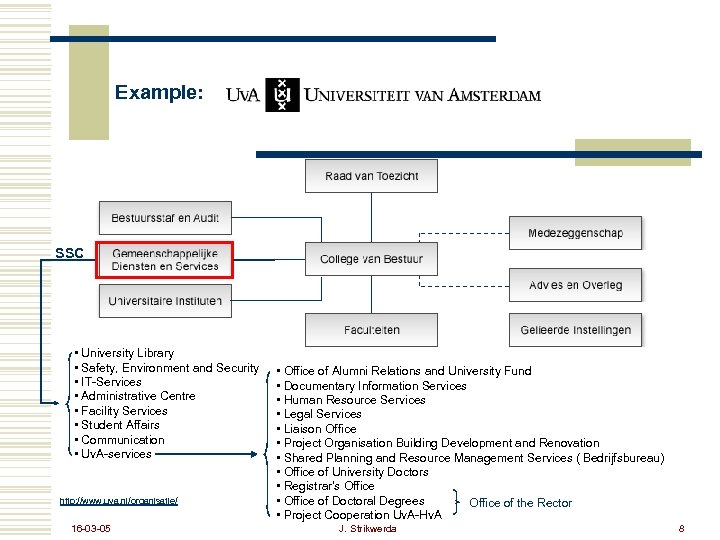 Example: SSC • University Library • Safety, Environment and Security • IT-Services • Administrative Centre • Facility Services • Student Affairs • Communication • Uv. A-services http: //www. uva. nl/organisatie/ 16 -03 -05 • Office of Alumni Relations and University Fund • Documentary Information Services • Human Resource Services • Legal Services • Liaison Office • Project Organisation Building Development and Renovation • Shared Planning and Resource Management Services ( Bedrijfsbureau) • Office of University Doctors • Registrar's Office • Office of Doctoral Degrees Office of the Rector • Project Cooperation Uv. A-Hv. A J. Strikwerda 8
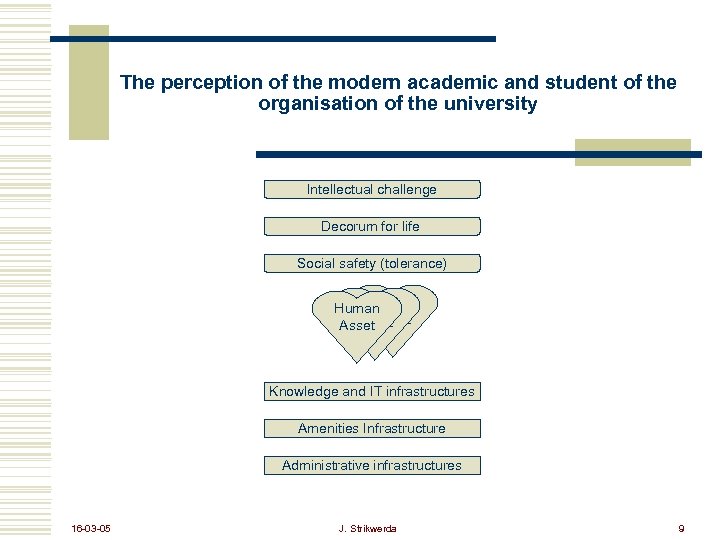 The perception of the modern academic and student of the organisation of the university Intellectual challenge Decorum for life Social safety (tolerance) Human Asset Knowledge and IT infrastructures Amenities Infrastructure Administrative infrastructures 16 -03 -05 J. Strikwerda 9
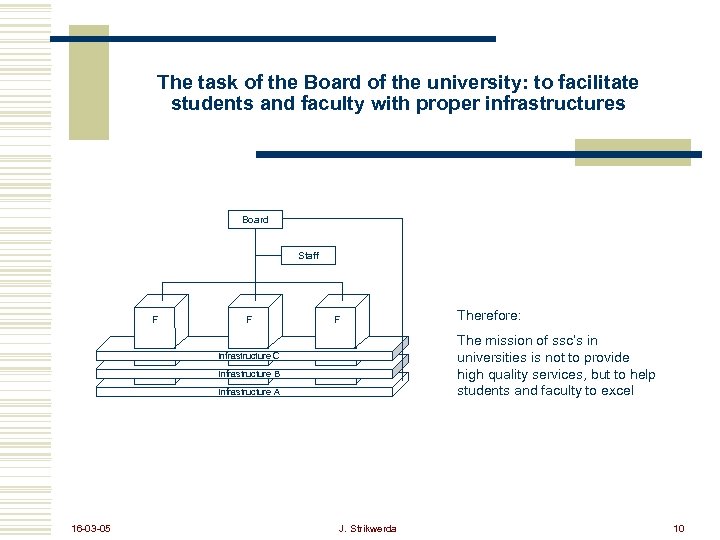 The task of the Board of the university: to facilitate students and faculty with proper infrastructures Board Staff F F F The mission of ssc’s in universities is not to provide high quality services, but to help students and faculty to excel Infrastructure C Infrastructure B Infrastructure A 16 -03 -05 Therefore: J. Strikwerda 10
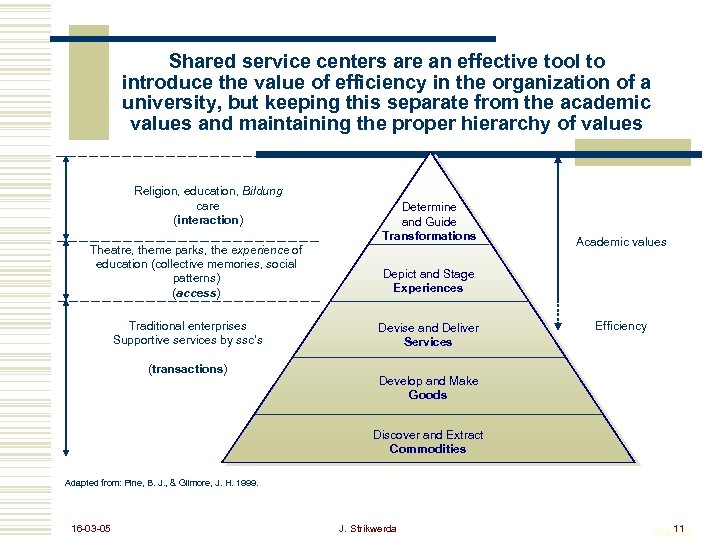 Shared service centers are an effective tool to introduce the value of efficiency in the organization of a university, but keeping this separate from the academic values and maintaining the proper hierarchy of values Religion, education, Bildung care (interaction) Theatre, theme parks, the experience of education (collective memories, social patterns) (access) Traditional enterprises Supportive services by ssc’s (transactions) Determine and Guide Transformations Academic values Depict and Stage Experiences Devise and Deliver Services Efficiency Develop and Make Goods Discover and Extract Commodities Adapted from: Pine, B. J. , & Gilmore, J. H. 1999. 16 -03 -05 J. Strikwerda 11 30103 A. 08
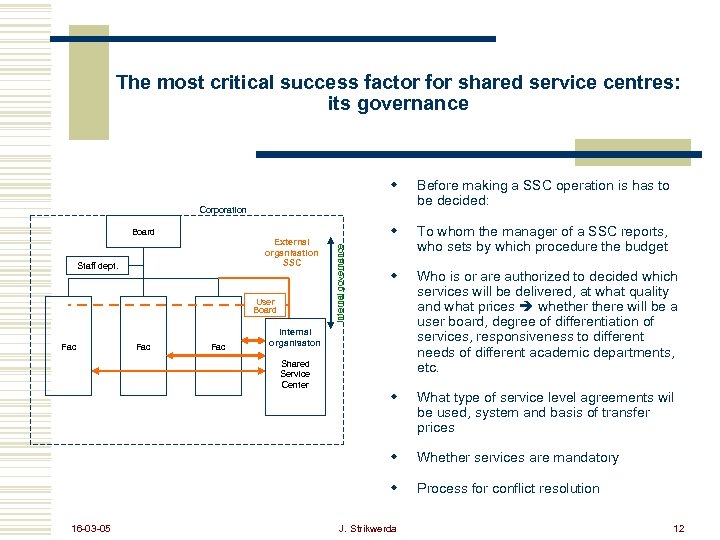 The most critical success factor for shared service centres: its governance w Before making a SSC operation is has to be decided: w To whom the manager of a SSC reports, who sets by which procedure the budget w Who is or are authorized to decided which services will be delivered, at what quality and what prices whethere will be a user board, degree of differentiation of services, responsiveness to different needs of different academic departments, etc. w What type of service level agreements wil be used, system and basis of transfer prices w Whether services are mandatory w Process for conflict resolution Board External organisation SSC Staff dept. User Board Fac Fac Internal organisaton Shared Service Center 16 -03 -05 Internal governance Corporation J. Strikwerda 12
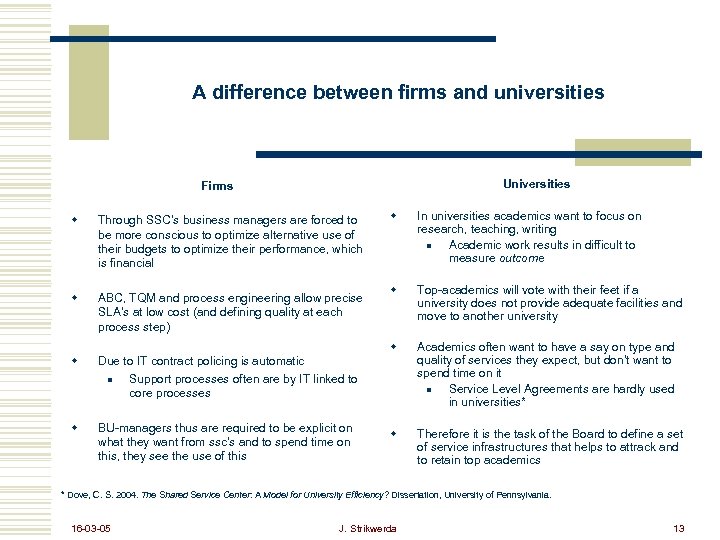 A difference between firms and universities Universities Firms Through SSC’s business managers are forced to be more conscious to optimize alternative use of their budgets to optimize their performance, which is financial w ABC, TQM and process engineering allow precise SLA’s at low cost (and defining quality at each process step) w BU-managers thus are required to be explicit on what they want from ssc’s and to spend time on this, they see the use of this In universities academics want to focus on research, teaching, writing n Academic work results in difficult to measure outcome w Top-academics will vote with their feet if a university does not provide adequate facilities and move to another university Academics often want to have a say on type and quality of services they expect, but don’t want to spend time on it n Service Level Agreements are hardly used in universities* w Therefore it is the task of the Board to define a set of service infrastructures that helps to attrack and to retain top academics Due to IT contract policing is automatic n Support processes often are by IT linked to core processes w w * Dove, C. S. 2004. The Shared Service Center: A Model for University Efficiency? Dissertation, University of Pennsylvania. 16 -03 -05 J. Strikwerda 13
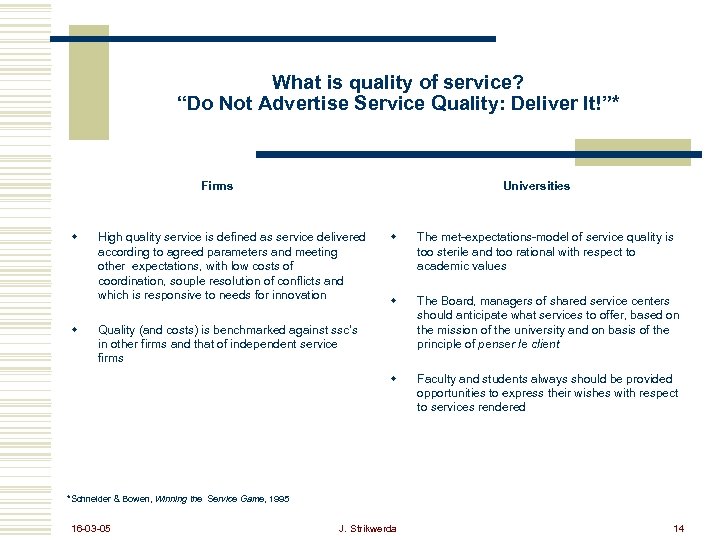 What is quality of service? “Do Not Advertise Service Quality: Deliver It!”* Firms w Universities w The met-expectations-model of service quality is too sterile and too rational with respect to academic values w The Board, managers of shared service centers should anticipate what services to offer, based on the mission of the university and on basis of the principle of penser le client w w High quality service is defined as service delivered according to agreed parameters and meeting other expectations, with low costs of coordination, souple resolution of conflicts and which is responsive to needs for innovation Faculty and students always should be provided opportunities to express their wishes with respect to services rendered Quality (and costs) is benchmarked against ssc’s in other firms and that of independent service firms *Schneider & Bowen, Winning the Service Game, 1995 16 -03 -05 J. Strikwerda 14
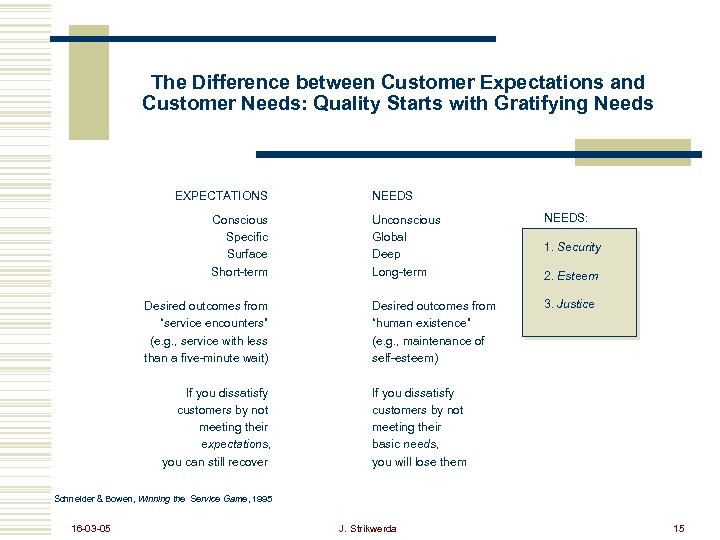 The Difference between Customer Expectations and Customer Needs: Quality Starts with Gratifying Needs EXPECTATIONS Conscious Specific Surface Short-term Desired outcomes from “service encounters” (e. g. , service with less than a five-minute wait) If you dissatisfy customers by not meeting their expectations, you can still recover NEEDS Unconscious Global Deep Long-term NEEDS: Desired outcomes from “human existence” (e. g. , maintenance of self-esteem) 3. Justice 1. Security 2. Esteem If you dissatisfy customers by not meeting their basic needs, you will lose them Schneider & Bowen, Winning the Service Game, 1995 16 -03 -05 J. Strikwerda 15
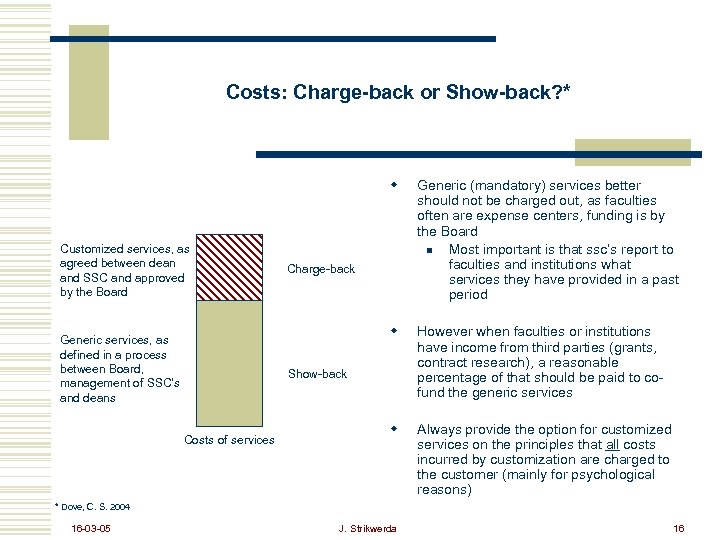 Costs: Charge-back or Show-back? * w w Customized services, as agreed between dean and SSC and approved by the Board Generic services, as defined in a process between Board, management of SSC’s and deans Generic (mandatory) services better should not be charged out, as faculties often are expense centers, funding is by the Board n Most important is that ssc’s report to faculties and institutions what services they have provided in a past period However when faculties or institutions have income from third parties (grants, contract research), a reasonable percentage of that should be paid to cofund the generic services w Always provide the option for customized services on the principles that all costs incurred by customization are charged to the customer (mainly for psychological reasons) Charge-back Show-back Costs of services * Dove, C. S. 2004 16 -03 -05 J. Strikwerda 16
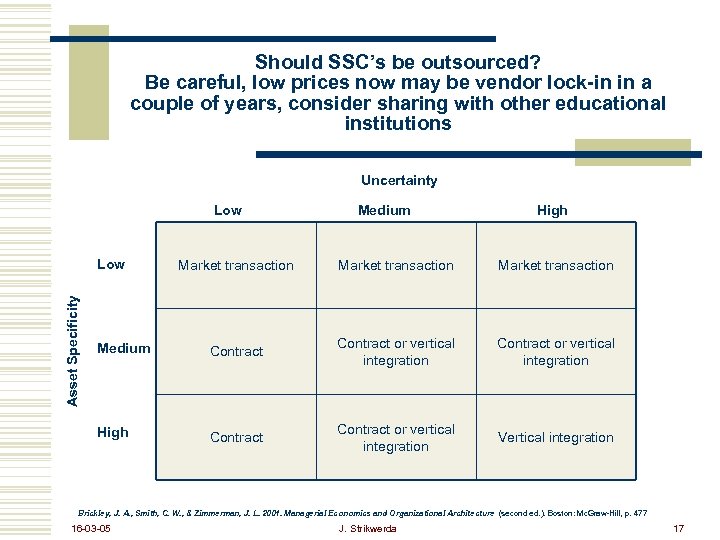 Should SSC’s be outsourced? Be careful, low prices now may be vendor lock-in in a couple of years, consider sharing with other educational institutions Uncertainty Low Medium High Market transaction Medium Contract or vertical integration High Asset Specificity Market transaction Contract or vertical integration Vertical integration Brickley, J. A. , Smith, C. W. , & Zimmerman, J. L. 2001. Managerial Economics and Organizational Architecture (second ed. ). Boston: Mc. Graw-Hill, p. 477 16 -03 -05 J. Strikwerda 17
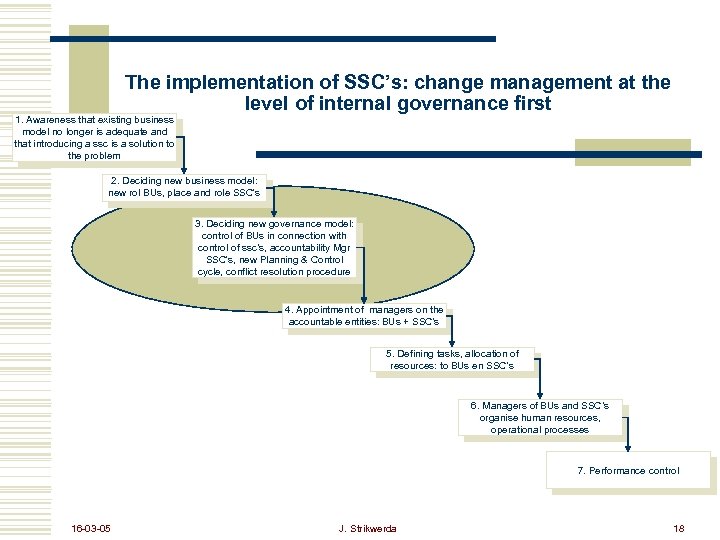 The implementation of SSC’s: change management at the level of internal governance first 1. Awareness that existing business model no longer is adequate and that introducing a ssc is a solution to the problem 2. Deciding new business model: new rol BUs, place and role SSC's 3. Deciding new governance model: control of BUs in connection with Change control of ssc’s, accountability Mgr Management SSC's, new Planning & Control cycle, conflict resolution procedure 4. Appointment of managers on the accountable entities: BUs + SSC's 5. Defining tasks, allocation of resources: to BUs en SSC’s 6. Managers of BUs and SSC’s organise human resources, operational processes 7. Performance control 16 -03 -05 J. Strikwerda 18
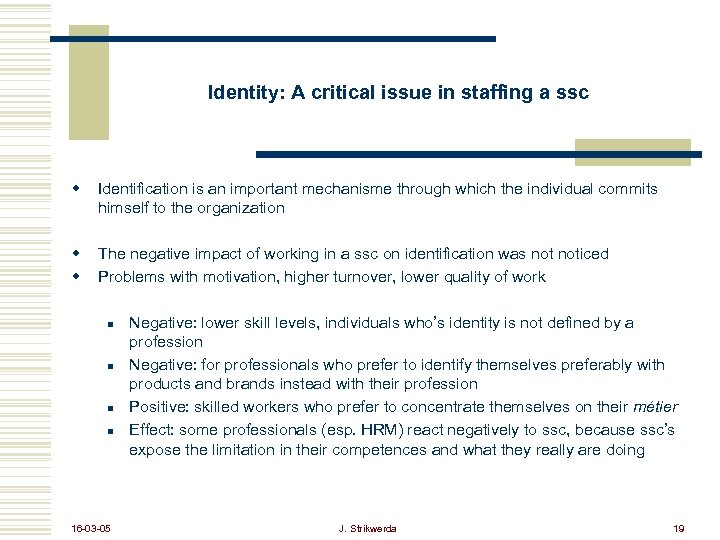 Identity: A critical issue in staffing a ssc w Identification is an important mechanisme through which the individual commits himself to the organization w w The negative impact of working in a ssc on identification was noticed Problems with motivation, higher turnover, lower quality of work n n 16 -03 -05 Negative: lower skill levels, individuals who’s identity is not defined by a profession Negative: for professionals who prefer to identify themselves preferably with products and brands instead with their profession Positive: skilled workers who prefer to concentrate themselves on their métier Effect: some professionals (esp. HRM) react negatively to ssc, because ssc’s expose the limitation in their competences and what they really are doing J. Strikwerda 19
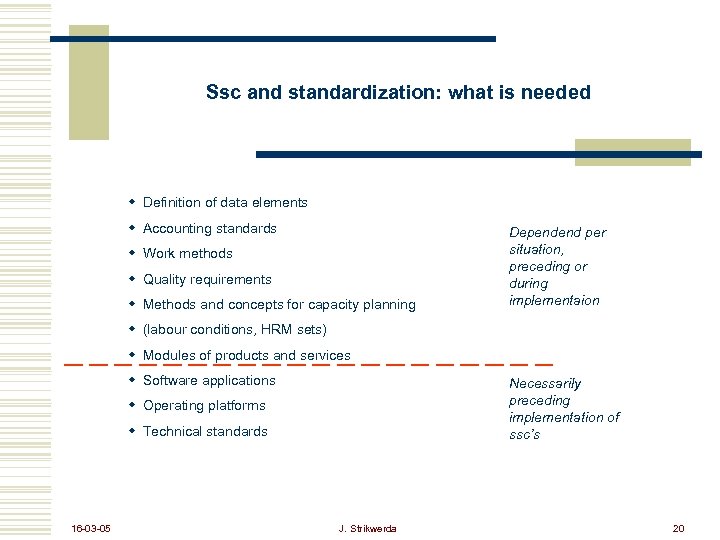 Ssc and standardization: what is needed w Definition of data elements w Accounting standards w Work methods w Quality requirements w Methods and concepts for capacity planning Dependend per situation, preceding or during implementaion w (labour conditions, HRM sets) w Modules of products and services w Software applications Necessarily preceding implementation of ssc’s w Operating platforms w Technical standards 16 -03 -05 J. Strikwerda 20
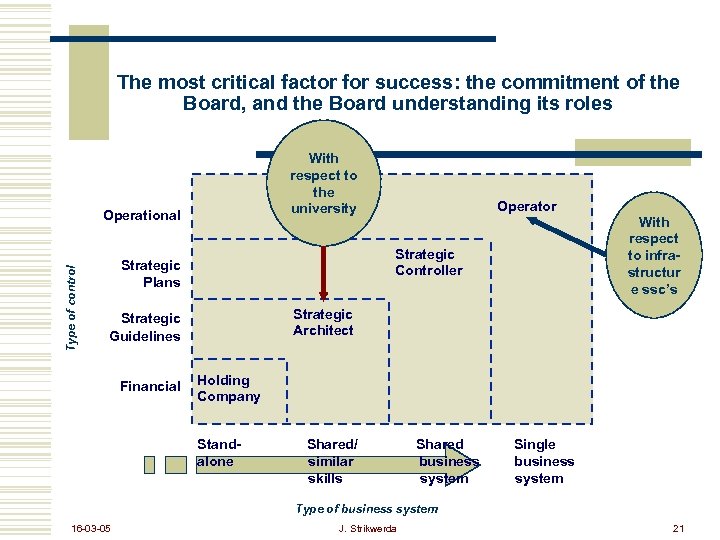 The most critical factor for success: the commitment of the Board, and the Board understanding its roles With respect to the university Type of control Operational With respect to infrastructur e ssc’s Strategic Controller Strategic Plans Strategic Architect Strategic Guidelines Financial Operator Holding Company Standalone Shared/ similar skills Shared business system Single business system Type of business system 16 -03 -05 J. Strikwerda 21