


 Скачать презентацию HUMAN TRAFFICKING AND SEXUAL OFFENCES Dr Kavita Singh
5e9fe5c56c58f966c13affd2cabbdfe7.ppt
- Количество слайдов: 67
 HUMAN TRAFFICKING AND SEXUAL OFFENCES Dr. Kavita Singh, Associate Professor, WBNUJS kavita. singh@nujs. edu
 A) WHAT IS TRAFFICKING? In its dictionary meaning, the concept of trafficking denotes a trade in something that should not be traded in. Thus, we have terms like drug trafficking, arms trafficking and human trafficking. The concept of trafficking in people refers to the criminal practice of exploitation of human beings whereby humans are treated as commodities for profit, subjected to various forms of exploitation.
 IN INDIA Immoral Traffic Prevention Act (ITPA 1956) explain the various activities involved in trafficking. Under Section 5, trafficking includes procuring, taking and even inducing a person for the sake of prostitution. Even attempt to procure and attempt to take or cause a person to carry on prostitution is an offence.
 THE UN PROTOCOL DEFINITION CONTAINS THREE MAIN ELEMENTS THAT CONSTITUTE TRAFFICKING: Acts: recruitment, transportation, transfer, harbouring or receipt of a person. Means: threat/use of force, other forms of coercion, abduction, fraud, deception or abuse of power or of a position of vulnerability. Purpose: prostitution, forced labour or services, slavery-like practices; servitude, organ trade etc. The second part of the definition of trafficking focuses on the issue of consent.
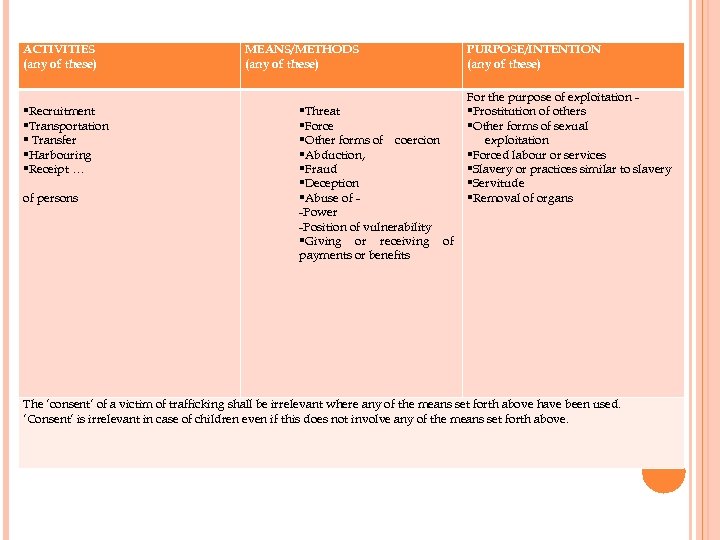 ACTIVITIES (any of these) Recruitment Transportation Transfer Harbouring Receipt … of persons MEANS/METHODS (any of these) Threat Force Other forms of coercion Abduction, Fraud Deception Abuse of -Power -Position of vulnerability Giving or receiving of payments or benefits PURPOSE/INTENTION (any of these) For the purpose of exploitation Prostitution of others Other forms of sexual exploitation Forced labour or services Slavery or practices similar to slavery Servitude Removal of organs The ‘consent’ of a victim of trafficking shall be irrelevant where any of the means set forth above have been used. ‘Consent’ is irrelevant in case of children even if this does not involve any of the means set forth above.
 CASE STUDY 1 NEW DELHI, India (AP) — Teena discovered she had been sold by her boss while riding in an auto-rickshaw headed to New Delhi’s red-light district. The 12 -year-old was working as a domestic servant in Calcutta when the homeowner told her about a good-paying job at his sister’s house in India’s capital. But instead, she was sold to a brothel owner and forced into prostitution for little more than a place to sleep and the occasional meal. Her ordeal lasted four years and Teena, now 21, says it left her “a very angry person. ” “The anger come suddenly, ” says Teena, who asked that her full name not be used because of the stigma associated with her past. Teena’s childhood before being sold into prostitution was filled with long days of domestic work in the rural eastern State of Jharkhand. She received little or no pay, she said, but “I was so poor, I could not leave. ” At the urging of her mother, she moved to Calcutta for what she was told would be a paid maid’s position. When her boss then sent her to New Delhi, Teena never found out the price she was bought for on the human trafficking market. She was rescued from the brothel by STOP, an anti-trafficking group founded in 1998.
 IT MUST BE KEPT IN MIND THAT TRAFFICKING IS DIFFERENT FROM MIGRATION AND SMUGGLING. There are important fundamental differences between migration, smuggling and trafficking: Migration is a situation in which a person moves from one country to another or within one country. Migration can take place by legal or illegal means and it can be either voluntary (with the consent of the person migrating) or forced (without their consent). Usually, however, migration is voluntary. Smuggling is the transport of a person (with their consent) to another country through illegal means. Smuggling has to include crossing of an international border. Trafficking involves the following: Movement of a person; With deception or coercion; Into a situation of forced labour, prostitution, servitude or slavery-like practices.
 B) WHAT ARE THE VARIED ELEMENTS OF TRAFFICKING? Displacement of a person from one community to another: While it is not necessary that the person is actually moved from one place to another to have been trafficked (displacement is also possible within the same building), usually victims are moved from one house to another, one village to another, one district to another, and so on. Exploitation of the trafficked victim: Displacement of the victim is followed by various forms of exploitation being meted out to the victim – using force, deceit and threats, as the case may be. Commercialization of the exploitation and commodification of the victim: Due to the portrayal of women as sex objects, and as property by patriarchal society, women have acquired a ‘face value’ within the ‘market’ whereby their bodies have become commodities in a commerce based on the exploitation of sex (hence, CSECommercial Sexual Exploitation).
 WHAT IS THE ‘ROUTE’ OF TRAFFICKING? Trafficking involves three focal points in spatial context: • Source • Transit • Destination Areas are identified on the trafficking map as being a source, transit or destination or a combination of any or all of these; however it is possible that all these may coexist. A girl child of a woman forced into CSE, living and also forced into CSE in the same brothel, for example, simultaneously depicts all three points on the trafficking map.
 D) WHAT IS THE DIFFERENCE BETWEEN TRAFFICKING AND PROSTITUTION? Often, trafficking is confused with prostitution. These are not synonymous. Trafficking is the process / means while prostitution can be the result/end (of being trafficked). Refer to Case Study 1: Teena was displaced and forcibly recruited into commercial sexual exploitation (CSE). While prostitution is a punishable offence when there is commercial sexual exploitation of a person and any other person who makes profit from the same [Section 2(f) of ITPA 1956], trafficking is the whole (or any point of the) process of recruiting, contracting, procuring or hiring a person for commercial sexual exploitation (CSE) or for any other purpose.
 Trafficking is therefore the overall ‘process’ while prostitution/ commercial sexual exploitation/ forced labour is the ‘result’. Thus, Meena has been both trafficked and forced into prostitution as she has been: - Sexually exploited. - She has been abused by a person(s) for commercial purposes. Her consent is irrelevant. - She is the victim and not a criminal.
 E) WHO IS A TRAFFICKER/OFFENDER? TRAFFICKERS CAN BE, BUT ARE NOT LIMITED TO, THE FOLLOWING PERSONS: Recruiter/Agent of Recruiter Seller of trafficked person Buyer of trafficked person Transporter Conspirator ‘Customer’/clientele, who create/perpetuate demand Pimp Brothel madam Brothel managers Financier Parent(s)/guardian(s) who knowingly sell/cause to sell/traffic their children/ward.
 F) WHO IS A ‘VICTIM’ OF TRAFFICKING FOR CSE? It is crucial to note that all trafficked persons are victims, irrespective of their proclaimed/apparent voluntariness. A victim of trafficking for CSE is: • Any person above the age of 18 who through force or threat of force, coercion, abuse of power, etc were/are required to perform sexual acts without their consent, by any person(s), for profit or gain of a third person. • Children and minors who are found in places of CSE i. e. “children” who have not completed the age of 16 years and ‘minors” who have completed the age of sixteen years but have not completed the age of eighteen years, who are found in places of CSE.
 G) ARE PEOPLE TRAFFICKED ONLY FOR CSE? Commercial sexual exploitation is only one of the results of trafficking. Trafficking in human beings also results in nonsex based exploitation such as forced labour and other forms of exploitation. Some manifested forms of exploitation (non-CSE) that may result from trafficking in persons include: • workers in the unorganized sector • slave trade/bondage • child labour • drug peddling • organ trading • forced marriages, mail order brides • beggary • adoption rackets • entertainment and sports (camel racing, exotic dancing, circus, etc. ) • others
 H) WHERE CAN CSE TAKE PLACE? The scene of crime (SOC) includes the source, the transit and destination points. In fact, in the case of CSE, the SOC is not limited to the place of exploitation – or, for example, the brothel alone. Therefore, for example, CSE can take place: • On the streets • In massage parlours • At bars • In the brothels • In vehicles used for transfer • In the form of escort service • At places where the survivor of trafficking has been sent for the purpose of recording pornography, transport of the same, and where the pornographic material is stored, purchased, used etc. • At other places.
 I) IS TRAFFICKING A CONTINUING CRIME? Trafficking is an organized and continuing crime. Multiple crimes can be culled out under trafficking such as abduction, kidnapping, illegal detainment, illegal confinement, criminal intimidation, hurt, grievous hurt, rape, outraging modesty, rape, unnatural offences, selling and buying of human beings, servitude, criminal conspiracy, abetment, etc. Therefore, multiple abuse and abusers located at different points of time and place together constitute the organized crime of trafficking.
 SECTION 370 IPC ‘ (1) Whoever, for the purpose of exploitation, (a) recruits, (b) transports, (c) harbours, (d) transfers, or (e) receives, a person or persons, by— First. — using threats, or Secondly. — using force, or any other form of coercion, or Thirdly. — by abduction, or Fourthly. — by practising fraud, or deception, or Fifthly. — by abuse of power, or Sixthly. — by inducement, including the giving or receiving of payments or benefits, in order to achieve the consent of any person having control over the person recruited, transported, harboured, transferred or received, commits the offence of trafficking. Explanation 1. — The expression "exploitation" shall include any act of physical exploitation or any form of sexual exploitation, slavery or practices similar to slavery, servitude, or the forced removal of organs. Explanation 2. — The consent of the victim is immaterial in determination of the offence of trafficking
 SECTION 370 A Whoever, knowingly or having reason to believe that a minor has been trafficked, engages such minor for sexual exploitation in any manner, shall be punished with rigorous imprisonment for a term which shall not be less than five years, but which may extend to seven years, and shall also be liable to fine. Whoever, knowingly by or having reason to believe that a person has been trafficked, engages such person for sexual exploitation in any manner, shall be punished With rigorous imprisonment for a term which shall not be less than three years, but which may extend to five years, and shall also be liable to fine. 1 Criminal Law (Amendment) Act, 2013
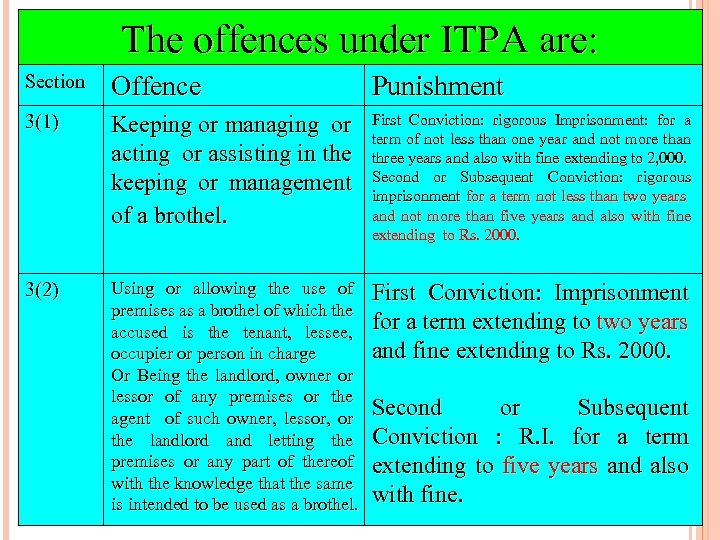 The offences under ITPA are: Section Offence Punishment 3(1) Keeping or managing or acting or assisting in the keeping or management of a brothel. First Conviction: rigorous Imprisonment: for a term of not less than one year and not more than three years and also with fine extending to 2, 000. Second or Subsequent Conviction: rigorous imprisonment for a term not less than two years and not more than five years and also with fine extending to Rs. 2000. 3(2) Using or allowing the use of premises as a brothel of which the accused is the tenant, lessee, occupier or person in charge Or Being the landlord, owner or lessor of any premises or the agent of such owner, lessor, or the landlord and letting the premises or any part of thereof with the knowledge that the same is intended to be used as a brothel. First Conviction: Imprisonment for a term extending to two years and fine extending to Rs. 2000. Second or Subsequent Conviction : R. I. for a term extending to five years and also with fine.
 PRESUMPTION U/S 3 (2 A) Presumption of knowledge that the premiseses or any part thereof are being used as a brothel – if – Report in published in news paper A copy of the list of all things found during the search
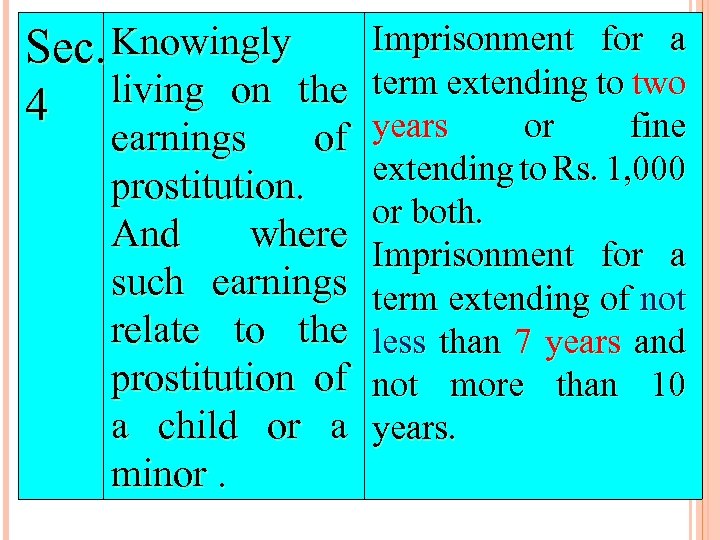 Sec. Knowingly living on the 4 earnings of prostitution. And where such earnings relate to the prostitution of a child or a minor. Imprisonment for a term extending to two years or fine extending to Rs. 1, 000 or both. Imprisonment for a term extending of not less than 7 years and not more than 10 years.
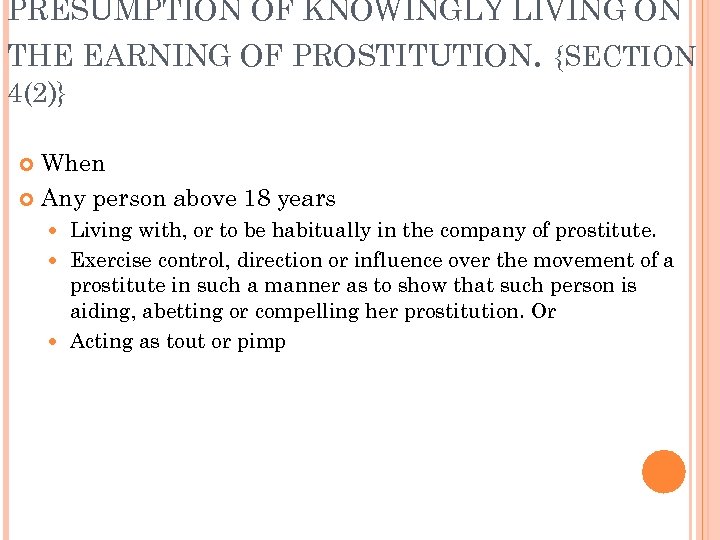 PRESUMPTION OF KNOWINGLY LIVING ON THE EARNING OF PROSTITUTION. {SECTION 4(2)} When Any person above 18 years Living with, or to be habitually in the company of prostitute. Exercise control, direction or influence over the movement of a prostitute in such a manner as to show that such person is aiding, abetting or compelling her prostitution. Or Acting as tout or pimp
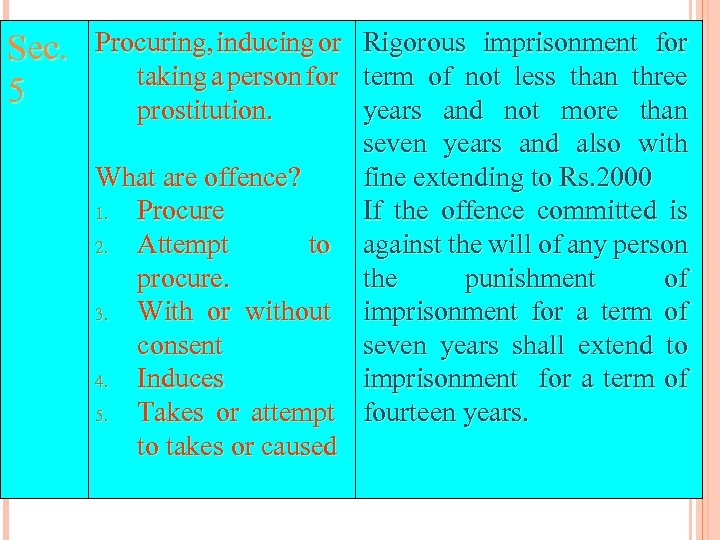 Sec. 5 Procuring, inducing or taking a person for prostitution. Rigorous imprisonment for term of not less than three years and not more than seven years and also with What are offence? fine extending to Rs. 2000 1. Procure If the offence committed is 2. Attempt to against the will of any person procure. the punishment of 3. With or without imprisonment for a term of consent seven years shall extend to 4. Induces imprisonment for a term of 5. Takes or attempt fourteen years. to takes or caused
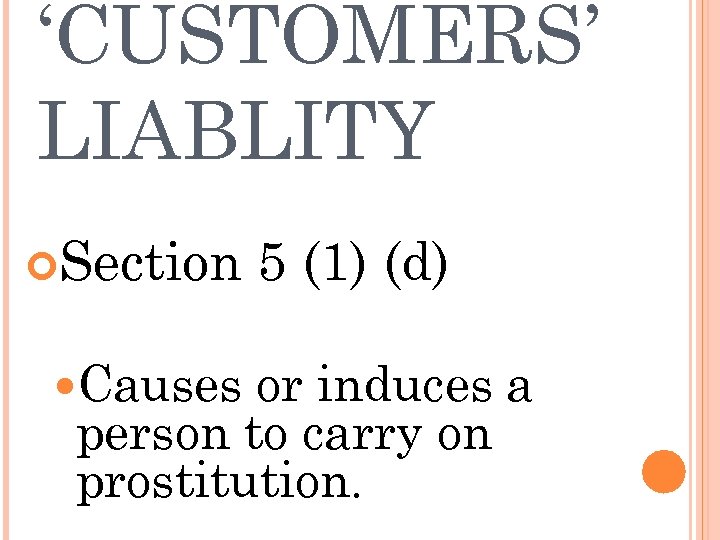 ‘CUSTOMERS’ LIABLITY Section Causes 5 (1) (d) or induces a person to carry on prostitution.
 PLACE OF TRIAL Section 5 (3) Place of procurement Place were inducement was made to go Taken or caused to be taken from Attempt being made Place where she may have gone Because of – inducement, attempt or otherwise.
 Sec. Detaining a person in a 6 brothel or in premises where prostitution is carried on. Imprisonment of either description for a term not less than seven years but may be for life or extend to ten years and also a fine.
 PRESUMPTION U/S 6 – AN IMPORTANT TOOL Where any person is found with a child in a brothel, it shall be presumed, unless the contrary is proved, that he has committed an offence under sub-section (1). (2 -A) Where a child or minor found in a brothel, is, on medical examination, detected to have been sexually abused, it shall be presumed unless the contrary is proved, that the child or minor has been detained for purposes of prostitution or, as the case may be, has been sexually exploited for commercial purposes.
 (3) A person shall be presumed to detail a person in a brothel or in upon any premises for the purpose of sexual intercourse with a man other than her lawful husband, if such person, with intent to compel or induce her to remain there, (a) Withholds from her any jewellery, wearing apparel, money or other property belonging to her, or (b) Threatens her with legal proceedings if she takes away with her any jewellery, wearing apparel, money or other property lent or supplied to her by or by the direction of such person.
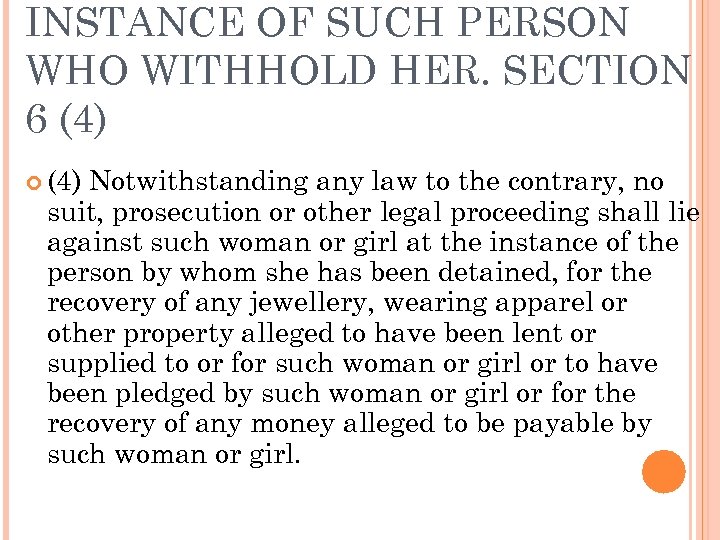 INSTANCE OF SUCH PERSON WHO WITHHOLD HER. SECTION 6 (4) Notwithstanding any law to the contrary, no suit, prosecution or other legal proceeding shall lie against such woman or girl at the instance of the person by whom she has been detained, for the recovery of any jewellery, wearing apparel or other property alleged to have been lent or supplied to or for such woman or girl or to have been pledged by such woman or girl or for the recovery of any money alleged to be payable by such woman or girl.
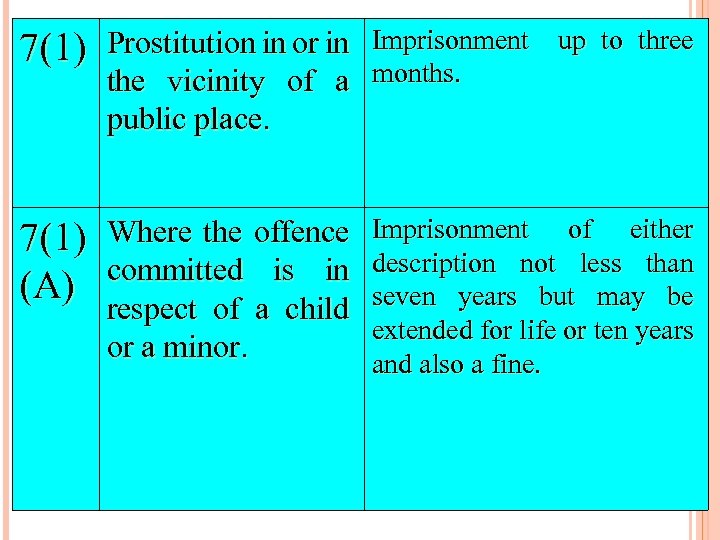 7(1) Prostitution in or in Imprisonment up to three the vicinity of a months. public place. 7(1) (A) Where the offence committed is in respect of a child or a minor. Imprisonment of either description not less than seven years but may be extended for life or ten years and also a fine.
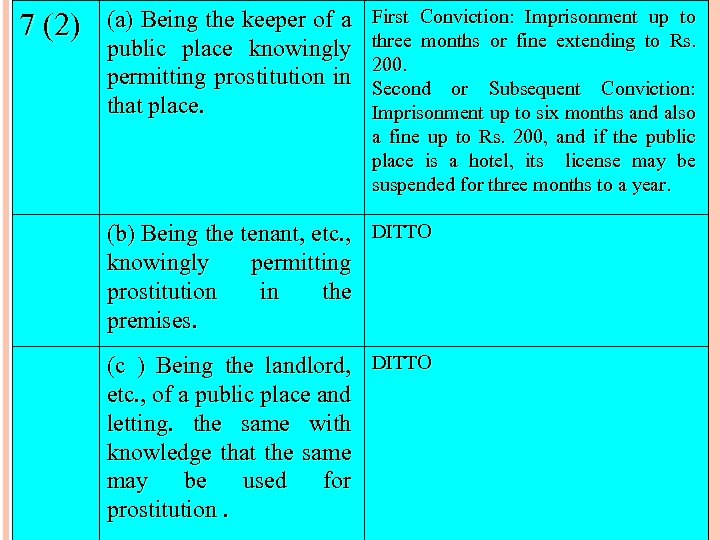 7 (2) (a) Being the keeper of a public place knowingly permitting prostitution in that place. First Conviction: Imprisonment up to three months or fine extending to Rs. 200. Second or Subsequent Conviction: Imprisonment up to six months and also a fine up to Rs. 200, and if the public place is a hotel, its license may be suspended for three months to a year. (b) Being the tenant, etc. , DITTO knowingly permitting prostitution in the premises. (c ) Being the landlord, DITTO etc. , of a public place and letting. the same with knowledge that the same may be used for prostitution.
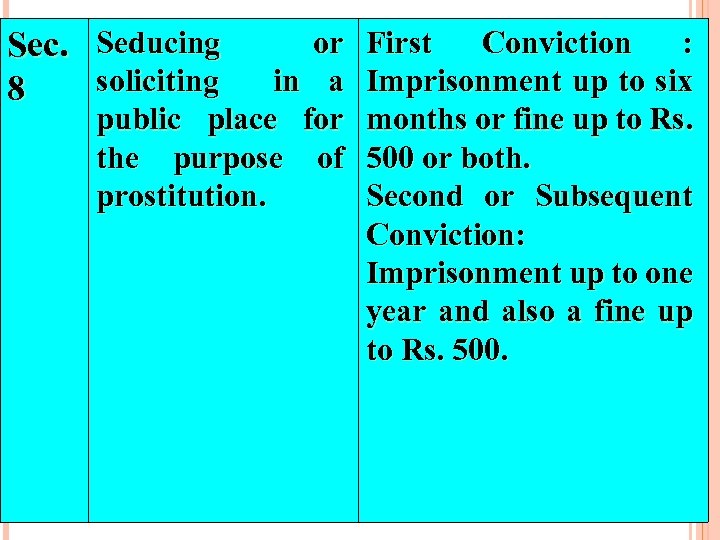 Sec. Seducing soliciting 8 or in a public place for the purpose of prostitution. First Conviction : Imprisonment up to six months or fine up to Rs. 500 or both. Second or Subsequent Conviction: Imprisonment up to one year and also a fine up to Rs. 500.
 Section 9: Seducing a person or causing or aiding or abetting her seduction when she is in the custody of a person having custody, charge or care or in a position of authority over any person. Imprisonment of either description for a term not less than seven years but which may extend to life or up to ten years and fine.
 RESCUE, SEARCH & CLOSURE OF BROTHEL Section 15: Search Without warrant Section 16: Rescue of Person – Any Magistrate (MM, JM, DM, SDM) Section 17 A – Condition to be observed before placing persons rescued under Section 16 to parents or guardians. Section 18 Closure of brothel.
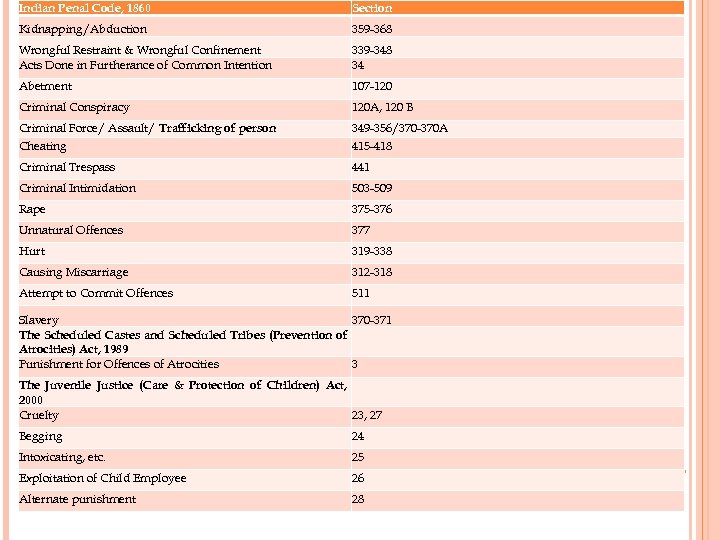 Indian Penal Code, 1860 Section Kidnapping/Abduction 359 -368 Wrongful Restraint & Wrongful Confinement Acts Done in Furtherance of Common Intention 339 -348 34 Abetment 107 -120 Criminal Conspiracy 120 A, 120 B Criminal Force/ Assault/ Trafficking of person Cheating 349 -356/370 -370 A 415 -418 Criminal Trespass 441 Criminal Intimidation 503 -509 Rape 375 -376 Unnatural Offences 377 Hurt 319 -338 Causing Miscarriage 312 -318 Attempt to Commit Offences 511 Slavery 370 -371 The Scheduled Castes and Scheduled Tribes (Prevention of Atrocities) Act, 1989 Punishment for Offences of Atrocities 3 The Juvenile Justice (Care & Protection of Children) Act, 2000 Cruelty 23, 27 Begging 24 Intoxicating, etc. 25 Exploitation of Child Employee 26 Alternate punishment 28
 SEXUAL OFFENCES The IPC has a number of sections dealing with numerous offences linked to commercial sexual exploitation of women and children. The Table below gives a brief list: Rape- 375, 376 Unnatural offences-377 Assault/ Criminal force/ act to dishonour/ outrage modesty, defamation- 354, 355, 509, 500
 RAPE ‘ 375. A person is said to commit “Rape” if that person–– (a) penetrates his penis, to any extent, into the vagina, mouth urethra or anus of another person or makes the person to do so with him or any other person; or (b) inserts, to any extent, any object or a part of the body, not being the penis, into the vagina, the urethra or anus of another person or makes the person to do so with him or any other person; or (c) manipulates any part of the body of another person so as to cause penetration into the vagina, urethra, anus or any part of body of such person or makes the person to do so with him or any other person; or (d) applies his mouth to the penis, vagina, anus, urethra of another person or makes such person to do so with him or any other person;
 First. –– Against the other person’s will. Secondly. –– Without the other person’s consent. Thirdly. –– With her consent when her consent has been obtained by putting such other person or any person in whom such other person is interested, in fear of death or of hurt. Fourthly. –– When her consent, when the man knows that he is not her husband that her consent is given because she believes that he is another man to whom she is or believes to be lawfully married. Fifthly. –– With the consent when, at the time of giving such consent, by reason of unsoundness of mind or intoxication or the administration by that personally or through another of any stupefying or unwholesome substance, the other person is unable to understand the nature and consequences of that action to which such other person gives consent. Sixthly. –– With or without consent, when she is under eighteen years of age. Seventhly. –– When the person is unable to communicate consent.
 Explanation 1. –– Penetration to any extent is “penetration” for the purposes of this section. Explanation 2. –– For the purposes of this section, “vagina” shall also include labia majora. Explanation 3. –– Consent means an unequivocal voluntary agreement when the person by words, gestures or any form of non-verbal communication, communicates willingness to participate in the specific act: Provided that, a person who does not physically resist to the act of penetration shall not by the reason only of that fact, be regarded as consenting to the sexual activity. Exception. 1 -Medical procedure or intervention not rape Exception 2 -Sexual intercourse or sexual acts by a man with his own wife, the wife not being under fifteen years of age, is not Rape.
 PUNISHMENT 376. (1) Whoever, except in the cases provided for by sub-section (2), commits rape, shall be punished with rigorous imprisonment of either description for a term which shall not be less than seven years but which may extend to imprisonment for life, and shall also be liable to fine.
 (a) being a police officer, commits rape– (i) within the limits of the police station to which such police officer is appointed; or (ii) in the premises of any station house; or (iii) on a person in such police officer’s custody or in the custody of a police officer subordinate to such police officer; or (b) being a public servant, commits rape on a person such public servant’s custody or in the custody of a public servant subordinate to such public servant; or (c) being a member of the armed forces is in the area by virtue of deployment by the Central or a State Government, commits rape; or
 (d) being on the management or on the staff of a jail, remand home or other place of custody established by or under any law for the time being in force or of a women’s or children’s institution, commits rape on any inmate of such jail, remand home, place or institution; or (e) being on the management or on the staff of a hospital, commits Rape on a person in that hospital; or (f) being a relative, guardian or teacher of, or a person in a position of trust or authority towards, the person assaulted, commits rape on such person; or (g) commits Rape during communal or sectarian violence or (h)commits Rape on a woman knowing her to be pregnant; or (i) commits rape on a person when she is under sixteen years of age; or
 (j) commits rape, where the person assaulted is incapable of giving consent; or (k) being in a position of economic or social dominance, commits rape on a person under such dominance; or (l) commits rape on a person suffering from mental or physical disability; or (m) while committing rape causes grievous bodily harm or maims or disfigures or endangers the life of a person; or (n) commits rape repeatedly on the same women, shall be punished with rigorous imprisonment for a term which shall not be less than ten years but which may extend to imprisonment for life, and shall also be liable to fine.
 376 A- Punishment for causing death or resulting in persistent vegetative state of victim. - RI not less than 20 yrs extend to life, or death 376 C- Sexual intercourse by a person in authority- RI not less than 10 yrs liable to fine 376 D- gang rape- RI not less than 20 yrs extend to life, with fine 376 E- repeat offence- Imprisonment for life, or with death
 COMPENSATION Interim compensation ordered in Bodhisattwa Gautam v. Subhra Chakraborty AIR 1966 SC 922. Section 357 Criminal Procedure Code authorizes Courts to order convicts to pay compensation to victims. Delhi Domestic Working Woman’s Forum v. Union of India (1995) 1 SCC 14 Karnel Singh v. State of Madhya Pradesh AIR 1995 SC 2472 State of Punjab v. Gurmit Singh AIR 1996 SC 1393 Rao Harnarain Singh, Sheoji Singh and other v. The State AIR 1958 Punj 123
 A landmark judgment, as far as the offence of rape goes, has been State of Punjab v. Gurmit Singh, in which the Supreme Court laid down the following parameters: Delay in lodging the FIR is not material when properly explained. Testimony of the victim in cases of sexual assault are vital and unless there are compelling reasons which necessitate looking for corroboration of her statement, the court should find no difficulty in convicting the accused on the victim’s testimony alone. Trial of sexual offenses should be in camera and invariably by women judges wherever available. Court must refrain from making observations that cast aspersions on the character of the victim. Court is under an obligation to see that the victim is not unnecessarily harassed and humiliated in crossexamination. AIR 1996 SC 1393
 UNNATURAL OFFENCES Unnatural offences especially against women and children are common in cases of trafficking and in the course of their being commercially sexually exploited. There is no concept of consent as regards unnatural offences. A mere commission of the act with or without consent attracts prosecution U/S. 377. The offence is punished with imprisonment for life, or with imprisonment of either description for a term which may extend to ten years, and shall also be liable to fine.
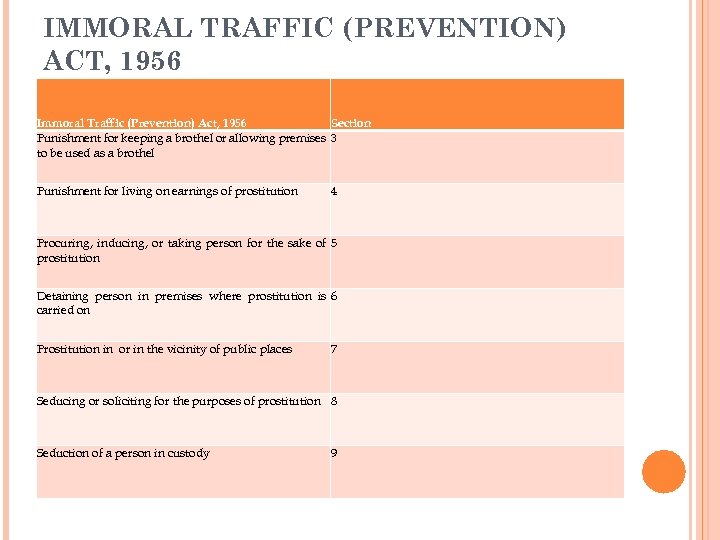 IMMORAL TRAFFIC (PREVENTION) ACT, 1956 Immoral Traffic (Prevention) Act, 1956 Section Punishment for keeping a brothel or allowing premises 3 to be used as a brothel Punishment for living on earnings of prostitution 4 Procuring, inducing, or taking person for the sake of 5 prostitution Detaining person in premises where prostitution is 6 carried on Prostitution in or in the vicinity of public places 7 Seducing or soliciting for the purposes of prostitution 8 Seduction of a person in custody 9
 VICTIM AND WITNESS CARE & PROTECTION DURING TRIAL: Victims are wary of the court ambience. Do orient and counsel them. Assure them that their rights will not be violated and that their truthful version of all facts is essential for delivery of justice which is in their interest and also in the larger public interest. Victims require briefing on the facts of the case, especially to recall the events in a logical way. This should be done before she is put in the witness box. Prosecutors ought to ensure that the defense-side does not violate the rights of the victim. Embarrassing questions need to be avoided. Intervention of the court should be sought immediately to prevent any such violations. All efforts should be made to ensure the anonymity of the victim. Anonymity provides strength and confidence to the victim.
 Move the court for allowing in-camera trial. The Supreme Court of India (Refer Judgement dated 26 May 2004, in ‘Sakshi vs Union of India’) has directed that in-camera trial should be extended to all cases of sexual assault on children. A screen has to be provided in the trial court so that the child victim is not exposed to the suspect and accused persons. A child counselor should be provided to assist in the court. Adequate recess should be allowed during trial proceeding so that the child victim gets rest. This is a landmark judgement in ensuring child rights and, therefore, needs to be implemented in letter and spirit. The police and prosecutors should move the trial courts for the same. Video conferencing is an ideal mechanism to prevent victimization of the trafficked victim. It should be done whenever possible. The Supreme Court, in its landmark decision, in State of Maharashtra vs Dr. Praful B. Desai 2003 (4) SCC 601, has underscored the validity of video conferencing and enumerated the safeguards to be ensured during the trial of cases.
 INSTITUTIONAL RESPONSE TO HUMAN TRAFFICKING National policy Police administration Ministry of women and child development role in combating human trafficking Governmental schemes Other agencies role in trafficking cases NHRC role The Commission for the Protection of Child Rights Act, 2005
 INSTITUTION UNDER JUVENILE JUSTICE LEGISLATION JUVENILE JUSTICE BOARD (JJB) Child Welfare Committee (CWC) CHILDREN HOME (S 34) SHELTER HOME (S 37) OBSERVATION HOME (S 8) SPECIAL HOME (S 9) AFTER CARE ORGANISATION (S 44)
 5 PROTOCOL FOR PRE-RESCUE, RESCUE AND POST-RESCUE OPERATIONS OF CHILD VICTIM OF TRAFFICKING FOR COMMERCIAL SEXUAL EXPLOITATION The Ministry of Women and Child Development prepared aforesaid Protocol for convenience and guidance of different stake holders. It provides mandate for state government to develop an Anti-Trafficking Policy specifying victim’s friendly provisions and structures. It also suggested the state to create an Anti. Trafficking Cell at the State and District level to co-ordinate with other relevant Departments and NGOs on the issues pertaining to trafficking, especially on the rescue and rehabilitation of child victims of trafficking for commercial sexual exploitation. It talk about creation of Database on traffickers, brothel owners, informants, decoy customers, number of cases registered, status of each case, source and destination areas in the State/District and any other relevant information.
 STRATEGY FOR PRE-RESCUE OPERATIONS For Rescue of Trafficked Child Vicitms Rescue Operation at a Community Level STRATEGY FOR RESCUE OPERATIONS STRATEGY FOR POST-RESCUE OPERATIONS STRATEGY FOR REHABILITATION (for functionaries in the Protective/Children Home)
 GOVERNMENT POLICIES ETC. INTEGRATED PLAN OF ACTION TO PREVENT AND COMBAT HUMAN TRAFFICKING WITH SPECIAL FOCUS ON CHILDREN AND WOMEN Swadhar: Ujjawala: Kishori Shakti Yojana: Swayamsidha: The Integrated Child Protection Scheme (ICPS) Other Schemes
 THE INTEGRATED PLAN OF ACTION OUTLINED BELOW CONSISTS OF ACTION POINTS GROUPED UNDER: Ensuring Human Rights Perspective for the Victims of Trafficking Preventing Trafficking Emerging Areas of Concern in Trafficking – Their Patterns and Trends Identification of Traffickers and Trafficked Victims Special Measures for Identification and Protection of Trafficked Child Victims
 Rescue of Trafficked Victims Especially in Brothel-Based and Street-Based Prostitution with Special Focus on Child Victims Rehabilitation, Reintegration and Repatriation of Trafficked Victims with Special Focus on Child Victims Cross-Border Trafficking: National and Regional Cooperation and Coordination Legal Framework and Law Enforcement Witness Protection and Support to Victims Training, Sensitization, Education and Awareness Methodology for Translating the Action Points into Action
 SWADHAR More often vulnerable women in distress end up as beggars or prostitutes for their own survival and at times for survivals and maintenance of their dependent children. The Ministry of Women and Child Development runs Shelter based homes Short Stay Homes, Swadhar Homes for women in difficult circumstances. The Schemes provides for shelter, food, clothing for women and children below the age of 18 years, counseling, clinical, medical, legal and other support, training and economic rehabilitation and helpline facilities.
 OBJECTIVES: i) To provide primary need of shelter, food, clothing and care to the marginalized women/girls living in difficult circumstances who are without any social and economic support; ii) To provide emotional support and counseling to such women; iii) To rehabilitate them socially and economically through education, awareness, skill up gradation and personality development through behavioral training etc. ; iv) To arrange for specific clinical, legal and other support for women/girls in need of those intervention by linking and networking with other organizations in both Govt. & Non. Govt. sector on case to case basis; v) To provide for help line or other facilities to such women in distress; and vi) To provide such other services as will be required for the support and rehabilitation to such women in distress.
 UJJAWALA: Ujjawala is a Comprehensive Scheme for Prevention of Trafficking for Rescue, Rehabilitation and Re-Integration of Victims of Trafficking for Commercial Sexual Exploitation. The main components of Ujjawala Scheme are: 1. Prevention; 2. Rescue; 3. Rehabilitation; 4. Re-Integration; and 5. Repatriation.
 OBJECTIVE OF THIS SCHEME: The main objective of this Scheme is as following: To prevent trafficking of women and children for commercial sexual exploitation through social mobilization and involvement of local communities, awareness generation programmes, generate public discourse through workshops/seminars and such events and any other innovative activity. To facilitate rescue of victims from the place of their exploitation and place them in safe custody. To provide rehabilitation services both immediate and longterm to the victims by providing basic amenities/needs such as shelter, food, clothing, medical treatment including counselling, legal aid and guidance and vocational training. To facilitate reintegration of the victims into the family and society at large. To facilitate repatriation of cross-border victims to their country of origin.
 KISHORI SHAKTI YOJANA Kishori Shakti Yojana is viewed as a holistic initiative for the development of adolescent girls (i. e. , girls within the age group of 11 -18 years). It aims at bringing about a difference in the lives of the adolescent girls. It also seeks to provide them with an opportunity to realize their full potential. This Scheme is a redesign of the already existing Adolescent Girls Scheme. The new scheme dramatically extends the coverage of the earlier scheme with significant content enrichment, strengthens the training component, particularly in skill development, aspects aimed at empowerment and enhanced self-perception. It also fosters convergence with other sectoral programmes, addressing the interrelated needs of adolescent girls and women.
 OBJECTIVE OF THIS SCHEME: The broad objectives of the Scheme are To improve the nutritional, health and development status of adolescent girls, To promote awareness of health, hygiene, nutrition and family care, Link them to opportunities for learning life skills, going back to school, To help them gain a better understanding of their social environment, and To take initiatives to become productive members of the society.
 SWAYAMSIDHA: Objective of this Scheme: The objective of this Scheme is to ensure that Self Help Groups members avail the benefit of all schemes and services in an integrated and holistic manner. Not only this, there also three pilot projects, which are being implemented. They are as following: Pilot project to combat trafficking women and children for commercial sexual exploitation under the sanction of tradition Pilot project to combat trafficking of women and children for commercial, sexual exploitation in source areas; and Pilot project to combat trafficking of women and children for commercial sexual exploitation in destination areas.
 THE INTEGRATED CHILD PROTECTION SCHEME (ICPS) The Integrated Child Protection Scheme (ICPS) is, proposed by the Ministry of Women and Child Development as a centrally sponsored scheme to address the issue of child protection and build a protective environment for children through Government-Civil Society Partnership.
 OBJECTIVES OF ICPS: The ICPS brings together multiple vertical schemes under one comprehensive child protection scheme, combining existing child protection schemes of the Ministry and integrating interventions for protecting children and preventing harm. The ICPS therefore broadly aims at: (i) Institutionalising essential services and strengthening structures (ii) Enhancing capacities at all levels (iii) Creating database and knowledge base for child protection services (iv) Strengthening child protection at family and community level (v) Ensuring appropriate inter-sectoral response at all levels
 KEY POINTS FOR REVISION Trafficking is not synonymous to prostitution. Trafficking is the process while commercial sexual exploitation is a result. • Prostitution (commercial sexual exploitation) is only one of the resultant features; the other being forced labour and other forms of exploitation. • A trafficked person is a victim and not a perpetrator or an offender. • A trafficker is a criminal who has infringed several laws and is capable of harming the victim. • Displacement of a trafficked victim is possible even without any movement in geographic space. • Trafficking is an organized and continuing crime involving multiple actors. • It needs to be looked into from a gender perspective. • It is a violation of human rights.