


 Скачать презентацию Human Systems Integration Presentation to Orlando INCOSE 09
40cad5fc27366b3f711a2c3bfd9881eb.ppt
- Количество слайдов: 50
 Human Systems Integration Presentation to Orlando INCOSE 09 June 2005 John Burns & Jerry Gordon Sonalysts, Inc. 1
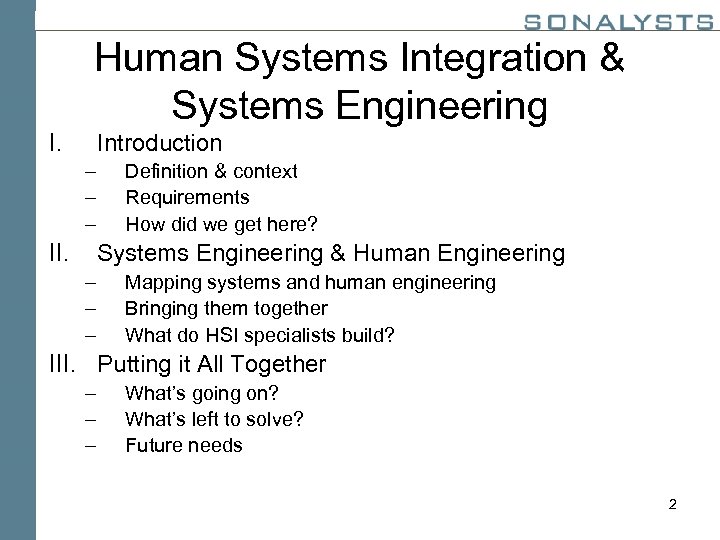 Human Systems Integration & Systems Engineering I. Introduction – – – II. Definition & context Requirements How did we get here? Systems Engineering & Human Engineering – – – Mapping systems and human engineering Bringing them together What do HSI specialists build? III. Putting it All Together – – – What’s going on? What’s left to solve? Future needs 2
 Part I Introduction 3
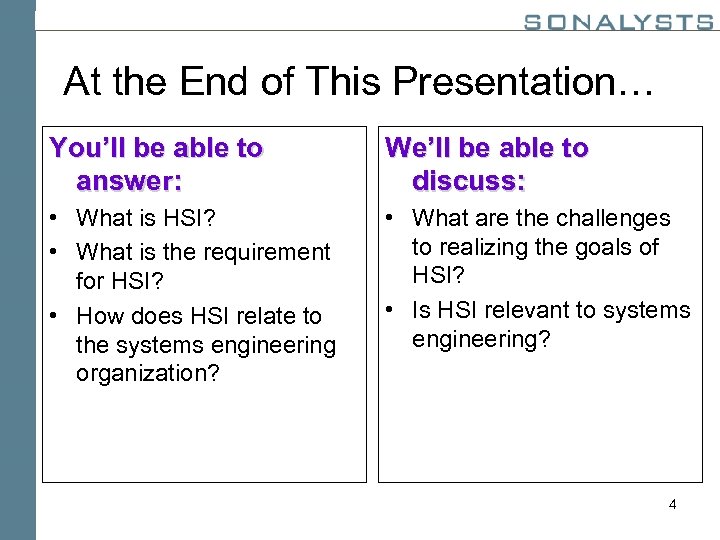 At the End of This Presentation… You’ll be able to answer: We’ll be able to discuss: • What is HSI? • What is the requirement for HSI? • How does HSI relate to the systems engineering organization? • What are the challenges to realizing the goals of HSI? • Is HSI relevant to systems engineering? 4
 For Additional Information… • Handbook of Human Systems Integration, Harold R. Booher, 2003, ISBN: 0 -471 -02053 -2, 1024 pages • Human Systems Integration Symposium 2005: – http: //www. navalengineers. org/Events/HSIS 2005/HSIS 05 Index. html • Human Systems Information Analysis Center: – http: //iac. dtic. mil/hsiac/index. htm • SC-21/ONR Science & Technology Manning Affordability Initiative: – http: //www. manningaffordability. com/s&tweb/index_main. htm 5
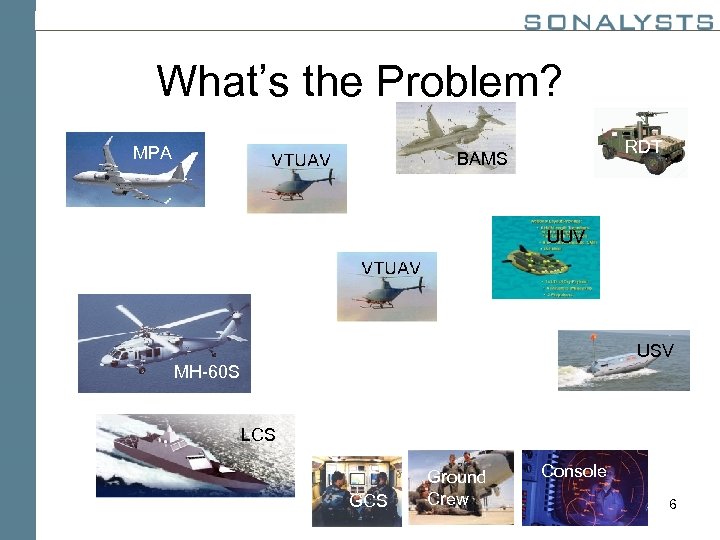 What’s the Problem? MPA RDT BAMS UUV USV MH-60 S LCS Ground Crew Console 6
 HSI Defined • Human Systems Integration is defined as a process that optimizes the human part of the total system equation by integrating human factors engineering, manpower, personnel, training, health, safety, survivability, and habitability considerations into the system acquisition process 7
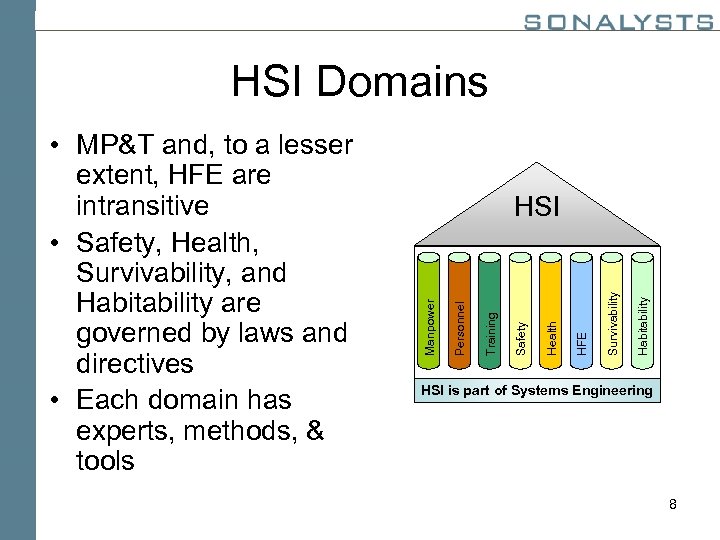 HSI Domains Habitability Survivability HFE Health Safety Training Personnel HSI Manpower • MP&T and, to a lesser extent, HFE are intransitive • Safety, Health, Survivability, and Habitability are governed by laws and directives • Each domain has experts, methods, & tools HSI is part of Systems Engineering 8
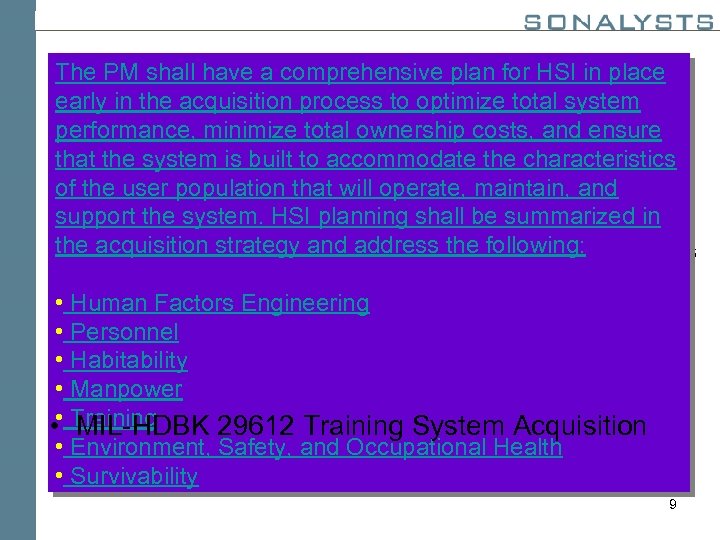 What is the HSI Requirement? The PM shall have a comprehensive plan for HSI in place early in the acquisition process to optimize total system performance, minimize total ownership costs, and ensure • that the system isthe Joint Chiefs of Staffcharacteristics Chairman of built to accommodate the Manual, of Operation Of Thethat will operate, maintain, and the user population Joint Capabilities Integration And the system. HSI planning shall be 3170. 01 A) support. Development System (CJCSI summarized in the–acquisition strategy and address the following: process Change from a requirements-based acquisition to a capabilities-based acquisition process. • Human Factors Engineering • • Personnel Department of Defense (Do. D) Instruction 5000. 2, 12 May 2003, “Operation of the Defense • Habitability Acquisition System • Manpower • • Training MIL-HDBK 29612 Training System Acquisition • Environment, Safety, and Occupational Health • Survivability 9
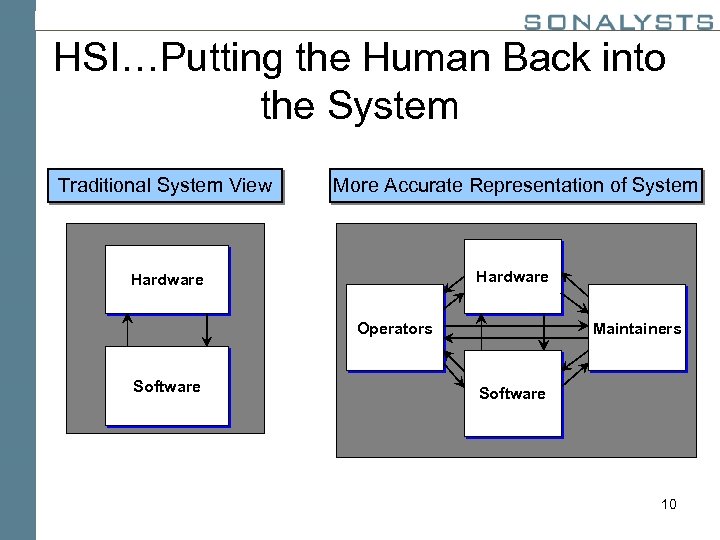 HSI…Putting the Human Back into the System Traditional System View More Accurate Representation of System Hardware Operators Software Maintainers Software 10
 HSI is Not Just About Tools 11
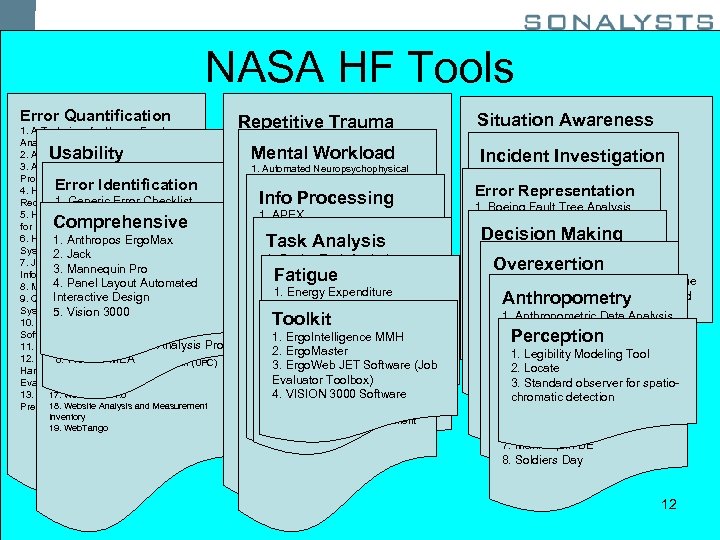 NASA HF Tools Error Quantification 1. A Technique for Human Event Analysis 2. Absolute Probability Judgment 3. Accident Sequence Evaluationfor Evaluation 1. Carlow Usability Test Tool Program Research and 2. Cognitive Walkthrough 4. Human Error Assessment and 3. 1. Generic Conceptual Walkthrough Reduction Technique. Error Checklist 4. DENIM Reliability Methodology 5. Human Error 2. Generic Error Modeling 5. for Event. Diagnostic Recorder for Usability Sequences System Measurement 6. Human Reliability Management 1. Anthropos Ergo. Max Tool 6. 3. Human Hazard and Distributed Usability Evaluation System 2. Jack Analysis 7. Heuristic Operability 7. Justification. Element. Study Data Error 8. Hiser of Human. Pro Toolkit 3. Mannequin Information Ease. HFUse guidelines 9. 4. KSC of PFMEA IBM 4. of Paired Comparisons 8. Method. Questionnaire for User Interface 10. Panel Layout Automated 5. Murphy Diagrams/Critical satisfaction Interactive Design 9. Quantitative Risk Assessment. Approach Action and Decision 11. Vision 3000 System 5. System Usability Measurement 6. Process Failure Mode and Inventory (SUMI) 10. Relex Reliability Prediction 12. System Analysis Effects Usability Scale Software 13. Technique for Human Error 7. Process Hazard Analysis Pro 11. Success Likelihood Index Method Assessment 12. Systems Analysis Programs for 8. Relex FMEA 14. Usability Problem Classification (UPC) Hands-on. User Talkthrough 15. Integrated Reliability Evaluations Test 16. User 13. Technique for Human Error Rate 17. Web. Metrics 1. 0 18. Prediction. Website Analysis and Measurement Usability Error Identification Comprehensive Inventory 19. Web. Tango Repetitive Trauma 1. @Work Office 2. Mental Workload American Conference of 1. Automated Neuropsychophysical Government Industrial Hygienists Assessment Level Hand Activity. Metrics Bedford Workload Scale 3. 2. Info Processing Continuous Safety Sampling 3. Cognitive Neurometric System Method 4. 1. APEX Cognitive Assessment Complex 4. Battery Ergo Intelligence Upper Extremity 2. ATLAS 5. 3. GOMS Analysis Embedded secondary task method Assessment Language Evaluation Task External secondary task method 5. 6. and Boeing Audit Program paper Ergonomics Task Analysis 1. Analysis 7. Frequency Weighted Task Checklist 4. i. GEN using method Complexity Index Micrografx and Fatigue 6. 8. 5. Improved Performance FAA Air Traffic. Self Assessment Control Checklist Designer Instantaneous Expenditure 1. Energy 7. 9. Research Integration. Method for Level. Critical Decision Workload 1 Ergonomics Methodology Modified Cooper-Harper Tool 2. Prediction Program Scale Maintenance/Inspection Guide Integrated Performance for 6. Toolkit. Avoidance Task Analysis 2. Fatigue 10. NASA Bipolar rating scales Work 3. Decision-Action diagram Areas Modeling Environment Scheduling Tool NASA Task Load Index MMH 1. Ergo. Intelligence 8. 11. 4. Event Sequence Diagram Moore-Garg Strain Index 7. Performance and Usability Man-Machine Integration 12. 2. Ergo. Master 3. FMR Alertness Monitor 9. Modeling in ATMSafety and Health Occupational Analysis System Design and Priority Analysis 5. Hierarchical Task for Change 4. Rodgers 3. Ergo. Web JET Software (Job Agency Linear Task Human Systems 13. 6. computer workstation 8. Primary task method Ship System Analysis Evaluator Toolbox) 14. 7. Rasmussen's SRK framework Psycho-physical Assessment and checklist Integration for Affordability Test 4. Workload 3000 Software System VISION Body Assessment 10. Rapid/ Entire. TAAssessment Performance Engineering 8. Tabular Monitor 11. Rapid Upper TA Assessment Limb 15. 9. Timeline Subjective Workload Assessment 12. Washington Safety and Health Technique Agency checklist Situation Awareness 1. Attention-detection 2. Cognitive Compatibility SART Incident Investigation 3. Crew Situation Assessment 1. Apollo RCA software w/ Reality 4. Critical cue detection Charting Error Representation 5. Critical Decision Method 2. Boeing Safety Management 1. Boeing Fault Tree Analysis 6. Performance measures System software 7. Situation Awareness Behaviorally 3. British Airways Human Factors Decision Making 2. Boeing paper-based fault tree Anchored Rating Scale Reporting System method 1. Adaptive User Model 8. Situation Awareness Global 4. Cause Consequence Process 3. Overexertion. Analysis 2. Cabin Procedural Investigation Analytical Hierarchy Assessment Technique Tool 4. Event Tree Strength Prediction 3. 1. 3 -D Static Applied Awareness Rating Technique 9. Situation Cognitive Task 5. Incident Analysis Tool - Modified 5. Fault Tree Awareness Verification and Analysis 10. Program Situation Anthropometry 6. Maintenance Error Decision 6. Faultrease Action Training Aid 4. 2. American Course of Analysis Tool Conference of 1. Anthropometric Data Analysis 7. Paper Root cause analysis 7. NASA Fault Tree Handbook Tool 11. Government Industrial Situation Chief Assessment 2. Crew Present 8. Procedural Event Analysis Tool with. Knowledge. Lifting Guide. Tasks Aerospace Applications 5. Hygienists Analysis of Perception Method. DOD-HDBK-743 A, 3. 9. Ramp Error Decision tree 8. Relex Fault tree/event Aid Tool 1. Legibility Modeling 3. Anthropometry of Assessment Auditory Hazard U. S. Military 10. REASON Root Cause Analysis 2. Locate Algorithm Personnel 11. Team Root Cause Analysis 4. 4. 3. Standardof Body Data spatio. National Institute for Generator observer Occupational detection Analysis 5. chromatic Safety and Health Human Engineering Lifting. Requirements Tool and Guide 5. 6. Human. Scale Utah Compression Force 7. Mannequin BE 8. Soldiers Day 12
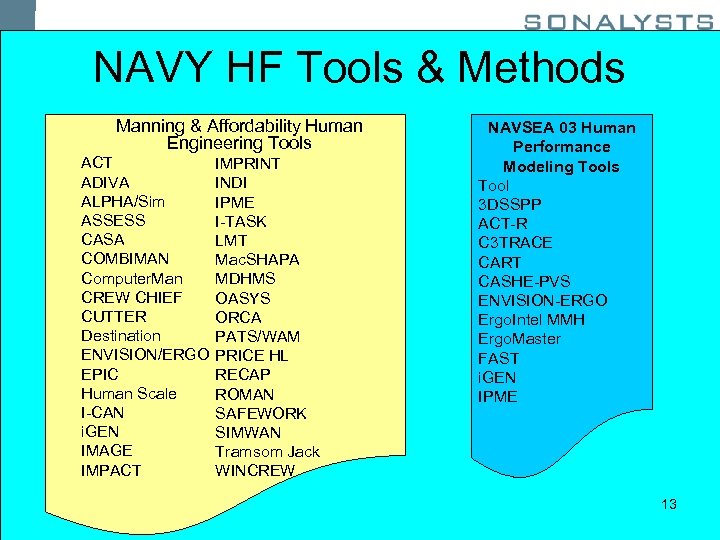 NAVY HF Tools & Methods Manning & Affordability Human Engineering Tools ACT ADIVA ALPHA/Sim ASSESS CASA COMBIMAN Computer. Man CREW CHIEF CUTTER Destination ENVISION/ERGO EPIC Human Scale I-CAN i. GEN IMAGE IMPACT IMPRINT INDI IPME I-TASK LMT Mac. SHAPA MDHMS OASYS ORCA PATS/WAM PRICE HL RECAP ROMAN SAFEWORK SIMWAN Tramsom Jack WINCREW NAVSEA 03 Human Performance Modeling Tools Tool 3 DSSPP ACT-R C 3 TRACE CART CASHE-PVS ENVISION-ERGO Ergo. Intel MMH Ergo. Master FAST i. GEN IPME 13
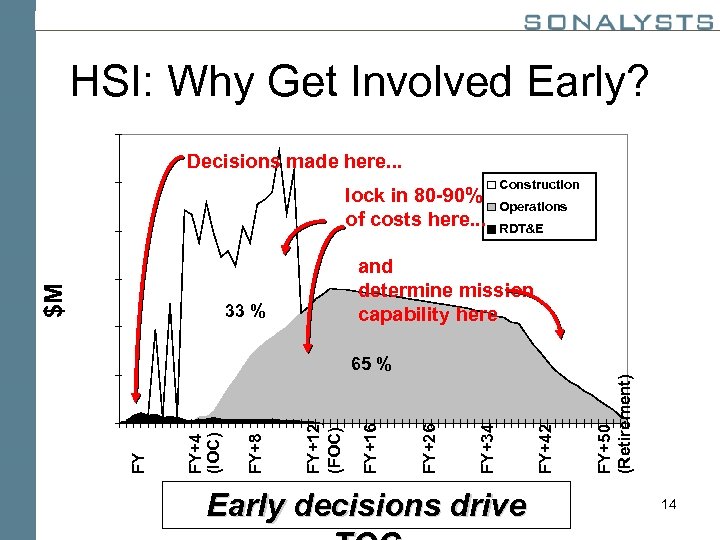 HSI: Why Get Involved Early? Decisions made here. . . $M lock in 80 -90% of costs here. . . Construction Operations RDT&E and determine mission capability here 33 % Early decisions drive FY+50 (Retirement) FY+42 FY+34 FY+26 FY+12 (FOC) FY+8 FY+4 (IOC) FY 65 % 14
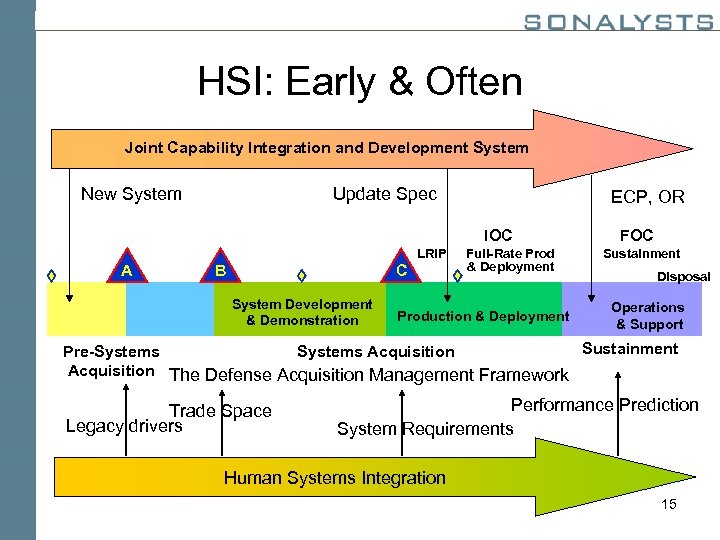 HSI: Early & Often Joint Capability Integration and Development System New System Update Spec ECP, OR IOC LRIP A B C System Development & Demonstration Full-Rate Prod & Deployment Production & Deployment FOC Sustainment Disposal Operations & Support Sustainment Pre-Systems Acquisition The Defense Acquisition Management Framework Trade Space Legacy drivers Performance Prediction System Requirements Human Systems Integration 15
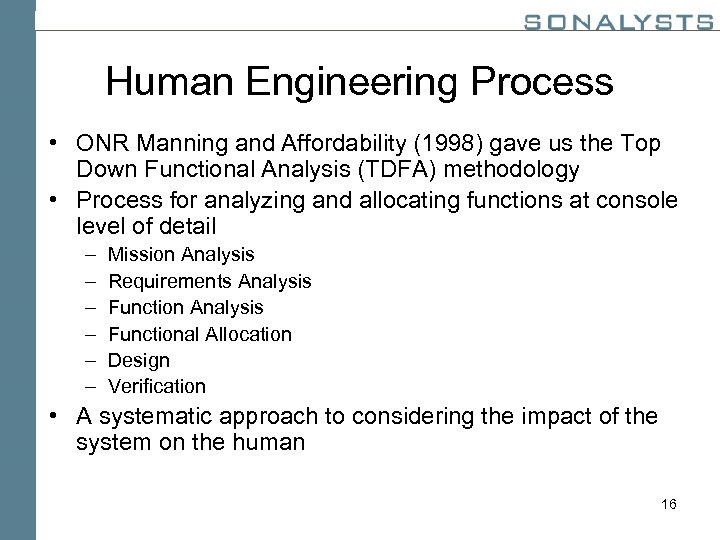 Human Engineering Process • ONR Manning and Affordability (1998) gave us the Top Down Functional Analysis (TDFA) methodology • Process for analyzing and allocating functions at console level of detail – – – Mission Analysis Requirements Analysis Functional Allocation Design Verification • A systematic approach to considering the impact of the system on the human 16
 Part II Systems Engineering & Human Engineering 17
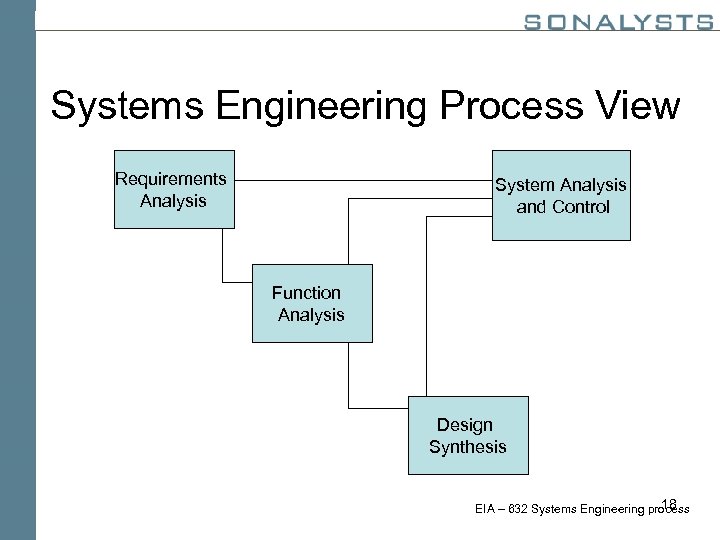 Systems Engineering Process View Requirements Analysis System Analysis and Control Function Analysis Design Synthesis 18 EIA – 632 Systems Engineering process
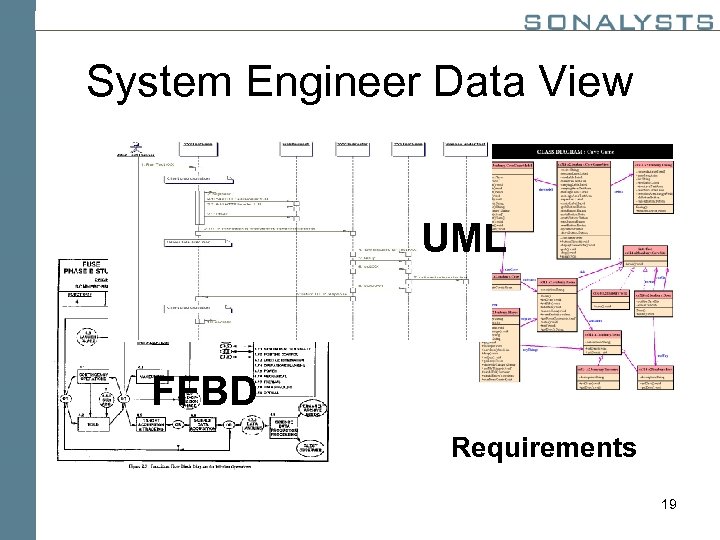 System Engineer Data View UML FFBD Requirements 19
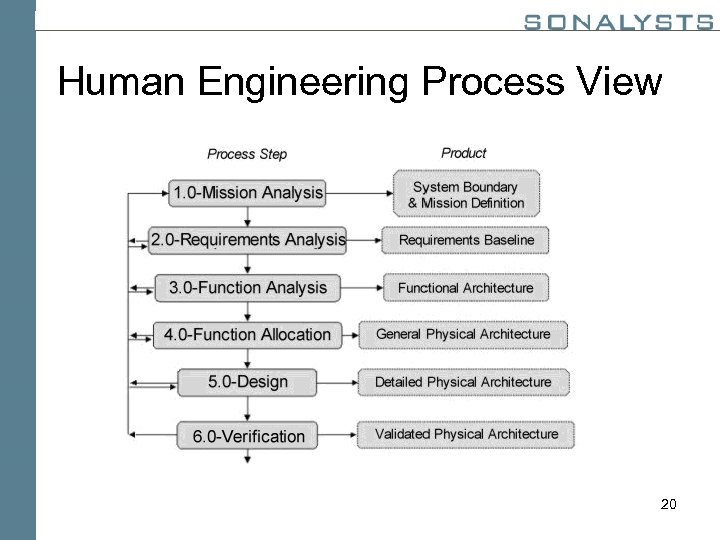 Human Engineering Process View 20
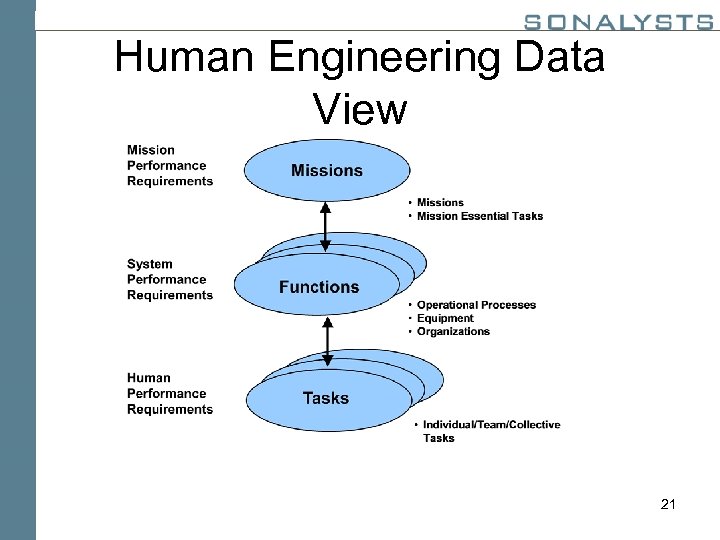 Human Engineering Data View 21
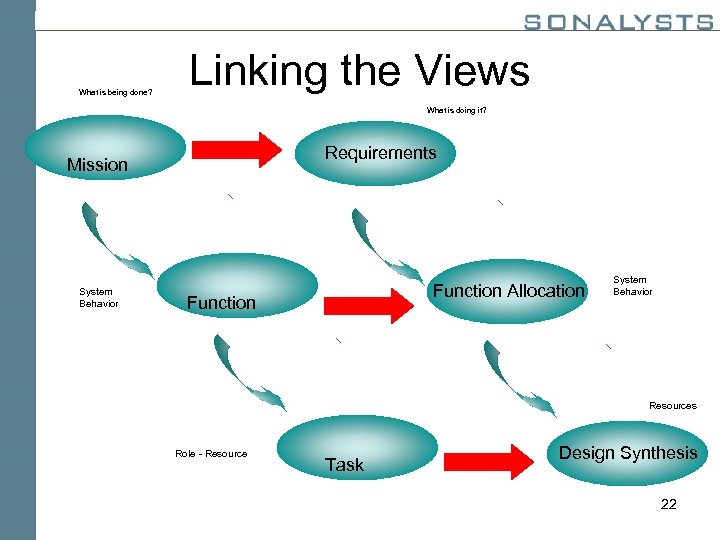 What is being done? Linking the Views What is doing it? Requirements Mission System Behavior Function Allocation Function System Behavior Resources Role - Resource Task Design Synthesis 22
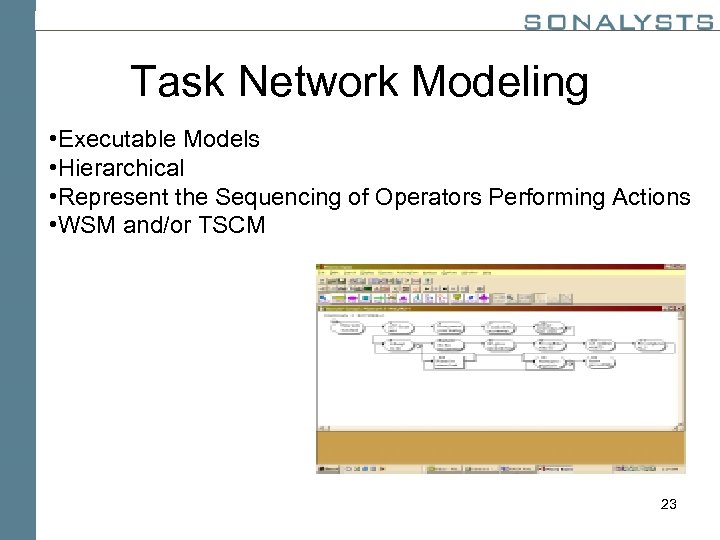 Task Network Modeling • Executable Models • Hierarchical • Represent the Sequencing of Operators Performing Actions • WSM and/or TSCM 23
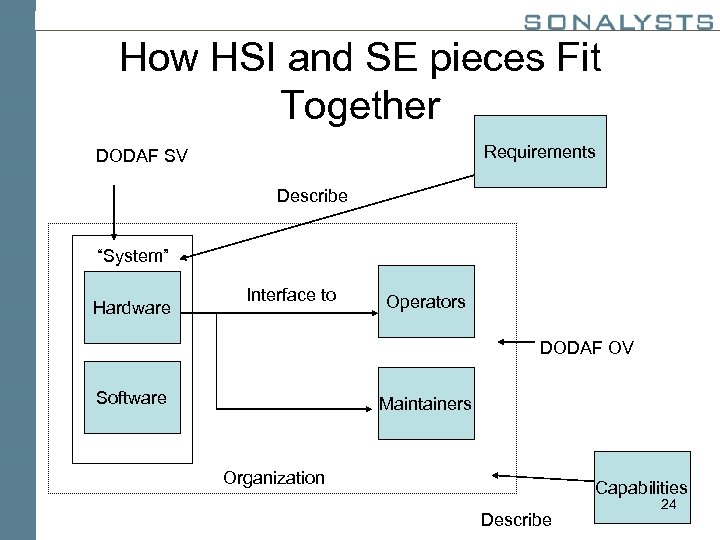 How HSI and SE pieces Fit Together Requirements DODAF SV Describe “System” Hardware Interface to Operators DODAF OV Software Maintainers Organization Capabilities Describe 24
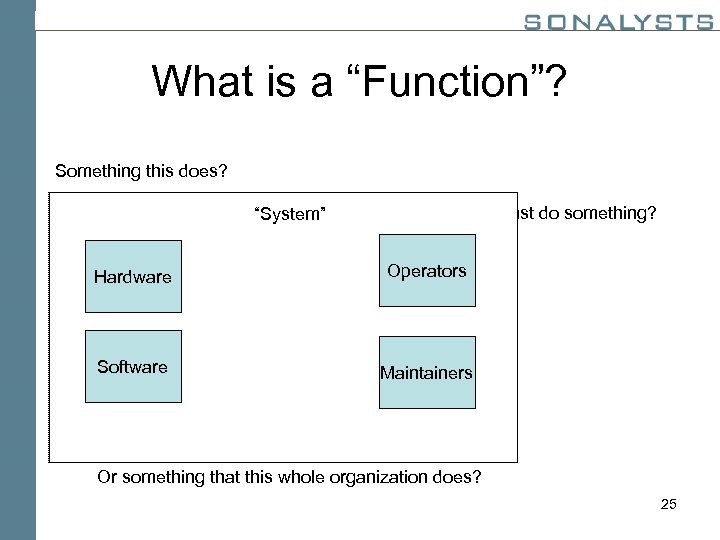 What is a “Function”? Something this does? “System” Which “System” implies that these must do something? Hardware Operators Software Maintainers Or something that this whole organization does? 25
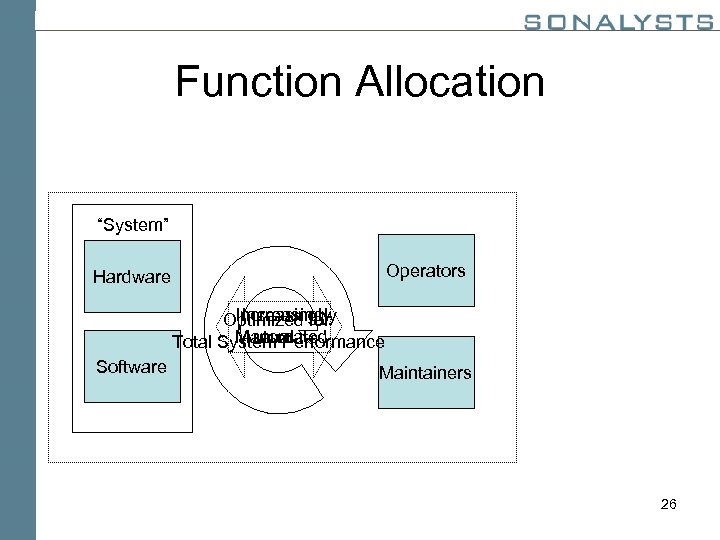 Function Allocation “System” Operators Hardware Increasingly Optimized for Manual Automated Total System Performance Software Maintainers 26
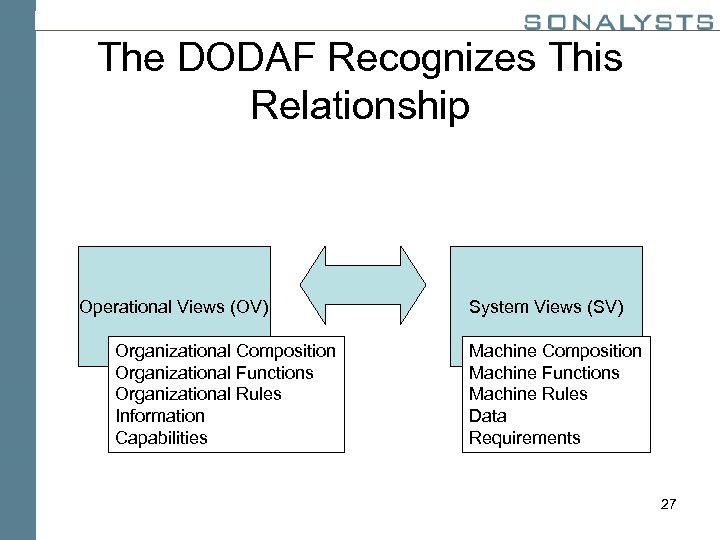 The DODAF Recognizes This Relationship Operational Views (OV) Organizational Composition Organizational Functions Organizational Rules Information Capabilities System Views (SV) Machine Composition Machine Functions Machine Rules Data Requirements 27
 Humans in the System Boundary • Notions of Human Capital Objects (HCO) as system components • System “behavior” (i. e. functional description) is now organizational in nature • Humans must be interfaced to the machine (Kybernetica) via Human factors, ergonomics and health and habitability 28
 HSI and Systems Engineering • Conventionally, human issues were grouped as “logistics” issues and system was “hardware and software” • Manning and Affordability (USN) addressed HSI as a “Human Engineering Process” in parallel with the “systems engineering process” • We think that HSI should be part of Systems Engineering • HSI and SE would then address the fabrication and support of human components (i. e. Human Capital Objects) in the systems engineering trade space 29
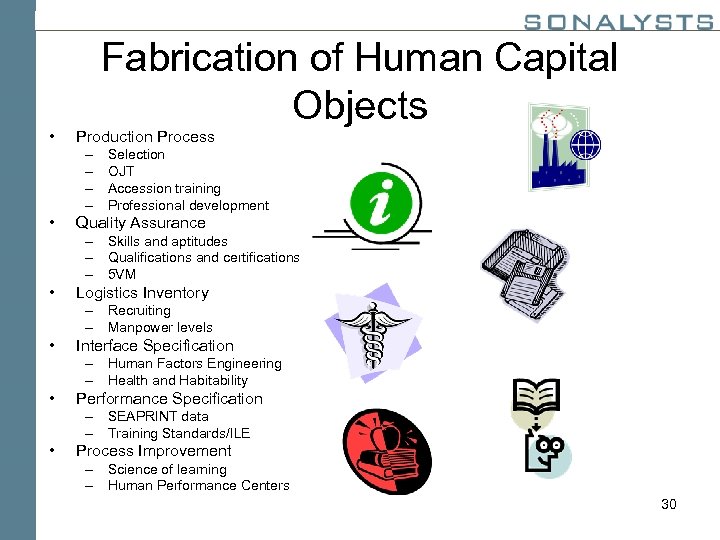 • Fabrication of Human Capital Objects Production Process – – • Selection OJT Accession training Professional development Quality Assurance – Skills and aptitudes – Qualifications and certifications – 5 VM • Logistics Inventory – Recruiting – Manpower levels • Interface Specification – Human Factors Engineering – Health and Habitability • Performance Specification – SEAPRINT data – Training Standards/ILE • Process Improvement – Science of learning – Human Performance Centers 30
 Human Capital Object • Acquiring human capital objects (HCOs) has the same concerns as building machines: performance expectations, production facilities, fabrication and logistics support costs, supply pipeline, development schedule, & technical risk 31
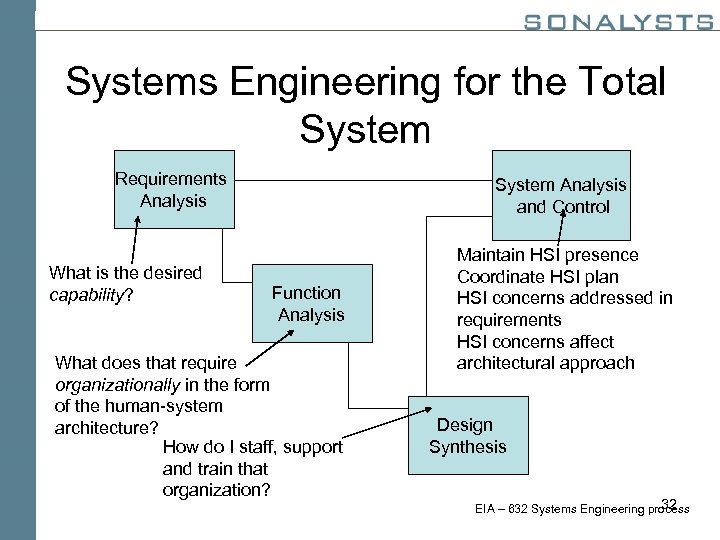 Systems Engineering for the Total System Requirements Analysis What is the desired capability? System Analysis and Control Function Analysis What does that require organizationally in the form of the human-system architecture? How do I staff, support and train that organization? Maintain HSI presence Coordinate HSI plan HSI concerns addressed in requirements HSI concerns affect architectural approach Design Synthesis 32 EIA – 632 Systems Engineering process
 Part III Putting It All Together 33
 Initiatives • • • JCIDS MANPRINT, SEAPRINT, AIRPRINT, US Navy Virtual SYSCOM Human Performance Centers OPNAV N 12 REORG 34
 Math “isms” that get in the way of Human Performance Analysis • Measures and Constructs used by human performance specialists often “collapse” these issues • Preserved in the best practices of a particular specialty, consistent with a traditional problem space • Communication is best when the receiver has a model of the transmitter • We can move data, but we use information 35
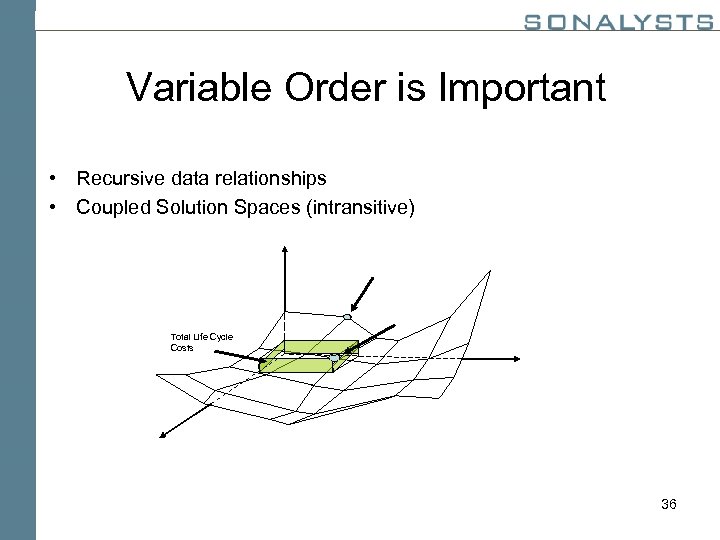 Variable Order is Important • Recursive data relationships • Coupled Solution Spaces (intransitive) Total Life Cycle Costs 36
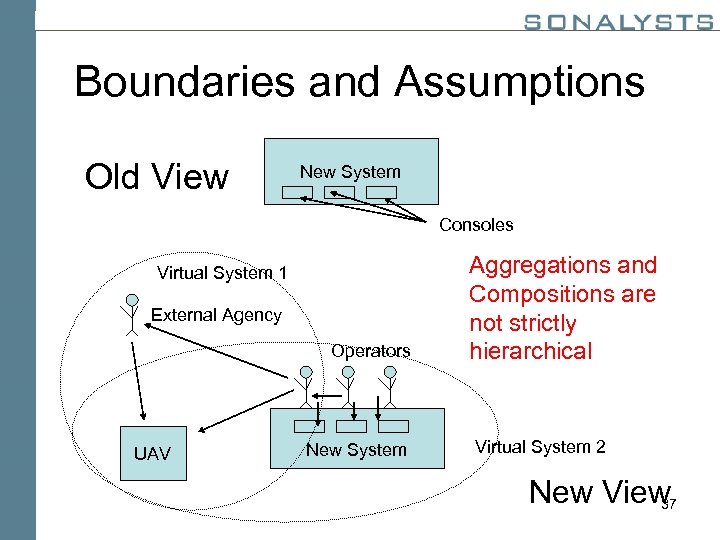 Boundaries and Assumptions Old View New System Consoles Virtual System 1 External Agency Operators UAV New System Aggregations and Compositions are not strictly hierarchical Virtual System 2 New View 37
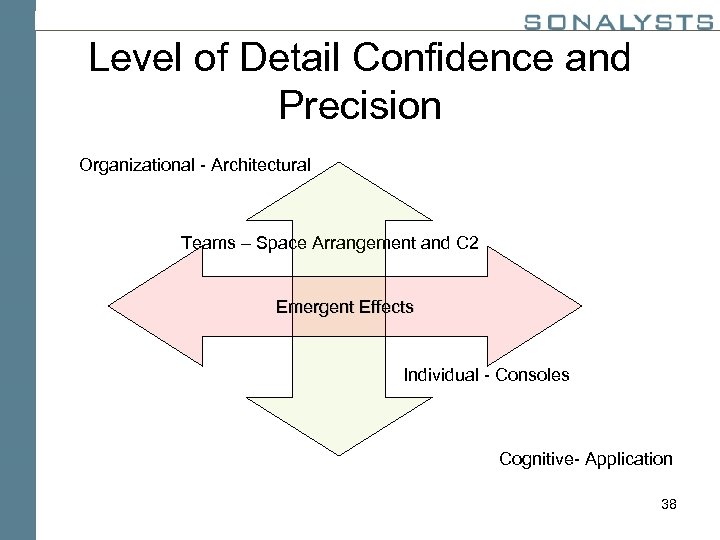 Level of Detail Confidence and Precision Organizational - Architectural Teams – Space Arrangement and C 2 Emergent Effects Individual - Consoles Cognitive- Application 38
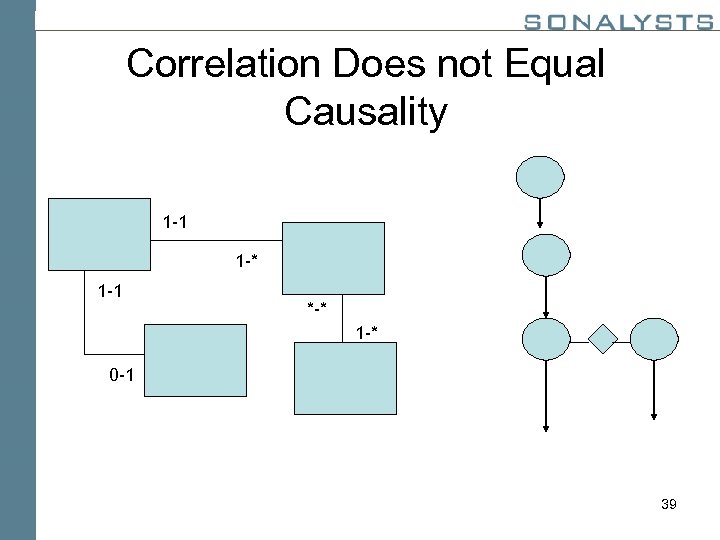 Correlation Does not Equal Causality 1 -1 1 -* 1 -1 *-* 1 -* 0 -1 39
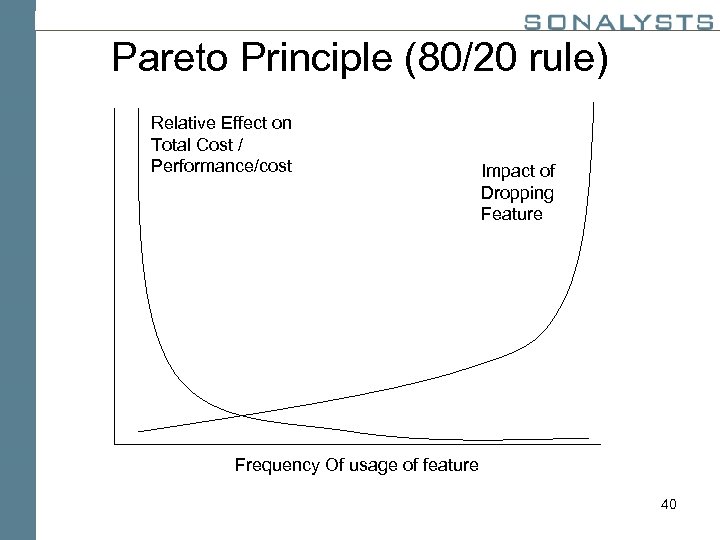 Pareto Principle (80/20 rule) Relative Effect on Total Cost / Performance/cost Impact of Dropping Feature Frequency Of usage of feature 40
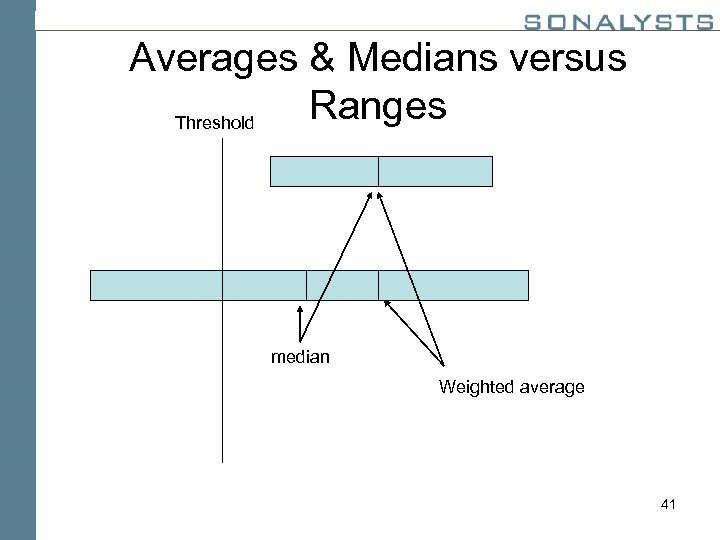 Averages & Medians versus Ranges Threshold median Weighted average 41
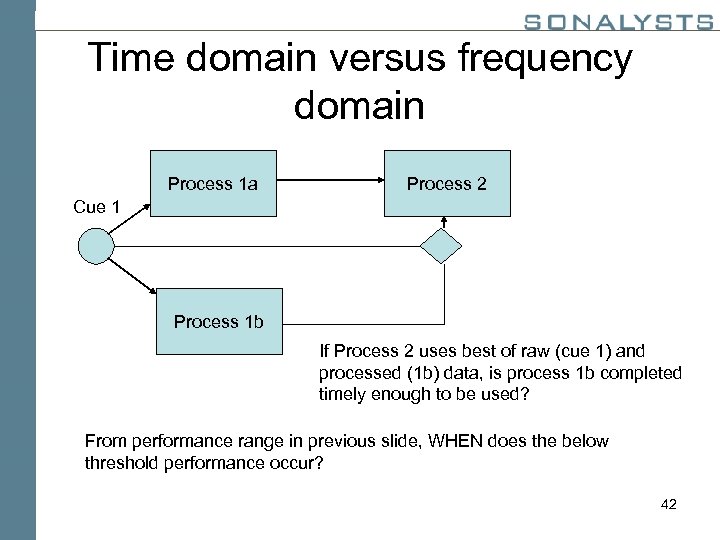 Time domain versus frequency domain Process 1 a Process 2 Cue 1 Process 1 b If Process 2 uses best of raw (cue 1) and processed (1 b) data, is process 1 b completed timely enough to be used? From performance range in previous slide, WHEN does the below threshold performance occur? 42
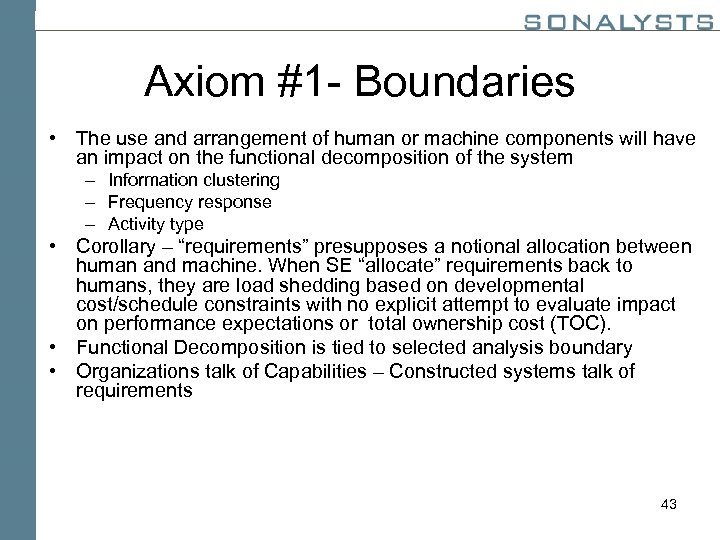 Axiom #1 - Boundaries • The use and arrangement of human or machine components will have an impact on the functional decomposition of the system – Information clustering – Frequency response – Activity type • Corollary – “requirements” presupposes a notional allocation between human and machine. When SE “allocate” requirements back to humans, they are load shedding based on developmental cost/schedule constraints with no explicit attempt to evaluate impact on performance expectations or total ownership cost (TOC). • Functional Decomposition is tied to selected analysis boundary • Organizations talk of Capabilities – Constructed systems talk of requirements 43
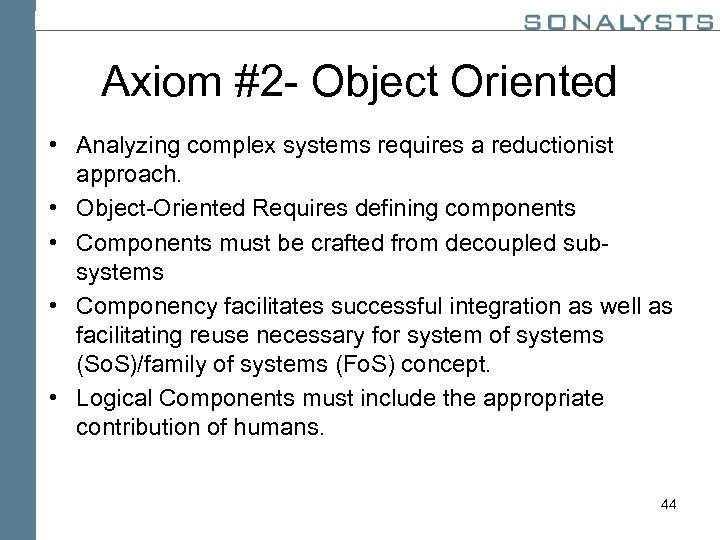 Axiom #2 - Object Oriented • Analyzing complex systems requires a reductionist approach. • Object-Oriented Requires defining components • Components must be crafted from decoupled subsystems • Componency facilitates successful integration as well as facilitating reuse necessary for system of systems (So. S)/family of systems (Fo. S) concept. • Logical Components must include the appropriate contribution of humans. 44
 Axiom #3 - Precision • Design and requirements decisions should only be made at the level of detail for which confidence in the information is high. • Every level of detail has constraints and variables which have effects on constraints and decisions for both finer and coarser grains 45
 Axiom #4 - Decoupling • Optimization of Cost, Schedule and Performance requires: – Logical Components must be analyzed individually for sensitivity to potential design changes, and the most sensitive components addressed first in the trade space – Fabrication and Support (including HSI and traditional ILS) issues with each component must be addressed in the proper order to ensure a decoupled trade space 46
 Axiom #5 - Formalism • In order to succeed and fully support systems engineering, HSI must adopt the formalism, language and paradigm of systems engineering. • SE supports acquisition by creating and monitoring artifacts • ICD, CDD, CPD • Milestone decisions • HSIP, NTSP, MER • Acquisition strategy drives the nature of the design problem • In order to be useful, HSI must be informed by, and directly support the artifacts of, system acquisition. 47
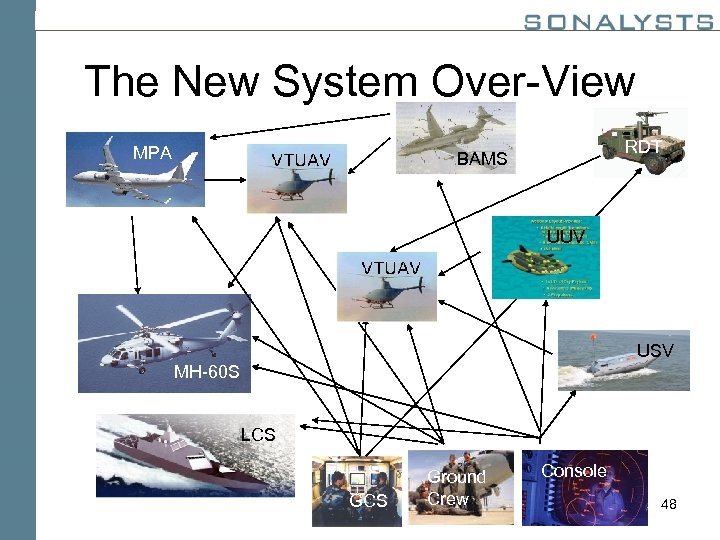 The New System Over-View MPA RDT BAMS UUV USV MH-60 S LCS Ground Crew Console 48
 Final Thoughts • What are the challenges to realizing the goals of HSI? • Is HSI relevant to systems engineering • Whither HSI? Should HSI be incorporated (back into) integrated logistics support? 49
 Questions/Discussion Thank You! 50