


 Скачать презентацию Human skeleton Description Human skeleton consist
Human_skeleton_Lysov_Valery_125.pptx
- Количество слайдов: 17
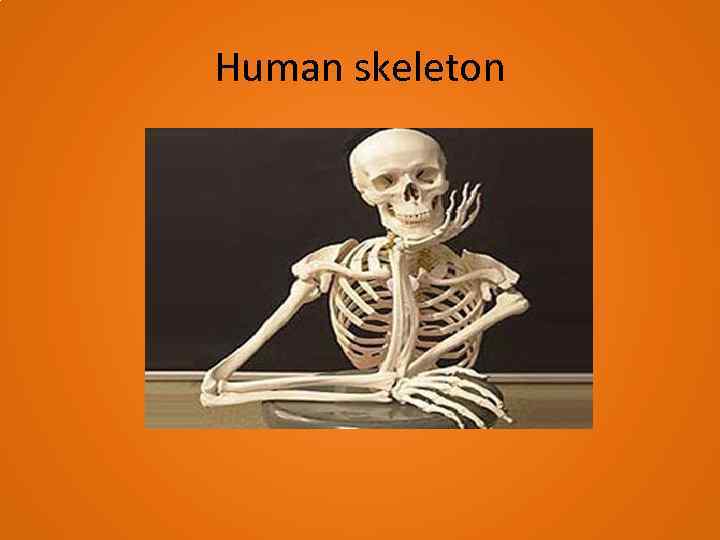 Human skeleton
 Description • Human skeleton consist of two departments axial and appendicular skeleton
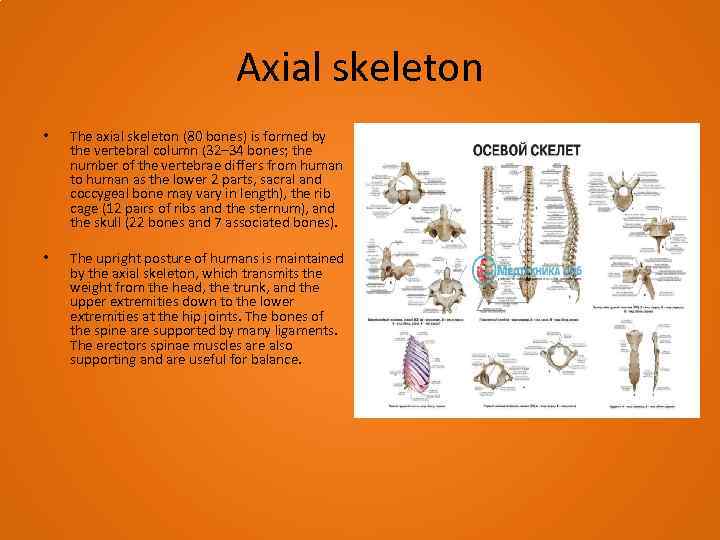 Axial skeleton • The axial skeleton (80 bones) is formed by the vertebral column (32– 34 bones; the number of the vertebrae differs from human to human as the lower 2 parts, sacral and coccygeal bone may vary in length), the rib cage (12 pairs of ribs and the sternum), and the skull (22 bones and 7 associated bones). • The upright posture of humans is maintained by the axial skeleton, which transmits the weight from the head, the trunk, and the upper extremities down to the lower extremities at the hip joints. The bones of the spine are supported by many ligaments. The erectors spinae muscles are also supporting and are useful for balance.
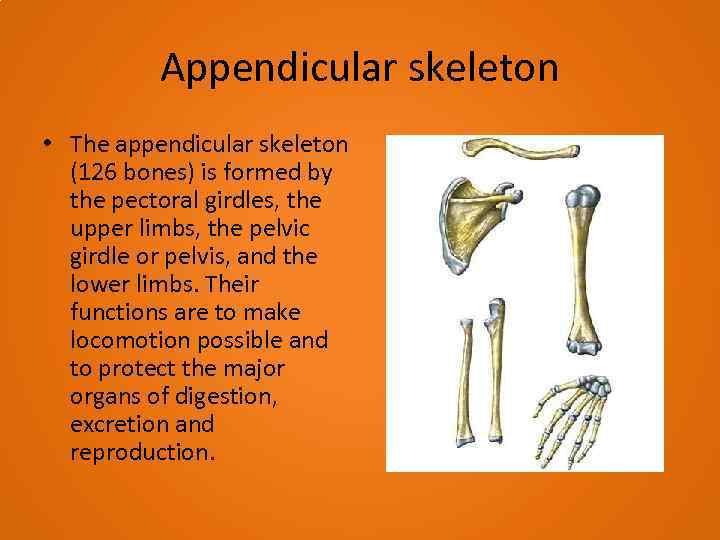 Appendicular skeleton • The appendicular skeleton (126 bones) is formed by the pectoral girdles, the upper limbs, the pelvic girdle or pelvis, and the lower limbs. Their functions are to make locomotion possible and to protect the major organs of digestion, excretion and reproduction.
 Functions • The skeleton serves six major functions; support, movement, protection, production of blood cells, storage of minerals and endocrine regulation.
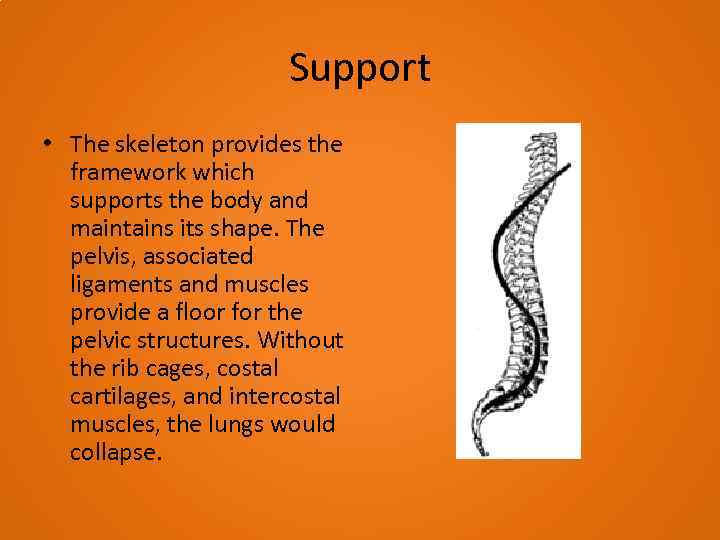 Support • The skeleton provides the framework which supports the body and maintains its shape. The pelvis, associated ligaments and muscles provide a floor for the pelvic structures. Without the rib cages, costal cartilages, and intercostal muscles, the lungs would collapse.
 Movement
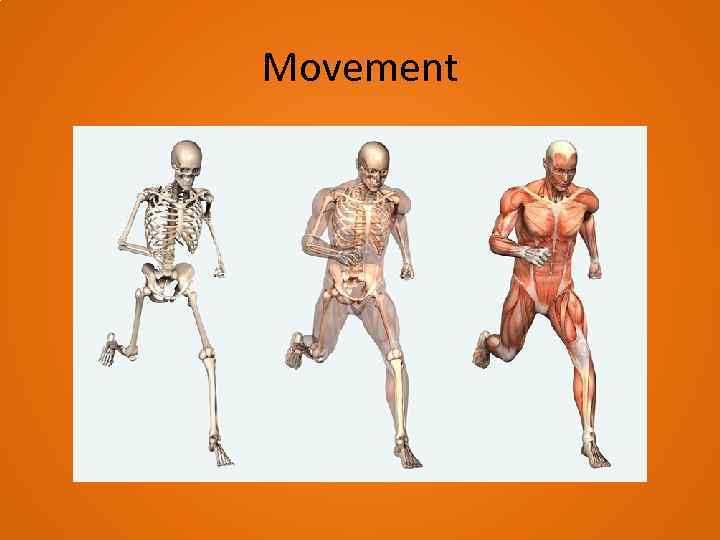
 Movement • The joints between bones allow movement, some allowing a wider range of movement than others, e. g. the ball and socket joint allows a greater range of movement than the pivot joint at the neck. Movement is powered by skeletal muscles, which are attached to the skeleton at various sites on bones. Muscles, bones, and joints provide the principal mechanics for movement, all coordinated by the nervous system. • It is believed that the reduction of human bone density in prehistoric times reduced the agility and dexterity of human movement. Shifting from hunting to agriculture have caused human bone density to reduce significantly.
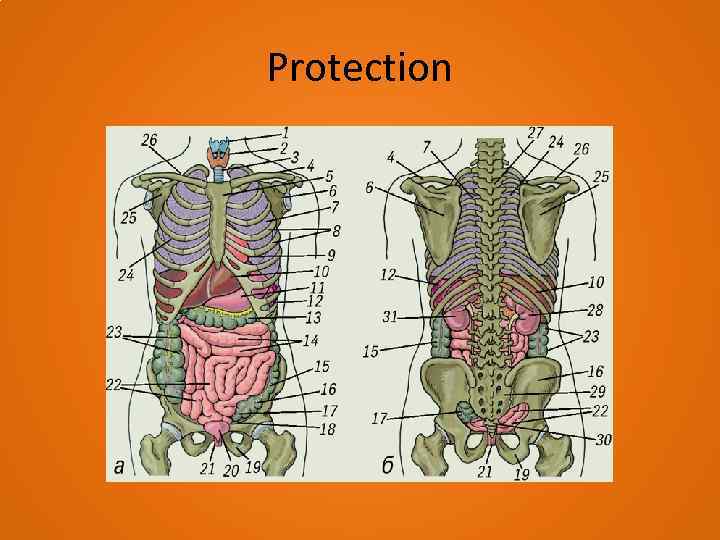 Protection
 Protection The skeleton helps protect our many vital internal organs from being damaged. • The skull protects the brain, the eyes, and the middle and inner ears. • The vertebrae protect the spinal cord. • The rib cage, spine, and sternum protect the lungs, heart and major blood vessels. • The clavicle and scapula protect the shoulder. • The ilium and spine protect the digestive and urogenital systems and the hip. • The patella and the ulna protect the knee and the elbow respectively. • The carpals and tarsals protect the wrist and ankle respectively.
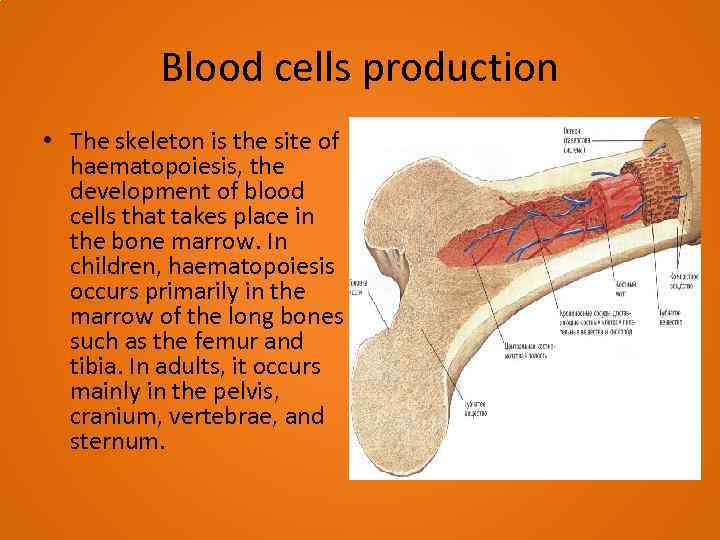 Blood cells production • The skeleton is the site of haematopoiesis, the development of blood cells that takes place in the bone marrow. In children, haematopoiesis occurs primarily in the marrow of the long bones such as the femur and tibia. In adults, it occurs mainly in the pelvis, cranium, vertebrae, and sternum.
 Storage of minerals • The bone matrix can store calcium and is involved in calcium metabolism, and bone marrow can store iron in ferritin and is involved in iron metabolism. However, bones are not entirely made of calcium, but a mixture of chondroitin sulfate and hydroxyapatite, the latter making up 70% of a bone. Hydroxyapatite is in turn composed of 39. 8% of calcium, 41. 4% of oxygen, 18. 5% of phosphorus, and 0. 2% of hydrogen by mass. Chondroitin sulfate is a sugar made up primarily of oxygen and carbon.
 Endocrine regulation • Bone cells release a hormone called osteocalcin, which contributes to the regulation of blood sugar (glucose) and fat deposition. Osteocalcin increases both the insulin secretion and sensitivity, in addition to boosting the number of insulin-producing cells and reducing stores of fat
 Skeleton disorders • There a lot of skeleton disorders, but main of them calls scoliosis, arthritis and osteoporosis.
 Scoliosis • Scoliosis is a side-to-side curve in the back or spine, often creating a pronounced "C" or "S" shape when viewed on an x-ray of the spine. This condition is most apparent during adolescence, and is most common with females.
 Arthritis • Arthritis is a disorder of the joints. It involves inflammation of one or more joints. When affected by arthritis, the joint or joints affected may be painful to move, may move in unusual directions or may be immobile completely. The symptoms of arthritis will vary differently between types of arthritis. The most common form of arthritis: Osteoarthritis can affect both the larger and smaller joints of the human skeleton. The cartilage in the affected joints will degrade, soften and wear away. This decreases the mobility of the joints and decreases the space between bones where cartilage should be.
 Osteoporosis • • Osteoporosis is a disease of bone where there is reduced bone mineral density, increasing the likelihood of fractures. Osteoporosis is defined by the World Health Organization in women as a bone mineral density 2. 5 standard deviations below peak bone mass, relative to the age and sex-matched average, as measured by Dual energy X-ray absorptiometry, with the term "established osteoporosis" including the presence of a fragility fracture. Osteoporosis is most common in women after menopause, when it is called "postmenopausal osteoporosis", but may develop in men and premenopausal women in the presence of particular hormonal disorders and other chronic diseases or as a result of smoking and medications, specifically glucocorticoids. Osteoporosis usually has no symptoms until a fracture occurs. For this reason, DEXA scans are often done in people with one or more risk factors, who have developed osteoporosis and be at risk of fracture. Osteoporosis treatment includes advice to stop smoking, decrease alcohol consumption, exercise regularly, and have a healthy diet. Calcium supplements may also be advised, as may Vitamin D. When medication is used, it may include bisphonates, Strontium ranelate, and osteoporosis may be one factor considered when commencing Hormone replacement therapy