 Скачать презентацию Human Resource Services Writing a Professional Staff Job
005e764f00c6685fa245f3f9514d7e8f.ppt
- Количество слайдов: 23



Human Resource Services Writing a Professional Staff Job Description Questionnaire ( JDQ ) 1
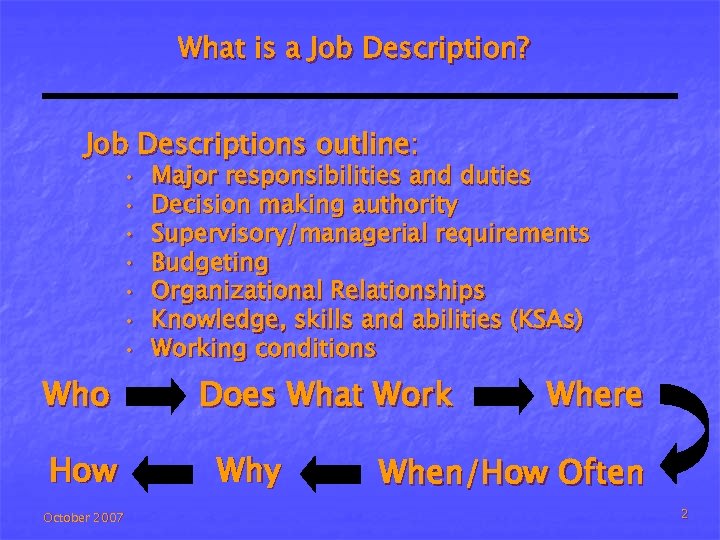
What is a Job Description? Job Descriptions outline: • • Who How October 2007 Major responsibilities and duties Decision making authority Supervisory/managerial requirements Budgeting Organizational Relationships Knowledge, skills and abilities (KSAs) Working conditions Does What Work Why Where When/How Often 2
Why Complete Job Descriptions? Job descriptions can be used to: • • • Assign work and document work assignments. Help clarify and align with the organization’s mission & values. Establish performance requirements. Act as a communication tool between employees and managers. Determine classification and benchmark to the external job market. Recruit for vacancies. Explore reasonable accommodations. Train employees. Help the organization comply with legal requirements related to equal opportunity, equal pay, FLSA (overtime eligibility), etc. Make decisions on work flow and job restructuring. Suggest ways to enrich the work experience. Support and inform succession planning efforts. October 2007 3
When Do I Write or Review Job Descriptions? The JDQ should be written, reviewed or revised as a cooperative effort between the employee and manager when: ü ü ü ü Adding/revising major job duties and/or responsibilities (not intended for minor changes). Requiring additional and/or new minimum qualifications. Creating a new position. During the annual review process (Performance Evaluations). Recruiting for a replacement in an established position. During re-design/re-organization efforts. Identifying revisions based on exploring reasonable accommodations. Development of other HR-related programs such as: • Work Planning • Performance Management • Work Re-Design • Succession Planning October 2007 4
Ask Yourself: In the past, have you completed a new job description focusing on: --what you want to pay? --what level of position you want? --the skills or potential of the employee? --the desire to give someone a raise? FOCUS ON THE WORK, NOT THE PERSON There are two systems that impact employee compensation: --Classification System (based on job duties) --Compensation System (based on employee performance) The JDQ is designed to describe actual work performed and is not intended to drive the compensation system. October 2007 5
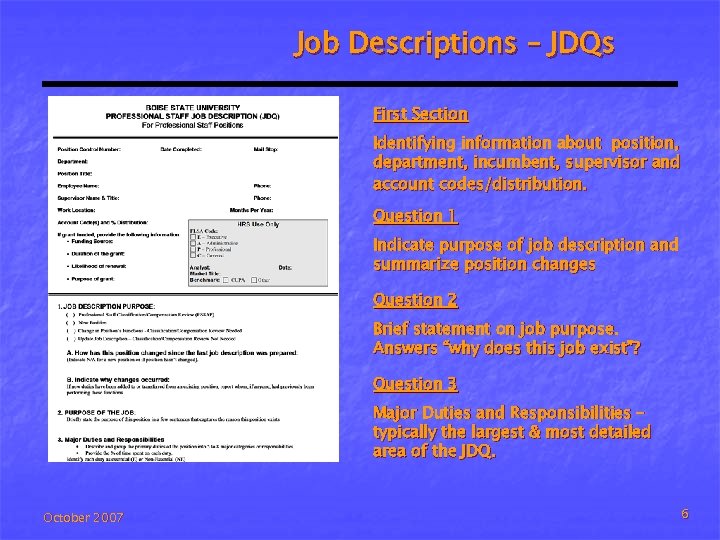
Job Descriptions – JDQs First Section Identifying information about position, department, incumbent, supervisor and account codes/distribution. Question 1 Indicate purpose of job description and summarize position changes Question 2 Brief statement on job purpose. Answers “why does this job exist”? Question 3 Major Duties and Responsibilities – typically the largest & most detailed area of the JDQ. October 2007 6
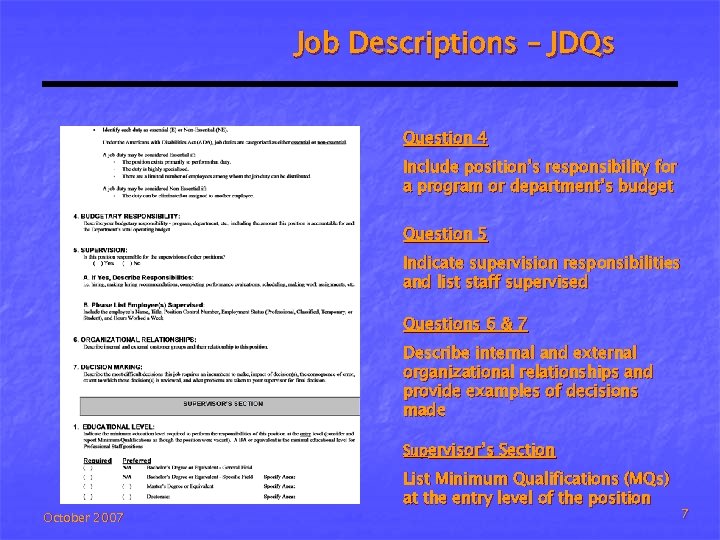
Job Descriptions – JDQs Question 4 Include position’s responsibility for a program or department’s budget Question 5 Indicate supervision responsibilities and list staff supervised Questions 6 & 7 Describe internal and external organizational relationships and provide examples of decisions made Supervisor’s Section October 2007 List Minimum Qualifications (MQs) at the entry level of the position 7
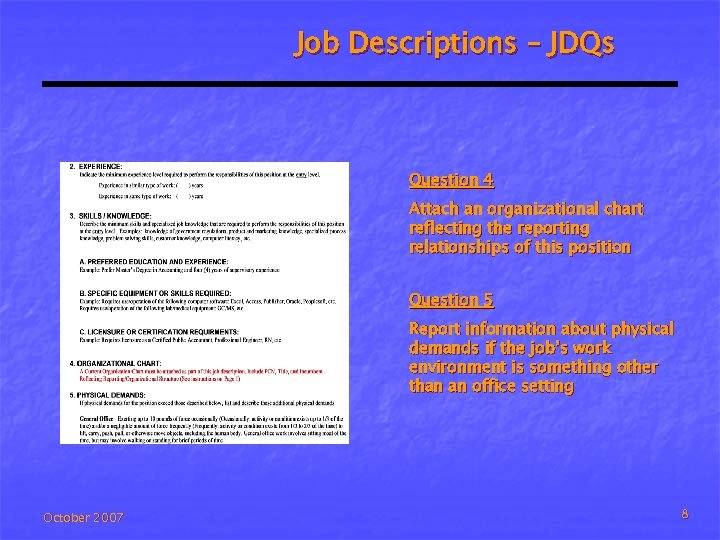
Job Descriptions – JDQs Question 4 Attach an organizational chart reflecting the reporting relationships of this position Question 5 Report information about physical demands if the job’s work environment is something other than an office setting October 2007 8
Job Description Questionnaires Under the Americans with Disabilities Act (ADA), job duties are categorized as either essential or non-essential. Job duties may be considered essential (E) if: • The position exists primarily to perform that duty • The duty is highly specialized • There a limited number of employees among whom the job duties can be distributed A job duty may be considered non-essential (NE) if: • The duties can be eliminated or assigned to another employee October 2007 9
Tips for Writing Job Descriptions n n n Organize like an outline Describe and group the primary duties of the position into 3 – 5 major sets of duties Estimate the approximate amount of time spent in each major heading List more important duties first Identify each set of duties as essential (E) or Non-Essential (NE) Update JDQ as necessary (major changes in job duties or reorganization, for example) October 2007 10
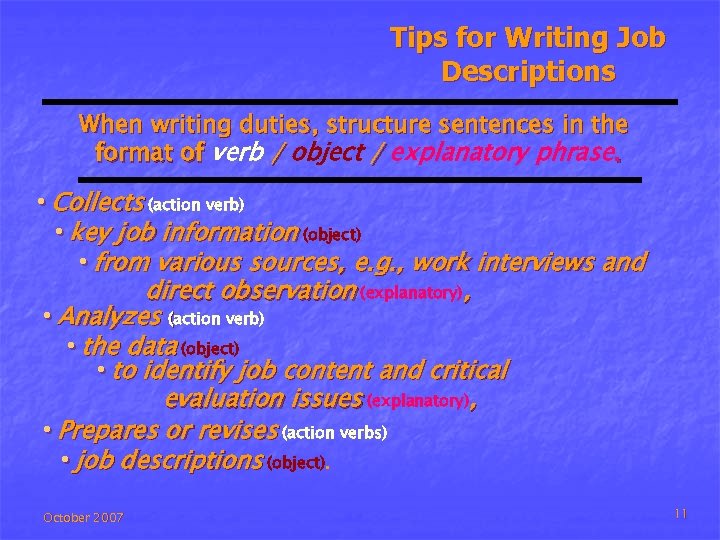
Tips for Writing Job Descriptions When writing duties, structure sentences in the format of verb / object / explanatory phrase. • Collects (action verb) • key job information (object) • from various sources, e. g. , work interviews and direct observation (explanatory), • Analyzes (action verb) • the data (object) • to identify job content and critical evaluation issues (explanatory), • Prepares or revises (action verbs) • job descriptions (object). October 2007 11
Tips for Writing Job Descriptions Caution q When writing a job description, beware of the “inflationary effect” that can occur when describing the extent of responsibilities or scope inherent in a task. q Be sure to consider the full working year and the full range of duties throughout the school year, calendar year or business cycle. q Do not include duties that are cross-covering in someone else’s absence unless it’s a set responsibility to fill in for that position (for example, an Assistant Director filling in for the Director or acting in absence of the Director). October 2007 12
Tips for Writing Job Descriptions No need to reinvent the wheel! Referring to “good examples” can ease the time-consuming task of writing JDQs. Sample materials used in job descriptions are available online at http: //hrs. boisestate. edu/compensation/jobdescriptions. s html Caution Remember, sample documents are very generic and general in nature and it may be tempting to copy these examples directly which can result in an inaccurate job description. If you utilize a sample job description, be sure to clarify the duties to the specific job and department and involve both the employee and supervisor in the development process. October 2007 13
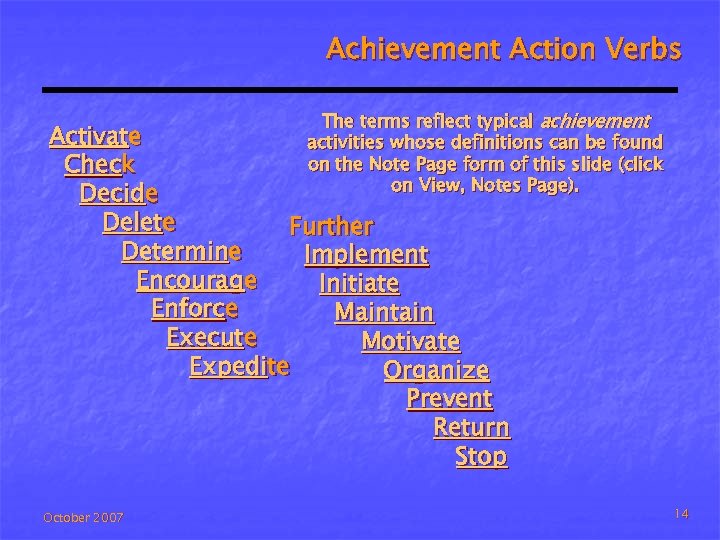
Achievement Action Verbs The terms reflect typical achievement activities whose definitions can be found on the Note Page form of this slide (click on View, Notes Page). Activate Check Decide Delete Further Determine Implement Encourage Initiate Enforce Maintain Execute Motivate Expedite Organize Prevent Return Stop October 2007 14
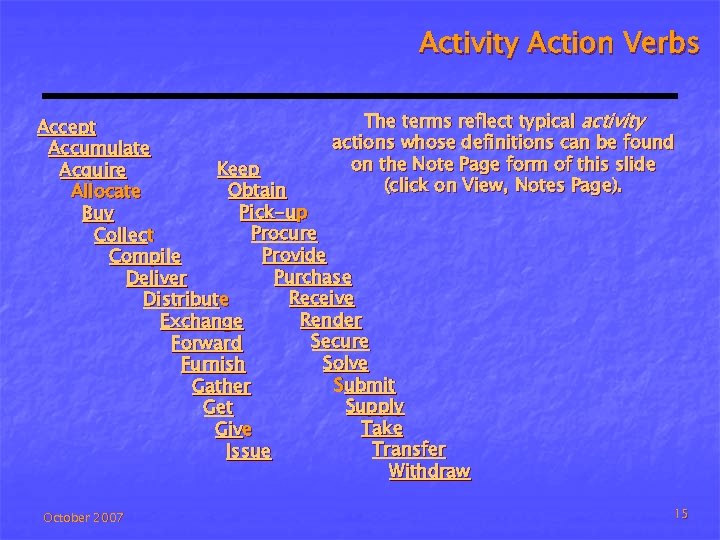
Activity Action Verbs The terms reflect typical activity Accept actions whose definitions can be found Accumulate on the Note Page form of this slide Keep Acquire (click on View, Notes Page). Obtain Allocate Pick-up Buy Procure Collect Provide Compile Purchase Deliver Receive Distribute Render Exchange Secure Forward Solve Furnish Submit Gather Supply Get Take Give Transfer Issue Withdraw October 2007 15
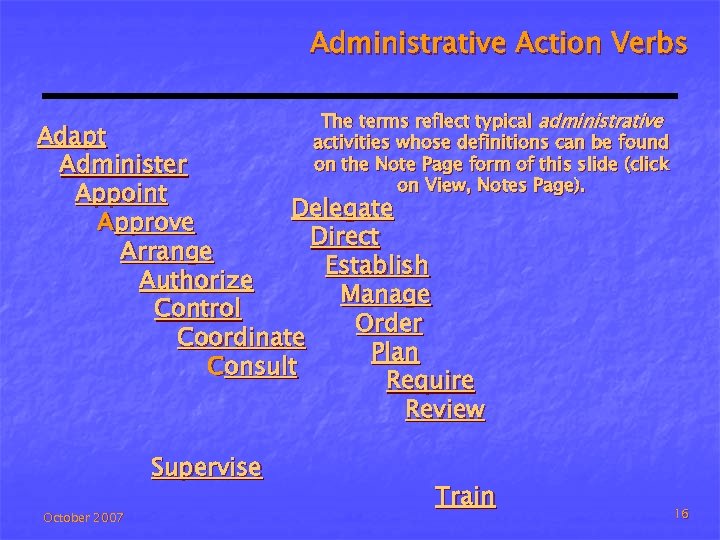
Administrative Action Verbs The terms reflect typical administrative activities whose definitions can be found on the Note Page form of this slide (click on View, Notes Page). Adapt Administer Appoint Delegate Approve Direct Arrange Establish Authorize Manage Control Order Coordinate Plan Consult Require Review Supervise October 2007 Train 16
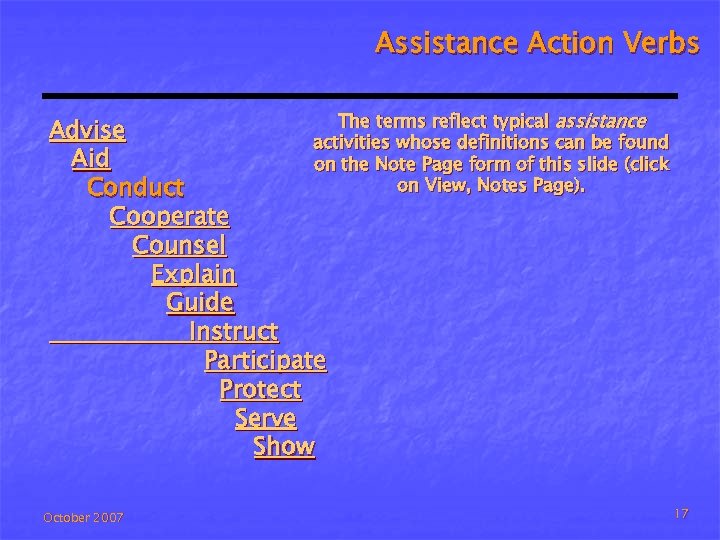
Assistance Action Verbs The terms reflect typical assistance Advise activities whose definitions can be found Aid on the Note Page form of this slide (click on View, Notes Page). Conduct Cooperate Counsel Explain Guide Instruct Participate Protect Serve Show October 2007 17
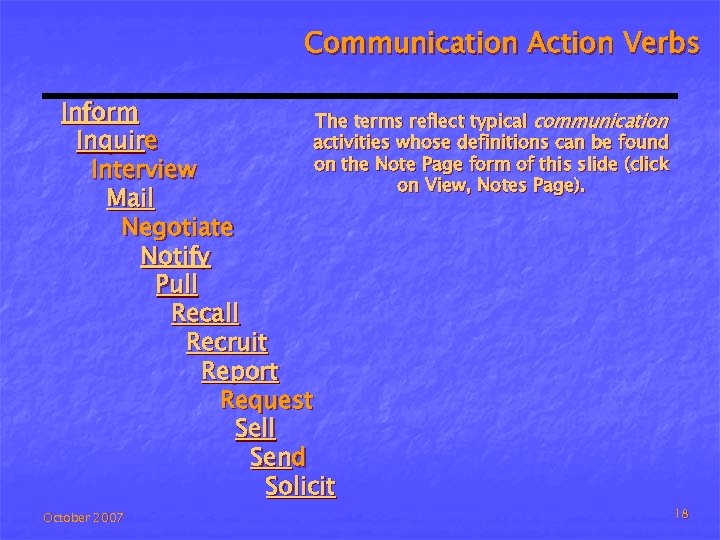
Communication Action Verbs Inform The terms reflect typical communication activities whose definitions can be found Inquire on the Note Page form of this slide (click Interview on View, Notes Page). Mail Negotiate Notify Pull Recall Recruit Report Request Sell Send Solicit October 2007 18
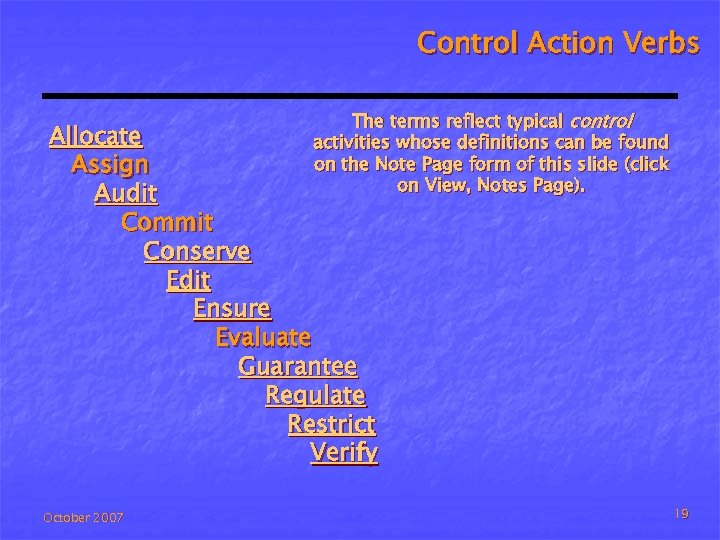
Control Action Verbs The terms reflect typical control activities whose definitions can be found on the Note Page form of this slide (click on View, Notes Page). Allocate Assign Audit Commit Conserve Edit Ensure Evaluate Guarantee Regulate Restrict Verify October 2007 19
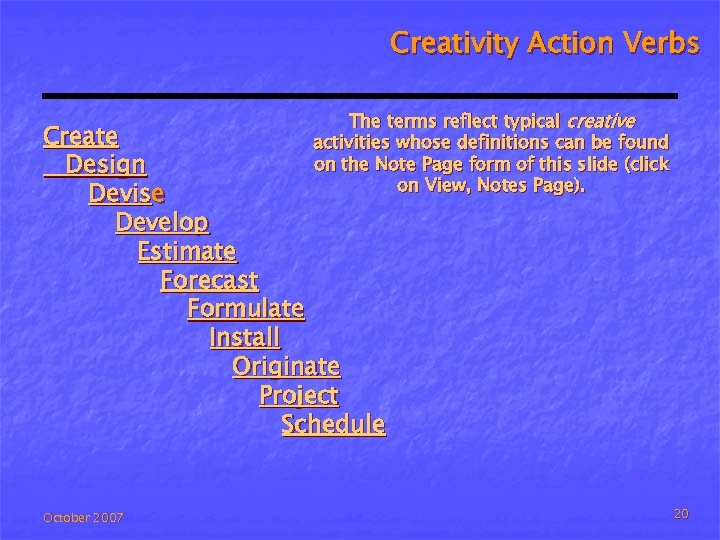
Creativity Action Verbs The terms reflect typical creative activities whose definitions can be found on the Note Page form of this slide (click on View, Notes Page). Create Design Devise Develop Estimate Forecast Formulate Install Originate Project Schedule October 2007 20
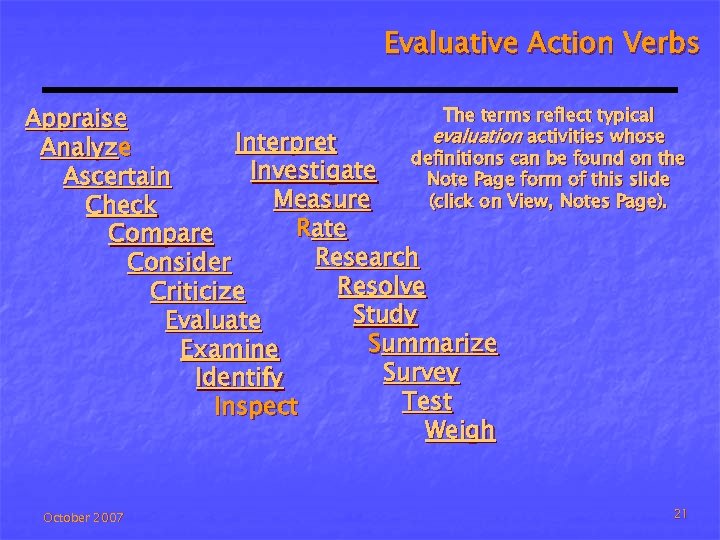
Evaluative Action Verbs The terms reflect typical Appraise evaluation activities whose Interpret Analyze definitions can be found on the Investigate Ascertain Note Page form of this slide (click on View, Notes Page). Measure Check Rate Compare Research Consider Resolve Criticize Study Evaluate Summarize Examine Survey Identify Test Inspect Weigh October 2007 21
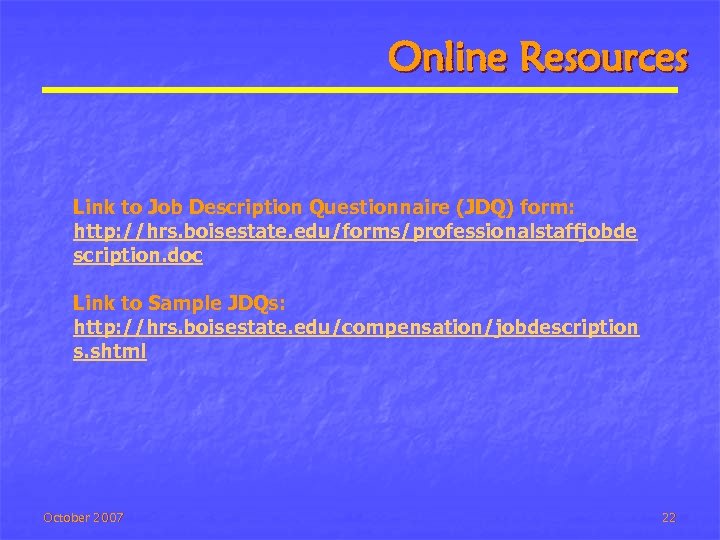
Online Resources Link to Job Description Questionnaire (JDQ) form: http: //hrs. boisestate. edu/forms/professionalstaffjobde scription. doc Link to Sample JDQs: http: //hrs. boisestate. edu/compensation/jobdescription s. shtml October 2007 22

Human Resource Services For more information, please contact Human Resource Services’ Classification/Compensation staff: Joan Thies 426 -1648 Andy Cover 426 -4419 Debi Alvord 426 -1740 October 2007 23
Скачать презентацию Human Resource Services Writing a Professional Staff Job
005e764f00c6685fa245f3f9514d7e8f.ppt