


 Скачать презентацию Human Resource Planning for Competitive Advantage Session
d5893e4e704cc69213613dc1b22cb844.ppt
- Количество слайдов: 25
 Human Resource Planning for Competitive Advantage – Session 6 IB 665 Oct. 15, 2005 Sources: Render & Heizer (2003 course text); Harvard Business Review articles (bibliography); Stonebreaker, P. W. & Leong, Keong, G (1994) (see bibliography), Hosein, Robert W. Dr. (2001 UWIDEC course manual & article in Ergonomics of Hybrid Automated Systems I , edited by Karwowski, W, Parsaei, H R, and Wilhelm, MR, Elsevier Science Publishers B. V. , Amsterdam, 1988; and Stevenson, William J (2002, see bibliography), Juran, J. , Handbook of Quality Control
 Human Resource Planning for Competitive Advantage – Session 6 IB 665 Oct. 15, 2005 Key Objectives: n To motivate employees to increase productivity and profitability. n Henry Ford II’s challenge: To synchronize the match of machines (controllable variability and pacing) to the unknown complex factor of production “Man” (variable pacing and unpredictable). n Role of HR is to manage and make more predictable the human factor.
 Human Resource Planning for Competitive Advantage: Success stories n Three excellent cases in which this strategy has worked are: Southwest airlines (R&H 2003); Harley’s Leadership UTurn( Teerlink, R. HBR July- August, 2000); the Employee. Customer-Profit Chain at Sears (see HBR Jan. 1998). See illustration of the model in the next slide. It should be noted that employee involvement is at the heart of Sear’s overall strategy to regain market share. While employing a different tactic, the same can be said for Harley Davidson’s turn around. In the case of Harley, survival required severe layoffs and the introduction of advanced technology. Management turned to the “behavioural” school. Emphasis was on inclusive leadership, employee involvement in change decisions, and sharing in financial gains.
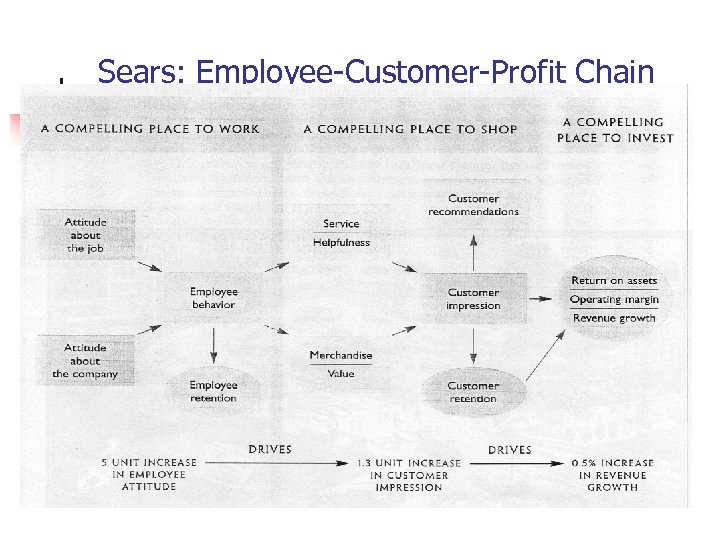 Sears: Employee-Customer-Profit Chain Model
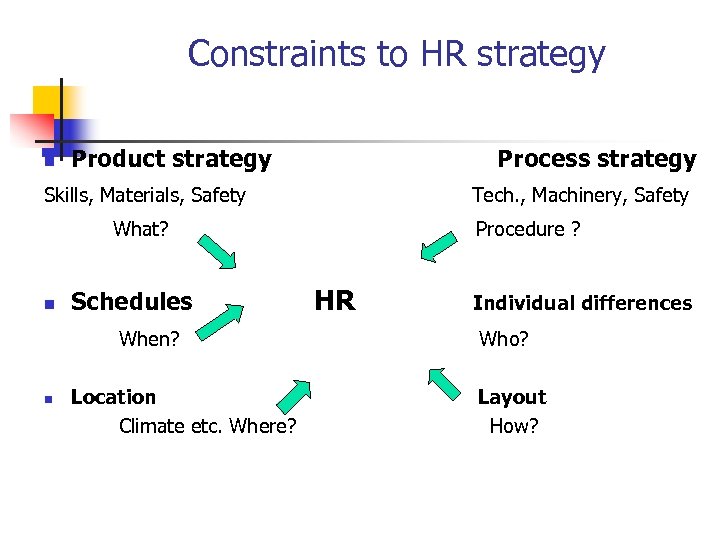 Constraints to HR strategy n Product strategy Process strategy Skills, Materials, Safety Tech. , Machinery, Safety What? n Schedules When? n Location Climate etc. Where? Procedure ? HR Individual differences Who? Layout How?
 Basic elements of HR Strategies Labour Planning : Stability policies; Work Schedules; Job Classification and Work Rules. JOB Design: encompasses the job content / tasks, methods, ergonomic considerations and performance measures.
 Integration of Job Design and Corporate goals (Recall Harley case and Sears) Frame work of job design for an individual or group: Content: Specifies what is to be done (e. g. tasks) Method: How it is to be done (i. e. , tools etc. ) Purpose: Why it is to be done (i. e. , purpose) Target: Are corporate goals being achieved. Ergonomics: incorporation of human factor in the work place. Optimize balance- Efficiency vs Behavioural school
 Integration of Job Design and Corporate goals Results in: Job description including performance monitoring. Shows nature of job in task-related behaviors Performance Measurement/Metrics
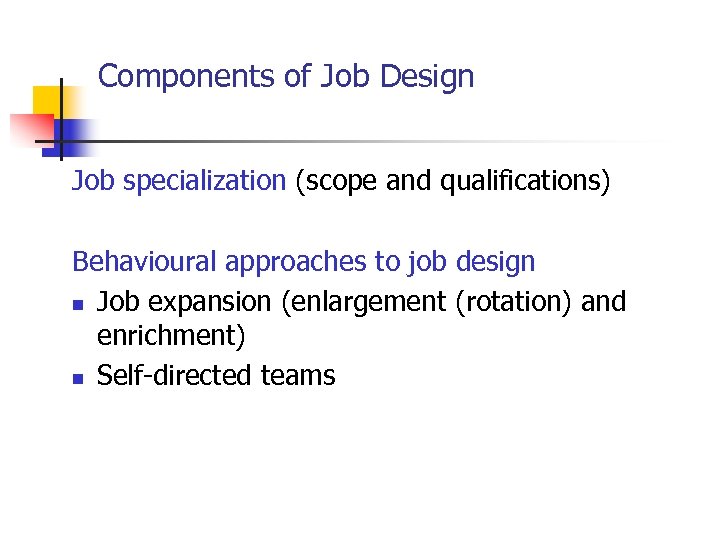 Components of Job Design Job specialization (scope and qualifications) Behavioural approaches to job design n Job expansion (enlargement (rotation) and enrichment) n Self-directed teams
 Job Expansion n Process of adding more variety to jobs Intended to reduce boredom associated with labor specialization Methods Job enlargement n Job enrichment n Job rotation n Employee empowerment n
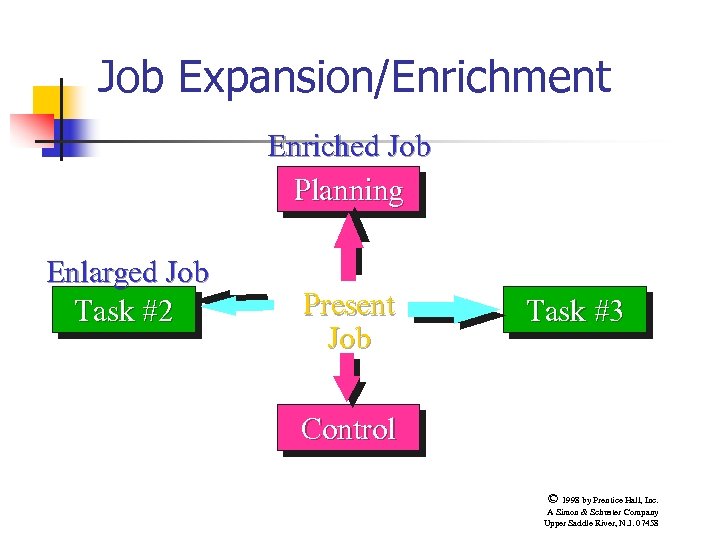 Job Expansion/Enrichment Enriched Job Planning Enlarged Job Task #2 Present Job Task #3 Control © 1998 by Prentice Hall, Inc. A Simon & Schuster Company Upper Saddle River, N. J. 07458
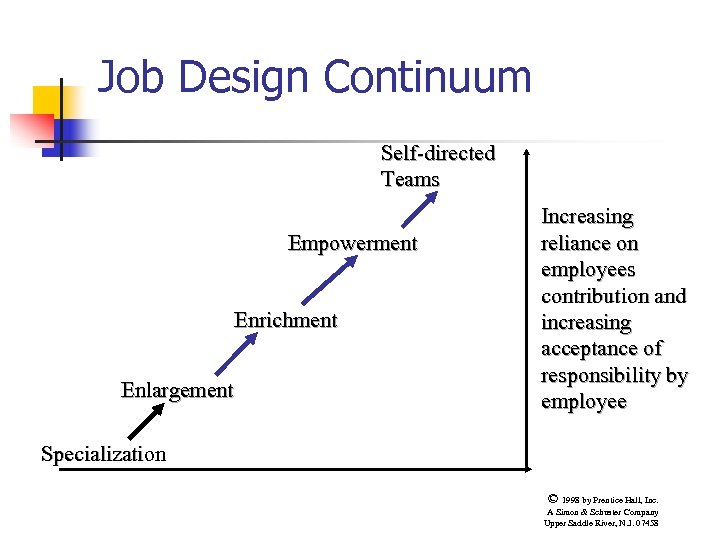 Job Design Continuum Self-directed Teams Empowerment Enrichment Enlargement Increasing reliance on employees contribution and increasing acceptance of responsibility by employee Specialization © 1998 by Prentice Hall, Inc. A Simon & Schuster Company Upper Saddle River, N. J. 07458
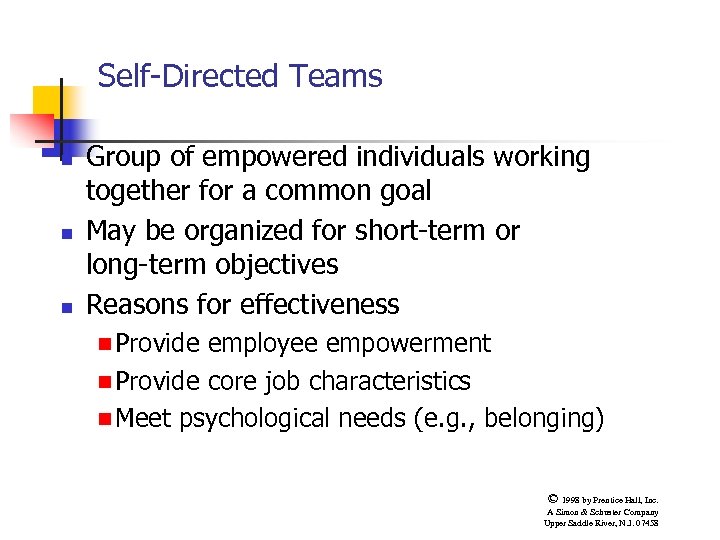 Self-Directed Teams n n n Group of empowered individuals working together for a common goal May be organized for short-term or long-term objectives Reasons for effectiveness n Provide employee empowerment n Provide core job characteristics n Meet psychological needs (e. g. , belonging) © 1998 by Prentice Hall, Inc. A Simon & Schuster Company Upper Saddle River, N. J. 07458
 Self-directed Teams (Caution: Volvo Case and Nut Island Effect n n The Volvo experiment that failed in Sweden suggests that the machine/human factor mix is complex. Probably, the technology of assembly line processes require selectivity in identifying the tasks that are better suited to teams and those that are not. See Stonebraker (1994 op. cit. ) The Nut Island Effect (HBR, March 2001) is also instructive. Good teams could go wrong if they are isolated physically and/or psychologically. , this team of conscientious sewer treatment plant operators dumped excessive chlorine and raw sewerage (3. 7 billion gallons over a six (6) month period in 1982) in the Boston harbour. This action was not executed out of malice but inattention by top management.
 Psychological factors and recruitment n Individual differences and assessment of differences in personalities should be taken into account in matching the profile of potential employees against the job profile.
 Components of Job Design (cont’d)- Motivation theories – (Job shop to Product focused processes) n n n Impact of machine “paced” work and working conditions on worker productivity influenced motivational research: Hawthorne illumination expt. and unintended discovery of sub-cultures, individual differences in work place. Maslow’s Hierarchy of needs ranging from physiological to security, social, egoistic, to self fulfilled/self actualization Mc Gregor’s Theory X and Y Frederick Herzberg (1960 s)… Hygiene theory. Prevent dissatisfaction by using motivational factors
 Core Job Characteristics (Hackman and Oldham) … follow up from Motivational studies n n n Skill variety Job identity Job significance Autonomy Feedback © 1998 by Prentice Hall, Inc. A Simon & Schuster Company Upper Saddle River, N. J. 07458
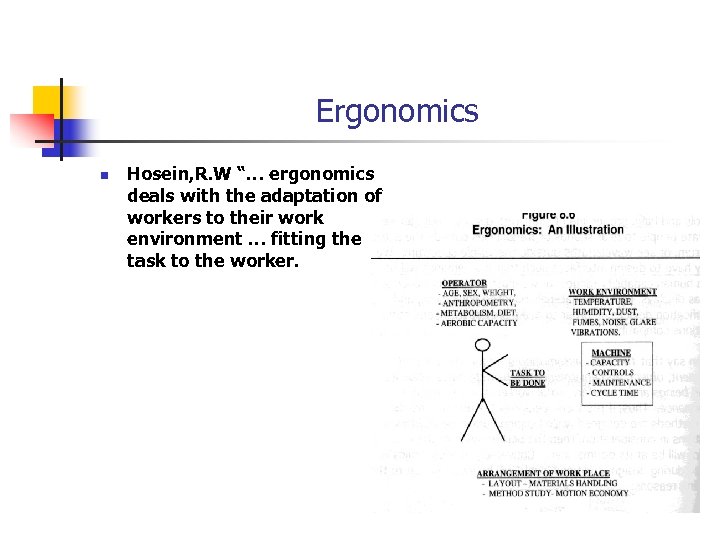 Ergonomics n Hosein, R. W “… ergonomics deals with the adaptation of workers to their work environment … fitting the task to the worker.
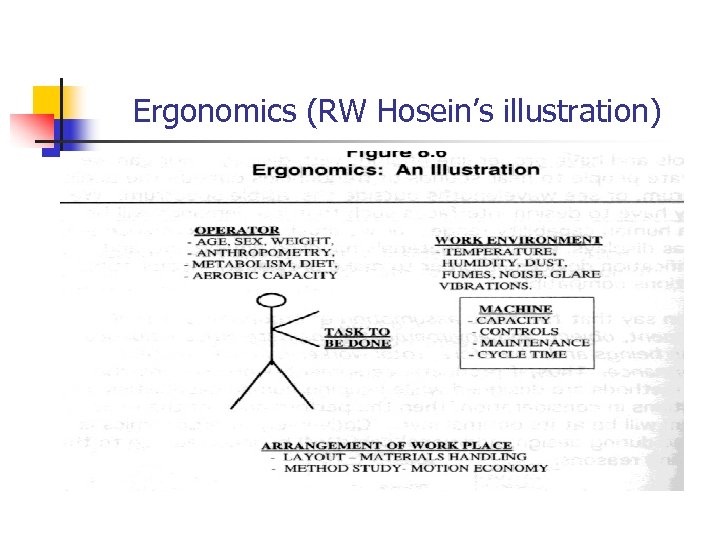 Ergonomics (RW Hosein’s illustration)
 Ergonomics n n Human factors linking workers and machines/equipment. Also applies to sports. e. g. typists/keyboard occupational risks ; tennis elbows. See your text R&H (2003) pp. 377 to 380 for details on ergonomics and work methods. Very important advice in refitting offices and work place.
 Ergonomics & Job specs. /standards for rest and safety ( Source: Dr. R. W. Hosein UWIDEC Manual n Worker performance depends on: n n n Motivation Individual characteristics Occupational biomechanics () *Worker characteristics, task characteristics *Job energy requirements (JER) [ Oxygen & Kilocal used. *Aerobic capacity [Heart beat and rest periods] *Physical Fitness Index (PFI) * Work load norm and rest –pauses * Metabolism and diet
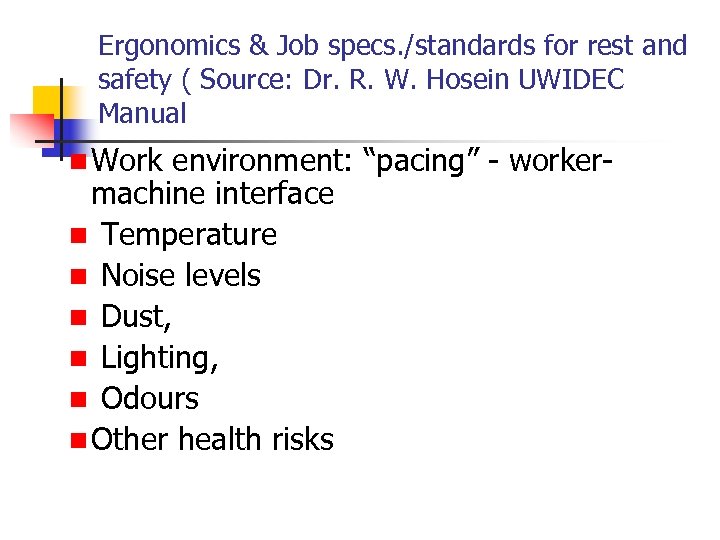 Ergonomics & Job specs. /standards for rest and safety ( Source: Dr. R. W. Hosein UWIDEC Manual n Work environment: “pacing” - workermachine interface n Temperature n Noise levels n Dust, n Lighting, n Odours n Other health risks
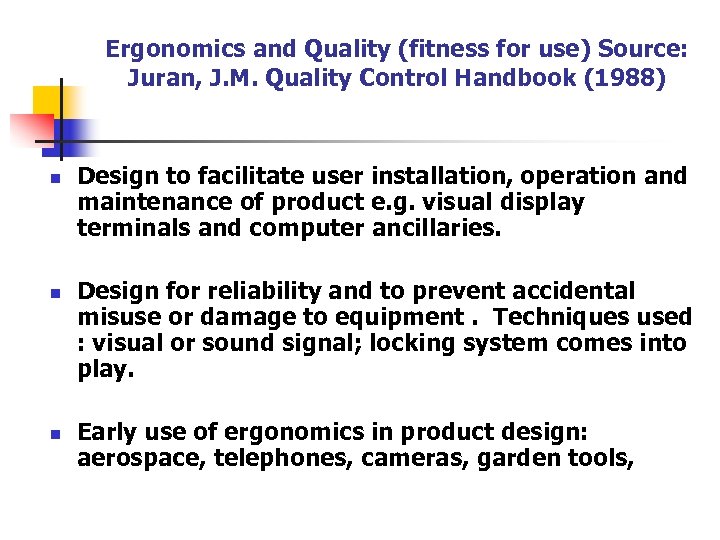 Ergonomics and Quality (fitness for use) Source: Juran, J. M. Quality Control Handbook (1988) n n n Design to facilitate user installation, operation and maintenance of product e. g. visual display terminals and computer ancillaries. Design for reliability and to prevent accidental misuse or damage to equipment. Techniques used : visual or sound signal; locking system comes into play. Early use of ergonomics in product design: aerospace, telephones, cameras, garden tools,
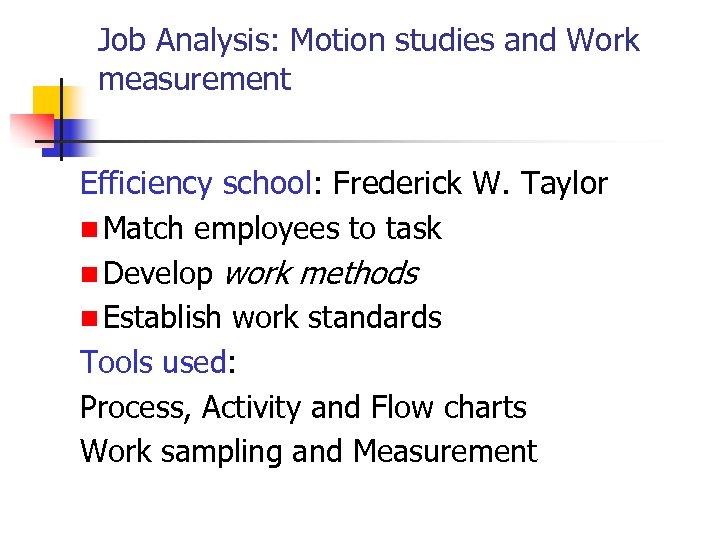 Job Analysis: Motion studies and Work measurement Efficiency school: Frederick W. Taylor n Match employees to task n Develop work methods n Establish work standards Tools used: Process, Activity and Flow charts Work sampling and Measurement
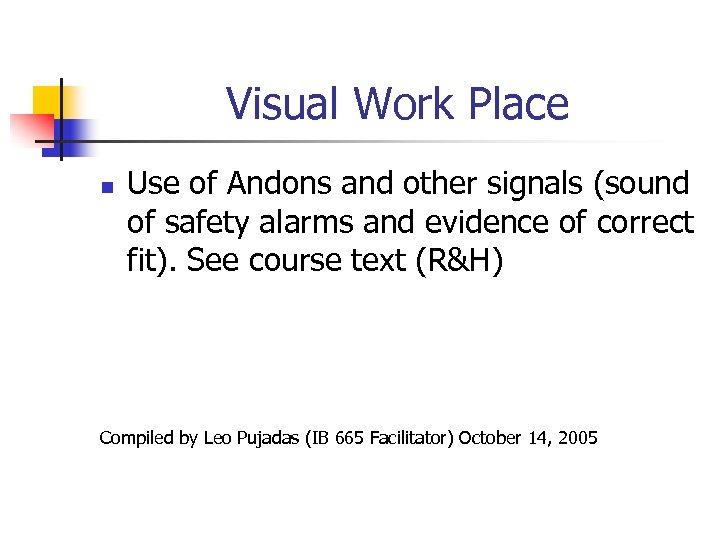 Visual Work Place n Use of Andons and other signals (sound of safety alarms and evidence of correct fit). See course text (R&H) Compiled by Leo Pujadas (IB 665 Facilitator) October 14, 2005