 Скачать презентацию Human Resource Management System HRMS Business Case Analysis
97ba34e4c55264d792081f99b7c0d095.ppt
- Количество слайдов: 40



Human Resource Management System (HRMS) Business Case Analysis Presented by Government Finance Officers Association James Harris and Barry Mc. Meekin
Agenda GFOA Background n City and County of San Francisco Project n What is an Enterprise System? n CCSF Visioning n Questions and Answers n
Contact Information n Anne Kinney – Project Director 312/977 -9700 AKinney@gfoa. org Barry Mc. Meekin - Project Manager 312/977 -9700 BMcmeekin@gfoa. org James Harris – Project Business Analyst 312/977 -9700 jamesharris@gfoa. org
GFOA Background “The purpose of the Government Finance Officers Association is to enhance and promote the professional management of governments for the public benefit. The GFOA accomplishes this mission by identifying and developing financial policies and practices and promoting them through education, training and leadership. ”
GFOA is the leading association promoting the professional management of financial resources in state and local governments in the United States and Canada. GFOA FACTS n n n Established in 1906 to promote sound financial management by encouraging the use of systematic budgeting and accounting methods Over 55 professionals in Chicago & DC Major source of recommended practices in public finance and budgeting Celebrating our Centennial this year!!! Diverse programs activities—annual conference, publications, training, and consulting
National Programs n Awards For Recognition – Certificate of Achievement of Excellence in Financial Reporting (CAFR Program) – Distinguished Budget Presentation Award (Budget Awards Program) n National Training Areas (Examples) Accounting Budgeting Best Practices Financial Reporting Capital Finance & Debt Admin. Pensions & Benefits ERP Strategies Municipal Bond Sales Evaluating Internal Controls
Research & Publications n Government Finance Review- GFOA’s Monthly Periodical – Focuses on the current issues that matter most in public finance » Financial Best Practices » HRMS. Payroll, Time and Labor » Performance Measurement » Enterprise Resource Planning » Etc.
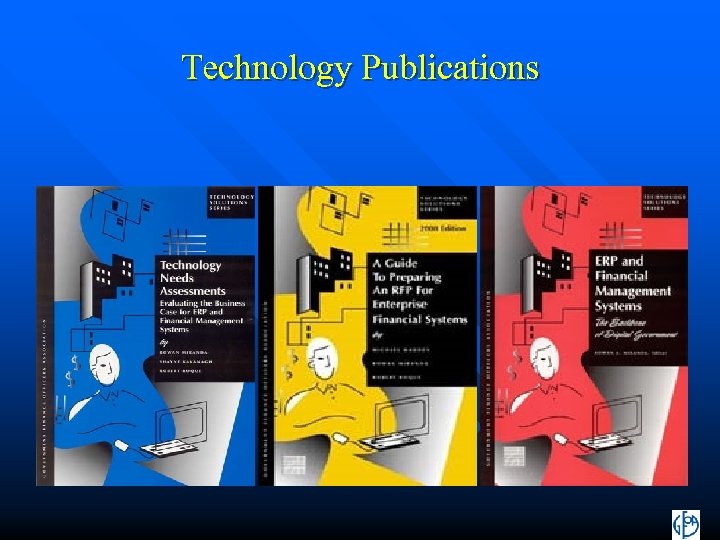
Technology Publications
Research and Consulting Center n n Management Consulting (performance measurement, financial planning, outsourcing, budget process reengineering) Technology Consulting (financial systems, ERP systems, utility billing, HRMS/Payroll, time and attendance, Enterprise Asset Management, CRM, and IT outsourcing) 18 Professionals focused on consulting—but are also authors of leading books and Publications Over 125 technology projects completed for a broad range of governments
A Growing List of Clients Des Moines Water. Works, IA Marin Municipal Water Authority, CA Clark County, NV Union Sanitary District, CA Cook County, IL Administrative Office of the Courts, CA Los Angeles County, CA California Bar Association Milwaukee Metropolitan Sewer District, WI Marin County, CA SEPTA (PA) San Luis Obispo County, CA Sonoma County, CA Wake County, NC City of Portland, OR City of Burnaby, BC Boston Water and Sewer Commission, MA Garland Independent School District, TX Collin County, TX Lake County, IL Wayne County, NY Rockland County, NY
The GFOA Advantage Independent Analysis n Experience n – We have assisted over 125 governmental entities in system procurement. – GFOA has negotiated approximately $700 million in software licenses and implementation services. n Negotiation Leverage Through Our Membership Network

The City and County of San Francisco Project
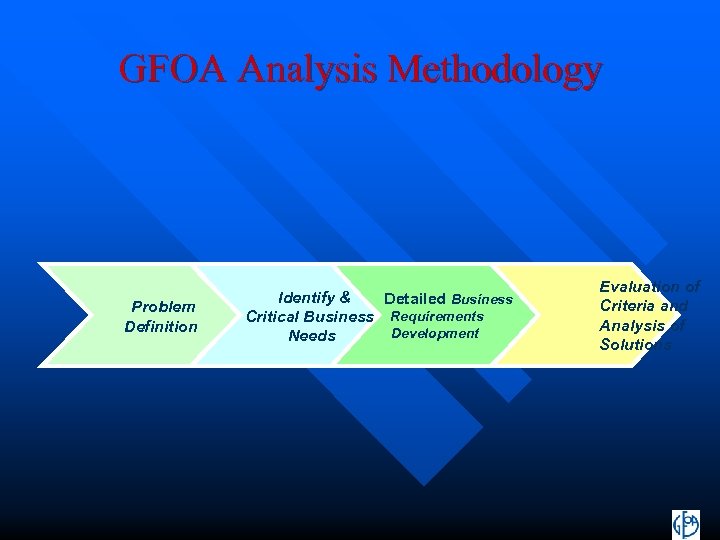
GFOA Analysis Methodology Problem Definition Identify & Detailed Business Critical Business Requirements Development Needs Evaluation of Criteria and Analysis of Solutions
Identify Critical Business Issues and Key Executive Vision Elements and Business Requirements Development n Key Activities – Strategic Planning/Executive. Visioning – Review of CCSF Documentation of Work to Date – Identification of Critical Business Drivers – Inventory of Current Systems – Business Requirements Development – Software Evaluation Plan with Criteria for Software Selection – Software Fit-Gap Analysis
Site Visit I Focus Groups What are major deficiencies of current system? n Are problems due to obsolete technology, ineffective org structure, poor policies and procedures, or something else? n Is staff properly trained to fully utilize features? n Are there unmet needs that could be addressed by new technology? n What are high-level business needs of the organization? n
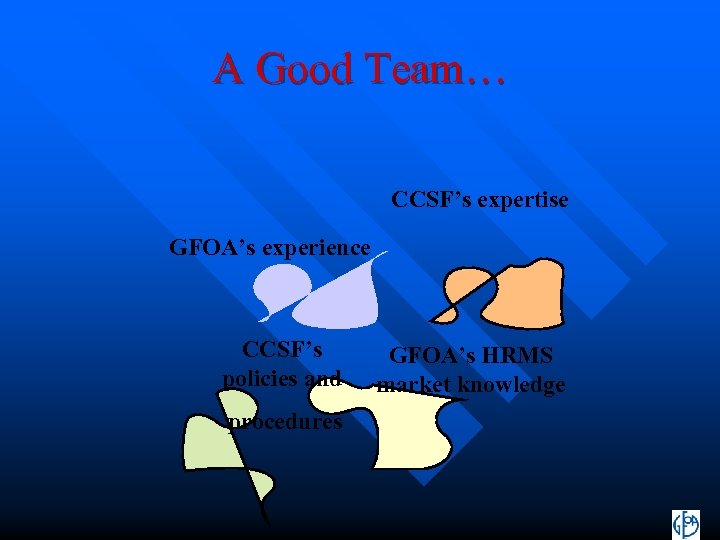
A Good Team… CCSF’s expertise GFOA’s experience CCSF’s policies and procedures GFOA’s HRMS market knowledge
Deliverables Project Plan n Synopsis of Critical HRMS Business Needs n Draft Set of HRMS Business Requirements n Validated Set of HRMS Business Requirements n Software Evaluation Plan with Criteria for Selection of Software n Business Requirements Analysis n
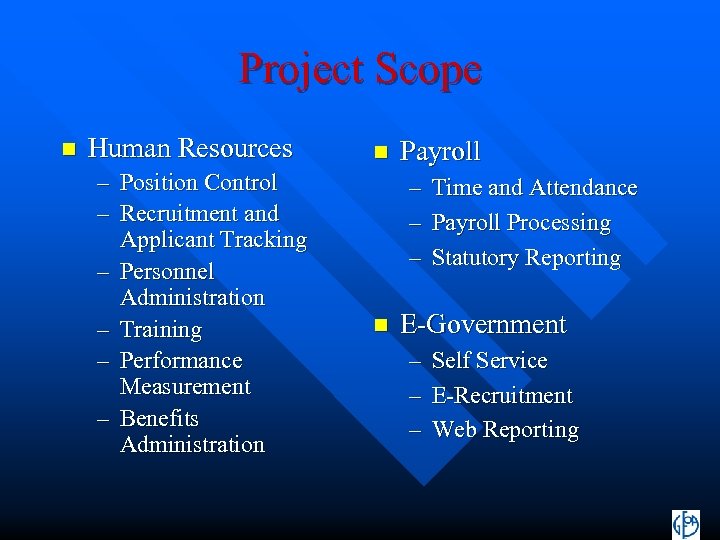
Project Scope n Human Resources – Position Control – Recruitment and Applicant Tracking – Personnel Administration – Training – Performance Measurement – Benefits Administration n Payroll – – – n Time and Attendance Payroll Processing Statutory Reporting E-Government – Self Service – E-Recruitment – Web Reporting
Project Timeline n Key Dates – Project Kick-Off / First Site Visit: August 8 – 10, 2006 – Second Site Visit: – Synopsis of Critical Business Needs Delivered – Validation Site Visit: – Draft Needs Assessment: – Needs Assessment Finalized:
What are Enterprise Systems?
Enterprise HRMS – A Backbone of Digital Government An integrated business model, enabled by technology, that improves operational efficiency and enterprisewide decision support through information integration and process improvement.
Enterprise Systems and Processes n Enterprise systems have an important impact on back-office business processes – Automation – Re-engineering/Re-design – Provide access to better information for managing processes – Integration
Enterprise Systems and People n Enterprise Systems have important implications for people – The CCSF’s best staff must participate heavily in implementation – HRMS distributes information and access widely, so staff throughout the organization must be trained to use the system. – HRMS automates many routine tasks, so many CCSF staff may need to work in re-defined roles (e. g. , from data entry to exception analysis).
HRMS and Technology n HRMS most tangible aspect is the software. Fundamental points are: – Enterprise packages that include HRMS are bought from a wide-ranging number of vendors. – Substantial consulting assistance may be required to implement the software. – The relationship between the CCSF and the vendor is ongoing – The software and service solution procured must enable the CCSF to meet both its technology and business process goals.
Goals of an Enterprise HRMS System • Breakdown department information silos and promote shared processes • Eliminate redundant departmental systems • Foster one version of the truth across the organization • Take advantage of commercially available software and proven “bestpractices”
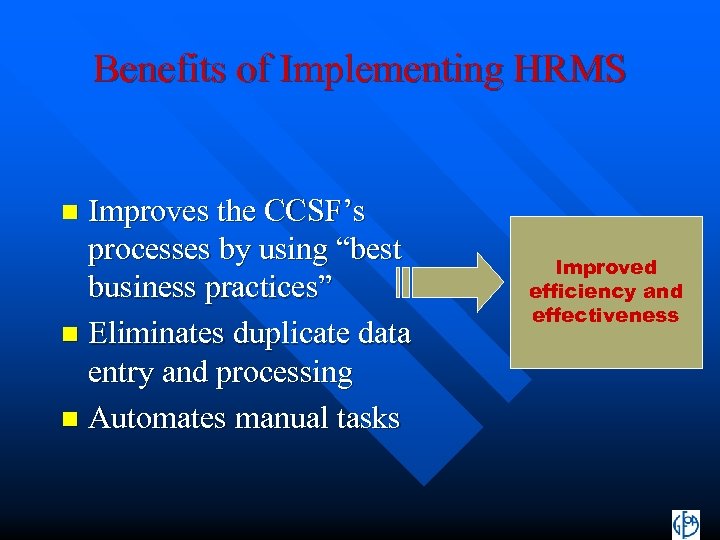
Benefits of Implementing HRMS Improves the CCSF’s processes by using “best business practices” n Eliminates duplicate data entry and processing n Automates manual tasks n Improved efficiency and effectiveness
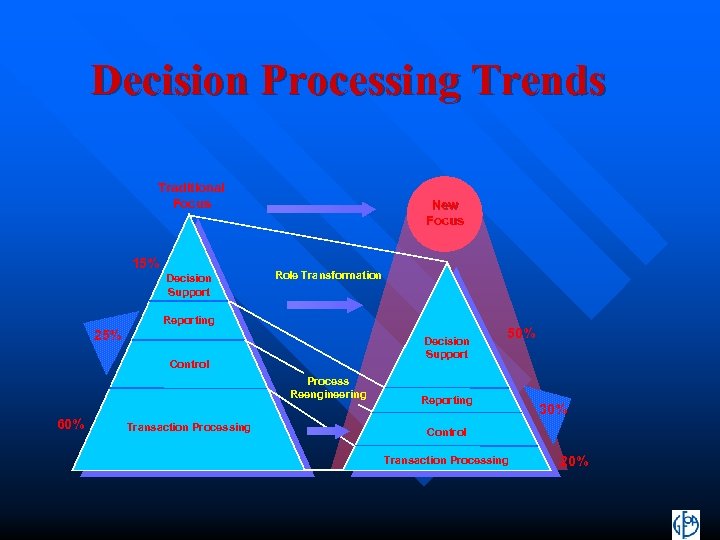
Decision Processing Trends Traditional Focus 15% Decision Support New Focus Role Transformation Reporting 25% Decision Support Control Process Reengineering 60% Transaction Processing 50% Reporting 30% Control Transaction Processing 20%
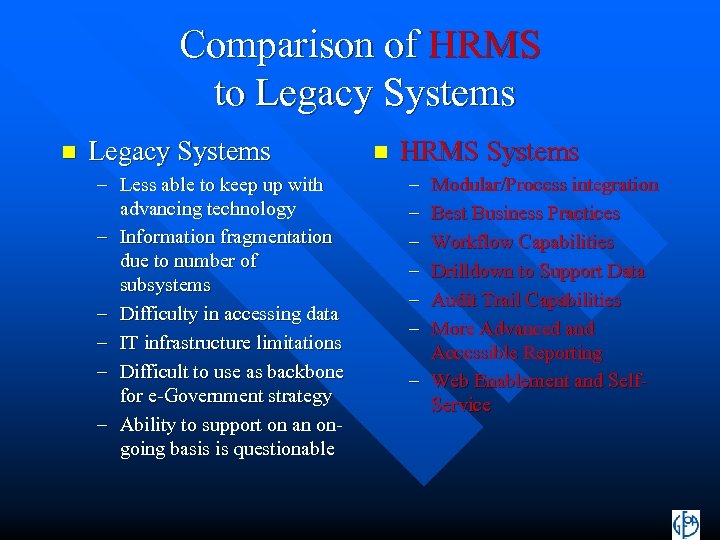
Comparison of HRMS to Legacy Systems n Legacy Systems – Less able to keep up with advancing technology – Information fragmentation due to number of subsystems – Difficulty in accessing data – IT infrastructure limitations – Difficult to use as backbone for e-Government strategy – Ability to support on an ongoing basis is questionable n HRMS Systems – – – Modular/Process integration Best Business Practices Workflow Capabilities Drilldown to Support Data Audit Trail Capabilities More Advanced and Accessible Reporting – Web Enablement and Self. Service
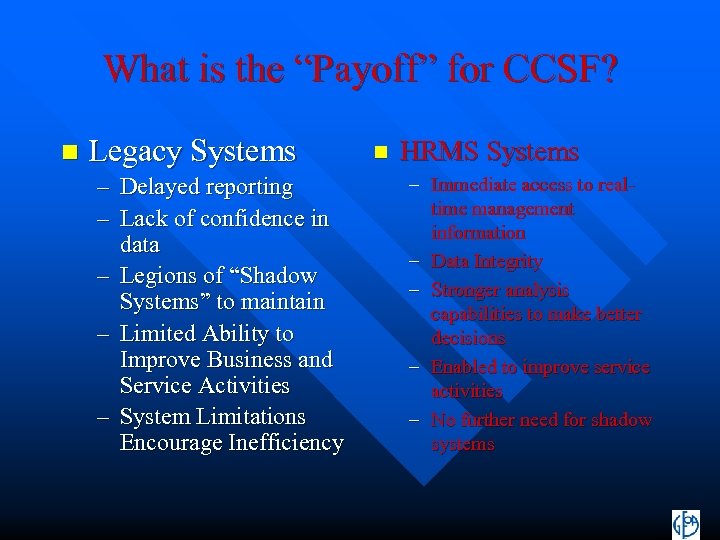
What is the “Payoff” for CCSF? n Legacy Systems – Delayed reporting – Lack of confidence in data – Legions of “Shadow Systems” to maintain – Limited Ability to Improve Business and Service Activities – System Limitations Encourage Inefficiency n HRMS Systems – Immediate access to realtime management information – Data Integrity – Stronger analysis capabilities to make better decisions – Enabled to improve service activities – No further need for shadow systems
Development of Business Drivers Visioning Session
1) Organizational Initiatives/Challenges What are the major organizational initiatives/challenges facing the CCSF? How are these related to the Enterprise HRMS System initiative?
2) Current System Strengths -What are the main strengths of the current system? -Is the system ‘stable’ from a transaction processing standpoint? -Is information and transaction history easily accessible? -Are there executive information needs that are being met that you would want to see continued in a new system? -Do the current systems meet the management information needs of the following? – – – Board of Supervisors IT Directors/Management Program/Operations Staff External Parties (e. g. , media, customers, vendors)
3) Current System Weaknesses What are the main weaknesses of the current system?
4) Key Questions n What management information do you need to run your organization? n What management tasks are you given that are difficult to perform today due to your current system? n Is CCSF ready for the requisite process changes of possible alternatives? n Will CCSF leadership sponsor changes if deemed necessary?
5) System Scope and Function n What should the new system be able to do? n Who should the new system serve? n How long should the new system last (useful life)? n What existing functions must the system be tightly linked/interfaced to?
6) Project Vision Statement Sample Vision Statement (to generate discussion) By 2008, the CCSF will be sustaining an integrated Human Resource Management System that supports staff in the efficient delivery of services.
7) Project Goals How do we measure “efficient delivery of services? ”
8) High Level Business Process Management What are the major business processes of each area in the project scope?
Next Steps Written Summary of Session n Follow-Up Session during Future Site Visit n

Questions or Comments
Скачать презентацию Human Resource Management System HRMS Business Case Analysis
97ba34e4c55264d792081f99b7c0d095.ppt