


 Скачать презентацию HUMAN RESOURCE MANAGEMENT PROVIDING TRAINING Most of
HRM training.ppt
- Количество слайдов: 20
 HUMAN RESOURCE MANAGEMENT
 PROVIDING TRAINING Most of us have, at some time, been a “trainer” People, animals, even plants, can be brought to a desired standard of efficiency, condition or behavior by instruction and practice.
 “Quality is never an accident; it is always the result of high intention, sincere effort, intelligent direction and skillful execution; it represents the wise choice of many alternatives” William A. Foster
 Training = methods used to give new or present employees the skills they need to perform their jobs. Training = the formal, ongoing efforts of organizations to improve the performance and self-fulfillment of their employees through a variety of methods and programs. The scope of training varies from instruction in highly specific job skills to long-term professional development.
 What factors influence the choice of a training program? - the complexity of the work environment - the very fast organizational and technological change - the nature of the work (growing number of jobs in fields that constantly generate new knowledge and thus, require new skills) - advances in learning theory have provided insights into how adults learn
 Training offers: - a way of developing skills - increased individual and organizational performance, in line with business goals - a method of improving employee morale - improved worker loyalty to the firm Training is widely accepted as: - an employee benefit - method of enhancing productivity and quality of work
 "Employees today must have access to continual training of all types just to keep up…. If you don't actively stride against the momentum of skills deficiency, you lose ground. If your workers stand still, your firm will lose the competency race. " Michael S. Schell & Charlene Marmer Solomon, 1997. Capitalizing on the Global Workforce: A Strategic Guide for Expatriate Management - Continuous learning - High level of stress
 All training programs are completely inefficient if the individual(s) sent to attend training courses do not really want to get involved - fundamental skills - reading a balance sheet operating some text processing systems using some complex production equipment /processes it can be very efficient - more general training – to improve interpersonal or management skills is much more problematic when a general behavior change is imposed training may prove itself as being too costly
 The training may not be efficient if: - the developed skills are not relevant for some individuals - the training may be conducted at an inappropriate level - the trainer’s skill may be insufficient J skills that need to be developed are correctly identified J training is well planned and implemented J employees are motivated, involved and learning a lot
 -Still employees cannot succeed to transfer at the workplace what they have just learned people act in the way they seem it brings them the most satisfactions ways that are efficient for them in the workplace context this context probably didn’t change while they were attending the training program and, despite of the good intentions, they will rapidly return to the old behavior The golem effect = the occurrence of poor trainee performance caused by the trainer’s low expectations for success
 On-the-Job Training = a person is learning a job by actually doing it; delivered to employees while they perform their regular jobs - Orientations (induction programs) - Self-instruction = assuming primary responsibility for their own learning - Apprenticeships = trainee works with a more experienced employee for a period of time, learning a group of related skills that will eventually qualify the trainee to perform a new job or function (production-oriented positions) - Internships = form of apprenticeship which combines on-the-job training under a more experienced employee with classroom learning.
 On-the-Job Training = a person is learning a job by actually doing it; delivered to employees while they perform their regular jobs - Job Rotation = employees move through a series of jobs in order to gain a broad understanding of the requirements of each role - Coaching = training with a focus on the individual needs and aiming to transfer more practical knowledge - Mentoring = training with a focus on soft skills, and on developing a balance between the employee’s professional and personal life
 Off-the-Job Training = workers are taken away from their place of work to be trained at a training agency or local college, or at their own training centers - Lectures = verbal methods of presenting the same information to a large number of people at one time. It is among the most costeffective training methods Drawbacks: - they may not provide the most interesting or effective training - one-way communication - difficult for the trainer to gauge the level of understanding of the material with a large group
 Off-the-Job Training = workers are taken away from their place of work to be trained at a training agency or local college, or at their own training centers - Case studies = students are provided with practical case reports to analyze (a description of a simulated or real-life situation) - Role playing = students will assume a role and play out that role within a group Advantages: - better understanding of their own behavior - immediate feedback - cost effectiveness (marketing/ management training)
 Off-the-Job Training = workers are taken away from their place of work to be trained at a training agency or local college, or at their own training centers - Simulations = structured competitions and operational models that emulate real-life scenarios Advantages: - improvement of problem-solving and decisionmaking skills - understanding of the organization as a whole - the ability to study actual problems - power to capture the student's interest
 Off-the-Job Training = workers are taken away from their place of work to be trained at a training agency or local college, or at their own training centers - Computer-Based Training (CBT) = use of computers and computer-based instructional materials as the primary medium of instruction: - tele-training - videoconferencing - online training Advantages: - allows employees to learn at their own pace, during convenient times - cost effective
 Off-the-Job Training = workers are taken away from their place of work to be trained at a training agency or local college, or at their own training centers - Audiovisual training = television, films, and videotapes (like case studies, role playing, and simulations) Advantage: exposes employees to "real world" situations in a time- and cost-effective manner Drawbacks: - cannot be customized for a particular audience - does not allow participants to ask questions or interact during the presentation of material - work groups with similar goals and objectives
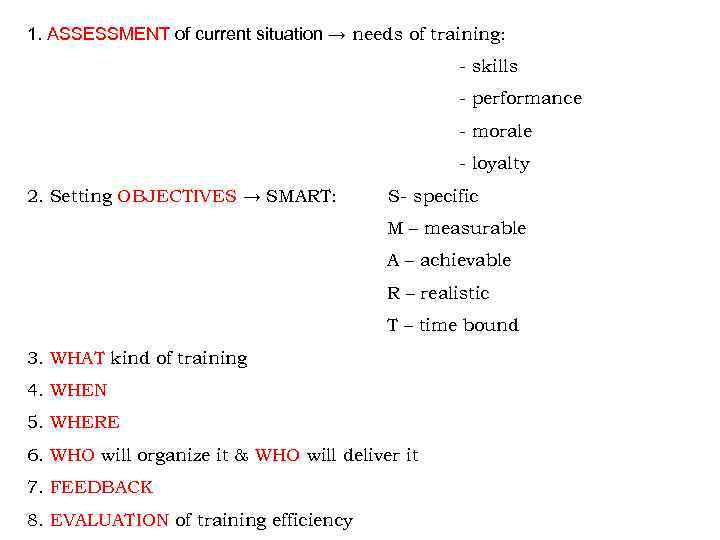 1. ASSESSMENT of current situation → needs of training: - skills - performance - morale - loyalty 2. Setting OBJECTIVES → SMART: S- specific M – measurable A – achievable R – realistic T – time bound 3. WHAT kind of training 4. WHEN 5. WHERE 6. WHO will organize it & WHO will deliver it 7. FEEDBACK 8. EVALUATION of training efficiency
 “If you don't know where you're going, any road will take you there. " "Within an organization, if you don't know where you are going, any road will take you to disaster. ” Eastmond, N. , Jr. , 1992. Structuring a program to prepare professional evaluators
 Questions?