 Скачать презентацию HUMAN RESOURCE Management Higher Business Management Human Resource
06bc9748455969a830ec241aa39c8197.ppt
- Количество слайдов: 134




HUMAN RESOURCE Management Higher Business Management Human Resource Management
HUMAN RESOURCE Management Learning Intentions: To introduce Human Resource Management Success Criteria: You should be able to: Describe the role and importance of HRM Describe the changing patterns of employment Describe the modern UK workforce BM Unit 2 - LO 2 2
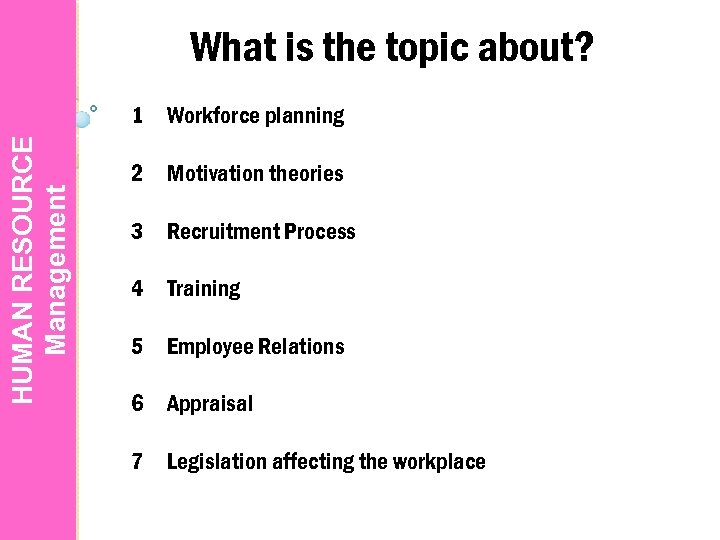
What is the topic about? HUMAN RESOURCE Management 1 Workforce planning 2 Motivation theories 3 Recruitment Process 4 Training 5 Employee Relations 6 Appraisal 7 Legislation affecting the workplace
HUMAN RESOURCE Management Role and importance of human resource management The most valuable asset in any organisation is its workforce. It is the human resources that generate wealth by providing services and producing goods. Care must be taken over employees, especially if the business wants to secure and retain staff.
HUMAN RESOURCE Management Function of human resources Human resource planning Recruitment and selection Training and development Maintenance of personnel records Legislation Employee relations Grievance and discipline
HUMAN RESOURCE Management Workforce Planning Learning and Teaching Scotland
HUMAN RESOURCE Management Changing patterns of employment In the UK 26 million people (70% of the working population) are employed. Decline in full-time, permanent work. Decline in heavy engineering. Increase in tertiary (service) sector employment (call centres, IT). Increase in women working (suited to new areas of employment).
HUMAN RESOURCE Management Changing patterns of employment Part-time work Variable hours Home working/teleworking Flexi-time Zero hours contracts Temporary work Self-employment More mature workforce – meaning people are working beyond 60 Increased automation
HUMAN RESOURCE Management Human resource planning Factors affecting human resource planning Changing goals of a business Changes in market Changes in technology Competition Population changes Trades unions Government legislation
Workforce planning HUMAN RESOURCE Management This is forecasting future recruitment requirements. The will mean estimating: - the number of employees required per department - the labour turnover (how many/often) staff leave - Customer demand – this determines staff required - Company finances – this could determine redundancies Factors that will determine the level of staff required: - Retirements - Promotion - Maternity/paternity leave- Work-life balance requests
Workforce planning HUMAN RESOURCE Management What should the HR department consider when looking to increase/decrease the number of staff? . . . - Finances available – is there a budget to recruit? - Local area – are there suitable employees nearby? - Training – is there a cost to employing new staff? - Current economic climate – are redundancies likely? - Grants – are there incentives to employ?
HUMAN RESOURCE Management
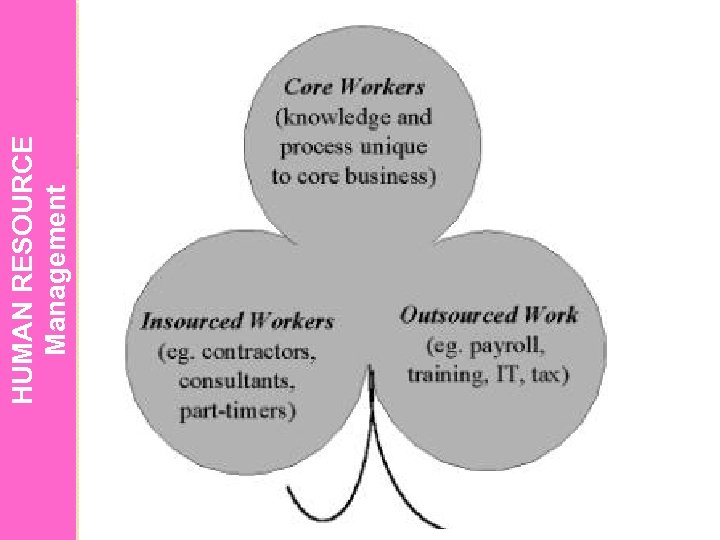
HUMAN RESOURCE Management Contractors are people/businesses who provide goods and services that the organisation does not wish to provide for itself. Examples: cleaners, consultants, security guards, suppliers. Because they are not permanent they are less expensive (no pension pay or holiday entitlement, for example).
HUMAN RESOURCE Management Reasons for subcontracting Potentially better skilled workforce. Professional expertise. Economies of scale. Can focus on what you’re good at (sticking to the knitting). Saves money in equipment and training.
HUMAN RESOURCE Management Learning Intentions: To introduce motivational theory Success Criteria: You should be able to: Describe motivational theory with the aid of a diagram Describe motivational techniques BM Unit 2 - LO 2 15
HUMAN RESOURCE Management Motivation: Leadership styles Arguably one of the most influential factors is how an employee is treated or how their ‘boss’ communicates with them. 1 Autocratic Their way or no way! Dictating instructions Lack of consultation Staff feel they are being controlled Don’t feel valued May create ‘them and us’ vibe Doesn’t encourage independent thinking May be appropriate when: deadlines have to be met consistent message needed
HUMAN RESOURCE Management Motivation: Leadership styles Arguably one of the most influential factors is how an employee is treated or how their ‘boss’ communicates with them. 2 Democratic Employees views sought Feedback is part of ethos Encourages independence Promotes togetherness Promotes a can-do attitude Encourages open-ness Could generate more ‘meetings’ and slow decision making May be appropriate when: Change is required – opinions on best way forward
HUMAN RESOURCE Management Motivation: Leadership styles Arguably one of the most influential factors is how an employee is treated or how their ‘boss’ communicates with them. 3 Laissez-faire Employees given much more responsibility Less direction from the ‘manager’ Promotes personal responsibility May prove ineffective: Projects/targets could drift/lack focus without direction With less supervision this may result in less productivity
HUMAN RESOURCE Management Motivation (what makes people work) Write down 3 reasons why people work
HUMAN RESOURCE Management Motivation (what makes people work) Money Security Job Satisfaction To make friends To make progress To make use of talents Why is it important for a business to be aware of this?

HUMAN RESOURCE Management Motivation Question! A motivated workforce can lead to …. . Better quality of customer service Better relationships between staff Improved time-keeping Reduced absenteeism Reduced labour turnover Increased workrate
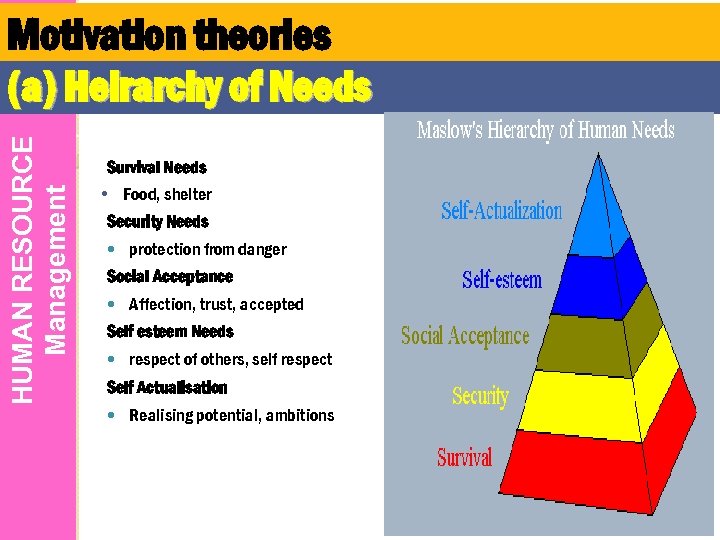
HUMAN RESOURCE Management Motivation theories (a) Heirarchy of Needs Survival Needs • Food, shelter Security Needs protection from danger Social Acceptance Affection, trust, accepted Self esteem Needs respect of others, self respect Self Actualisation Realising potential, ambitions
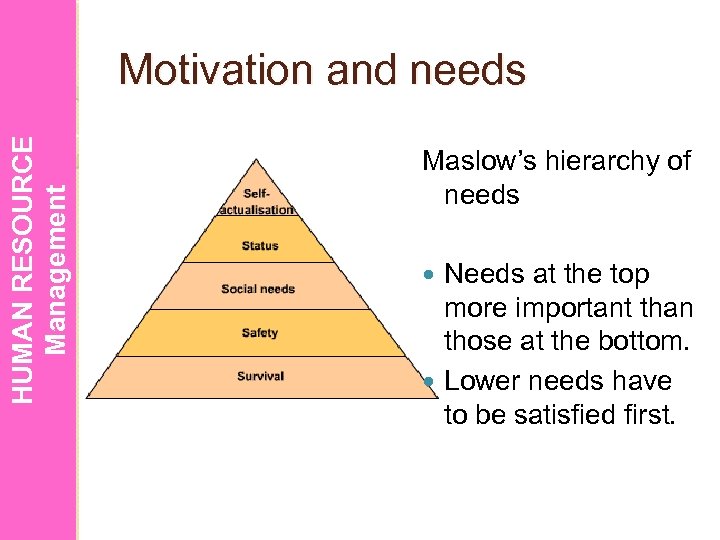
HUMAN RESOURCE Management Motivation and needs Maslow’s hierarchy of needs Needs at the top more important than those at the bottom. Lower needs have to be satisfied first.
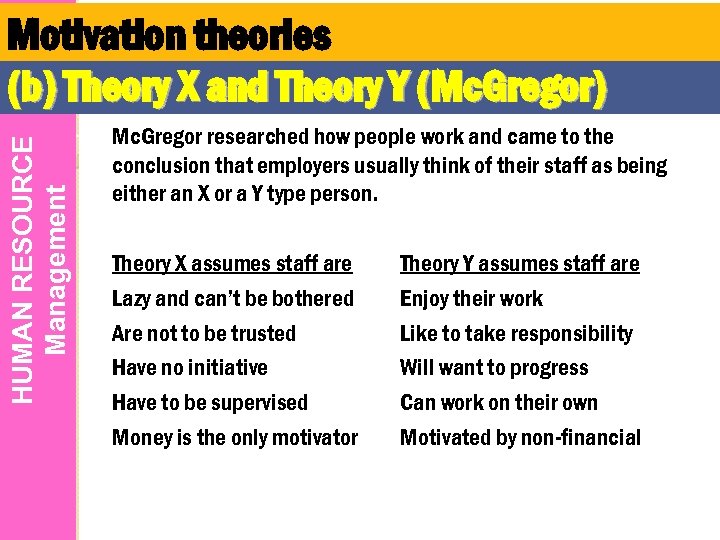
HUMAN RESOURCE Management Motivation theories (b) Theory X and Theory Y (Mc. Gregor) Mc. Gregor researched how people work and came to the conclusion that employers usually think of their staff as being either an X or a Y type person. Theory X assumes staff are Lazy and can’t be bothered Are not to be trusted Have no initiative Have to be supervised Money is the only motivator Theory Y assumes staff are Enjoy their work Like to take responsibility Will want to progress Can work on their own Motivated by non-financial
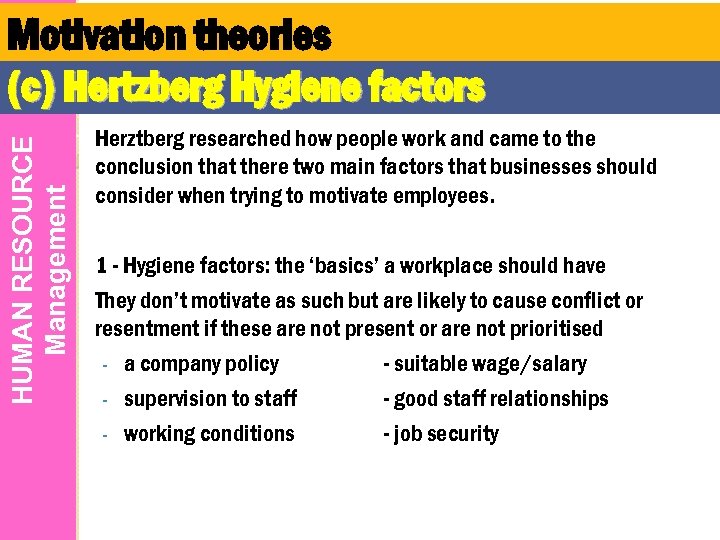
HUMAN RESOURCE Management Motivation theories (c) Hertzberg Hygiene factors Herztberg researched how people work and came to the conclusion that there two main factors that businesses should consider when trying to motivate employees. 1 - Hygiene factors: the ‘basics’ a workplace should have They don’t motivate as such but are likely to cause conflict or resentment if these are not present or are not prioritised - a company policy - suitable wage/salary - supervision to staff - good staff relationships - working conditions - job security
HUMAN RESOURCE Management 2 – Motivation theories (c) Hertzberg Hygiene factors 2 – Motivational factors: Research indicated that most people are motivated by the desire to progress, be recognised and achieve at their work. If staff are motived to achieve the above then …. - Staff will have greater job satisfaction - Staff will work above and beyond the minimum - Staff will try to achieve status – go for promotion - Staff will try to take responsibility, take on leadership Herzberg said business should create a culture that allows this to flourish so that employees are empowered.
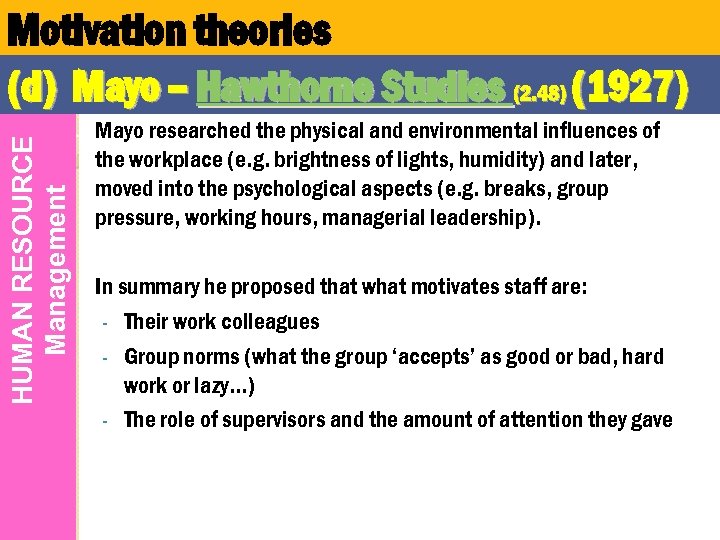
HUMAN RESOURCE Management Motivation theories (d) Mayo – Hawthorne Studies (2. 48) (1927) Mayo researched the physical and environmental influences of the workplace (e. g. brightness of lights, humidity) and later, moved into the psychological aspects (e. g. breaks, group pressure, working hours, managerial leadership). In summary he proposed that what motivates staff are: - Their work colleagues - Group norms (what the group ‘accepts’ as good or bad, hard work or lazy…) - The role of supervisors and the amount of attention they gave
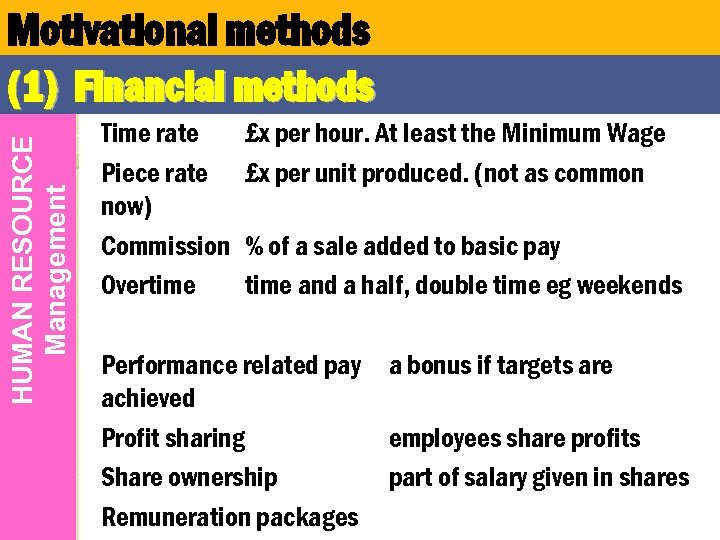
HUMAN RESOURCE Management Motivational methods (1) Financial methods Time rate Piece rate now) Commission Overtime £x per hour. At least the Minimum Wage £x per unit produced. (not as common % of a sale added to basic pay time and a half, double time eg weekends Performance related pay achieved Profit sharing Share ownership Remuneration packages a bonus if targets are employees share profits part of salary given in shares perks eg cheaper health
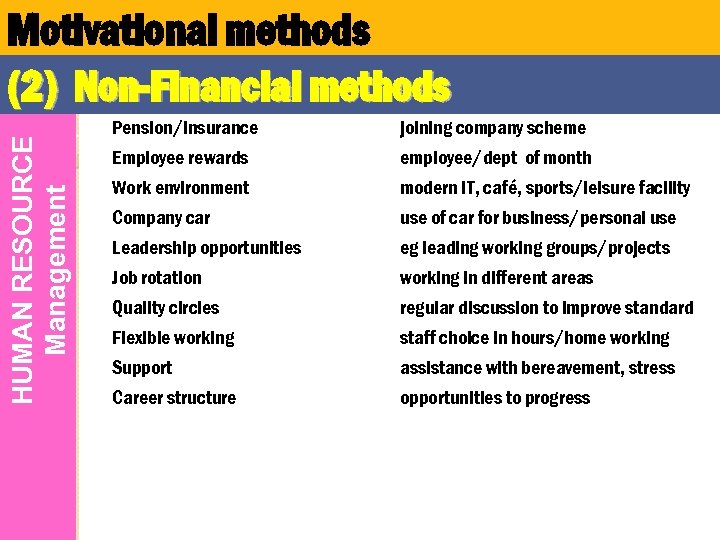
HUMAN RESOURCE Management Motivational methods (2) Non-Financial methods Pension/insurance Employee rewards Work environment Company car Leadership opportunities Job rotation Quality circles Flexible working Support Career structure joining company scheme employee/dept of month modern IT, café, sports/leisure facility use of car for business/personal use eg leading working groups/projects working in different areas regular discussion to improve standard staff choice in hours/home working assistance with bereavement, stress opportunities to progress
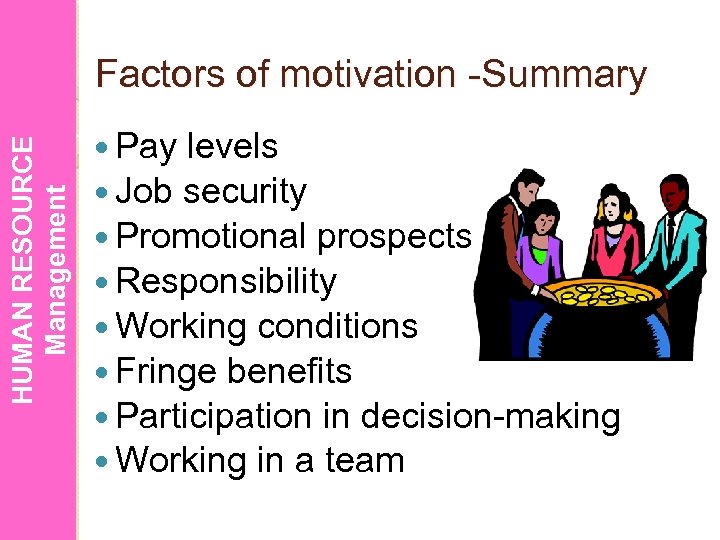
HUMAN RESOURCE Management Factors of motivation -Summary Pay levels Job security Promotional prospects Responsibility Working conditions Fringe benefits Participation in decision-making Working in a team

HUMAN RESOURCE Management RECRUITMENT AND SELECTION
HUMAN RESOURCE Management Learning Intentions: To introduce recruitment terminology Success Criteria: You should be able to: Identify key terminology and describe the main steps in the recruitment process. Eg Job analysis, Job description, person specification, internal and external advertising, internal and external recruitment. BM Unit 2 - LO 2 32
HUMAN RESOURCE Management Two clips to watch and be prepared to answer questions on…. 1 - listen out for what they look for in their employees http: //www. youtube. com/watch? v=A 7 HVt 3 xg. Tn 4 2 - What skills and qualities are required for a person doing this job? http: //www. youtube. com/watch? v=5 vm. Bd. Syy. Pls This is a bit random…. But hopefully interesting.
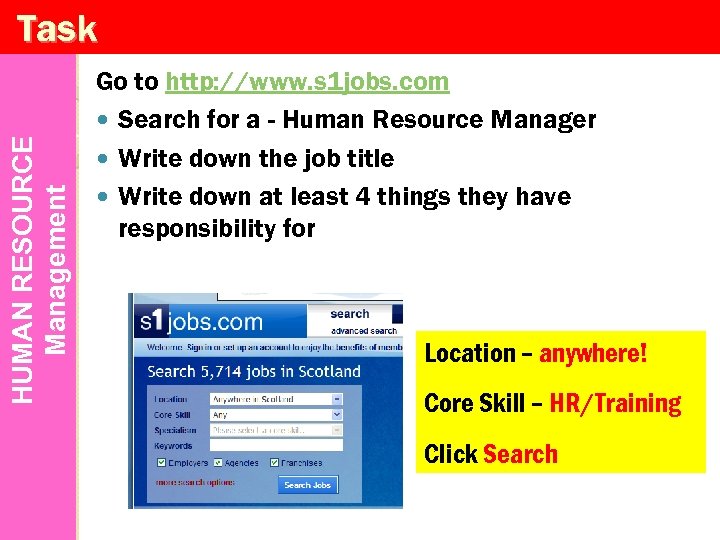
HUMAN RESOURCE Management Task Go to http: //www. s 1 jobs. com Search for a - Human Resource Manager Write down the job title Write down at least 4 things they have responsibility for Location – anywhere! Core Skill – HR/Training Click Search
HUMAN RESOURCE Management Steps in recruitment Is there a vacancy in the organisation? 2. What does the job involve? 3. Where are we going to attract our applicants from? 4. Process of selection. 1.
HUMAN RESOURCE Management Identify job vacancy Could occur due to: an employee leaving the organisation retirement an employee being promoted a new post being created. Someone may be sacked
HUMAN RESOURCE Management Conduct job analysis This identifies: tasks to be performed skills needed (both physical and mental) duties and responsibilities (and accountability) environment job takes place in (including any hazards). Gives an idea if a position is needed.
HUMAN RESOURCE Management Prepare job description This states: job title location tasks duties and responsibilities hours holiday entitlements qualifications required by applicant.
HUMAN RESOURCE Management Prepare person specification A description of the type of person suitable for post. This includes: qualifications skills experience personal qualities hobbies and interests.
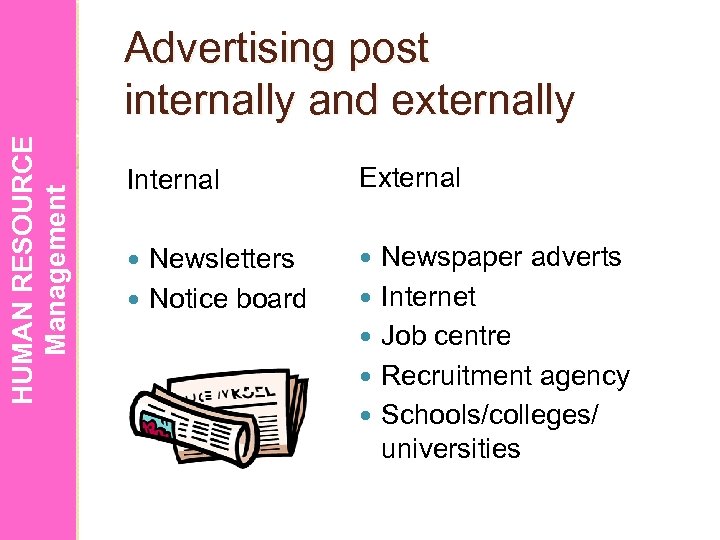
HUMAN RESOURCE Management Advertising post internally and externally Internal External Newsletters Notice board Newspaper adverts Internet Job centre Recruitment agency Schools/colleges/ universities
HUMAN RESOURCE Management Internal recruitment Advantages Disadvantages Applicant and ability Limited skills pool familiar to organisation Own job needs to be filled Organisation may have Resentment from invested in person overlooked staff through training Individual aware of culture (no need for induction training)
HUMAN RESOURCE Management Task Go to http: //www. s 1 jobs. com Search for one job in these categories: ‘Marketing/PR’ and ‘Any’ ‘Production/Operation’ and ‘Quality Control’ Write down the 3 things that would be examples of person specification Write down 3 things that would be examples of job description You have 15 minutes maximum to do this…
HUMAN RESOURCE Management Radio Newspapers Internet Employment Agencies Methods of External Recruitment Job Centres
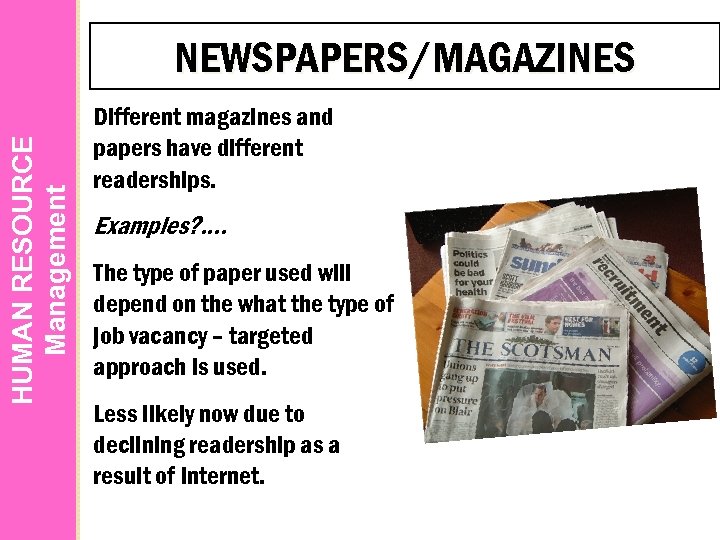
HUMAN RESOURCE Management NEWSPAPERS/MAGAZINES Different magazines and papers have different readerships. Examples? . . The type of paper used will depend on the what the type of job vacancy – targeted approach is used. Less likely now due to declining readership as a result of Internet.
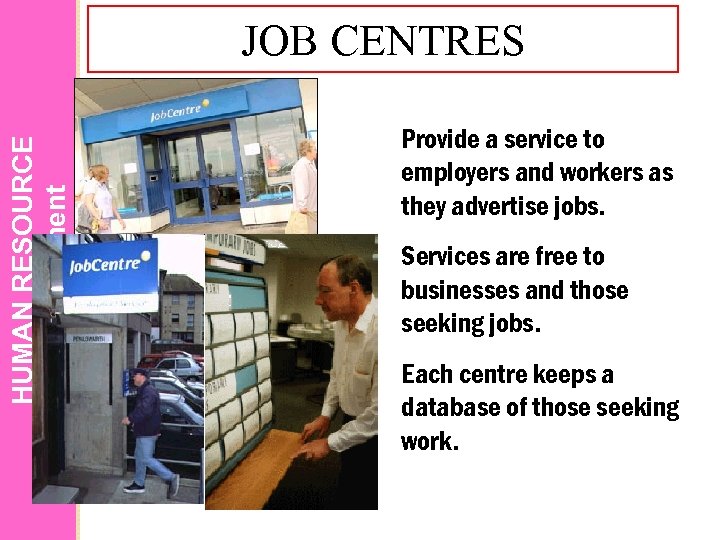
HUMAN RESOURCE Management JOB CENTRES Provide a service to employers and workers as they advertise jobs. Services are free to businesses and those seeking jobs. Each centre keeps a database of those seeking work.
HUMAN RESOURCE Management Recruitment using the INTERNET • The internet is becoming an increasingly popular method of advertising job vacancies • Relatively nexpensive method of advertising • Applicants can upload CVs online and apply much quicker. • Often used by recruitment agencies – eg Stafffinders • Agencies may specialise in particular occupations.
HUMAN RESOURCE Management RADIO Different radio stations have different audiences Different radio programmes have different audiences Mostly used to advertise local job vacancies Radio stations charge for their services
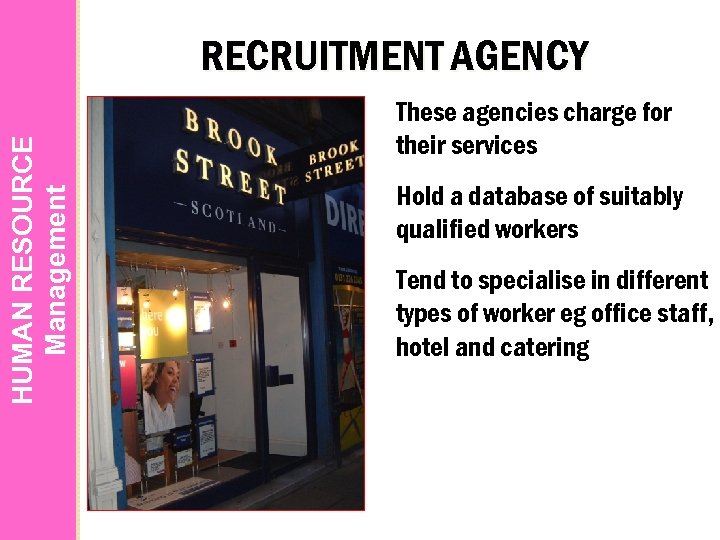
HUMAN RESOURCE Management RECRUITMENT AGENCY These agencies charge for their services Hold a database of suitably qualified workers Tend to specialise in different types of worker eg office staff, hotel and catering.
HUMAN RESOURCE Management External recruitment Advantages Can target specific sections of the population Wider job skills pool No need to fill another post Disadvantages Expensive Time taken can be long Successful candidates may turn down job
HUMAN RESOURCE Management Answer a question Describe the recruitment process that may be used by a human resources department. (5 marks) 2009 10 minutes
HUMAN RESOURCE Management Solution Identify a job vacancy, which could arise due to retirement or an employee leaving the firm. Carry out a job analysis that will detail the requirements of the job. Prepare a job description outlining the roles, duties and responsibilities of the job. Draw up a person specification outlining the skills, qualifications and experience required, both essential and desirable, by candidates. Advertise the vacancy either internally or externally. Send out application forms to candidates.
HUMAN RESOURCE Management Learning Intentions: To introduce selection terminology Success Criteria: You should be able to: Identify and describe key terminology associated with selection. BM Unit 2 - LO 2 52

HUMAN RESOURCE Management Selection at Google http: //www. youtube. com/watch? v=w 88 7 NIa_V 9 w What are they looking for?
HUMAN RESOURCE Management First steps in selection When applications are received they should be divided into three categories: 1. 2. 3. seems suitable – invite to interview possibly suitable – invite for interview if not enough in category 1 unsuitable – send polite letter of rejection. A shortlist is created.
HUMAN RESOURCE Management Application forms Initial contact. Information gathered checked against the person specification to select suitable candidates for the vacancy. Usually read in conjunction with CV.
HUMAN RESOURCE Management CV Curriculum vitae or life history: personal details education qualifications work experience hobbies/interests additional information.
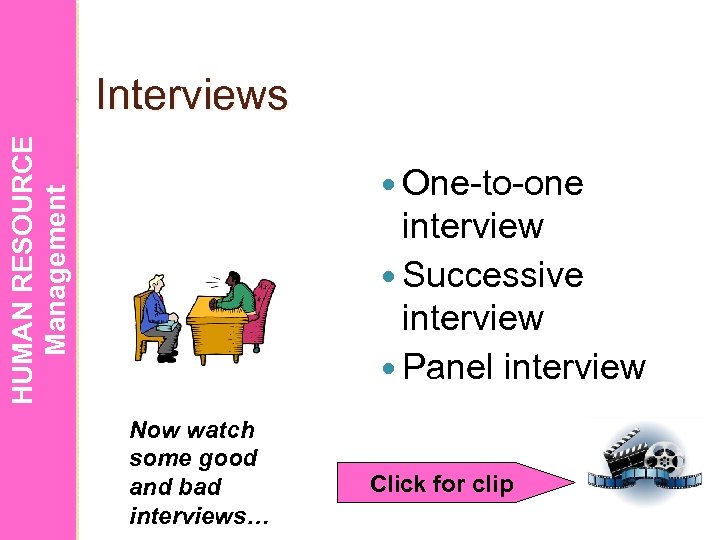
HUMAN RESOURCE Management Interviews One-to-one interview Successive interview Panel interview Now watch some good and bad interviews… Click for clip
HUMAN RESOURCE Management Interview advice Be prepared – know about the organisation Be smartly dressed Be early Have a firm handshake Make eye contact Be positive Sit up! Don’t slump in your chair Drink lots of water for concentration Take your time when answering a question Structure your answers Click for clip
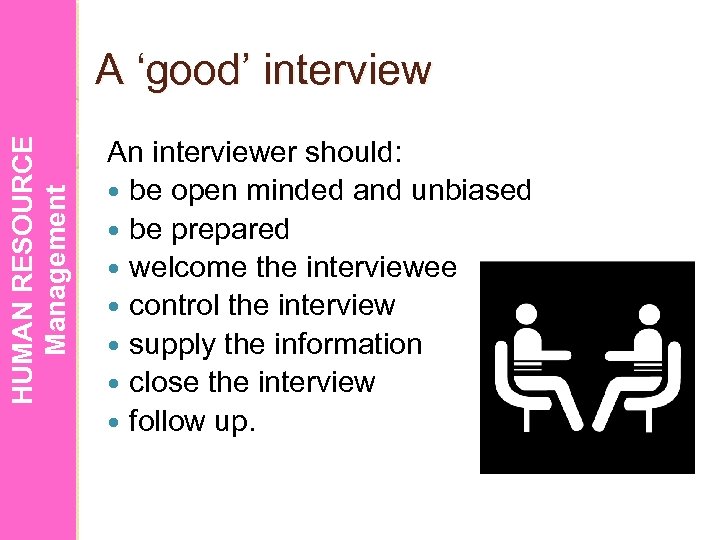
HUMAN RESOURCE Management A ‘good’ interview An interviewer should: be open minded and unbiased be prepared welcome the interviewee control the interview supply the information close the interview follow up.
HUMAN RESOURCE Management Tests Attainment tests Aptitude tests IQ tests Psychometric tests Medical tests
HUMAN RESOURCE Management Assessment centres Intensive assessment held over one or two days Activities: team building role play interviews Qualities looked for: social skills, leadership qualities and personality
HUMAN RESOURCE Management Answer a question Describe a selection process that an organisation could use to ensure it employs the best workers. (4 marks) 2010 8 minutes
HUMAN RESOURCE Management Solution Compare application forms and CVs to the job description and person specification to identify potential interviewees. Send for references, to check that what is said in the application packs is a true reflection of the candidate. Interview the candidates to discover what skills they have and what they can bring to the job. Test the candidates by using a test that is measurable, eg psychometric, aptitude etc. On some occasions a second set of interviews may be conducted. Use assessment centres for some candidates – used for high-powered jobs.
HUMAN RESOURCE Management Learning Intentions: To introduce training within business Success Criteria: You should be able to: • Identify and describe suitable training methods for business organisations • Describe the costs and benefits of training for an organisation BM Unit 2 - LO 2 64
HUMAN RESOURCE Management TRAINING Training is teaching workers new skills or improving their existing skills. What are the benefits that training brings to the workplace?
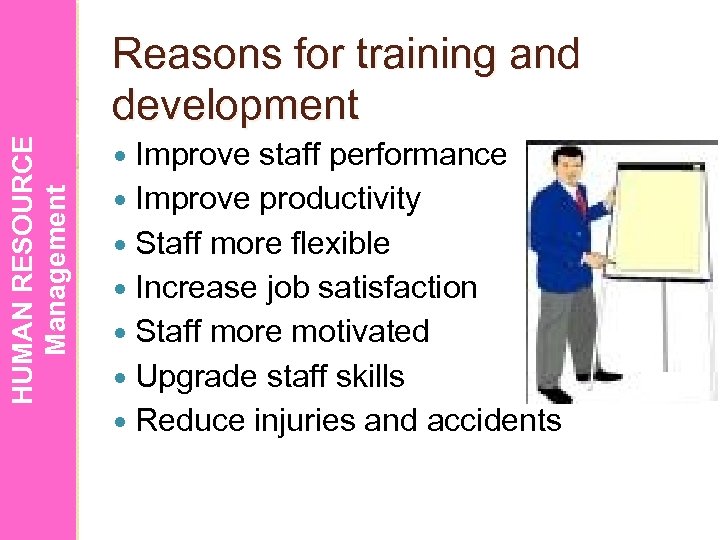
HUMAN RESOURCE Management Reasons for training and development Improve staff performance Improve productivity Staff more flexible Increase job satisfaction Staff more motivated Upgrade staff skills Reduce injuries and accidents
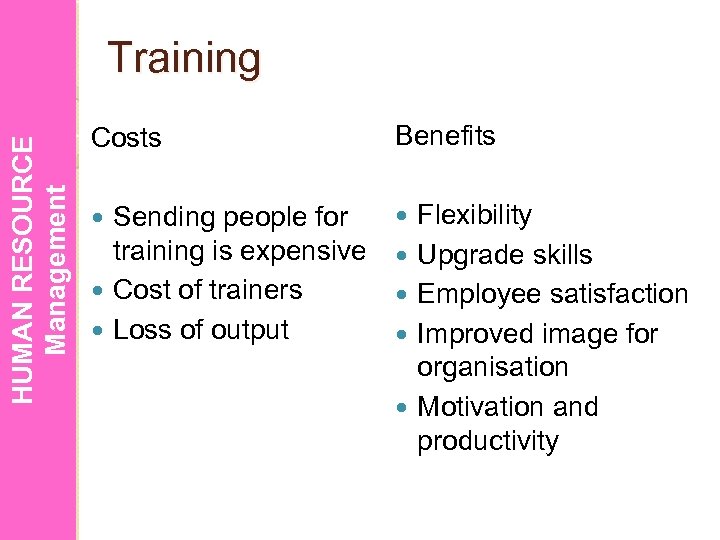
HUMAN RESOURCE Management Training Costs Benefits Sending people for training is expensive Cost of trainers Loss of output Flexibility Upgrade skills Employee satisfaction Improved image for organisation Motivation and productivity
HUMAN RESOURCE Management TYPES OF TRAINING • INDUCTION TRAINING • VIRTUAL LEARNING (VLE) • MULTI-SKILLING • ON THE JOB • OFF THE JOB
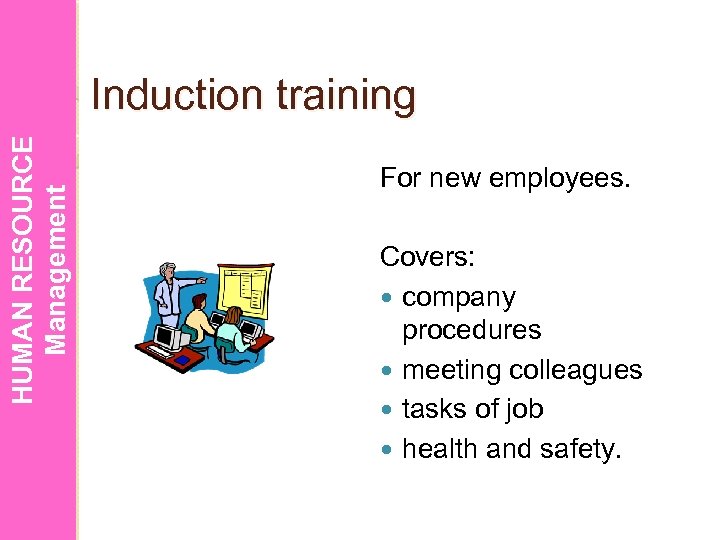
HUMAN RESOURCE Management Induction training For new employees. Covers: company procedures meeting colleagues tasks of job health and safety.
HUMAN RESOURCE Management ON-THE-JOB TRAINING Takes place at the workplace. The employee trains alongside an experienced worker while doing the job. Think of occupations where this is best suited. Why? ADVANTAGES DISADVANTAGES • Possibly cheaper as done inhouse by the business itself. • Bad habits might be passed on • Workers do not have to leave the workplace. Normal work may be able to continue. • Skills improved in workplace • Training is not done by a qualified instructor • Don’t benefit from meeting other employees and sharing ideas.
HUMAN RESOURCE Management VIRTUAL LEARNING ENVIRONMENT (VLE) Using IT such as a website whereby there are tasks, challenges and assessments to complete. Could be a tailor-made programme that employees work through at their leisure or as part of formal training. Could be linked to a ‘mentor’ who the employee regularly speaks to Staff could collaborate with each other on projects. Think of a situation/occupation where this is most likely?
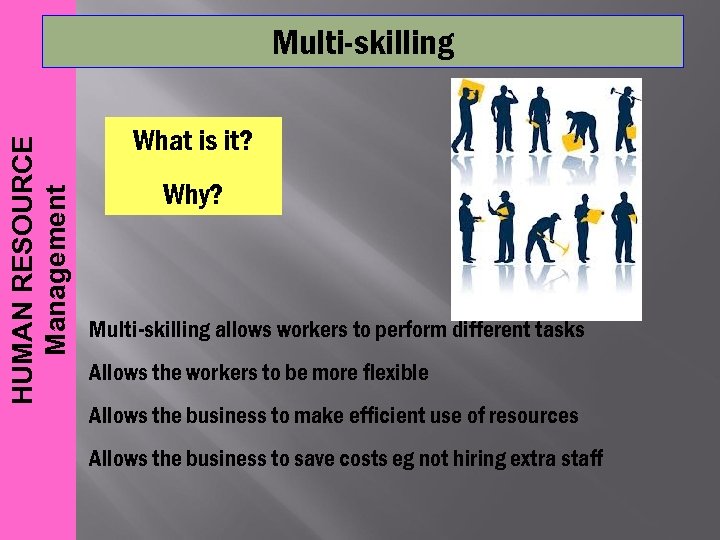
HUMAN RESOURCE Management Multi-skilling What is it? Why? Multi-skilling allows workers to perform different tasks Allows the workers to be more flexible Allows the business to make efficient use of resources Allows the business to save costs eg not hiring extra staff
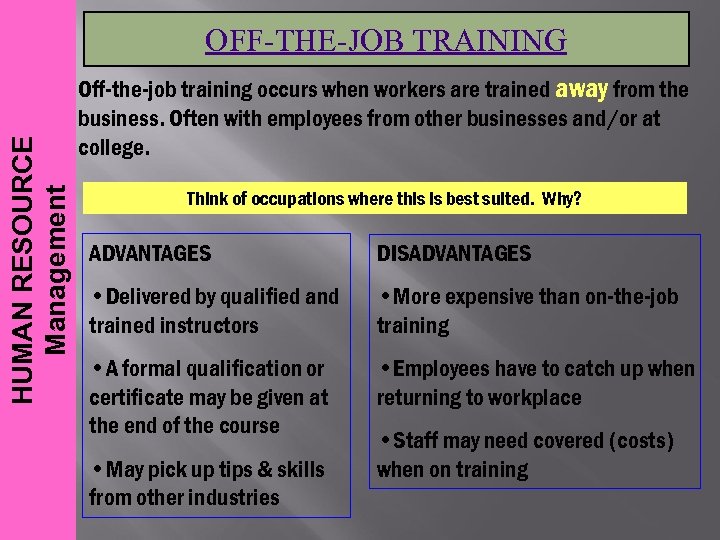
HUMAN RESOURCE Management OFF-THE-JOB TRAINING Off-the-job training occurs when workers are trained away from the business. Often with employees from other businesses and/or at college. Think of occupations where this is best suited. Why? ADVANTAGES DISADVANTAGES • Delivered by qualified and trained instructors • More expensive than on-the-job training • A formal qualification or certificate may be given at the end of the course • Employees have to catch up when returning to workplace • May pick up tips & skills from other industries • Staff may need covered (costs) when on training
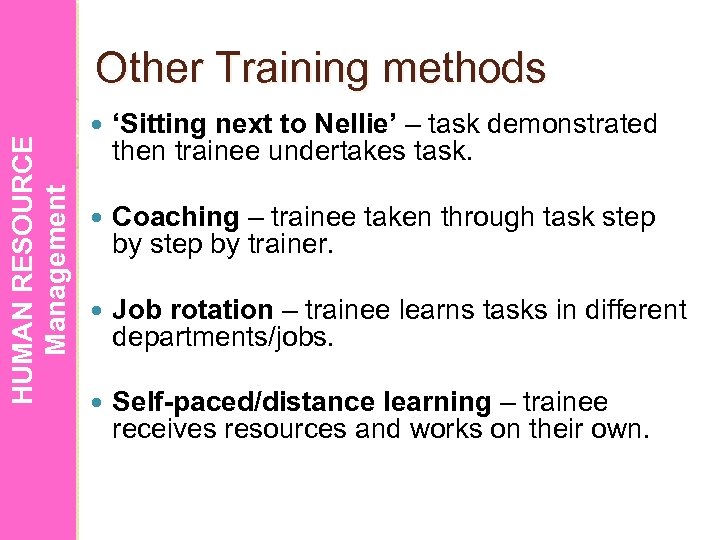
HUMAN RESOURCE Management Other Training methods ‘Sitting next to Nellie’ – task demonstrated then trainee undertakes task. Coaching – trainee taken through task step by trainer. Job rotation – trainee learns tasks in different departments/jobs. Self-paced/distance learning – trainee receives resources and works on their own.
HUMAN RESOURCE Management Answer a question Describe the benefits to an organisation of staff training. (5 marks) 2010 10 minutes
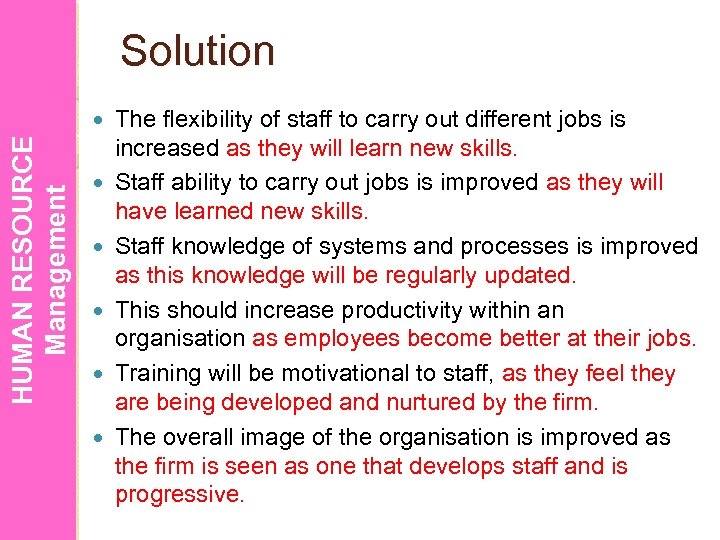
Solution HUMAN RESOURCE Management The flexibility of staff to carry out different jobs is increased as they will learn new skills. Staff ability to carry out jobs is improved as they will have learned new skills. Staff knowledge of systems and processes is improved as this knowledge will be regularly updated. This should increase productivity within an organisation as employees become better at their jobs. Training will be motivational to staff, as they feel they are being developed and nurtured by the firm. The overall image of the organisation is improved as the firm is seen as one that develops staff and is progressive.
HUMAN RESOURCE Management Appraisal Learning and Teaching Scotland
HUMAN RESOURCE Management Learning Intentions: To introduce Appraisal Success Criteria: You should be able to: Describe appraisal Give reasons for carrying out appraisal BM Unit 2 - LO 2 78
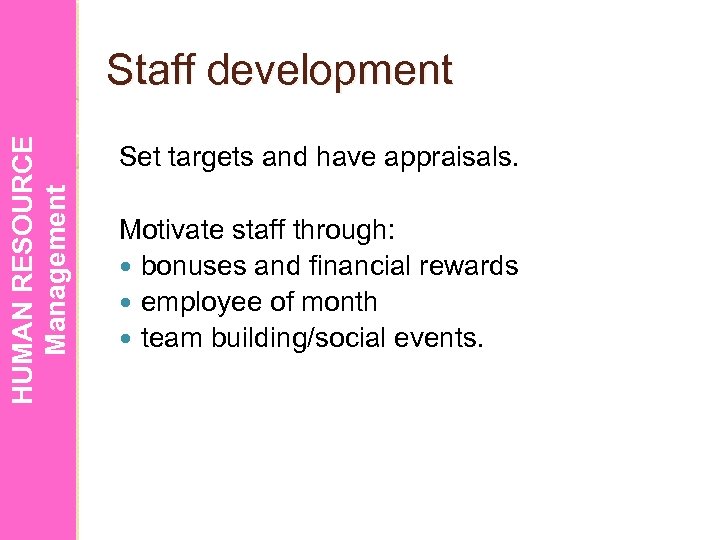
HUMAN RESOURCE Management Staff development Set targets and have appraisals. Motivate staff through: bonuses and financial rewards employee of month team building/social events.
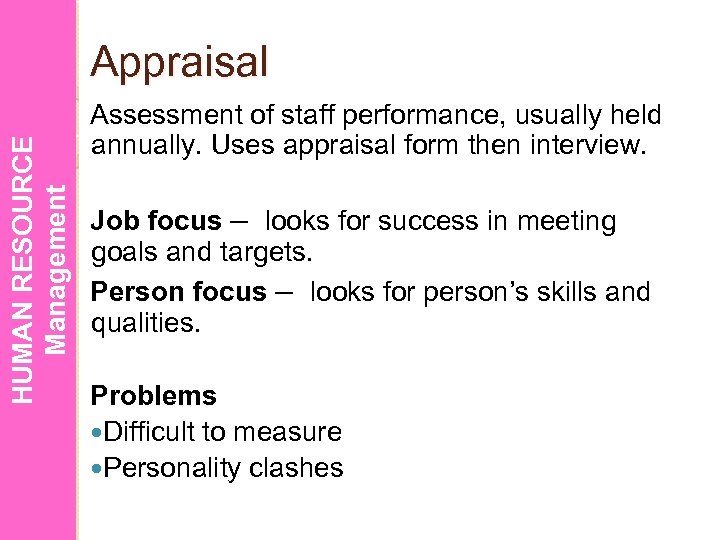
HUMAN RESOURCE Management Appraisal Assessment of staff performance, usually held annually. Uses appraisal form then interview. Job focus – looks for success in meeting goals and targets. Person focus – looks for person’s skills and qualities. Problems Difficult to measure Personality clashes
HUMAN RESOURCE Management Reasons for appraisal To identify future training needs. To consider individual’s development needs. To improve employee performance. To provide feedback on performance. To identify promotion hopefuls.
HUMAN RESOURCE Management Answer a question Discuss the value of an appraisal system. (4 marks) 2006 8 minutes
Solution HUMAN RESOURCE Management To identify future training needs, which can then be planned for over the coming year. To consider development needs of the individual in order for the employee to progress. To improve the performance of the employee and therefore increase productivity and efficiency. To provide feedback to the employee about their performance, and so improve long-term results. To identify people who have promotion potential, who can be nurtured and developed. To identify people who have additional skills that could be useful to the organisation and who may otherwise be overlooked. To identify targets for the coming year. May demotivate employees if the system highlights them as underperforming.
HUMAN RESOURCE Management Employee Relations Learning and Teaching Scotland
HUMAN RESOURCE Management Learning Intentions: To introduce employee relations Success Criteria: You should be able to: Describe the term employee relations Describe the term trade unions Describe the term collective bargaining Describe ACAS and its involvement in business organisations BM Unit 2 - LO 2 85
HUMAN RESOURCE Management Employee relations ‘The formal relationship between employees and employers’. Refers mainly to the way employers deal with employees either as individuals or as part of a group. Industrial relations (IR) is the part of employee relations that involves dealings between employers and trade unions.
HUMAN RESOURCE Management Main areas covered by employee relations policies Trade union recognition Collective bargaining Employee relations procedures The employment relationship Participation and involvement
HUMAN RESOURCE Management Advisory, Conciliation and Arbitration Service (ACAS) Provides impartial information to people with problems at work. Prevents and resolves problems at work. Settles complaints about employees’ rights. Runs workshops and seminars on latest employment issues and legislation.
HUMAN RESOURCE Management Employers’ associations These are organisations that represent the views and interests of companies within one sector of industry, eg Newspaper Society, Engineering Employers’ Association. They provide a range of services: • pressure group • collective market research organisation • public relations voice for the industry • provider of negotiating teams.
HUMAN RESOURCE Management Trade unions Organisation representing workers on pay negotiations, working conditions, dismissal, redundancy. NUM and EIS are examples of unions. Collective bargaining is the basis of unions – giving a group of workers a better negotiating position. Trade unions are funded by annual subscriptions from their members.
HUMAN RESOURCE Management Current Unions • Association of Headteachers and Deputes in Scotland AHTS (www. ahds. org. uk) • Association of School and College Leaders ASCL (www. ascl. org. uk) • Association of Teachers and Lecturers ATL (www. atl. org. uk) • Bakers, Food and Allied Workers Union BFAWU (www. bfawu. org. uk) • British Air Line Pilots Association BALPA (www. balpa. org. uk) • British Association of Colliery Management BACT - TEAM (www. bacmteam. org. uk) • British Association of Dental Nurses BADN ([6]) • British Association of Journalists BAJ (www. bajunion. org. uk/) • British Association of Occupational Therapists BAOT (www. baot. co. uk/) • British Dental Association BDA (www. bda. org/) • British Dietetic Association BDA (www. bda. uk. com) • British Medical Association BMA (www. bma. org. uk/) • British Orthoptic Society BOS (www. orthoptics. org. uk/) • Educational Institute of Scotland EIS (www. eis. org. uk) • EQUITY (actors) • Fire Brigades Union FBU (www. fbu. org. uk) • Fire Officers Association (www. fireofficers. org. uk) • GMB (General workers' union) (www. gmb. org. uk) • ‡General Federation of Trade Unions • Unison • NUJ BM Unit 2 - LO 4 91
HUMAN RESOURCE Management Trade union aims Improve the pay of its members. Improve working conditions. Support training and development of members. Ensure members’ interests are considered by employers.
HUMAN RESOURCE Management CBI vs TUC The Confederation of British Industry (CBI) and the Trade Unions Congress (TUC) are counterparts. The CBI represents the employers associations, whereas the TUC represents the different workers’ unions.
HUMAN RESOURCE Management Professional associations These organisations represent ‘professional’ occupations, eg the British Medical Association (BMA) for doctors, the Police Federation for the police and even the Professional Footballers’ Association (PFA) for footballers. They sometimes perform similar roles to unions, and also are involved in maintaining standards, etiquette and codes of conduct.
HUMAN RESOURCE Management Collective bargaining Begins with a change in existing contracts. Employers make offer to employee representatives (reps). Reps tell members and counter-claim occurs. Negotiations begin. Eventually a compromise is reached.
HUMAN RESOURCE Management Answer a question Describe the role of the following in supporting employees and employers when disputes occur in the workplace: trade unions ACAS (6 marks) 2006 10 minutes
HUMAN RESOURCE Management Hint Think about the kind of things unions get involved in, eg pay, working conditions, negotiation etc Also think of ACAS as a peace envoy sent by the United Nations to help bring two warring countries to the negotiating table!
Solution Trade unions represent employees with regard to wage negotiations, conditions of service, dismissal, redundancy and other work-related matters. They undertake collective bargaining on behalf of employees and have greater negotiating power than individuals. Unions offer employers advice in work-related matters. Unions are involved with industrial tribunals. HUMAN RESOURCE Management ACAS give advice to employers, employees and trade unions on matters such as contracts of employment, human resource policies, legislation and other work-related matters (advice). At the request of management, ACAS can intervene in a dispute and offer a solution that both parties may accept (conciliation). ACAS can look at the problem and recommend a course of action which both parties agree to abide by (arbitration).
HUMAN RESOURCE Management Learning Intentions: Success Criteria: You should be able to: BM Unit 2 - LO 2 99
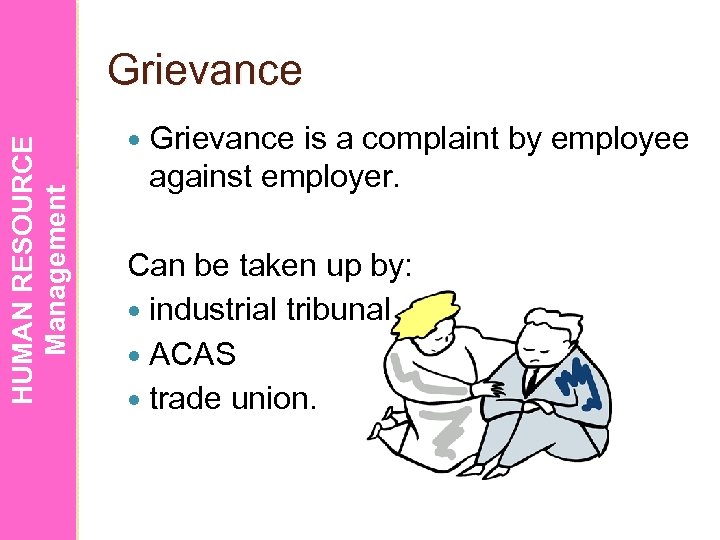
HUMAN RESOURCE Management Grievance is a complaint by employee against employer. Can be taken up by: industrial tribunal ACAS trade union.
HUMAN RESOURCE Management Discipline procedures are taken out by employers against an employee. Employees must be aware of the rules. Verbal and written warnings given for breaking rules. Suspensions can follow then dismissal.
HUMAN RESOURCE Management Processes Negotiation Consultation Arbitration
HUMAN RESOURCE Management Negotiation Where employers and employees discuss matters of mutual concern and come to an agreement on what should happen. The essence of this process is that both parties must agree to the final outcome. Negotiation usually involves bargaining and compromise.
HUMAN RESOURCE Management Consultation Where organisations discuss matters of mutual concern with their employees and listen to the views expressed. However, the final decision lies with the organisation and there is no obligation to come to any agreement. In making its decision the organisation may or may not take account of the opinions of its employees.
HUMAN RESOURCE Management Arbitration Where employers and employees decide that a decision will be made by an independent, neutral arbitrator. Both parties agree to accept the decision, whatever it may be. This process usually involves both parties putting their case separately to the arbitrator, who may also collect other relevant evidence. This often happens when negotiations have broken down and employers and employees have failed to agree on the matters under discussion.
HUMAN RESOURCE Management Works councils Set up by an organisation and contain the same number of employees and employer representatives. Groups meet to discuss any proposed changes before they are implemented. Decisions reached by the council are usually accepted by the workforce as their representatives have been involved.
HUMAN RESOURCE Management Answer a question Describe the role of human resource management in employee relations. (5 marks) 2010 10 minutes
Solution HUMAN RESOURCE Management Recognition of trade unions, who represent employees. (Written) procedures for dealing with staff complaints to ensure every employee is fairly treated. (Written) terms and conditions for all staff – required by law. Use of works councils to give employees a say in the running of the business. Ensure employees are aware of the goals and objectives of the organisation. The role of appraisal by ensuring performance reviews take place. Work with ACAS and take part in collective bargaining process in order to agree to working conditions.
HUMAN RESOURCE Management Learning Intentions: To introduce industrial action Success Criteria: You should be able to: Define the term industrial action Give examples of industrial action in terms of the employee and the employer Describe the effects of industrial action BM Unit 2 - LO 2 109
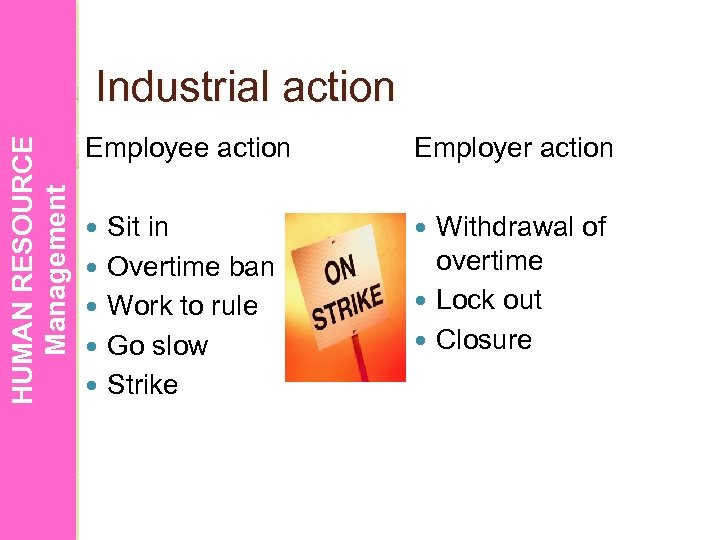
HUMAN RESOURCE Management Industrial action Employee action Sit in Overtime ban Work to rule Go slow Strike Employer action Withdrawal of overtime Lock out Closure
HUMAN RESOURCE Management Answer a question Describe the types of industrial action employees can use. (4 marks) 2008 8 minutes
Solution HUMAN RESOURCE Management A strike is when employees refuse to do their work and do not enter the workplace – this is the most extreme form of industrial action. A sit-in is when employees are in their place of work but do not do any work. Work to rule is when employees only undertake the exact jobs written in their job description. Go-slow is when employees deliberately work at a much slower rate. Overtime ban is when employees do not do any overtime. This can affect overall production. Picketing is when employees protest at the entrance to the place of work, trying to dissuade other employees from going in to work.
HUMAN RESOURCE Management Record keeping A key element of human resource management is maintaining records of personnel. By doing this, the human resource management department is able to: find out information about employees in the organisation monitor the work of the human resource management department provide information that the organisation can use in the development of strategy provide advice to line managers and others in the organisation.
Information stored HUMAN RESOURCE Management Basic employee data, eg address, employee number, National Insurance number etc. Training, eg courses attended, qualifications obtained. Absence, eg because of sickness. Applicants for posts, eg to comply with equal opportunities legislation. Holidays. Wages and salaries, eg pay scale, method of payment, bonuses. Labour turnover. Occupational health.

HUMAN RESOURCE Management The Law and Employment
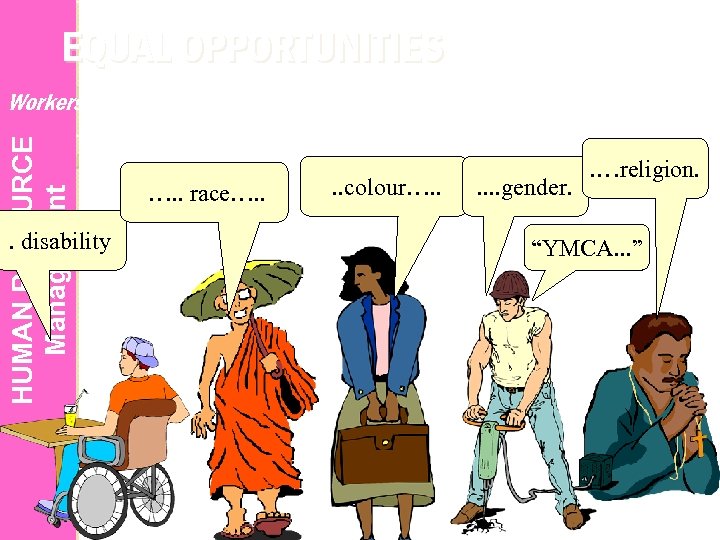
EQUAL OPPORTUNITIES HUMAN RESOURCE Management Workers must not be discriminated against on the grounds of . disability …. . race…. . colour…. . . gender. . …religion. “YMCA. . . ”

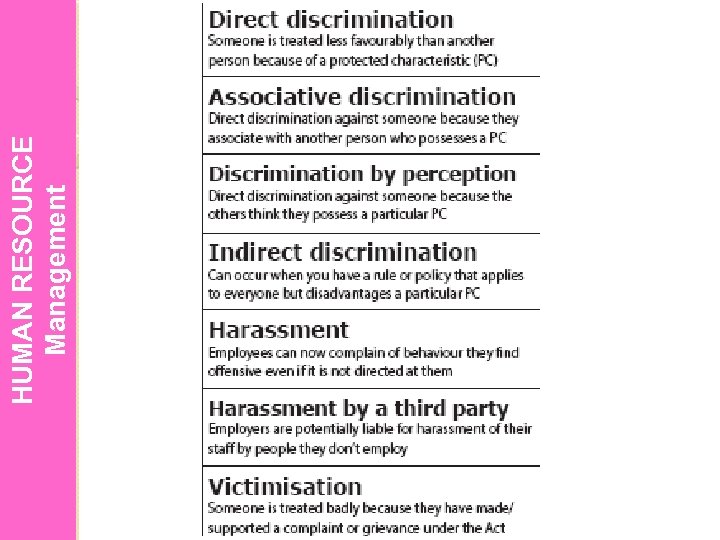
Equality Act 2010 HUMAN RESOURCE Management The Equality Act 2010 is the law which bans unfair treatment and helps achieve equal opportunities in the workplace and in society. Replaces all previous equality legislation in England, Scotland & Wales: - Race Relations Act - the Disability Discrimination Act - Sex Discrimination Act - Equal Pay Act - Employment Equality (Age) Regulations The protected characteristics (PC) are: age disability gender reassignment religion or belief marriage and civil partnership sex pregnancy and maternity race sexual orientation
HUMAN RESOURCE Management
HUMAN RESOURCE Management Equal Opportunities Facts People with mental health problems face significant difficulties accessing work eg only 23% of people with depression are in employment. Strong occupational segregation by race and gender still persists eg one in 4 Pakistani men is a taxi driver; one in 3 women is in a managerial job while more than ¾ of administrative jobs are done by women. 11 9
HUMAN RESOURCE Management Equal Opportunities Facts The gender pay gap widens significantly as a result of motherhood, with mothers with mid-level qualifications facing a 25% loss in lifetime earnings and those with no qualifications a 58% loss. Lesbian, gay or bisexual adults are twice as likely to report harassment, discrimination or other unfair treatment at work compared to other employees. 12 0

HUMAN RESOURCE Management The Equality Act 2010 Replaced previous antidiscrimination laws with a single act To make the law simpler To remove inconsistencies Easier for people to understand comply with Strengthened protection in some situations 12 1
HUMAN RESOURCE Management Age Refers to a particular age or a range of ages “I’m dismissing you because you’re 65” “No applicant over 50 will be considered for this job” 12 2
HUMAN RESOURCE Management Disability A physical or mental impairment and the impairment has a substantial and longterm adverse effect on their ability to carry out normal day-to-day activities. Physical: eg arthritis, sciatica, diabetes, heart disease Mental: eg depression and anxiety, learning difficulties, autism, Asperger’s syndrome Long-term: 12 months, rest of life 12 3
HUMAN RESOURCE Management Gender reassignment Person is proposing to undergo, is undergoing or has undergone a process (or part of a process) for the purpose of reassigning the person’s sex by changing physiological or other attributes of sex. Process does not need to be a medical procedure. 12 4
HUMAN RESOURCE Management Race Includes: colour eg black or white Nationality eg British, Columbian or Slovakian Ethnic or national origins eg Roma or Irish traveller background 12 5
HUMAN RESOURCE Management Religion or belief Includes: Any religion or philosophical belief Lack of religion or philosophical belief Religions covered include: Christianity Hinduism Islam Judaism Sikhism 12 6
HUMAN RESOURCE Management Sexual orientation Outlaws discrimination in employment based on sexual orientation towards: people of the same sex opposite sex the same sex and the opposite sex 12 7
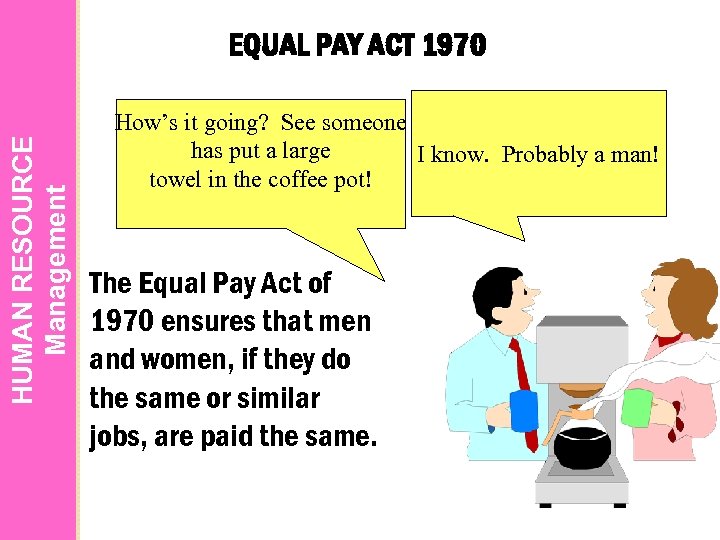
HUMAN RESOURCE Management EQUAL PAY ACT 1970 How’s it going? See someone has put a large I know. Probably a man! towel in the coffee pot! The Equal Pay Act of 1970 ensures that men and women, if they do the same or similar jobs, are paid the same.

HUMAN RESOURCE Management HEALTH AND SAFETY AT WORK ACT Employers must take responsibility for the health and safety of workers. Employees are expected to be responsible for their safety and the safety of others. The main law which deals with health and safety is the Health and Safety at Work Act 1974. I think there’s been a breach of the Health and Safety at Work Act 1974
HUMAN RESOURCE Management HEALTH AND SAFETY AT WORK ACT The Health & Safety at Work Act 1974 sets out the responsibilities of employers and employees with regards to health and safety in the workplace. Employers’ responsibilities (the business you are working for): · provide and maintain suitable surroundings · provide information and training · provide protective clothing and equipment if necessary · prepare a health and safety policy. Employees’ responsibilities (the person working for the business): · take reasonable care for their own safety and others · cooperate with employer · do not interfere with or misuse equipment.

NATIONAL MINIMUM WAGE ACT HUMAN RESOURCE Management Employers are obliged to pay a minimum wage (Oct 2015) of 21 and over 18 to 20 Under 18 Apprentice* £ 6. 50 £ 5. 13 £ 3. 79 £ 2. 73 £ 6. 50 an hour!! I don’t think the business can afford that. Och well, I’ll continue to develop my idea for writing on black paper.

HUMAN RESOURCE Management Data Protection Act This controls how your personal information is used by organisations, businesses or the government. Everyone who is responsible for using data has to follow the ‘principles’, so that information is …. • used fairly and lawfully • used for limited, specifically stated purposes • used in a way that is adequate, relevant and not excessive • accurate • kept for no longer than is absolutely necessary • handled according to people’s data protection rights • kept safe and secure • not transferred outside the UK without adequate protection
HUMAN RESOURCE Management Answer a question Describe the purpose of: the Health & Safety at Work Act 1974 the Race Relations Act 1976 the Equal Pay Act 1970 (3 marks) 2006 6 minutes
Solution Health & Safety at Work Act 1974 States employers’ and employees’ duties with regard to health and safety. Employees have a duty to take care of their own health as well as that of other employees. Race Relations Act 1976 Unlawful to discriminate on the grounds of race, colour, religion or ethnic origin with regard to recruitment, training, promotion or conditions of service. Equal Pay Act 1970 All employees should receive the same rate of pay where work of equal value is undertaken. HUMAN RESOURCE Management
Скачать презентацию HUMAN RESOURCE Management Higher Business Management Human Resource
06bc9748455969a830ec241aa39c8197.ppt