


 Скачать презентацию Human Reproduction ORCA Education Limited 2004 and
Human Reproduction VT.ppt
- Количество слайдов: 20
 Human Reproduction © ORCA Education Limited 2004 and suppliers all rights reserved New Words
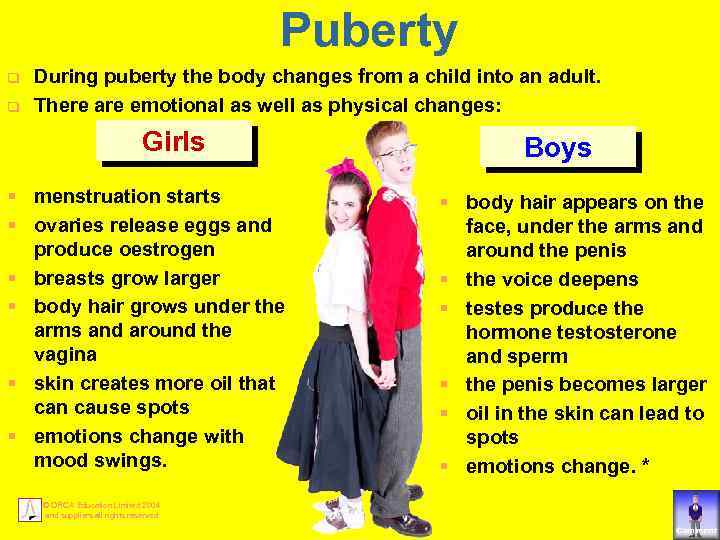 Puberty q q During puberty the body changes from a child into an adult. There are emotional as well as physical changes: Girls § menstruation starts § ovaries release eggs and produce oestrogen § breasts grow larger § body hair grows under the arms and around the vagina § skin creates more oil that can cause spots § emotions change with mood swings. © ORCA Education Limited 2004 and suppliers all rights reserved Boys § body hair appears on the face, under the arms and around the penis § the voice deepens § testes produce the hormone testosterone and sperm § the penis becomes larger § oil in the skin can lead to spots § emotions change. *
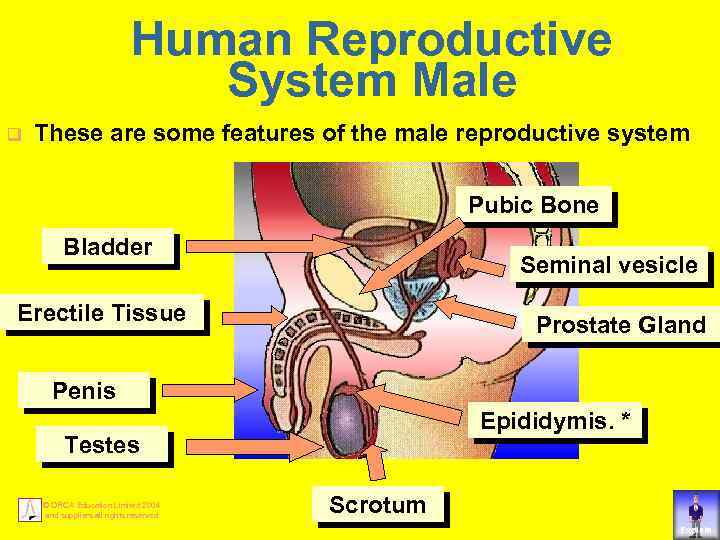 Human Reproductive System Male q These are some features of the male reproductive system Pubic Bone Bladder Seminal vesicle Erectile Tissue Prostate Gland Penis Epididymis. * Testes © ORCA Education Limited 2004 and suppliers all rights reserved Scrotum
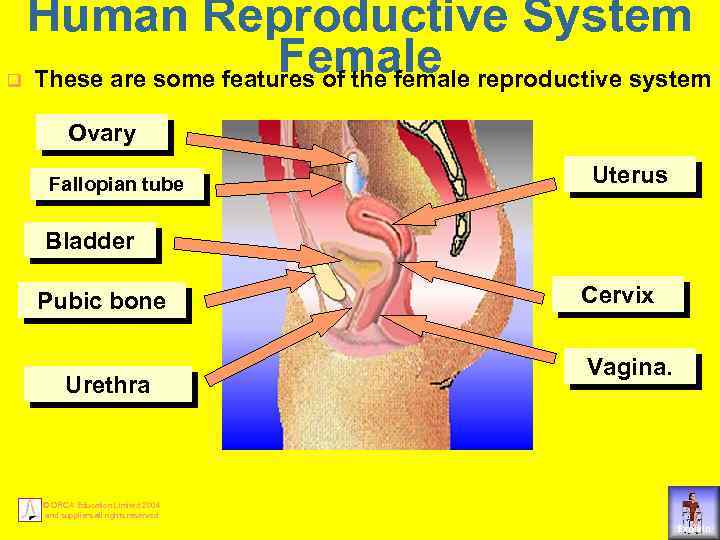 q Human Reproductive System Female reproductive system These are some features of the female Ovary Fallopian tube Uterus Bladder Pubic bone Urethra © ORCA Education Limited 2004 and suppliers all rights reserved Cervix Vagina.
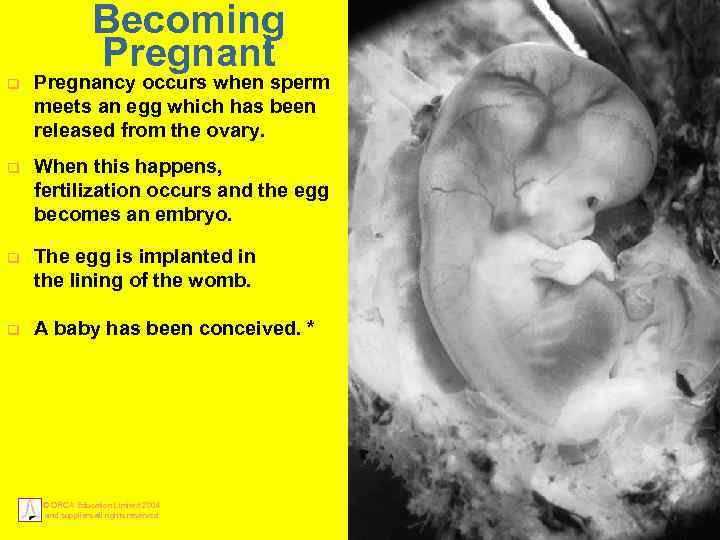 Becoming Pregnant q Pregnancy occurs when sperm meets an egg which has been released from the ovary. q When this happens, fertilization occurs and the egg becomes an embryo. q The egg is implanted in the lining of the womb. q A baby has been conceived. * © ORCA Education Limited 2004 and suppliers all rights reserved
 q q The Menstrual Cycle and Pregnancy during the Usually, an egg is released once a month (28 days) menstrual cycle. This cycle can be irregular. A woman cannot normally tell when she is fertile so she must use contraceptives to avoid becoming pregnant if she has intercourse. Ovulation and being fertile happen in response to hormones in the woman’s body particularly oestrogen and progesterone. * © ORCA Education Limited 2004 and suppliers all rights reserved
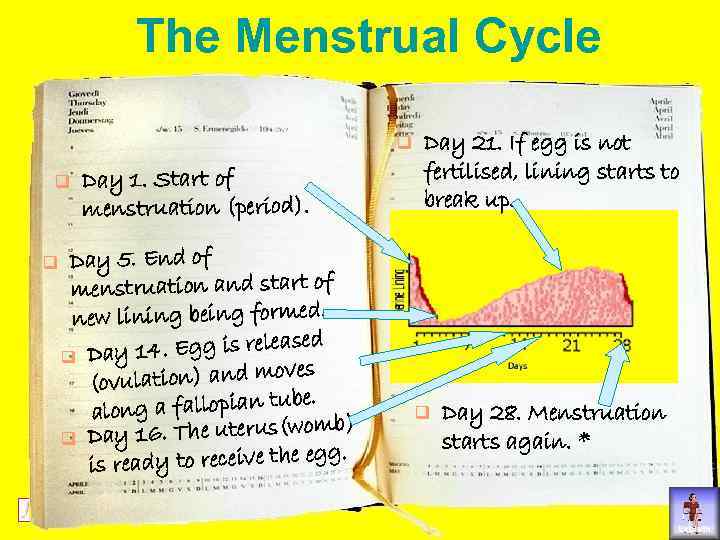 The Menstrual Cycle q q q Day 1. Start of menstruation (period). Day 5. End of menstruation and start of new lining being formed. sed y 14. Egg is relea q Da lation) and moves (ovu a fallopian tube. along b) Day 16. The uterus(wom q. ready to receive the egg is © ORCA Education Limited 2004 and suppliers all rights reserved Day 21. If egg is not fertilised, lining starts to break up. q Day 28. Menstruation starts again. *
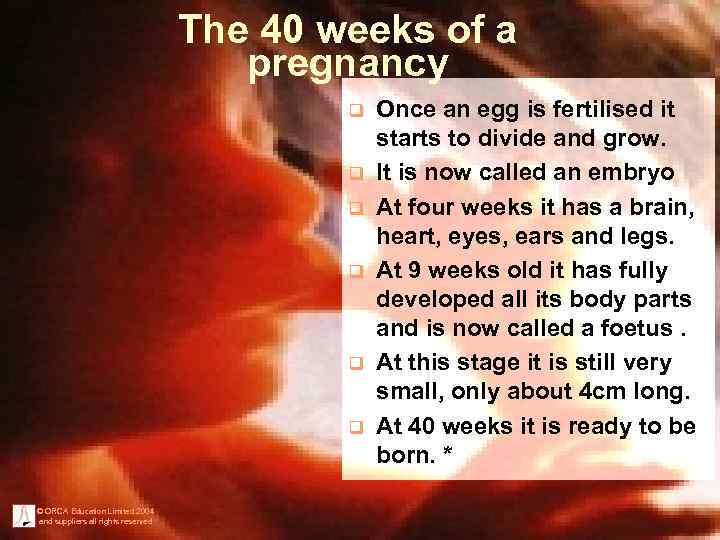 The 40 weeks of a pregnancy q q q © ORCA Education Limited 2004 © ORCA Educationrights reserved and suppliers all Limited 2004 and suppliers all rights reserved Once an egg is fertilised it starts to divide and grow. It is now called an embryo At four weeks it has a brain, heart, eyes, ears and legs. At 9 weeks old it has fully developed all its body parts and is now called a foetus. At this stage it is still very small, only about 4 cm long. At 40 weeks it is ready to be born. *
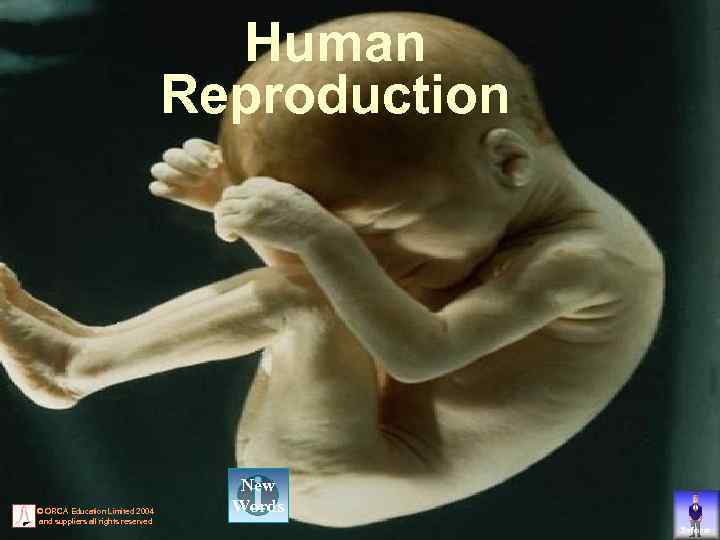
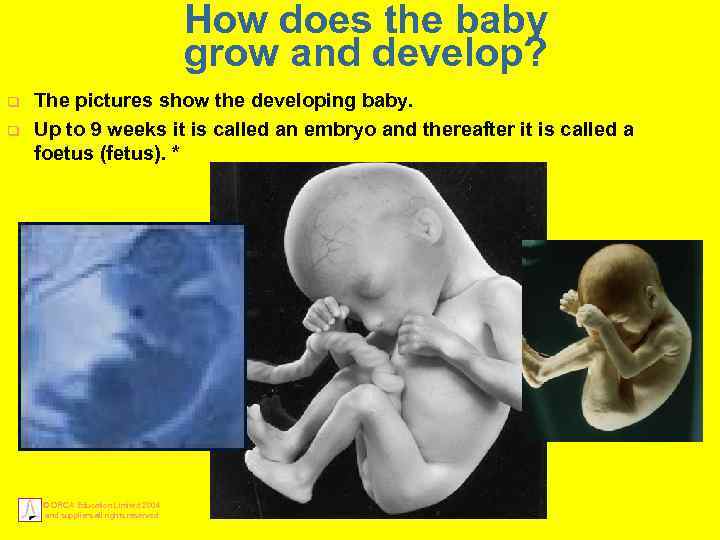 How does the baby grow and develop? q q The pictures show the developing baby. Up to 9 weeks it is called an embryo and thereafter it is called a foetus (fetus). * © ORCA Education Limited 2004 and suppliers all rights reserved
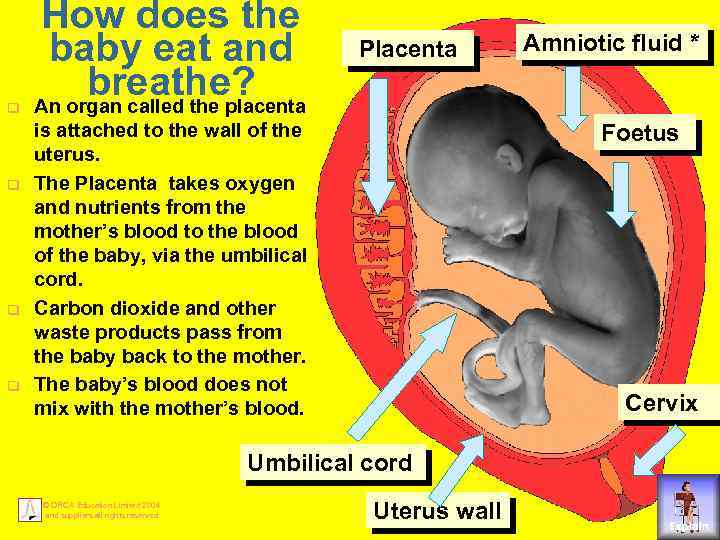 q q How does the baby eat and breathe? An organ called the placenta Placenta is attached to the wall of the uterus. The Placenta takes oxygen and nutrients from the mother’s blood to the blood of the baby, via the umbilical cord. Carbon dioxide and other waste products pass from the baby back to the mother. The baby’s blood does not mix with the mother’s blood. Foetus Cervix Umbilical cord © ORCA Education Limited 2004 and suppliers all rights reserved Amniotic fluid * Uterus wall
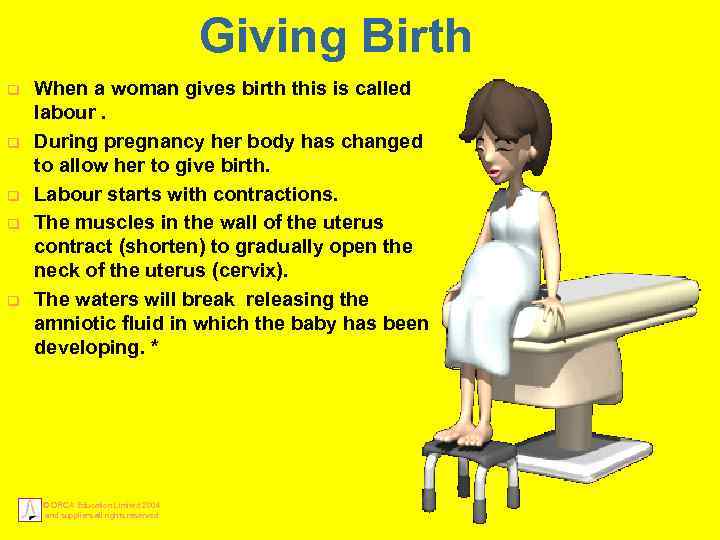 Giving Birth q q q When a woman gives birth this is called labour. During pregnancy her body has changed to allow her to give birth. Labour starts with contractions. The muscles in the wall of the uterus contract (shorten) to gradually open the neck of the uterus (cervix). The waters will break releasing the amniotic fluid in which the baby has been developing. * © ORCA Education Limited 2004 and suppliers all rights reserved
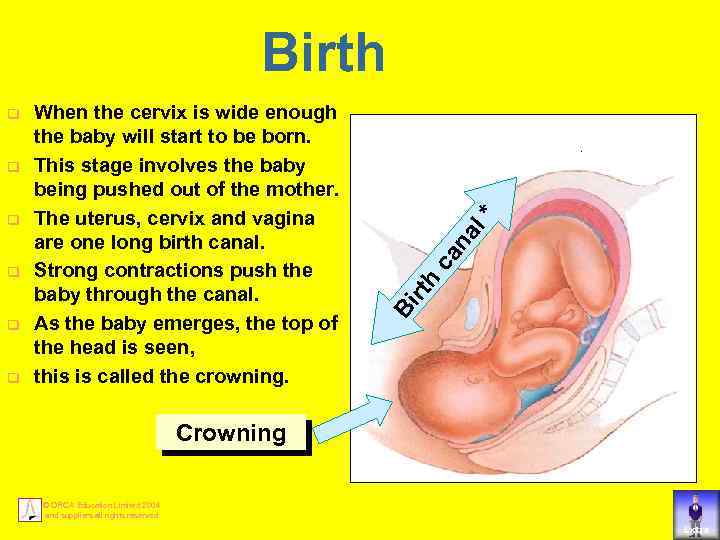 q q q Crowning © ORCA Education Limited 2004 and suppliers all rights reserved na l ca q rth q When the cervix is wide enough the baby will start to be born. This stage involves the baby being pushed out of the mother. The uterus, cervix and vagina are one long birth canal. Strong contractions push the baby through the canal. As the baby emerges, the top of the head is seen, this is called the crowning. Bi q * Birth
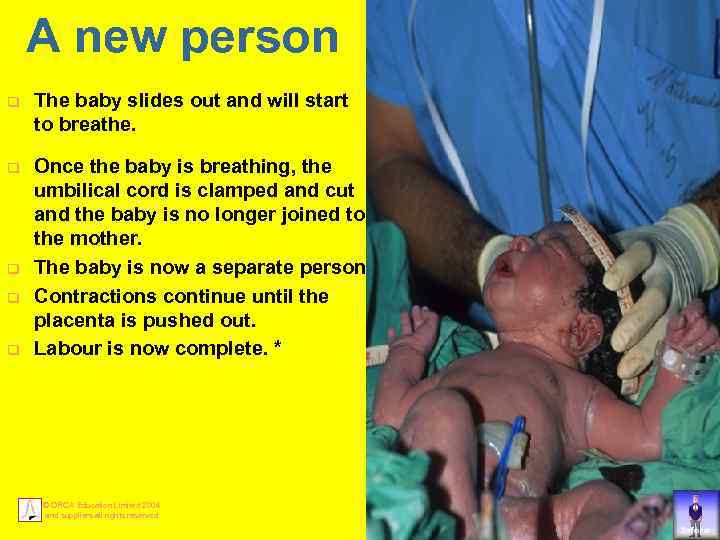 A new person q The baby slides out and will start to breathe. q Once the baby is breathing, the umbilical cord is clamped and cut and the baby is no longer joined to the mother. The baby is now a separate person. Contractions continue until the placenta is pushed out. Labour is now complete. * q q q © ORCA Education Limited 2004 and suppliers all rights reserved
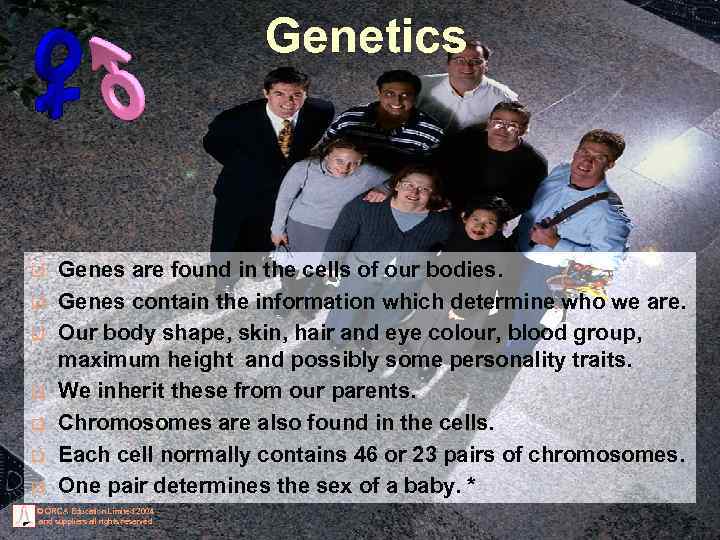 Genetics q q q q Genes are found in the cells of our bodies. Genes contain the information which determine who we are. Our body shape, skin, hair and eye colour, blood group, maximum height and possibly some personality traits. We inherit these from our parents. Chromosomes are also found in the cells. Each cell normally contains 46 or 23 pairs of chromosomes. One pair determines the sex of a baby. * © ORCA Education Limited 2004 © ORCA Educationrights reserved and suppliers all Limited 2004 and suppliers all rights reserved
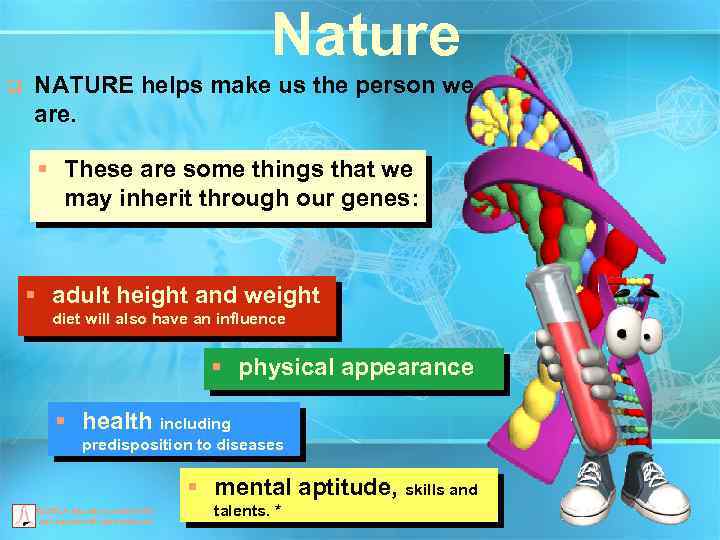 Nature q NATURE helps make us the person we are. § These are some things that we may inherit through our genes: § adult height and weight diet will also have an influence § physical appearance § health including predisposition to diseases § mental aptitude, skills and © ORCA Education Limited 2004 © ORCA Educationrights reserved and suppliers all Limited 2004 and suppliers all rights reserved talents. *
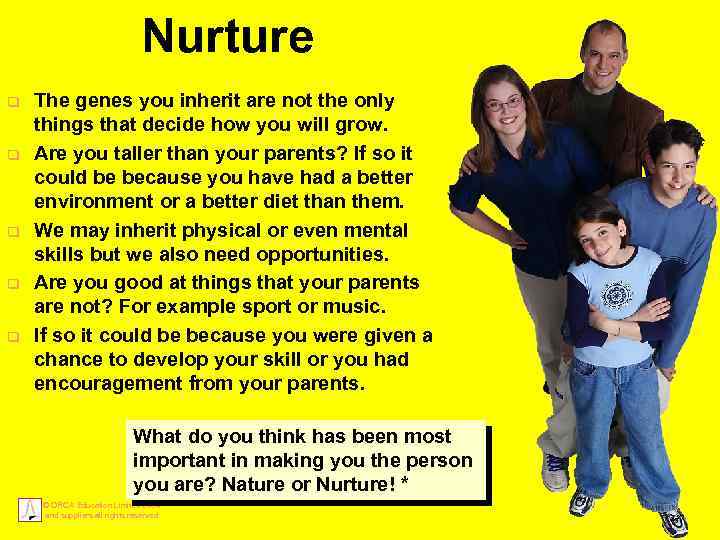 Nurture q q q The genes you inherit are not the only things that decide how you will grow. Are you taller than your parents? If so it could be because you have had a better environment or a better diet than them. We may inherit physical or even mental skills but we also need opportunities. Are you good at things that your parents are not? For example sport or music. If so it could be because you were given a chance to develop your skill or you had encouragement from your parents. What do you think has been most important in making you the person you are? Nature or Nurture! * © ORCA Education Limited 2004 and suppliers all rights reserved
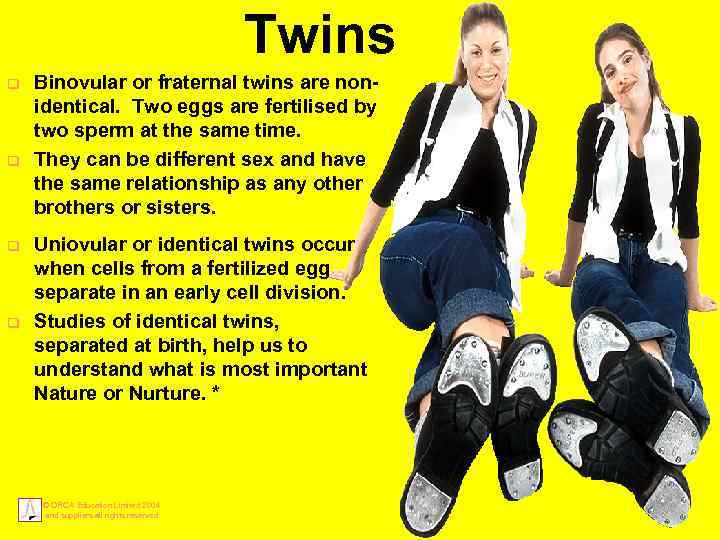 Twins q q Binovular or fraternal twins are nonidentical. Two eggs are fertilised by two sperm at the same time. They can be different sex and have the same relationship as any other brothers or sisters. Uniovular or identical twins occur when cells from a fertilized egg separate in an early cell division. Studies of identical twins, separated at birth, help us to understand what is most important Nature or Nurture. * © ORCA Education Limited 2004 and suppliers all rights reserved
 Vocabulary Some words or terms to learn embryo q foetus q placenta q uterus q umbilical cord q amniotic fluid q menstruation q fallopian tubes q erectile tissue q testosterone q testes q © ORCA Education Limited 2004 and suppliers all rights reserved scrotum q penis q seminal vesicle q cervix q vagina q urethra q oestrogen q progesterone q ovary q contraception q ovulation q chromosomes * q
 The Teacher Task q q q Give three changes that only happen to the body of girls during puberty. Give three changes that only happen to the body of boys during puberty. What three changes are the same for both boys and girls? Draw a diagram of a baby in the womb and label it to show the baby is able to breathe, and grow. Write a list of stages that happen during birth. * © ORCA Education Limited 2004 and suppliers all rights reserved
 End Show Acknowledgements All images used in these presentations are the property of their owners, ORCA Education Limited and suppliers inc. Hemera Images, Jupiter Media Corp. and Animation Factory All rights are reserved. The Licence agreement applies to all elements of these presentations. ORCA. VT is a trademark of ORCA Education Limited Microsoft Agent is the property of Microsoft Corporation, Redmond WA. ORCA Education Limited are licensed distributors of Microsoft Agent technology Licence 276899. The Microsoft Agent Technology elements including Peedy character may not be distributed beyond the constraints of this product licence Microsoft Agent characters Susan and Tom are packaged with this product as part of the Vox Proxy development tools used by ORCA Education. They are not for resale or distribution beyond their use in these products © ORCA Education Limited 2004 The introductory slide image is from Sayward BC and is the property of RCMP Constable Mark Whitworth. All rights reserved and suppliers all rights reserved