 Скачать презентацию Human history becomes more and more a race
H. G. Wells.ppt
- Количество слайдов: 14



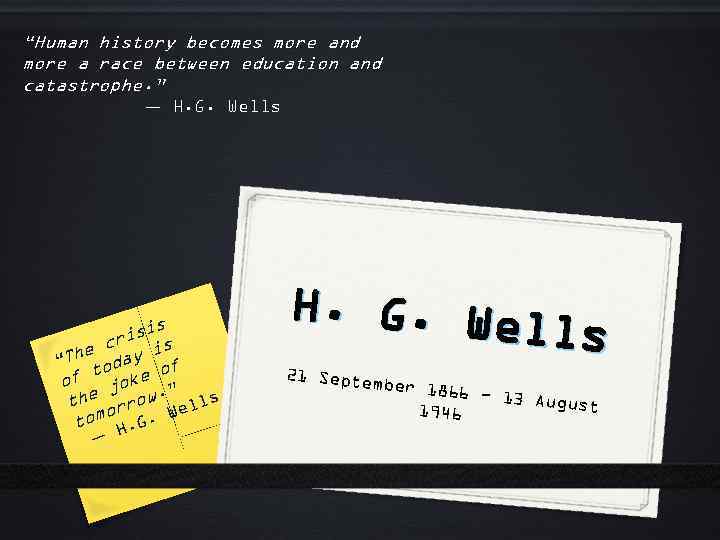
“Human history becomes more and more a race between education and catastrophe. ” ― H. G. Wells s isi r e c y is “Th oda of t of joke ” the rrow. ells o W tom H. G. ― H. G. We lls 21 Septe mber 1866 - 1 3 August 1946
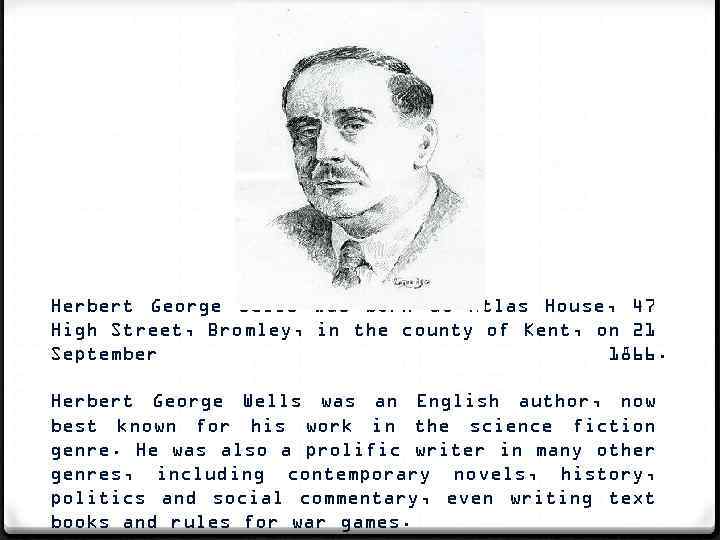
Herbert George Wells was born at Atlas House, 47 High Street, Bromley, in the county of Kent, on 21 September 1866. Herbert George Wells was an English author, now best known for his work in the science fiction genre. He was also a prolific writer in many other genres, including contemporary novels, history, politics and social commentary, even writing text books and rules for war games.
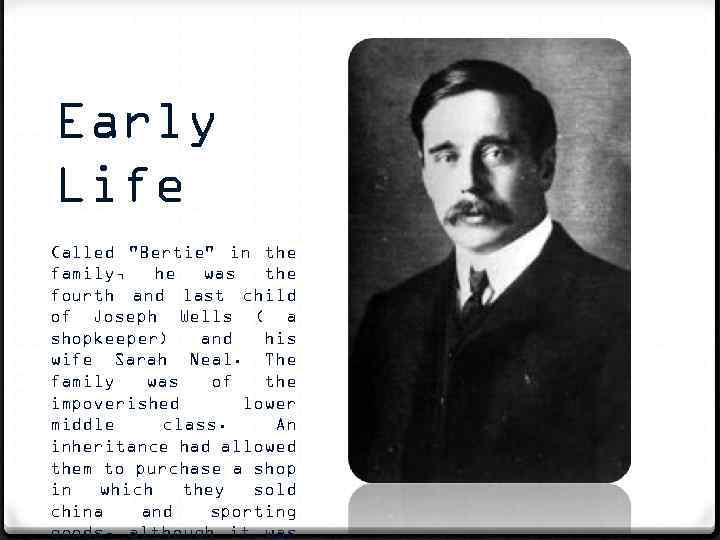
Early Life Called "Bertie" in the family, he was the fourth and last child of Joseph Wells ( a shopkeeper) and his wife Sarah Neal. The family was of the impoverished lower middle class. An inheritance had allowed them to purchase a shop in which they sold china and sporting goods, although it was
Early Life A defining incident of young Wels's life was an accident he had in 1874, which left him bedridden with a broken leg. To pass the time he started reading books from the local library, brought to him by his father. He soon became devoted to the other worlds and lives to which books gave him access; they also stimulated his desire to write. Later that year he entered Thomas Morley's Commercial Academy. The teaching was erratic, the curriculum mostly focused, Wells later said, on producing copperplate handwriting and "doing the sort of sums useful to tradesmen". Wells continued at Morley's Academy until 1880. Wels's mother and father had never got along with one another particularly well (she was a Protestant, he a freethinker), and when she went back to work as a lady's maid (at Up park, a country house in Sussex) one of the conditions of work was that she would not have space for her husband or children. Thereafter, she and Joseph lived separate lives, though they never divorced and neither ever developed any other liaison. As for Wells, he not only failed at being a draper, he also failed as a chemist's assistant, and after each failure, he would arrive at Up park — "the bad shilling back again!" as he said — and stay there until a fresh start could be arranged for him. Fortunately for Wells,
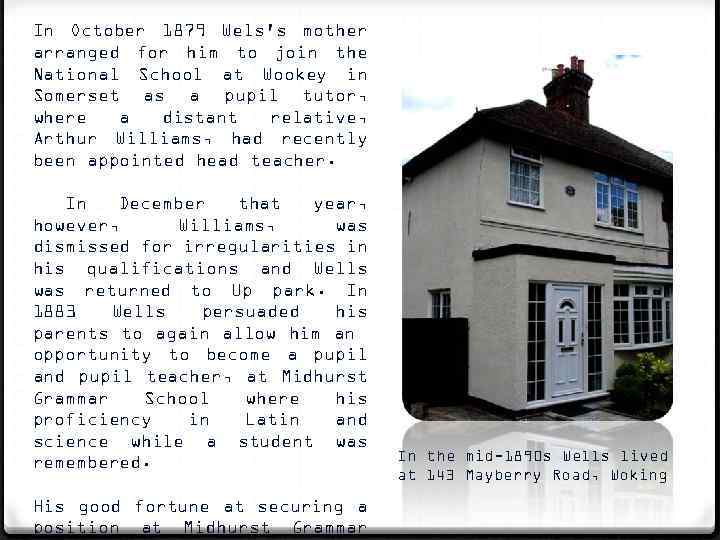
In October 1879 Wels's mother arranged for him to join the National School at Wookey in Somerset as a pupil tutor, where a distant relative, Arthur Williams, had recently been appointed head teacher. In December that year, however, Williams, was dismissed for irregularities in his qualifications and Wells was returned to Up park. In 1883 Wells persuaded his parents to again allow him an opportunity to become a pupil and pupil teacher, at Midhurst Grammar School where his proficiency in Latin and science while a student was remembered. His good fortune at securing a position at Midhurst Grammar In the mid-1890 s Wells lived at 143 Mayberry Road, Woking
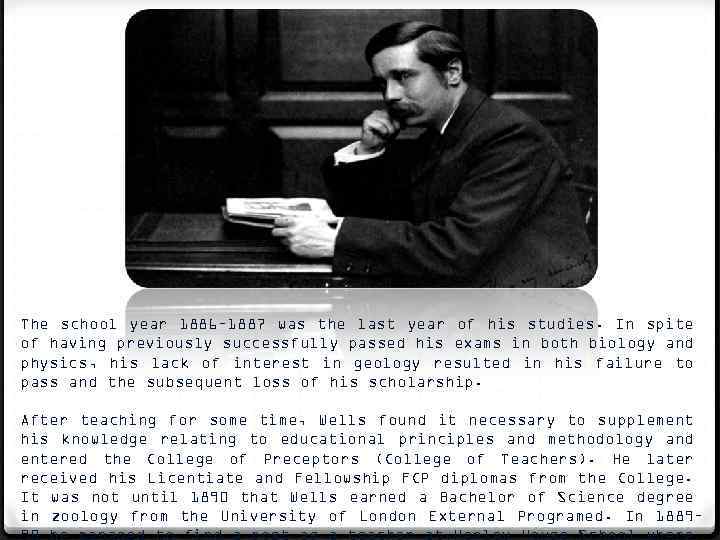
The school year 1886– 1887 was the last year of his studies. In spite of having previously successfully passed his exams in both biology and physics, his lack of interest in geology resulted in his failure to pass and the subsequent loss of his scholarship. After teaching for some time, Wells found it necessary to supplement his knowledge relating to educational principles and methodology and entered the College of Preceptors (College of Teachers). He later received his Licentiate and Fellowship FCP diplomas from the College. It was not until 1890 that Wells earned a Bachelor of Science degree in zoology from the University of London External Programed. In 1889–
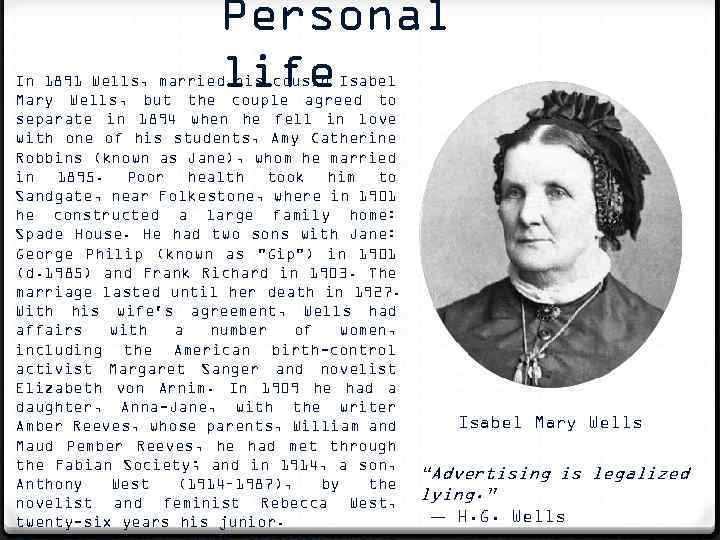
Personal life In 1891 Wells, married his cousin Isabel Mary Wells, but the couple agreed to separate in 1894 when he fell in love with one of his students, Amy Catherine Robbins (known as Jane), whom he married in 1895. Poor health took him to Sandgate, near Folkestone, where in 1901 he constructed a large family home: Spade House. He had two sons with Jane: George Philip (known as "Gip") in 1901 (d. 1985) and Frank Richard in 1903. The marriage lasted until her death in 1927. With his wife's agreement, Wells had affairs with a number of women, including the American birth-control activist Margaret Sanger and novelist Elizabeth von Arnim. In 1909 he had a daughter, Anna-Jane, with the writer Amber Reeves, whose parents, William and Maud Pember Reeves, he had met through the Fabian Society; and in 1914, a son, Anthony West (1914– 1987), by the novelist and feminist Rebecca West, twenty-six years his junior. Isabel Mary Wells “Advertising is legalized lying. ” ― H. G. Wells
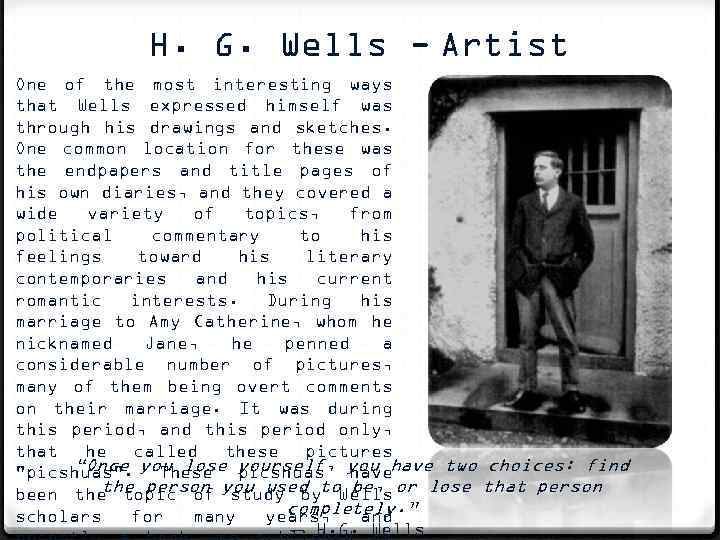
H. G. Wells - Artist One of the most interesting ways that Wells expressed himself was through his drawings and sketches. One common location for these was the endpapers and title pages of his own diaries, and they covered a wide variety of topics, from political commentary to his feelings toward his literary contemporaries and his current romantic interests. During his marriage to Amy Catherine, whom he nicknamed Jane, he penned a considerable number of pictures, many of them being overt comments on their marriage. It was during this period, and this period only, that he called these pictures “Once "picshuas". you lose yourself, you have two choices: find These picshuas have the person study by be, been the topic of you used to. Wells or lose that person completely. ” scholars for many years, and ― H. G. Wells
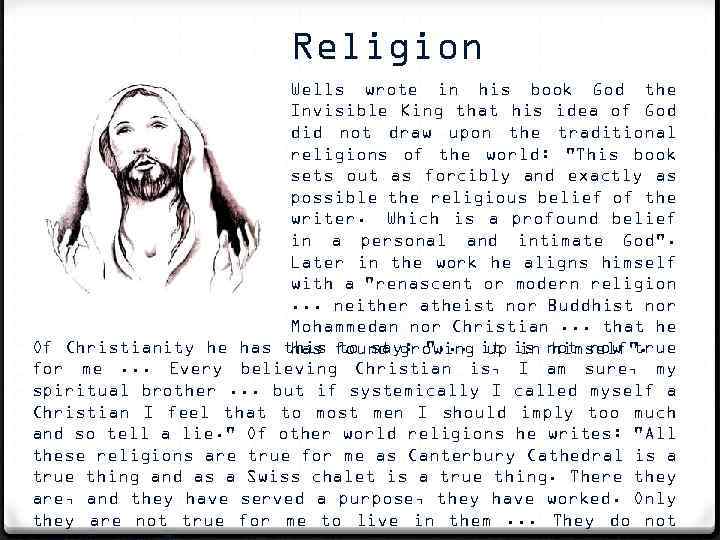
Religion Wells wrote in his book God the Invisible King that his idea of God did not draw upon the traditional religions of the world: "This book sets out as forcibly and exactly as possible the religious belief of the writer. Which is a profound belief in a personal and intimate God". Later in the work he aligns himself with a "renascent or modern religion. . . neither atheist nor Buddhist nor Mohammedan nor Christian. . . that he Of Christianity he has this found growing it is not now true has to say: ". . . up in himself". for me. . . Every believing Christian is, I am sure, my spiritual brother. . . but if systemically I called myself a Christian I feel that to most men I should imply too much and so tell a lie. " Of other world religions he writes: "All these religions are true for me as Canterbury Cathedral is a true thing and as a Swiss chalet is a true thing. There they are, and they have served a purpose, they have worked. Only they are not true for me to live in them. . . They do not
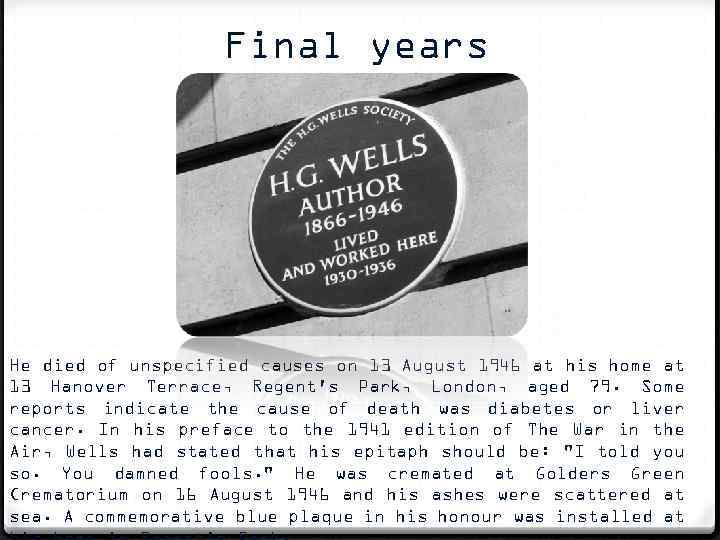
Final years He died of unspecified causes on 13 August 1946 at his home at 13 Hanover Terrace, Regent's Park, London, aged 79. Some reports indicate the cause of death was diabetes or liver cancer. In his preface to the 1941 edition of The War in the Air, Wells had stated that his epitaph should be: "I told you so. You damned fools. " He was cremated at Golders Green Crematorium on 16 August 1946 and his ashes were scattered at sea. A commemorative blue plaque in his honour was installed at
e tru ty is r “Ou onali i nat ind. ” ells k man H. G. W ― H. G. Wel ls fictions , short stories Full lis t of lit erature
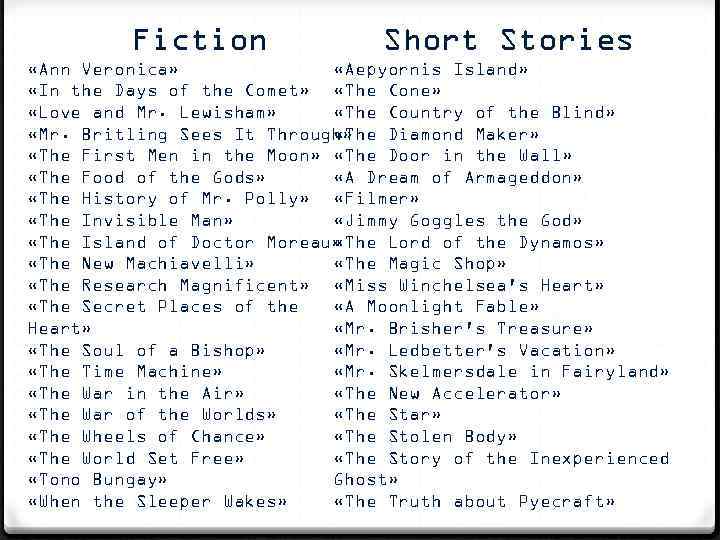
Fiction Short Stories «Ann Veronica» «Aepyornis Island» «In the Days of the Comet» «The Cone» «Love and Mr. Lewisham» «The Country of the Blind» «Mr. Britling Sees It Through» «The Diamond Maker» «The First Men in the Moon» «The Door in the Wall» «The Food of the Gods» «A Dream of Armageddon» «The History of Mr. Polly» «Filmer» «The Invisible Man» «Jimmy Goggles the God» «The Island of Doctor Moreau» «The Lord of the Dynamos» «The New Machiavelli» «The Magic Shop» «The Research Magnificent» «Miss Winchelsea's Heart» «The Secret Places of the «A Moonlight Fable» Heart» «Mr. Brisher's Treasure» «The Soul of a Bishop» «Mr. Ledbetter's Vacation» «The Time Machine» «Mr. Skelmersdale in Fairyland» «The War in the Air» «The New Accelerator» «The War of the Worlds» «The Star» «The Wheels of Chance» «The Stolen Body» «The World Set Free» «The Story of the Inexperienced «Tono Bungay» Ghost» «When the Sleeper Wakes» «The Truth about Pyecraft»
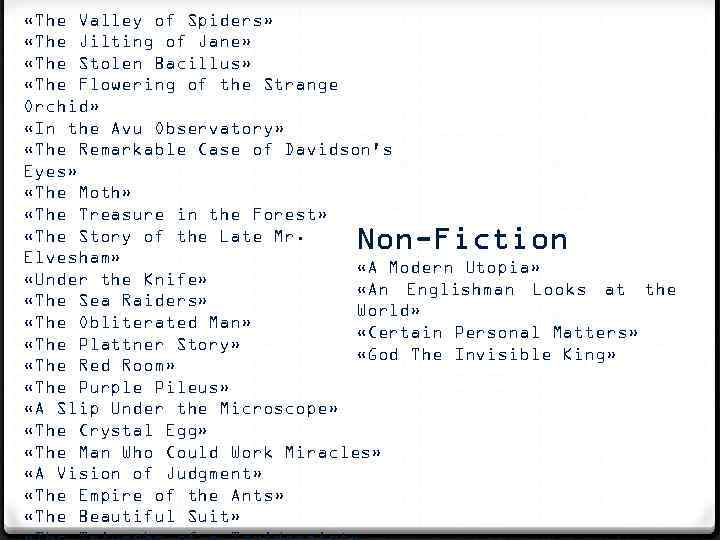
«The Valley of Spiders» «The Jilting of Jane» «The Stolen Bacillus» «The Flowering of the Strange Orchid» «In the Avu Observatory» «The Remarkable Case of Davidson's Eyes» «The Moth» «The Treasure in the Forest» «The Story of the Late Mr. Elvesham» «A Modern Utopia» «Under the Knife» «An Englishman Looks at the «The Sea Raiders» World» «The Obliterated Man» «Certain Personal Matters» «The Plattner Story» «God The Invisible King» «The Red Room» «The Purple Pileus» «A Slip Under the Microscope» «The Crystal Egg» «The Man Who Could Work Miracles» «A Vision of Judgment» «The Empire of the Ants» «The Beautiful Suit» Non-Fiction
Thanks for Watching! This presentation created by Varga
Скачать презентацию Human history becomes more and more a race
H. G. Wells.ppt