


 Скачать презентацию Human Health and Ecological Risk Assessment with Spatial
0f05abe313769b57df59e819f65bc022.ppt
- Количество слайдов: 57
 Human Health and Ecological Risk Assessment with Spatial Analysis and Decision Assistance (SADA) Freeware • Tom Purucker • Robert Stewart • Fred Dolislager
 Human and Ecological Risk Functions SADA implements EPA methods for conducting ecological and human health risk assessments Calculation of site-specific preliminary remediation goals Benchmark database for contaminant effects on ecological receptors Exposure modeling for humans and over 20 other terrestrial species Contains IRIS/HEAST toxicity databases for calculating risk from exposure Contains EPA default exposure parameters for the risk models Tabular screening and risk results Point screens Risk and dose mapping 2
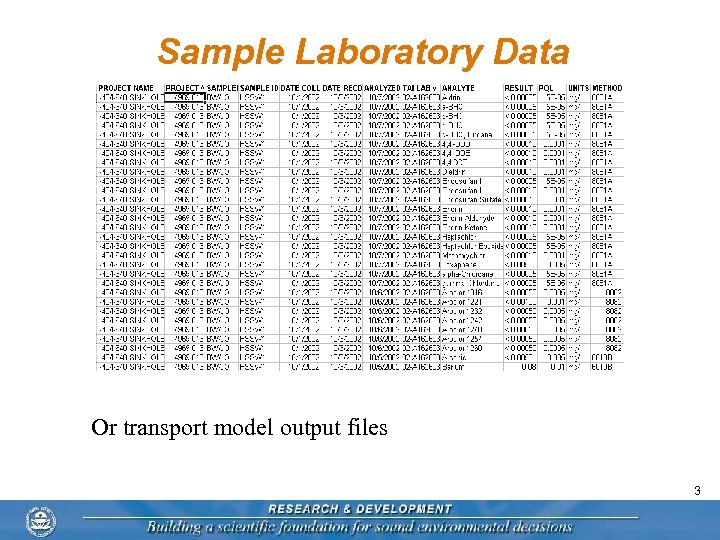 Sample Laboratory Data Or transport model output files 3
 Data Formats SADA can accept data in two formats: comma delimited files (csv) and Microsoft Access. Requires the presence of certain fields in the data set. Easting Northing Depth Value Name Can use other forms of information as well Media Detection Date CAS Number Any other form of meta data can be imported as well. User can plot and retrieve this meta data during an analysis. SADA recognizes soil, sediment, surfacewater, groundwater, air, biota, and background, and the “basic” media type. Basic is assigned to data that have no media type. 4
 Data! Risk Assessments are data driven: as quality and confidence in data increases, then so does the quality and confidence in risk estimates. SADA offers reliable and effective data storage, visual analysis, and synthesis that can enhance risk assessments. But ultimately, the quality of the risk assessment is dependent upon the quality and quantity of the data. 5
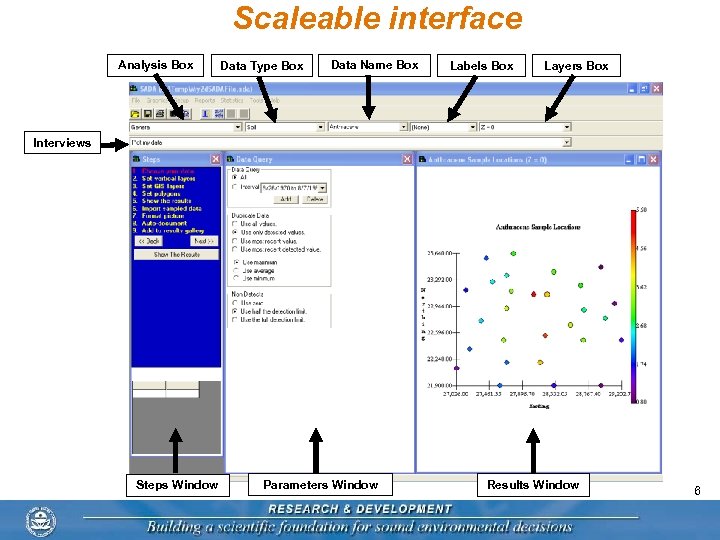 Scaleable interface Analysis Box Data Type Box Data Name Box Labels Box Layers Box Interviews Steps Window Parameters Window Results Window 6
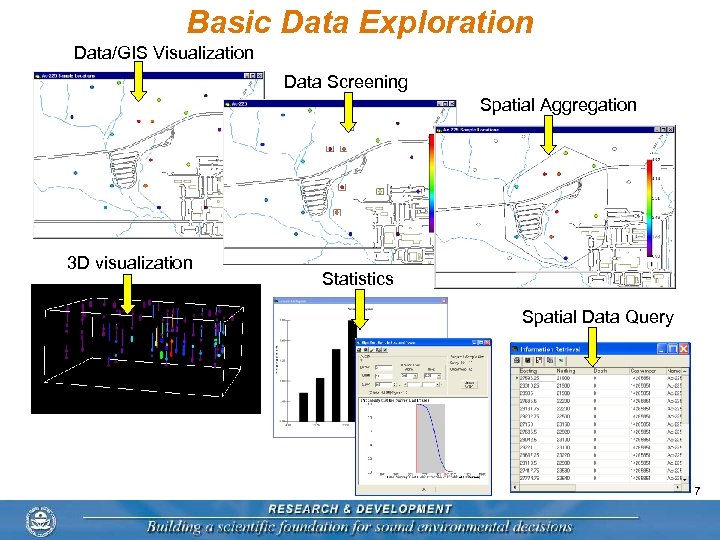 Basic Data Exploration Data/GIS Visualization Data Screening Spatial Aggregation 3 D visualization Statistics Spatial Data Query 7
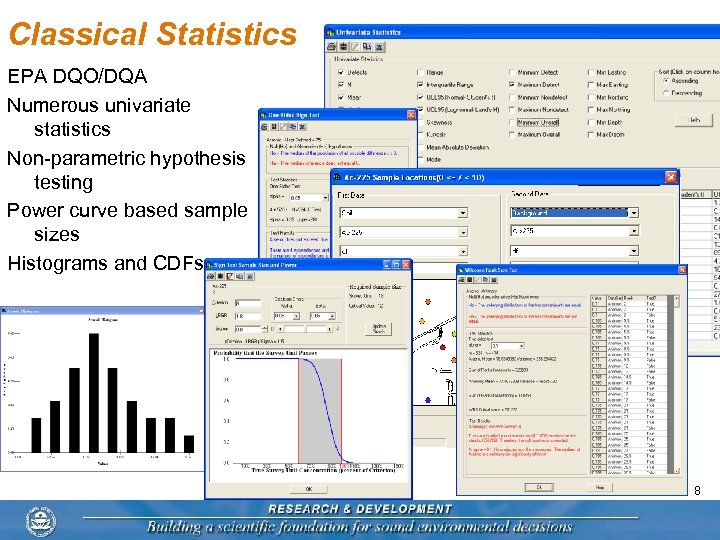 Classical Statistics EPA DQO/DQA Numerous univariate statistics Non-parametric hypothesis testing Power curve based sample sizes Histograms and CDFs 8
 Human Health Risk SADA implements EPA methods for conducting human health risk assessments Calculation of site-specific preliminary remediation goals Exposure modeling for humans for five different land use scenarios Contains IRIS/HEAST toxicity databases for calculating risk from exposure Contains EPA default exposure parameters for the risk models Tabular screening and risk results Point screens Risk and dose mapping 9
 SADA Human Health Functionality Setting Up Human Health Viewing Scenario Parameters Viewing Toxicological Parameters Changing Target Risk/Hazard Index Setting Screening and Exposure Statistics PRG Tables PRG Screen Tables Risk Tables Spatial PRG Screens Point Risk Maps Rematching a Single Contaminant 10
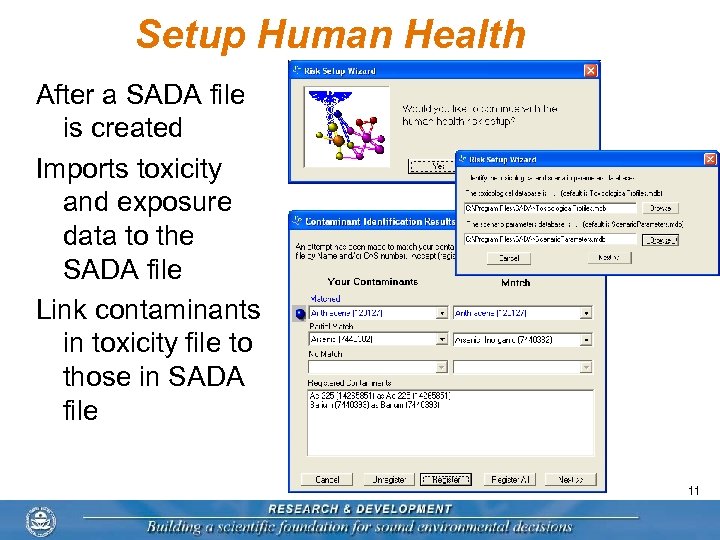 Setup Human Health After a SADA file is created Imports toxicity and exposure data to the SADA file Link contaminants in toxicity file to those in SADA file 11
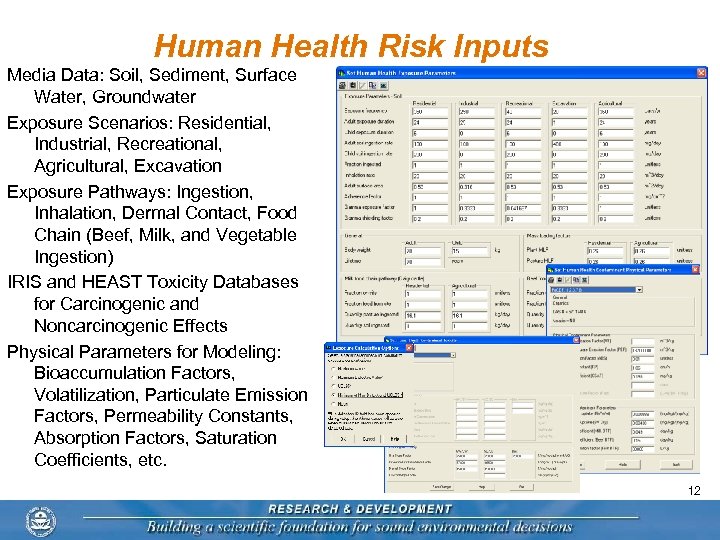 Human Health Risk Inputs Media Data: Soil, Sediment, Surface Water, Groundwater Exposure Scenarios: Residential, Industrial, Recreational, Agricultural, Excavation Exposure Pathways: Ingestion, Inhalation, Dermal Contact, Food Chain (Beef, Milk, and Vegetable Ingestion) IRIS and HEAST Toxicity Databases for Carcinogenic and Noncarcinogenic Effects Physical Parameters for Modeling: Bioaccumulation Factors, Volatilization, Particulate Emission Factors, Permeability Constants, Absorption Factors, Saturation Coefficients, etc. 12
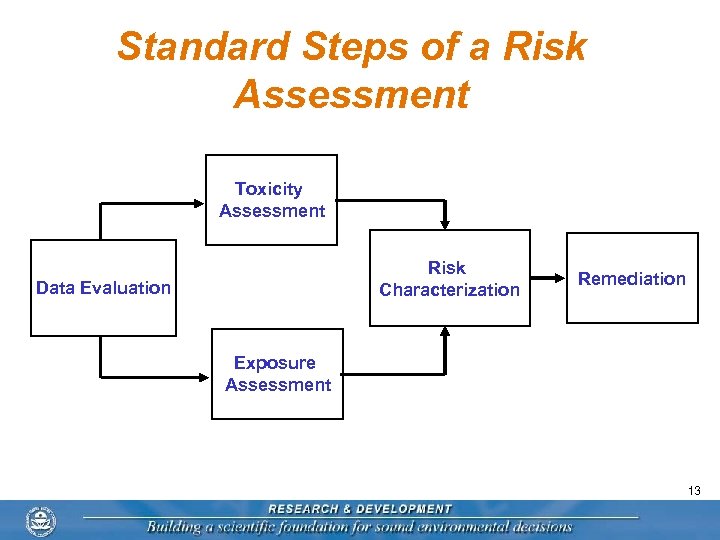 Standard Steps of a Risk Assessment Toxicity Assessment Risk Characterization Data Evaluation Remediation Exposure Assessment 13
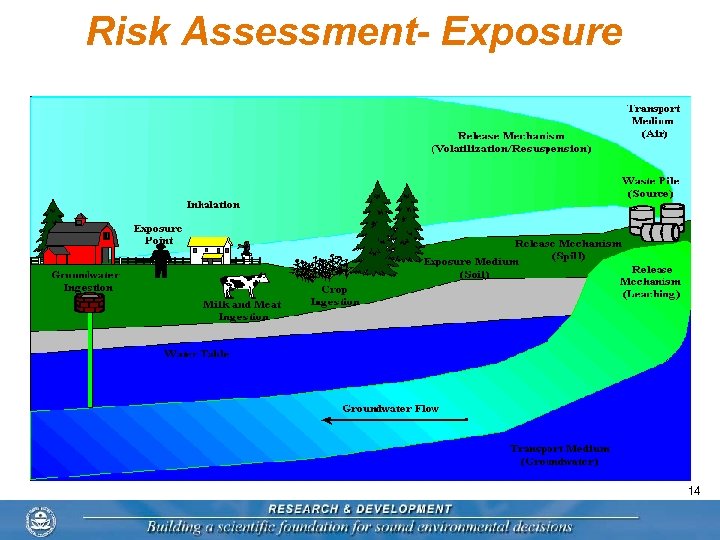 Risk Assessment- Exposure 14
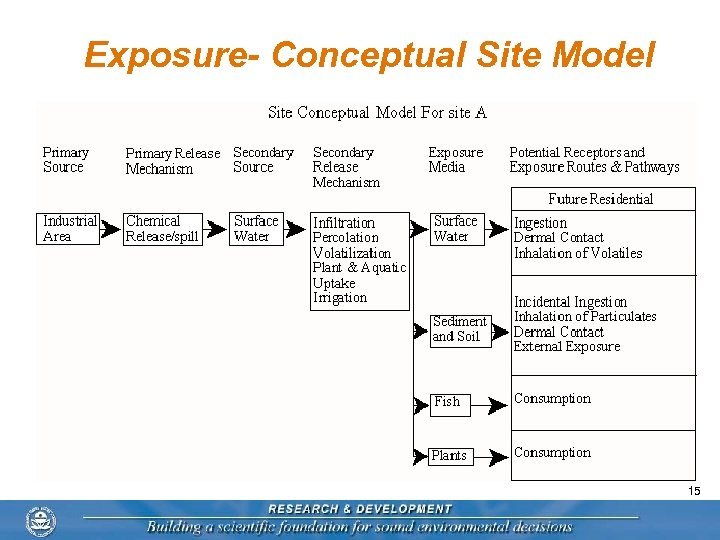 Exposure- Conceptual Site Model 15
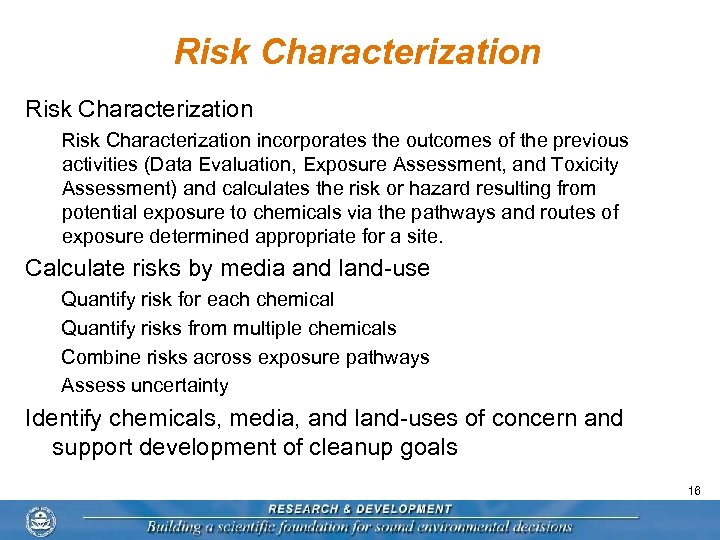 Risk Characterization incorporates the outcomes of the previous activities (Data Evaluation, Exposure Assessment, and Toxicity Assessment) and calculates the risk or hazard resulting from potential exposure to chemicals via the pathways and routes of exposure determined appropriate for a site. Calculate risks by media and land-use Quantify risk for each chemical Quantify risks from multiple chemicals Combine risks across exposure pathways Assess uncertainty Identify chemicals, media, and land-uses of concern and support development of cleanup goals 16
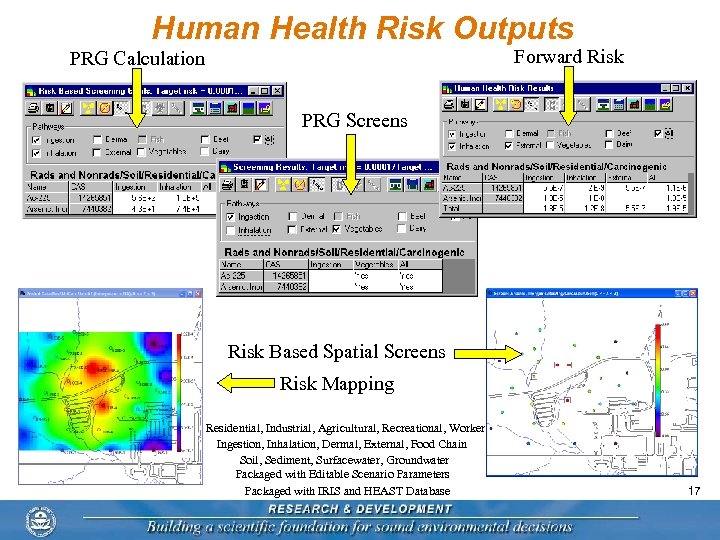 Human Health Risk Outputs Forward Risk PRG Calculation PRG Screens Risk Based Spatial Screens Risk Mapping Residential, Industrial, Agricultural, Recreational, Worker Ingestion, Inhalation, Dermal, External, Food Chain Soil, Sediment, Surfacewater, Groundwater Packaged with Editable Scenario Parameters Packaged with IRIS and HEAST Database 17
 Exposure Statistics Default values are maximum detected value for screening calculations and lesser of the maximum detected value and the UCL 95 for exposure calculations. User can change the approach: Maximum Value: the maximum concentration, detected or nondetected, for normal or lognormal distribution Maximum Detected Value: the maximum detected concentration for normal or lognormal distribution UCL 95: the 95% upper confidence limit on the mean for normal or lognormal distribution Mean: the average concentration over all values for normal or lognormal distribution 18
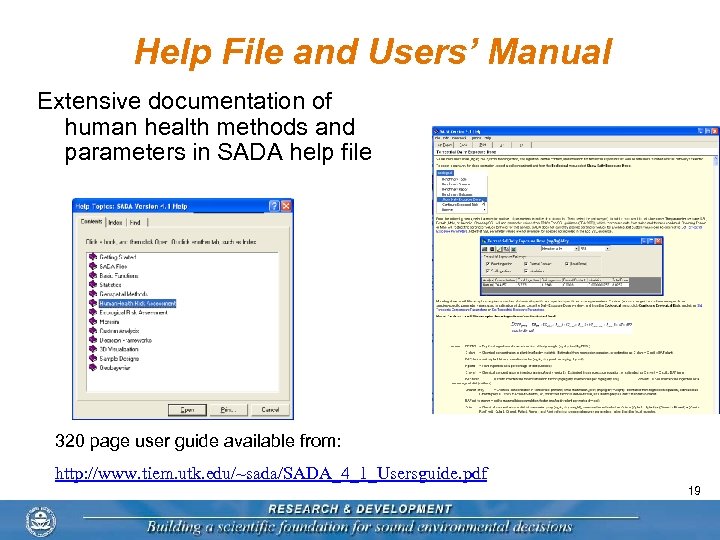 Help File and Users’ Manual Extensive documentation of human health methods and parameters in SADA help file 320 page user guide available from: http: //www. tiem. utk. edu/~sada/SADA_4_1_Usersguide. pdf 19
 Current limitations for Human Health Risk Pro. UCL 95 (confidence limits, automatic distribution testing) Additional tox info, target organs RAGS Part D reporting format Screening PRGs as benchmarks Air, dermal modifications Uncertainty analysis 20
 Ecological Capabilities in SADA implements EPA methods for conducting ecological risk assessments Benchmark database for contaminant effects on ecological receptors Exposure modeling for over 20 other terrestrial species Contains EPA default exposure parameters for the risk models where available Tabular screening and risk results Point screens Risk and dose mapping 21
 Ecological Functionality Setting Up Ecological Risk Assessment Procedure Setting Physical Parameters Description of Ecological Benchmark Database Histograms of Benchmark Values Tables of Benchmark Values Setting Screening and Exposure Statistics Area Result Tables (Screens, Ratios) Map Result Values (Screens, Ratios) Rematching a Single Contaminant Checking Ecological Version Terrestrial Dose Modeling 22
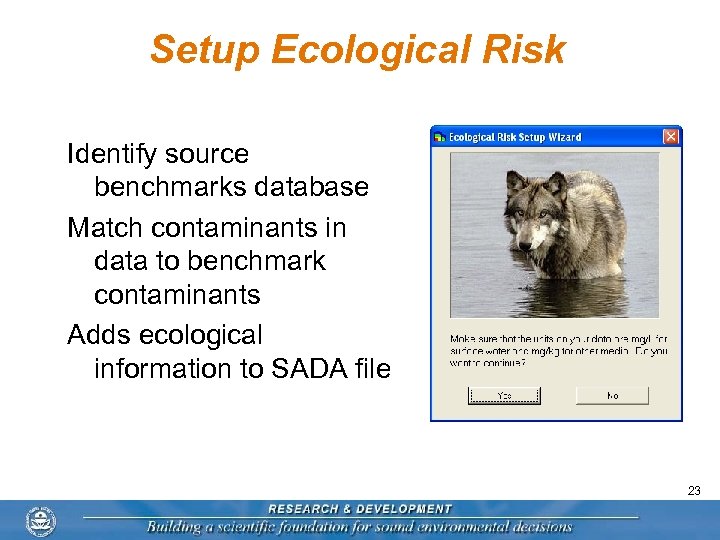 Setup Ecological Risk Identify source benchmarks database Match contaminants in data to benchmark contaminants Adds ecological information to SADA file 23
 Hazard v. Risk Assessment Ecological Hazard Assessment- a comparison of an environmental concentration to an estimated toxic threshold for a particular contaminant -most common method for examining effects of chemicals in environment -comparison of environmental exposure concentration to a toxic threshold (benchmark) -iterative (or tiered) implementation -number of toxicity data sets for soil, sediment, and surface water available for screening Ecological Risk Assessment- explicitly attempts to estimate the probability and magnitude of the effects of exposure to contamination 24
 Benchmark Screening Media-specific concentration benchmarks Choice of statistics (max, percentile, UCL 95, etc. ) Hierarchy of media-specific benchmarks for screening Spatial and tabular display of ratios Derivation of Benchmarks: Toxicity testing (acute or chronic) -regression of concentration-response data -hypothesis testing Extrapolation from another benchmark Simulation of an assessment endpoint 25
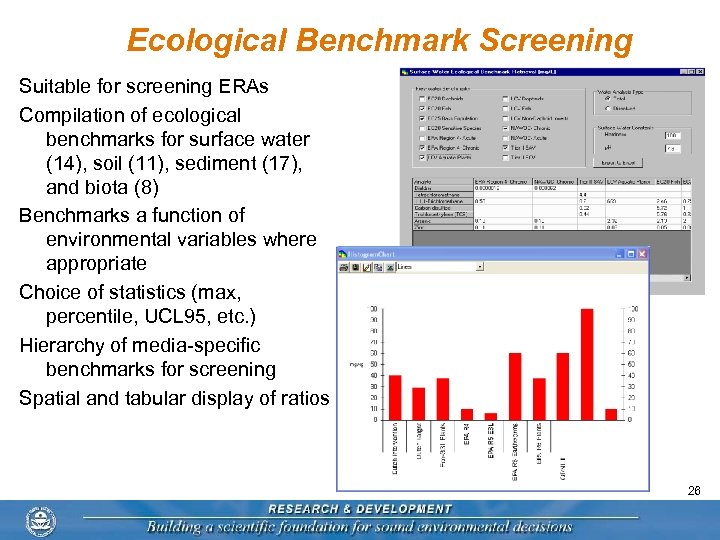 Ecological Benchmark Screening Suitable for screening ERAs Compilation of ecological benchmarks for surface water (14), soil (11), sediment (17), and biota (8) Benchmarks a function of environmental variables where appropriate Choice of statistics (max, percentile, UCL 95, etc. ) Hierarchy of media-specific benchmarks for screening Spatial and tabular display of ratios 26
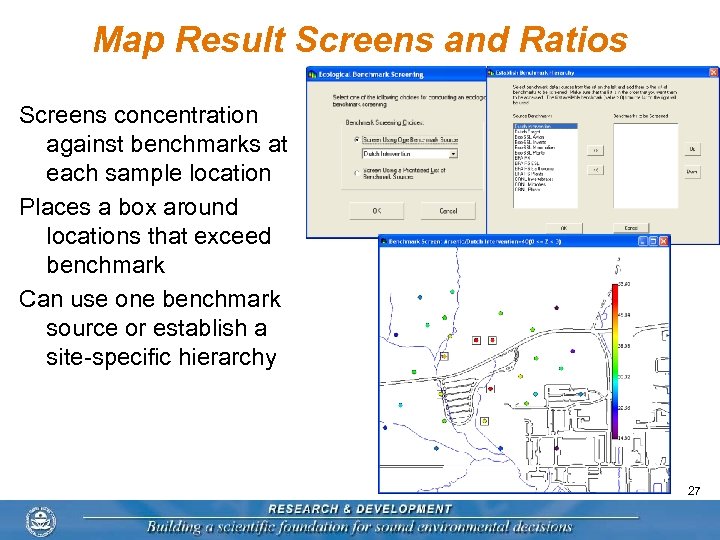 Map Result Screens and Ratios Screens concentration against benchmarks at each sample location Places a box around locations that exceed benchmark Can use one benchmark source or establish a site-specific hierarchy 27
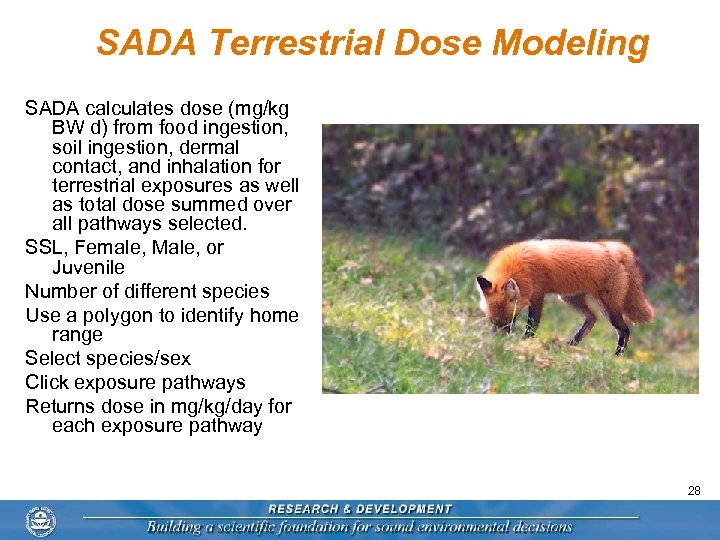 SADA Terrestrial Dose Modeling SADA calculates dose (mg/kg BW d) from food ingestion, soil ingestion, dermal contact, and inhalation for terrestrial exposures as well as total dose summed over all pathways selected. SSL, Female, Male, or Juvenile Number of different species Use a polygon to identify home range Select species/sex Click exposure pathways Returns dose in mg/kg/day for each exposure pathway 28
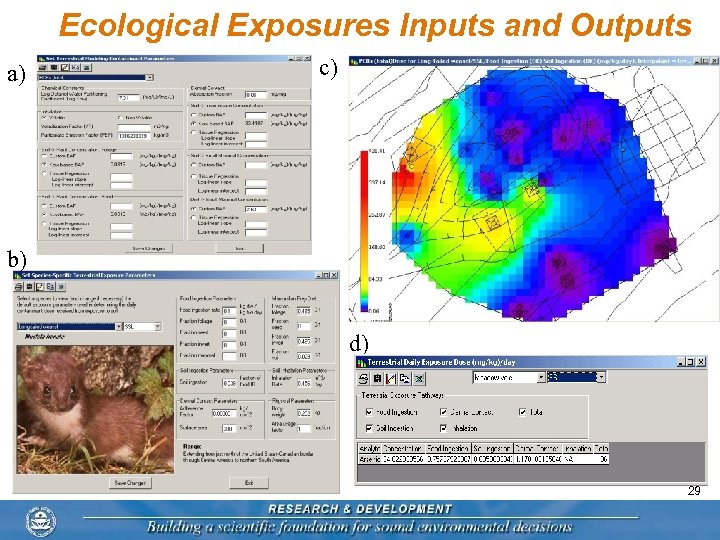 Ecological Exposures Inputs and Outputs a) c) b) d) 29
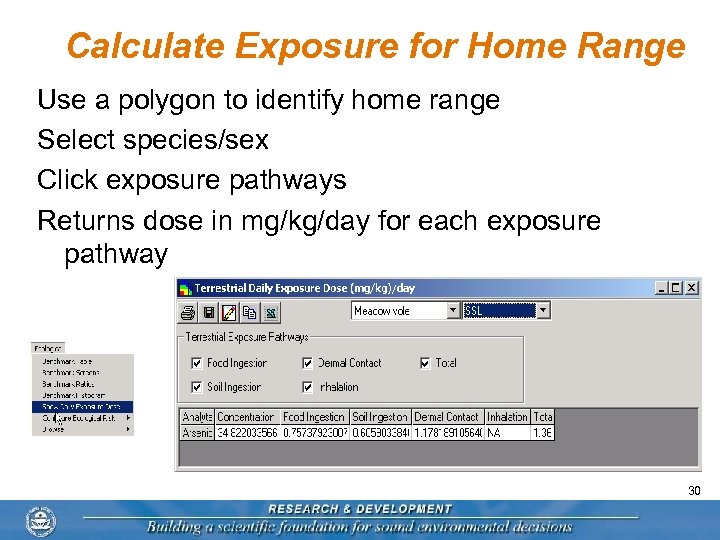 Calculate Exposure for Home Range Use a polygon to identify home range Select species/sex Click exposure pathways Returns dose in mg/kg/day for each exposure pathway 30
 SADA Ecological Risk Needs Additional benchmarks Radionuclide benchmarks and dose assessment methods Terrestrial movement and habitat models Eco PRG tables/calculations Aquatic dose models Uncertainty for dose assessment 31
 Spatially Explicit Ecological RA Use spatial distribution of contamination with dynamic movement models that also incorporate: -Habitat quality -Foraging behavior -Ecological interactions Number of movement models available in the literature 32
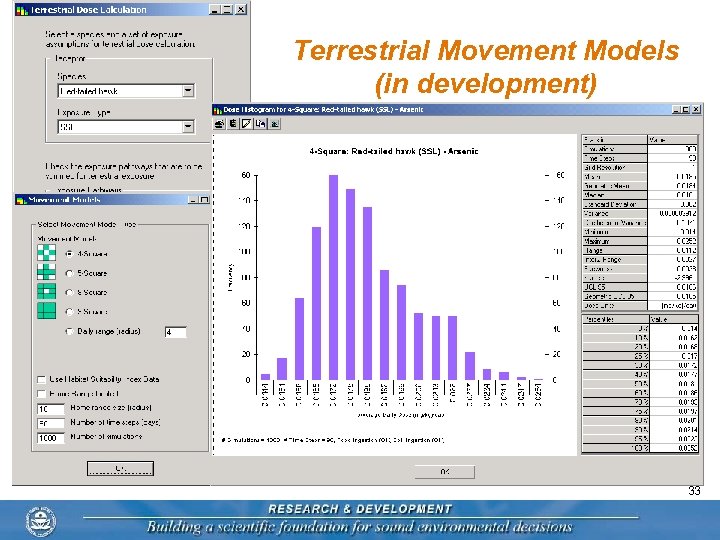 Terrestrial Movement Models (in development) 33
 Spatial Risk Assessment Conventional Risk Assessment Limitations Typically regulatory exposure assessment guidance recommends a summary statistic for the exposure concentration Spatial information is lost when a summary statistic is used in the RA- exposure is assumed to be continuous in space and time Often this lost info not recovered in the rest of the assessment/remediation process 34
 Spatial Risk Assessment Reasons for incorporating spatial statistics into risk assessment Maximize the use of limited resources Efficiently collect data Retain collected spatial info in the risk assessment Use all types of available data, including expert judgment To more adequately characterize the exposure distribution Extrapolate from known data to cover data gaps Account for spatial processes related to exposure Better understand uncertainties in the exposure assessment Efficient (selective) determination of areas in need of remediation 35
 Selective Remediation Process that achieves a local- and/or sitespecific concentration level while minimizing cleanup volume. Implementation requires: - data - spatial interpolation model - decision-maker cleanup criteria - spatial scale inputs Results in a spatially explicit remedial design 36
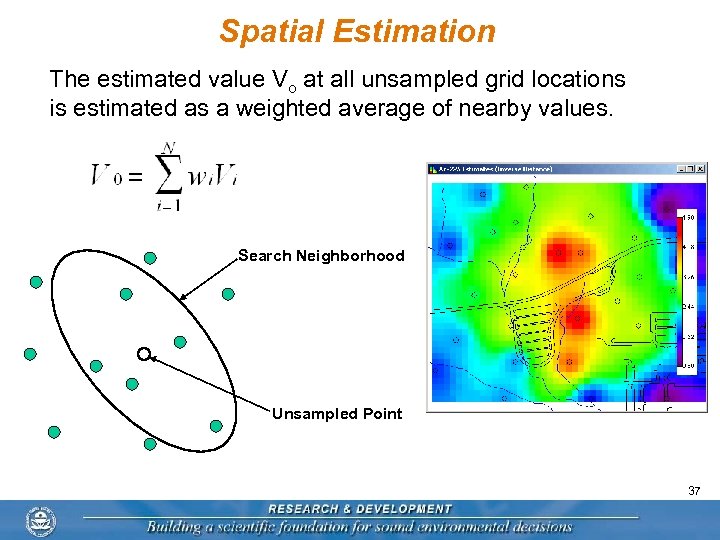 Spatial Estimation The estimated value Vo at all unsampled grid locations is estimated as a weighted average of nearby values. Search Neighborhood Unsampled Point 37
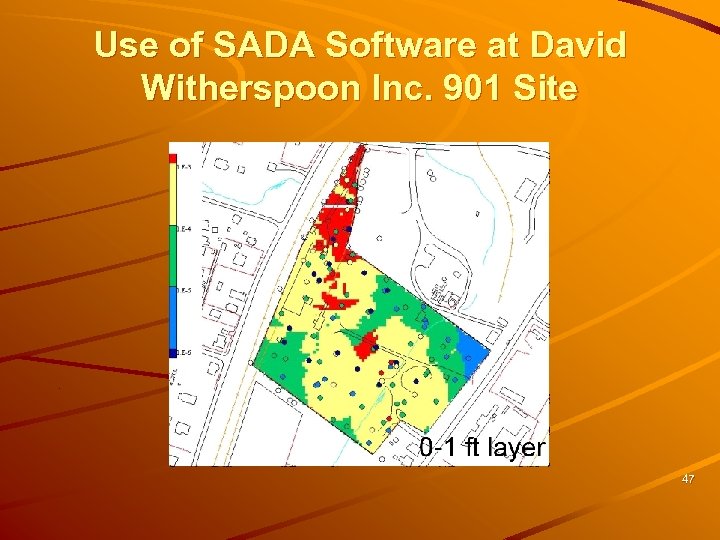
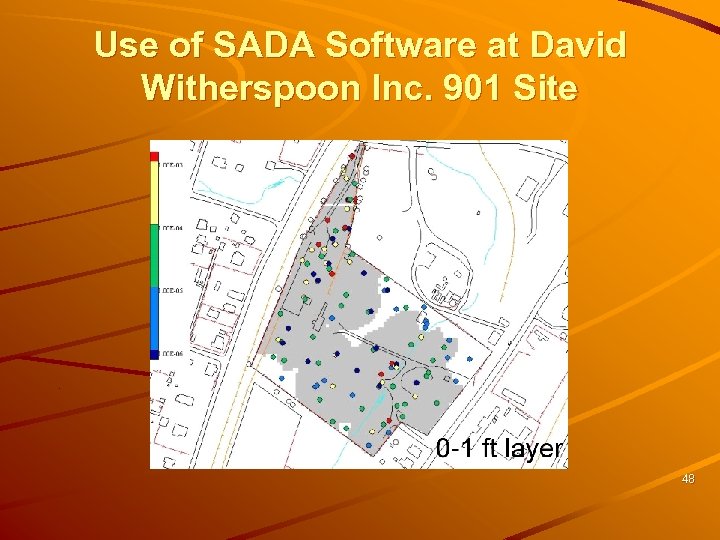
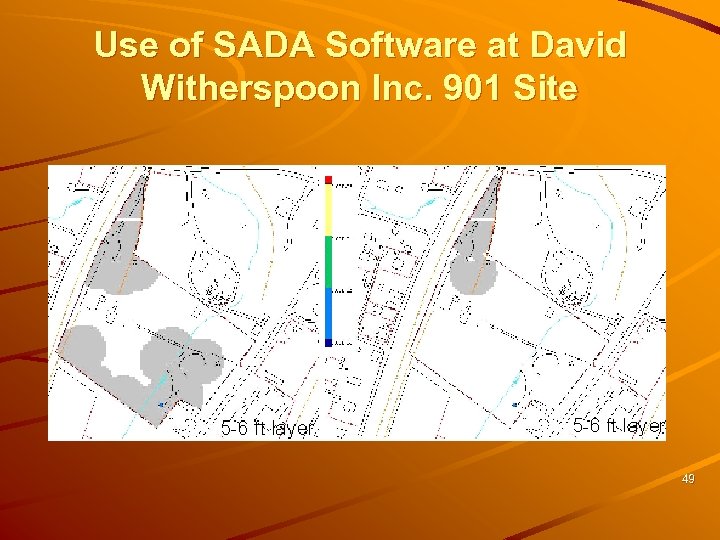
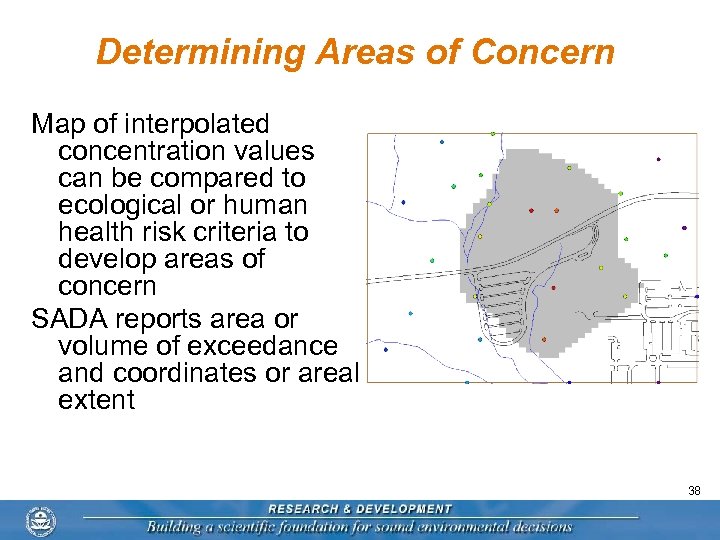 Determining Areas of Concern Map of interpolated concentration values can be compared to ecological or human health risk criteria to develop areas of concern SADA reports area or volume of exceedance and coordinates or areal extent 38
 SADA web site http: //www. tiem. utk. edu/~sada/ Or just google “SADA” to freely download program and documentation. 39
 Questions? Comments? This presentation has been reviewed in accordance with the U. S. Environmental Protection Agency’s peer and administrative review policies and approved for presentation. Mention of trade names or commercial products does not constitute endorsement or recommendation for use. 40
 Case Studies and Additional Slides Marino Brothers Scrap Yard, Rochester Borough, Pennsylvania • http: //www. frtr. gov/decisionsupport/PDF/FIELDS_SADACase. Study_8 -2205. pdf • http: //www. kvvm. hu/szakmai/karmentes/egyeb/us_epa/22_Marino Brothers CS. pdf Navy TCE Plume, Lemoore Naval Air Station, Lemoore, California • http: //www. kvvm. hu/szakmai/karmentes/egyeb/us_epa/14_Navy TCE Plume Case Study. pdf Small Arms Range, Tacoma, Washington • http: //www. kvvm. hu/szakmai/karmentes/egyeb/us_epa/18_Rifle Range Case Study. pdf Barker Chemical Company, Inglis, Florida • http: //www. frtr. gov/decisionsupport/PDF/SADA Case Study_053907 Barker. pdf • manuscript in review- Environmental Modeling and Assessment 41 41
 Use of SADA Software at David Witherspoon Inc. 901 Site Fred Dolislager The University of TN fdolislager@utk. edu 42
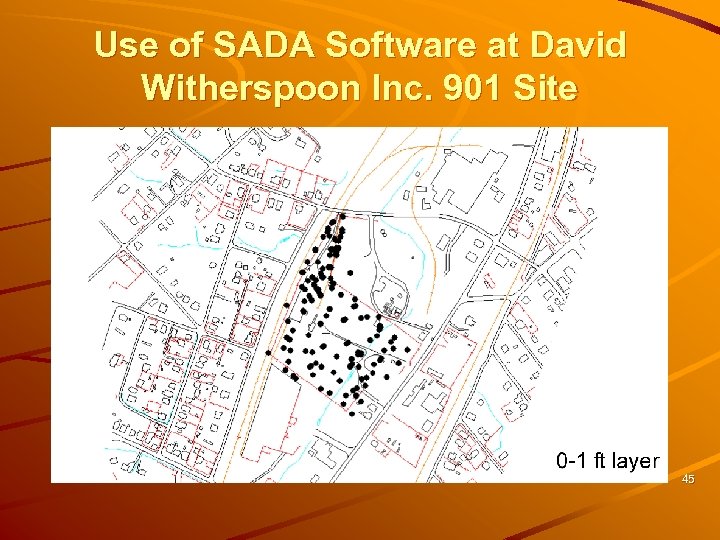
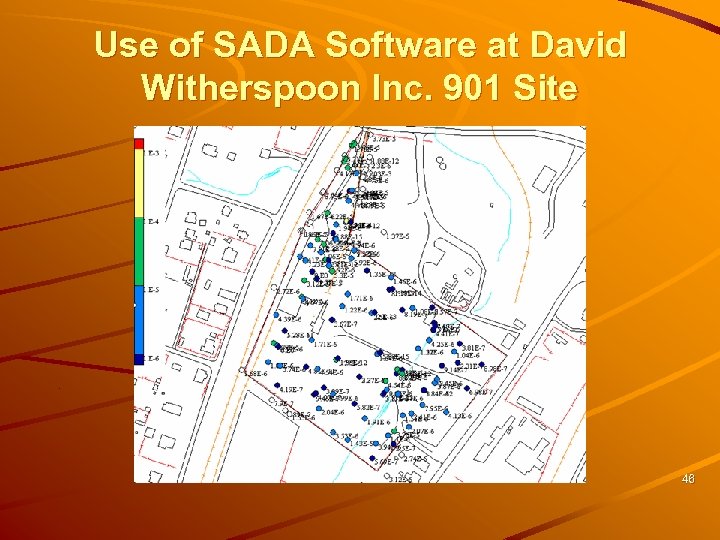
 Use of SADA Software at David Witherspoon Inc. 901 Site Spatial Analysis and Decision Assistance (SADA) software was used as the primary risk assessment/spatial assessment tool Operations at the site resulted in widespread radionuclide and other hazardous substances Shut down in 1993 Contaminated Soil, Sediment, Groundwater and Surface Water 10. 5 acre site 43
 Use of SADA Software at David Witherspoon Inc. 901 Site Visualization Geospatial Analysis Statistical Analysis Human Health Risk Ecological Risk Cost/Benefit Analysis Sample Design Decision Analysis Site Characterization Data Aggregation Risk Assessment 3 -D Risk Modeling Removal Volumes Decision Analysis Sample Design Data Screening 44
 Use of SADA Software at David Witherspoon Inc. 901 Site 45
 Use of SADA Software at David Witherspoon Inc. 901 Site 46
 Use of SADA Software at David Witherspoon Inc. 901 Site 47
 Use of SADA Software at David Witherspoon Inc. 901 Site 48
 Use of SADA Software at David Witherspoon Inc. 901 Site 49
 Use of SADA Software at David Witherspoon Inc. 901 Site Tools in SADA that were useful – Overburden – Benching Angles – Selection of Interpolation Models – Volume Calculations – Reproducibility for changes at meetings – Auto documentation – Dynamics of Risk Library – Site Scale versus Block Scale 50
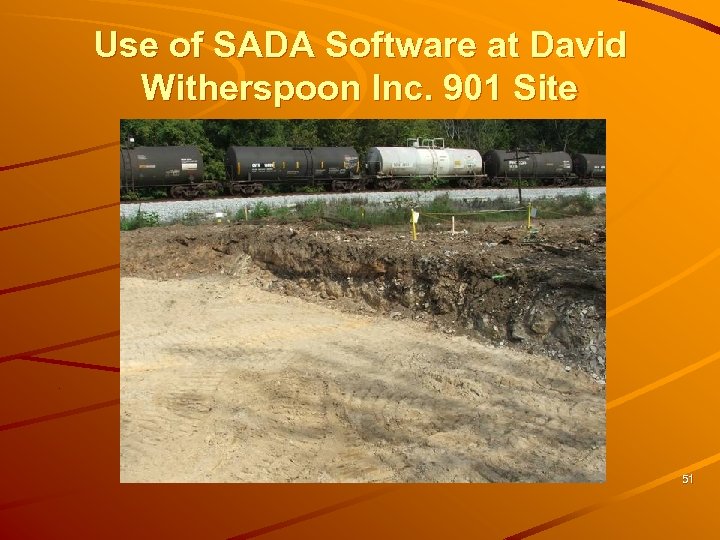 Use of SADA Software at David Witherspoon Inc. 901 Site 51
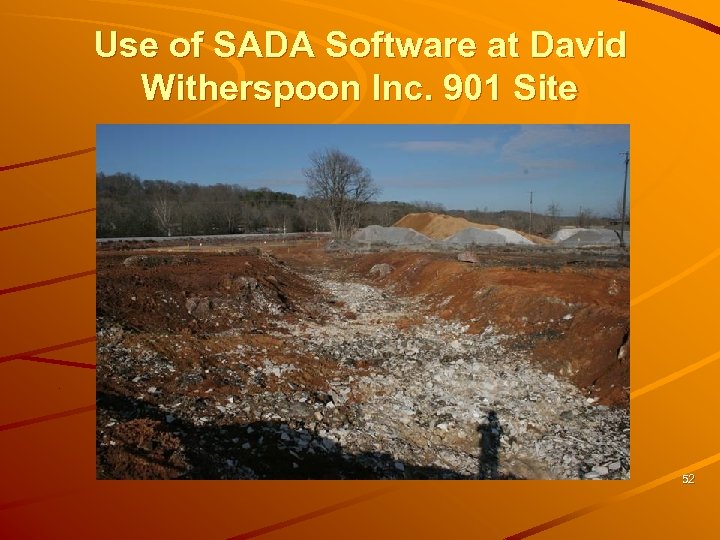 Use of SADA Software at David Witherspoon Inc. 901 Site 52
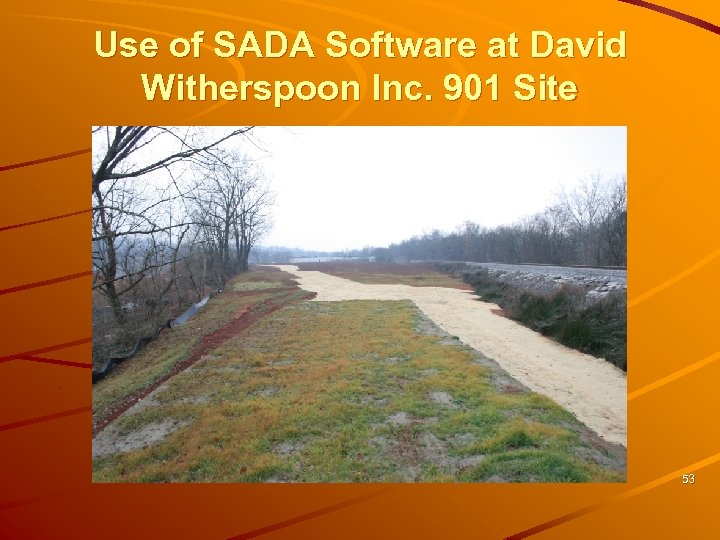 Use of SADA Software at David Witherspoon Inc. 901 Site 53
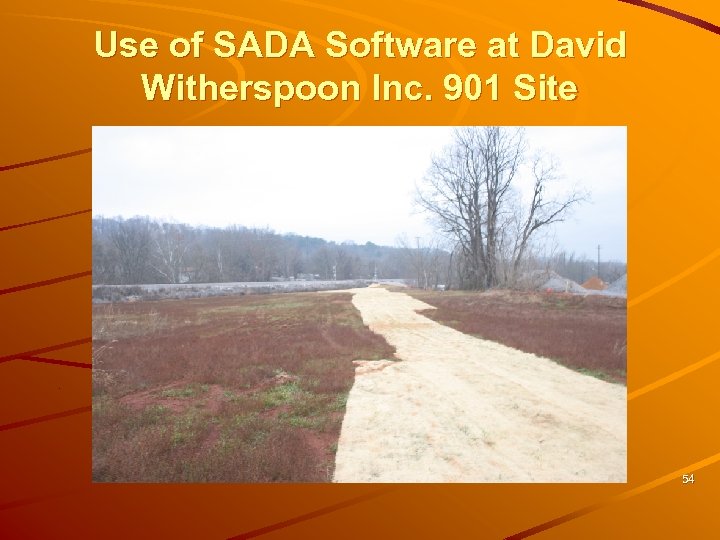 Use of SADA Software at David Witherspoon Inc. 901 Site 54
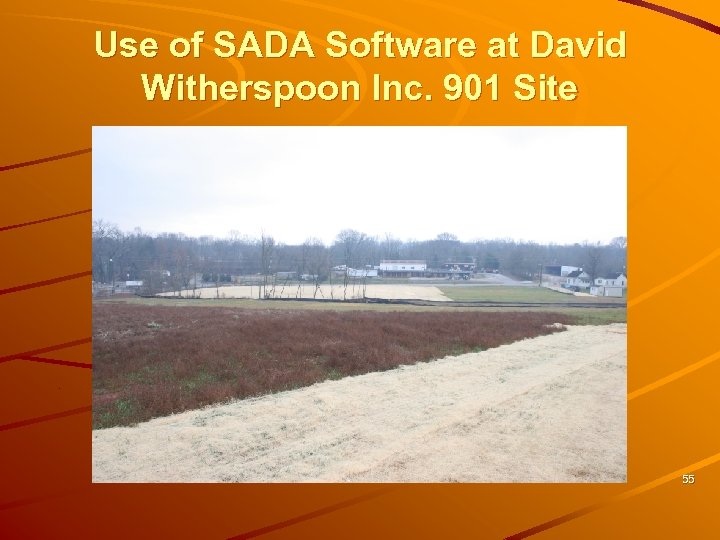 Use of SADA Software at David Witherspoon Inc. 901 Site 55
 Questions? Comments? 56
 Thank You After viewing the links to additional resources, please complete our online feedback form. Thank You Links to Additional Resources 57